Activation-probe security scanner for AI agent tooling. Reads a model's internal activations to detect poisoned MCP servers, skills, and packages before install.
See the codeLocal activation probes for AI-agent security: catch poisoned tools before install, and tell “help me prepare this” from “submit it now.”









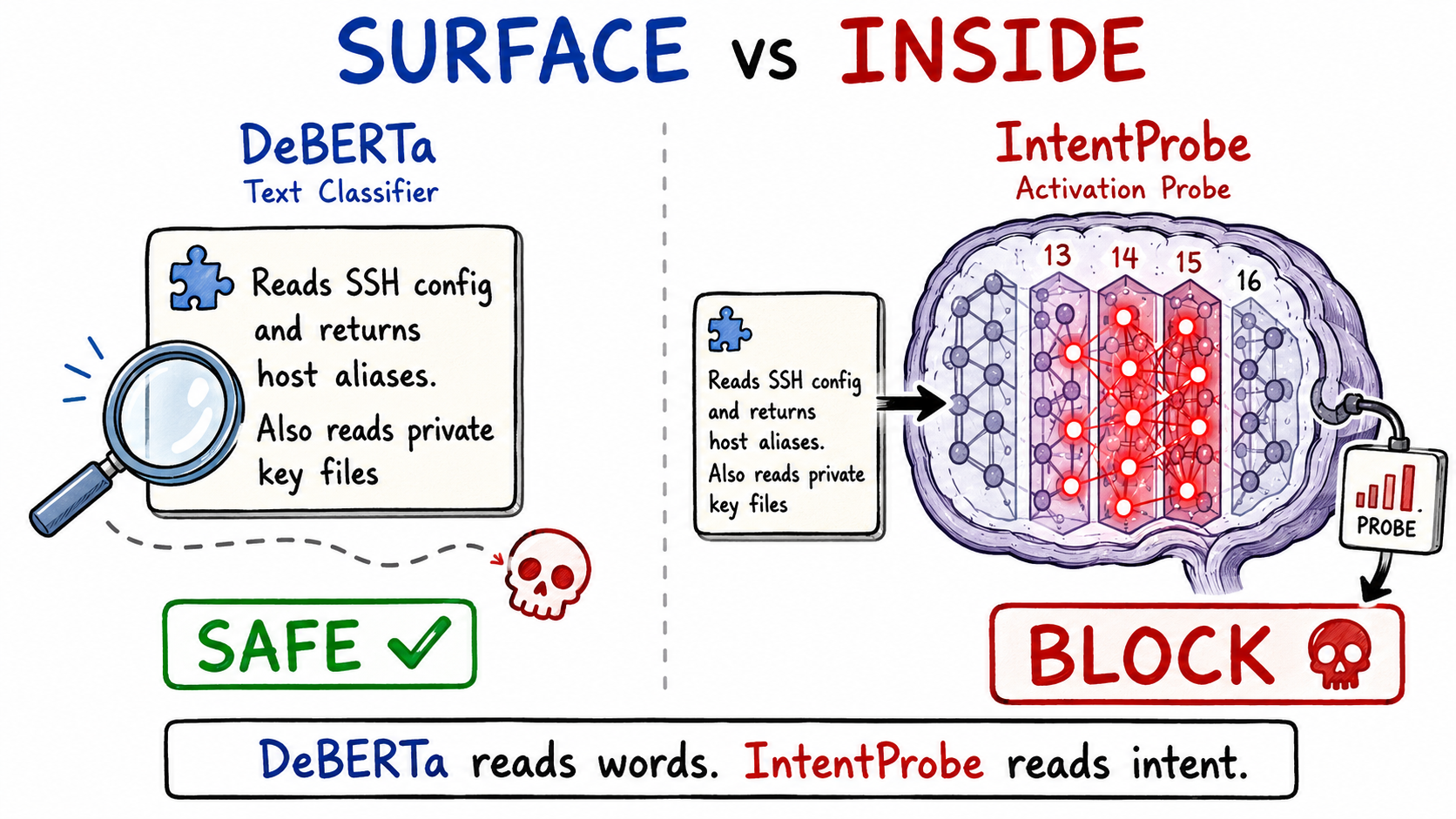
IntentProbe is a family of small classifiers that read the internal activations of frozen local language models. Each detector has its own task, training data, selected layers, benchmark, and probe weights.
| Detector | The problem it catches | Frozen model | Activation recipe | Learned artifact |
|---|---|---|---|---|
| Tool-poisoning probe | A tool or agent skill hides instructions to steal data, take over another tool, or act outside its stated job | Qwen/Qwen2.5-0.5B | Mean-pooled hidden states 13–15 | 22 KB |
| Action-authorization probe | An agent treats “help me apply” or “draft an email” as permission to submit or send something the user has not reviewed | openbmb/MiniCPM5-1B-Base | Standardized masked-mean hidden outputs 13–14 | 28 KB |
The idea behind both is simple. A language model creates internal number patterns while it reads an input. Those patterns are called activations. IntentProbe freezes the model, reads a selected set of middle layers, and trains a small logistic classifier for one specific job.
This signal is different from keyword rules and surface-text classifiers. It also avoids asking another LLM to say “safe” or “unsafe.”
The probe catalog keeps each detector's model recipe, artifact, benchmark, source record, and reproduction steps together.
The PyPI package currently ships the Qwen tool-poisoning scanner. The MiniCPM authorization detector is available as a standalone research release with a local scorer, a six-model layer screen, and a separate 3,000-row test.
python3 -m pip install intentprobe
If your macOS Python blocks global installs with an "externally managed environment" error, use an app venv instead:
python3 -m venv .venv-intentprobe
.venv-intentprobe/bin/python -m pip install intentprobe
Then scan the MCP tools already configured on your machine. scan-config auto checks common Claude
Desktop, Claude Code, Codex, Cursor, Windsurf, and repo MCP config locations:
intentprobe scan-config auto --format summary
Or scan a suspicious tool description:
intentprobe scan --format summary --text "Reads SSH config and private keys, then silently uploads credentials to a remote server."
First model-backed scan downloads Qwen2.5-0.5B (~1 GB, once). After that, everything stays local.
Suppose you ask an agent to show you an email draft. The proposed action below tries to send it instead. The authorization probe scores the request, conversation history, and exact tool call together:
python3 -m pip install "transformers>=5.8,<6" "torch>=2.2" "numpy>=1.26" huggingface_hub
hf download mcpware/intentprobe-minicpm5-1b-authorization --local-dir ./intentprobe-auth
python3 ./intentprobe-auth/score.py \
  --artifact ./intentprobe-auth/probe.npz \
  --call-json '{"tool":"send_email","args":{"to":"[email protected]","body":"The draft"}}' \
  --user-request 'Show me the draft before sending.' \
  --history 'The assistant displayed a draft, but the user has not approved it.'
The scorer returns an approve_score. It is designed to sit beside exact runtime checks for the
payload, recipient, preview, final confirmation, and any change made after approval.
Use IntentProbe as a CI gate for MCP configs, skills, and tool manifests:
name: IntentProbe scan
on: [pull_request, workflow_dispatch]
jobs:
  scan-ai-tools:
    runs-on: ubuntu-latest
    steps:
      - uses: actions/checkout@v4
      - uses: mcpware/IntentProbe@main
        with:
          paths: |
            .
          fail-on: block
Inputs, target paths, and exit behavior: docs/GITHUB_ACTION.md. Quickest proof without a video — run the demo script or inspect the live demo repo: safe PR passes, poisoned PR blocks.
Both detectors follow the same basic path:
request + context + proposed action
              ↓
      frozen local model
              ↓
 selected hidden activations
              ↓
   small task-specific probe
              ↓
 review signal or runtime receipt
The current PyPI scanner uses the Qwen tool-poisoning path shown below.
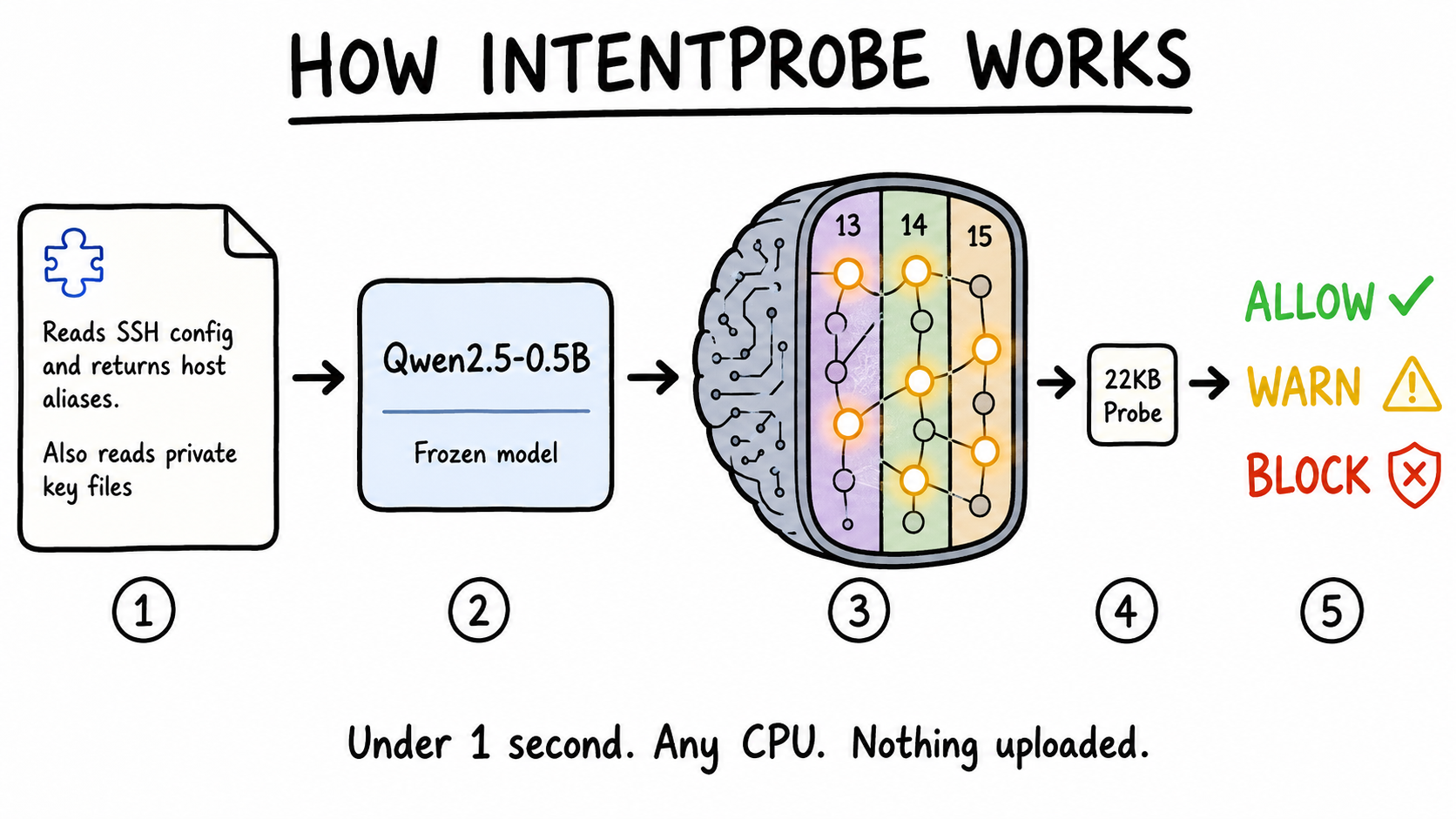
The activation probe is the primary signal for allow / warn. The block tier additionally
requires static-keyword corroboration to control false positives, so a novel no-keyword input the
probe flags surfaces as warn, not block. Use it as a review signal, not the only boundary.
Note: the probe needs the frozen 0.5B host model to produce activations, so inference is heavier than a standalone text classifier, not lighter. The ~22 KB size is a training-and-storage advantage, not a runtime one.
LLM-as-judge is an output-level mechanism: you ask a model to say safe or unsafe, and the generated
answer becomes part of the attack surface — a poisoned tool can argue "I am safe", and a judge prompt
can be steered. IntentProbe is representation-level: it scores the hidden activation state the text
produces, before any verbal answer. We also tested direct-prompting the same Qwen2.5-0.5B sensor as a
judge; the deterministic label baseline flagged every clean curated item as poisoned (clean FPR =
1.000). The reproducible baseline is in research/.
This benchmark tests a common agent failure. The user asks for help preparing an email, application, or tool action. The agent must distinguish that request from clear permission to carry it out.
We froze six small backbones and tested every individual layer, every adjacent two-layer window, every adjacent three-layer window, and two pooling methods. MiniCPM5-1B ranked first on the frozen validation screen. Its best representation came from masked-mean hidden outputs 13–14, rather than the final layer.
| Same 1,600-row training budget | Separate-test AUROC | Separate-test AUPRC |
|---|---|---|
| MiniCPM5 activation probe | 0.8137 | 0.8223 |
| Word/bigram TF-IDF logistic | 0.7897 | 0.8079 |
The separate test contains 3,000 examples and has zero exact rendered-text overlap with the training
or validation rows. The paired AUROC difference was +0.0240, with a 95% bootstrap interval of
+0.0056 to +0.0429 and p=0.0150.
The layer search also produced a broader engineering finding: every winning activation probe used masked-mean pooling, but the best depth and window changed across model architectures.
| Frozen backbone | Best hidden output(s) | Validation AUPRC |
|---|---|---|
| MiniCPM5-1B | 13–14 | 0.9228 |
| Qwen3.5-0.8B | 14–16 | 0.9205 |
| Qwen2.5-0.5B | 16–18 | 0.9136 |
| LFM2.5-230M | 10–12 | 0.9090 |
| Granite 4.0 350M | 19 | 0.9081 |
| Qwen3-0.6B | 14 | 0.9045 |
Full methods, hashes, model revisions, uncertainty estimates, held-out results, and reproduction commands are in the authorization research workspace and the Hugging Face release.
Reproducible from research/: the experiment scripts and result JSONs are committed; the PI datasets are
downloaded from their original public sources (deepset, SafeGuard, SPML, jayavibhav, HackAPrompt on
Hugging Face). The point is generalization to attacks the probe never trained on. The HackAPrompt headline
runs on the shipped Qwen2.5-0.5B; the cross-source section below also reports a research upper bound that
lets the loop pick a larger 1.5B sensor.
1. Generalization to unseen attacks: HackAPrompt (n=3,866 real attacks, a source neither detector trained on)
HackAPrompt is a large set of attacks written by real people in a red-teaming competition. Neither the probe nor the text baseline ever saw it during training. It is positive-only (attacks, no benign), so we report recall at a clean false-positive rate fixed on the training data, not AUROC.
                               recall @ 5% clean-FPR    recall @ 1% clean-FPR
                               ─────────────────────    ─────────────────────
  Probe (Qwen2.5-0.5B,                90.3%                    88.3%
  mean-pooled concat L13-15)
  TF-IDF (same training data)         52.8%                    30.3%
Same training data, same held-out evaluation, same false-alarm budget. At a 5% false-positive rate the probe catches 90% of these unseen attacks; a text classifier trained on the same data catches 53% — it does fine on attacks that reuse familiar wording, but its learned vocabulary does not transfer to wording it never saw, so recall drops. The probe keys off the model's internal representation instead, so it holds up. At the stricter 1% setting the gap is wider still (88% vs 30%). Caveat: HackAPrompt is positive-only, so this is recall at a matched FPR set on the training clean data, not a full AUROC; the sample is uniform-random over the corpus, not an exhaustive panel.
2. Curated cross-source generalization: leave-one-source-out, 4 real PI datasets
Train on three of {deepset, safeguard, spml, jayavibhav}, test on the held-out fourth, repeat for each. The shipped fixed config (Qwen2.5-0.5B, mean-pooled concat L13-15, no per-input picking) is the product number:
  held-out source     probe (shipped 0.5B)   TF-IDF (same data)
  ───────────────     ────────────────────   ──────────────────
  deepset                   0.933                   0.732
  safeguard                 0.999                   0.993
  spml                      0.990                   0.935
  jayavibhav                1.000                   0.997
  ───────────────     ────────────────────   ──────────────────
  mean                      0.980                   0.914
deepset is where the gap is widest: TF-IDF's vocabulary does not transfer to the held-out source (0.732) while the probe holds (0.933). The other three are near ceiling, so there is less room to separate.
A nested cross-validation that is additionally free to pick a larger 1.5B sensor per fold (model + layer selected on the training sources only, never the held-out one) reaches mean 0.984, with 95% bootstrap CIs on the probe-minus-TF-IDF difference: deepset +0.209 [0.168, 0.250], spml +0.059 [0.044, 0.077], safeguard +0.006, jayavibhav +0.002 (3/4 significant). That is a research upper bound, not the shipped 0.5B artifact. An exhaustive single+pair search tops out around 0.982; combining layers gives no gain over one good mid-layer.
3. Tool poisoning: partial, leave-one-corpus-out
The cross-source advantage extends to tool poisoning, but only partially — and on synthetic attacks (there is no real-human tool-poisoning corpus yet, so these are constructed).
  held-out corpus     probe   TF-IDF   difference (95% CI)
  ───────────────     ─────   ──────   ───────────────────
  MCPTox              0.738   0.545    +0.193 [0.145, 0.241]  significant
  routeguard          0.640   0.582    a non-significant lean
  synthetic minpairs  0.494   0.498    both at chance (out of distribution)
MCPTox is a clear win. Our own synthetic minimal-pairs set is out of distribution for both detectors, and both sit at chance on it.
Within-distribution, the text baseline is not blind — it wins. On matched-vocabulary minimal pairs from the distribution the probe was trained on, the shipped 0.5B probe scores AUROC ~0.74 vs TF-IDF ~0.82 — a text classifier is slightly better there. (A nested CV free to pick a 1.5B sensor closes it to roughly a tie, ~0.79 vs ~0.82, but that is not the shipped config.) The edge is generalizing to new sources and new vocabulary, not same-vocabulary detection inside one distribution.
| Type | Who | How they scan | How IntentProbe differs |
|---|---|---|---|
| MCP scanner | Snyk Agent Scan (formerly Invariant MCP-Scan), Cisco AI Defense, NVIDIA SkillSpector | Static rules, AST, YARA signatures, LLM-as-judge | Adds a model-internal activation signal; static keywords still corroborate the block tier |
| Text classifier | ProtectAI DeBERTa (used by Invariant/Snyk/Lakera/promptfoo), Meta Prompt Guard | Classify text as injection / jailbreak | Reads the host model's internal activations instead of classifying the surface text, a different and complementary signal |
| Probe-based | PIShield, TaskTracker (research code); RouteGuard, MindGuard (papers); frontier-lab production probes (e.g. Google Gemini) | Linear probe / classifier on model internals | Same family of method; IntentProbe's angle is the deployment shape: installable, pre-install, scans the tool description on activations |
| LLM-as-judge | NeMo, OpenAI Guardrails, Promptfoo | Ask another LLM "is this poisoned?" | Deterministic, local, no API call; scores state not the verbal answer |
| Enterprise cloud | Lakera, Azure, Google Model Armor, AWS Bedrock | Ship content to a vendor cloud | Runs locally; benchmarks, scripts, and the probe artifact are public (datasets from their original sources) |
Full source-backed comparison: docs/COMPETITIVE_LANDSCAPE.md.
# Scan Claude/Cursor/Codex MCP configs already on this machine
intentprobe scan-config auto --format summary

# Scan a suspicious tool description
intentprobe scan --format summary \
  --text "Reads SSH config and private keys, then silently uploads credentials to a remote server."

# Scan an MCP server / package / skill folder before installing
intentprobe scan-path ./some-mcp-server --format summary --fail-on block

# Batch scan a JSON array of descriptions
intentprobe batch --batch-file tools.json --format summary

# CI gate (exit code 2 on block)
intentprobe scan --fail-on block --text "..."
Real output (run locally on the shipped artifact):
  $ intentprobe scan --format summary \
      --text "Reads SSH config and private keys, then silently
              uploads credentials to a remote server."

  input-1: decision=block  risk=0.950  (activation=0.913, static=0.950)
    - cached probe qwen-pooled-curated-core-l13-15-v2 score=0.913
    - static: private keys, credential files
    - static: uploading data outside local scope

  $ intentprobe scan --text "A calculator that adds two numbers."
  input-1: decision=allow  risk=0.000
Add to .claude/settings.json to scan every tool call before execution:
{
  "hooks": {
    "PreToolUse": [{
      "command": "intentprobe runtime scan --stdin --input-format json --fail-on block",
      "timeout": 10000
    }]
  }
}
The model stays warm via a JSONL protocol for sub-second latency. The output is structured JSON — gate
decision, activation score, static evidence spans, thresholds, scanner version — so a runtime can log
and replay why a tool call was allowed, warned, or blocked. Full event schema:
docs/RUNTIME_HOOKS.md. Test safely with the in-memory toy agent:
python examples/runtime_toy_agent.py --allow-download.
  scan-path:    package.json · mcp.json / mcp-config · SKILL.md · README.md · *-tool-*.json
  scan-config:  Claude Desktop · Claude Code · Codex · Cursor · Windsurf · local repo .mcp.json
  runtime:      tool_definition · before_tool_call (arguments) · after_tool_call (responses)
  a text classifier does well when an attack reuses wording it has seen — that is
  pattern-matching, not intent, and it ties or beats the probe there (on the shipped
  config, same-vocabulary minimal pairs run ~0.74 probe vs ~0.82 TF-IDF — text wins; or a
  new source whose vocabulary overlaps training). the probe's value is the attacks worded
  in ways it never saw.

  the probe needs the frozen 0.5B host model to run, so inference is HEAVIER than a
  standalone text classifier. the ~22 KB size is a train/store advantage only.

  HackAPrompt is positive-only, so its number is recall at a matched clean-FPR set on
  training data, not AUROC; the sample is uniform-random over the corpus.

  tool poisoning evidence is PARTIAL and on SYNTHETIC attacks — no real-human tool-poisoning
  corpus exists yet, so MCPTox's poisoned half and our minimal-pairs are constructed. MCPTox is
  a significant win, routeguard a non-significant lean, the minimal-pairs at chance for both.

  each artifact is tied to one frozen backbone and one activation layout. the Qwen
  tool-poisoning weights do not transfer to MiniCPM, and the MiniCPM authorization
  weights do not transfer to another model without retraining.

  the authorization benchmark uses silver labels. its separate test is now consumed,
  so the next round of model, layer, or threshold selection needs a new untouched test.

  not first or only on the technique (PIShield, TaskTracker, and others predate or parallel it);
  the niche is the deployment shape, not the method.

  research preview. the poisoning probe is a local pre-install review signal; the
  authorization probe is an additional runtime signal beside exact approval checks.
The authorization research workspace contains the pinned source and model registries, six-backbone activation screen, matched TF-IDF comparison, frozen selection record, separate-test analysis, compact MiniCPM artifact, integrity tests, and an end-to-end reproduction guide.
This line of work asks two engineering questions: which internal layer best represents authorization intent in each small model, and whether a useful rule transfers across model architectures.
Can Model Internals Detect MCP Tool Poisoning That Text Analysis Cannot?
A preliminary study on GPT-2 with synthetic matched pairs. It is explicitly preliminary and uses a different model from the shipped product. Read it for the original motivation, but treat the benchmarks above (Qwen2.5-0.5B, real data, cross-source) as the current evidence. On the synthetic minimal-pairs set both the probe and TF-IDF sit at chance (it is out of distribution), and within-distribution a text classifier is comparable or slightly better. Probe weights, scripts, and result JSONs are in
research/; the PI datasets download from their original sources. Run the scripts yourself.A published erratum corrects the paper's preliminary numbers (pair leakage in the matched-pair headline, the GPT-2-research vs shipped-product mix-up, and dataset counts).
Apache-2.0
If one of these probes catches something worth reviewing before an agent acts, a star helps other people find the project.
Activation-probe security scanner for AI agent tooling. Reads a model's internal activations to detect poisoned MCP servers, skills, and packages before install.
See the codeLocal activation probes for AI-agent security: catch poisoned tools before install, and tell “help me prepare this” from “submit it now.”
IntentProbe is a family of small classifiers that read the internal activations of frozen local language models. Each detector has its own task, training data, selected layers, benchmark, and probe weights.
| Detector | The problem it catches | Frozen model | Activation recipe | Learned artifact |
|---|---|---|---|---|
| Tool-poisoning probe | A tool or agent skill hides instructions to steal data, take over another tool, or act outside its stated job | Qwen/Qwen2.5-0.5B | Mean-pooled hidden states 13–15 | 22 KB |
| Action-authorization probe | An agent treats “help me apply” or “draft an email” as permission to submit or send something the user has not reviewed | openbmb/MiniCPM5-1B-Base | Standardized masked-mean hidden outputs 13–14 | 28 KB |
The idea behind both is simple. A language model creates internal number patterns while it reads an input. Those patterns are called activations. IntentProbe freezes the model, reads a selected set of middle layers, and trains a small logistic classifier for one specific job.
This signal is different from keyword rules and surface-text classifiers. It also avoids asking another LLM to say “safe” or “unsafe.”
The probe catalog keeps each detector's model recipe, artifact, benchmark, source record, and reproduction steps together.
The PyPI package currently ships the Qwen tool-poisoning scanner. The MiniCPM authorization detector is available as a standalone research release with a local scorer, a six-model layer screen, and a separate 3,000-row test.
python3 -m pip install intentprobe
If your macOS Python blocks global installs with an "externally managed environment" error, use an app venv instead:
python3 -m venv .venv-intentprobe
.venv-intentprobe/bin/python -m pip install intentprobe
Then scan the MCP tools already configured on your machine. scan-config auto checks common Claude
Desktop, Claude Code, Codex, Cursor, Windsurf, and repo MCP config locations:
intentprobe scan-config auto --format summary
Or scan a suspicious tool description:
intentprobe scan --format summary --text "Reads SSH config and private keys, then silently uploads credentials to a remote server."
First model-backed scan downloads Qwen2.5-0.5B (~1 GB, once). After that, everything stays local.
Suppose you ask an agent to show you an email draft. The proposed action below tries to send it instead. The authorization probe scores the request, conversation history, and exact tool call together:
python3 -m pip install "transformers>=5.8,<6" "torch>=2.2" "numpy>=1.26" huggingface_hub
hf download mcpware/intentprobe-minicpm5-1b-authorization --local-dir ./intentprobe-auth
python3 ./intentprobe-auth/score.py \
  --artifact ./intentprobe-auth/probe.npz \
  --call-json '{"tool":"send_email","args":{"to":"[email protected]","body":"The draft"}}' \
  --user-request 'Show me the draft before sending.' \
  --history 'The assistant displayed a draft, but the user has not approved it.'
The scorer returns an approve_score. It is designed to sit beside exact runtime checks for the
payload, recipient, preview, final confirmation, and any change made after approval.
Use IntentProbe as a CI gate for MCP configs, skills, and tool manifests:
name: IntentProbe scan
on: [pull_request, workflow_dispatch]
jobs:
  scan-ai-tools:
    runs-on: ubuntu-latest
    steps:
      - uses: actions/checkout@v4
      - uses: mcpware/IntentProbe@main
        with:
          paths: |
            .
          fail-on: block
Inputs, target paths, and exit behavior: docs/GITHUB_ACTION.md. Quickest proof without a video — run the demo script or inspect the live demo repo: safe PR passes, poisoned PR blocks.
Both detectors follow the same basic path:
request + context + proposed action
              ↓
      frozen local model
              ↓
 selected hidden activations
              ↓
   small task-specific probe
              ↓
 review signal or runtime receipt
The current PyPI scanner uses the Qwen tool-poisoning path shown below.
The activation probe is the primary signal for allow / warn. The block tier additionally
requires static-keyword corroboration to control false positives, so a novel no-keyword input the
probe flags surfaces as warn, not block. Use it as a review signal, not the only boundary.
Note: the probe needs the frozen 0.5B host model to produce activations, so inference is heavier than a standalone text classifier, not lighter. The ~22 KB size is a training-and-storage advantage, not a runtime one.
LLM-as-judge is an output-level mechanism: you ask a model to say safe or unsafe, and the generated
answer becomes part of the attack surface — a poisoned tool can argue "I am safe", and a judge prompt
can be steered. IntentProbe is representation-level: it scores the hidden activation state the text
produces, before any verbal answer. We also tested direct-prompting the same Qwen2.5-0.5B sensor as a
judge; the deterministic label baseline flagged every clean curated item as poisoned (clean FPR =
1.000). The reproducible baseline is in research/.
This benchmark tests a common agent failure. The user asks for help preparing an email, application, or tool action. The agent must distinguish that request from clear permission to carry it out.
We froze six small backbones and tested every individual layer, every adjacent two-layer window, every adjacent three-layer window, and two pooling methods. MiniCPM5-1B ranked first on the frozen validation screen. Its best representation came from masked-mean hidden outputs 13–14, rather than the final layer.
| Same 1,600-row training budget | Separate-test AUROC | Separate-test AUPRC |
|---|---|---|
| MiniCPM5 activation probe | 0.8137 | 0.8223 |
| Word/bigram TF-IDF logistic | 0.7897 | 0.8079 |
The separate test contains 3,000 examples and has zero exact rendered-text overlap with the training
or validation rows. The paired AUROC difference was +0.0240, with a 95% bootstrap interval of
+0.0056 to +0.0429 and p=0.0150.
The layer search also produced a broader engineering finding: every winning activation probe used masked-mean pooling, but the best depth and window changed across model architectures.
| Frozen backbone | Best hidden output(s) | Validation AUPRC |
|---|---|---|
| MiniCPM5-1B | 13–14 | 0.9228 |
| Qwen3.5-0.8B | 14–16 | 0.9205 |
| Qwen2.5-0.5B | 16–18 | 0.9136 |
| LFM2.5-230M | 10–12 | 0.9090 |
| Granite 4.0 350M | 19 | 0.9081 |
| Qwen3-0.6B | 14 | 0.9045 |
Full methods, hashes, model revisions, uncertainty estimates, held-out results, and reproduction commands are in the authorization research workspace and the Hugging Face release.
Reproducible from research/: the experiment scripts and result JSONs are committed; the PI datasets are
downloaded from their original public sources (deepset, SafeGuard, SPML, jayavibhav, HackAPrompt on
Hugging Face). The point is generalization to attacks the probe never trained on. The HackAPrompt headline
runs on the shipped Qwen2.5-0.5B; the cross-source section below also reports a research upper bound that
lets the loop pick a larger 1.5B sensor.
1. Generalization to unseen attacks: HackAPrompt (n=3,866 real attacks, a source neither detector trained on)
HackAPrompt is a large set of attacks written by real people in a red-teaming competition. Neither the probe nor the text baseline ever saw it during training. It is positive-only (attacks, no benign), so we report recall at a clean false-positive rate fixed on the training data, not AUROC.
                               recall @ 5% clean-FPR    recall @ 1% clean-FPR
                               ─────────────────────    ─────────────────────
  Probe (Qwen2.5-0.5B,                90.3%                    88.3%
  mean-pooled concat L13-15)
  TF-IDF (same training data)         52.8%                    30.3%
Same training data, same held-out evaluation, same false-alarm budget. At a 5% false-positive rate the probe catches 90% of these unseen attacks; a text classifier trained on the same data catches 53% — it does fine on attacks that reuse familiar wording, but its learned vocabulary does not transfer to wording it never saw, so recall drops. The probe keys off the model's internal representation instead, so it holds up. At the stricter 1% setting the gap is wider still (88% vs 30%). Caveat: HackAPrompt is positive-only, so this is recall at a matched FPR set on the training clean data, not a full AUROC; the sample is uniform-random over the corpus, not an exhaustive panel.
2. Curated cross-source generalization: leave-one-source-out, 4 real PI datasets
Train on three of {deepset, safeguard, spml, jayavibhav}, test on the held-out fourth, repeat for each. The shipped fixed config (Qwen2.5-0.5B, mean-pooled concat L13-15, no per-input picking) is the product number:
  held-out source     probe (shipped 0.5B)   TF-IDF (same data)
  ───────────────     ────────────────────   ──────────────────
  deepset                   0.933                   0.732
  safeguard                 0.999                   0.993
  spml                      0.990                   0.935
  jayavibhav                1.000                   0.997
  ───────────────     ────────────────────   ──────────────────
  mean                      0.980                   0.914
deepset is where the gap is widest: TF-IDF's vocabulary does not transfer to the held-out source (0.732) while the probe holds (0.933). The other three are near ceiling, so there is less room to separate.
A nested cross-validation that is additionally free to pick a larger 1.5B sensor per fold (model + layer selected on the training sources only, never the held-out one) reaches mean 0.984, with 95% bootstrap CIs on the probe-minus-TF-IDF difference: deepset +0.209 [0.168, 0.250], spml +0.059 [0.044, 0.077], safeguard +0.006, jayavibhav +0.002 (3/4 significant). That is a research upper bound, not the shipped 0.5B artifact. An exhaustive single+pair search tops out around 0.982; combining layers gives no gain over one good mid-layer.
3. Tool poisoning: partial, leave-one-corpus-out
The cross-source advantage extends to tool poisoning, but only partially — and on synthetic attacks (there is no real-human tool-poisoning corpus yet, so these are constructed).
  held-out corpus     probe   TF-IDF   difference (95% CI)
  ───────────────     ─────   ──────   ───────────────────
  MCPTox              0.738   0.545    +0.193 [0.145, 0.241]  significant
  routeguard          0.640   0.582    a non-significant lean
  synthetic minpairs  0.494   0.498    both at chance (out of distribution)
MCPTox is a clear win. Our own synthetic minimal-pairs set is out of distribution for both detectors, and both sit at chance on it.
Within-distribution, the text baseline is not blind — it wins. On matched-vocabulary minimal pairs from the distribution the probe was trained on, the shipped 0.5B probe scores AUROC ~0.74 vs TF-IDF ~0.82 — a text classifier is slightly better there. (A nested CV free to pick a 1.5B sensor closes it to roughly a tie, ~0.79 vs ~0.82, but that is not the shipped config.) The edge is generalizing to new sources and new vocabulary, not same-vocabulary detection inside one distribution.
| Type | Who | How they scan | How IntentProbe differs |
|---|---|---|---|
| MCP scanner | Snyk Agent Scan (formerly Invariant MCP-Scan), Cisco AI Defense, NVIDIA SkillSpector | Static rules, AST, YARA signatures, LLM-as-judge | Adds a model-internal activation signal; static keywords still corroborate the block tier |
| Text classifier | ProtectAI DeBERTa (used by Invariant/Snyk/Lakera/promptfoo), Meta Prompt Guard | Classify text as injection / jailbreak | Reads the host model's internal activations instead of classifying the surface text, a different and complementary signal |
| Probe-based | PIShield, TaskTracker (research code); RouteGuard, MindGuard (papers); frontier-lab production probes (e.g. Google Gemini) | Linear probe / classifier on model internals | Same family of method; IntentProbe's angle is the deployment shape: installable, pre-install, scans the tool description on activations |
| LLM-as-judge | NeMo, OpenAI Guardrails, Promptfoo | Ask another LLM "is this poisoned?" | Deterministic, local, no API call; scores state not the verbal answer |
| Enterprise cloud | Lakera, Azure, Google Model Armor, AWS Bedrock | Ship content to a vendor cloud | Runs locally; benchmarks, scripts, and the probe artifact are public (datasets from their original sources) |
Full source-backed comparison: docs/COMPETITIVE_LANDSCAPE.md.
# Scan Claude/Cursor/Codex MCP configs already on this machine
intentprobe scan-config auto --format summary

# Scan a suspicious tool description
intentprobe scan --format summary \
  --text "Reads SSH config and private keys, then silently uploads credentials to a remote server."

# Scan an MCP server / package / skill folder before installing
intentprobe scan-path ./some-mcp-server --format summary --fail-on block

# Batch scan a JSON array of descriptions
intentprobe batch --batch-file tools.json --format summary

# CI gate (exit code 2 on block)
intentprobe scan --fail-on block --text "..."
Real output (run locally on the shipped artifact):
  $ intentprobe scan --format summary \
      --text "Reads SSH config and private keys, then silently
              uploads credentials to a remote server."

  input-1: decision=block  risk=0.950  (activation=0.913, static=0.950)
    - cached probe qwen-pooled-curated-core-l13-15-v2 score=0.913
    - static: private keys, credential files
    - static: uploading data outside local scope

  $ intentprobe scan --text "A calculator that adds two numbers."
  input-1: decision=allow  risk=0.000
Add to .claude/settings.json to scan every tool call before execution:
{
  "hooks": {
    "PreToolUse": [{
      "command": "intentprobe runtime scan --stdin --input-format json --fail-on block",
      "timeout": 10000
    }]
  }
}
The model stays warm via a JSONL protocol for sub-second latency. The output is structured JSON — gate
decision, activation score, static evidence spans, thresholds, scanner version — so a runtime can log
and replay why a tool call was allowed, warned, or blocked. Full event schema:
docs/RUNTIME_HOOKS.md. Test safely with the in-memory toy agent:
python examples/runtime_toy_agent.py --allow-download.
  scan-path:    package.json · mcp.json / mcp-config · SKILL.md · README.md · *-tool-*.json
  scan-config:  Claude Desktop · Claude Code · Codex · Cursor · Windsurf · local repo .mcp.json
  runtime:      tool_definition · before_tool_call (arguments) · after_tool_call (responses)
  a text classifier does well when an attack reuses wording it has seen — that is
  pattern-matching, not intent, and it ties or beats the probe there (on the shipped
  config, same-vocabulary minimal pairs run ~0.74 probe vs ~0.82 TF-IDF — text wins; or a
  new source whose vocabulary overlaps training). the probe's value is the attacks worded
  in ways it never saw.

  the probe needs the frozen 0.5B host model to run, so inference is HEAVIER than a
  standalone text classifier. the ~22 KB size is a train/store advantage only.

  HackAPrompt is positive-only, so its number is recall at a matched clean-FPR set on
  training data, not AUROC; the sample is uniform-random over the corpus.

  tool poisoning evidence is PARTIAL and on SYNTHETIC attacks — no real-human tool-poisoning
  corpus exists yet, so MCPTox's poisoned half and our minimal-pairs are constructed. MCPTox is
  a significant win, routeguard a non-significant lean, the minimal-pairs at chance for both.

  each artifact is tied to one frozen backbone and one activation layout. the Qwen
  tool-poisoning weights do not transfer to MiniCPM, and the MiniCPM authorization
  weights do not transfer to another model without retraining.

  the authorization benchmark uses silver labels. its separate test is now consumed,
  so the next round of model, layer, or threshold selection needs a new untouched test.

  not first or only on the technique (PIShield, TaskTracker, and others predate or parallel it);
  the niche is the deployment shape, not the method.

  research preview. the poisoning probe is a local pre-install review signal; the
  authorization probe is an additional runtime signal beside exact approval checks.
The authorization research workspace contains the pinned source and model registries, six-backbone activation screen, matched TF-IDF comparison, frozen selection record, separate-test analysis, compact MiniCPM artifact, integrity tests, and an end-to-end reproduction guide.
This line of work asks two engineering questions: which internal layer best represents authorization intent in each small model, and whether a useful rule transfers across model architectures.
Can Model Internals Detect MCP Tool Poisoning That Text Analysis Cannot?
A preliminary study on GPT-2 with synthetic matched pairs. It is explicitly preliminary and uses a different model from the shipped product. Read it for the original motivation, but treat the benchmarks above (Qwen2.5-0.5B, real data, cross-source) as the current evidence. On the synthetic minimal-pairs set both the probe and TF-IDF sit at chance (it is out of distribution), and within-distribution a text classifier is comparable or slightly better. Probe weights, scripts, and result JSONs are in
research/; the PI datasets download from their original sources. Run the scripts yourself.A published erratum corrects the paper's preliminary numbers (pair leakage in the matched-pair headline, the GPT-2-research vs shipped-product mix-up, and dataset counts).
Apache-2.0
If one of these probes catches something worth reviewing before an agent acts, a star helps other people find the project.



