
README
ReNikud Plus — Hebrew Grapheme-to-Phoneme Inference
Convert unvocalized Hebrew text into IPA for TTS, speech technology, and spoken-language research. Trained without any benchmark-derived data; on 126k words of unseen podcast speech it scores 93.3% word accuracy.
Benchmark
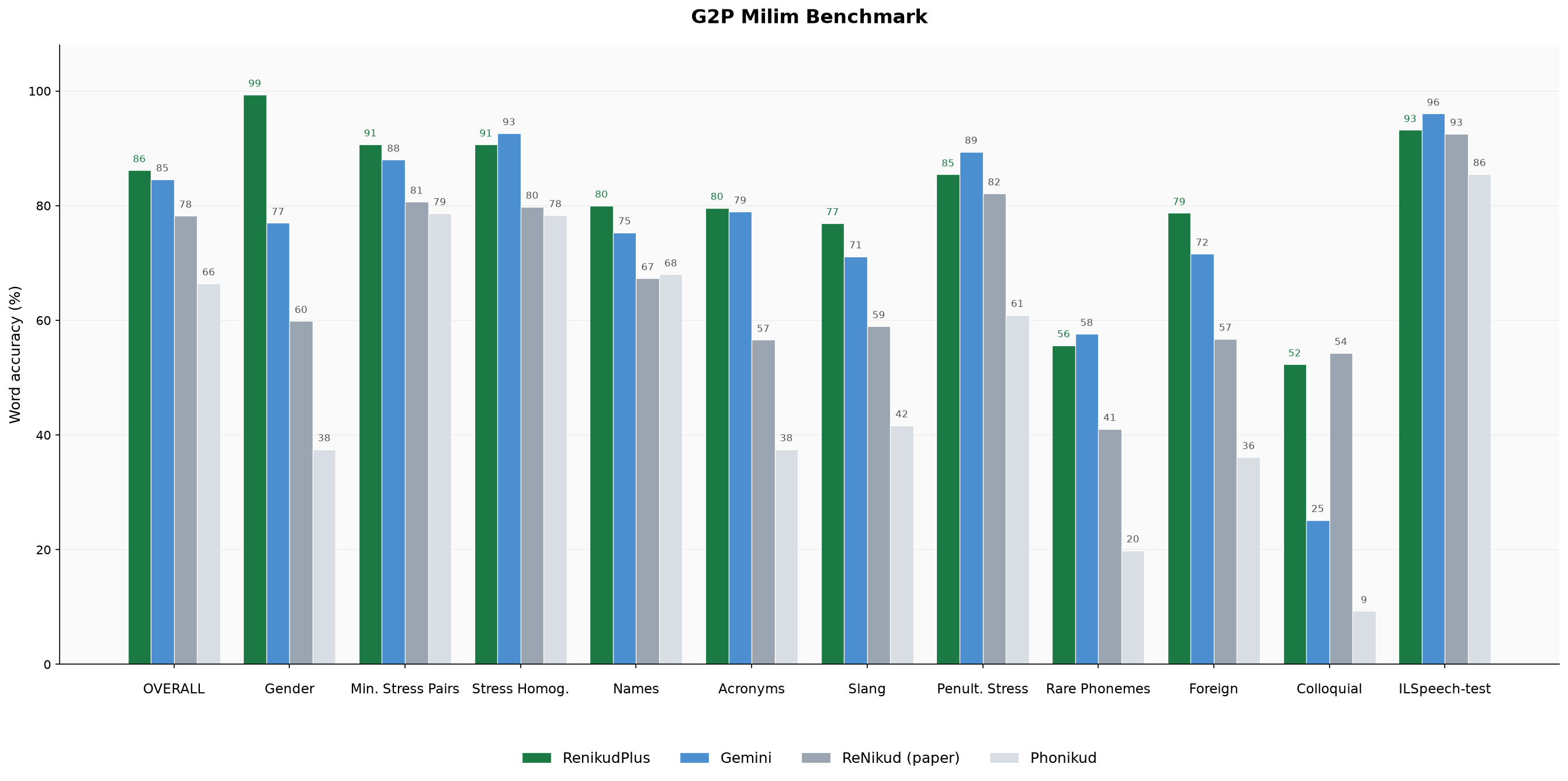
| word accuracy | RenikudPlus | int8 | Gemini | ReNikud | Phonikud |
|---|---|---|---|---|---|
| OVERALL | 86.2 | 85.9 | 84.6 | 78.2 | 66.4 |
| Gender | 99.3 | 99.3 | 77.0 | 59.9 | 37.5 |
| Min. Stress Pairs | 90.0 | 91.3 | 88.0 | 80.7 | 78.7 |
| Stress Homographs | 91.1 | 90.6 | 92.6 | 79.8 | 78.3 |
| Names | 80.0 | 82.0 | 75.3 | 67.3 | 68.0 |
| Acronyms | 79.6 | 76.3 | 79.0 | 56.6 | 37.5 |
| Slang | 75.6 | 75.0 | 71.2 | 59.0 | 41.7 |
| Penultimate Stress | 85.4 | 86.1 | 89.4 | 82.1 | 60.9 |
| Rare Phonemes | 58.3 | 55.0 | 57.6 | 41.1 | 19.9 |
| Foreign | 78.1 | 77.4 | 71.6 | 56.8 | 36.1 |
| Colloquial | 51.0 | 51.0 | 25.2 | 54.3 | 9.3 |
| ILSpeech-test | 93.2 | 93.1 | 96.0 | 92.5 | 85.5 |
Install
From PyPI:
pip install 'renikud-plus[cpu]'    # CPU inference
pip install 'renikud-plus[gpu]'    # CUDA inference
Pick the extra that matches the machine. ONNX Runtime is not a hard dependency
on purpose: onnxruntime and onnxruntime-gpu are separate distributions that
unpack into the same onnxruntime/ directory, so pip installs both happily
and whichever it writes last wins. If this package depended on the CPU build,
it would silently disable CUDA for anyone who also asked for onnxruntime-gpu
— and because pip's install order is topological rather than file order, they
could not fix it by reordering their requirements. Nothing errors; sessions just
quietly run on CPU.
If you already manage ONNX Runtime yourself, plain pip install renikud-plus
leaves your build untouched.
From this repo (no PyPI):
uv sync --extra cpu # or --extra gpu
Then run the example:
uv run python examples/basic.py
The ONNX weights (~310 MB) download automatically from Hugging Face on first
use and are cached locally. No separate hf download step is required.
Usage
from renikud_onnx import G2P

g2p = G2P()  # downloads notmax123/RenikudPlus model.onnx if needed
print(g2p.phonemize("שלום לכולם"))
# → ʃalˈom lekulˈam
The weights are the only file the package needs — there is no sidecar JSON. The
vocabularies, per-letter constraints and cascade conditioning all travel inside
the .onnx metadata.
Pass a local path if you already have the weights, or name the quantized build to download that one instead:
g2p = G2P("model.onnx")                    # a local file
g2p = G2P(filename="model_int8.onnx")      # 4× smaller, within ~0.3 pt overall
For a gender-conditioned ONNX model, pass speaker and target_speaker as
0 (unknown), 1 (male), or 2 (female):
g2p.phonemize("היא רצה", speaker=2, target_speaker=2)
What runs around the model
- Exact-MAP cascade decode (default). Consonant, vowel and stress are
decoded jointly under
E(c,v,s) = log P(c) + log P(v|c) + log P(s|c,v), with per-letter legality and "stress needs a vowel" as hard constraints, so the one-stress-per-word choice can flip the vowel and consonant too. Passexact_map=Falsefor the old greedy argmax. - Force lexicon —
G2P(..., lexicon={"סבתא": "sˈavta"})or a TSV path. Off unless passed; wins wherever it matches. - Hebrew number front end, from
hebrew-num2words(installed as a dependency). Digits never appear in training text, so they are expanded to words first — gender-, construct- and context-aware ("המחיר 1250 שקלים"→hameχˈiʁ ʔˈelef matˈajim veχamiʃˈim ʃkalˈim), with clock time, date, year, percent, decimal and identifier readings.number_norm="off"skips it. Its API is re-exported, sofrom renikud_onnx import normalize_numbersstill works. - Long inputs. Text past the encoder's 2,046-character window is split on
sentence, then comma, then word boundaries and decoded window by window; the
pieces are contiguous, so concatenation is lossless. A
[א-ת]-in-output backstop warns (or raises,on_hebrew_leak="raise") if raw Hebrew survives into the IPA.
Vowelized (pointed) input
Input may carry niqqud or cantillation, in either of two modes.
niqqud="strip" (default). The marks are dropped before tokenization, so
pointed text decodes exactly like the same text unpointed — and, in particular,
cannot disambiguate anything:
g2p.phonemize("שָׁלוֹם לְכֻּלָּם") # → ʃalˈom lekulˈam, identical to the bare form
niqqud="use". The points are read as evidence. Each vowel sign, dagesh qal
and shin/sin dot is pinned into the exact-MAP energy as a hard constraint, so
the model predicts only what the pointing leaves open:
g2p = G2P(niqqud="use")          # or per call: g2p.phonemize(text, niqqud="use")
g2p.phonemize("סֵפֶר")   # sˈefeʁ   book
g2p.phonemize("סַפָּר")   # sˈapaʁ   barber
g2p.phonemize("סָפַר")   # sˈafaʁ   counted
g2p.phonemize("סִפֵּר")   # sˈipeʁ   told
All four are sˈefeʁ under "strip" — the skeleton ספר cannot tell them apart.
Two signs stay ambiguous on purpose and are left to the model: qamats, since
qamats qatan (/o/, as in כָּל → kˈol) is written with the same sign in most
pointed text, and shva, since shva na is /e/ while shva nah is nothing.
Unmarked letters inside a pointed word are read the way pointed text implies —
a bare ו is the consonant (a vowel vav would carry holam or dagesh), a bare י
after hiriq or tsere is a mater, a word-final bare א/ה is silent.
Caveats. The mode needs the exact-MAP decode (it raises with exact_map=False).
Niqqud does not mark stress, so stress stays the model's own call — and where
the pointing overrules its reading of the skeleton, its stress can still reflect
the reading it preferred (סַפָּר → sˈapaʁ, not sapˈaʁ). A constraint that
would leave a letter with no legal reading at all is dropped rather than
enforced, so partially or sloppily pointed text degrades to the default decode
instead of breaking.
On 24 hand-checked pointed words, "use" gets 24/24 vowels and consonants
right against 17/24 for "strip"; including stress, 18/24 against 16/24. On the
seven pointed possessive-suffix words from the field report (בְּנֹתָיו,
צִדְקֹתָיו, קֳדָשָׁיו, …) it matches the reference reading 7/7.
Niqqud output
vocalize renders the same predictions as pointed Hebrew (niqqud) instead of
IPA — for TTS engines that read niqqud natively but ignore phoneme markup. It
accepts the same speaker / target_speaker arguments.
print(g2p.vocalize("שלום לכולם"))
# → שַׁלוֹם לֶכּוּלַם
Niqqud has no stress mark, so predicted stress is not represented in this output
(it is in phonemize). Diacritization is phonetically faithful but not
publication-grade — e.g. shva in clusters is omitted. The force lexicon
rewrites IPA strings and so does not apply here.
Citation
@misc{melichov2026renikud,
  title={ReNikud: Audio-Supervised Hebrew Grapheme-to-Phoneme Conversion},
  author={Maxim Melichov and Yakov Kolani and Morris Alper},
  year={2026},
  url={https://arxiv.org/pdf/2606.20179},
}
Contributors

13 commits

6 commits
Similar repos





Languages
Python
100.0%
README
ReNikud Plus — Hebrew Grapheme-to-Phoneme Inference
Convert unvocalized Hebrew text into IPA for TTS, speech technology, and spoken-language research. Trained without any benchmark-derived data; on 126k words of unseen podcast speech it scores 93.3% word accuracy.
Benchmark
| word accuracy | RenikudPlus | int8 | Gemini | ReNikud | Phonikud |
|---|---|---|---|---|---|
| OVERALL | 86.2 | 85.9 | 84.6 | 78.2 | 66.4 |
| Gender | 99.3 | 99.3 | 77.0 | 59.9 | 37.5 |
| Min. Stress Pairs | 90.0 | 91.3 | 88.0 | 80.7 | 78.7 |
| Stress Homographs | 91.1 | 90.6 | 92.6 | 79.8 | 78.3 |
| Names | 80.0 | 82.0 | 75.3 | 67.3 | 68.0 |
| Acronyms | 79.6 | 76.3 | 79.0 | 56.6 | 37.5 |
| Slang | 75.6 | 75.0 | 71.2 | 59.0 | 41.7 |
| Penultimate Stress | 85.4 | 86.1 | 89.4 | 82.1 | 60.9 |
| Rare Phonemes | 58.3 | 55.0 | 57.6 | 41.1 | 19.9 |
| Foreign | 78.1 | 77.4 | 71.6 | 56.8 | 36.1 |
| Colloquial | 51.0 | 51.0 | 25.2 | 54.3 | 9.3 |
| ILSpeech-test | 93.2 | 93.1 | 96.0 | 92.5 | 85.5 |
Install
From PyPI:
pip install 'renikud-plus[cpu]'    # CPU inference
pip install 'renikud-plus[gpu]'    # CUDA inference
Pick the extra that matches the machine. ONNX Runtime is not a hard dependency
on purpose: onnxruntime and onnxruntime-gpu are separate distributions that
unpack into the same onnxruntime/ directory, so pip installs both happily
and whichever it writes last wins. If this package depended on the CPU build,
it would silently disable CUDA for anyone who also asked for onnxruntime-gpu
— and because pip's install order is topological rather than file order, they
could not fix it by reordering their requirements. Nothing errors; sessions just
quietly run on CPU.
If you already manage ONNX Runtime yourself, plain pip install renikud-plus
leaves your build untouched.
From this repo (no PyPI):
uv sync --extra cpu # or --extra gpu
Then run the example:
uv run python examples/basic.py
The ONNX weights (~310 MB) download automatically from Hugging Face on first
use and are cached locally. No separate hf download step is required.
Usage
from renikud_onnx import G2P

g2p = G2P()  # downloads notmax123/RenikudPlus model.onnx if needed
print(g2p.phonemize("שלום לכולם"))
# → ʃalˈom lekulˈam
The weights are the only file the package needs — there is no sidecar JSON. The
vocabularies, per-letter constraints and cascade conditioning all travel inside
the .onnx metadata.
Pass a local path if you already have the weights, or name the quantized build to download that one instead:
g2p = G2P("model.onnx")                    # a local file
g2p = G2P(filename="model_int8.onnx")      # 4× smaller, within ~0.3 pt overall
For a gender-conditioned ONNX model, pass speaker and target_speaker as
0 (unknown), 1 (male), or 2 (female):
g2p.phonemize("היא רצה", speaker=2, target_speaker=2)
What runs around the model
- Exact-MAP cascade decode (default). Consonant, vowel and stress are
decoded jointly under
E(c,v,s) = log P(c) + log P(v|c) + log P(s|c,v), with per-letter legality and "stress needs a vowel" as hard constraints, so the one-stress-per-word choice can flip the vowel and consonant too. Passexact_map=Falsefor the old greedy argmax. - Force lexicon —
G2P(..., lexicon={"סבתא": "sˈavta"})or a TSV path. Off unless passed; wins wherever it matches. - Hebrew number front end, from
hebrew-num2words(installed as a dependency). Digits never appear in training text, so they are expanded to words first — gender-, construct- and context-aware ("המחיר 1250 שקלים"→hameχˈiʁ ʔˈelef matˈajim veχamiʃˈim ʃkalˈim), with clock time, date, year, percent, decimal and identifier readings.number_norm="off"skips it. Its API is re-exported, sofrom renikud_onnx import normalize_numbersstill works. - Long inputs. Text past the encoder's 2,046-character window is split on
sentence, then comma, then word boundaries and decoded window by window; the
pieces are contiguous, so concatenation is lossless. A
[א-ת]-in-output backstop warns (or raises,on_hebrew_leak="raise") if raw Hebrew survives into the IPA.
Vowelized (pointed) input
Input may carry niqqud or cantillation, in either of two modes.
niqqud="strip" (default). The marks are dropped before tokenization, so
pointed text decodes exactly like the same text unpointed — and, in particular,
cannot disambiguate anything:
g2p.phonemize("שָׁלוֹם לְכֻּלָּם") # → ʃalˈom lekulˈam, identical to the bare form
niqqud="use". The points are read as evidence. Each vowel sign, dagesh qal
and shin/sin dot is pinned into the exact-MAP energy as a hard constraint, so
the model predicts only what the pointing leaves open:
g2p = G2P(niqqud="use")          # or per call: g2p.phonemize(text, niqqud="use")
g2p.phonemize("סֵפֶר")   # sˈefeʁ   book
g2p.phonemize("סַפָּר")   # sˈapaʁ   barber
g2p.phonemize("סָפַר")   # sˈafaʁ   counted
g2p.phonemize("סִפֵּר")   # sˈipeʁ   told
All four are sˈefeʁ under "strip" — the skeleton ספר cannot tell them apart.
Two signs stay ambiguous on purpose and are left to the model: qamats, since
qamats qatan (/o/, as in כָּל → kˈol) is written with the same sign in most
pointed text, and shva, since shva na is /e/ while shva nah is nothing.
Unmarked letters inside a pointed word are read the way pointed text implies —
a bare ו is the consonant (a vowel vav would carry holam or dagesh), a bare י
after hiriq or tsere is a mater, a word-final bare א/ה is silent.
Caveats. The mode needs the exact-MAP decode (it raises with exact_map=False).
Niqqud does not mark stress, so stress stays the model's own call — and where
the pointing overrules its reading of the skeleton, its stress can still reflect
the reading it preferred (סַפָּר → sˈapaʁ, not sapˈaʁ). A constraint that
would leave a letter with no legal reading at all is dropped rather than
enforced, so partially or sloppily pointed text degrades to the default decode
instead of breaking.
On 24 hand-checked pointed words, "use" gets 24/24 vowels and consonants
right against 17/24 for "strip"; including stress, 18/24 against 16/24. On the
seven pointed possessive-suffix words from the field report (בְּנֹתָיו,
צִדְקֹתָיו, קֳדָשָׁיו, …) it matches the reference reading 7/7.
Niqqud output
vocalize renders the same predictions as pointed Hebrew (niqqud) instead of
IPA — for TTS engines that read niqqud natively but ignore phoneme markup. It
accepts the same speaker / target_speaker arguments.
print(g2p.vocalize("שלום לכולם"))
# → שַׁלוֹם לֶכּוּלַם
Niqqud has no stress mark, so predicted stress is not represented in this output
(it is in phonemize). Diacritization is phonetically faithful but not
publication-grade — e.g. shva in clusters is omitted. The force lexicon
rewrites IPA strings and so does not apply here.
Citation
@misc{melichov2026renikud,
  title={ReNikud: Audio-Supervised Hebrew Grapheme-to-Phoneme Conversion},
  author={Maxim Melichov and Yakov Kolani and Morris Alper},
  year={2026},
  url={https://arxiv.org/pdf/2606.20179},
}
Similar repos
Contributors
13 commits
6 commits
Languages
Python
100.0%