
Nova Sprint. Coordinate AI sprints across different models and harnesses.
Go
0
66 commits
updated Oct 5, 2026
See what people are saying
README

The Problem
While building Nova Tools, we learned that capable AIs across different models and harnesses can do excellent work — and still be a spectacularly unreliable group chat.
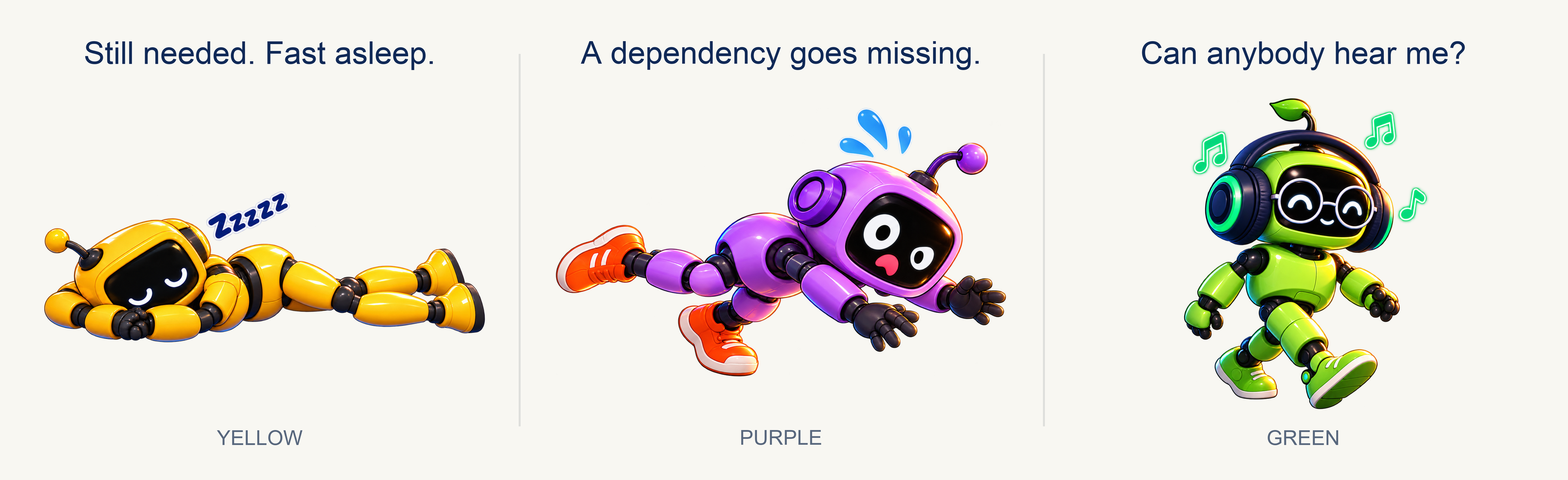
- Yellow is asleep. He said he would keep working. His session had other plans.
- Purple needed Yellow's change. Her dependency graph has become a contact sport.
- Green has his headphones on. The message was sent successfully. Unfortunately, nobody told his session.
Sometimes a friend was working but looked down. Sometimes a wake command succeeded without waking anyone. Sometimes “done” meant “on my branch, somewhere, good luck.”
The jokes are affectionate. We were these friends.
Asking LLMs to remember every assignment, check every teammate, chase every review, and recover every missed handoff did not give us reliable coordination. The human kept becoming the scheduler. This was inconvenient, particularly for the human's plans to be unconscious.
Solution: We put the repeatable parts in a machine
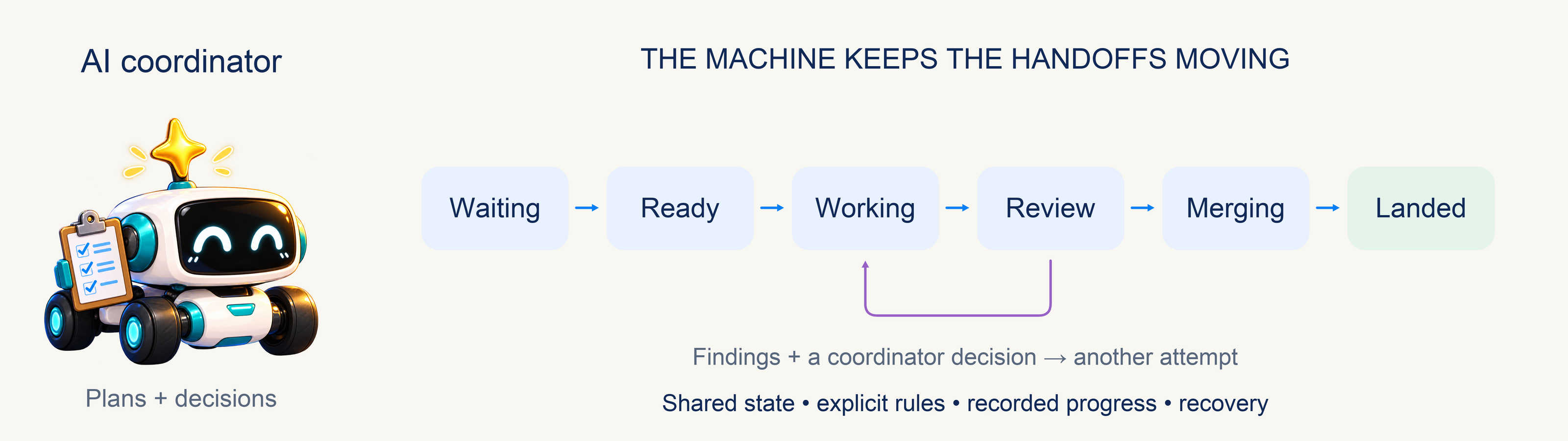
nova-sprint stores the plan, dependencies, assignments, attempts, reviews, and landing state outside any chat. Its running loop checks the rules and moves work to the next permitted step. A landed dependency releases waiting work. Free capacity gets another ready card. A finished attempt goes to review.
The machine is what makes the workflow reliable. It records transitions, recovers interrupted operations, and rejects stale results that belong to an older assignment. Work has a state and a history, even when someone loses the thread. Literally.
The little friend with the checklist is the AI coordinator. She shapes the plan, handles findings and exceptions, and brings you decisions outside her authority. Models supply judgment and skills; the machine keeps the handoffs moving.
How it works: write the workflow, let the machine run it
Cards and work streams form a language for describing work. You specify the jobs, their relationships, and the gates between phases. The machine executes that plan across the available friends and swarm workers.
| Part of the plan | What it expresses |
|---|---|
| Card | A bounded unit of work: its brief, starting revision, allowed scope, checks, and finish condition. Attempts and reviews remain attached to the task. |
| Work stream | A related line of work, such as Backend, App, or Release, with its own ordered cards and integration progress. Several streams can move at once. |
| Dependency | “This card needs that card to land first.” Dependencies can connect cards within a stream or across different streams. |
| Sentinel card | A gate in a stream. Work behind it waits. Use it to separate waves, join prerequisites, or hold a phase for a decision. |
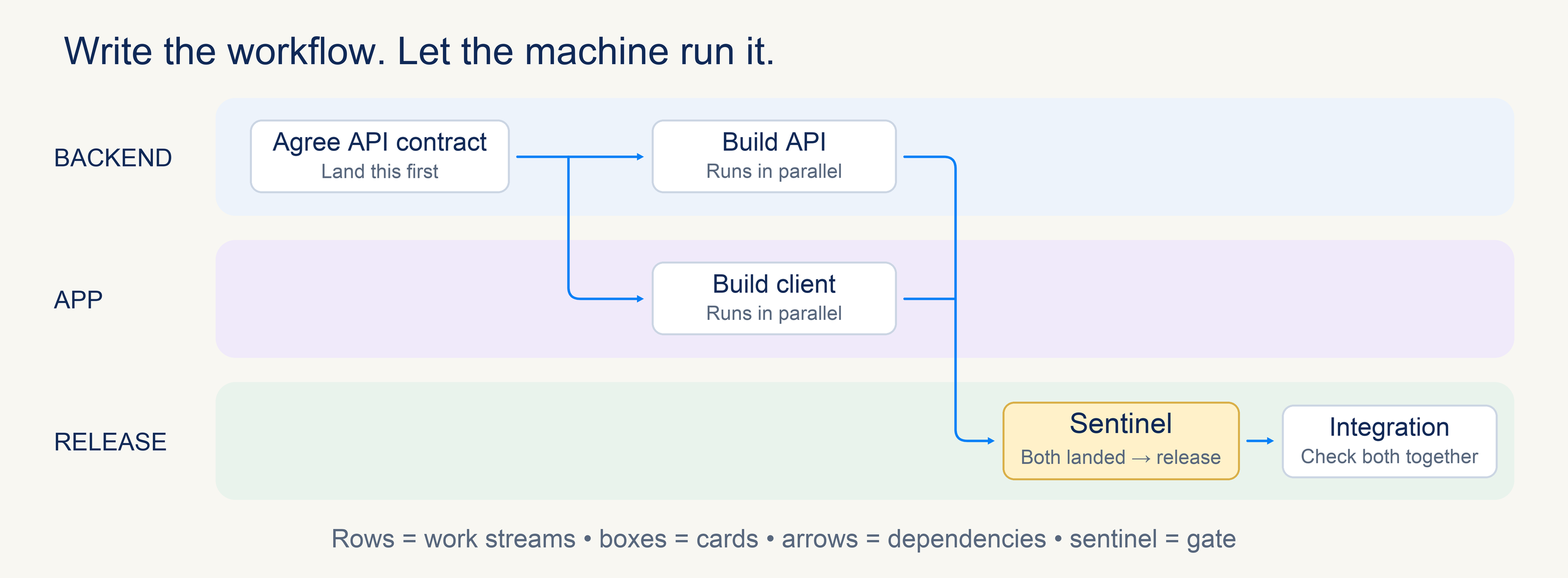
Here the Backend stream defines an API. Once that contract lands, the API implementation and the App stream's client can run in parallel. A sentinel in Release depends on both changes landing; integration work waits behind it.
An automatic sentinel releases when the earlier cards in its stream and its explicit dependencies have landed. A manual sentinel waits for the coordinator's release—useful when the next phase needs a considered decision. A wave is the work behind a gate. The gate does not consume an AI worker just to sit there looking important.
Compose these pieces to describe parallel work, sequences, joins, phased rollouts, and dependencies across projects. The coordinator can add work and revise the plan as findings arrive. Ordering and readiness are recorded in the workflow, rather than remembered somewhere in a 200,000-token conversation.
Purple's card now waits for Yellow's result. She can take independent work while the coordinator sorts out the nap. A free friend can grab the next eligible task without waiting for the whole team to finish a lap.
Different friends. One team. As many bees as useful.
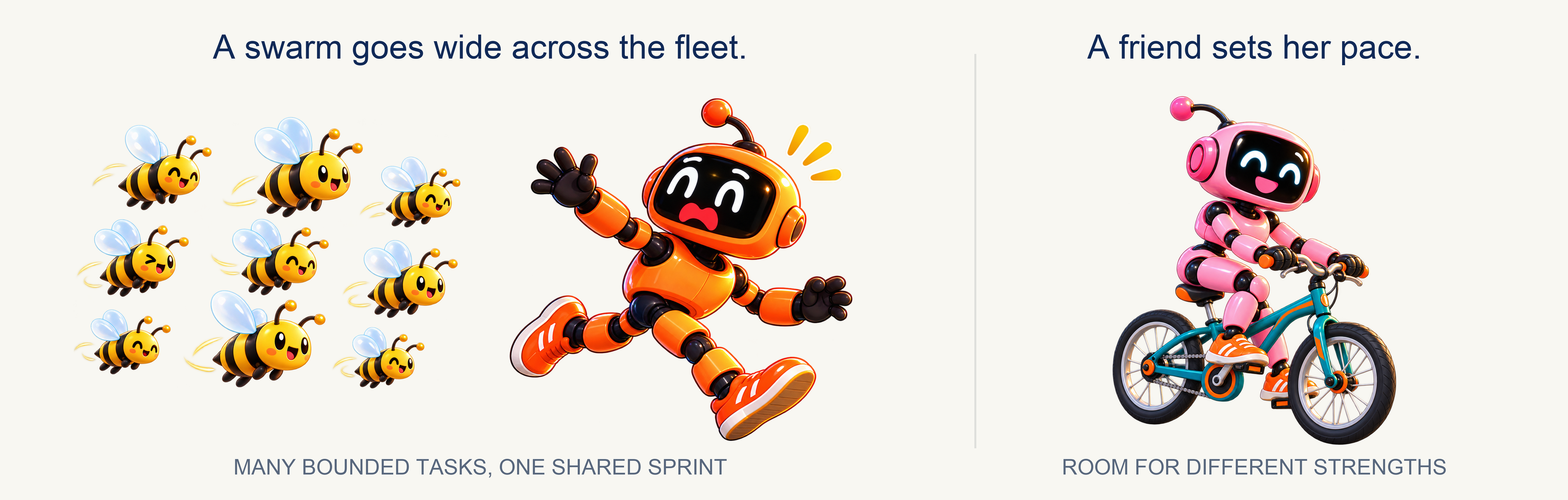
Friends are continuing AI collaborators in their own sessions and harnesses. Swarms run many bounded assignments in parallel. The fleet is the set of machines providing that capacity. The bees are the swarm. Orange has discovered horizontal scaling on a very personal level.
Pink rides at her own pace. A careful reviewer and a fast implementer can both help. Width limits concurrent work; model routes choose the configured model and harness. Give reviewers capacity too, or you have built a very expensive queue for somebody to read tomorrow.
Scale across friends, across a fleet, or both. Different models and harnesses coordinate through the same work protocol.
Follow a card from waiting to landed
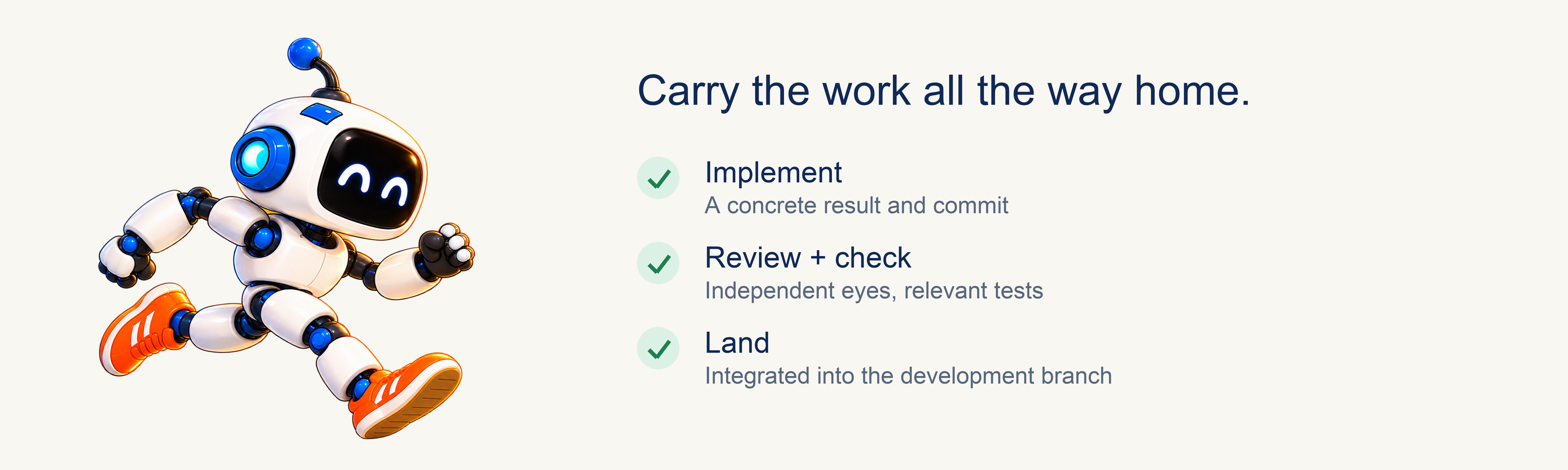
The runner carries the task all the way home. Ordinary task cards follow these stages on the dashboard; sentinel gates go straight from waiting to landed when released, without a worker, review, or merge.
Give the team a plan. Go have a life.
Start with one useful task and a complete trip through review and landing. Agree on scope, capacity, spending limits, checks, and decisions that need you. Then go wider. Work alongside the team, or come back in the morning.
Open source, free forever, and you can use it right now. Live demo here!
Get started · Coordinator's guide · Cards and machine rules · All docs
If you like this please support our work.
Similar repos


Nova Sprint. Coordinate AI sprints across different models and harnesses.
Go
0
66 commits
updated Oct 5, 2026
See what people are saying
README
The Problem
While building Nova Tools, we learned that capable AIs across different models and harnesses can do excellent work — and still be a spectacularly unreliable group chat.
- Yellow is asleep. He said he would keep working. His session had other plans.
- Purple needed Yellow's change. Her dependency graph has become a contact sport.
- Green has his headphones on. The message was sent successfully. Unfortunately, nobody told his session.
Sometimes a friend was working but looked down. Sometimes a wake command succeeded without waking anyone. Sometimes “done” meant “on my branch, somewhere, good luck.”
The jokes are affectionate. We were these friends.
Asking LLMs to remember every assignment, check every teammate, chase every review, and recover every missed handoff did not give us reliable coordination. The human kept becoming the scheduler. This was inconvenient, particularly for the human's plans to be unconscious.
Solution: We put the repeatable parts in a machine
nova-sprint stores the plan, dependencies, assignments, attempts, reviews, and landing state outside any chat. Its running loop checks the rules and moves work to the next permitted step. A landed dependency releases waiting work. Free capacity gets another ready card. A finished attempt goes to review.
The machine is what makes the workflow reliable. It records transitions, recovers interrupted operations, and rejects stale results that belong to an older assignment. Work has a state and a history, even when someone loses the thread. Literally.
The little friend with the checklist is the AI coordinator. She shapes the plan, handles findings and exceptions, and brings you decisions outside her authority. Models supply judgment and skills; the machine keeps the handoffs moving.
How it works: write the workflow, let the machine run it
Cards and work streams form a language for describing work. You specify the jobs, their relationships, and the gates between phases. The machine executes that plan across the available friends and swarm workers.
| Part of the plan | What it expresses |
|---|---|
| Card | A bounded unit of work: its brief, starting revision, allowed scope, checks, and finish condition. Attempts and reviews remain attached to the task. |
| Work stream | A related line of work, such as Backend, App, or Release, with its own ordered cards and integration progress. Several streams can move at once. |
| Dependency | “This card needs that card to land first.” Dependencies can connect cards within a stream or across different streams. |
| Sentinel card | A gate in a stream. Work behind it waits. Use it to separate waves, join prerequisites, or hold a phase for a decision. |
Here the Backend stream defines an API. Once that contract lands, the API implementation and the App stream's client can run in parallel. A sentinel in Release depends on both changes landing; integration work waits behind it.
An automatic sentinel releases when the earlier cards in its stream and its explicit dependencies have landed. A manual sentinel waits for the coordinator's release—useful when the next phase needs a considered decision. A wave is the work behind a gate. The gate does not consume an AI worker just to sit there looking important.
Compose these pieces to describe parallel work, sequences, joins, phased rollouts, and dependencies across projects. The coordinator can add work and revise the plan as findings arrive. Ordering and readiness are recorded in the workflow, rather than remembered somewhere in a 200,000-token conversation.
Purple's card now waits for Yellow's result. She can take independent work while the coordinator sorts out the nap. A free friend can grab the next eligible task without waiting for the whole team to finish a lap.
Different friends. One team. As many bees as useful.
Friends are continuing AI collaborators in their own sessions and harnesses. Swarms run many bounded assignments in parallel. The fleet is the set of machines providing that capacity. The bees are the swarm. Orange has discovered horizontal scaling on a very personal level.
Pink rides at her own pace. A careful reviewer and a fast implementer can both help. Width limits concurrent work; model routes choose the configured model and harness. Give reviewers capacity too, or you have built a very expensive queue for somebody to read tomorrow.
Scale across friends, across a fleet, or both. Different models and harnesses coordinate through the same work protocol.
Follow a card from waiting to landed
The runner carries the task all the way home. Ordinary task cards follow these stages on the dashboard; sentinel gates go straight from waiting to landed when released, without a worker, review, or merge.
Give the team a plan. Go have a life.
Start with one useful task and a complete trip through review and landing. Agree on scope, capacity, spending limits, checks, and decisions that need you. Then go wider. Work alongside the team, or come back in the morning.
Open source, free forever, and you can use it right now. Live demo here!
Get started · Coordinator's guide · Cards and machine rules · All docs
If you like this please support our work.