
README




🚀 ankerl::unordered_dense::{map, set}
A fast & densely stored hashmap and hashset for C++17 and later.
The classes ankerl::unordered_dense::map and ankerl::unordered_dense::set are (almost) drop-in replacements of std::unordered_map and std::unordered_set. While they don't have as strong iterator / reference stability guarantees, they are typically much faster.
Additionally, there are ankerl::unordered_dense::segmented_map and ankerl::unordered_dense::segmented_set with lower peak memory usage, and stable references (iterators are NOT stable) on insert.
A word count, with map in its default configuration:
#include <ankerl/unordered_dense.h>

#include <iostream>
#include <string>

auto main() -> int {
    auto counts = ankerl::unordered_dense::map<std::string, int>();
    for (auto const* word : {"the", "quick", "brown", "fox", "the"}) {
        ++counts[word];
    }

    // iterating walks a std::vector, in insertion order
    for (auto const& [word, count] : counts) {
        std::cout << count << ' ' << word << '\n';
    }
}
Dense storage, and what it costs
The chosen design has a few advantages over std::unordered_map:
- Perfect iteration speed - Data is stored in a
std::vector, all data is contiguous! - Very fast insertion & lookup speed, in the same ballpark as
absl::flat_hash_map - Low memory usage
- Full support for
std::allocators, and polymorphic allocators. There areankerl::unordered_dense::pmrtypedefs available - Customizable storage type: with a template parameter you can e.g. switch from
std::vectortoboost::interprocess::vectoror any other compatible random-access container. - Better debugging: the underlying data can be easily seen in any debugger that can show an
std::vector.
There's no free lunch, so there are a few disadvantages:
- Deletion speed is relatively slow. This needs two lookups: one for the element to delete, and one for the element that is moved onto the newly empty spot.
- no
const Keyinstd::pair<Key, Value> - Iterators and references are not stable on insert or erase.
Benchmarks
Obviously this is my own map's README, so the bias is where you'd expect it. Rows are sorted by the geometric mean of all five panels, and one of the five is iterate, which a dense map wins by 5.4x to 13x. That column decides most of the order on its own. Sorted by find instead, unordered_dense is seventh of fourteen.
Every map runs in the configuration you get by typing its type name, own hash included. Everything is relative to ankerl::unordered_dense::map from the latest release, 5.2.0, so 1.00 is level with it and 2.00 is twice the cost. Ryzen 9 7950X, clang 22.1.8, one binary per map, one million to two million entries. Raw numbers are in doc/bench_readme.csv.
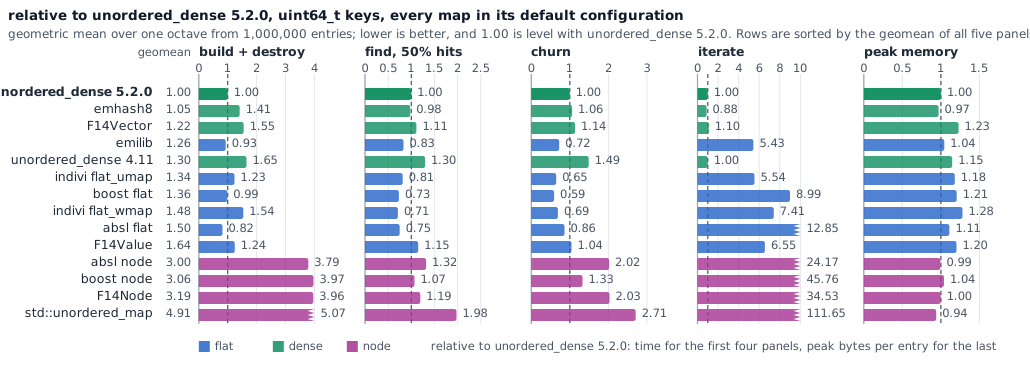
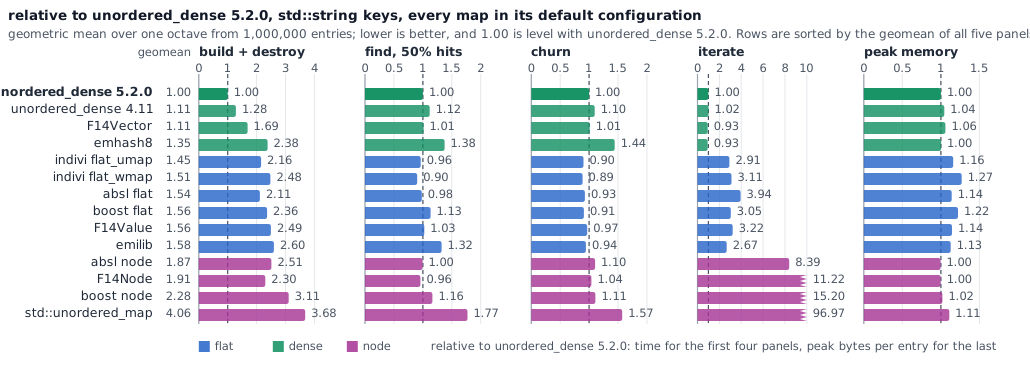
In short: iteration is what the dense layout buys, 0.20 ns per element against 5.4x to 13x for the flat maps and 112x for std::unordered_map. With std::string keys it builds and destroys 2.1x to 2.6x faster than any flat map. Integer find and churn are what that costs, 0.73 and 0.59 against boost::unordered_flat_map.
doc/benchmarks.md has what each panel measures, all twelve configurations of unordered_dense (segmented_map, group_big, pmr, huge pages and their combinations), how the run was taken and what it does not say.
Installation
The map is header-only. Copy include/ankerl/unordered_dense.h and include/ankerl/stl.h into your project, keeping them in the same directory, and include unordered_dense.h. stl.h holds nothing but the standard includes, split out so that a build using import std can skip it. include/ankerl/huge_page_allocator.h and include/ankerl/mapped_view.h are optional: nothing references them, and you only need them if you want huge pages or a map read in place from a file.
Or install it. The default installation location is /usr/local. Clone the repository and run these commands in the cloned folder:
mkdir build && cd build
cmake ..
cmake --build . --target install
Consider setting an install prefix if you do not want to install unordered_dense system wide, like so:
mkdir build && cd build
cmake -DCMAKE_INSTALL_PREFIX:PATH=${HOME}/unordered_dense_install ..
cmake --build . --target install
To make use of the installed library, add this to your project:
find_package(unordered_dense CONFIG REQUIRED)
target_link_libraries(your_project_name unordered_dense::unordered_dense)
Documentation
- Usage - the hash, the API a vector of values makes possible, and the shapes
mapandsetcan be asked to take. - Upgrading from 4.x - what 5.0 broke, the four renames that fix most of it, and the two breaks that are not compile errors.
- Design - how the index works: one 88 byte block per group of sixteen slots, the overflow counters that make tombstones unnecessary, and what an insert, a lookup and an erase do.
- Benchmarks - the long version of the two graphs above.
- Real world usage - the open source projects that use this map, from MySQL to PrusaSlicer.
- scripts/ab - the measurement harnesses. Every result they have produced is written down in notes/index-design.md, the negative ones included.
Significant stargazers
(top 24 of 39)

949 followers · starred Jan 2024

930 followers · starred Aug 2024

1,430 followers · starred Mar 2023

830 followers · starred Oct 2024
Similar repos


Languages
C++
64.9%
Python
27.1%
Shell
7.0%
README
🚀 ankerl::unordered_dense::{map, set}
A fast & densely stored hashmap and hashset for C++17 and later.
The classes ankerl::unordered_dense::map and ankerl::unordered_dense::set are (almost) drop-in replacements of std::unordered_map and std::unordered_set. While they don't have as strong iterator / reference stability guarantees, they are typically much faster.
Additionally, there are ankerl::unordered_dense::segmented_map and ankerl::unordered_dense::segmented_set with lower peak memory usage, and stable references (iterators are NOT stable) on insert.
A word count, with map in its default configuration:
#include <ankerl/unordered_dense.h>

#include <iostream>
#include <string>

auto main() -> int {
    auto counts = ankerl::unordered_dense::map<std::string, int>();
    for (auto const* word : {"the", "quick", "brown", "fox", "the"}) {
        ++counts[word];
    }

    // iterating walks a std::vector, in insertion order
    for (auto const& [word, count] : counts) {
        std::cout << count << ' ' << word << '\n';
    }
}
Dense storage, and what it costs
The chosen design has a few advantages over std::unordered_map:
- Perfect iteration speed - Data is stored in a
std::vector, all data is contiguous! - Very fast insertion & lookup speed, in the same ballpark as
absl::flat_hash_map - Low memory usage
- Full support for
std::allocators, and polymorphic allocators. There areankerl::unordered_dense::pmrtypedefs available - Customizable storage type: with a template parameter you can e.g. switch from
std::vectortoboost::interprocess::vectoror any other compatible random-access container. - Better debugging: the underlying data can be easily seen in any debugger that can show an
std::vector.
There's no free lunch, so there are a few disadvantages:
- Deletion speed is relatively slow. This needs two lookups: one for the element to delete, and one for the element that is moved onto the newly empty spot.
- no
const Keyinstd::pair<Key, Value> - Iterators and references are not stable on insert or erase.
Benchmarks
Obviously this is my own map's README, so the bias is where you'd expect it. Rows are sorted by the geometric mean of all five panels, and one of the five is iterate, which a dense map wins by 5.4x to 13x. That column decides most of the order on its own. Sorted by find instead, unordered_dense is seventh of fourteen.
Every map runs in the configuration you get by typing its type name, own hash included. Everything is relative to ankerl::unordered_dense::map from the latest release, 5.2.0, so 1.00 is level with it and 2.00 is twice the cost. Ryzen 9 7950X, clang 22.1.8, one binary per map, one million to two million entries. Raw numbers are in doc/bench_readme.csv.
In short: iteration is what the dense layout buys, 0.20 ns per element against 5.4x to 13x for the flat maps and 112x for std::unordered_map. With std::string keys it builds and destroys 2.1x to 2.6x faster than any flat map. Integer find and churn are what that costs, 0.73 and 0.59 against boost::unordered_flat_map.
doc/benchmarks.md has what each panel measures, all twelve configurations of unordered_dense (segmented_map, group_big, pmr, huge pages and their combinations), how the run was taken and what it does not say.
Installation
The map is header-only. Copy include/ankerl/unordered_dense.h and include/ankerl/stl.h into your project, keeping them in the same directory, and include unordered_dense.h. stl.h holds nothing but the standard includes, split out so that a build using import std can skip it. include/ankerl/huge_page_allocator.h and include/ankerl/mapped_view.h are optional: nothing references them, and you only need them if you want huge pages or a map read in place from a file.
Or install it. The default installation location is /usr/local. Clone the repository and run these commands in the cloned folder:
mkdir build && cd build
cmake ..
cmake --build . --target install
Consider setting an install prefix if you do not want to install unordered_dense system wide, like so:
mkdir build && cd build
cmake -DCMAKE_INSTALL_PREFIX:PATH=${HOME}/unordered_dense_install ..
cmake --build . --target install
To make use of the installed library, add this to your project:
find_package(unordered_dense CONFIG REQUIRED)
target_link_libraries(your_project_name unordered_dense::unordered_dense)
Documentation
- Usage - the hash, the API a vector of values makes possible, and the shapes
mapandsetcan be asked to take. - Upgrading from 4.x - what 5.0 broke, the four renames that fix most of it, and the two breaks that are not compile errors.
- Design - how the index works: one 88 byte block per group of sixteen slots, the overflow counters that make tombstones unnecessary, and what an insert, a lookup and an erase do.
- Benchmarks - the long version of the two graphs above.
- Real world usage - the open source projects that use this map, from MySQL to PrusaSlicer.
- scripts/ab - the measurement harnesses. Every result they have produced is written down in notes/index-design.md, the negative ones included.
Similar repos
Significant stargazers
(top 24 of 39)
949 followers · starred Jan 2024
930 followers · starred Aug 2024
1,430 followers · starred Mar 2023
830 followers · starred Oct 2024
Languages
C++
64.9%
Python
27.1%
Shell
7.0%