
DOOM simulated and rendered inside Firebird SQL, running in the browser via Firebird WASM
See the codeSee what people are saying
README
Firebird DOOM
DOOM, simulated and rendered inside the Firebird SQL database, running entirely in your browser on Firebird 6 compiled to WebAssembly.
▶ Play: https://mariuz.github.io/firebird-doom/
Every game tic is a PSQL procedure call. Every frame is a SELECT. JavaScript only reads the
keyboard and paints the rows Firebird returns.
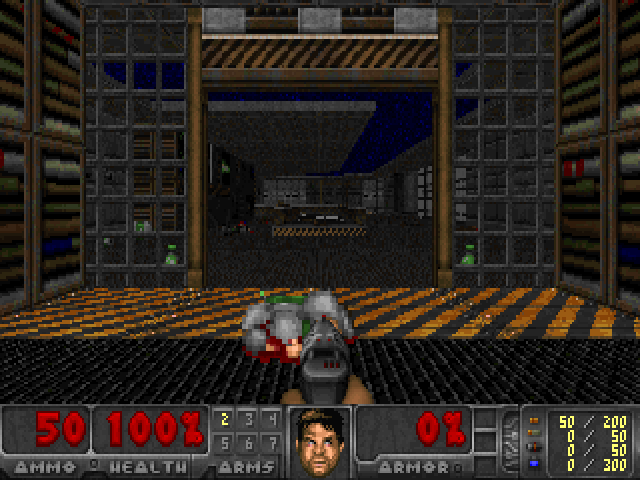
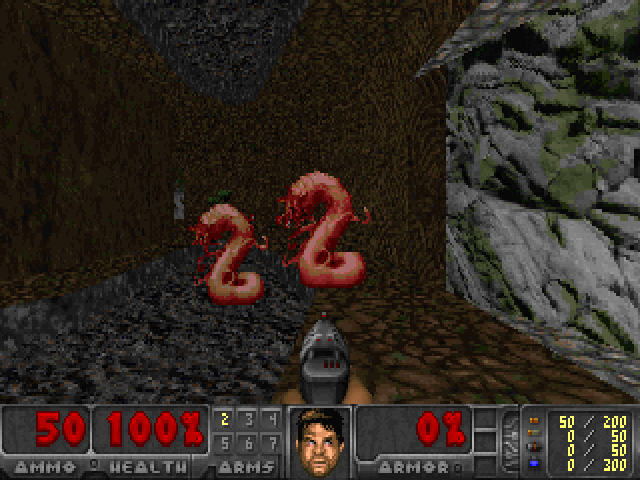 | 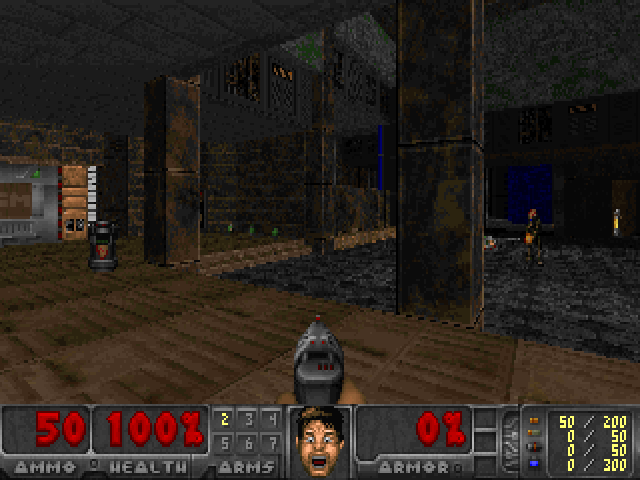 |
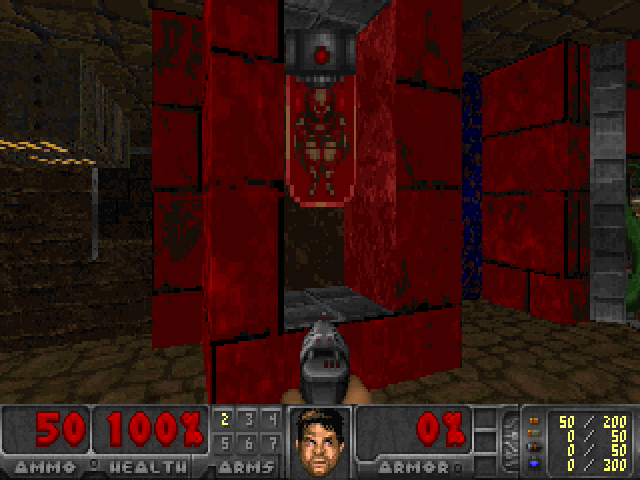 | 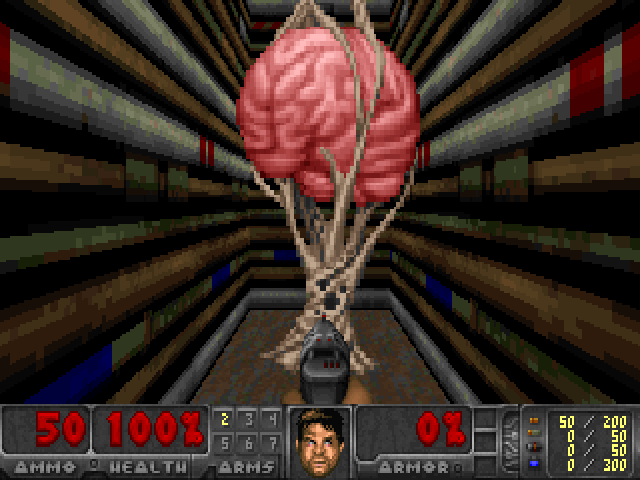 |
These screenshots come from npm run screenshots, which runs the same SQL and
rasteriser as the page, headless in Node.
This project follows CedarDB's SQL DOOM (the original WAD, rendered by a database) and DOOMQL (a DOOM-like game in pure SQL), and DuckDB-DOOM (a SQL raycaster in the browser through DuckDB-WASM). This one is graphical, plays real DOOM maps, and runs Firebird in the tab.
How it works
 keyboard ─▶ SELECT * FROM doom_tic(tics, fwd, side, turn, fire, use, weapon, run)   ← game logic
             SELECT * FROM frame_walls      ← which wall slice is visible in which column
             SELECT * FROM frame_sprites    ← which sprite frame, where, how bright
             SELECT * FROM frame_sectors    ← live floor/ceiling heights and light
         ─▶ JS looks up texels + colormaps ─▶ <canvas>
| DOOM source | Firebird |
|---|---|
WAD lumps VERTEXES LINEDEFS SIDEDEFS SECTORS SEGS SSECTORS NODES THINGS | tables of the same names (sql/schema.sql) |
info.c mobjinfo | THING_TYPES rows (src/thinginfo.js) |
R_PointInSubsector | SECTOR_AT() walks the BSP; INIT_MAP locates every thing in one recursive CTE |
BLOCKMAP | LINE_BLOCKS, a 128×128 grid built by INIT_MAP |
P_CheckPosition, P_TryMove | CHECK_POSITION, plus wall sliding in PLAYER_THINK |
P_CheckSight | CHECK_SIGHT() walks the blockmap cells along the sight line |
P_UseLines, P_CrossSpecialLine, EV_DoDoor/Plat/Floor, stairs, exits | ACTIVATE_LINE, MOVERS, MOVERS_THINK |
A_Look / A_Chase / attacks, pain, death, barrels | MONSTERS_THINK |
A_Tracer (revenant), A_FatAttack1/2/3 (mancubus) | homing and volleys in MONSTERS_THINK, MONSTER_MISSILE |
A_BossDeath, A_KeenDie | BOSS_DEATH, KEEN_DIE |
A_BrainSpit, A_SpawnFly, A_BrainScream (the Icon of Sin) | the shooter, cube and brain kinds in MONSTERS_THINK |
MF_SPAWNCEILING (hanging bodies, Commander Keen) | THING_TYPES.HANG, placed in INIT_MAP |
P_LineAttack (pistol, shotgun, chaingun, fist) | HITSCAN |
A_Saw, A_FireShotgun2 (chainsaw, super shotgun) | HITSCAN at melee range / 20 pellets; reload sounds timed in PLAYER_THINK |
P_SpawnPlayerMissile, P_RadiusAttack, A_BFGSpray (rocket launcher, plasma gun, BFG) | FIRE_MISSILE, RADIUS_ATTACK, BFG_SPRAY; projectiles fly in MONSTERS_THINK |
P_TouchSpecialThing | pickups in PLAYER_THINK |
| light flashes, strobes, glows | LIGHTS_THINK |
R_RenderBSPNode, R_CheckBBox, R_ClipSolidWallSegment (solidsegs) | RENDER_SLICES_BSP (sql/render.sql) |
r_segs.c clip arrays, markceiling / markfloor | RENDER_WALLS / FRAME_WALLS (or FRAME_WALLS_WINDOWED) |
r_plane.c visplanes: R_FindPlane, R_CheckPlane, R_MakeSpans, R_MapPlane | c_top/c_bot/f_top/f_bot per slice, FRAME_VISPLANES; spans in src/renderer.js |
r_things.c | RENDER_SPRITES / FRAME_SPRITES |
S_StartSound (+ sfxinfo sounds per monster) | PLAY_SOUND / SECTOR_SOUND → SOUND_EVENTS; played by src/audio.js |
I_PlaySong with the OPL GENMIDI bank | src/music.js: MUS + MIDI parser, FM synthesiser |
The renderer
There are two wall renderers. You can switch between them under Renderer in the page's
settings; the choice is stored in VIEWCFG.USE_BSP.
BSP front to back with solidsegs (the default). RENDER_SLICES_BSP walks NODES from the
root like R_RenderBSPNode, nearer child first. Before entering the farther child it projects
that child's bounding box onto the screen (R_CheckBBox) and skips the whole subtree if
every column it covers is already hidden. In each subsector it projects the segs that face the
viewer (R_AddLine). When a seg is solid (one-sided, or a closed door) its columns are marked
as covered (R_ClipSolidWallSegment). PSQL has no arrays, so DOOM's solidsegs list is a
VARCHAR with one character per screen column, and the traversal stack is a string too. The walk
stops when no '0' is left in the coverage string. On Freedoom's 36 maps this is about 3×
faster than brute force, and it finds exactly the same visible walls. CI checks that.
Brute force. RENDER_SLICES projects every linedef in front of the camera, whether or not
anything hides it.
Both generators transform into view space, clip to the near plane, and intersect each screen
column's ray with the seg. That gives an exact depth, a texture column, and the vertical
opening the seg leaves (open_top/open_bot) for whatever is behind it. RENDER_WALLS then
plays the part of DOOM's ceilingclip[]/floorclip[] arrays: ORDER BY col, depth sorts each
column front to back, and the clip window is carried down the column. The same idea, stated
declaratively, is the FRAME_WALLS_WINDOWED view:
SELECT *
  FROM (SELECT s.*,
               COALESCE(MAX(open_top) OVER (PARTITION BY col ORDER BY depth
                        ROWS BETWEEN UNBOUNDED PRECEDING AND 1 PRECEDING), 0) clip_top,
               COALESCE(MIN(open_bot) OVER (PARTITION BY col ORDER BY depth
                        ROWS BETWEEN UNBOUNDED PRECEDING AND 1 PRECEDING), 1e9) clip_bot
          FROM render_slices s)
 WHERE clip_top < clip_bot
The smoke test checks that FRAME_WALLS_WINDOWED matches FRAME_WALLS slice for slice. The
game uses the procedural clip because Firebird's window sort costs about twice as much.
Two Firebird-specific performance lessons:
- Derived tables are inlined. Each reference to a computed CTE column re-evaluates its whole expression tree, so a five-deep chain of projections took seconds. Generator procedures compute each value once into a variable. A PSQL loop runs at about 0.2 µs per statement in WASM.
- Pin the join order. Joining a computed range to
SCREEN_COLStook 65 s as an inner join, because the optimizer drove from the wrong side. WithCROSS JOIN LATERALorLEFT JOINit took 0.2 s.
Floors and ceilings: visplanes
DOOM doesn't texture floors column by column. While drawing walls it records, for each column,
which rows of the front sector's ceiling and floor the wall leaves visible (markceiling and
markfloor in R_StoreWallRange). It collects those rows into visplanes: one per distinct
height, flat and light level, with at most one span per column. Then it draws each visplane as
horizontal spans, because every pixel in a row of a flat surface is the same distance away.
Here RENDER_WALLS returns those rows with every slice: c_top/c_bot for the ceiling and
f_top/f_bot for the floor, computed from the same clip window it uses for the walls. The
browser does R_FindPlane/R_CheckPlane. It groups the spans by (height, flat, light), starts
a new plane when a column is already taken, and merges all sky into one plane. R_MakeSpans
then sweeps each plane left to right, turning column spans into row spans. R_MapPlane
draws each row span with one distance and light lookup, stepping the texture coordinates
linearly. SELECT * FROM frame_visplanes shows the current frame's planes in the SQL console,
and the stats line under the view counts them. Across Freedoom's maps the busiest frame
needs 42, comfortably under vanilla DOOM's MAXVISPLANES of 128.
Sound and music
The simulation decides what you hear. PLAY_SOUND inserts a row into SOUND_EVENTS (sound
lump, origin, map position) for:
- the player: gunfire, pain and death, a hard landing, "oof" against a wall, pickups
- monsters: sighting, attacks, pain and death (per type, from
THING_TYPES) - the world: doors, lifts, switches, teleports, exploding fireballs and barrels
Each frame the browser reads the rows it hasn't seen, in the same pipelined batch as the
render queries. It plays the WAD's DMX sound lumps through Web Audio. Volume falls off between
200 and 1200 units and sound is panned by the angle to the listener, like
S_AdjustSoundParams. A new sound from the same origin cuts off the previous one, as DOOM's
channels do.
Music comes from the WAD's D_* lumps (MIDI in Freedoom, MUS in the original IWADs). It plays
through a small FM synthesiser built from the WAD's own GENMIDI lump, the OPL2 instrument
bank DOOM's Adlib/Sound Blaster driver used. Each voice is a modulator oscillator driving a
carrier's frequency (or both summed, for additive patches), with OPL-style envelopes and the
four OPL2 waveforms. Operator feedback is baked into the waveform. Percussion uses GENMIDI's
47 drum patches. Volumes are under the view, and audio starts after your first click or key
press (a browser rule). In the devtools console, await doom.audio.renderLevel('D_E1M1')
renders a few seconds offline and reports the level.
Running locally
npm install
npm run fetch-wad
npm test
npm run serve
npm run fetch-wad downloads Freedoom and writes public/wads/freedoom1.wad and
freedoom2.wad, minus PC-speaker sounds and demos. The page's Game setting switches between
them. Phase 1 plays like DOOM (E1M1–E4M9). Phase 2 plays like DOOM II (MAP01–MAP32), with
the super shotgun, the megasphere and DOOM II's monsters. Phase 2 downloads only when you pick it. npm test runs the game SQL in the real WASM engine under Node. npm run serve builds
dist/ and serves it on http://localhost:8080 without COOP/COEP headers, just like
GitHub Pages. That way the service worker is what makes the page cross-origin isolated
(Firebird's pthreads need SharedArrayBuffer).
You can also load your own DOOM1.WAD / DOOM.WAD / DOOM2.WAD with the file picker. Nothing
is uploaded anywhere.
npm run test:all-maps loads, plays and renders every map in the WAD, and fires each map's first
teleporter. npm run test:weapons fires the rocket launcher, plasma gun, BFG, chainsaw and, when the WAD
has it (WAD=public/wads/freedoom2.wad), the super shotgun at a monster. It checks ammo,
sounds, damage, splash and pickups. npm run test:specials checks that hanging decorations hang. It also checks that the boss-death
specials fire (E1M8, E2M8, E3M8, MAP07), that the last Commander Keen opens the 666 door, and that
the Icon of Sin spits cubes, spawns monsters and ends the game when its brain dies. Use
WAD=public/wads/freedoom2.wad for the Phase 2 parts. npm run test:renderers compares the BSP and brute-force renderers from several
spots and headings on every map, and reports the speed-up. npm run screenshots regenerates
docs/*.png. node scripts/bench.mjs queries.sql times SQL statements against a loaded map, with
statements separated by -- @@ lines.
Controls
Click the view to capture the mouse. WASD or the
arrow keys move, Ctrl or a click fires, Space/E uses,
Shift runs, 1–7 pick weapons (fist, pistol, shotgun, chaingun, rocket
launcher, plasma gun, BFG9000). As in DOOM II, pressing 1 again toggles the chainsaw and
3 again the super shotgun. Tab shows the
automap, and P pauses. Under the view you can set Detail (320 or 160 columns) and
Renderer (BSP + solidsegs, or brute force), plus Sound and Music volume. These settings
are remembered in your browser. The SQL console under the game queries the live game
database. Try the IDKFA button.
Deploying
.github/workflows/pages.yml runs on every push to main. It
installs, fetches and caches Freedoom, runs the SQL smoke test and the BSP-vs-brute-force
renderer check, builds, and publishes dist/ to
GitHub Pages. Pull requests run everything except the deploy.
Simplifications
Monster movement, attack timing and accuracy follow DOOM's rules, not its exact frame tables.
Projectiles fly flat, and there are no crushers. Most DOOM II monsters reuse the existing
attack kinds. Two are faithful: revenant missiles home like A_Tracer (turning up to 16.875° every
4 tics and trailing smoke), and the mancubus fires DOOM's three volleys of two fireballs
(A_FatAttack1/2/3). The arch-vile's fire is still an instant hit, and the revenant has no
punch. Music is an approximation of OPL2
FM synthesis, not a cycle-exact emulator.
Large maps with many monsters awake at once can still drop below 10 fps. The Low detail setting (160
columns, like DOOM's own) halves the render cost.
Credits
- Engine: Electric Firebird (
firebird-wasm, Apache-2.0) - Game data: Freedoom (BSD-3-Clause)
- DOOM © id Software. This is a clean-room SQL re-implementation that reads the WAD format.
- Inspired by SQL DOOM / DOOMQL by CedarDB and duckdb-doom
MIT licensed.
Similar repos


DOOM simulated and rendered inside Firebird SQL, running in the browser via Firebird WASM
See the codeSee what people are saying
README
Firebird DOOM
DOOM, simulated and rendered inside the Firebird SQL database, running entirely in your browser on Firebird 6 compiled to WebAssembly.
▶ Play: https://mariuz.github.io/firebird-doom/
Every game tic is a PSQL procedure call. Every frame is a SELECT. JavaScript only reads the
keyboard and paints the rows Firebird returns.
| |
| |
These screenshots come from npm run screenshots, which runs the same SQL and
rasteriser as the page, headless in Node.
This project follows CedarDB's SQL DOOM (the original WAD, rendered by a database) and DOOMQL (a DOOM-like game in pure SQL), and DuckDB-DOOM (a SQL raycaster in the browser through DuckDB-WASM). This one is graphical, plays real DOOM maps, and runs Firebird in the tab.
How it works
 keyboard ─▶ SELECT * FROM doom_tic(tics, fwd, side, turn, fire, use, weapon, run)   ← game logic
             SELECT * FROM frame_walls      ← which wall slice is visible in which column
             SELECT * FROM frame_sprites    ← which sprite frame, where, how bright
             SELECT * FROM frame_sectors    ← live floor/ceiling heights and light
         ─▶ JS looks up texels + colormaps ─▶ <canvas>
| DOOM source | Firebird |
|---|---|
WAD lumps VERTEXES LINEDEFS SIDEDEFS SECTORS SEGS SSECTORS NODES THINGS | tables of the same names (sql/schema.sql) |
info.c mobjinfo | THING_TYPES rows (src/thinginfo.js) |
R_PointInSubsector | SECTOR_AT() walks the BSP; INIT_MAP locates every thing in one recursive CTE |
BLOCKMAP | LINE_BLOCKS, a 128×128 grid built by INIT_MAP |
P_CheckPosition, P_TryMove | CHECK_POSITION, plus wall sliding in PLAYER_THINK |
P_CheckSight | CHECK_SIGHT() walks the blockmap cells along the sight line |
P_UseLines, P_CrossSpecialLine, EV_DoDoor/Plat/Floor, stairs, exits | ACTIVATE_LINE, MOVERS, MOVERS_THINK |
A_Look / A_Chase / attacks, pain, death, barrels | MONSTERS_THINK |
A_Tracer (revenant), A_FatAttack1/2/3 (mancubus) | homing and volleys in MONSTERS_THINK, MONSTER_MISSILE |
A_BossDeath, A_KeenDie | BOSS_DEATH, KEEN_DIE |
A_BrainSpit, A_SpawnFly, A_BrainScream (the Icon of Sin) | the shooter, cube and brain kinds in MONSTERS_THINK |
MF_SPAWNCEILING (hanging bodies, Commander Keen) | THING_TYPES.HANG, placed in INIT_MAP |
P_LineAttack (pistol, shotgun, chaingun, fist) | HITSCAN |
A_Saw, A_FireShotgun2 (chainsaw, super shotgun) | HITSCAN at melee range / 20 pellets; reload sounds timed in PLAYER_THINK |
P_SpawnPlayerMissile, P_RadiusAttack, A_BFGSpray (rocket launcher, plasma gun, BFG) | FIRE_MISSILE, RADIUS_ATTACK, BFG_SPRAY; projectiles fly in MONSTERS_THINK |
P_TouchSpecialThing | pickups in PLAYER_THINK |
| light flashes, strobes, glows | LIGHTS_THINK |
R_RenderBSPNode, R_CheckBBox, R_ClipSolidWallSegment (solidsegs) | RENDER_SLICES_BSP (sql/render.sql) |
r_segs.c clip arrays, markceiling / markfloor | RENDER_WALLS / FRAME_WALLS (or FRAME_WALLS_WINDOWED) |
r_plane.c visplanes: R_FindPlane, R_CheckPlane, R_MakeSpans, R_MapPlane | c_top/c_bot/f_top/f_bot per slice, FRAME_VISPLANES; spans in src/renderer.js |
r_things.c | RENDER_SPRITES / FRAME_SPRITES |
S_StartSound (+ sfxinfo sounds per monster) | PLAY_SOUND / SECTOR_SOUND → SOUND_EVENTS; played by src/audio.js |
I_PlaySong with the OPL GENMIDI bank | src/music.js: MUS + MIDI parser, FM synthesiser |
The renderer
There are two wall renderers. You can switch between them under Renderer in the page's
settings; the choice is stored in VIEWCFG.USE_BSP.
BSP front to back with solidsegs (the default). RENDER_SLICES_BSP walks NODES from the
root like R_RenderBSPNode, nearer child first. Before entering the farther child it projects
that child's bounding box onto the screen (R_CheckBBox) and skips the whole subtree if
every column it covers is already hidden. In each subsector it projects the segs that face the
viewer (R_AddLine). When a seg is solid (one-sided, or a closed door) its columns are marked
as covered (R_ClipSolidWallSegment). PSQL has no arrays, so DOOM's solidsegs list is a
VARCHAR with one character per screen column, and the traversal stack is a string too. The walk
stops when no '0' is left in the coverage string. On Freedoom's 36 maps this is about 3×
faster than brute force, and it finds exactly the same visible walls. CI checks that.
Brute force. RENDER_SLICES projects every linedef in front of the camera, whether or not
anything hides it.
Both generators transform into view space, clip to the near plane, and intersect each screen
column's ray with the seg. That gives an exact depth, a texture column, and the vertical
opening the seg leaves (open_top/open_bot) for whatever is behind it. RENDER_WALLS then
plays the part of DOOM's ceilingclip[]/floorclip[] arrays: ORDER BY col, depth sorts each
column front to back, and the clip window is carried down the column. The same idea, stated
declaratively, is the FRAME_WALLS_WINDOWED view:
SELECT *
  FROM (SELECT s.*,
               COALESCE(MAX(open_top) OVER (PARTITION BY col ORDER BY depth
                        ROWS BETWEEN UNBOUNDED PRECEDING AND 1 PRECEDING), 0) clip_top,
               COALESCE(MIN(open_bot) OVER (PARTITION BY col ORDER BY depth
                        ROWS BETWEEN UNBOUNDED PRECEDING AND 1 PRECEDING), 1e9) clip_bot
          FROM render_slices s)
 WHERE clip_top < clip_bot
The smoke test checks that FRAME_WALLS_WINDOWED matches FRAME_WALLS slice for slice. The
game uses the procedural clip because Firebird's window sort costs about twice as much.
Two Firebird-specific performance lessons:
- Derived tables are inlined. Each reference to a computed CTE column re-evaluates its whole expression tree, so a five-deep chain of projections took seconds. Generator procedures compute each value once into a variable. A PSQL loop runs at about 0.2 µs per statement in WASM.
- Pin the join order. Joining a computed range to
SCREEN_COLStook 65 s as an inner join, because the optimizer drove from the wrong side. WithCROSS JOIN LATERALorLEFT JOINit took 0.2 s.
Floors and ceilings: visplanes
DOOM doesn't texture floors column by column. While drawing walls it records, for each column,
which rows of the front sector's ceiling and floor the wall leaves visible (markceiling and
markfloor in R_StoreWallRange). It collects those rows into visplanes: one per distinct
height, flat and light level, with at most one span per column. Then it draws each visplane as
horizontal spans, because every pixel in a row of a flat surface is the same distance away.
Here RENDER_WALLS returns those rows with every slice: c_top/c_bot for the ceiling and
f_top/f_bot for the floor, computed from the same clip window it uses for the walls. The
browser does R_FindPlane/R_CheckPlane. It groups the spans by (height, flat, light), starts
a new plane when a column is already taken, and merges all sky into one plane. R_MakeSpans
then sweeps each plane left to right, turning column spans into row spans. R_MapPlane
draws each row span with one distance and light lookup, stepping the texture coordinates
linearly. SELECT * FROM frame_visplanes shows the current frame's planes in the SQL console,
and the stats line under the view counts them. Across Freedoom's maps the busiest frame
needs 42, comfortably under vanilla DOOM's MAXVISPLANES of 128.
Sound and music
The simulation decides what you hear. PLAY_SOUND inserts a row into SOUND_EVENTS (sound
lump, origin, map position) for:
- the player: gunfire, pain and death, a hard landing, "oof" against a wall, pickups
- monsters: sighting, attacks, pain and death (per type, from
THING_TYPES) - the world: doors, lifts, switches, teleports, exploding fireballs and barrels
Each frame the browser reads the rows it hasn't seen, in the same pipelined batch as the
render queries. It plays the WAD's DMX sound lumps through Web Audio. Volume falls off between
200 and 1200 units and sound is panned by the angle to the listener, like
S_AdjustSoundParams. A new sound from the same origin cuts off the previous one, as DOOM's
channels do.
Music comes from the WAD's D_* lumps (MIDI in Freedoom, MUS in the original IWADs). It plays
through a small FM synthesiser built from the WAD's own GENMIDI lump, the OPL2 instrument
bank DOOM's Adlib/Sound Blaster driver used. Each voice is a modulator oscillator driving a
carrier's frequency (or both summed, for additive patches), with OPL-style envelopes and the
four OPL2 waveforms. Operator feedback is baked into the waveform. Percussion uses GENMIDI's
47 drum patches. Volumes are under the view, and audio starts after your first click or key
press (a browser rule). In the devtools console, await doom.audio.renderLevel('D_E1M1')
renders a few seconds offline and reports the level.
Running locally
npm install
npm run fetch-wad
npm test
npm run serve
npm run fetch-wad downloads Freedoom and writes public/wads/freedoom1.wad and
freedoom2.wad, minus PC-speaker sounds and demos. The page's Game setting switches between
them. Phase 1 plays like DOOM (E1M1–E4M9). Phase 2 plays like DOOM II (MAP01–MAP32), with
the super shotgun, the megasphere and DOOM II's monsters. Phase 2 downloads only when you pick it. npm test runs the game SQL in the real WASM engine under Node. npm run serve builds
dist/ and serves it on http://localhost:8080 without COOP/COEP headers, just like
GitHub Pages. That way the service worker is what makes the page cross-origin isolated
(Firebird's pthreads need SharedArrayBuffer).
You can also load your own DOOM1.WAD / DOOM.WAD / DOOM2.WAD with the file picker. Nothing
is uploaded anywhere.
npm run test:all-maps loads, plays and renders every map in the WAD, and fires each map's first
teleporter. npm run test:weapons fires the rocket launcher, plasma gun, BFG, chainsaw and, when the WAD
has it (WAD=public/wads/freedoom2.wad), the super shotgun at a monster. It checks ammo,
sounds, damage, splash and pickups. npm run test:specials checks that hanging decorations hang. It also checks that the boss-death
specials fire (E1M8, E2M8, E3M8, MAP07), that the last Commander Keen opens the 666 door, and that
the Icon of Sin spits cubes, spawns monsters and ends the game when its brain dies. Use
WAD=public/wads/freedoom2.wad for the Phase 2 parts. npm run test:renderers compares the BSP and brute-force renderers from several
spots and headings on every map, and reports the speed-up. npm run screenshots regenerates
docs/*.png. node scripts/bench.mjs queries.sql times SQL statements against a loaded map, with
statements separated by -- @@ lines.
Controls
Click the view to capture the mouse. WASD or the
arrow keys move, Ctrl or a click fires, Space/E uses,
Shift runs, 1–7 pick weapons (fist, pistol, shotgun, chaingun, rocket
launcher, plasma gun, BFG9000). As in DOOM II, pressing 1 again toggles the chainsaw and
3 again the super shotgun. Tab shows the
automap, and P pauses. Under the view you can set Detail (320 or 160 columns) and
Renderer (BSP + solidsegs, or brute force), plus Sound and Music volume. These settings
are remembered in your browser. The SQL console under the game queries the live game
database. Try the IDKFA button.
Deploying
.github/workflows/pages.yml runs on every push to main. It
installs, fetches and caches Freedoom, runs the SQL smoke test and the BSP-vs-brute-force
renderer check, builds, and publishes dist/ to
GitHub Pages. Pull requests run everything except the deploy.
Simplifications
Monster movement, attack timing and accuracy follow DOOM's rules, not its exact frame tables.
Projectiles fly flat, and there are no crushers. Most DOOM II monsters reuse the existing
attack kinds. Two are faithful: revenant missiles home like A_Tracer (turning up to 16.875° every
4 tics and trailing smoke), and the mancubus fires DOOM's three volleys of two fireballs
(A_FatAttack1/2/3). The arch-vile's fire is still an instant hit, and the revenant has no
punch. Music is an approximation of OPL2
FM synthesis, not a cycle-exact emulator.
Large maps with many monsters awake at once can still drop below 10 fps. The Low detail setting (160
columns, like DOOM's own) halves the render cost.
Credits
- Engine: Electric Firebird (
firebird-wasm, Apache-2.0) - Game data: Freedoom (BSD-3-Clause)
- DOOM © id Software. This is a clean-room SQL re-implementation that reads the WAD format.
- Inspired by SQL DOOM / DOOMQL by CedarDB and duckdb-doom
MIT licensed.