
Simple React app which illustrates ideas from "Defeating Nondeterminism in LLM Inference" by Thinking Machines
0
stars
6
commits
JavaScript
primary language
Sep 22, 2025
updated
README
LLM Determinism Explorer
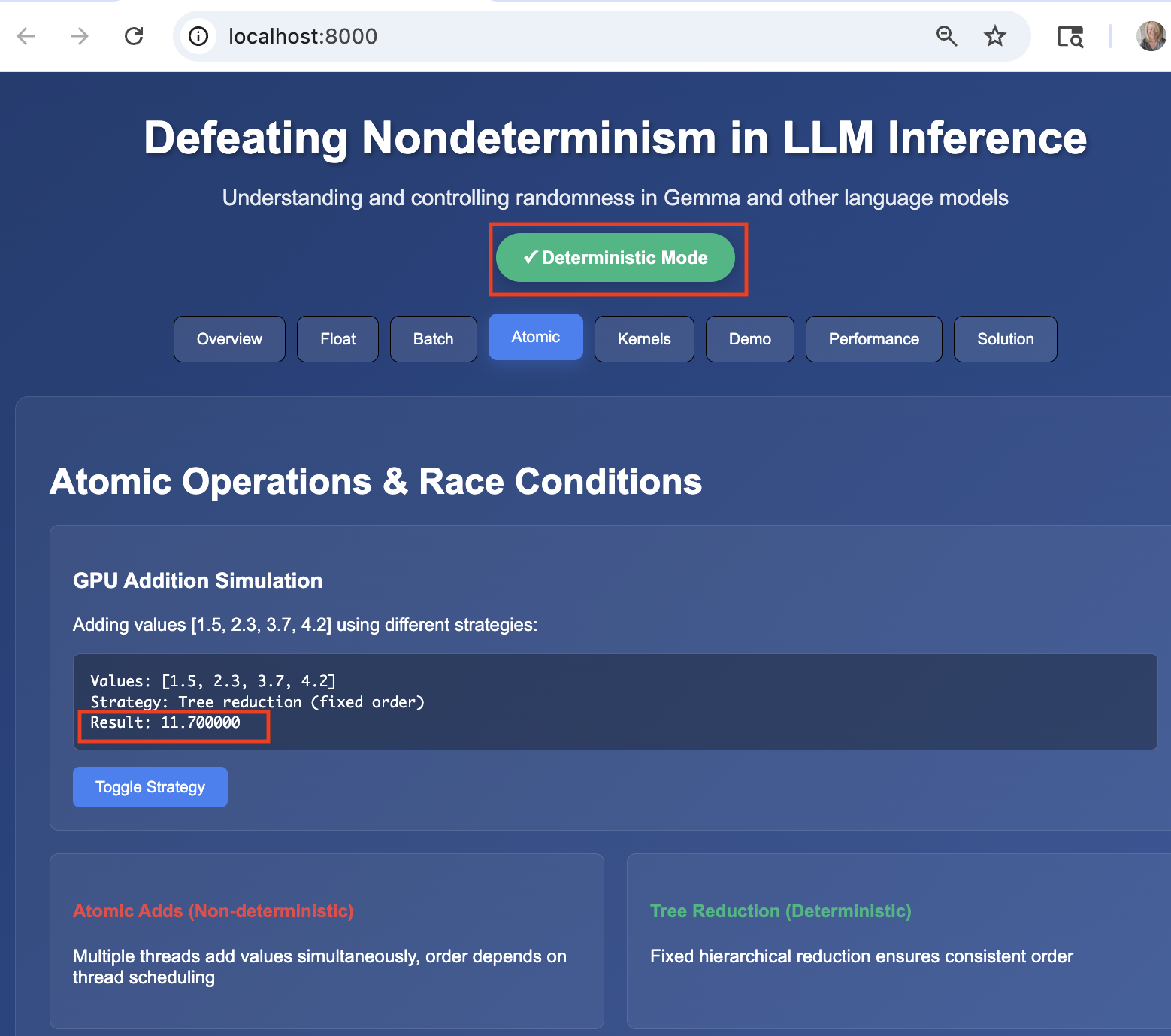
Deterministic Mode |
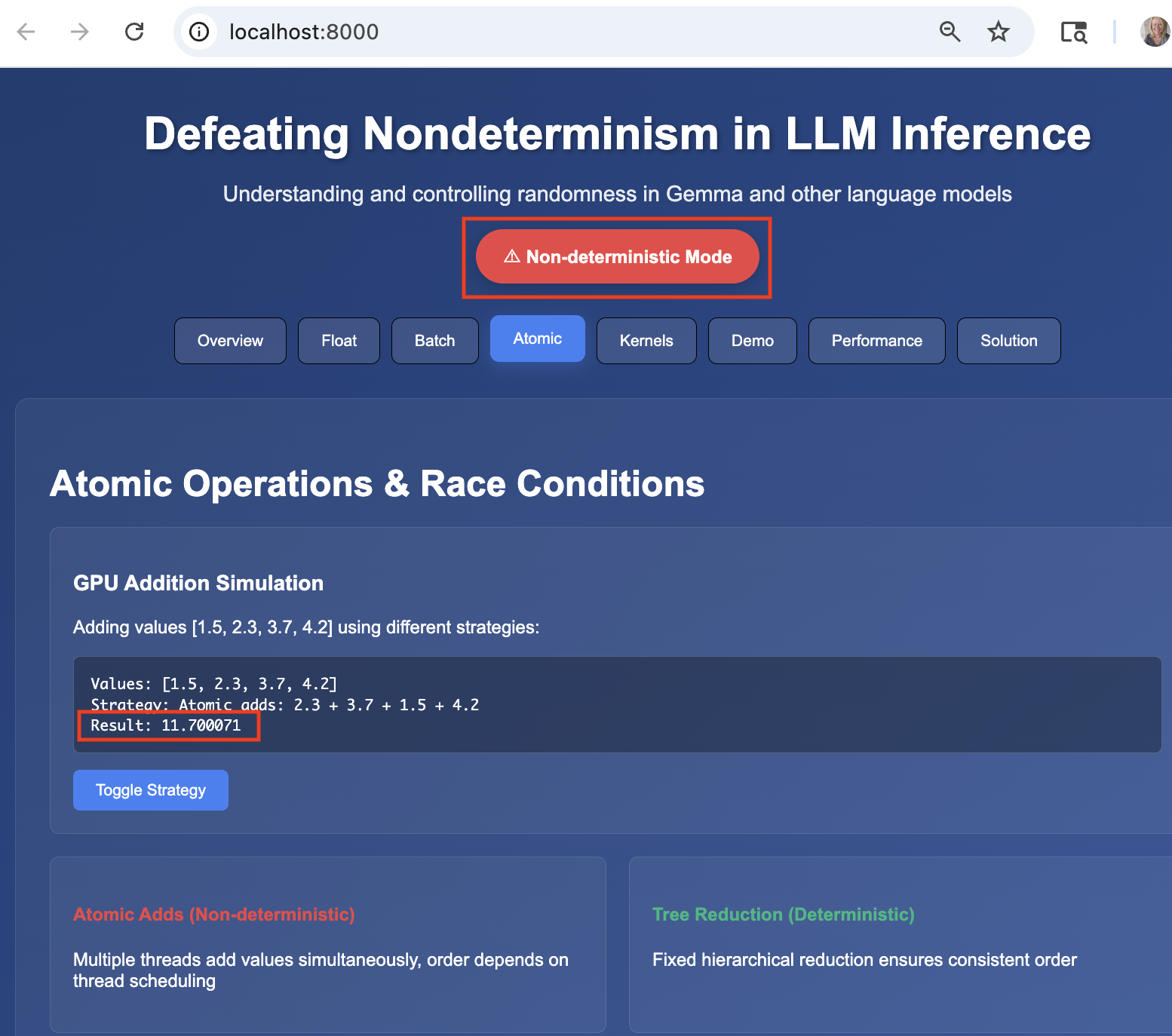
Non-Deterministic Mode |
An interactive React application that demonstrates and explains nondeterminism in Large Language Model (LLM) inference, based on the research "Defeating Nondeterminism in LLM Inference" by Thinking Machines Lab.
Features
This single-page application explores why LLMs such as Google's Gemma produce different outputs even at temperature=0, and provides practical solutions for achieving determinism.
Interactive Demonstrations
- Overview: Qwen-235B experiment results showing 80 unique outputs from 1000 runs
- Float Calculator: Interactive floating-point non-associativity demonstration
- Batch Simulation: How different batch sizes trigger different kernels
- Atomic Operations: Race conditions in GPU parallel operations
- Kernel Solutions: Code examples for deterministic implementations
- Live Demo: Gemma-2B inference simulation with copy-to-clipboard code
- Performance Analysis: Throughput comparisons and trade-offs
- Implementation Guide: Step-by-step setup instructions
Key Features
- Deterministic Mode Toggle: Affects all simulations throughout the app
- Dark Gradient Theme: Professional blue gradient background
- Interactive Elements: Calculators, dropdowns, simulations with realistic delays
- Code Examples: Copy-to-clipboard functionality for implementation
- Responsive Design: Works on desktop and mobile devices
Quick Start
- Clone or download this repository
- Start a local HTTP server in the project directory:
python3 -m http.server 8000 - Open your browser and go to
http://localhost:8000 - Explore the tabs to learn about LLM nondeterminism
Note: A local server is required to avoid CORS issues when loading the JSX component file.
File Structure
LLM-determinism-app/
├── index.html              # Main HTML file with React setup
├── LLMDeterminismApp.jsx   # Complete React application
└── README.md              # This file
Browser Requirements
- Modern browser with ES6+ support
- JavaScript enabled
- Network access for React CDN (or download for offline use)
Usage
Navigation
- Use the tab navigation to explore different aspects of LLM nondeterminism
- Toggle Deterministic Mode to see how it affects all simulations
- Click copy buttons to get implementation code examples
Interactive Elements
- Float Calculator: Adjust values to see floating-point precision issues
- Batch Selector: Change batch sizes to see kernel variations
- Kernel Dropdown: Explore different operation types and solutions
- Demo Runner: Simulate Gemma-2B inference with different configurations
Educational Content
The Problem
- LLMs produce different outputs even at temperature=0
- Research shows 80 unique outputs from 1000 identical runs
- Three root causes: floating-point ops, batch variance, concurrency
The Solutions
- Environment configuration for deterministic algorithms
- Model loading with appropriate data types
- Generation parameters for consistent results
- Performance trade-offs and when to use deterministic mode
Technical Implementation
- Single-file React component with inline styles
- No external CSS dependencies
- Uses React from CDN with Babel for JSX transformation
- Responsive grid layouts
- Color-coded status indicators
- Realistic simulation delays
- Clipboard integration
Performance Notes
The app demonstrates that deterministic mode typically results in:
- 30-40% throughput reduction
- Higher memory usage (float32 vs float16)
- Limited optimization opportunities
Research Reference
Based on "Defeating Nondeterminism in LLM Inference" research demonstrating:
- Qwen-235B nondeterminism at temperature=0
- Token 103 divergence patterns
- Practical solutions for reproducible inference
Development
To modify the application:
- Start the development server:
python3 -m http.server 8000 - Edit
LLMDeterminismApp.jsx(uses React hooks, no ES6 imports) - Refresh your browser at
http://localhost:8000 - Changes will be reflected immediately
The component uses React hooks for state management and includes hover effects, animations, and interactive simulations.
Technical Notes
- The JSX file has been modified to work with Babel standalone in the browser
- React imports have been replaced with global
React.useStatecalls - Component is exported to
window.LLMDeterminismAppfor browser compatibility
License
This educational demonstration is provided as-is for learning purposes.
Contributors

6 commits
Similar repos


Languages
JavaScript
95.8%
HTML
4.2%
Simple React app which illustrates ideas from "Defeating Nondeterminism in LLM Inference" by Thinking Machines
0
stars
6
commits
JavaScript
primary language
Sep 22, 2025
updated
README
LLM Determinism Explorer
|
Deterministic Mode |
Non-Deterministic Mode |
An interactive React application that demonstrates and explains nondeterminism in Large Language Model (LLM) inference, based on the research "Defeating Nondeterminism in LLM Inference" by Thinking Machines Lab.
Features
This single-page application explores why LLMs such as Google's Gemma produce different outputs even at temperature=0, and provides practical solutions for achieving determinism.
Interactive Demonstrations
- Overview: Qwen-235B experiment results showing 80 unique outputs from 1000 runs
- Float Calculator: Interactive floating-point non-associativity demonstration
- Batch Simulation: How different batch sizes trigger different kernels
- Atomic Operations: Race conditions in GPU parallel operations
- Kernel Solutions: Code examples for deterministic implementations
- Live Demo: Gemma-2B inference simulation with copy-to-clipboard code
- Performance Analysis: Throughput comparisons and trade-offs
- Implementation Guide: Step-by-step setup instructions
Key Features
- Deterministic Mode Toggle: Affects all simulations throughout the app
- Dark Gradient Theme: Professional blue gradient background
- Interactive Elements: Calculators, dropdowns, simulations with realistic delays
- Code Examples: Copy-to-clipboard functionality for implementation
- Responsive Design: Works on desktop and mobile devices
Quick Start
- Clone or download this repository
- Start a local HTTP server in the project directory:
python3 -m http.server 8000 - Open your browser and go to
http://localhost:8000 - Explore the tabs to learn about LLM nondeterminism
Note: A local server is required to avoid CORS issues when loading the JSX component file.
File Structure
LLM-determinism-app/
├── index.html              # Main HTML file with React setup
├── LLMDeterminismApp.jsx   # Complete React application
└── README.md              # This file
Browser Requirements
- Modern browser with ES6+ support
- JavaScript enabled
- Network access for React CDN (or download for offline use)
Usage
Navigation
- Use the tab navigation to explore different aspects of LLM nondeterminism
- Toggle Deterministic Mode to see how it affects all simulations
- Click copy buttons to get implementation code examples
Interactive Elements
- Float Calculator: Adjust values to see floating-point precision issues
- Batch Selector: Change batch sizes to see kernel variations
- Kernel Dropdown: Explore different operation types and solutions
- Demo Runner: Simulate Gemma-2B inference with different configurations
Educational Content
The Problem
- LLMs produce different outputs even at temperature=0
- Research shows 80 unique outputs from 1000 identical runs
- Three root causes: floating-point ops, batch variance, concurrency
The Solutions
- Environment configuration for deterministic algorithms
- Model loading with appropriate data types
- Generation parameters for consistent results
- Performance trade-offs and when to use deterministic mode
Technical Implementation
- Single-file React component with inline styles
- No external CSS dependencies
- Uses React from CDN with Babel for JSX transformation
- Responsive grid layouts
- Color-coded status indicators
- Realistic simulation delays
- Clipboard integration
Performance Notes
The app demonstrates that deterministic mode typically results in:
- 30-40% throughput reduction
- Higher memory usage (float32 vs float16)
- Limited optimization opportunities
Research Reference
Based on "Defeating Nondeterminism in LLM Inference" research demonstrating:
- Qwen-235B nondeterminism at temperature=0
- Token 103 divergence patterns
- Practical solutions for reproducible inference
Development
To modify the application:
- Start the development server:
python3 -m http.server 8000 - Edit
LLMDeterminismApp.jsx(uses React hooks, no ES6 imports) - Refresh your browser at
http://localhost:8000 - Changes will be reflected immediately
The component uses React hooks for state management and includes hover effects, animations, and interactive simulations.
Technical Notes
- The JSX file has been modified to work with Babel standalone in the browser
- React imports have been replaced with global
React.useStatecalls - Component is exported to
window.LLMDeterminismAppfor browser compatibility
License
This educational demonstration is provided as-is for learning purposes.
Similar repos
Contributors
6 commits
Languages
JavaScript
95.8%
HTML
4.2%