AgentFlow: In-the-Flow Agentic System Optimization
See the code










AgentFlow is a trainable, tool-integrated agentic framework designed to overcome the scalability and generalization limits of today’s tool-augmented reasoning approaches.
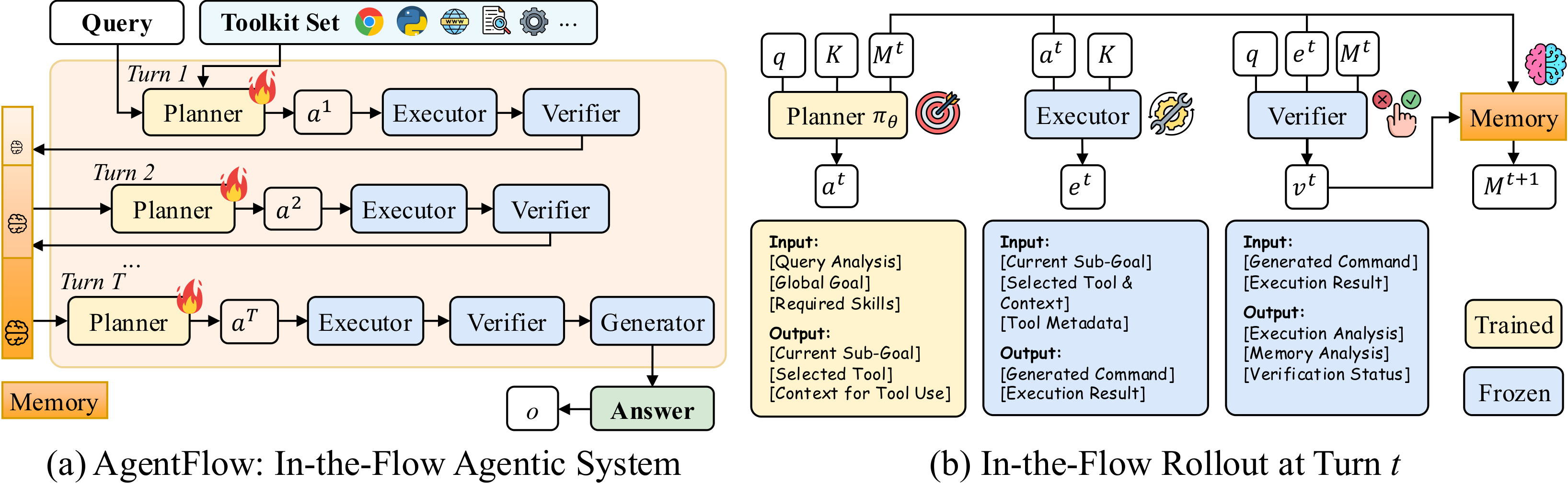
Unlike prevailing approaches such as Search-R1 which train a single LLM to interleave reasoning steps with tool calls, AgentFlow introduces a modular agentic system with four specialized modules: 🧭 Planner, 🛠 Executor, ✅ Verifier, and ✍️ Generator.
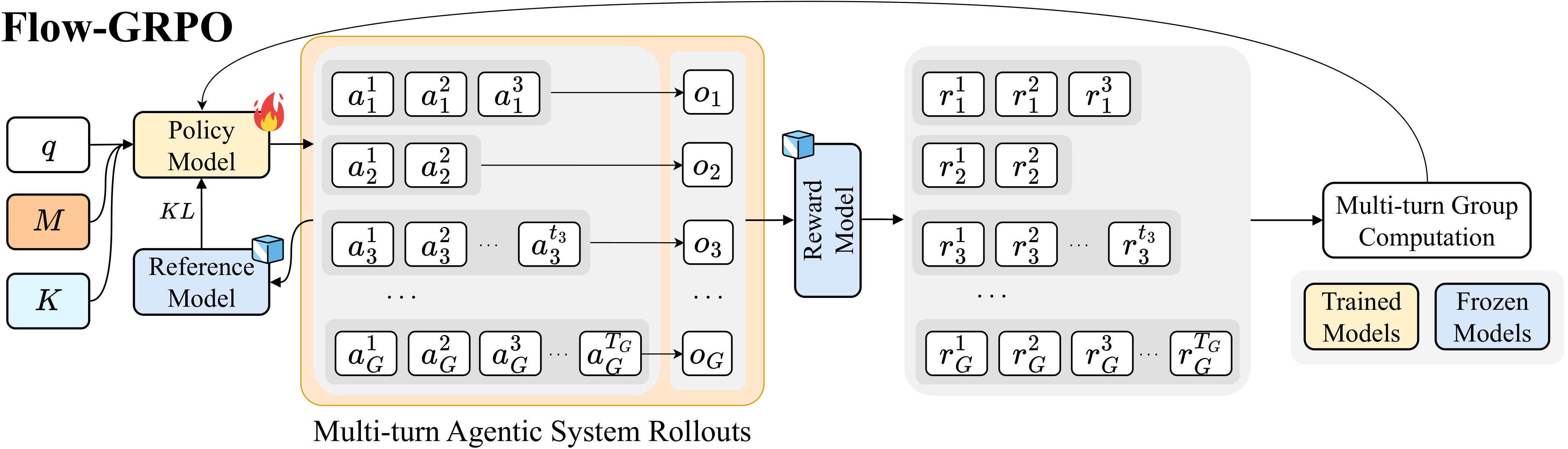
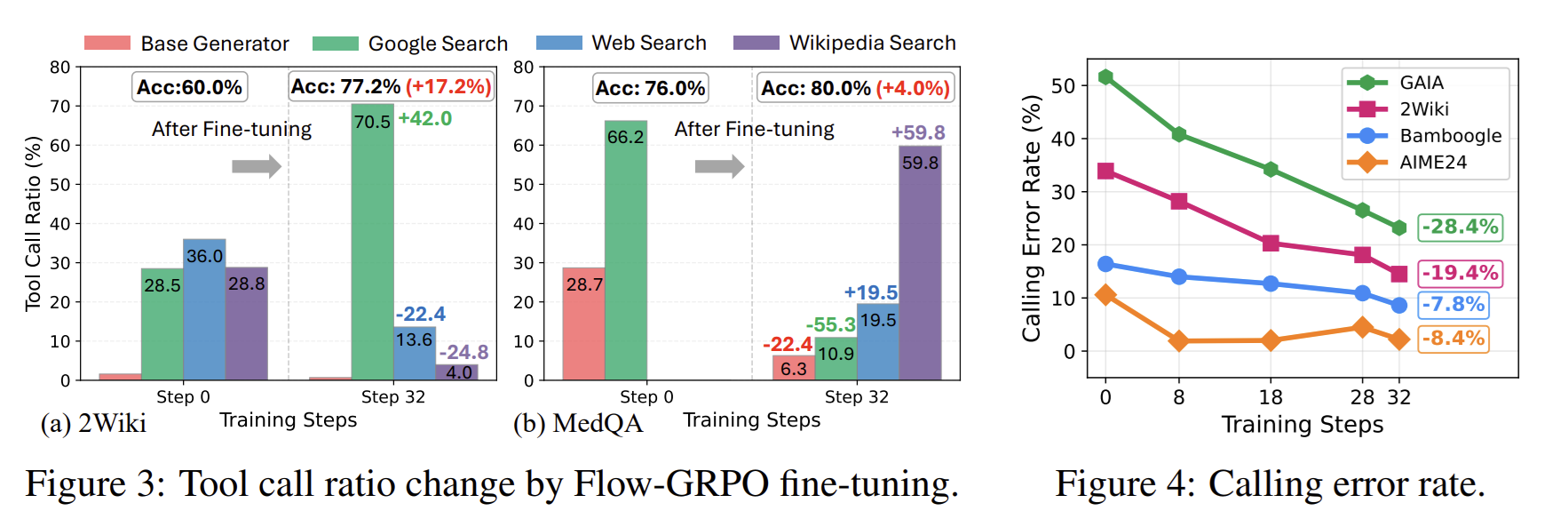
For effective planning and tool use, the framework directly optimizes planner agent within the system in an online fashion using Flow-based Group Refined Policy Optimization (Flow-GRPO), achieving superior performance across diverse domains with improved tool-calling reliability and long-horizon reasoning capabilities.
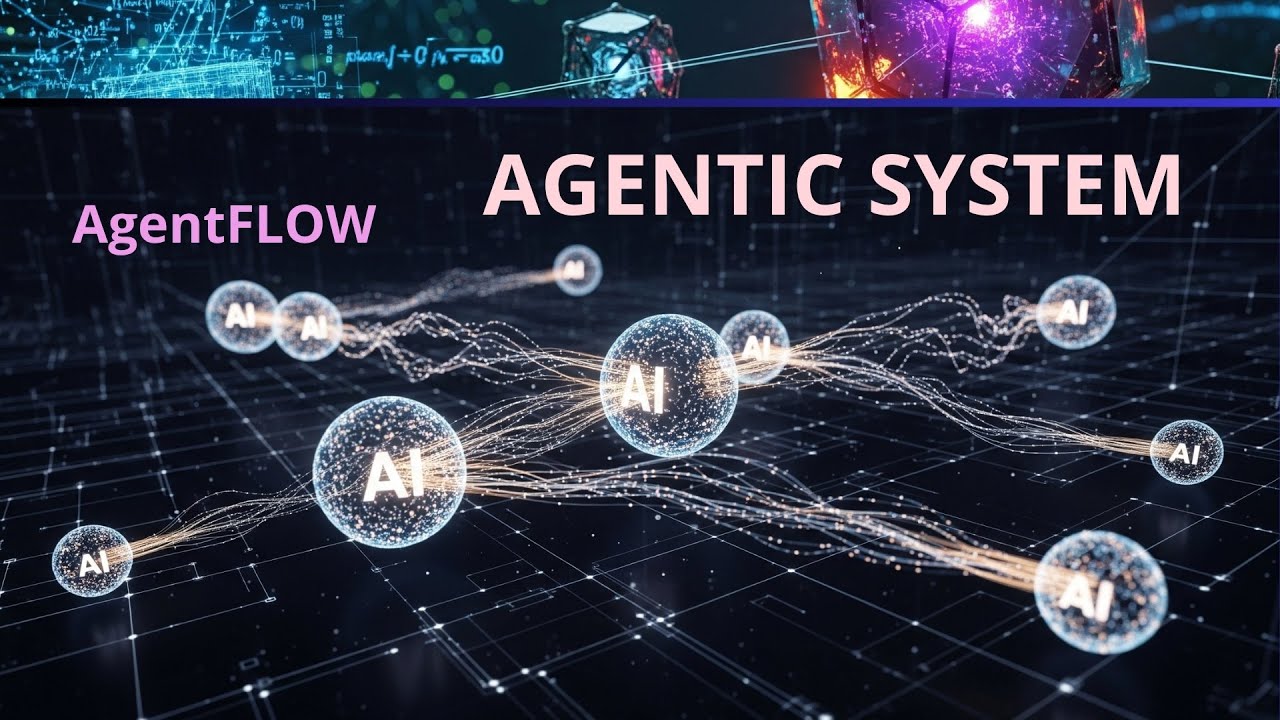
Excited to have a tutorial video for AgentFlow covered by Discover AI on YouTube!
base_generator, python_coder, google_search, wikipedia_search, web_search, and more.bash setup.sh
source .venv/bin/activate
# (Optional) Install `parallel` for running benchmark experiments in parallel:
sudo apt-get update
sudo apt-get install parallel
Copy the .env.template file from agentflow/.env.template and rename it to .env, then place it in the agentflow/ folder. Update the following variables with your own API keys:
OPENAI_API_KEY (for judging reasponse)GOOGLE_API_KEY (for Google Search tool)DASHSCOPE_API_KEY ([optional] for calling Qwen-2.5-7B-Instruct as engine for agents and tools)TOGETHER_API_KEY ([optional] alternative for calling Qwen-2.5-7B-Instruct as engine for agents and tools - recommended for international users)serve_vllm_local.md).Please check API Key Setup Guide for detailed instructions on how to obtain these keys.
cp agentflow/.env.template agentflow/.env
# Then edit agentflow/.env with your API keys
Before running inference or training, we recommend verifying that your API keys and environment are properly configured.
Run the following command to test all integrated tools:
cd agentflow/agentflow
bash ./tools/test_all_tools.sh
Example output:
Testing all tools...
✅ base_generator passed
✅ google_search passed
✅ python_coder passed
✅ wikipedia_search passed
...
✅ All tests passed
Verify that your LLM engines (OpenAI, DashScope, Gemini, etc.) are correctly initialized and responding:
python agentflow/scripts/test_llm_engine.py
Example output:
🚀 Starting fault-tolerant test for 11 engines...
✅ Passed: 4
   • gpt-4o → ChatOpenAI
   • dashscope-qwen2.5-3b-instruct → ChatDashScope
   • gemini-1.5-flash → ChatGemini
   • deepseek-chat → ChatDeepseek
...
🎉 All engines initialized successfully!
AgentFlow provides a modular agentic system with four specialized modules (planner, executor, verifier, generator) that coordinate through evolving memory and a toolkit over multiple turns to solve complex reasoning tasks.
To quickly experience the system in action, run the command below (don’t forget to set up your API key):
python quick_start.py
Example output of python quick_start.py:
==> Initializing agentflow...
==> Setting up tools...
==> 🎯 Reasoning Steps from AgentFlow (Deep Thinking...)
==> 🔍 Step 0: Query Analysis
==> 🎯 Step 1: Action Prediction (Google_Search_Tool)
==> 🛠️ Step 1: Command Execution (Google_Search_Tool)
...
**Answer:** The capital of France is Paris.
==> ✅ Query Solved!

**Process Summary:**
1. **Query Analysis:** Identified as a factual question about the capital of France.
2. **Tool Selection:** Used Google Search for accurate information.
3. **Execution:** Confirmed Paris as the capital.
4. **Verification:** Cross-referenced sources for reliability.

**Answer:** The capital of France is Paris.
For effective planning and tool use, the framework directly optimizes the planner agent within the system in an online fashion using Flow-GRPO. Below is a quick start for training.
Before diving in, we recommend verifying that AgentFlow's tools, LLM engines, and network configuration are properly set up. See test_env.md for detailed testing instructions.
We mix two datasets for training: NQ (Natural Questions) for agentic search and DeepMath-103K for mathematical reasoning.
# train data
python data/get_train_data.py
# validation data
python data/aime24_data.py
After that, data dir should be:
data/
├── train/
│   └── combined_train.parquet (182,190 samples)
├── val/
│   └── aime24.parquet (30 samples)
├── aime24_data.py
└── get_train_data.py
Start agentflow training using Flow-GRPO with tmux:
# Create tmux session and start agentflow service (Window 0)
tmux new-session -s agentflow
bash train/serve_with_logs.sh

# Create new window (Ctrl+B then C) and start training (Window 1)
bash train/train_with_logs.sh
Configuration:
All training hyperparameters are in train/config.yaml (model settings, tools, RL parameters, resources, etc.)
Logging: We provide a comprehensive logging to monitor training. See logs.md for more details.
Serve the trained planner model with VLLM (here we deploy our 7B Flow-GRPO planner model):
bash scripts/serve_vllm.sh
Run inference on specific benchmark tasks:
cd test
# Run Bamboogle benchmark
bash bamboogle/run.sh
After running, each task folder (e.g., test/bamboogle/) will contain:
data/: Contains the evaluation dataset (e.g., data.json).logs/: Contains detailed execution logs for each problem index (organized by model label).results/: Contains the model's generated answers (output_i.json) and final evaluation scores (finalscore_*.log).You can find more benchmarking details in benchmark.md.
AgentFlow supports different LLM engines for each agent module. See llm_engine.md for supported models and factory.py for the corresponding model_string configuration:
Planner Agent:
llm_engine_name parameter in the corresponding run.sh script (e.g., test/bamboogle/run.sh)Other Agents (Executor, Verifier, Generator):
self.llm_engine_fixed in agentflow/agentflow/models/planner.py:19:self.llm_engine_fixed = create_llm_engine(model_string="your-engine", is_multimodal=False, temperature=temperature)
and
llm_engine_name parameter in the Executor instantiation from agentflow/agentflow/solver.py:232:# Instantiate Executor
executor = Executor(
# llm_engine_name=llm_engine_name,
llm_engine_name="dashscope",
root_cache_dir=root_cache_dir,
verbose=verbose,
# base_url=base_url,
temperature=temperature
)
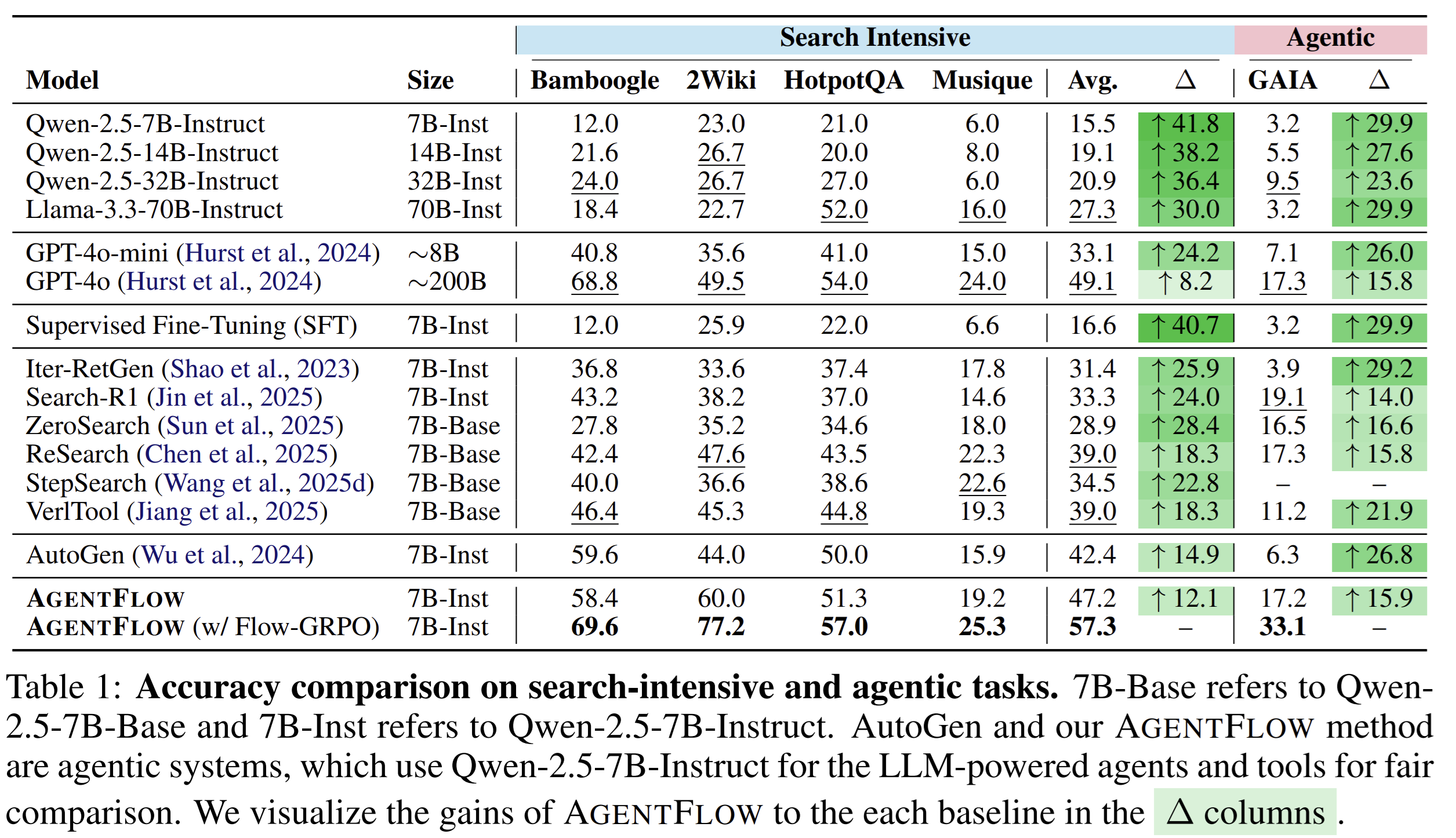
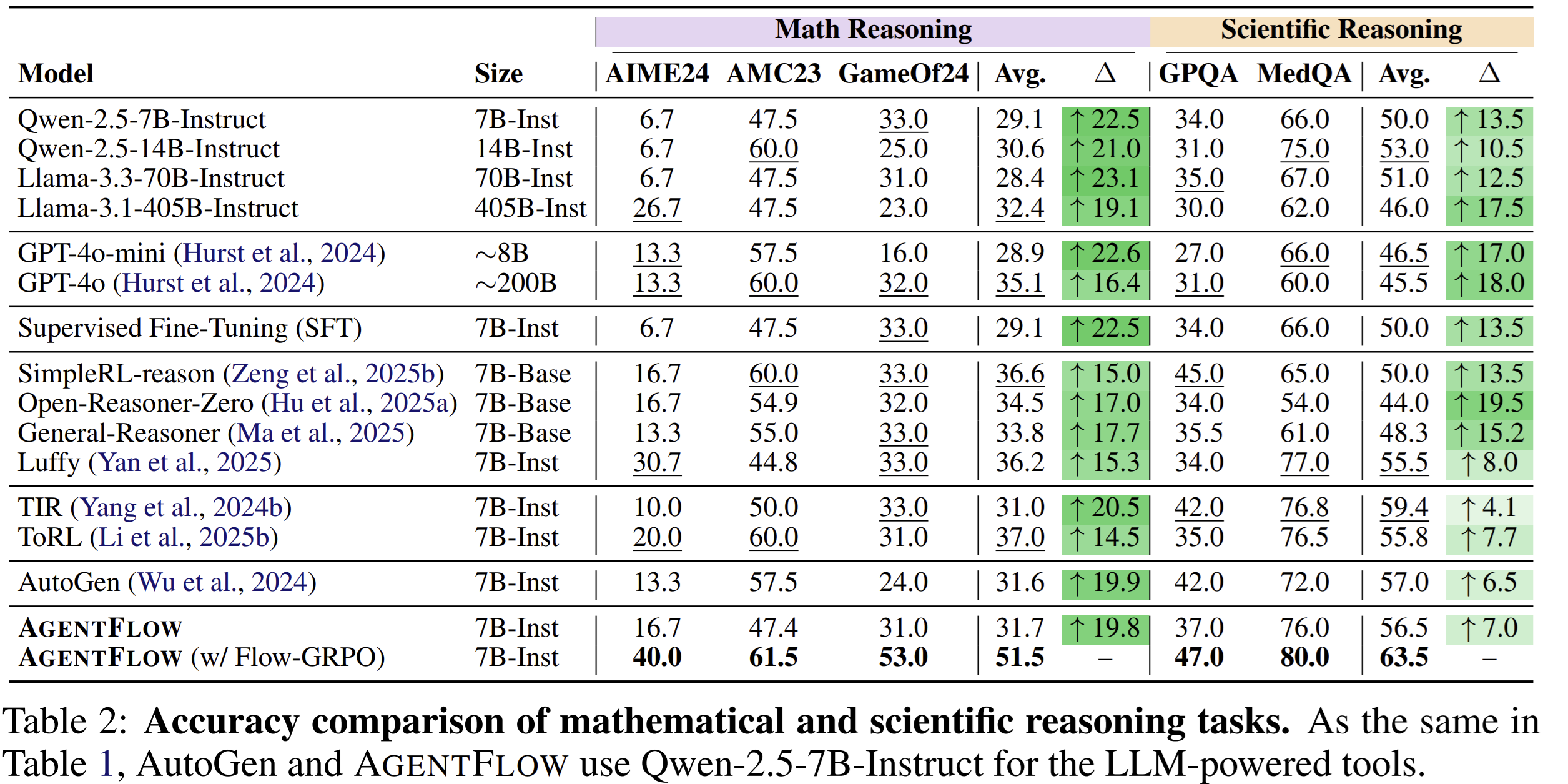
model_string formats, see llm_engine.mdAgentFlow (Qwen-2.5-7B-Instruct Backbone) outperforms top baselines on 10 benchmarks:
💡 Even surpasses larger proprietary models like GPT-4o (~200B).
Explore more in our paper or project page.
We thank the following open-source projects:
We thank Lambda for GPU support!
We are truly looking forward to open-source contributions to AgentFlow! If you’re interested in contributing, collaborating, or reporting issues, please feel free to open an issue or submit a pull request (PR). You can also reach us at [email protected], [email protected], [email protected] or join our Slack community: AgentFlow.
We are also looking forward to your feedback and suggestions!
@inproceedings{li2026flow,
    title = {In-the-Flow Agentic System Optimization for Effective Planning and Tool Use},
    author = {Li, Zhuofeng and Zhang, Haoxiang and Han, Seungju and Liu, Sheng and Xie, Jianwen and Zhang, Yu and Choi, Yejin and Zou, James and Lu, Pan},
    booktitle = {International Conference on Learning Representations (ICLR)},
    year = {2026}
}
167 followers · starred Mar 2026
3,001 followers · starred Feb 2026
1,974 followers · starred Oct 2025
595 followers · starred Oct 2025
AgentFlow: In-the-Flow Agentic System Optimization
See the code
AgentFlow is a trainable, tool-integrated agentic framework designed to overcome the scalability and generalization limits of today’s tool-augmented reasoning approaches.
Unlike prevailing approaches such as Search-R1 which train a single LLM to interleave reasoning steps with tool calls, AgentFlow introduces a modular agentic system with four specialized modules: 🧭 Planner, 🛠 Executor, ✅ Verifier, and ✍️ Generator.
For effective planning and tool use, the framework directly optimizes planner agent within the system in an online fashion using Flow-based Group Refined Policy Optimization (Flow-GRPO), achieving superior performance across diverse domains with improved tool-calling reliability and long-horizon reasoning capabilities.
Excited to have a tutorial video for AgentFlow covered by Discover AI on YouTube!
base_generator, python_coder, google_search, wikipedia_search, web_search, and more.bash setup.sh
source .venv/bin/activate
# (Optional) Install `parallel` for running benchmark experiments in parallel:
sudo apt-get update
sudo apt-get install parallel
Copy the .env.template file from agentflow/.env.template and rename it to .env, then place it in the agentflow/ folder. Update the following variables with your own API keys:
OPENAI_API_KEY (for judging reasponse)GOOGLE_API_KEY (for Google Search tool)DASHSCOPE_API_KEY ([optional] for calling Qwen-2.5-7B-Instruct as engine for agents and tools)TOGETHER_API_KEY ([optional] alternative for calling Qwen-2.5-7B-Instruct as engine for agents and tools - recommended for international users)serve_vllm_local.md).Please check API Key Setup Guide for detailed instructions on how to obtain these keys.
cp agentflow/.env.template agentflow/.env
# Then edit agentflow/.env with your API keys
Before running inference or training, we recommend verifying that your API keys and environment are properly configured.
Run the following command to test all integrated tools:
cd agentflow/agentflow
bash ./tools/test_all_tools.sh
Example output:
Testing all tools...
✅ base_generator passed
✅ google_search passed
✅ python_coder passed
✅ wikipedia_search passed
...
✅ All tests passed
Verify that your LLM engines (OpenAI, DashScope, Gemini, etc.) are correctly initialized and responding:
python agentflow/scripts/test_llm_engine.py
Example output:
🚀 Starting fault-tolerant test for 11 engines...
✅ Passed: 4
   • gpt-4o → ChatOpenAI
   • dashscope-qwen2.5-3b-instruct → ChatDashScope
   • gemini-1.5-flash → ChatGemini
   • deepseek-chat → ChatDeepseek
...
🎉 All engines initialized successfully!
AgentFlow provides a modular agentic system with four specialized modules (planner, executor, verifier, generator) that coordinate through evolving memory and a toolkit over multiple turns to solve complex reasoning tasks.
To quickly experience the system in action, run the command below (don’t forget to set up your API key):
python quick_start.py
Example output of python quick_start.py:
==> Initializing agentflow...
==> Setting up tools...
==> 🎯 Reasoning Steps from AgentFlow (Deep Thinking...)
==> 🔍 Step 0: Query Analysis
==> 🎯 Step 1: Action Prediction (Google_Search_Tool)
==> 🛠️ Step 1: Command Execution (Google_Search_Tool)
...
**Answer:** The capital of France is Paris.
==> ✅ Query Solved!

**Process Summary:**
1. **Query Analysis:** Identified as a factual question about the capital of France.
2. **Tool Selection:** Used Google Search for accurate information.
3. **Execution:** Confirmed Paris as the capital.
4. **Verification:** Cross-referenced sources for reliability.

**Answer:** The capital of France is Paris.
For effective planning and tool use, the framework directly optimizes the planner agent within the system in an online fashion using Flow-GRPO. Below is a quick start for training.
Before diving in, we recommend verifying that AgentFlow's tools, LLM engines, and network configuration are properly set up. See test_env.md for detailed testing instructions.
We mix two datasets for training: NQ (Natural Questions) for agentic search and DeepMath-103K for mathematical reasoning.
# train data
python data/get_train_data.py
# validation data
python data/aime24_data.py
After that, data dir should be:
data/
├── train/
│   └── combined_train.parquet (182,190 samples)
├── val/
│   └── aime24.parquet (30 samples)
├── aime24_data.py
└── get_train_data.py
Start agentflow training using Flow-GRPO with tmux:
# Create tmux session and start agentflow service (Window 0)
tmux new-session -s agentflow
bash train/serve_with_logs.sh

# Create new window (Ctrl+B then C) and start training (Window 1)
bash train/train_with_logs.sh
Configuration:
All training hyperparameters are in train/config.yaml (model settings, tools, RL parameters, resources, etc.)
Logging: We provide a comprehensive logging to monitor training. See logs.md for more details.
Serve the trained planner model with VLLM (here we deploy our 7B Flow-GRPO planner model):
bash scripts/serve_vllm.sh
Run inference on specific benchmark tasks:
cd test
# Run Bamboogle benchmark
bash bamboogle/run.sh
After running, each task folder (e.g., test/bamboogle/) will contain:
data/: Contains the evaluation dataset (e.g., data.json).logs/: Contains detailed execution logs for each problem index (organized by model label).results/: Contains the model's generated answers (output_i.json) and final evaluation scores (finalscore_*.log).You can find more benchmarking details in benchmark.md.
AgentFlow supports different LLM engines for each agent module. See llm_engine.md for supported models and factory.py for the corresponding model_string configuration:
Planner Agent:
llm_engine_name parameter in the corresponding run.sh script (e.g., test/bamboogle/run.sh)Other Agents (Executor, Verifier, Generator):
self.llm_engine_fixed in agentflow/agentflow/models/planner.py:19:self.llm_engine_fixed = create_llm_engine(model_string="your-engine", is_multimodal=False, temperature=temperature)
and
llm_engine_name parameter in the Executor instantiation from agentflow/agentflow/solver.py:232:# Instantiate Executor
executor = Executor(
# llm_engine_name=llm_engine_name,
llm_engine_name="dashscope",
root_cache_dir=root_cache_dir,
verbose=verbose,
# base_url=base_url,
temperature=temperature
)
model_string formats, see llm_engine.mdAgentFlow (Qwen-2.5-7B-Instruct Backbone) outperforms top baselines on 10 benchmarks:
💡 Even surpasses larger proprietary models like GPT-4o (~200B).
Explore more in our paper or project page.
We thank the following open-source projects:
We thank Lambda for GPU support!
We are truly looking forward to open-source contributions to AgentFlow! If you’re interested in contributing, collaborating, or reporting issues, please feel free to open an issue or submit a pull request (PR). You can also reach us at [email protected], [email protected], [email protected] or join our Slack community: AgentFlow.
We are also looking forward to your feedback and suggestions!
@inproceedings{li2026flow,
    title = {In-the-Flow Agentic System Optimization for Effective Planning and Tool Use},
    author = {Li, Zhuofeng and Zhang, Haoxiang and Han, Seungju and Liu, Sheng and Xie, Jianwen and Zhang, Yu and Choi, Yejin and Zou, James and Lu, Pan},
    booktitle = {International Conference on Learning Representations (ICLR)},
    year = {2026}
}
167 followers · starred Mar 2026
3,001 followers · starred Feb 2026
1,974 followers · starred Oct 2025
595 followers · starred Oct 2025