
See what people are saying
README
tmux-companion









One binary behind your whole tmux config. It draws the status bar, runs the pickers behind your keybindings, and builds your project sessions, out of a daemon that is already warm.
https://asciinema.org/a/1266213
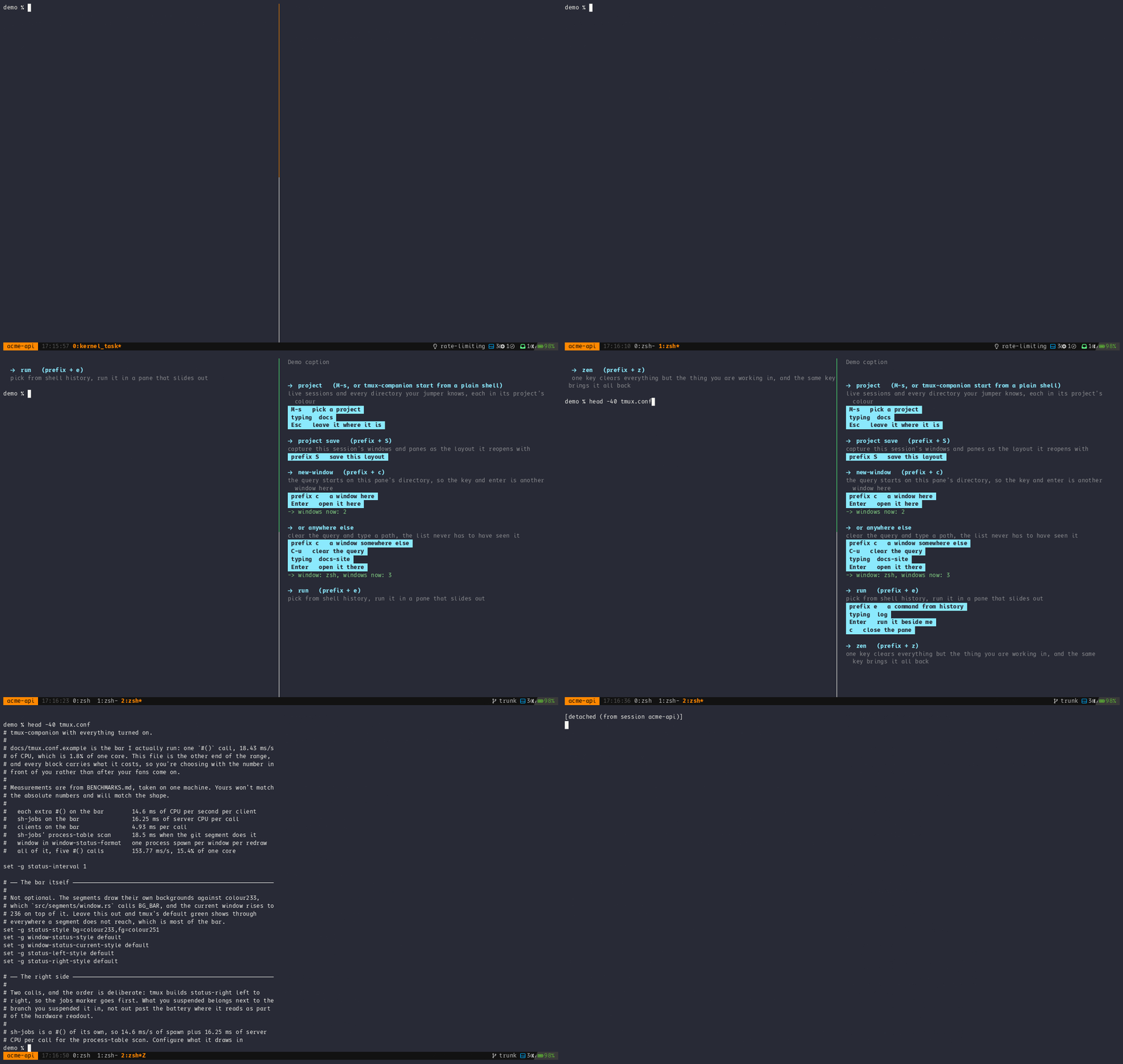
Twenty four seconds of it: the project picker, a window opened somewhere else, a command pulled out of shell history, and zen. The chords are in the right hand column and every one of them was really pressed, so those are the real popups. The full recording behind that link runs four minutes and covers the rest, and it is worth watching there rather than here because you can pause it and it has a marker on every chapter.
Try it first
docker run --rm -it lonkarorg/tmux-companion:playground
tmux, the binary, five fake projects and a guided tour through the bindings, in a container that goes away when you leave it. Nothing is mounted from your machine. docs/how-to/playground.md.
What it costs
Measured from inside tmux on one machine, against the zsh this replaced, with the method beside the numbers in BENCHMARKS.md.
| the bar | 29.71 ms/s, 3.0% of a core |
| the zsh bar it replaced | 344.01 ms/s, 34.4% of a core |
| a picker, keypress to first row | 86 ms, and the zsh took 82 |
| a picker, CPU per press | 33.3 ms, against 66.7 for the zsh |
| the whole right side, computed | 1.43 ms |
| one fork and exec, as tmux runs it | 13.07 ms |
The picker rows are the honest part. Opening one is not faster: what a person
waits through is display-popup at 21 ms, a process starting and a terminal
painting, and none of that got cheaper. What halved is what it costs to do.
Why
My tmux config shelled out for everything. The bar spawned five processes a
second. Every binding that needed to think ran a zsh script that started a
shell, read some config, called fzf, and exited. I'd built it that way over
years, a script at a time, and never added it up.
So there's one process now. It holds its caches, answers over a unix socket, and everything my tmux used to shell out for talks to it instead.
I wrote a post about it too: ten years of tmux.
What you get
status-right | git, bandwidth and battery in one call |
keys | fuzzy search every binding, press enter to run it |
cheatsheet | the bindings you wrote, four boxes, most-used first |
project | one session per project, sessions and your directory jumper in one list |
project save | capture this session's panes as the layout it reopens with |
run | pick from shell history, run it in a pane that slides out |
open | open the URL or file:line:col under your cursor |
theme pick | your themes with a swatch each, applied on the spot; theme init writes six to start |
shell-init | the prompt marks tmux's next-prompt has waited for since 3.3 |
sh-jobs | what's suspended under this pane, with your icons |
doctor | everything a bug report needs, in one screen |
Background tasks, all of them off till you turn them on: fetching your repositories so ahead and behind mean something, sourcing tmux's config when it changes, naming windows after what's running in them, and saying when a long command finished somewhere you weren't looking.
Every flag: docs/reference/cli.md.
Install
curl -fsSL https://raw.githubusercontent.com/lonkar-org/tmux-companion/main/scripts/install.sh | bash
tmux-companion doctor
That downloads the binary for your machine, checks it against the checksums the release published, and puts it on PATH. Nothing to compile. Read the script first if you'd rather not pipe it, which is a fair thing to want.
With tpm:
set -g @plugin 'lonkar-org/tmux-companion'
It binds no keys and sets no options. Or clone it and run
cargo build --release yourself.
On a Mac or a Linux with Homebrew:
brew tap lonkar-org/tap
brew trust lonkar-org/tap
brew install tmux-companion
Homebrew 7 won't load a formula from a tap you haven't trusted, hence the middle
line. That path brings the manual with it, so man tmux-companion works
straight after.
All four paths, with the flags and how to remove it again, are in docs/how-to/install.md.
Then the way in, from a shell that is not in tmux yet:
tmux-companion start
That opens the project picker, live sessions first and then every directory
your jumper knows, and attaches to what you choose. tmux on its own leaves you in
a session called 0 with one bare shell, which is the thing this replaces.
start --last goes back to whatever you were in without asking, and
start ~/src/thing skips the picker.
The jumper is zoxide by default and is not a requirement: [project] dirs_source also takes z, cdr, ghq or none, dirs_command takes
anything else that prints paths, and with nothing installed at all you get live
sessions and whatever you type. docs/reference/configuration.md
has the table.
One line in tmux.conf gets you the bar:
set -g status-right "#(tmux-companion status-right --branch-max-len 40 #{pane_current_path})"
The annotated version, with the reasoning for every line and what each feature costs, is docs/tmux.conf.full.example. The smaller one I actually run is docs/tmux.conf.example.
Configuration
There's no config file till you write one, and the defaults are what the binary did before the file existed.
tmux-companion config dump > ~/.config/tmux-companion/config.toml
tmux-companion config check
If your bar's a row of boxes you don't have a Nerd Font, and this is the line:
[glyphs]
preset = "ascii"
Every setting with its default is in docs/config.example.toml, and the reasoning is in docs/reference/configuration.md.
What it doesn't do
- macOS and Linux. Not Windows, and not planned: the whole thing is a unix
socket and a
SIGWINCH. - The pickers need tmux 3.2 for
display-popup -E. The bar is happy on 3.0. - It won't restore your sessions on its own. It saves them on a timer, and restoring stays on a key you press, cause an automatic restore would resurrect a stale layout over a session you'd already started working in.
- It's not a theme pack.
theme initwrites six colours and the two files that apply them,theme gen --shadesgrows that to 151, every colour in tmux's cube whose text clears WCAG AAA, with the contrast computed against your terminal.--shades a4,a5anda6are shorter lists if 151 is more than you want to scroll, down to the original eighteen. After that the palette is yours; it doesn't compete with catppuccin or rose-pine.
Documentation
| docs/reference/cli.md | every subcommand and flag |
| docs/reference/configuration.md | the config file, and what it changes |
| docs/config.example.toml | every setting with its default |
| docs/tmux.conf.example | the bar I actually run |
| docs/tmux.conf.full.example | every feature on, with what each costs |
| docs/how-to/playground.md | a container to try it in, and the tour inside it |
| docs/how-to/install.md | the three ways in, and how to remove it |
| docs/how-to/themes.md | where themes live, what one is, and the contrast they clear |
| docs/reference/requirements.md | tmux, fonts, platforms, Rust |
| DESIGN.md | how the daemon and the protocol work |
| BENCHMARKS.md | what it costs, and how that was measured |
| CONTRIBUTING.md | build, test, lint, and what a patch needs |
| CHANGELOG.md | what changed |
Building
Rust 1.85 or newer, which is the first release with edition 2024. No system libraries.
cargo build --release      # target/release/tmux-companion, about 4 MB
cargo test                 # 639 unit, 22 integration, 5 end-to-end against a real tmux

# on a machine somebody is using, keep off every core
nice -n 15 cargo build --release -j 4
Releases carry four binaries: macOS on Apple silicon and Intel, Linux on ARM and on Intel or AMD. The Linux pair link statically against musl, so one binary runs on any distribution.
Patches welcome, including the ones that tell me I got something wrong. CONTRIBUTING.md has the three commands CI runs.
MIT.
Contributors

109 commits
Similar repos


Languages
Rust
86.2%
Shell
9.0%
Python
3.6%
See what people are saying
README
tmux-companion
One binary behind your whole tmux config. It draws the status bar, runs the pickers behind your keybindings, and builds your project sessions, out of a daemon that is already warm.
https://asciinema.org/a/1266213
Twenty four seconds of it: the project picker, a window opened somewhere else, a command pulled out of shell history, and zen. The chords are in the right hand column and every one of them was really pressed, so those are the real popups. The full recording behind that link runs four minutes and covers the rest, and it is worth watching there rather than here because you can pause it and it has a marker on every chapter.
Try it first
docker run --rm -it lonkarorg/tmux-companion:playground
tmux, the binary, five fake projects and a guided tour through the bindings, in a container that goes away when you leave it. Nothing is mounted from your machine. docs/how-to/playground.md.
What it costs
Measured from inside tmux on one machine, against the zsh this replaced, with the method beside the numbers in BENCHMARKS.md.
| the bar | 29.71 ms/s, 3.0% of a core |
| the zsh bar it replaced | 344.01 ms/s, 34.4% of a core |
| a picker, keypress to first row | 86 ms, and the zsh took 82 |
| a picker, CPU per press | 33.3 ms, against 66.7 for the zsh |
| the whole right side, computed | 1.43 ms |
| one fork and exec, as tmux runs it | 13.07 ms |
The picker rows are the honest part. Opening one is not faster: what a person
waits through is display-popup at 21 ms, a process starting and a terminal
painting, and none of that got cheaper. What halved is what it costs to do.
Why
My tmux config shelled out for everything. The bar spawned five processes a
second. Every binding that needed to think ran a zsh script that started a
shell, read some config, called fzf, and exited. I'd built it that way over
years, a script at a time, and never added it up.
So there's one process now. It holds its caches, answers over a unix socket, and everything my tmux used to shell out for talks to it instead.
I wrote a post about it too: ten years of tmux.
What you get
status-right | git, bandwidth and battery in one call |
keys | fuzzy search every binding, press enter to run it |
cheatsheet | the bindings you wrote, four boxes, most-used first |
project | one session per project, sessions and your directory jumper in one list |
project save | capture this session's panes as the layout it reopens with |
run | pick from shell history, run it in a pane that slides out |
open | open the URL or file:line:col under your cursor |
theme pick | your themes with a swatch each, applied on the spot; theme init writes six to start |
shell-init | the prompt marks tmux's next-prompt has waited for since 3.3 |
sh-jobs | what's suspended under this pane, with your icons |
doctor | everything a bug report needs, in one screen |
Background tasks, all of them off till you turn them on: fetching your repositories so ahead and behind mean something, sourcing tmux's config when it changes, naming windows after what's running in them, and saying when a long command finished somewhere you weren't looking.
Every flag: docs/reference/cli.md.
Install
curl -fsSL https://raw.githubusercontent.com/lonkar-org/tmux-companion/main/scripts/install.sh | bash
tmux-companion doctor
That downloads the binary for your machine, checks it against the checksums the release published, and puts it on PATH. Nothing to compile. Read the script first if you'd rather not pipe it, which is a fair thing to want.
With tpm:
set -g @plugin 'lonkar-org/tmux-companion'
It binds no keys and sets no options. Or clone it and run
cargo build --release yourself.
On a Mac or a Linux with Homebrew:
brew tap lonkar-org/tap
brew trust lonkar-org/tap
brew install tmux-companion
Homebrew 7 won't load a formula from a tap you haven't trusted, hence the middle
line. That path brings the manual with it, so man tmux-companion works
straight after.
All four paths, with the flags and how to remove it again, are in docs/how-to/install.md.
Then the way in, from a shell that is not in tmux yet:
tmux-companion start
That opens the project picker, live sessions first and then every directory
your jumper knows, and attaches to what you choose. tmux on its own leaves you in
a session called 0 with one bare shell, which is the thing this replaces.
start --last goes back to whatever you were in without asking, and
start ~/src/thing skips the picker.
The jumper is zoxide by default and is not a requirement: [project] dirs_source also takes z, cdr, ghq or none, dirs_command takes
anything else that prints paths, and with nothing installed at all you get live
sessions and whatever you type. docs/reference/configuration.md
has the table.
One line in tmux.conf gets you the bar:
set -g status-right "#(tmux-companion status-right --branch-max-len 40 #{pane_current_path})"
The annotated version, with the reasoning for every line and what each feature costs, is docs/tmux.conf.full.example. The smaller one I actually run is docs/tmux.conf.example.
Configuration
There's no config file till you write one, and the defaults are what the binary did before the file existed.
tmux-companion config dump > ~/.config/tmux-companion/config.toml
tmux-companion config check
If your bar's a row of boxes you don't have a Nerd Font, and this is the line:
[glyphs]
preset = "ascii"
Every setting with its default is in docs/config.example.toml, and the reasoning is in docs/reference/configuration.md.
What it doesn't do
- macOS and Linux. Not Windows, and not planned: the whole thing is a unix
socket and a
SIGWINCH. - The pickers need tmux 3.2 for
display-popup -E. The bar is happy on 3.0. - It won't restore your sessions on its own. It saves them on a timer, and restoring stays on a key you press, cause an automatic restore would resurrect a stale layout over a session you'd already started working in.
- It's not a theme pack.
theme initwrites six colours and the two files that apply them,theme gen --shadesgrows that to 151, every colour in tmux's cube whose text clears WCAG AAA, with the contrast computed against your terminal.--shades a4,a5anda6are shorter lists if 151 is more than you want to scroll, down to the original eighteen. After that the palette is yours; it doesn't compete with catppuccin or rose-pine.
Documentation
| docs/reference/cli.md | every subcommand and flag |
| docs/reference/configuration.md | the config file, and what it changes |
| docs/config.example.toml | every setting with its default |
| docs/tmux.conf.example | the bar I actually run |
| docs/tmux.conf.full.example | every feature on, with what each costs |
| docs/how-to/playground.md | a container to try it in, and the tour inside it |
| docs/how-to/install.md | the three ways in, and how to remove it |
| docs/how-to/themes.md | where themes live, what one is, and the contrast they clear |
| docs/reference/requirements.md | tmux, fonts, platforms, Rust |
| DESIGN.md | how the daemon and the protocol work |
| BENCHMARKS.md | what it costs, and how that was measured |
| CONTRIBUTING.md | build, test, lint, and what a patch needs |
| CHANGELOG.md | what changed |
Building
Rust 1.85 or newer, which is the first release with edition 2024. No system libraries.
cargo build --release      # target/release/tmux-companion, about 4 MB
cargo test                 # 639 unit, 22 integration, 5 end-to-end against a real tmux

# on a machine somebody is using, keep off every core
nice -n 15 cargo build --release -j 4
Releases carry four binaries: macOS on Apple silicon and Intel, Linux on ARM and on Intel or AMD. The Linux pair link statically against musl, so one binary runs on any distribution.
Patches welcome, including the ones that tell me I got something wrong. CONTRIBUTING.md has the three commands CI runs.
MIT.
Similar repos
Contributors
109 commits
Languages
Rust
86.2%
Shell
9.0%
Python
3.6%