Exploration of mechanistic interpretability of AI model (LLM) behaviours
HTML
0
60 commits
updated Jun 7, 2026
Mechanistic interpretability of refusal in instruction-tuned LLMs. Built
around the mech_security Python package + experiments/ runners + a
calibrated dual-judge eval pipeline.
Phase 1 (Gemma-2-2b-it) — headline: Classification ≠ Causation in Refusal Directions — published replication of Arditi-style interventions with Wollschläger-inspired LDA controls and a continuous causal metric.
Phase 2 (Qwen-2.5-3B-Instruct) — in progress: the layer-selection
lesson — see PROJECT_STATE.md for the binding
terminology + current state.
| If you want to… | Read |
|---|---|
| Understand the Phase 1 finding in 10 minutes | The writeup at docs/index.html (published mirror: lonehacker.github.io/mech-interp) |
| Understand the mechanics of the code | HOW_IT_WORKS.md — end-to-end walkthrough |
| See the Phase 2 framing + current state | PROJECT_STATE.md — terminology + the 2×2 of layer-selection × extraction |
| Deep-read the project structurally | READING_GUIDE.md — 5-pass guide |
| Browse experiment results | results/ — one markdown per experiment with raw numbers |
| Read the code | mech_security/ library, experiments/ runners |
| Verify reproducibility | make verify (cache-key invariants, ~3 sec) + make test (full suite, ~5 sec) |
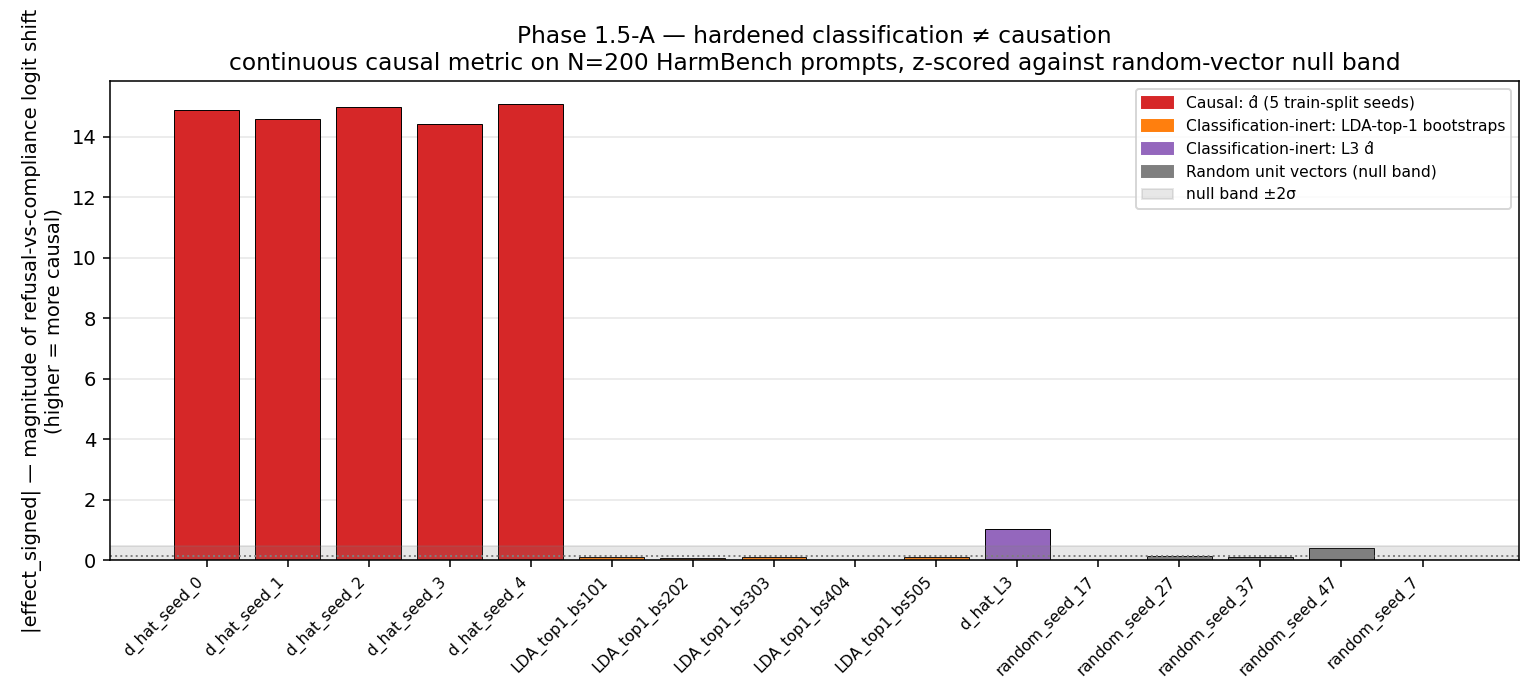
16 directions, 200 held-out HarmBench prompts each, continuous causal metric (|refusal − compliance| first-token logit shift), z-scored against a 5-vector random null band:
| Category | Cells | |effect| | Z-score |
|---|---|---:|---:|
| Causal (d̂ × 5 train-split seeds) | tight cluster | 14.4 – 15.1 | +89 to +94 |
| Classification-inert (LDA × 5 bootstraps, each AUC=1.0 cross-dist) | inside null band | 0.009 – 0.113 | -0.79 to -0.14 |
| Partially causal (L3 diff-of-means, cos 0.08 with L13 d̂) | above null but ~14× smaller | 1.03 | +5.6 |
| Random unit vectors (null band) | reference | mean 0.136 ± 0.160 | (defines null) |
Binary corroboration on the headline cells (N=200, dual-judge):
| Cell | Continuous z | Binary refusal rate |
|---|---|---|
d̂ ablated | +92.2 | 0.080 (16/200) |
| LDA-bootstrap-101 ablated | -0.18 | 0.985 (197/200) |
| Random unit vector ablated | ≈ 0 | 0.990 (198/200) |
| Baseline (no hook) | 0 | 0.990 (198/200) |
TinyMMLU preserved (Δ = +0.03, within noise) → the ablation is
refusal-specific, not lobotomization. Full numbers + per-prompt
completions: results/phase1_hardened_subspace.md,
results/phase1_harmbench.md,
results/phase1_tinymmlu_capability.md.
This does not refute Wollschläger et al.'s ICML 2025 multi-dimensional refusal-cone claim on Gemma — their multi-D directions are recovered by gradient-based RDO, not by statistical extraction. The methodological contribution is making the statistical-vs-gradient extraction decoupling explicit and showing what statistical methods do vs do not recover.
Two structural lessons emerging:
d̂_L22 ablation
collapses refusal cleanly (10/10 judge-complied) while random
ablation at the same cell leaves refusal at baseline (≥ 9/10
judge-refused, all three seeds).The standalone Phase 2 writeup is in progress; the binding terminology
PROJECT_STATE.md.
Per-experiment markdowns under results/phase2_*.md.Requires Python 3.11. The repo uses an isolated .venv/:
git clone https://github.com/lonehacker/mech-interp.git
cd mech-interp
make setup            # creates .venv, installs pinned deps + editable package
source .venv/bin/activate
Pre-flight checks:
make test             # 67 tests, no model load (~5 sec)
make verify           # reproducibility harness only (~3 sec)
Optional for the LLM-judge cross-check (substring scorer works without this, but undercounts pivot-style refusals):
echo "ANTHROPIC_API_KEY=sk-ant-..." > .env
For Gemma-2-2b-it experiments: accept the license on Hugging Face and set
HF_TOKEN in .env.
# Phase 1 — the canonical headline
python -m experiments.phase1_step3_steering              # ablation: 12/12 → 0/12
python -m experiments.phase1_hardened_subspace           # the N=200 headline (continuous + binary)
python -m experiments.phase1_harmbench_eval              # 200-prompt HarmBench with dual-judge
python -m experiments.phase1_tinymmlu_capability         # capability sanity check

# Phase 1 — supporting evidence
python -m experiments.phase1_step2_layer_sweep           # per-layer AUC sweep
python -m experiments.phase1_step3b_addition_sweep       # addition operating band (layer × coeff)
python -m experiments.phase1_subspace_ablation           # original 6-cell pilot
python -m experiments.phase1_step5_localization          # single-layer ablation

# Phase 2 — Qwen-2.5-3B-Instruct
python -m experiments.phase2_step1_layer_sweep           # confirms AUC saturation
python -m experiments.phase2_step3_causal                # the L14 null
python -m experiments.phase2_part2_dim_bypass_gap_sweep  # the L19–L25 × pos {-1,-4} sweep
python -m experiments.phase2_part2_random_control_at_prior  # specificity controls at the prior cells
Each run ~5–40 min on macOS MPS (Apple Silicon), faster on CUDA. Per-run
JSON is written under artifacts/runs/<step>/<timestamp>/result.json
with full prompt+completion pairs; figures land under artifacts/figures/.
The activation-cache directory (artifacts/cache/) is gitignored — it's a
~100 MB binary cache reproducible by running the experiments. The cache
keys are content-hashed and load-bearing for reproducibility; make verify
confirms the on-disk Phase 2 step3e matched-set L14 artifact
(c101587891347bd3.pt) still resolves under the current code.
.
├── docs/index.html              # The Phase 1 writeup (GitHub Pages)
├── README.md                    # This file
├── HOW_IT_WORKS.md              # End-to-end mechanics walkthrough
├── PROJECT_STATE.md             # Phase 2 terminology + 2×2 + current state
├── READING_GUIDE.md             # 5-pass structured reading
├── CONTRIBUTING.md              # Code conventions (ruff, naming, dtypes, hooks)
├── Makefile                     # setup / test / verify / lint / format / clean
├── pyproject.toml               # Package metadata
├── requirements.txt             # Pinned deps
├── ruff.toml                    # Linter config
├── data/                        # Frozen contrastive sets + benchmark CSVs
│   ├── contrastive.jsonl
│   ├── code_contrastive_matched.jsonl  # Phase 2 matched set (vocab/length-controlled)
│   ├── affect-test.jsonl
│   └── harmbench_behaviors_text_all.csv
├── mech_security/               # The library (importable as `mech_security`)
│   ├── model.py                 # Model loader + chat-template helpers
│   ├── activations.py           # Residual-stream caching (layer + position)
│   ├── directions.py            # Extraction (diff-of-means, LDA), hooks (ablate_dir, ablate_subspace, add_dir), bypass_gap, extract_d_hat
│   ├── causal_metric.py         # Continuous first-token logit-shift metric
│   ├── probes.py                # Logistic-regression probes + shuffled control
│   ├── eval.py                  # Substring refusal scorer
│   ├── eval_llm.py              # Calibrated Claude judge (Haiku 4.5)
│   └── controls.py              # Contrastive-set audit
├── experiments/                 # One file per experiment; see experiments/README.md
├── results/                     # Markdown summaries per experiment
├── artifacts/
│   ├── figures/                 # PNGs referenced in writeups
│   ├── runs/                    # Per-run JSON with prompt+completion pairs
│   └── cache/                   # Activation caches (gitignored, ~100 MB)
└── tests/                       # 67 unit tests
    ├── test_directions.py
    ├── test_activations.py
    ├── test_causal_metric_discovery.py
    ├── test_eval.py
    ├── test_probes.py
    └── test_reproducibility.py  # Cache-key + extract_d_hat invariants
Explicitly out of scope for v1: SAE training, training a model from scratch, multimodal extensions, RDO replication on Gemma (the gradient-extraction method — runs against Wollschläger's external codebase).
Defensive characterization, not an attack cookbook. The artifact reports
mechanism, localization, robustness, and per-category refusal-rate deltas
— measurements, not capability uplift. Per-prompt completions are
persisted under artifacts/runs/ for verification; harmful content is
drawn from the public AdvBench and HarmBench datasets and is not expanded
beyond what those benchmarks already publish.
If you use this code or the methodology described in the writeup, please also cite the foundational papers it replicates:
See LICENSE. Replicated methodology follows the published papers' methods
and is reproduced for safety research purposes.
Exploration of mechanistic interpretability of AI model (LLM) behaviours
HTML
0
60 commits
updated Jun 7, 2026
Mechanistic interpretability of refusal in instruction-tuned LLMs. Built
around the mech_security Python package + experiments/ runners + a
calibrated dual-judge eval pipeline.
Phase 1 (Gemma-2-2b-it) — headline: Classification ≠ Causation in Refusal Directions — published replication of Arditi-style interventions with Wollschläger-inspired LDA controls and a continuous causal metric.
Phase 2 (Qwen-2.5-3B-Instruct) — in progress: the layer-selection
lesson — see PROJECT_STATE.md for the binding
terminology + current state.
| If you want to… | Read |
|---|---|
| Understand the Phase 1 finding in 10 minutes | The writeup at docs/index.html (published mirror: lonehacker.github.io/mech-interp) |
| Understand the mechanics of the code | HOW_IT_WORKS.md — end-to-end walkthrough |
| See the Phase 2 framing + current state | PROJECT_STATE.md — terminology + the 2×2 of layer-selection × extraction |
| Deep-read the project structurally | READING_GUIDE.md — 5-pass guide |
| Browse experiment results | results/ — one markdown per experiment with raw numbers |
| Read the code | mech_security/ library, experiments/ runners |
| Verify reproducibility | make verify (cache-key invariants, ~3 sec) + make test (full suite, ~5 sec) |
16 directions, 200 held-out HarmBench prompts each, continuous causal metric (|refusal − compliance| first-token logit shift), z-scored against a 5-vector random null band:
| Category | Cells | |effect| | Z-score |
|---|---|---:|---:|
| Causal (d̂ × 5 train-split seeds) | tight cluster | 14.4 – 15.1 | +89 to +94 |
| Classification-inert (LDA × 5 bootstraps, each AUC=1.0 cross-dist) | inside null band | 0.009 – 0.113 | -0.79 to -0.14 |
| Partially causal (L3 diff-of-means, cos 0.08 with L13 d̂) | above null but ~14× smaller | 1.03 | +5.6 |
| Random unit vectors (null band) | reference | mean 0.136 ± 0.160 | (defines null) |
Binary corroboration on the headline cells (N=200, dual-judge):
| Cell | Continuous z | Binary refusal rate |
|---|---|---|
d̂ ablated | +92.2 | 0.080 (16/200) |
| LDA-bootstrap-101 ablated | -0.18 | 0.985 (197/200) |
| Random unit vector ablated | ≈ 0 | 0.990 (198/200) |
| Baseline (no hook) | 0 | 0.990 (198/200) |
TinyMMLU preserved (Δ = +0.03, within noise) → the ablation is
refusal-specific, not lobotomization. Full numbers + per-prompt
completions: results/phase1_hardened_subspace.md,
results/phase1_harmbench.md,
results/phase1_tinymmlu_capability.md.
This does not refute Wollschläger et al.'s ICML 2025 multi-dimensional refusal-cone claim on Gemma — their multi-D directions are recovered by gradient-based RDO, not by statistical extraction. The methodological contribution is making the statistical-vs-gradient extraction decoupling explicit and showing what statistical methods do vs do not recover.
Two structural lessons emerging:
d̂_L22 ablation
collapses refusal cleanly (10/10 judge-complied) while random
ablation at the same cell leaves refusal at baseline (≥ 9/10
judge-refused, all three seeds).The standalone Phase 2 writeup is in progress; the binding terminology
PROJECT_STATE.md.
Per-experiment markdowns under results/phase2_*.md.Requires Python 3.11. The repo uses an isolated .venv/:
git clone https://github.com/lonehacker/mech-interp.git
cd mech-interp
make setup            # creates .venv, installs pinned deps + editable package
source .venv/bin/activate
Pre-flight checks:
make test             # 67 tests, no model load (~5 sec)
make verify           # reproducibility harness only (~3 sec)
Optional for the LLM-judge cross-check (substring scorer works without this, but undercounts pivot-style refusals):
echo "ANTHROPIC_API_KEY=sk-ant-..." > .env
For Gemma-2-2b-it experiments: accept the license on Hugging Face and set
HF_TOKEN in .env.
# Phase 1 — the canonical headline
python -m experiments.phase1_step3_steering              # ablation: 12/12 → 0/12
python -m experiments.phase1_hardened_subspace           # the N=200 headline (continuous + binary)
python -m experiments.phase1_harmbench_eval              # 200-prompt HarmBench with dual-judge
python -m experiments.phase1_tinymmlu_capability         # capability sanity check

# Phase 1 — supporting evidence
python -m experiments.phase1_step2_layer_sweep           # per-layer AUC sweep
python -m experiments.phase1_step3b_addition_sweep       # addition operating band (layer × coeff)
python -m experiments.phase1_subspace_ablation           # original 6-cell pilot
python -m experiments.phase1_step5_localization          # single-layer ablation

# Phase 2 — Qwen-2.5-3B-Instruct
python -m experiments.phase2_step1_layer_sweep           # confirms AUC saturation
python -m experiments.phase2_step3_causal                # the L14 null
python -m experiments.phase2_part2_dim_bypass_gap_sweep  # the L19–L25 × pos {-1,-4} sweep
python -m experiments.phase2_part2_random_control_at_prior  # specificity controls at the prior cells
Each run ~5–40 min on macOS MPS (Apple Silicon), faster on CUDA. Per-run
JSON is written under artifacts/runs/<step>/<timestamp>/result.json
with full prompt+completion pairs; figures land under artifacts/figures/.
The activation-cache directory (artifacts/cache/) is gitignored — it's a
~100 MB binary cache reproducible by running the experiments. The cache
keys are content-hashed and load-bearing for reproducibility; make verify
confirms the on-disk Phase 2 step3e matched-set L14 artifact
(c101587891347bd3.pt) still resolves under the current code.
.
├── docs/index.html              # The Phase 1 writeup (GitHub Pages)
├── README.md                    # This file
├── HOW_IT_WORKS.md              # End-to-end mechanics walkthrough
├── PROJECT_STATE.md             # Phase 2 terminology + 2×2 + current state
├── READING_GUIDE.md             # 5-pass structured reading
├── CONTRIBUTING.md              # Code conventions (ruff, naming, dtypes, hooks)
├── Makefile                     # setup / test / verify / lint / format / clean
├── pyproject.toml               # Package metadata
├── requirements.txt             # Pinned deps
├── ruff.toml                    # Linter config
├── data/                        # Frozen contrastive sets + benchmark CSVs
│   ├── contrastive.jsonl
│   ├── code_contrastive_matched.jsonl  # Phase 2 matched set (vocab/length-controlled)
│   ├── affect-test.jsonl
│   └── harmbench_behaviors_text_all.csv
├── mech_security/               # The library (importable as `mech_security`)
│   ├── model.py                 # Model loader + chat-template helpers
│   ├── activations.py           # Residual-stream caching (layer + position)
│   ├── directions.py            # Extraction (diff-of-means, LDA), hooks (ablate_dir, ablate_subspace, add_dir), bypass_gap, extract_d_hat
│   ├── causal_metric.py         # Continuous first-token logit-shift metric
│   ├── probes.py                # Logistic-regression probes + shuffled control
│   ├── eval.py                  # Substring refusal scorer
│   ├── eval_llm.py              # Calibrated Claude judge (Haiku 4.5)
│   └── controls.py              # Contrastive-set audit
├── experiments/                 # One file per experiment; see experiments/README.md
├── results/                     # Markdown summaries per experiment
├── artifacts/
│   ├── figures/                 # PNGs referenced in writeups
│   ├── runs/                    # Per-run JSON with prompt+completion pairs
│   └── cache/                   # Activation caches (gitignored, ~100 MB)
└── tests/                       # 67 unit tests
    ├── test_directions.py
    ├── test_activations.py
    ├── test_causal_metric_discovery.py
    ├── test_eval.py
    ├── test_probes.py
    └── test_reproducibility.py  # Cache-key + extract_d_hat invariants
Explicitly out of scope for v1: SAE training, training a model from scratch, multimodal extensions, RDO replication on Gemma (the gradient-extraction method — runs against Wollschläger's external codebase).
Defensive characterization, not an attack cookbook. The artifact reports
mechanism, localization, robustness, and per-category refusal-rate deltas
— measurements, not capability uplift. Per-prompt completions are
persisted under artifacts/runs/ for verification; harmful content is
drawn from the public AdvBench and HarmBench datasets and is not expanded
beyond what those benchmarks already publish.
If you use this code or the methodology described in the writeup, please also cite the foundational papers it replicates:
See LICENSE. Replicated methodology follows the published papers' methods
and is reproduced for safety research purposes.



