
See what people are saying (1)
README
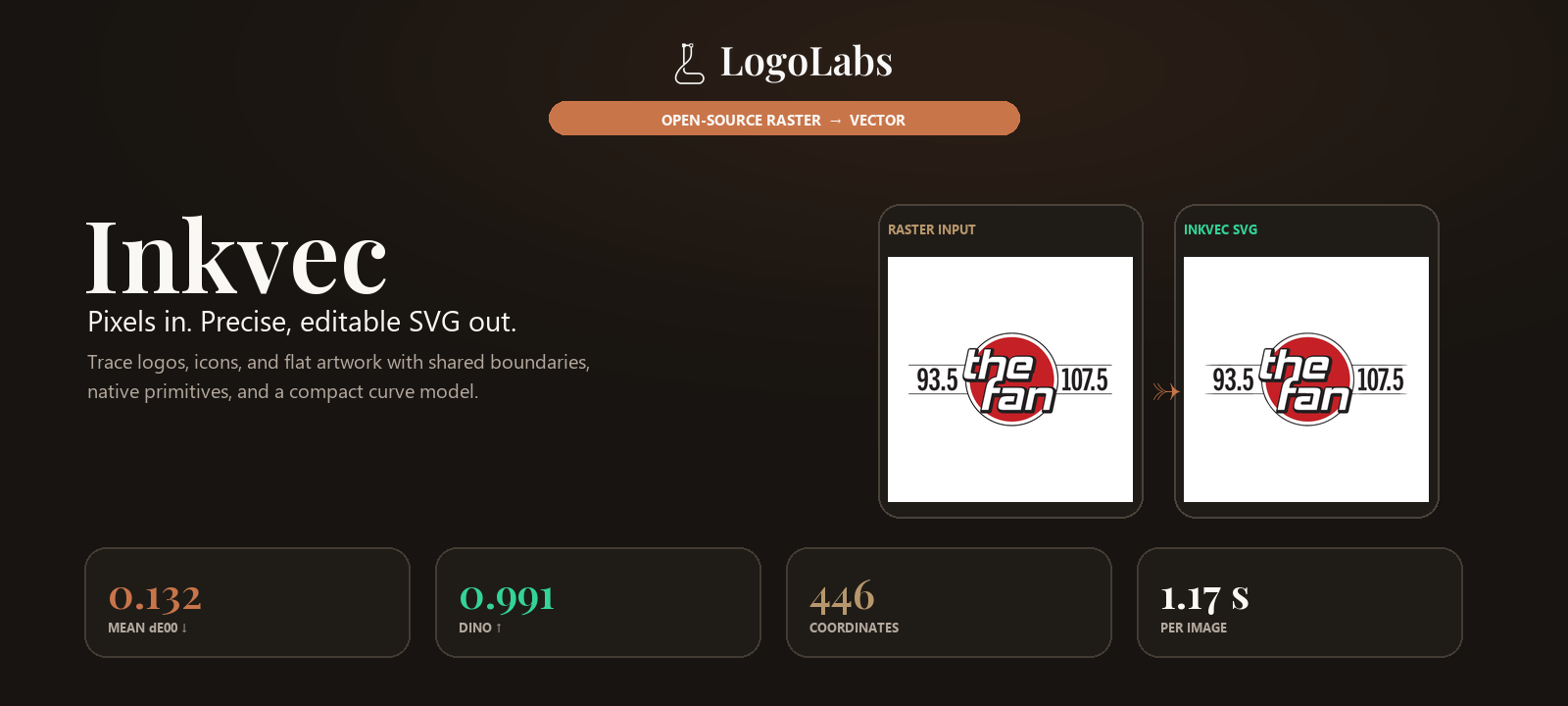








Inkvec reads a PNG, JPEG, WebP, GIF, BMP or TIFF and writes an SVG whose geometry is decided by the evidence in the pixels:
- A boundary sits where the anti-aliasing says it is — within ~0.05 px on analytic test circles (the level-set extraction's own resolution limit;
crates/inkvec-trace/src/coverage.rs), which is a synthetic-input figure, not a corpus one. - A circle is written as
<circle>, not four cubics pretending to be one. - A smooth ramp becomes a real gradient, not coloured bands.
- The number of coordinates is chosen by minimum description length — not a tolerance slider you have to guess at.
Most tracers spend points wherever their curve-fit tolerance lets them. Inkvec spends them where the artist would have: one path per region, a circle where there is a circle, shared edges between shapes that never drift apart.
Results
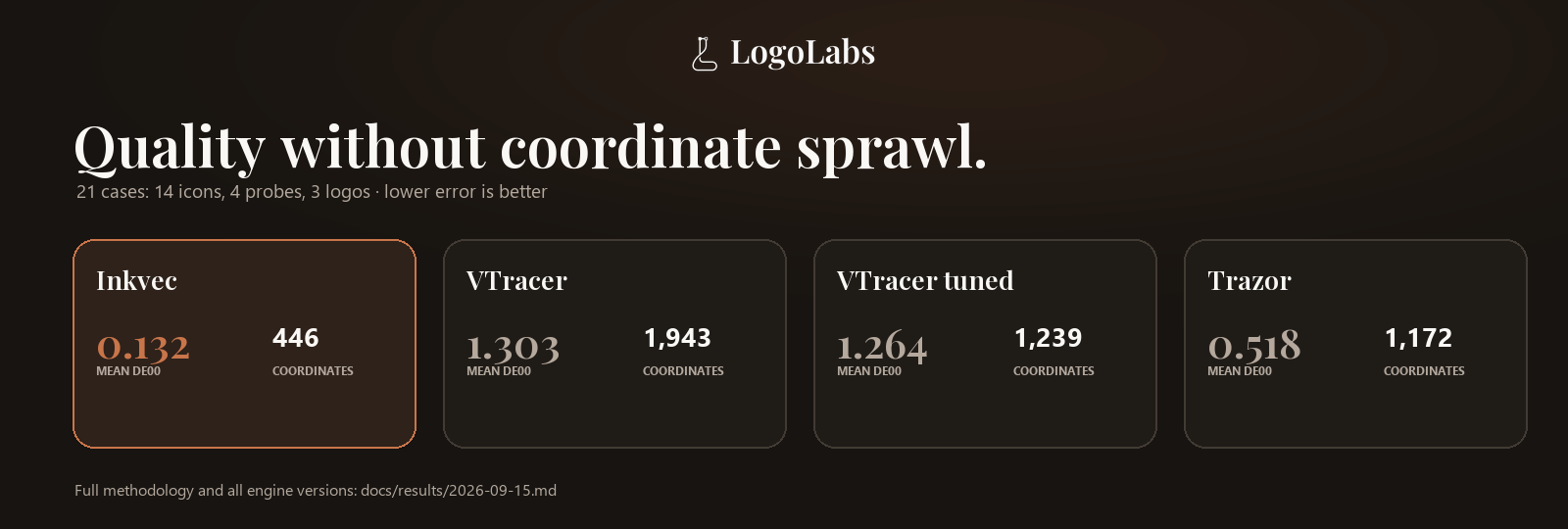
Inkvec vs two other engines (VTracer and Trazor) on 21 cases, scored with CIEDE2000 colour error, DISTS, DINOv3, and coordinate count. The set is fixed from the selection seed crosscompare-2026-09-15-v1 (bench/crosscompare_current.py): 14 hash-selected real icons (2 per family across lucide, material-icons, simple-icons, twemoji, noto-emoji, openmoji and fluent-emoji), 4 hand-picked synthetic probes (prim_circle, mosaic_pie6, gradient_linear, gradient_radial), and 3 real brand logos drawn from an external brand dataset that is not part of this repository — a clean clone selects only the other 18 (see docs/results/2026-09-15.md):
| Engine | Mean dE00 ↓ | Median dE00 ↓ | DISTS ↓ | DINO ↑ | Coords vs Inkvec | Time |
|---|---|---|---|---|---|---|
| Inkvec | 0.132 | 0.054 | 0.0236 | 0.991 | 1× (446) | 1.17 s |
| VTracer (default; 0.6.15 / 1.0.0-alpha.4) | 1.303 | 0.598 | 0.051 | 0.963 | 4.4× (1,943) | 0.04–0.05 s |
| VTracer (tuned, 1.0.0-alpha.4) | 1.264 | 0.579 | 0.064 | 0.954 | 2.8× (1,239) | 0.06 s |
| Trazor | 0.518 | 0.227 | 0.048 | 0.971 | 2.6× (1,172) | 2.19 s |
The two VTracer defaults (0.6.15 and 1.0.0-alpha.4) are the same engine: they emit byte-different files but near-identical geometry (per-case dE00 0.0001–0.0012), and only the tuned setting differs materially — they are not independent corroboration. "Coords vs Inkvec" counts each primitive (<circle>, <ellipse>, <rect>) as 2 coordinates and each cubic as 6, which favours engines that emit primitives. Against the artist's own file, Inkvec's like-for-like ratio (geom_ratio: geometry parameters ÷ ground-truth geometry parameters) is 1.402 on this set. n = 21, with no error bars or significance test; the timings are approximate.
One engine is deliberately absent from the table: color-trace ("potrace-color", migvel/color_trace — pngquant quantisation + per-layer Potrace) is not apples-to-apples, because it reproduces the raster by drawing every pixel back rather than tracing artist-shaped geometry — on these same 21 cases its median dE00 is 0.229 at a median 25,018 coordinates, against Inkvec's 0.054 at 202 — roughly 124× the coordinates. Full detail in the non-apples-to-apples section of docs/results/2026-09-15.md.
VTracer is meaningfully faster — this is a quality/speed trade, not a free win. Source: docs/results/2026-09-15.md.
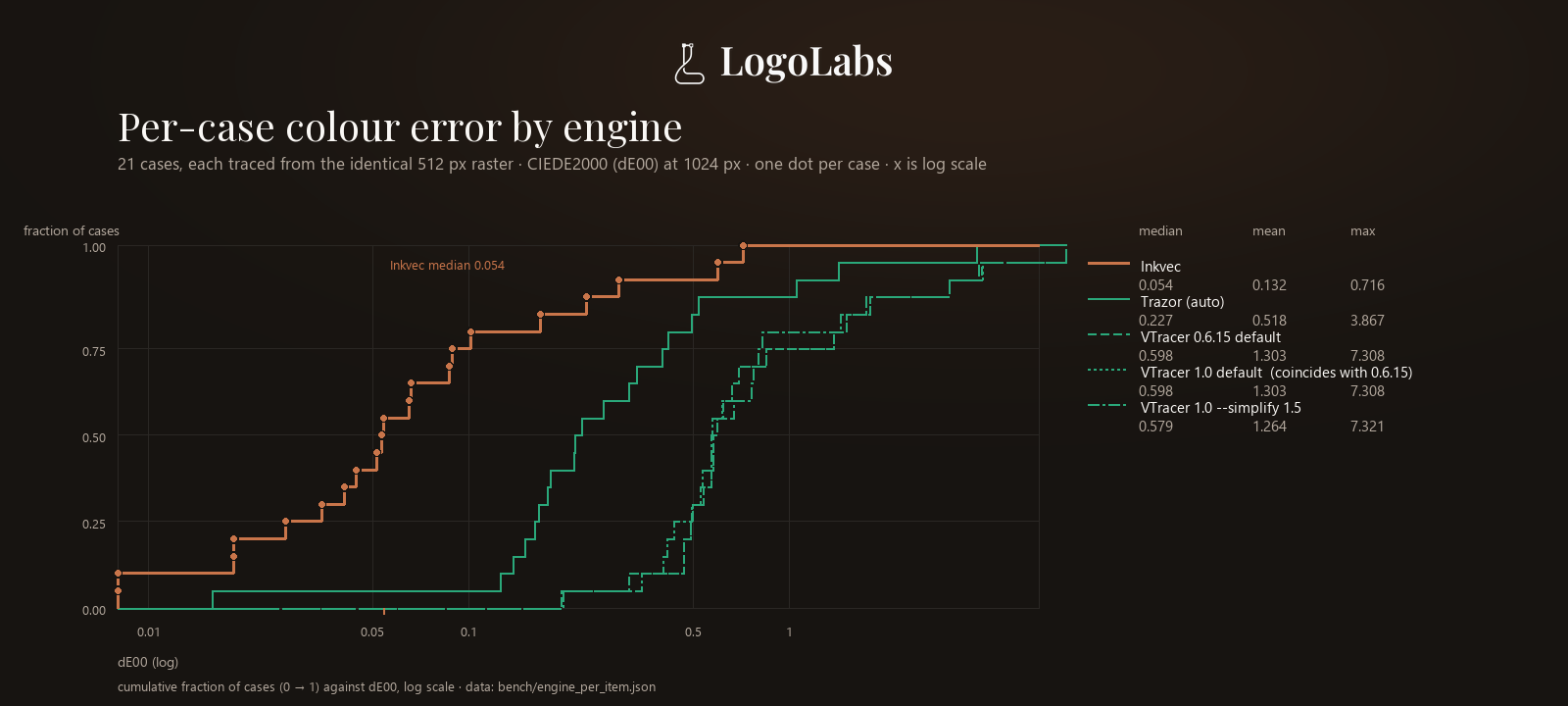
Per-case colour error (dE00) over the 21 cases — the distribution behind the table's mean and median, not only the summary. Reproduce with python tools/make_engine_distribution.py, which reads bench/engine_per_item.json (one row per case × engine).
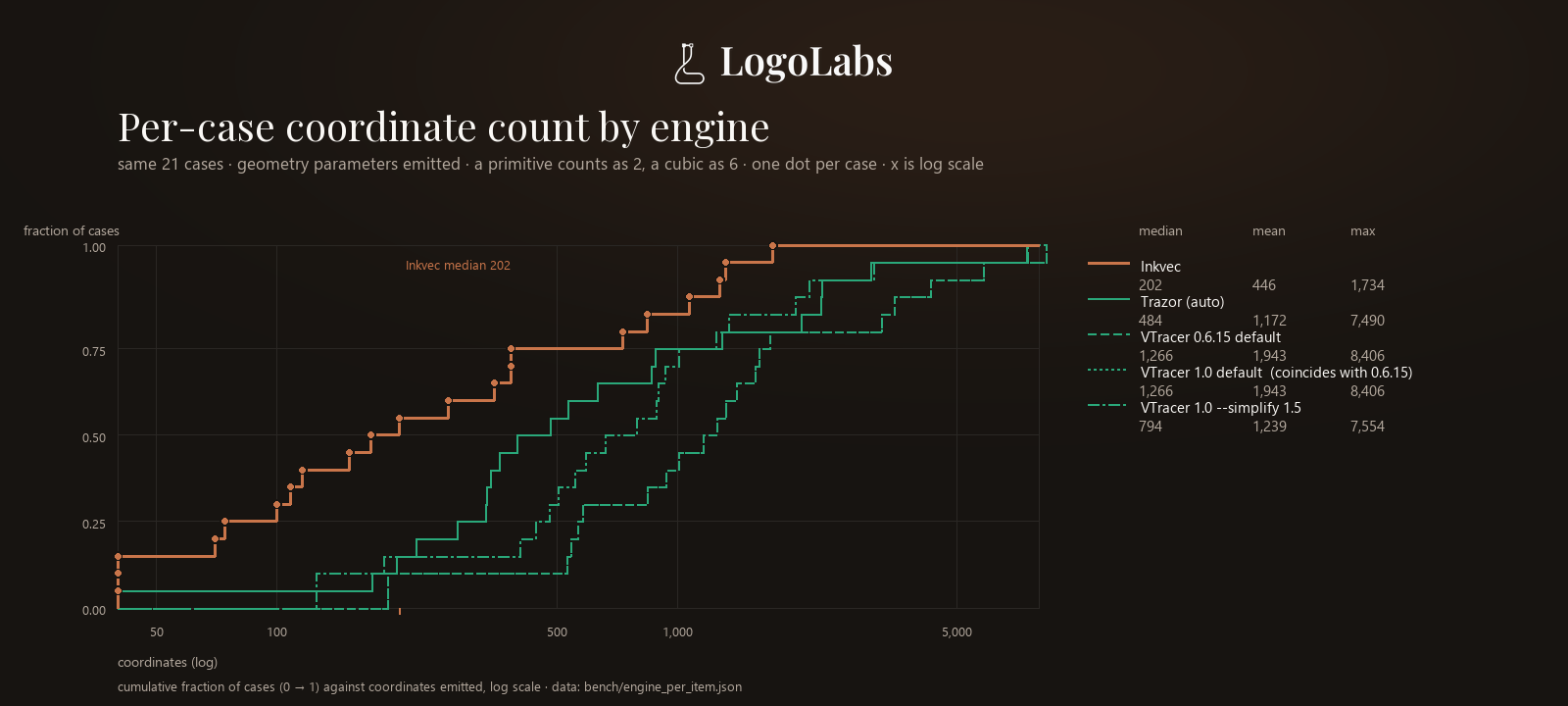
Per-case coordinate count over the same 21 cases, from the same script and data file.
Inkvec's row was re-measured on the 0.1.1 release build (inkvec.exe sha256 73c2f67a4e42194a42f72eba9063815942accb8e05d3e70e472fad1b5d115753), and these two distribution charts are from that same run; the competitor rows are unchanged because their binaries reproduce exactly (VTracer default 1.303 / 1,943; tuned 1.264 / 1,239; Trazor 0.518 / 1,172).
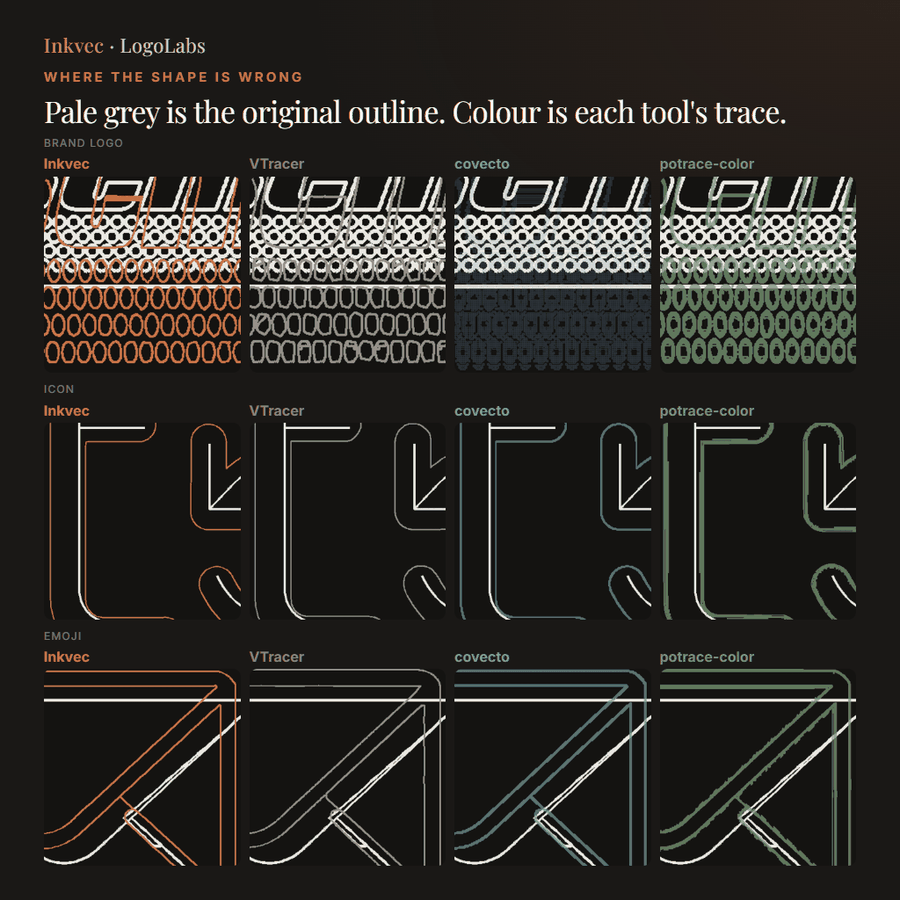
On the regression corpus (246 icons from lucide, material-icons, simple-icons, noto-emoji, openmoji, twemoji — the set CI gates on): mean dE00 0.299, 1.46× the parameters a human author would use. That mean is a family macro-average and is outlier-driven, so read it next to the median (per-item) 0.125 — p10 0.024, p90 0.612, worst 5.72, and 13 of the 246 cases above dE00 1.0. The typical icon sits at ~0.125, and the mean is roughly 2.4× the median because a small tail pulls it up. (An earlier 0.149 figure came from a pre-release snapshot that was not reproducible; the baseline was re-recorded against the reproducible release build — see
CHANGELOG.md.) Source:bench/gate/baseline.json.
Damaged input: JPEG, WebP, AI-decoder output
Inkvec ships an optional trained restorer that removes compression and decode damage before tracing. It is off by default (--restore off; --restore auto enables it only when the input looks damaged). The weights that ship — restorer.onnx from Logolabs/inkvec-denoiser-001, pulled on first use or via tools/pull_model.py — have no published benchmark in this repository, and no LPIPS or ablation figure for them is reported anywhere here. The figures that previously appeared in this section were measured during development on a different checkpoint and are not reproduced for the shipped weights; the VectorArk and StarVector numbers were those projects' own published results, measured under their protocols, not here.
Install
Pre-built binaries
Download the latest release for your platform from the Releases page.
Build from source
cargo install --path crates/inkvec-cli
or from a checkout:
cargo build --release -p inkvec-cli
target/release/inkvec logo.png -o logo.svg
Requires Rust 1.88 or newer. cargo test --release --workspace runs 200+ tests.
Quickstart
inkvec logo.png -o logo.svg
  intake        2x more pixels than detail: scaling min-area x4
logo.png (512x512)
  palette       3 colours, 26 faces (0 gradient)
  planar map    29 shared edges (3 primitive)
  boundary solve  E 285.5 -> 23.0 in 7 iteration(s), 7208 point(s) moved
  symmetry      none in the label map
  repair        0 boundary refit(s) to stop rings crossing
  segments      266  (160 line, 106 cubic) from 9176 measured points, 34.5x reduction
  lambda        8.54
  wrote         logo.svg (7886 bytes)
Exit codes: 0 success · 1 usage/input error · 2 flat input under --strict · 3 debug-dump write failure.
Usage
inkvec <input> [-o <output.svg>] [OPTIONS]
| Flag | Default | What it does |
|---|---|---|
--restore <auto|on|off> | off | Trained-network cleanup for JPEG/WebP/AI-decoder damage. auto only restores if it looks damaged. |
--sr <auto|on|off> | off | Super-resolution pre-pass (2-4× upscale), complementary to --restore. |
--lossy <auto|on|off> | auto | Whether to trust the file as clean or trace with noise-aware intake. |
--max-dim <px> | 2048 | Cap on the longer side; SVG is written at the original size. |
--time-budget <s> | 0 | Advisory wall-clock budget; trace is still correct if it runs out. |
--no-background | off | Drop the face that paints the whole canvas. |
--minify | off | No ids, no groups, no trailing zeros — ~10% smaller, identical geometry. |
Run inkvec --help for the full list.
Optional features
| Feature | What it adds | Cost |
|---|---|---|
restore-model | Trained restorer (--restore) via ONNX Runtime, CPU | Downloads prebuilt ONNX Runtime at build time |
restore-burn | Same network via Burn, pure Rust, no native library | ~4× slower than restore-model |
restore-wgpu | Restorer via Burn on GPU (Vulkan/DX12/Metal) | No CUDA needed |
cargo build --release -p inkvec-cli --features restore-model
The denoiser weights (restorer.onnx) are hosted on Hugging Face at Logolabs/inkvec-denoiser-001 under Apache-2.0, and are automatically pulled on first --restore use. To pull manually:
python tools/pull_model.py
In the browser
crates/inkvec-wasm compiles the same pipeline to WebAssembly. web/ is the static page around it — drop a logo, get the SVG, nothing uploaded.
Try it live: huggingface.co/spaces/logolabs/inkvec
To embed in your own page, call trace(bytes, precision, min_area, colors, merge, max_dim, time_budget, no_background, minify, margin, content_units) — see crates/inkvec-wasm/src/lib.rs.
Library API
use inkvec_cli::{trace_image, post_process, Args};
use inkvec_trace::load_image;

fn trace(input: &str) -> Result<String, Box<dyn std::error::Error>> {
    let args = Args { input: input.into(), ..Args::default() };
    let img = load_image(&args.input)?;
    let traced = trace_image(img, &args)?;
    Ok(post_process(&args, traced.svg, traced.width, traced.height))
}
Args::default() holds every flag's default. trace_image is the whole pipeline behind both the CLI and the WASM build.
How it works
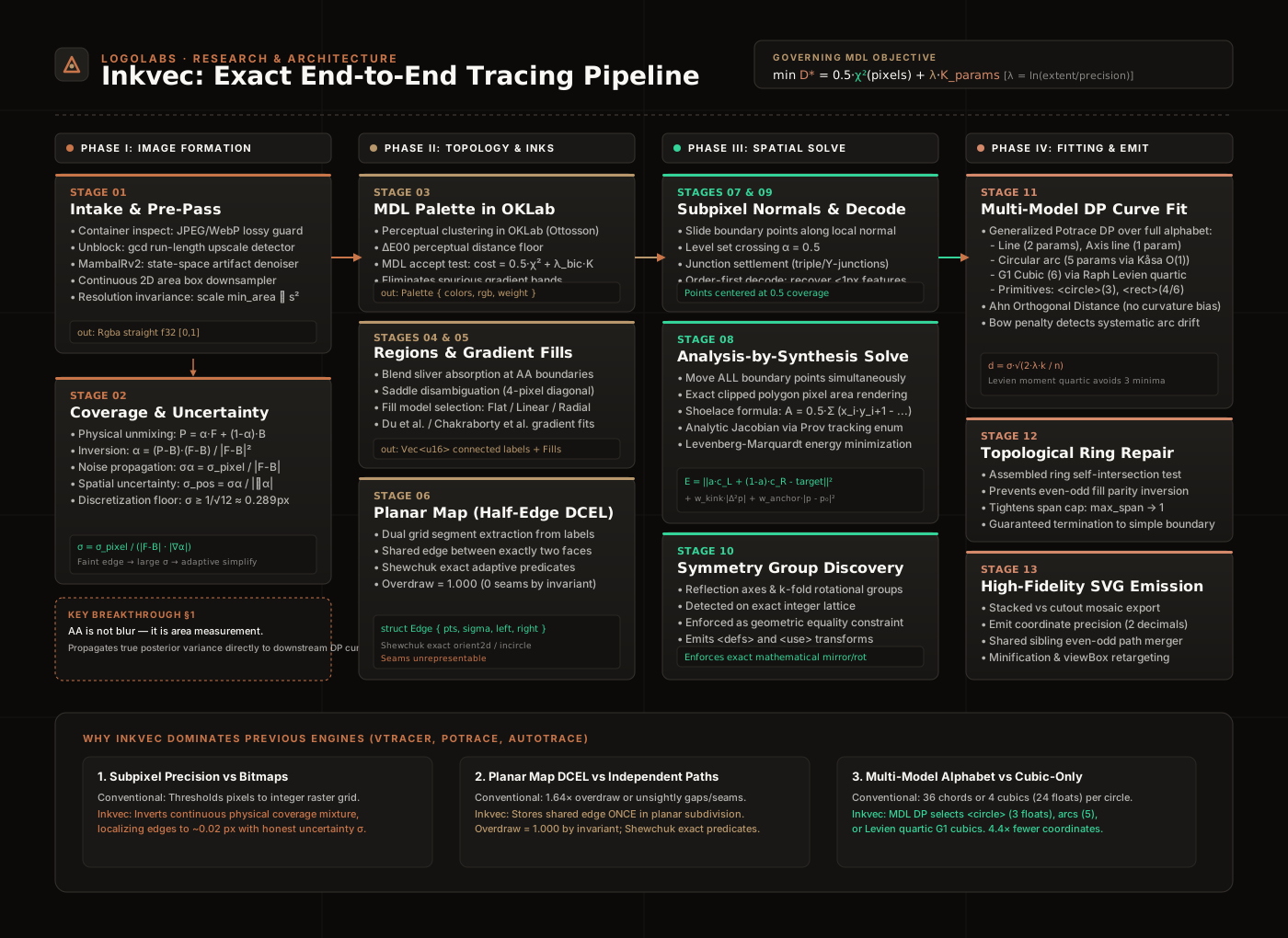
- Intake & Super-Resolution. Lossy container inspection, GCD upscale unblocking, MambaIRv2 state-space restoration, and exact continuous area-weighted downsampling.
- Sub-Pixel Coverage. Linear unmixing across 3D RGB channels inverts anti-aliasing to a fraction of a pixel, establishing honest per-point uncertainty $\sigma_{\text{pos}}$.
- Palette. Minimum description length clustering in OKLab ($\Delta E_{00}$) eliminates spurious bands and fake inks.
- Planar Map (DCEL). Boundaries are stored once between adjacent faces, so the model has no overdraw ($1.000\times$ internally); seams are unrepresentable.
- Boundary Solve. Analysis-by-synthesis moves all boundary points simultaneously under nonlinear conjugate gradient (Fletcher–Reeves) with a backtracking line search and an analytic Shoelace-derived gradient.
- Curve Fitting. Global dynamic programming over lines, arcs, Raph Levien quartic G1 Béziers, and primitives (
<circle>,<ellipse>,<rect>). - Repair & Emit. Capped span refitting eliminates self-crossing rings; output is emitted with shared geometry and clean even-odd paths.
📖 Comprehensive Technical & Scientific Guide: See PIPELINE_EXPLANATION.md for full mathematical derivations, branded step-by-step diagrams, and an extensive review of all research and arXiv papers used (AnchorFlow, VectorArk, AdaVec, SuperSVG, MambaIR, Levien Bézier fits, Shewchuk exact predicates, and more).
🤖 AI Provenance & Transparency: See docs/AI_USAGE.md for our detailed disclosure separating agentic development tooling, runtime restoration models (EuroHPC Arrhenius-trained denoiser & MambaIR), and the 100% deterministic non-neural mathematical geometry core.
Full stage reference: docs/algorithm/ (start at docs/algorithm/index.html). Design rationale: docs/DESIGN.md.
Benchmark and CI gate
bench/ scores against a source SVG with CIEDE2000, DISTS, LPIPS, DINOv2/v3, parameter ratio, bytes and time. CI runs cargo test on Linux, Windows and macOS, then bench/ci_gate.py against the 246-icon screen set, failing if colour error or anchor turning rise more than 1% or the parameter ratio more than 5%.
Known Limitations & Technical Boundaries
See docs/LIMITATIONS.md for our comprehensive architectural boundary disclosure.
Inkvec is engineered specifically for graphic artwork, logotypes, icons, and diagrams. Because the core operates under an exact planar partition and description-length model, specific inputs are outside its design scope:
| Scenario | Expected Behavior / Failure Mode | Recommended Alternative |
|---|---|---|
| Photographs | Natural color transitions violate discrete ink models; causes severe color banding and high coordinate counts. | Keep as AVIF/WebP raster or use diffusion curves. |
| Text & Typography | Glyphs are traced purely as geometric Bézier contours (<path>); no font detection, OCR, or <text> tags. | Use an OCR engine (e.g. Tesseract) for semantic text. |
| Variable-Width Art / Sketches | Medial axis stroke recovery (--strokes) requires uniform width; rough sketches fall back to filled outlines. | Use manual vector pen tools or specialized sketch tracers. |
| Sub-Pixel Gaps (< 1px) | Optical anti-aliasing ramps overlap, merging fine gaps into single faces. | Enable --sr on (MambaIR) to upsample before tracing. |
| Exotic Gradients & Blurs | Linear and radial gradients are supported; mesh gradients, angular sweeps, and drop shadows are quantised into bands. | SVG 1.1 limitation; manual gradient mesh authoring. |
| Real-Time / 60 FPS Video | Heavy global optimization (nonlinear conjugate gradient + MDL DP) takes $\approx 1.2\text{s}$ per graphic. | Use Potrace (<0.01s) or VTracer (~0.04s) for interactive speed. |
Roadmap & Future Work
Active engineering initiatives tracked in docs/TODO.md:
- Neural Post-Processing Refinement Pass: Integrating our 20M vision-conditioned Graph Neural Network (
TraceRefineGNN20M) with equality-constrained CAD least-squares snapping (KKT solver) and topological collinear edge collapse to eliminate subtle raster quantization and restore sharp $C^0$ corners. - High-Volume Benchmarking: Scaling from the 246-icon regression gate to a multi-thousand-sample suite across diverse complexity tiers, streaming multi-engine Pareto frontiers against Potrace, VTracer, and Adobe Illustrator.
Licence
Apache-2.0. See LICENSE. Third-party components: docs/THIRD_PARTY.md. Every Rust dependency of the default build is permissive; two weakly-copyleft MPL-2.0 crates (colored, option-ext) are pulled in only by the optional Burn restorer backends (restore-burn/restore-wgpu/cuda), never by default features or the published default/restore-model archives. Potrace (GPL) is used only as a benchmark baseline — never linked or redistributed.
Citation
@software{inkvec2026,
  title  = {Inkvec: exact raster-to-vector tracing by minimum description length},
  author = {{LogoLabs} and Deleanu, Stefan-Lucian},
  year   = {2026},
  url    = {https://github.com/logolabs/inkvec}
}
Acknowledgements

We acknowledge EuroHPC JU for awarding the project ID EHPC-AIF-2026PG01-907 access to resources on Arrhenius GPU at NAISS, Sweden. The Arrhenius system is operated by the National Academic Infrastructure for Supercomputing in Sweden (NAISS). Compute time on Arrhenius enabled the training and evaluation of the denoiser/restorer model shipped with this release.
Contributors

1 commits
Similar repos



Languages
Rust
72.4%
Python
23.9%
HTML
2.1%
JavaScript
1.4%
See what people are saying (1)
README
Inkvec reads a PNG, JPEG, WebP, GIF, BMP or TIFF and writes an SVG whose geometry is decided by the evidence in the pixels:
- A boundary sits where the anti-aliasing says it is — within ~0.05 px on analytic test circles (the level-set extraction's own resolution limit;
crates/inkvec-trace/src/coverage.rs), which is a synthetic-input figure, not a corpus one. - A circle is written as
<circle>, not four cubics pretending to be one. - A smooth ramp becomes a real gradient, not coloured bands.
- The number of coordinates is chosen by minimum description length — not a tolerance slider you have to guess at.
Most tracers spend points wherever their curve-fit tolerance lets them. Inkvec spends them where the artist would have: one path per region, a circle where there is a circle, shared edges between shapes that never drift apart.
Results
Inkvec vs two other engines (VTracer and Trazor) on 21 cases, scored with CIEDE2000 colour error, DISTS, DINOv3, and coordinate count. The set is fixed from the selection seed crosscompare-2026-09-15-v1 (bench/crosscompare_current.py): 14 hash-selected real icons (2 per family across lucide, material-icons, simple-icons, twemoji, noto-emoji, openmoji and fluent-emoji), 4 hand-picked synthetic probes (prim_circle, mosaic_pie6, gradient_linear, gradient_radial), and 3 real brand logos drawn from an external brand dataset that is not part of this repository — a clean clone selects only the other 18 (see docs/results/2026-09-15.md):
| Engine | Mean dE00 ↓ | Median dE00 ↓ | DISTS ↓ | DINO ↑ | Coords vs Inkvec | Time |
|---|---|---|---|---|---|---|
| Inkvec | 0.132 | 0.054 | 0.0236 | 0.991 | 1× (446) | 1.17 s |
| VTracer (default; 0.6.15 / 1.0.0-alpha.4) | 1.303 | 0.598 | 0.051 | 0.963 | 4.4× (1,943) | 0.04–0.05 s |
| VTracer (tuned, 1.0.0-alpha.4) | 1.264 | 0.579 | 0.064 | 0.954 | 2.8× (1,239) | 0.06 s |
| Trazor | 0.518 | 0.227 | 0.048 | 0.971 | 2.6× (1,172) | 2.19 s |
The two VTracer defaults (0.6.15 and 1.0.0-alpha.4) are the same engine: they emit byte-different files but near-identical geometry (per-case dE00 0.0001–0.0012), and only the tuned setting differs materially — they are not independent corroboration. "Coords vs Inkvec" counts each primitive (<circle>, <ellipse>, <rect>) as 2 coordinates and each cubic as 6, which favours engines that emit primitives. Against the artist's own file, Inkvec's like-for-like ratio (geom_ratio: geometry parameters ÷ ground-truth geometry parameters) is 1.402 on this set. n = 21, with no error bars or significance test; the timings are approximate.
One engine is deliberately absent from the table: color-trace ("potrace-color", migvel/color_trace — pngquant quantisation + per-layer Potrace) is not apples-to-apples, because it reproduces the raster by drawing every pixel back rather than tracing artist-shaped geometry — on these same 21 cases its median dE00 is 0.229 at a median 25,018 coordinates, against Inkvec's 0.054 at 202 — roughly 124× the coordinates. Full detail in the non-apples-to-apples section of docs/results/2026-09-15.md.
VTracer is meaningfully faster — this is a quality/speed trade, not a free win. Source: docs/results/2026-09-15.md.
Per-case colour error (dE00) over the 21 cases — the distribution behind the table's mean and median, not only the summary. Reproduce with python tools/make_engine_distribution.py, which reads bench/engine_per_item.json (one row per case × engine).
Per-case coordinate count over the same 21 cases, from the same script and data file.
Inkvec's row was re-measured on the 0.1.1 release build (inkvec.exe sha256 73c2f67a4e42194a42f72eba9063815942accb8e05d3e70e472fad1b5d115753), and these two distribution charts are from that same run; the competitor rows are unchanged because their binaries reproduce exactly (VTracer default 1.303 / 1,943; tuned 1.264 / 1,239; Trazor 0.518 / 1,172).
On the regression corpus (246 icons from lucide, material-icons, simple-icons, noto-emoji, openmoji, twemoji — the set CI gates on): mean dE00 0.299, 1.46× the parameters a human author would use. That mean is a family macro-average and is outlier-driven, so read it next to the median (per-item) 0.125 — p10 0.024, p90 0.612, worst 5.72, and 13 of the 246 cases above dE00 1.0. The typical icon sits at ~0.125, and the mean is roughly 2.4× the median because a small tail pulls it up. (An earlier 0.149 figure came from a pre-release snapshot that was not reproducible; the baseline was re-recorded against the reproducible release build — see
CHANGELOG.md.) Source:bench/gate/baseline.json.
Damaged input: JPEG, WebP, AI-decoder output
Inkvec ships an optional trained restorer that removes compression and decode damage before tracing. It is off by default (--restore off; --restore auto enables it only when the input looks damaged). The weights that ship — restorer.onnx from Logolabs/inkvec-denoiser-001, pulled on first use or via tools/pull_model.py — have no published benchmark in this repository, and no LPIPS or ablation figure for them is reported anywhere here. The figures that previously appeared in this section were measured during development on a different checkpoint and are not reproduced for the shipped weights; the VectorArk and StarVector numbers were those projects' own published results, measured under their protocols, not here.
Install
Pre-built binaries
Download the latest release for your platform from the Releases page.
Build from source
cargo install --path crates/inkvec-cli
or from a checkout:
cargo build --release -p inkvec-cli
target/release/inkvec logo.png -o logo.svg
Requires Rust 1.88 or newer. cargo test --release --workspace runs 200+ tests.
Quickstart
inkvec logo.png -o logo.svg
  intake        2x more pixels than detail: scaling min-area x4
logo.png (512x512)
  palette       3 colours, 26 faces (0 gradient)
  planar map    29 shared edges (3 primitive)
  boundary solve  E 285.5 -> 23.0 in 7 iteration(s), 7208 point(s) moved
  symmetry      none in the label map
  repair        0 boundary refit(s) to stop rings crossing
  segments      266  (160 line, 106 cubic) from 9176 measured points, 34.5x reduction
  lambda        8.54
  wrote         logo.svg (7886 bytes)
Exit codes: 0 success · 1 usage/input error · 2 flat input under --strict · 3 debug-dump write failure.
Usage
inkvec <input> [-o <output.svg>] [OPTIONS]
| Flag | Default | What it does |
|---|---|---|
--restore <auto|on|off> | off | Trained-network cleanup for JPEG/WebP/AI-decoder damage. auto only restores if it looks damaged. |
--sr <auto|on|off> | off | Super-resolution pre-pass (2-4× upscale), complementary to --restore. |
--lossy <auto|on|off> | auto | Whether to trust the file as clean or trace with noise-aware intake. |
--max-dim <px> | 2048 | Cap on the longer side; SVG is written at the original size. |
--time-budget <s> | 0 | Advisory wall-clock budget; trace is still correct if it runs out. |
--no-background | off | Drop the face that paints the whole canvas. |
--minify | off | No ids, no groups, no trailing zeros — ~10% smaller, identical geometry. |
Run inkvec --help for the full list.
Optional features
| Feature | What it adds | Cost |
|---|---|---|
restore-model | Trained restorer (--restore) via ONNX Runtime, CPU | Downloads prebuilt ONNX Runtime at build time |
restore-burn | Same network via Burn, pure Rust, no native library | ~4× slower than restore-model |
restore-wgpu | Restorer via Burn on GPU (Vulkan/DX12/Metal) | No CUDA needed |
cargo build --release -p inkvec-cli --features restore-model
The denoiser weights (restorer.onnx) are hosted on Hugging Face at Logolabs/inkvec-denoiser-001 under Apache-2.0, and are automatically pulled on first --restore use. To pull manually:
python tools/pull_model.py
In the browser
crates/inkvec-wasm compiles the same pipeline to WebAssembly. web/ is the static page around it — drop a logo, get the SVG, nothing uploaded.
Try it live: huggingface.co/spaces/logolabs/inkvec
To embed in your own page, call trace(bytes, precision, min_area, colors, merge, max_dim, time_budget, no_background, minify, margin, content_units) — see crates/inkvec-wasm/src/lib.rs.
Library API
use inkvec_cli::{trace_image, post_process, Args};
use inkvec_trace::load_image;

fn trace(input: &str) -> Result<String, Box<dyn std::error::Error>> {
    let args = Args { input: input.into(), ..Args::default() };
    let img = load_image(&args.input)?;
    let traced = trace_image(img, &args)?;
    Ok(post_process(&args, traced.svg, traced.width, traced.height))
}
Args::default() holds every flag's default. trace_image is the whole pipeline behind both the CLI and the WASM build.
How it works
- Intake & Super-Resolution. Lossy container inspection, GCD upscale unblocking, MambaIRv2 state-space restoration, and exact continuous area-weighted downsampling.
- Sub-Pixel Coverage. Linear unmixing across 3D RGB channels inverts anti-aliasing to a fraction of a pixel, establishing honest per-point uncertainty $\sigma_{\text{pos}}$.
- Palette. Minimum description length clustering in OKLab ($\Delta E_{00}$) eliminates spurious bands and fake inks.
- Planar Map (DCEL). Boundaries are stored once between adjacent faces, so the model has no overdraw ($1.000\times$ internally); seams are unrepresentable.
- Boundary Solve. Analysis-by-synthesis moves all boundary points simultaneously under nonlinear conjugate gradient (Fletcher–Reeves) with a backtracking line search and an analytic Shoelace-derived gradient.
- Curve Fitting. Global dynamic programming over lines, arcs, Raph Levien quartic G1 Béziers, and primitives (
<circle>,<ellipse>,<rect>). - Repair & Emit. Capped span refitting eliminates self-crossing rings; output is emitted with shared geometry and clean even-odd paths.
📖 Comprehensive Technical & Scientific Guide: See PIPELINE_EXPLANATION.md for full mathematical derivations, branded step-by-step diagrams, and an extensive review of all research and arXiv papers used (AnchorFlow, VectorArk, AdaVec, SuperSVG, MambaIR, Levien Bézier fits, Shewchuk exact predicates, and more).
🤖 AI Provenance & Transparency: See docs/AI_USAGE.md for our detailed disclosure separating agentic development tooling, runtime restoration models (EuroHPC Arrhenius-trained denoiser & MambaIR), and the 100% deterministic non-neural mathematical geometry core.
Full stage reference: docs/algorithm/ (start at docs/algorithm/index.html). Design rationale: docs/DESIGN.md.
Benchmark and CI gate
bench/ scores against a source SVG with CIEDE2000, DISTS, LPIPS, DINOv2/v3, parameter ratio, bytes and time. CI runs cargo test on Linux, Windows and macOS, then bench/ci_gate.py against the 246-icon screen set, failing if colour error or anchor turning rise more than 1% or the parameter ratio more than 5%.
Known Limitations & Technical Boundaries
See docs/LIMITATIONS.md for our comprehensive architectural boundary disclosure.
Inkvec is engineered specifically for graphic artwork, logotypes, icons, and diagrams. Because the core operates under an exact planar partition and description-length model, specific inputs are outside its design scope:
| Scenario | Expected Behavior / Failure Mode | Recommended Alternative |
|---|---|---|
| Photographs | Natural color transitions violate discrete ink models; causes severe color banding and high coordinate counts. | Keep as AVIF/WebP raster or use diffusion curves. |
| Text & Typography | Glyphs are traced purely as geometric Bézier contours (<path>); no font detection, OCR, or <text> tags. | Use an OCR engine (e.g. Tesseract) for semantic text. |
| Variable-Width Art / Sketches | Medial axis stroke recovery (--strokes) requires uniform width; rough sketches fall back to filled outlines. | Use manual vector pen tools or specialized sketch tracers. |
| Sub-Pixel Gaps (< 1px) | Optical anti-aliasing ramps overlap, merging fine gaps into single faces. | Enable --sr on (MambaIR) to upsample before tracing. |
| Exotic Gradients & Blurs | Linear and radial gradients are supported; mesh gradients, angular sweeps, and drop shadows are quantised into bands. | SVG 1.1 limitation; manual gradient mesh authoring. |
| Real-Time / 60 FPS Video | Heavy global optimization (nonlinear conjugate gradient + MDL DP) takes $\approx 1.2\text{s}$ per graphic. | Use Potrace (<0.01s) or VTracer (~0.04s) for interactive speed. |
Roadmap & Future Work
Active engineering initiatives tracked in docs/TODO.md:
- Neural Post-Processing Refinement Pass: Integrating our 20M vision-conditioned Graph Neural Network (
TraceRefineGNN20M) with equality-constrained CAD least-squares snapping (KKT solver) and topological collinear edge collapse to eliminate subtle raster quantization and restore sharp $C^0$ corners. - High-Volume Benchmarking: Scaling from the 246-icon regression gate to a multi-thousand-sample suite across diverse complexity tiers, streaming multi-engine Pareto frontiers against Potrace, VTracer, and Adobe Illustrator.
Licence
Apache-2.0. See LICENSE. Third-party components: docs/THIRD_PARTY.md. Every Rust dependency of the default build is permissive; two weakly-copyleft MPL-2.0 crates (colored, option-ext) are pulled in only by the optional Burn restorer backends (restore-burn/restore-wgpu/cuda), never by default features or the published default/restore-model archives. Potrace (GPL) is used only as a benchmark baseline — never linked or redistributed.
Citation
@software{inkvec2026,
  title  = {Inkvec: exact raster-to-vector tracing by minimum description length},
  author = {{LogoLabs} and Deleanu, Stefan-Lucian},
  year   = {2026},
  url    = {https://github.com/logolabs/inkvec}
}
Acknowledgements
We acknowledge EuroHPC JU for awarding the project ID EHPC-AIF-2026PG01-907 access to resources on Arrhenius GPU at NAISS, Sweden. The Arrhenius system is operated by the National Academic Infrastructure for Supercomputing in Sweden (NAISS). Compute time on Arrhenius enabled the training and evaluation of the denoiser/restorer model shipped with this release.
Similar repos
Contributors
1 commits
Languages
Rust
72.4%
Python
23.9%
HTML
2.1%
JavaScript
1.4%