
[ICLR 2026] "VideoReasonBench: Can MLLMs Perform Vision-Centric Complex Video Reasoning?", Yuanxin Liu, Kun Ouyang, Haoning Wu, Yi Liu, Lin Sui, Xinhao Li, Yan Zhong, Y. Charles, Xinyu Zhou, Xu Sun
See the codeREADME
 VideoReasonBench: Can MLLMs Perform Vision-Centric Complex Video Reasoning?



News
[2026-01] 🎊🎊🎊 VideoReasonBench is accepted by ICLR 2026!
[2025-12] 🎉🎉🎉 Excited to see Seed1.8 adopt VideoReasonBench for evaluating video reasoning! Huge congratulations to the Seed team on the impressive 30+ point gain over Seed1.5-VL.
✨ Highlights
 |
|---|
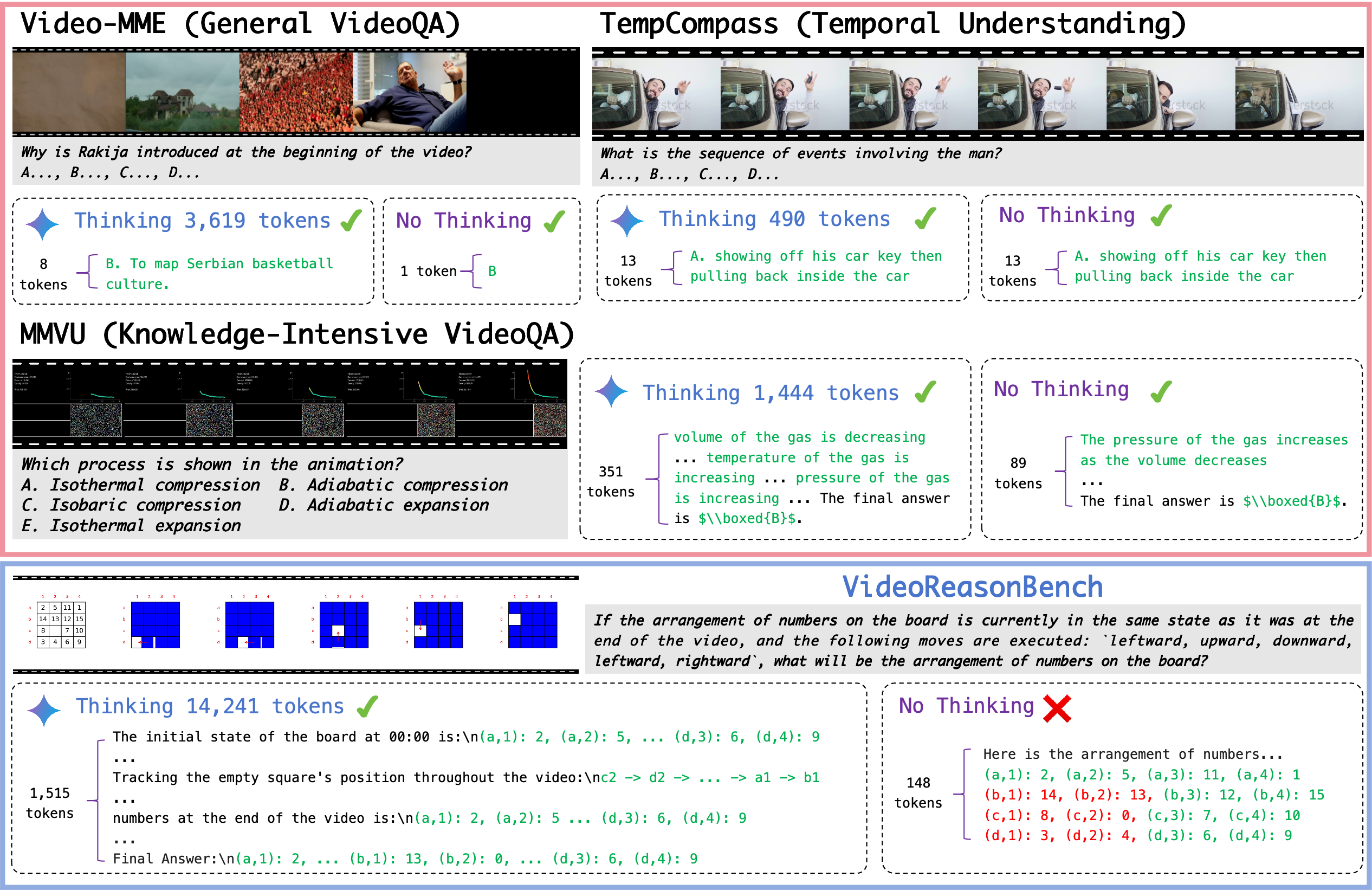
| Examples from VideoReasonBench and three existing VideoQA benchmarks. Responses are generated by Gemini-2.5-Flash in both "Thinking" and "No Thinking" modes. |
 |
|---|
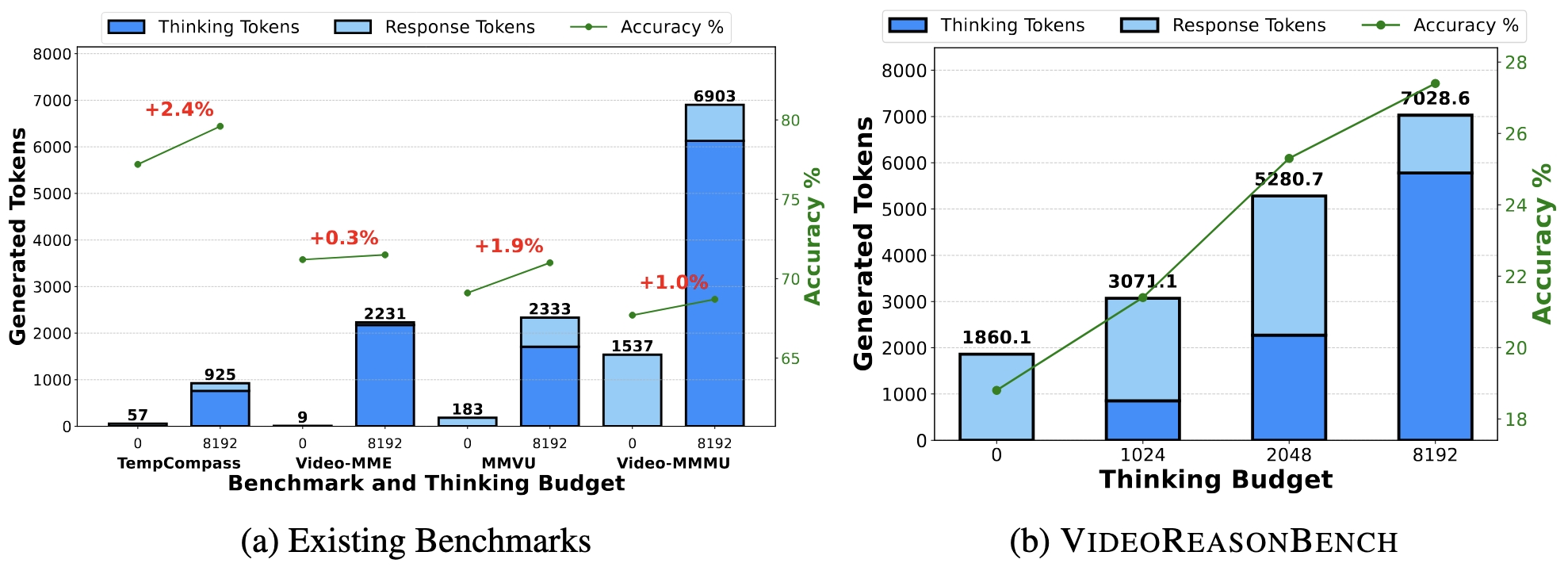
| Performance of Gemini-2.5-Flash with varying thinking budgets on five benchmarks. |
Complex Reasoning
- Gemini-2.5-Flash achieves over 65% accuracy on standard benchmarks but drops to just 27.4% on VideoReasonBench.
- On average, it consumes over 7,000 tokens to arrive at an answer.
Thinking-Reliant
- VideoReasonBench performance shows stronger correlation with the thinking budget, compared with existing benchmarks.
Vision-Centric Reasoning
- The reasoning process is deeply grounded in the video content.
👉 Overview
Videos
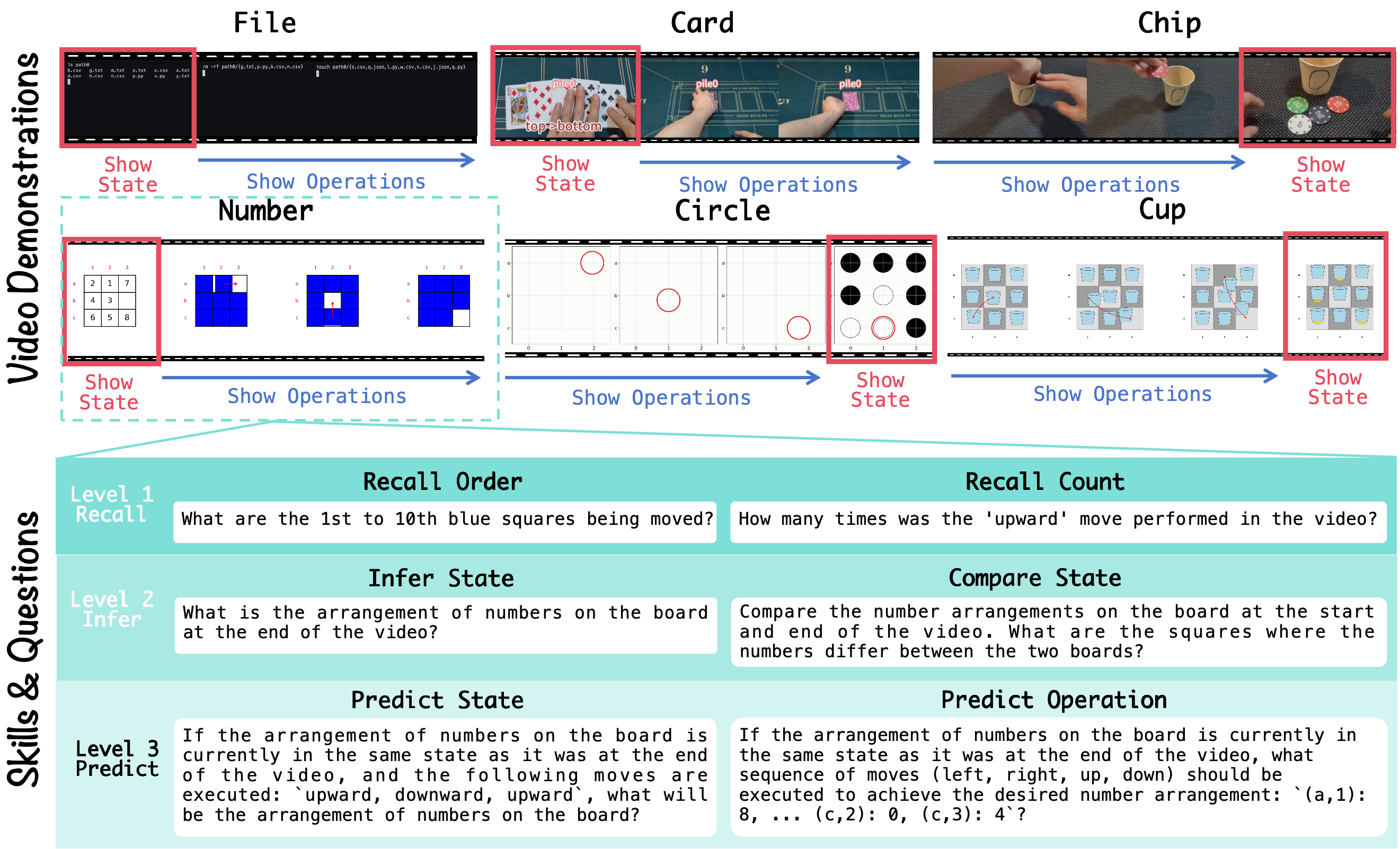
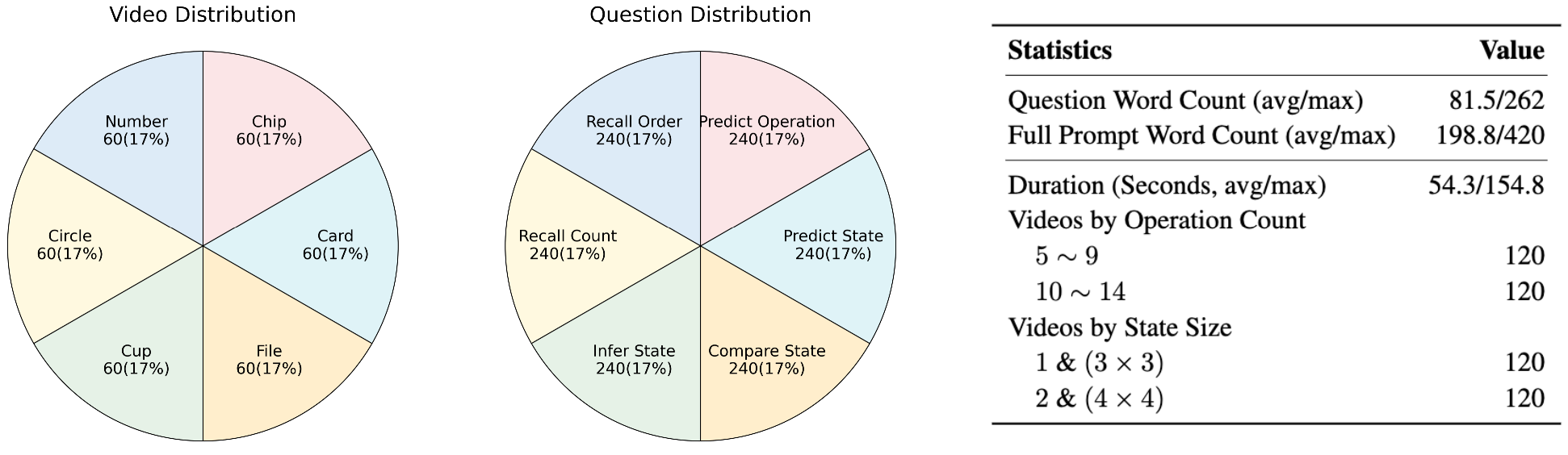
Each video features a latent state and a sequence of operations. The latent state is revealed either at the beginning or the end of the video. Throughout the rest of the video, the latent state remains invisible while the operations drive state transitions. There are six types of video demonstrations:
- Number: Sliding number puzzle.
- Circle: A red circle moving on grid, flipping the color of black and white pieces.
- Cup: Swapping cups and the content beneath.
- File: Creating, deleting, copying, and moving files within/between paths.
- Card: Adding or removing cards to/from piles.
- Chip: Adding or removing chips to/from cups.
Questions
The questions assess video reasoning skills across three levels:
- Level 1 (Recall): Precisely recalling the sequential visual observations from the video.
- Level 2 (Infer): Infer latent information that is not directly observable from the video.
- Level 3 (Predict): Predict new information beyond the video.
🚀 Quick Start
Direct Evaluation
Step 1: Setup
Installation
pip install google-genai==1.12.0
pip install openai==1.64.0
pip install transformers
Setup Keys
Set the environment variables GEMINI_API_KEY, OPENAI_API_KEY and OPENAI_API_BASE.
Step 2: Download Videos
wget https://huggingface.co/datasets/lyx97/reasoning_videos/resolve/main/videos.zip
unzip videos.zip
Step 3: Evaluation
bash eval_gemini.sh        # evaluate gemini series models
bash eval_openai.sh        # evaluate openai models
bash eval_qwen.sh          # evaluate qwen2.5-vl models
An example of evaluation result can be found here.
Evaluation using VLMEvalKit
Step 1: Setup
Installation
cd vlmevalkit
pip install -e .
Setup Keys
Place the required keys in vlmevalkit/.env or directly set them as the environment variable.
Step 2: Configuration
Setup the model and dataset configuration in vlmevalkit/configs/{your_config}.json. For example:
{
    "model": {
        "Qwen2.5-VL-72B-Instruct": {
            "class": "Qwen2VLChat",
            "model_path": "Qwen/Qwen2.5-VL-72B-Instruct",
            "min_pixels": 50176,
            "max_pixels": 200704,
            "max_new_tokens": 4096
        }
    },
    "data": {
        "VideoReasoningBench_64frame": {
            "class": "VideoReasoningBench",
            "dataset": "VideoReasoningBench",
            "nframe": 64
        }
    }
}
Step 3: Evaluation
torchrun --nproc-per-node=8 run.py --judge gpt-4o-1120 --config configs/video_reasoning_bench_qwen2.5-vl-7b.json --reuse        # 7B-scale model
AUTO_SPLIT=1 torchrun --nproc-per-node=1 run.py --judge gpt-4o-1120 --config configs/video_reasoning_bench_qwen2.5-vl-72b.json  # 72B-scale model
An example of evaluation result can be found here.
📊 Evaluation Results
Main Results
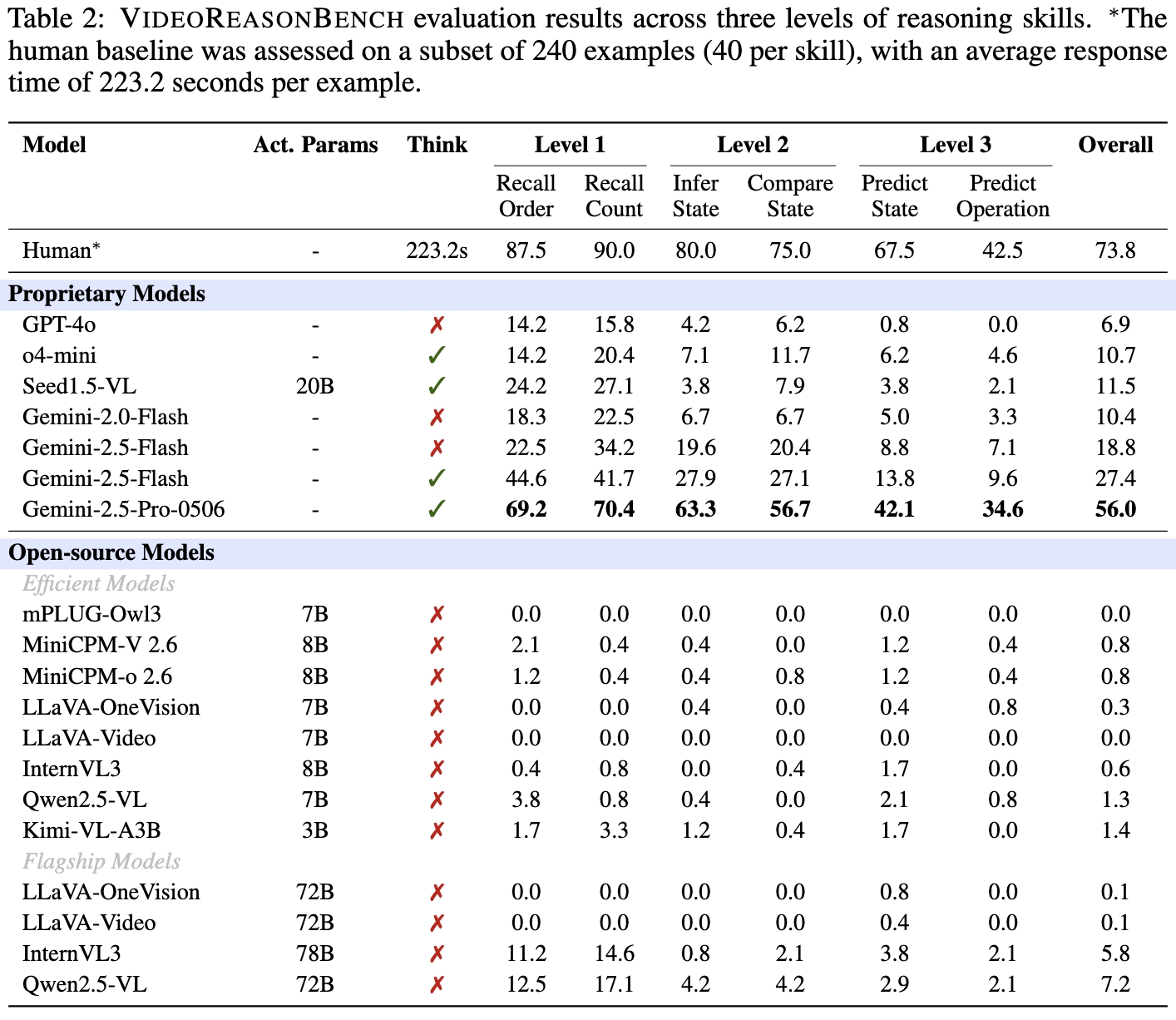
- Current MLLMs struggle with vision-centric complex video reasoning.
- VideoReasonBench poses substantial challenges—even for humans.
- Thinking is critical for performance on VideoReasonBench.
- Reasoning difficulty increases from Level 1 to Level 3.
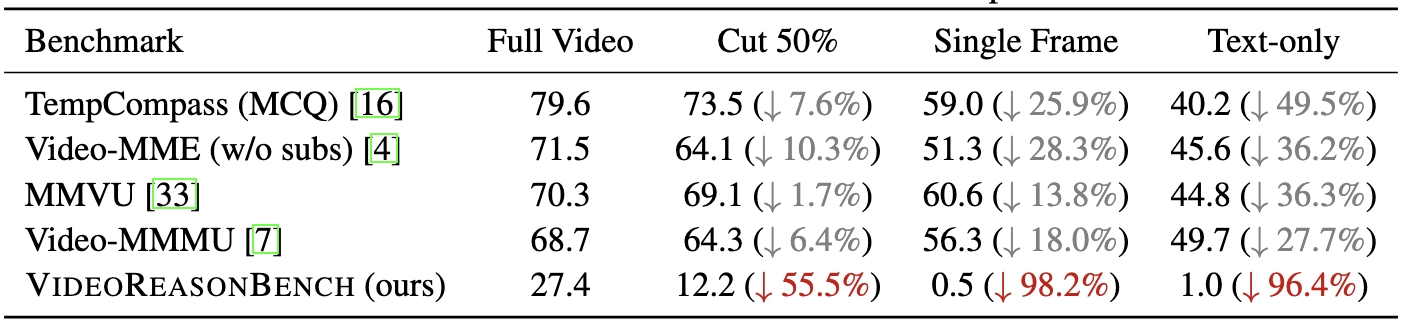
Results of Gemini-2.5-Flash with different visual inputs
- VideoReasonBench demands a higher degree of vision reliance (vision-centric) than current video understanding benchmarks.
Citation
@article{liu2025videoreasonbench,
  title   = {VideoReasonBench: Can MLLMs Perform Vision-Centric Complex Video Reasoning?},
  author  = {Yuanxin Liu, Kun Ouyang, Haoning Wu, Yi Liu, Lin Sui, Xinhao Li, Yan Zhong, Y. Charles, Xinyu Zhou, Xu Sun},
  year    = {2025},
  journal = {arXiv preprint arXiv: 2505.23359}
}
Contributors

5 commits
Similar repos







Languages
Python
99.0%
[ICLR 2026] "VideoReasonBench: Can MLLMs Perform Vision-Centric Complex Video Reasoning?", Yuanxin Liu, Kun Ouyang, Haoning Wu, Yi Liu, Lin Sui, Xinhao Li, Yan Zhong, Y. Charles, Xinyu Zhou, Xu Sun
See the codeREADME
VideoReasonBench: Can MLLMs Perform Vision-Centric Complex Video Reasoning?
News
[2026-01] 🎊🎊🎊 VideoReasonBench is accepted by ICLR 2026!
[2025-12] 🎉🎉🎉 Excited to see Seed1.8 adopt VideoReasonBench for evaluating video reasoning! Huge congratulations to the Seed team on the impressive 30+ point gain over Seed1.5-VL.
✨ Highlights
|
|---|
| Examples from VideoReasonBench and three existing VideoQA benchmarks. Responses are generated by Gemini-2.5-Flash in both "Thinking" and "No Thinking" modes. |
|
|---|
| Performance of Gemini-2.5-Flash with varying thinking budgets on five benchmarks. |
Complex Reasoning
- Gemini-2.5-Flash achieves over 65% accuracy on standard benchmarks but drops to just 27.4% on VideoReasonBench.
- On average, it consumes over 7,000 tokens to arrive at an answer.
Thinking-Reliant
- VideoReasonBench performance shows stronger correlation with the thinking budget, compared with existing benchmarks.
Vision-Centric Reasoning
- The reasoning process is deeply grounded in the video content.
👉 Overview
Videos
Each video features a latent state and a sequence of operations. The latent state is revealed either at the beginning or the end of the video. Throughout the rest of the video, the latent state remains invisible while the operations drive state transitions. There are six types of video demonstrations:
- Number: Sliding number puzzle.
- Circle: A red circle moving on grid, flipping the color of black and white pieces.
- Cup: Swapping cups and the content beneath.
- File: Creating, deleting, copying, and moving files within/between paths.
- Card: Adding or removing cards to/from piles.
- Chip: Adding or removing chips to/from cups.
Questions
The questions assess video reasoning skills across three levels:
- Level 1 (Recall): Precisely recalling the sequential visual observations from the video.
- Level 2 (Infer): Infer latent information that is not directly observable from the video.
- Level 3 (Predict): Predict new information beyond the video.
🚀 Quick Start
Direct Evaluation
Step 1: Setup
Installation
pip install google-genai==1.12.0
pip install openai==1.64.0
pip install transformers
Setup Keys
Set the environment variables GEMINI_API_KEY, OPENAI_API_KEY and OPENAI_API_BASE.
Step 2: Download Videos
wget https://huggingface.co/datasets/lyx97/reasoning_videos/resolve/main/videos.zip
unzip videos.zip
Step 3: Evaluation
bash eval_gemini.sh        # evaluate gemini series models
bash eval_openai.sh        # evaluate openai models
bash eval_qwen.sh          # evaluate qwen2.5-vl models
An example of evaluation result can be found here.
Evaluation using VLMEvalKit
Step 1: Setup
Installation
cd vlmevalkit
pip install -e .
Setup Keys
Place the required keys in vlmevalkit/.env or directly set them as the environment variable.
Step 2: Configuration
Setup the model and dataset configuration in vlmevalkit/configs/{your_config}.json. For example:
{
    "model": {
        "Qwen2.5-VL-72B-Instruct": {
            "class": "Qwen2VLChat",
            "model_path": "Qwen/Qwen2.5-VL-72B-Instruct",
            "min_pixels": 50176,
            "max_pixels": 200704,
            "max_new_tokens": 4096
        }
    },
    "data": {
        "VideoReasoningBench_64frame": {
            "class": "VideoReasoningBench",
            "dataset": "VideoReasoningBench",
            "nframe": 64
        }
    }
}
Step 3: Evaluation
torchrun --nproc-per-node=8 run.py --judge gpt-4o-1120 --config configs/video_reasoning_bench_qwen2.5-vl-7b.json --reuse        # 7B-scale model
AUTO_SPLIT=1 torchrun --nproc-per-node=1 run.py --judge gpt-4o-1120 --config configs/video_reasoning_bench_qwen2.5-vl-72b.json  # 72B-scale model
An example of evaluation result can be found here.
📊 Evaluation Results
Main Results
- Current MLLMs struggle with vision-centric complex video reasoning.
- VideoReasonBench poses substantial challenges—even for humans.
- Thinking is critical for performance on VideoReasonBench.
- Reasoning difficulty increases from Level 1 to Level 3.
Results of Gemini-2.5-Flash with different visual inputs
- VideoReasonBench demands a higher degree of vision reliance (vision-centric) than current video understanding benchmarks.
Citation
@article{liu2025videoreasonbench,
  title   = {VideoReasonBench: Can MLLMs Perform Vision-Centric Complex Video Reasoning?},
  author  = {Yuanxin Liu, Kun Ouyang, Haoning Wu, Yi Liu, Lin Sui, Xinhao Li, Yan Zhong, Y. Charles, Xinyu Zhou, Xu Sun},
  year    = {2025},
  journal = {arXiv preprint arXiv: 2505.23359}
}
Similar repos
Contributors
5 commits
Languages
Python
99.0%