README-first research reproduction skills with bounded execution, auditable evidence, and byte-preserving README annotations.
Python
485
89 commits
updated Sep 23, 2026
Run research repositories from their README, with bounded execution and auditable evidence. RigorPilot adds section-level results without rewriting the original README. Trusted reproduction is the default; candidate exploration requires explicit authorization.







Real examples · Install & use · Skill index · Validation · Engineering roadmap
Original commands, prose, badges, images, videos and HTML stay in the source file. RigorPilot splits that file into sections and inserts one evidence-linked card per section. Removing its insertion blocks restores the retained original README byte for byte.
Each card below opens a full annotated README beside the original README in a retained repository checkout. Supporting repository files are kept so relative links and media retain their original context.
🟢 selected checks passed · 🔵 not executed · ⚪ read only · 🟡 partial · 🔴 blocked · 🟣 decision needed. Green does not automatically mean paper-result reproduction; blue is not an execution failure.
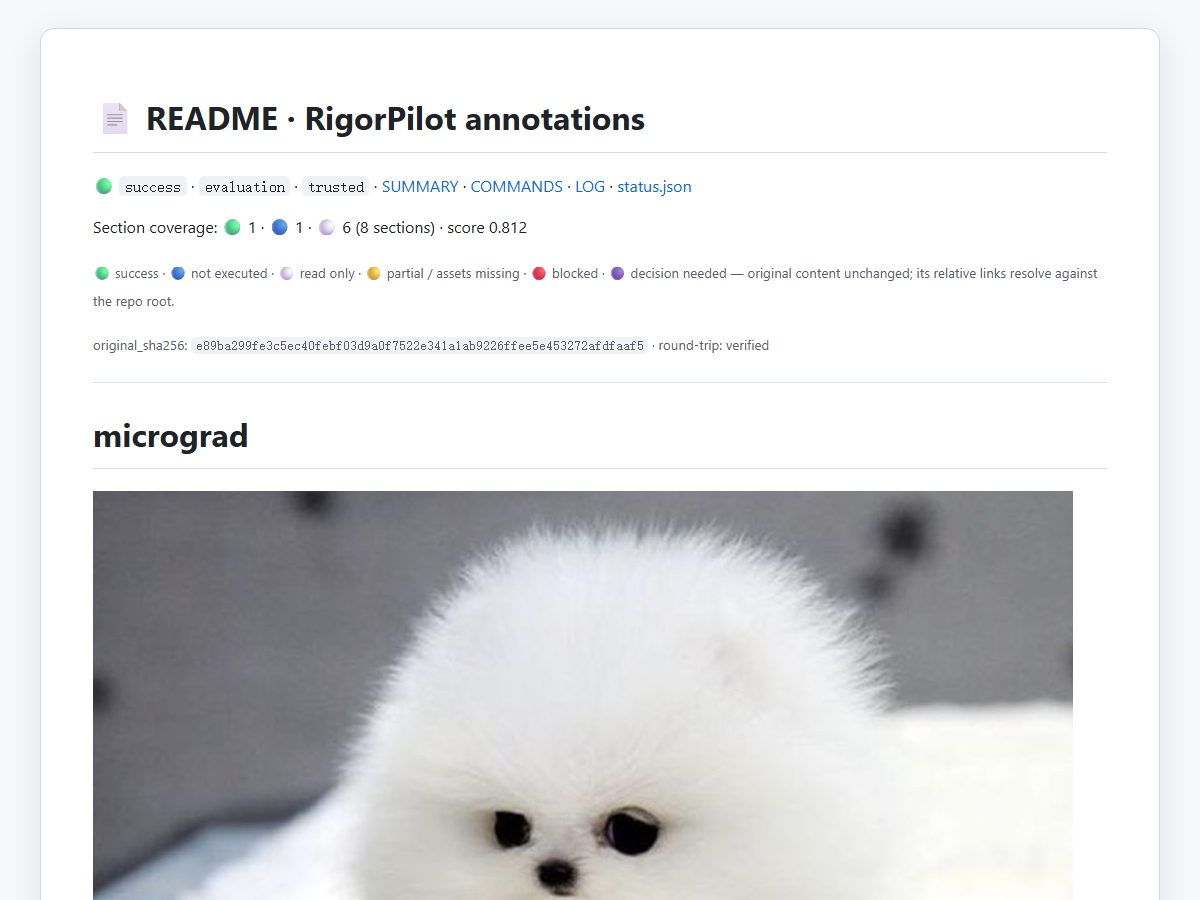 micrograd · correctness checks 🟢 2 tests passed in 7.62 s 8 headings = 8 annotations · original bytes preserved Open full RigorPilot README → |
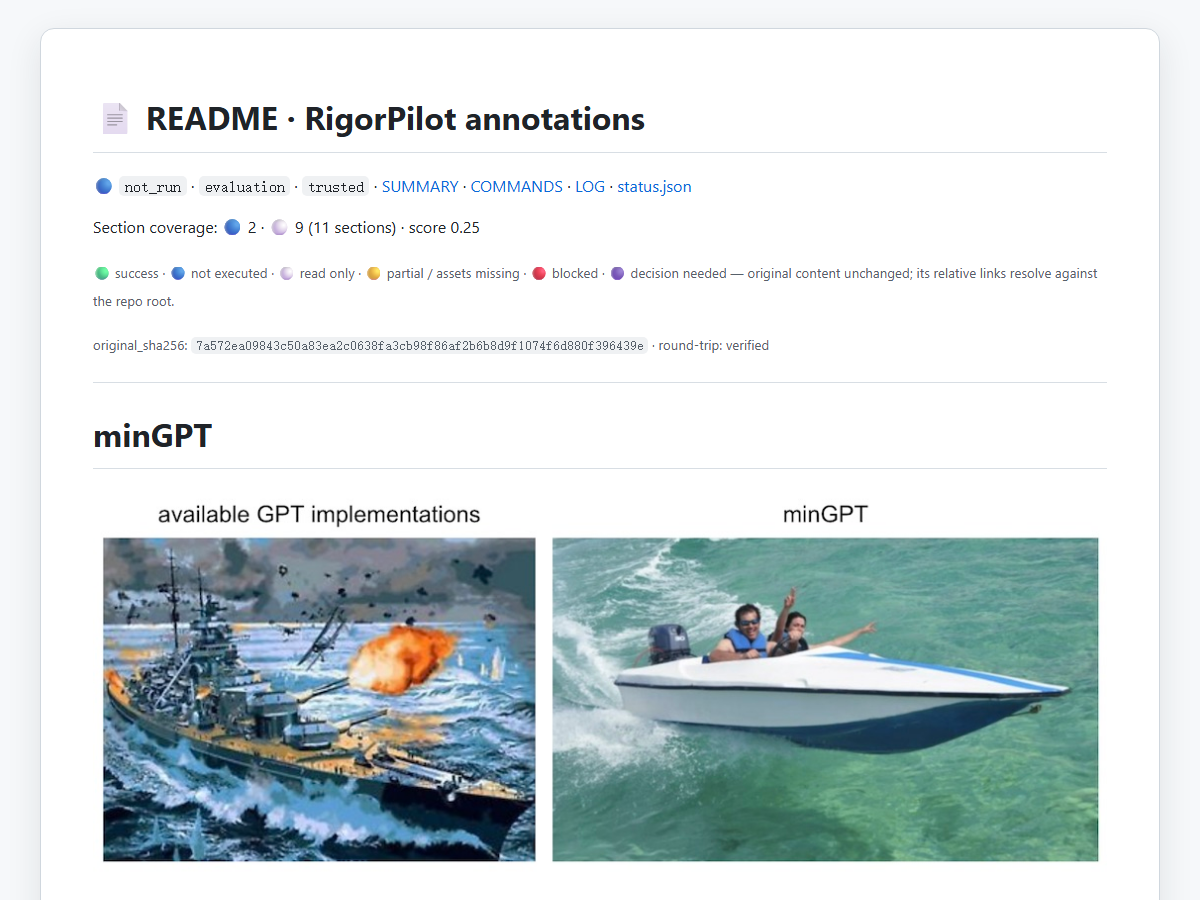 minGPT · selection boundary 🔵 Test selected, not executed · no model download 11 headings = 11 annotations · original bytes preserved Open full RigorPilot README → |
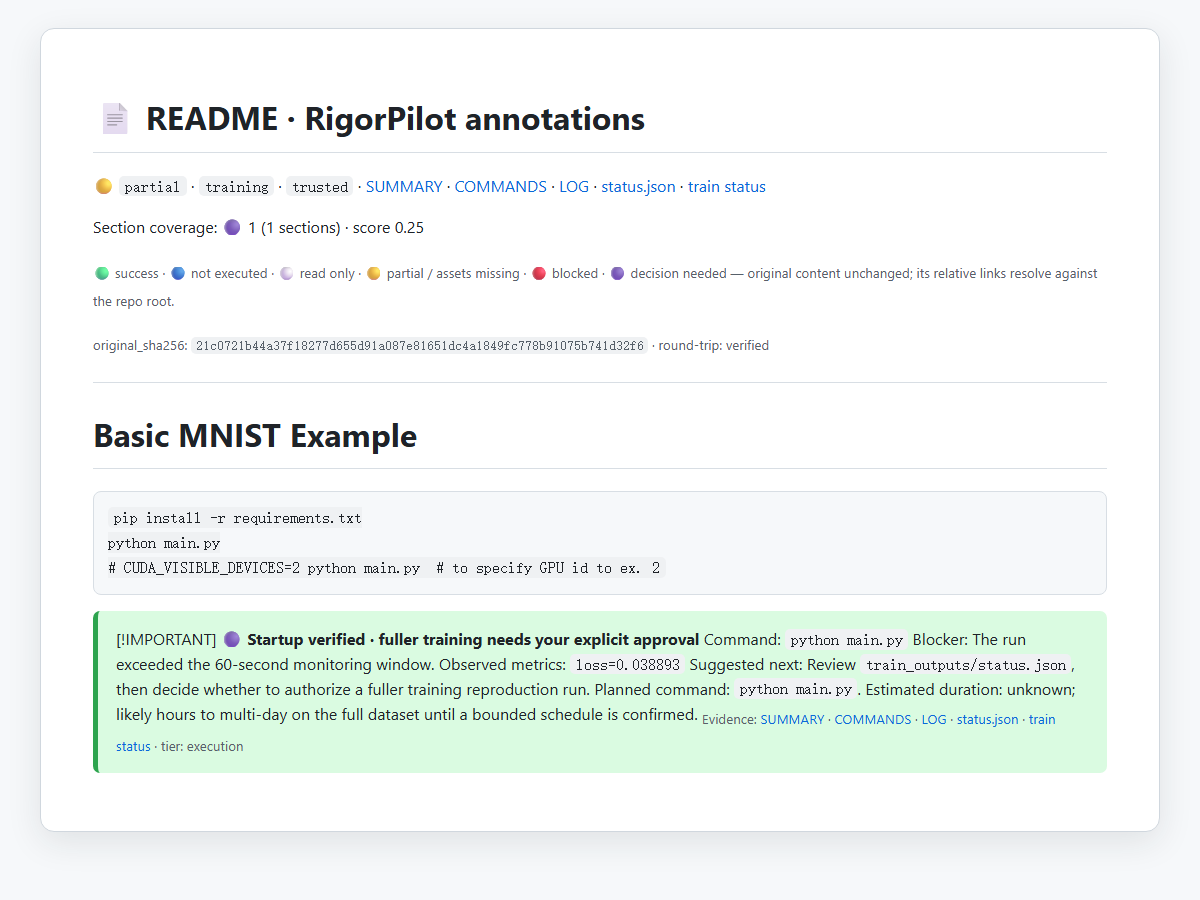 PyTorch MNIST · bounded startup 🟡 Partial training · observed loss 0.038893 1 heading = 1 annotation · original bytes preserved Open full RigorPilot README → |
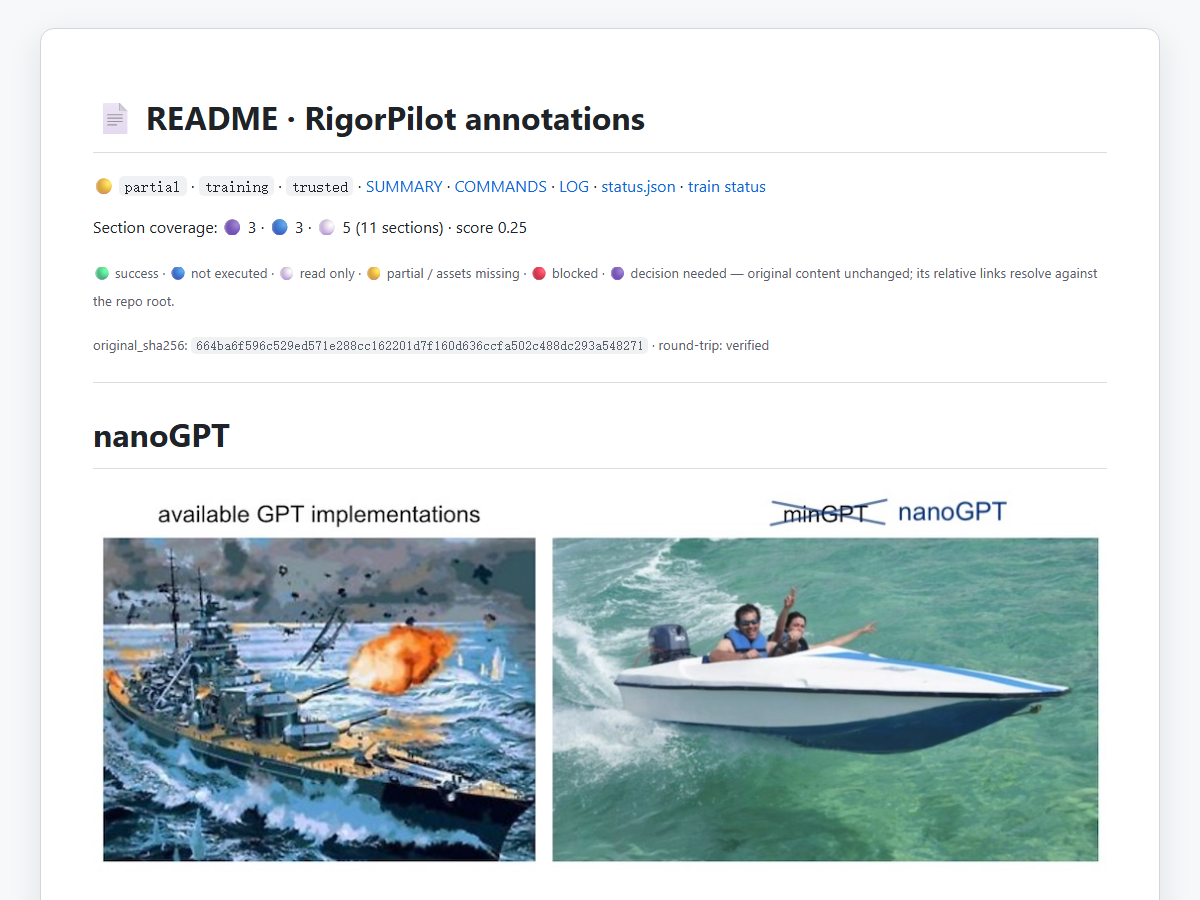 nanoGPT Shakespeare · bounded training 🟡 Partial · train loss 4.1676 · validation loss 4.1649 11 headings = 11 annotations · original bytes preserved Open full RigorPilot README → |
All four cases and upstream links · Recorded suite · Case definitions · Methodology
These are historical, commit-pinned deterministic runs: 4/4 case protocols
passed in 251.0 s, with a peak workspace of 98.67 MiB and 0 model API calls.
The zero-API count applies only to that suite. Selection-only and partial cases
are not completed evaluations, converged training or reproduced paper scores.
New: installed-skill micrograd trial, with before/after command reports, a retained failed attempt and independent checks—not a model-quality comparison.
Current acceptance: explicit named-skill and fresh-client natural-language AUTO both pass end to end; earlier failures remain retained and A/B/model uplift remain unrun. Compact status · real-client evidence
The installer needs Node.js/npm. Tested with [email protected] and Node 22.20.0;
that installer requires Node ≥22.20.0. If you see EBADENGINE, check the requested version.
Install the self-contained reproduction skill:
npx skills add lllllllama/RigorPilot-Skills --skill ai-research-reproduction
Install all skills for the companion research entrypoints:
npx skills add lllllllama/RigorPilot-Skills --all
These commands use the current GitHub repository name.
Open the target repository in a Skills-capable agent, then ask:
Use ai-research-reproduction: run the smallest README-documented evaluation, preserve the source and write evidence to repro_outputs/, plus an annotated copy beside the original README. Ask before large downloads or long training.
The main skill works alone; choose all skills for companion and leaf entrypoints. Your existing agent loads the skill. The standalone model runner is optional. Client compatibility
Recommended first run:
| Step | What it does | What it does not do |
|---|---|---|
| Plan | Lists README-backed cmd-XX candidates, selects the smallest trusted target, and returns a selection fingerprint | No target execution, installs, downloads, source edits or evidence writes |
| Run | Executes a reviewed command-id bound to that plan fingerprint and writes evidence under the target repo by default | Setup/download commands cannot be selected; a changed plan fails before target execution |
| Verify | Rechecks the retained evidence, README round trip, runtime state and current source snapshot | Does not rerun the target command |
Start with the RIGORPILOT_README.md reported in source_adjacent_readme.path,
then follow its command and log links. If a conflicting file blocks the extra
copy, that file stays intact; inspect repro_outputs/SUMMARY.md for the outcome
and next action.
README → documented target → reviewed setup → bounded execution → verification → evidence.
This is local execution, not an OS sandbox. Approved commands can access the host and network; use trusted repositories. Resource admission and between-action budget checks are not hard OS quotas or subscription-balance monitoring.
The optional model loop currently supports Anthropic Messages and reviewed command IDs, not unrestricted source repair. This standalone runner has no successful live-model acceptance recorded yet: three provider attempts returned HTTP 502. Other model profiles are metadata, not proof of working transports or equivalent model performance. Runner and recovery contract · Implementation evidence and limits
| Task | Skill |
|---|---|
| Reproduce from README commands | ai-research-reproduction |
| Read-only repository analysis | analyze-project |
| Prepare environment, data and weights | env-and-assets-bootstrap |
| Run documented inference or evaluation | minimal-run-and-audit |
| Start or verify training conservatively | run-train |
| Diagnose before proposing a patch | safe-debug |
| Coordinate authorized candidate exploration | ai-research-explore |
| Implement a candidate change on an isolated branch | explore-code |
| Execute a bounded candidate experiment | explore-run |
Two helpers support orchestration: repo-intake-and-plan and paper-context-resolver.
Exploration requires a durable current_research anchor and a frozen comparison
contract. Candidate results never become trusted baseline results by declaration.
Routing · Research loop ·
Campaign inputs
| Artifact | What to inspect |
|---|---|
repro_outputs/ANNOTATED_README.md | Original README with inserted section verdicts |
SUMMARY.md, COMMANDS.md, LOG.md, status.json | Outcome, exact commands, reviewed selection provenance, stable error.code, observations and machine-readable status |
invocation.json, evidence_manifest.json | Invocation/source-integrity summary plus retained file sizes and SHA-256 hashes for local consistency checks |
PATCHES.md, SCIENTIFIC_CHANGELOG.md, COMPARABILITY_REPORT.md | Changes, scientific meaning and comparison boundaries |
_runtime/<run_id>/ | Process state, events, resource samples and stdout/stderr |
.repro_job/ | Optional short-call supervisor: frozen request, reusable receipt, phase logs and completion-time verification |
agent_state.json, trajectory.jsonl | Optional model runner's checkpoints, tool calls and reported usage |
🟢 success · 🔵 not executed · ⚪ read only · 🟡 partial · 🔴 blocked · 🟣 decision required
Standard evidence stays under repro_outputs/. Both main runners accept
--source-adjacent-readme to also write RIGORPILOT_README.md beside the original,
preserving the context of its relative media/file links. Only inserted evidence
links are rebased. The same output directory may refresh its unchanged owned
copy, never an unrelated or manually edited file. Retain supporting repository
files and the evidence directory's readme_delivery.json.
Output contract · Rigor principles
For agent clients, the shortest normal path is --plan-only --agent-output, then
run a returned cmd-XX with its --plan-fingerprint, then --verify-output --agent-output.
The fingerprint binds execution to the reviewed README command set; setup/download
commands are excluded from reproduction candidates. Routine success should not
require reading orchestrator, bundle, writer, or runtime source.
When --output-dir is omitted, the orchestrator writes to the target repository's
repro_outputs/ directory, not the caller's current working directory.
The evidence manifest detects later changes against the retained manifest; it is
not a digital signature, external attestation or substitute for an OS sandbox.
Short tool-call hosts can opt in with --plan-only --include-agent-handoff to
receive identity-bound start/status/cancel argv. Ordinary plans omit this extra
control path. Short-call contract
For normal development, run the high-signal core suite first:
python -m pip install -r requirements-dev.txt
python scripts/run_all_tests.py --core
Before commit/release, run the complete automatically discovered suite:
python scripts/run_all_tests.py
python scripts/check_publication.py
The latest version-bound counts and timing are in the
acceptance ledger. Reports and complete per-script
logs are written outside the repository by default; use --report PATH to
choose a location. The core suite does not replace the full suite or CI.
For installed-layout functional acceptance without model calls:
python benchmarks/run_skill_acceptance.py --output tmp/skill-check
It covers positive/negative evidence behavior and can optionally include pinned micrograd when PyTorch/pytest already exist. Functional acceptance
For installation/environment problems (replace the skill path after installation):
python skills/ai-research-reproduction/scripts/doctor.py --repo /path/to/target
This read-only check reports the actual Python, Git, bundled-file integrity and
README availability. Add --require-module torch --require-module pytest for
dependency discovery; it does not install anything or execute target code.
Deeper checks are intentionally off the main path: benchmark methodology · agent runtime/fault evidence · paired A/B kit · controlled trials. Local tests do not substitute for live-model or held-out evaluation.
Engineering roadmap · Contributing · Security and reporting · CI workflow · Reproduction feedback · MIT license
Keep acceptance checks independent, retain failed evidence and review traces before publication. Do not publish credentials or unreviewed private repository data. Agent guidance · Operating principles · Personalization policy
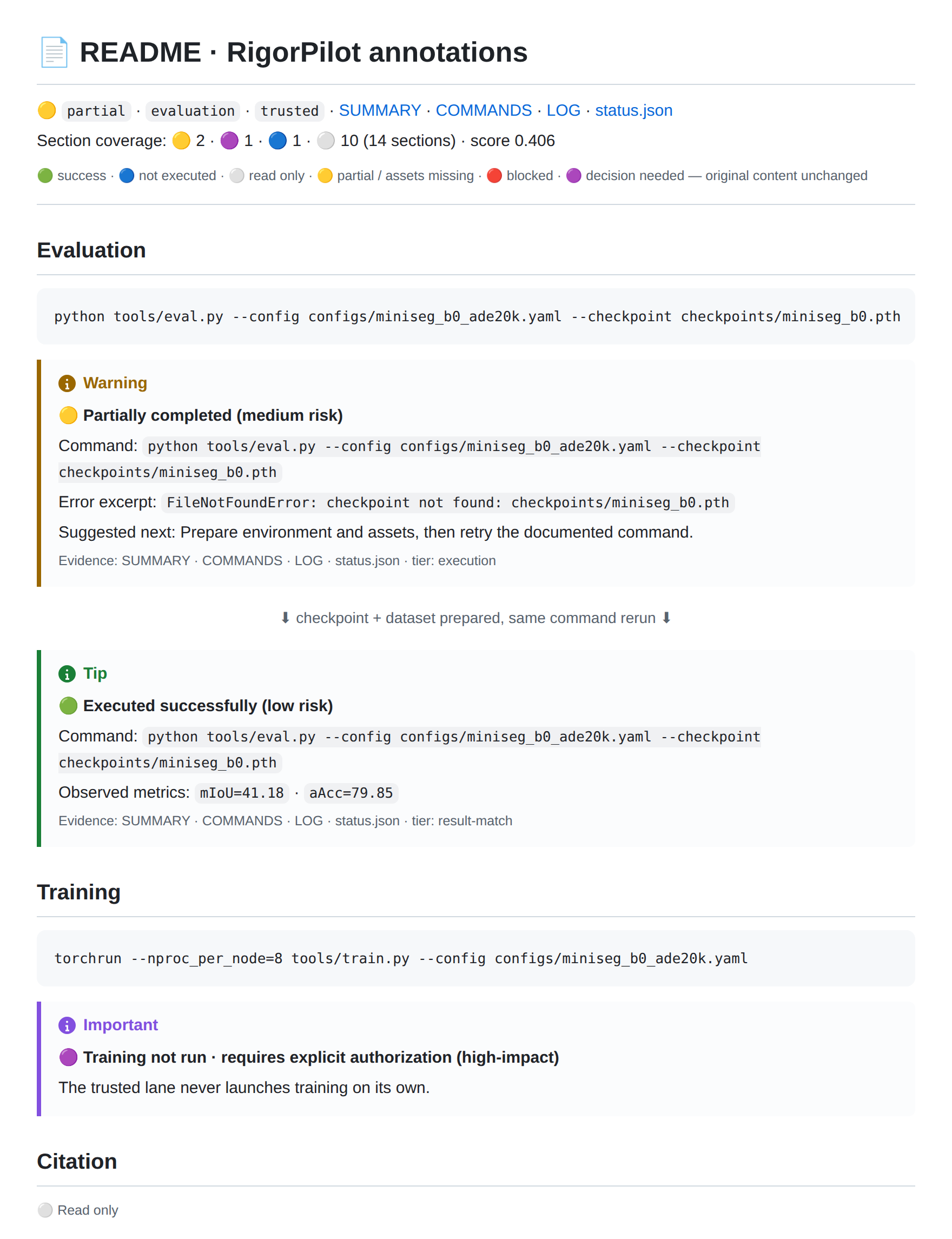
First attempt · After setup. This older MiniSeg preview illustrates error, metric and authorization displays. Its execution provenance is not independently verified; it is excluded from benchmarks.
README-first research reproduction skills with bounded execution, auditable evidence, and byte-preserving README annotations.
Python
485
89 commits
updated Sep 23, 2026
Run research repositories from their README, with bounded execution and auditable evidence. RigorPilot adds section-level results without rewriting the original README. Trusted reproduction is the default; candidate exploration requires explicit authorization.
Real examples · Install & use · Skill index · Validation · Engineering roadmap
Original commands, prose, badges, images, videos and HTML stay in the source file. RigorPilot splits that file into sections and inserts one evidence-linked card per section. Removing its insertion blocks restores the retained original README byte for byte.
Each card below opens a full annotated README beside the original README in a retained repository checkout. Supporting repository files are kept so relative links and media retain their original context.
🟢 selected checks passed · 🔵 not executed · ⚪ read only · 🟡 partial · 🔴 blocked · 🟣 decision needed. Green does not automatically mean paper-result reproduction; blue is not an execution failure.
|
micrograd · correctness checks 🟢 2 tests passed in 7.62 s 8 headings = 8 annotations · original bytes preserved Open full RigorPilot README → |
minGPT · selection boundary 🔵 Test selected, not executed · no model download 11 headings = 11 annotations · original bytes preserved Open full RigorPilot README → |
|
PyTorch MNIST · bounded startup 🟡 Partial training · observed loss 0.038893 1 heading = 1 annotation · original bytes preserved Open full RigorPilot README → |
nanoGPT Shakespeare · bounded training 🟡 Partial · train loss 4.1676 · validation loss 4.1649 11 headings = 11 annotations · original bytes preserved Open full RigorPilot README → |
All four cases and upstream links · Recorded suite · Case definitions · Methodology
These are historical, commit-pinned deterministic runs: 4/4 case protocols
passed in 251.0 s, with a peak workspace of 98.67 MiB and 0 model API calls.
The zero-API count applies only to that suite. Selection-only and partial cases
are not completed evaluations, converged training or reproduced paper scores.
New: installed-skill micrograd trial, with before/after command reports, a retained failed attempt and independent checks—not a model-quality comparison.
Current acceptance: explicit named-skill and fresh-client natural-language AUTO both pass end to end; earlier failures remain retained and A/B/model uplift remain unrun. Compact status · real-client evidence
The installer needs Node.js/npm. Tested with [email protected] and Node 22.20.0;
that installer requires Node ≥22.20.0. If you see EBADENGINE, check the requested version.
Install the self-contained reproduction skill:
npx skills add lllllllama/RigorPilot-Skills --skill ai-research-reproduction
Install all skills for the companion research entrypoints:
npx skills add lllllllama/RigorPilot-Skills --all
These commands use the current GitHub repository name.
Open the target repository in a Skills-capable agent, then ask:
Use ai-research-reproduction: run the smallest README-documented evaluation, preserve the source and write evidence to repro_outputs/, plus an annotated copy beside the original README. Ask before large downloads or long training.
The main skill works alone; choose all skills for companion and leaf entrypoints. Your existing agent loads the skill. The standalone model runner is optional. Client compatibility
Recommended first run:
| Step | What it does | What it does not do |
|---|---|---|
| Plan | Lists README-backed cmd-XX candidates, selects the smallest trusted target, and returns a selection fingerprint | No target execution, installs, downloads, source edits or evidence writes |
| Run | Executes a reviewed command-id bound to that plan fingerprint and writes evidence under the target repo by default | Setup/download commands cannot be selected; a changed plan fails before target execution |
| Verify | Rechecks the retained evidence, README round trip, runtime state and current source snapshot | Does not rerun the target command |
Start with the RIGORPILOT_README.md reported in source_adjacent_readme.path,
then follow its command and log links. If a conflicting file blocks the extra
copy, that file stays intact; inspect repro_outputs/SUMMARY.md for the outcome
and next action.
README → documented target → reviewed setup → bounded execution → verification → evidence.
This is local execution, not an OS sandbox. Approved commands can access the host and network; use trusted repositories. Resource admission and between-action budget checks are not hard OS quotas or subscription-balance monitoring.
The optional model loop currently supports Anthropic Messages and reviewed command IDs, not unrestricted source repair. This standalone runner has no successful live-model acceptance recorded yet: three provider attempts returned HTTP 502. Other model profiles are metadata, not proof of working transports or equivalent model performance. Runner and recovery contract · Implementation evidence and limits
| Task | Skill |
|---|---|
| Reproduce from README commands | ai-research-reproduction |
| Read-only repository analysis | analyze-project |
| Prepare environment, data and weights | env-and-assets-bootstrap |
| Run documented inference or evaluation | minimal-run-and-audit |
| Start or verify training conservatively | run-train |
| Diagnose before proposing a patch | safe-debug |
| Coordinate authorized candidate exploration | ai-research-explore |
| Implement a candidate change on an isolated branch | explore-code |
| Execute a bounded candidate experiment | explore-run |
Two helpers support orchestration: repo-intake-and-plan and paper-context-resolver.
Exploration requires a durable current_research anchor and a frozen comparison
contract. Candidate results never become trusted baseline results by declaration.
Routing · Research loop ·
Campaign inputs
| Artifact | What to inspect |
|---|---|
repro_outputs/ANNOTATED_README.md | Original README with inserted section verdicts |
SUMMARY.md, COMMANDS.md, LOG.md, status.json | Outcome, exact commands, reviewed selection provenance, stable error.code, observations and machine-readable status |
invocation.json, evidence_manifest.json | Invocation/source-integrity summary plus retained file sizes and SHA-256 hashes for local consistency checks |
PATCHES.md, SCIENTIFIC_CHANGELOG.md, COMPARABILITY_REPORT.md | Changes, scientific meaning and comparison boundaries |
_runtime/<run_id>/ | Process state, events, resource samples and stdout/stderr |
.repro_job/ | Optional short-call supervisor: frozen request, reusable receipt, phase logs and completion-time verification |
agent_state.json, trajectory.jsonl | Optional model runner's checkpoints, tool calls and reported usage |
🟢 success · 🔵 not executed · ⚪ read only · 🟡 partial · 🔴 blocked · 🟣 decision required
Standard evidence stays under repro_outputs/. Both main runners accept
--source-adjacent-readme to also write RIGORPILOT_README.md beside the original,
preserving the context of its relative media/file links. Only inserted evidence
links are rebased. The same output directory may refresh its unchanged owned
copy, never an unrelated or manually edited file. Retain supporting repository
files and the evidence directory's readme_delivery.json.
Output contract · Rigor principles
For agent clients, the shortest normal path is --plan-only --agent-output, then
run a returned cmd-XX with its --plan-fingerprint, then --verify-output --agent-output.
The fingerprint binds execution to the reviewed README command set; setup/download
commands are excluded from reproduction candidates. Routine success should not
require reading orchestrator, bundle, writer, or runtime source.
When --output-dir is omitted, the orchestrator writes to the target repository's
repro_outputs/ directory, not the caller's current working directory.
The evidence manifest detects later changes against the retained manifest; it is
not a digital signature, external attestation or substitute for an OS sandbox.
Short tool-call hosts can opt in with --plan-only --include-agent-handoff to
receive identity-bound start/status/cancel argv. Ordinary plans omit this extra
control path. Short-call contract
For normal development, run the high-signal core suite first:
python -m pip install -r requirements-dev.txt
python scripts/run_all_tests.py --core
Before commit/release, run the complete automatically discovered suite:
python scripts/run_all_tests.py
python scripts/check_publication.py
The latest version-bound counts and timing are in the
acceptance ledger. Reports and complete per-script
logs are written outside the repository by default; use --report PATH to
choose a location. The core suite does not replace the full suite or CI.
For installed-layout functional acceptance without model calls:
python benchmarks/run_skill_acceptance.py --output tmp/skill-check
It covers positive/negative evidence behavior and can optionally include pinned micrograd when PyTorch/pytest already exist. Functional acceptance
For installation/environment problems (replace the skill path after installation):
python skills/ai-research-reproduction/scripts/doctor.py --repo /path/to/target
This read-only check reports the actual Python, Git, bundled-file integrity and
README availability. Add --require-module torch --require-module pytest for
dependency discovery; it does not install anything or execute target code.
Deeper checks are intentionally off the main path: benchmark methodology · agent runtime/fault evidence · paired A/B kit · controlled trials. Local tests do not substitute for live-model or held-out evaluation.
Engineering roadmap · Contributing · Security and reporting · CI workflow · Reproduction feedback · MIT license
Keep acceptance checks independent, retain failed evidence and review traces before publication. Do not publish credentials or unreviewed private repository data. Agent guidance · Operating principles · Personalization policy
First attempt · After setup. This older MiniSeg preview illustrates error, metric and authorization displays. Its execution provenance is not independently verified; it is excluded from benchmarks.



