


A calendar app for Django
pip install django-scheduler
Edit your settings.py
Add to INSTALLED_APPS:
'schedule',
Add to TEMPLATE_CONTEXT_PROCESSORS:
"django.template.context_processors.request"
Django Scheduler's bundled templates use Bootstrap 5 and Bootstrap Icons loaded via CDN. The FullCalendar view also loads FullCalendar 6 via CDN.
No additional installation is needed — the default templates include all required CSS and JavaScript from CDN links.
If you prefer to manage frontend assets yourself (e.g., via npm, or self-hosted files), you can override the templates in your project.
Remember to execute "python manage.py collectstatic"
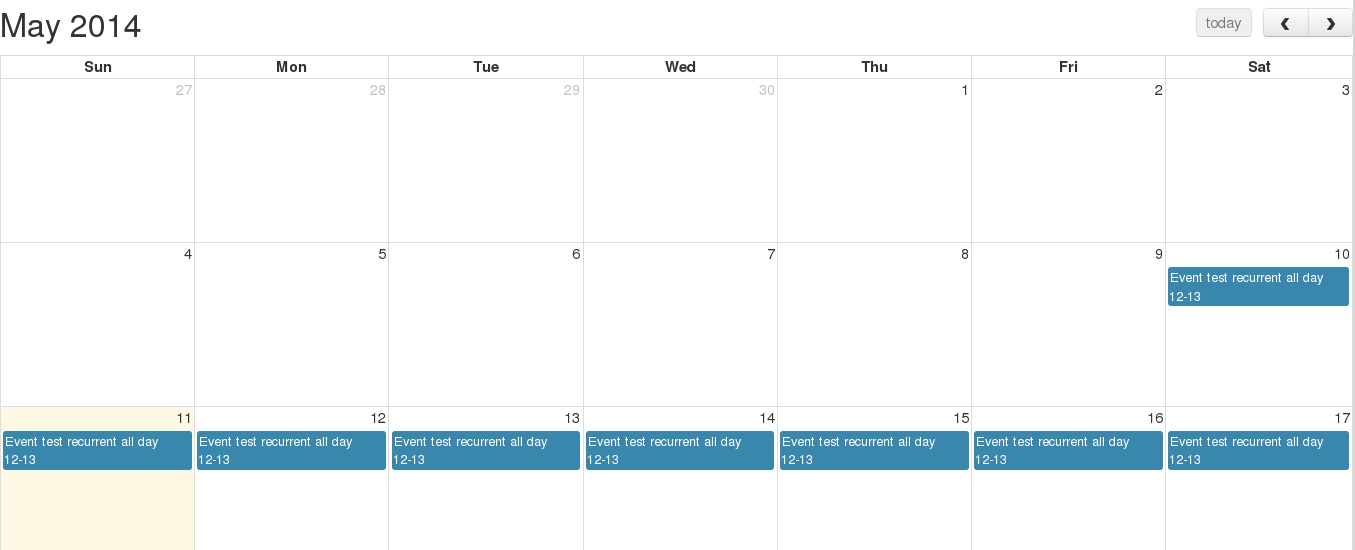
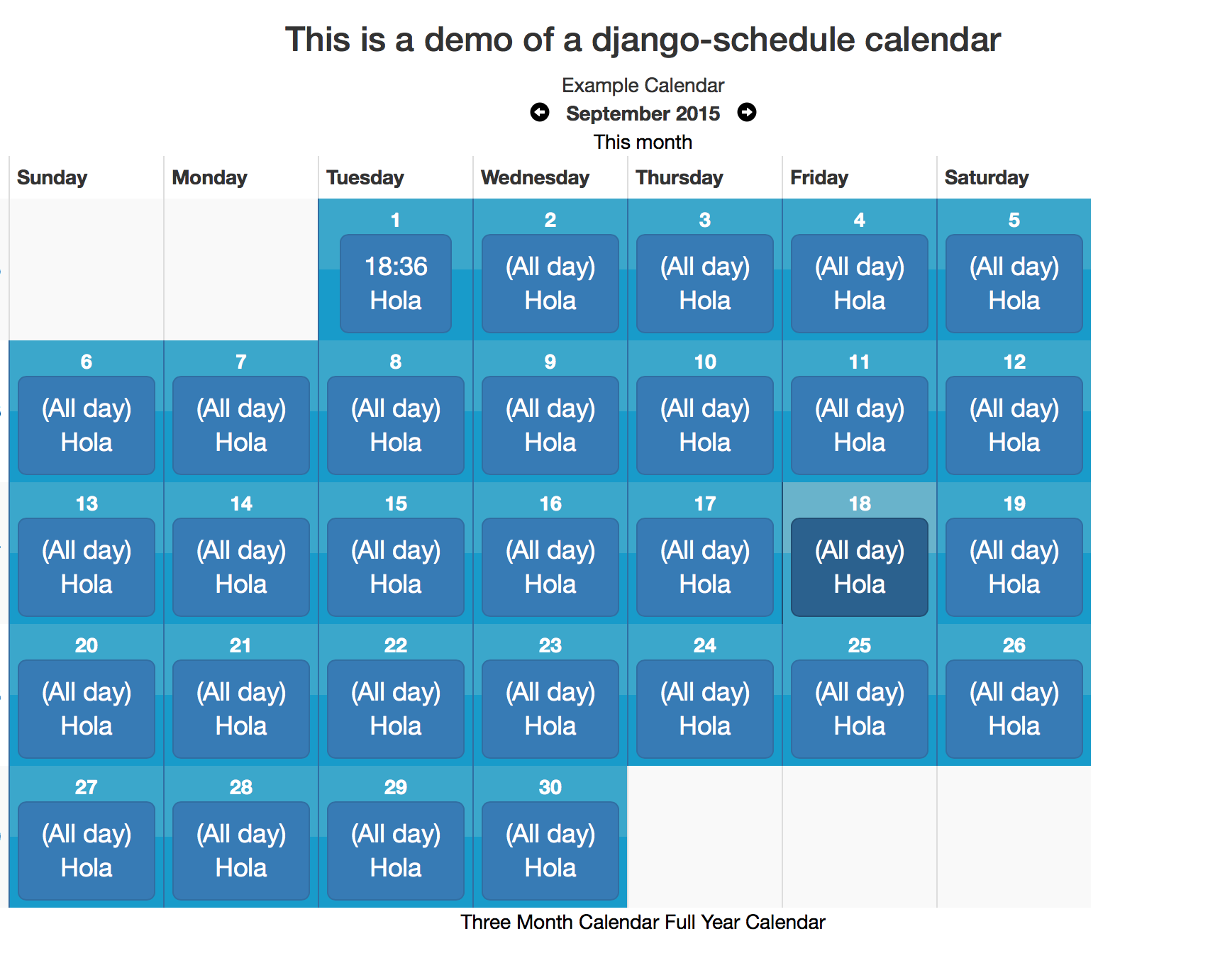
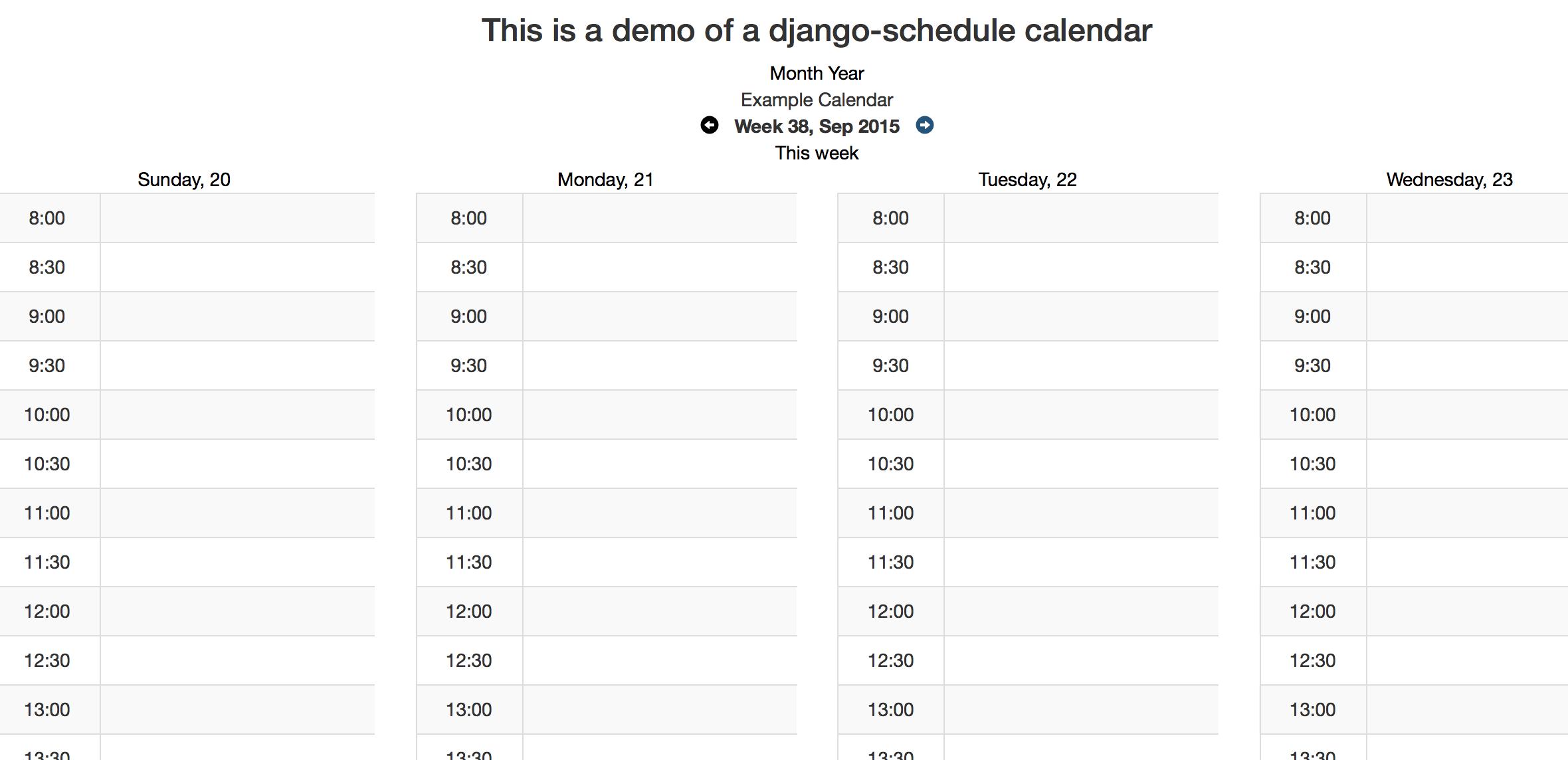

This setting determines which day of the week your calendar begins on if your locale doesn't already set it. Default is 0, which is Sunday.
This setting controls the behavior of Views.get_next_url. If set, all calendar modifications will redirect here (unless there is a next set in the request.)
This setting controls the behavior of Period.classify_occurrence. If True, then occurrences that have been cancelled will be displayed with a css class of canceled, otherwise they won't appear at all.
Defaults to False
This setting controls the callable used to determine if a user has permission to edit an event or occurrence. The callable must take the object (event) and the user and return a boolean.
Default:
    check_edit_permission(ob, user):
        return user.is_authenticated
If ob is None, then the function is checking for permission to add new events
This setting controls the callable used to determine if a user has permission to add, update or delete an events in specific calendar. The callable must take the object (calendar) and the user and return a boolean.
Default:
    check_edit_permission(ob, user):
        return user.is_authenticated
This setting controls the callable that gets all events for calendar display. The callable must take the request and the calendar and return a QuerySet of events. Modifying this setting allows you to pull events from multiple calendars or to filter events based on permissions
Default:
    get_events(request, calendar):
        return calendar.event_set.all()
This settings allows to set the upper and lower limit in calendars navigation. Value is in seconds.
Default (two years): 62208000
To run tests on all supported versions of Django and Python, use tox:
$ tox
Update the version in pyproject.toml and add a changelog entry.
Commit, tag, and push:
git commit -am "Release X.Y.Z"
git tag vX.Y.Z
git push && git push --tags
uv build
uv publish --token pypi-YOUR_TOKEN
You can generate an API token at https://pypi.org/manage/account/token/.
Overall
Maintained
Code review
PyPI
Latest release
Releases this year
261 followers · starred Aug 2019
40 followers · starred Nov 2017
35 followers · starred May 2015
A calendar app for Django
pip install django-scheduler
Edit your settings.py
Add to INSTALLED_APPS:
'schedule',
Add to TEMPLATE_CONTEXT_PROCESSORS:
"django.template.context_processors.request"
Django Scheduler's bundled templates use Bootstrap 5 and Bootstrap Icons loaded via CDN. The FullCalendar view also loads FullCalendar 6 via CDN.
No additional installation is needed — the default templates include all required CSS and JavaScript from CDN links.
If you prefer to manage frontend assets yourself (e.g., via npm, or self-hosted files), you can override the templates in your project.
Remember to execute "python manage.py collectstatic"
This setting determines which day of the week your calendar begins on if your locale doesn't already set it. Default is 0, which is Sunday.
This setting controls the behavior of Views.get_next_url. If set, all calendar modifications will redirect here (unless there is a next set in the request.)
This setting controls the behavior of Period.classify_occurrence. If True, then occurrences that have been cancelled will be displayed with a css class of canceled, otherwise they won't appear at all.
Defaults to False
This setting controls the callable used to determine if a user has permission to edit an event or occurrence. The callable must take the object (event) and the user and return a boolean.
Default:
    check_edit_permission(ob, user):
        return user.is_authenticated
If ob is None, then the function is checking for permission to add new events
This setting controls the callable used to determine if a user has permission to add, update or delete an events in specific calendar. The callable must take the object (calendar) and the user and return a boolean.
Default:
    check_edit_permission(ob, user):
        return user.is_authenticated
This setting controls the callable that gets all events for calendar display. The callable must take the request and the calendar and return a QuerySet of events. Modifying this setting allows you to pull events from multiple calendars or to filter events based on permissions
Default:
    get_events(request, calendar):
        return calendar.event_set.all()
This settings allows to set the upper and lower limit in calendars navigation. Value is in seconds.
Default (two years): 62208000
To run tests on all supported versions of Django and Python, use tox:
$ tox
Update the version in pyproject.toml and add a changelog entry.
Commit, tag, and push:
git commit -am "Release X.Y.Z"
git tag vX.Y.Z
git push && git push --tags
uv build
uv publish --token pypi-YOUR_TOKEN
You can generate an API token at https://pypi.org/manage/account/token/.
Overall
Maintained
Code review
PyPI
Latest release
Releases this year
261 followers · starred Aug 2019
40 followers · starred Nov 2017
35 followers · starred May 2015



