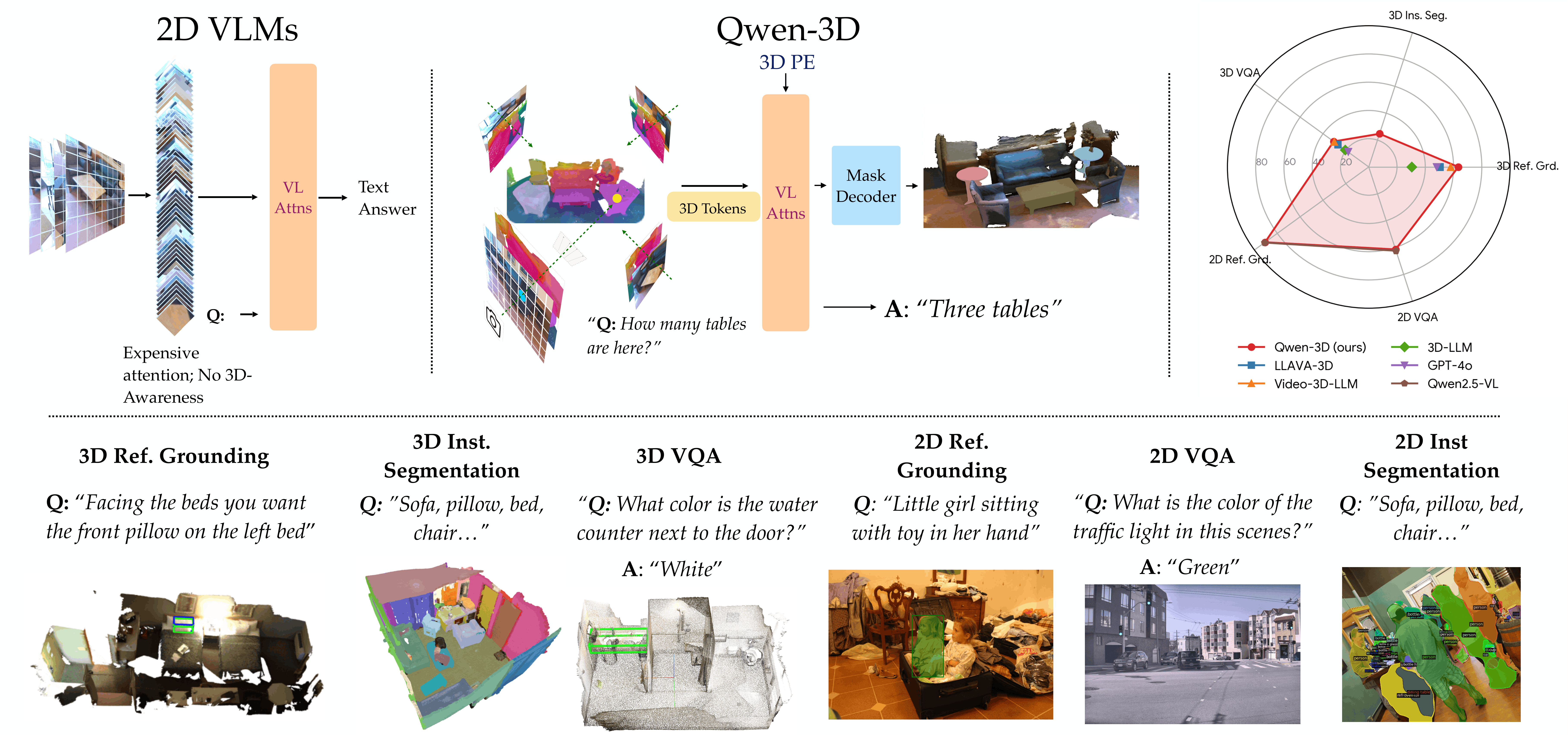
Code repository for Qwen-3D: A Generalist 3D Vision-Language Model for Spatial Understanding
Python
102
6 commits
updated Oct 12, 2026
Lucy Lin*
Ayush Jain*
Yifan Liu
Katerina Fragkiadaki
Carnegie Mellon University





Install dependencies:
conda create -n qwen3d python=3.12
conda activate qwen3d

# (Optional) If no CUDA is installed
conda install cuda cuda-nvcc -c nvidia/label/cuda-12.9.0
export LD_LIBRARY_PATH="$CONDA_PREFIX/lib:$LD_LIBRARY_PATH"
export CUDA_HOME=$CONDA_PREFIX

pip install torch==2.12.1 torchvision==0.27.1 --index-url https://download.pytorch.org/whl/cu129
pip install torch-scatter --no-build-isolation
pip install 'git+https://github.com/facebookresearch/detectron2.git' --no-build-isolation
pip install git+https://github.com/facebookresearch/pytorch3d.git@stable --no-build-isolation
bash docs/init.sh
pip install -r requirements.txt
python -m spacy download en_core_web_sm
python -c 'import nltk; nltk.download("stopwords")'
For instructions on how to download and pre-process the data, see docs/DATA.md.
Download pretrained Qwen-3D weights from Hugging Face:
mkdir -p ckpts
hf download katefgroup/Qwen-3D qwen3d_3b.pth --local-dir ckpts
hf download katefgroup/Qwen-3D qwen3d_7b.pth --local-dir ckpts
Use the checkpoint that matches your backbone (QWEN_MODEL):
| Checkpoint | Backbone |
|---|---|
ckpts/qwen3d_3b.pth | Qwen/Qwen2.5-VL-3B-Instruct (default) |
ckpts/qwen3d_7b.pth | Qwen/Qwen2.5-VL-7B-Instruct |
Load weights with MODEL.WEIGHTS (and match QWEN_MODEL), for example:
CKPT_PATH="ckpts/qwen3d_3b.pth"
# add to your train/eval command:
MODEL.WEIGHTS "$CKPT_PATH" \
QWEN_MODEL "Qwen/Qwen2.5-VL-3B-Instruct"
For evaluation-only runs, set EVAL_ONLY=1 (see docs/RUN.md).
Optional precomputed Qwen2.5-VL ViT features for ScanNet RGB frames are available on Hugging Face. Enabling them skips the ViT forward on cache hits and speeds up ScanNet training.
hf download katefgroup/qwen3d_cached_scannet_vit_features --local-dir ./qwen3d_cached_scannet_vit_features

FEATURE_DIR="/path/to/scannet_image_qwen_features"
mkdir -p "$FEATURE_DIR"
tar -xf ./qwen3d_cached_scannet_vit_features/scannet_image_qwen_features_3b.tar -C "$FEATURE_DIR"
tar -xf ./qwen3d_cached_scannet_vit_features/scannet_image_qwen_features_7b.tar -C "$FEATURE_DIR"
Each archive unpacks under a backbone prefix, yielding:
FEATURE_DIR/
  3b/<scene_id>/<frame>.pt
  7b/<scene_id>/<frame>.pt
Point training at the parent FEATURE_DIR (the code resolves 3b / 7b from QWEN_MODEL):
CACHE_QWEN_FEATURES True \
FEATURE_DIR "/path/to/scannet_image_qwen_features" \
QWEN_MODEL "Qwen/Qwen2.5-VL-3B-Instruct"
Caching applies to ScanNet datasets only. Leave CACHE_QWEN_FEATURES False (default) if you are not using cached features. To rebuild the cache yourself, see docs/cache_qwen_vit_features.py and docs/RUN.md.
See docs/RUN.md for training and evaluation commands.
DETECTRON2_DATASETS to the path where you store the Posed RGB-D data. You might also need to change 3D Mesh point cloud paths (like SCANNET_DATA_DIR) for each script. You may want to find these variables in qwen3d/config.py and permanently modify these paths.MODEL.WEIGHTS to a downloaded checkpoint (see Checkpoints) and match QWEN_MODEL. For evaluation, set EVAL_ONLY=1.CACHE_QWEN_FEATURES True and FEATURE_DIR (see Cached ScanNet ViT Features).SOLVER.IMS_PER_BATCH controls the batch size. This is effective batch size i.e. if you are running on 2 GPUs and the batch size is set to 6, you are using bs=3 per GPU.SOLVER.TEST_IMS_PER_BATCH controls the (effective) test batch size. Since, there are variable number of images in a scene, we use bs=1 per GPU at test time. MAX_FRAME_NUM=-1 means that it loads all images in a scene for inference, which is our usual strategy. In some datasets, the images can simply be too large, thus there we actually set a maximum limit on images.INPUT.SAMPLING_FRAME_NUM controls the number of images we sample at test time -- for eg. in ScanNet, we train on 25 image chunks at training time.CHECKPOINT_PERIOD is the number of iterations after which a checkpoint is saved. EVAL_PERIOD specifies the number of steps after which the eval is run.OUTPUT_DIR stores the checkpoints and the tensorboard logs. --resume resumes the training from the last checkpoint stored in OUTPUT_DIR. If no checkpoint is present, it loads the weights from MODEL.WEIGHTSDATASETS.TRAIN and DATASETS.TEST flags control the datasets in the training and evaluation set. Check docs/RUN.md for scripts with various combinations of training sets and the flags associated with them.BS, BS2D, BS3D, and BBS all control the batch sizes with various training setups. We train with batch_size=1 due to memory constraints - the current model forward will not accept different batch sizes. We are looking to fix this later.@inproceedings{lin2026qwen3d,
title = {Qwen-3D: A Generalist 3D Vision-Language Model for Spatial Understanding},
author = {Lin, Lucy and Jain, Ayush and Liu, Yifan and Fragkiadaki, Katerina},
booktitle = {European Conference on Computer Vision (ECCV)},
year = {2026}
}
108 followers · starred Aug 2026
Code repository for Qwen-3D: A Generalist 3D Vision-Language Model for Spatial Understanding
Python
102
6 commits
updated Oct 12, 2026
Lucy Lin*
Ayush Jain*
Yifan Liu
Katerina Fragkiadaki
Carnegie Mellon University
Install dependencies:
conda create -n qwen3d python=3.12
conda activate qwen3d

# (Optional) If no CUDA is installed
conda install cuda cuda-nvcc -c nvidia/label/cuda-12.9.0
export LD_LIBRARY_PATH="$CONDA_PREFIX/lib:$LD_LIBRARY_PATH"
export CUDA_HOME=$CONDA_PREFIX

pip install torch==2.12.1 torchvision==0.27.1 --index-url https://download.pytorch.org/whl/cu129
pip install torch-scatter --no-build-isolation
pip install 'git+https://github.com/facebookresearch/detectron2.git' --no-build-isolation
pip install git+https://github.com/facebookresearch/pytorch3d.git@stable --no-build-isolation
bash docs/init.sh
pip install -r requirements.txt
python -m spacy download en_core_web_sm
python -c 'import nltk; nltk.download("stopwords")'
For instructions on how to download and pre-process the data, see docs/DATA.md.
Download pretrained Qwen-3D weights from Hugging Face:
mkdir -p ckpts
hf download katefgroup/Qwen-3D qwen3d_3b.pth --local-dir ckpts
hf download katefgroup/Qwen-3D qwen3d_7b.pth --local-dir ckpts
Use the checkpoint that matches your backbone (QWEN_MODEL):
| Checkpoint | Backbone |
|---|---|
ckpts/qwen3d_3b.pth | Qwen/Qwen2.5-VL-3B-Instruct (default) |
ckpts/qwen3d_7b.pth | Qwen/Qwen2.5-VL-7B-Instruct |
Load weights with MODEL.WEIGHTS (and match QWEN_MODEL), for example:
CKPT_PATH="ckpts/qwen3d_3b.pth"
# add to your train/eval command:
MODEL.WEIGHTS "$CKPT_PATH" \
QWEN_MODEL "Qwen/Qwen2.5-VL-3B-Instruct"
For evaluation-only runs, set EVAL_ONLY=1 (see docs/RUN.md).
Optional precomputed Qwen2.5-VL ViT features for ScanNet RGB frames are available on Hugging Face. Enabling them skips the ViT forward on cache hits and speeds up ScanNet training.
hf download katefgroup/qwen3d_cached_scannet_vit_features --local-dir ./qwen3d_cached_scannet_vit_features

FEATURE_DIR="/path/to/scannet_image_qwen_features"
mkdir -p "$FEATURE_DIR"
tar -xf ./qwen3d_cached_scannet_vit_features/scannet_image_qwen_features_3b.tar -C "$FEATURE_DIR"
tar -xf ./qwen3d_cached_scannet_vit_features/scannet_image_qwen_features_7b.tar -C "$FEATURE_DIR"
Each archive unpacks under a backbone prefix, yielding:
FEATURE_DIR/
  3b/<scene_id>/<frame>.pt
  7b/<scene_id>/<frame>.pt
Point training at the parent FEATURE_DIR (the code resolves 3b / 7b from QWEN_MODEL):
CACHE_QWEN_FEATURES True \
FEATURE_DIR "/path/to/scannet_image_qwen_features" \
QWEN_MODEL "Qwen/Qwen2.5-VL-3B-Instruct"
Caching applies to ScanNet datasets only. Leave CACHE_QWEN_FEATURES False (default) if you are not using cached features. To rebuild the cache yourself, see docs/cache_qwen_vit_features.py and docs/RUN.md.
See docs/RUN.md for training and evaluation commands.
DETECTRON2_DATASETS to the path where you store the Posed RGB-D data. You might also need to change 3D Mesh point cloud paths (like SCANNET_DATA_DIR) for each script. You may want to find these variables in qwen3d/config.py and permanently modify these paths.MODEL.WEIGHTS to a downloaded checkpoint (see Checkpoints) and match QWEN_MODEL. For evaluation, set EVAL_ONLY=1.CACHE_QWEN_FEATURES True and FEATURE_DIR (see Cached ScanNet ViT Features).SOLVER.IMS_PER_BATCH controls the batch size. This is effective batch size i.e. if you are running on 2 GPUs and the batch size is set to 6, you are using bs=3 per GPU.SOLVER.TEST_IMS_PER_BATCH controls the (effective) test batch size. Since, there are variable number of images in a scene, we use bs=1 per GPU at test time. MAX_FRAME_NUM=-1 means that it loads all images in a scene for inference, which is our usual strategy. In some datasets, the images can simply be too large, thus there we actually set a maximum limit on images.INPUT.SAMPLING_FRAME_NUM controls the number of images we sample at test time -- for eg. in ScanNet, we train on 25 image chunks at training time.CHECKPOINT_PERIOD is the number of iterations after which a checkpoint is saved. EVAL_PERIOD specifies the number of steps after which the eval is run.OUTPUT_DIR stores the checkpoints and the tensorboard logs. --resume resumes the training from the last checkpoint stored in OUTPUT_DIR. If no checkpoint is present, it loads the weights from MODEL.WEIGHTSDATASETS.TRAIN and DATASETS.TEST flags control the datasets in the training and evaluation set. Check docs/RUN.md for scripts with various combinations of training sets and the flags associated with them.BS, BS2D, BS3D, and BBS all control the batch sizes with various training setups. We train with batch_size=1 due to memory constraints - the current model forward will not accept different batch sizes. We are looking to fix this later.@inproceedings{lin2026qwen3d,
title = {Qwen-3D: A Generalist 3D Vision-Language Model for Spatial Understanding},
author = {Lin, Lucy and Jain, Ayush and Liu, Yifan and Fragkiadaki, Katerina},
booktitle = {European Conference on Computer Vision (ECCV)},
year = {2026}
}
108 followers · starred Aug 2026



