[ICLR 2024 Spotlight] SyncDreamer: Generating Multiview-consistent Images from a Single-view Image
See the codeSyncDreamer: Generating Multiview-consistent Images from a Single-view Image
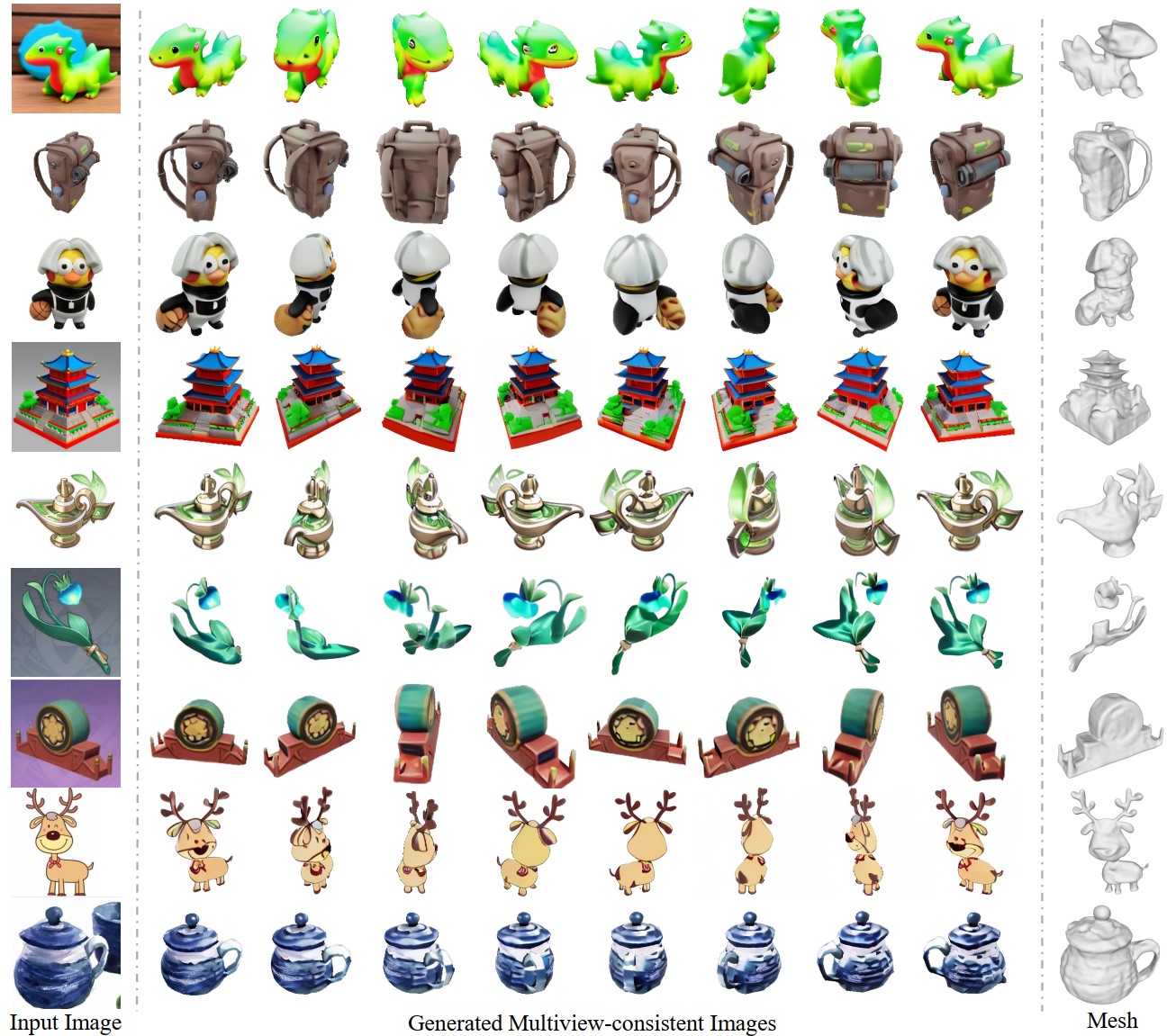
requirements.txt. We test our model on a 40G A100 GPU with 11.1 CUDA and 1.10.2 pytorch. But inference on GPUs with smaller memory (=10G) is possible.conda create -n syncdreamer
conda activate syncdreamer
pip install -r requirements.txt
SyncDreamer
|-- ckpt
    |-- ViT-L-14.ckpt
    |-- syncdreamer-pretrain.ckpt
foreground_segment.py using carvekit to predict foreground masks and you need to first crop the object region before feeding it to foreground_segment.py. We may double check the predicted masks are correct or not.python foreground_segment.py --input <image-file-to-input> --output <image-file-in-png-format-to-output>
python generate.py --ckpt ckpt/syncdreamer-pretrain.ckpt \
                   --input testset/aircraft.png \
                   --output output/aircraft \
                   --sample_num 4 \
                   --cfg_scale 2.0 \
                   --elevation 30 \
                   --crop_size 200
Explanation:
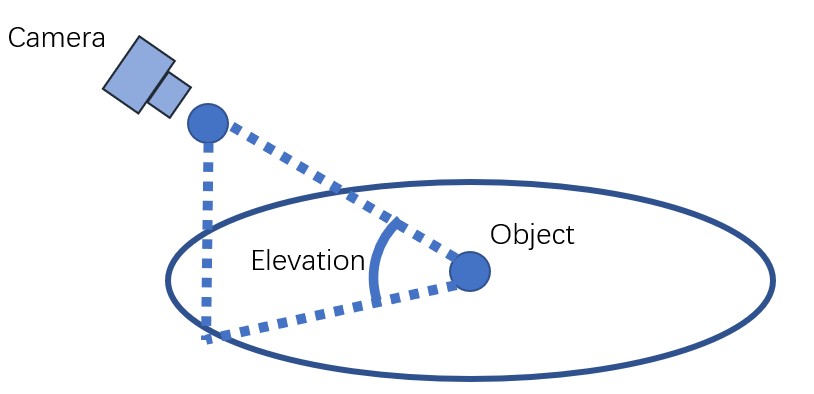
--ckpt is the checkpoint to load.--input is the input image in the RGBA form. The alpha value means the foreground object mask.--output is the output directory. Results would be saved to output/aircraft/0.png which contains 16 images of predefined viewpoints per png file.--sample_num is the number of instances we will generate. --sample_num 4 means we sample 4 instances from output/aircraft/0.png to output/aircraft/3.png.--cfg_scale is the classifier-free-guidance. 2.0 is OK for most cases. We may also try 1.5.--elevation is the elevation angle of the input image in degree. As shown in the following figure,
--crop_size affects how we resize the object on the input image. The input image will be resize to 256*256 and the object region is resized to crop_size as follows. crop_size=-1 means we do not resize the object but only directly resize the input image to 256*256.
crop_size=200 works in most cases. We may also try 180 or 150.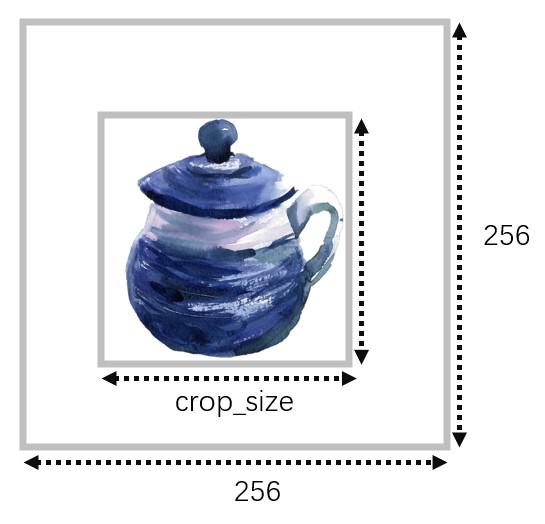
crop_size and elevation to get the best result. SyncDreamer does not always produce good results but we may generate multiple times with different --seed and select the most reasonable one.--sample_num 1 and --batch_view_num 4, which samples 1 instance and denoises 4 images on every step. This costs less than 10G GPU memory but is much slower in generation.# train a neus
python train_renderer.py -i output/aircraft/0.png \
-n aircraft-neus \
-b configs/neus.yaml \
-l output/renderer
# train a nerf
python train_renderer.py -i output/aircraft/0.png \
-n aircraft-nerf \
-b configs/nerf.yaml \
-l output/renderer
Explanation:
-i contains the multiview images generated by SyncDreamer. Since SyncDreamer does not always produce good results, we may need to select a good generated image set (from 0.png to 3.png) for reconstruction.-n means the name. -l means the log dir. Results will be saved to <log_dir>/<name> i.e. output/renderer/aircraft-neus and output/renderer/aircraft-nerf.carvekit to find the foreground mask in _init_dataset() in renderer/renderer.py. The resulted masked images locate at output/renderer/aircraft-nerf/masked-*.png. Sometimes, carvekit may produce incorrect masks.output/renderer/aircraft-neus/rendering.mp4 or output/renderer/aircraft-nerf/rendering.mp4.output/renderer/aircraft-neus/mesh.ply.random dataset, we need to cat z01 zip > zip and then unzip the output file according to the description here# generate renderings for fixed target views
blender --background --python blender_script.py -- \
--object_path objaverse_examples/6f99fb8c2f1a4252b986ed5a765e1db9/6f99fb8c2f1a4252b986ed5a765e1db9.glb \
--output_dir ./training_examples/target --camera_type fixed
# generate renderings for random input views
blender --background --python blender_script.py -- \
--object_path objaverse_examples/6f99fb8c2f1a4252b986ed5a765e1db9/6f99fb8c2f1a4252b986ed5a765e1db9.glb \
--output_dir ./training_examples/input --camera_type random
SyncDreamer
|-- training_examples
    |-- target
        |-- <renderings-of-uid-0>
        |-- <renderings-of-uid-1>
        |-- ...
    |-- input
        |-- <renderings-of-uid-0>
        |-- <renderings-of-uid-1>
        |-- ...
    |-- uid_set.pkl # this is a .pkl file containing a list of uids. Refer to `render_batch.py` for how I generate these files.
python train_syncdreamer.py -b configs/syncdreamer-train.yaml \
                           --finetune_from <path-to-your-zero123-xl-model> \
                           -l <logging-directory>  \
                           -c <checkpoint-directory> \
                           --gpus 0,1,2,3,4,5,6,7
Note in configs/syncdreamer-train.yaml, we specify the following directories which contain the training data and the validation data.
target_dir: training_examples/target
input_dir: training_examples/input
uid_set_pkl: training_examples/uid_set.pkl
validation_dir: validation_set
During training, we will run validation to output images to <log_dir>/<images>/val every 1k steps.
GT meshes and renderings for the GSO dataset can be found at here.
python eval_colmap.py --dir eval_examples/chicken-pr --project eval_examples/chicken-project --name chicken --colmap <path-to-your-colmap>
Note the 16 views are relatively very sparse for COLMAP so it sometimes fails to reconstruct.
2. Evaluate novel view synthesis, pip install lpips and
python eval_nvs.py --gt eval_examples/chicken-gt --pr eval_examples/chicken-pr
pip install mesh2sdf and install nvdiffrast here. Then,python eval_mesh.py --pr_mesh eval_examples/chicken-pr.ply --pr_name syncdreamer --gt_dir eval_examples/chicken-gt --gt_mesh eval_examples/chicken-mesh/meshes/model.obj --gt_name chicken
Note we manually rotate the example when rendering. The rotations are listed in get_gt_rotate_angle in eval_mesh.py.
We have intensively borrow codes from the following repositories. Many thanks to the authors for sharing their codes.
If you find this repository useful in your project, please cite the following work. :)
@article{liu2023syncdreamer,
  title={SyncDreamer: Generating Multiview-consistent Images from a Single-view Image},
  author={Liu, Yuan and Lin, Cheng and Zeng, Zijiao and Long, Xiaoxiao and Liu, Lingjie and Komura, Taku and Wang, Wenping},
  journal={arXiv preprint arXiv:2309.03453},
  year={2023}
}
565 followers · starred Sep 2023
157 followers · starred Sep 2023
146 followers · starred Aug 2024
47 followers · starred Dec 2023
[ICLR 2024 Spotlight] SyncDreamer: Generating Multiview-consistent Images from a Single-view Image
See the codeSyncDreamer: Generating Multiview-consistent Images from a Single-view Image
requirements.txt. We test our model on a 40G A100 GPU with 11.1 CUDA and 1.10.2 pytorch. But inference on GPUs with smaller memory (=10G) is possible.conda create -n syncdreamer
conda activate syncdreamer
pip install -r requirements.txt
SyncDreamer
|-- ckpt
    |-- ViT-L-14.ckpt
    |-- syncdreamer-pretrain.ckpt
foreground_segment.py using carvekit to predict foreground masks and you need to first crop the object region before feeding it to foreground_segment.py. We may double check the predicted masks are correct or not.python foreground_segment.py --input <image-file-to-input> --output <image-file-in-png-format-to-output>
python generate.py --ckpt ckpt/syncdreamer-pretrain.ckpt \
                   --input testset/aircraft.png \
                   --output output/aircraft \
                   --sample_num 4 \
                   --cfg_scale 2.0 \
                   --elevation 30 \
                   --crop_size 200
Explanation:
--ckpt is the checkpoint to load.--input is the input image in the RGBA form. The alpha value means the foreground object mask.--output is the output directory. Results would be saved to output/aircraft/0.png which contains 16 images of predefined viewpoints per png file.--sample_num is the number of instances we will generate. --sample_num 4 means we sample 4 instances from output/aircraft/0.png to output/aircraft/3.png.--cfg_scale is the classifier-free-guidance. 2.0 is OK for most cases. We may also try 1.5.--elevation is the elevation angle of the input image in degree. As shown in the following figure,
--crop_size affects how we resize the object on the input image. The input image will be resize to 256*256 and the object region is resized to crop_size as follows. crop_size=-1 means we do not resize the object but only directly resize the input image to 256*256.
crop_size=200 works in most cases. We may also try 180 or 150.crop_size and elevation to get the best result. SyncDreamer does not always produce good results but we may generate multiple times with different --seed and select the most reasonable one.--sample_num 1 and --batch_view_num 4, which samples 1 instance and denoises 4 images on every step. This costs less than 10G GPU memory but is much slower in generation.# train a neus
python train_renderer.py -i output/aircraft/0.png \
-n aircraft-neus \
-b configs/neus.yaml \
-l output/renderer
# train a nerf
python train_renderer.py -i output/aircraft/0.png \
-n aircraft-nerf \
-b configs/nerf.yaml \
-l output/renderer
Explanation:
-i contains the multiview images generated by SyncDreamer. Since SyncDreamer does not always produce good results, we may need to select a good generated image set (from 0.png to 3.png) for reconstruction.-n means the name. -l means the log dir. Results will be saved to <log_dir>/<name> i.e. output/renderer/aircraft-neus and output/renderer/aircraft-nerf.carvekit to find the foreground mask in _init_dataset() in renderer/renderer.py. The resulted masked images locate at output/renderer/aircraft-nerf/masked-*.png. Sometimes, carvekit may produce incorrect masks.output/renderer/aircraft-neus/rendering.mp4 or output/renderer/aircraft-nerf/rendering.mp4.output/renderer/aircraft-neus/mesh.ply.random dataset, we need to cat z01 zip > zip and then unzip the output file according to the description here# generate renderings for fixed target views
blender --background --python blender_script.py -- \
--object_path objaverse_examples/6f99fb8c2f1a4252b986ed5a765e1db9/6f99fb8c2f1a4252b986ed5a765e1db9.glb \
--output_dir ./training_examples/target --camera_type fixed
# generate renderings for random input views
blender --background --python blender_script.py -- \
--object_path objaverse_examples/6f99fb8c2f1a4252b986ed5a765e1db9/6f99fb8c2f1a4252b986ed5a765e1db9.glb \
--output_dir ./training_examples/input --camera_type random
SyncDreamer
|-- training_examples
    |-- target
        |-- <renderings-of-uid-0>
        |-- <renderings-of-uid-1>
        |-- ...
    |-- input
        |-- <renderings-of-uid-0>
        |-- <renderings-of-uid-1>
        |-- ...
    |-- uid_set.pkl # this is a .pkl file containing a list of uids. Refer to `render_batch.py` for how I generate these files.
python train_syncdreamer.py -b configs/syncdreamer-train.yaml \
                           --finetune_from <path-to-your-zero123-xl-model> \
                           -l <logging-directory>  \
                           -c <checkpoint-directory> \
                           --gpus 0,1,2,3,4,5,6,7
Note in configs/syncdreamer-train.yaml, we specify the following directories which contain the training data and the validation data.
target_dir: training_examples/target
input_dir: training_examples/input
uid_set_pkl: training_examples/uid_set.pkl
validation_dir: validation_set
During training, we will run validation to output images to <log_dir>/<images>/val every 1k steps.
GT meshes and renderings for the GSO dataset can be found at here.
python eval_colmap.py --dir eval_examples/chicken-pr --project eval_examples/chicken-project --name chicken --colmap <path-to-your-colmap>
Note the 16 views are relatively very sparse for COLMAP so it sometimes fails to reconstruct.
2. Evaluate novel view synthesis, pip install lpips and
python eval_nvs.py --gt eval_examples/chicken-gt --pr eval_examples/chicken-pr
pip install mesh2sdf and install nvdiffrast here. Then,python eval_mesh.py --pr_mesh eval_examples/chicken-pr.ply --pr_name syncdreamer --gt_dir eval_examples/chicken-gt --gt_mesh eval_examples/chicken-mesh/meshes/model.obj --gt_name chicken
Note we manually rotate the example when rendering. The rotations are listed in get_gt_rotate_angle in eval_mesh.py.
We have intensively borrow codes from the following repositories. Many thanks to the authors for sharing their codes.
If you find this repository useful in your project, please cite the following work. :)
@article{liu2023syncdreamer,
  title={SyncDreamer: Generating Multiview-consistent Images from a Single-view Image},
  author={Liu, Yuan and Lin, Cheng and Zeng, Zijiao and Long, Xiaoxiao and Liu, Lingjie and Komura, Taku and Wang, Wenping},
  journal={arXiv preprint arXiv:2309.03453},
  year={2023}
}
565 followers · starred Sep 2023
157 followers · starred Sep 2023
146 followers · starred Aug 2024
47 followers · starred Dec 2023



