Litmus helps SREs and developers practice chaos engineering in a Cloud-native way. Chaos experiments are published at the ChaosHub (https://hub.litmuschaos.io). Community notes is at https://hackmd.io/a4Zu_sH4TZGeih-xCimi3Q
See the code








LitmusChaos is an open source Chaos Engineering platform that enables teams to identify weaknesses & potential outages in infrastructures by inducing chaos tests in a controlled way. Developers & SREs can practice Chaos Engineering with LitmusChaos as it is easy to use, based on modern Chaos Engineering principles & community collaborated. It is 100% open source & a CNCF project.
LitmusChaos takes a cloud-native approach to create, manage and monitor chaos. The platform itself runs as a set of microservices and uses Kubernetes custom resources (CRs) to define the chaos intent, as well as the steady state hypothesis.
At a high-level, Litmus comprises of:

At the heart of the platform are the following chaos custom resources:
ChaosExperiment: A resource to group the configuration parameters of a particular fault. ChaosExperiment CRs are essentially installable templates that describe the library carrying out the fault, indicate permissions needed to run it & the defaults it will operate with. Through the ChaosExperiment, Litmus supports BYOC (bring-your-own-chaos) that helps integrate (optional) any third-party tooling to perform the fault injection.
ChaosEngine: A resource to link a Kubernetes application workload/service, node or an infra component to a fault described by the ChaosExperiment. It also provides options to tune the run properties and specify the steady state validation constraints using 'probes'. ChaosEngine is watched by the Chaos-Operator, which reconciles it (triggers experiment execution) via runners.
The ChaosExperiment & ChaosEngine CRs are embedded within a Workflow object that can string together one or more experiments in a desired order.
ChaosExperiment CRs are hosted on hub.litmuschaos.io. It is a central hub where the application developers or vendors share their chaos experiments so that their users can use them to increase the resilience of the applications in production.
To get started, check out the Litmus Docs and specifically the Installation section of the Getting Started with Litmus page.
Check out the Contributing Guidelines for the Chaos Hub
Feel free to reach out if you have any queries, concerns, or feature requests
Give us a star ⭐️ - If you are using LitmusChaos or think it is an interesting project, we would love a star ❤️
Follow LitmusChaos on Twitter @LitmusChaos.
Subscribe to the LitmusChaos YouTube channel for regular updates & meeting recordings.
To join our Slack Community and meet our community members, put forward your questions & opinions, join the #litmus channel on the Kubernetes Slack.
Fill out the LitmusChaos Meetings invite form to get your Calendar invite!
Community Blogs:
Check out the Adopters of LitmusChaos
(Send a PR to the above page if you are using Litmus in your chaos engineering practice)
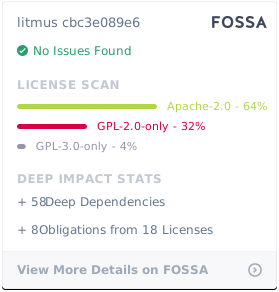
Litmus is licensed under the Apache License, Version 2.0. See LICENSE for the full license text. Some of the projects used by the Litmus project may be governed by a different license, please refer to its specific license.
Litmus Chaos is part of the CNCF Projects.


(top 24 of 51)
999 followers · starred Dec 2023
162 followers · starred Dec 2025
513 followers · starred Nov 2021
544 followers · starred Dec 2025
Litmus helps SREs and developers practice chaos engineering in a Cloud-native way. Chaos experiments are published at the ChaosHub (https://hub.litmuschaos.io). Community notes is at https://hackmd.io/a4Zu_sH4TZGeih-xCimi3Q
See the code
LitmusChaos is an open source Chaos Engineering platform that enables teams to identify weaknesses & potential outages in infrastructures by inducing chaos tests in a controlled way. Developers & SREs can practice Chaos Engineering with LitmusChaos as it is easy to use, based on modern Chaos Engineering principles & community collaborated. It is 100% open source & a CNCF project.
LitmusChaos takes a cloud-native approach to create, manage and monitor chaos. The platform itself runs as a set of microservices and uses Kubernetes custom resources (CRs) to define the chaos intent, as well as the steady state hypothesis.
At a high-level, Litmus comprises of:
At the heart of the platform are the following chaos custom resources:
ChaosExperiment: A resource to group the configuration parameters of a particular fault. ChaosExperiment CRs are essentially installable templates that describe the library carrying out the fault, indicate permissions needed to run it & the defaults it will operate with. Through the ChaosExperiment, Litmus supports BYOC (bring-your-own-chaos) that helps integrate (optional) any third-party tooling to perform the fault injection.
ChaosEngine: A resource to link a Kubernetes application workload/service, node or an infra component to a fault described by the ChaosExperiment. It also provides options to tune the run properties and specify the steady state validation constraints using 'probes'. ChaosEngine is watched by the Chaos-Operator, which reconciles it (triggers experiment execution) via runners.
The ChaosExperiment & ChaosEngine CRs are embedded within a Workflow object that can string together one or more experiments in a desired order.
ChaosExperiment CRs are hosted on hub.litmuschaos.io. It is a central hub where the application developers or vendors share their chaos experiments so that their users can use them to increase the resilience of the applications in production.
To get started, check out the Litmus Docs and specifically the Installation section of the Getting Started with Litmus page.
Check out the Contributing Guidelines for the Chaos Hub
Feel free to reach out if you have any queries, concerns, or feature requests
Give us a star ⭐️ - If you are using LitmusChaos or think it is an interesting project, we would love a star ❤️
Follow LitmusChaos on Twitter @LitmusChaos.
Subscribe to the LitmusChaos YouTube channel for regular updates & meeting recordings.
To join our Slack Community and meet our community members, put forward your questions & opinions, join the #litmus channel on the Kubernetes Slack.
Fill out the LitmusChaos Meetings invite form to get your Calendar invite!
Community Blogs:
Check out the Adopters of LitmusChaos
(Send a PR to the above page if you are using Litmus in your chaos engineering practice)
Litmus is licensed under the Apache License, Version 2.0. See LICENSE for the full license text. Some of the projects used by the Litmus project may be governed by a different license, please refer to its specific license.
Litmus Chaos is part of the CNCF Projects.
(top 24 of 51)
999 followers · starred Dec 2023
162 followers · starred Dec 2025
513 followers · starred Nov 2021
544 followers · starred Dec 2025



