
ScreenCoder — Turn any UI screenshot into clean, editable HTML/CSS with full control. Fast, accurate, and easy to customize.
Python
2,992
40 commits
updated Sep 15, 2026
README
ScreenCoder: Advancing Visual-to-Code Generation for Front-End Automation via Modular Multimodal Agents
Yilei Jiang1*, Yaozhi Zheng1*, Yuxuan Wan2*, Jiaming Han1, Qunzhong Wang1,
Michael R. Lyu2, Xiangyu Yue1✉
1CUHK MMLab, 2CUHK ARISE Lab
*Equal contribution ✉Corresponding author


Introduction
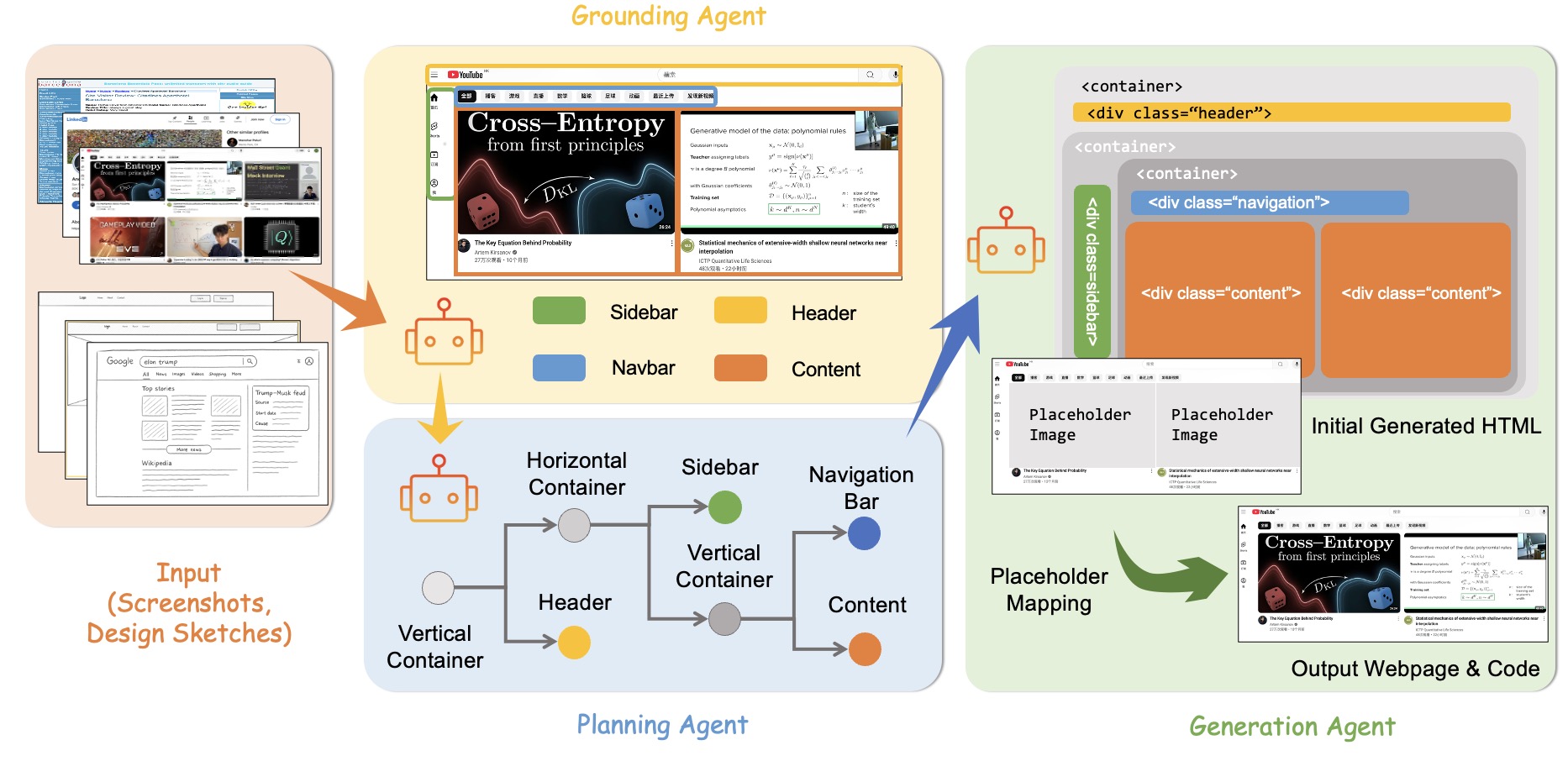
ScreenCoder is an intelligent UI-to-code generation system that transforms any screenshot or design mockup into clean, production-ready HTML/CSS code. Built with a modular multi-agent architecture, it combines visual understanding, layout planning, and adaptive code synthesis to produce accurate and editable front-end code.
It also supports customized modifications, allowing developers and designers to tweak layout and styling with ease. Whether you're prototyping quickly or building pixel-perfect interfaces, ScreenCoder bridges the gap between design and development — just copy, customize, and deploy.
News
- 🎉 ScreenCoder has been accepted to the EMNLP 2026 Main Conference! Visit the project page or read the paper.
- We have released the post-training code (SFT + RL) used to align ScreenCoder.
- We also release ScreenBench (https://huggingface.co/datasets/Leigest/ScreenCoder), a novel benchmark for visual-to-code/web UI generation, including 1000 up-to-date real-world sampled web screenshots and corresponding HTML source code with diverse topics.
Huggingface Demo
-
Try our huggingface demo at Demo
-
Run the demo locally (download from huggingface space):
python app.py
Demo Videos
A showcase of how ScreenCoder transforms UI screenshots into structured, editable HTML/CSS code using a modular multi-agent framework.
Youtube Page
https://github.com/user-attachments/assets/5d4c0808-76b8-4eb3-b333-79d0ac690189
Instagram Page
https://github.com/user-attachments/assets/9819d559-863e-4126-8506-1eccaa806df0
Design Draft(allow customized modifications!)
https://github.com/user-attachments/assets/d2f26583-4649-4b6d-8072-b11cd1025f4b
Qualitative Comparisons
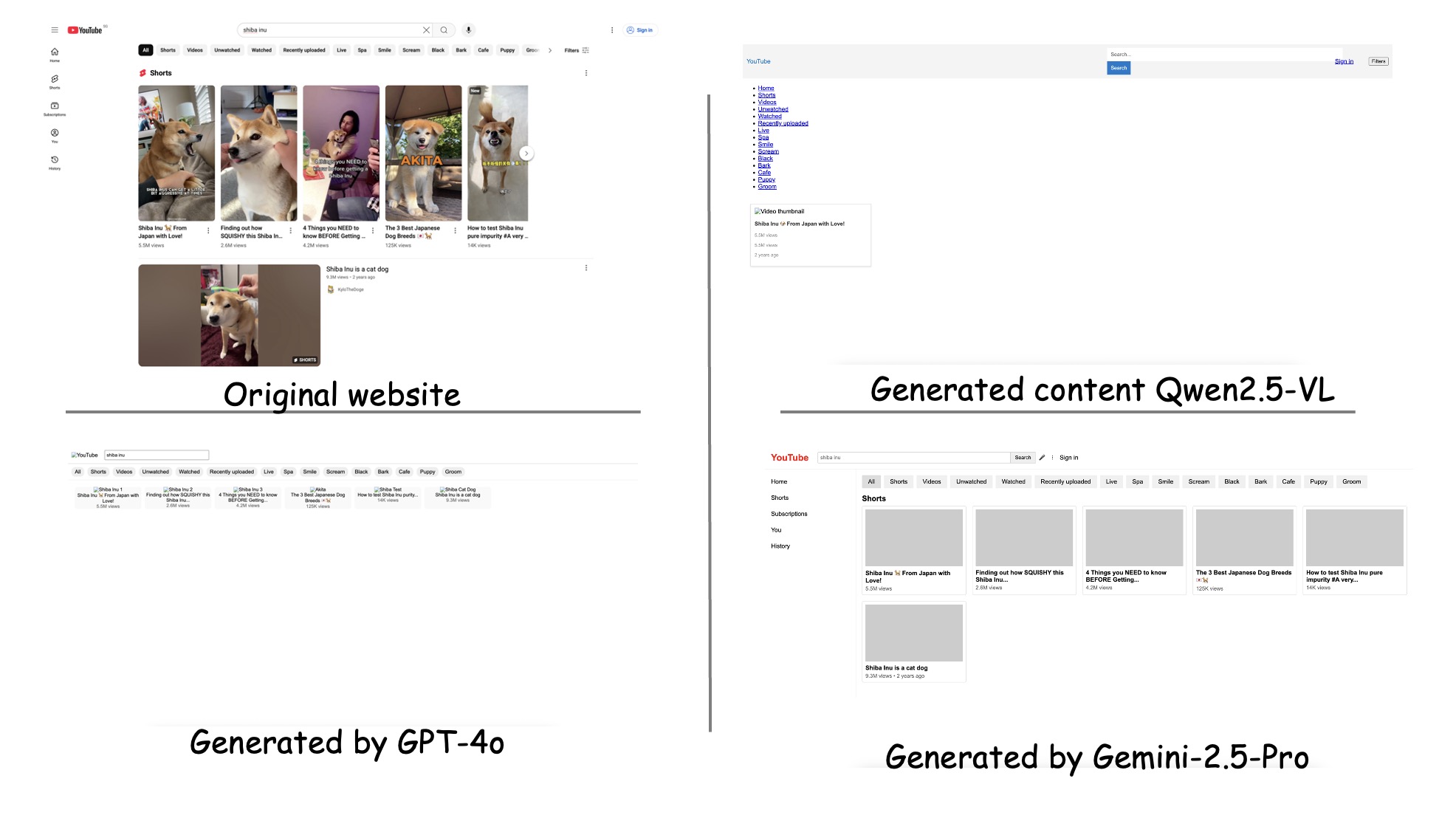
We present qualitative examples to illustrate the improvements achieved by our method over existing approaches. The examples below compare the output of a baseline method with ours on the same input.
Baseline or Other Method
Our Method
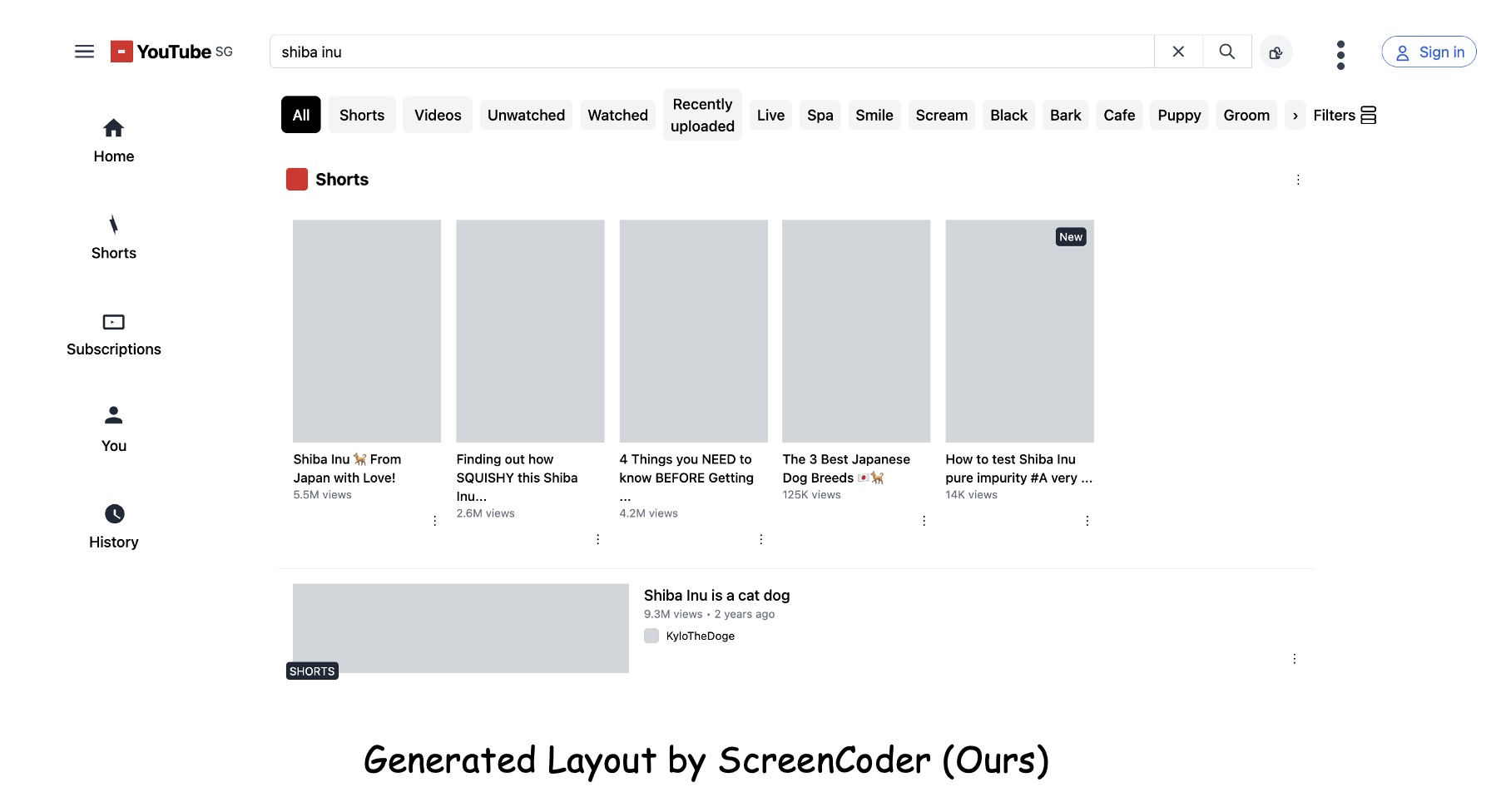
As shown above, our method produces results that are more accurate, visually aligned, and semantically faithful to the original design.
Project Structure
main.py: The main script to generate final HTML code for a single screenshot.UIED/: Contains the UIED (UI Element Detection) engine for analyzing screenshots and detecting components.run_single.py: Python script to run UI component detection on a single image.
html_generator.py: Takes the detected component data and generates a complete HTML layout with generated code for each module.image_replacer.py: A script to replace placeholder divs in the final HTML with actual cropped images.mapping.py: Maps the detected UIED components to logical page regions.requirements.txt: Lists all the necessary Python dependencies for the project.doubao_api.txt: API key file for the Doubao model (should be kept private and is included in.gitignore).
Setup and Installation
-
Clone the repository:
git clone https://github.com/leigest519/ScreenCoder.git cd screencoder -
Create a virtual environment:
python3 -m venv .venv source .venv/bin/activate -
Install dependencies:
pip install -r requirements.txt -
Configure the model and API key
- Choose a generation model: Set the desired model in
block_parsor.pyandhtml_generator.py. Supported options: Doubao(default), Qwen, GPT, Gemini. - Add the API key: Create a plain-text file (
doubao_api.txt,qwen_api.txt,gpt_api.txt,gemini_api.txt) in the project root directory that corresponds to your selected model, and paste your API key inside.
- Choose a generation model: Set the desired model in
Usage
The typical workflow is a multi-step process as follows:
-
Initial Generation with Placeholders: Run the Python script to generate the initial HTML code for a given screenshot.
- Block Detection:
python block_parsor.py - Generation with Placeholders (Gray Images Blocks):
python html_generator.py
- Block Detection:
-
Final HTML Code: Run the python script to generate final HTML code with copped images from the original screenshot.
- Placeholder Detection:
python image_box_detection.py - UI Element Detection:
python UIED/run_single.py - Mapping Alignment Between Placeholders and UI Elements:
python mapping.py - Placeholder Replacement:
python image_replacer.py
- Placeholder Detection:
-
Simple Run: Run the python script to generate the final HTML code:
python main.py
More Projects on MLLM for Web/Code Generation
-
WebPAI (Web Development Powered by AI) released a set of research resources and datasets for webpage generation studies, aiming to build an AI platform for more reliable and practical automated webpage generation.
-
Awesome-Multimodal-LLM-for-Code maintains a comprehensive list of papers on methods, benchmarks, and evaluation for code generation under multimodal scenarios.
Acknowledgements
This project builds upon several outstanding open-source efforts. We would like to thank the authors and contributors of the following projects: UIED, DCGen, Design2Code
Contributors


Similar repos



Languages
Python
91.2%
Jupyter Notebook
4.3%
Shell
2.5%
HTML
1.3%
ScreenCoder — Turn any UI screenshot into clean, editable HTML/CSS with full control. Fast, accurate, and easy to customize.
Python
2,992
40 commits
updated Sep 15, 2026
README
ScreenCoder: Advancing Visual-to-Code Generation for Front-End Automation via Modular Multimodal Agents
Yilei Jiang1*, Yaozhi Zheng1*, Yuxuan Wan2*, Jiaming Han1, Qunzhong Wang1,
Michael R. Lyu2, Xiangyu Yue1✉
1CUHK MMLab, 2CUHK ARISE Lab
*Equal contribution ✉Corresponding author
Introduction
ScreenCoder is an intelligent UI-to-code generation system that transforms any screenshot or design mockup into clean, production-ready HTML/CSS code. Built with a modular multi-agent architecture, it combines visual understanding, layout planning, and adaptive code synthesis to produce accurate and editable front-end code.
It also supports customized modifications, allowing developers and designers to tweak layout and styling with ease. Whether you're prototyping quickly or building pixel-perfect interfaces, ScreenCoder bridges the gap between design and development — just copy, customize, and deploy.
News
- 🎉 ScreenCoder has been accepted to the EMNLP 2026 Main Conference! Visit the project page or read the paper.
- We have released the post-training code (SFT + RL) used to align ScreenCoder.
- We also release ScreenBench (https://huggingface.co/datasets/Leigest/ScreenCoder), a novel benchmark for visual-to-code/web UI generation, including 1000 up-to-date real-world sampled web screenshots and corresponding HTML source code with diverse topics.
Huggingface Demo
-
Try our huggingface demo at Demo
-
Run the demo locally (download from huggingface space):
python app.py
Demo Videos
A showcase of how ScreenCoder transforms UI screenshots into structured, editable HTML/CSS code using a modular multi-agent framework.
Youtube Page
https://github.com/user-attachments/assets/5d4c0808-76b8-4eb3-b333-79d0ac690189
Instagram Page
https://github.com/user-attachments/assets/9819d559-863e-4126-8506-1eccaa806df0
Design Draft(allow customized modifications!)
https://github.com/user-attachments/assets/d2f26583-4649-4b6d-8072-b11cd1025f4b
Qualitative Comparisons
We present qualitative examples to illustrate the improvements achieved by our method over existing approaches. The examples below compare the output of a baseline method with ours on the same input.
Baseline or Other Method
Our Method
As shown above, our method produces results that are more accurate, visually aligned, and semantically faithful to the original design.
Project Structure
main.py: The main script to generate final HTML code for a single screenshot.UIED/: Contains the UIED (UI Element Detection) engine for analyzing screenshots and detecting components.run_single.py: Python script to run UI component detection on a single image.
html_generator.py: Takes the detected component data and generates a complete HTML layout with generated code for each module.image_replacer.py: A script to replace placeholder divs in the final HTML with actual cropped images.mapping.py: Maps the detected UIED components to logical page regions.requirements.txt: Lists all the necessary Python dependencies for the project.doubao_api.txt: API key file for the Doubao model (should be kept private and is included in.gitignore).
Setup and Installation
-
Clone the repository:
git clone https://github.com/leigest519/ScreenCoder.git cd screencoder -
Create a virtual environment:
python3 -m venv .venv source .venv/bin/activate -
Install dependencies:
pip install -r requirements.txt -
Configure the model and API key
- Choose a generation model: Set the desired model in
block_parsor.pyandhtml_generator.py. Supported options: Doubao(default), Qwen, GPT, Gemini. - Add the API key: Create a plain-text file (
doubao_api.txt,qwen_api.txt,gpt_api.txt,gemini_api.txt) in the project root directory that corresponds to your selected model, and paste your API key inside.
- Choose a generation model: Set the desired model in
Usage
The typical workflow is a multi-step process as follows:
-
Initial Generation with Placeholders: Run the Python script to generate the initial HTML code for a given screenshot.
- Block Detection:
python block_parsor.py - Generation with Placeholders (Gray Images Blocks):
python html_generator.py
- Block Detection:
-
Final HTML Code: Run the python script to generate final HTML code with copped images from the original screenshot.
- Placeholder Detection:
python image_box_detection.py - UI Element Detection:
python UIED/run_single.py - Mapping Alignment Between Placeholders and UI Elements:
python mapping.py - Placeholder Replacement:
python image_replacer.py
- Placeholder Detection:
-
Simple Run: Run the python script to generate the final HTML code:
python main.py
More Projects on MLLM for Web/Code Generation
-
WebPAI (Web Development Powered by AI) released a set of research resources and datasets for webpage generation studies, aiming to build an AI platform for more reliable and practical automated webpage generation.
-
Awesome-Multimodal-LLM-for-Code maintains a comprehensive list of papers on methods, benchmarks, and evaluation for code generation under multimodal scenarios.
Acknowledgements
This project builds upon several outstanding open-source efforts. We would like to thank the authors and contributors of the following projects: UIED, DCGen, Design2Code
Similar repos
Contributors
Languages
Python
91.2%
Jupyter Notebook
4.3%
Shell
2.5%
HTML
1.3%