
README
Lean-auto is an interface between Lean and automated theorem provers. Up to now, lean-auto is maintained and developed primarily by Yicheng Qian (GitHub: PratherConid). It is currently in active development, and pull requests/issues are welcome. For more information, feel free to reach out to Yicheng Qian on Lean Zulip.
Lean-auto is based on a monomorphization procedure from dependent type theory to higher-order logic and a deep embedding of higher-order logic into dependent type theory. It is capable of handling dependently-typed and/or universe-polymorphic input terms. Currently, proof reconstruction can be handled by Duper, a higher-order superposition prover written in Lean. To enable Duper, please import the duper repo in your project, and set the following options:
import Auto.Tactic
import Duper.Tactic

open Lean Auto in
def Auto.duperRaw (lemmas : Array Lemma) (inhs : Array Lemma) : MetaM Expr := do
  let lemmas : Array (Expr × Expr × Array Name × Bool) ← lemmas.mapM
    (fun ⟨⟨proof, ty, _⟩, _⟩ => do return (ty, ← Meta.mkAppM ``eq_true #[proof], #[], true))
  Duper.runDuper lemmas.toList [] 0

attribute [rebind Auto.Native.solverFunc] Auto.duperRaw
set_option auto.native true
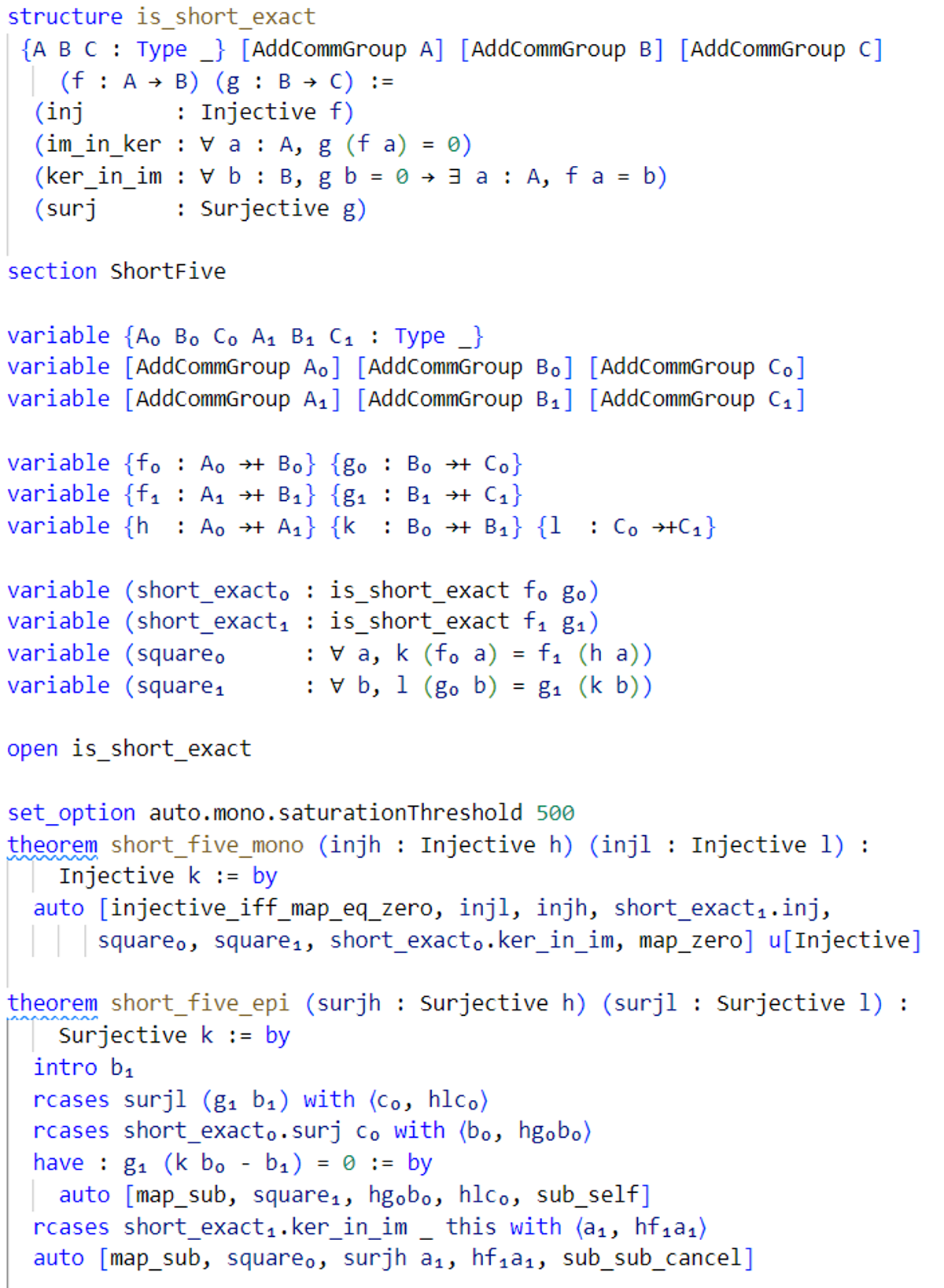
Although Lean-auto is still under development, it's already able to solve nontrivial problems. For example the first part of the "snake lemma" in category theory can be solved by a direct invocation to auto (and the second part can also be partly automated):
Type "auto 👍" to test whether auto is set up.
Usage
auto [<term>,*] u[<ident>,*] d[<ident>,*]u[<ident>,*]: Unfold identifiersd[<ident>,*]: Add definitional equality related to identifiers
- The file
Test/Test_Regression.leanin this repo contains working examples of usages oflean-auto. Note that thenativemode inTest/Test_Regressionuses a dummy native solver, but this is only for testing. In real use cases, you should replace the dummy solver with a native theorem prover such asduper. See below for detailed instructions. - Currently, auto supports
- SMT solver invocation:
set_option auto.smt true, but without proof reconstruction. Make sure that SMT solvers are installed, and thatauto.smt.solver.nameis correctly set. If you want to try - TPTP solver invocation:
set_option auto.tptp true, but without proof reconstruction.- Currently, we only support the TPTP solver
zipperposition - To use the raw
zipperpositionexecutable, useset_option auto.tptp.solver.name "zipperposition". The executable will be automatically downloaded whenlean-autois built. - To use the advanced
zipperpositionportfolio mode, useset_option auto.tptp.solver.name zeport-lamsorset_option auto.tptp.solver.name zeport-fo. You need to obtain the source code ofzipperpositionand make sure thatauto.tptp.zeport.pathpoints to the correct python script that runszipperpositionwith the portfolio mode, presumably in theportfoliofolder of the source code of zipperposition.
- Currently, we only support the TPTP solver
- Proof search by native prover. Assume your native prover is a
leanrepository that haslean-autoas dependency. To enable proof search by native prover, useset_option auto.native true, and useattribute [rebind Auto.Native.solverFunc] <solve_interface>to bindlean-autoto the interface of the solver, which should be a Lean constant of typeArray Lemma → Array Lemma → MetaM Expr.
- SMT solver invocation:
Installing Lean-auto
z3version >= 4.12.2. Lower versions may not be able to deal with smt-lib 2.6 string escape sequence.cvc5zipperpositionportfolio mode
Troubleshooting
Monomorphization failed because ...:
Try addingset_option auto.mono.ignoreNonQuasiHigherOrder truebefore you invokeautoDuper Saturatedwhen usinglean-auto + duper:
This can happen if- $(1)$ The list of hints you provided to
autois insufficient - $(2)$
duperis unable to prove the translated problem, although the translated problem is provable - $(3)$
autois unable to handle certain Lean features in the problem
To find out if the issue is caused by $(1)$, try proving the goal manually using only the basic tactics (e.g.rw,apply,simp only, anddsimp only) and the hints you provided tolean-auto. Try not to usesimp,simp_allandgrindbecause they might automatically use theorems that are not within the hint list provided to them. If you're able to prove the goal manually, it means that the list of hints you provided is sufficient.
To find out if the issue is caused by $(2)$, try usinglean-auto + SMT solverandlean-auto + TPTP solverand see if they're able to solve the goal. Note that even if the goal is still not solved, it does not necessarily mean that the translated problem is unprovable.- $(1)$ The list of hints you provided to
Utilities
- Command
#getExprAndApply [ <term> | <ident> ]: Defined inExprExtra.lean. This command first elaborates the<term>into a leanExpr, then applies function<ident>toExpr. The constantidentmust be already declared and be of typeExpr → TermElabM Unit - Command
#genMonadState <term>, #genMonadContext <term>: Defined inMonadUtils.lean. Refer to the comment at the beginning ofMonadUtils.lean. - Command
#fromMetaTactic [<ident>]: CallsTactic.liftMetaTacticon<ident>. The constant<ident>must be already declared and be of typeMVarId → MetaM (List MVarId) - Lexical Analyzer Generator:
Parser/LeanLex.lean. The frontend is not yet implemented. The backend can be found inNDFA.lean.
Translation Workflow (Tentative)
- Collecting assumptions from local context and user-provided facts
- We reduce
letbinders and unfold projections when we collect assumptions. So, in the following discussion, we'll assume that the expression contains noletbinders and noprojs. - We also $\beta$ reduce user provided facts so that there are nothing like $(\lambda x. t_1) \ t_2$
- We reduce
- $CIC \to COC$: Collecting constructors and recursors for inductive types (effectively, not directly)
- e.g collecting equational theorem for match constructs
- e.g collect constructors for inductively defined propositions
- $COC \to COC(\lambda^{c.u.})$: Monomorphization
- Monomorphize all (dependently typed/universe polymorphic) facts to higher-order universe-monomorphic facts
- $c.u.$ stands for "constant universe level"
- Note that at this stage, all the facts we've obtained are still valid $CIC$ expressions and has convenient CIC proofs from the assumptions.
- $COC(\lambda^{c.u.}) \to COC(\lambda)$
- We want all types $α$ occuring in the signature of constants and variables to be of sort
Type (u + 1), i.e., $α : Type \ (u + 1)$. This is necessary because we want to write a checker (instead of directly reconstructing proof in DTT) and the valuation function from less expressive logic to dependent type theory requires [the elements in the range of the valuation function] to be [of the same sort]. - To do this, we use
GLift. For example,Nat.addis transformed intoNat.addLiftstructure GLift.{u, v} (α : Sort u) : Sort (max u (v + 1)) where /-- Lift a value into `GLift α` -/ up :: /-- Extract a value from `GLift α` -/ down : α def Nat.addLift.{u} (x y : GLift.{1, u} Nat) := GLift.up (Nat.add (GLift.down x) (GLift.down y)) - We only transfer these "lifted" terms to the less expressive $\lambda_2$, and $\lambda_2$ is unaware of the universe levels wrapped inside
GLift.up. - Lifted constantes should be introduced into the local context. Theorems corresponding to the original one but using only lifted constants and with uniform universe levels, should also be introduced into the local context. Later translations should only use theorems and constants with uniform universe levels.
- We want all types $α$ occuring in the signature of constants and variables to be of sort
- $\lambda \to \lambda(\text{TPTP TF0})$: Instantiating function arguments
- $\lambda$ is the reified $COC(\lambda)$
- There should also be a process similar to ULifting that "lifts" Bool into Prop, Nat to Int
Reification
- $COC(\lambda) \to \lambda(\text{TPTP\ TH0})$
Auto/Translation/LamReif.lean
- $\lambda(\text{TPTP TF0}) \to \text{TPTP TF0}$
Auto/Translation/LamFOL2SMT.lean
Checker
- The checker is based on a deep embedding of simply-typed lambda calculus into dependent type theory.
- The checker is slow on large input. For example, it takes
6sto typecheck the final example inBinderComplexity.lean. However, this is probably acceptable for mathlib usages, because e.gMathlib/Analysis/BoxIntegral/DivergenceTheorem.leanhas two theorems that take4sto compile (but a large portion of the4sare spent on typeclass inference)
Rules in Proof Tree
defeq <num> <name>: The<num>-th definitional equality associated with definition<name>hw <name>: Lemmas hard-wired into Lean-autolctxInh: Inhabitation fact from local contextlctxLem: Lemma from local contextrec <indName>.<ctorName>rw [0, 1]: Rewrite0using1(1must be an equality)tyCanInh: Inhabitation instance synthesized for canonicalized typeciInstDefEq: Definitional equality resulting from instance relations betweenConstInststermLikeDefEq: Definitional equality resulting from definitional equalities between term-like subexpressions❰<term>❱: User-provided lemma<term>queryNative::<func_name>: Proved by native prover
Contributors


Similar repos


Languages
Lean
99.6%
README
Lean-auto is an interface between Lean and automated theorem provers. Up to now, lean-auto is maintained and developed primarily by Yicheng Qian (GitHub: PratherConid). It is currently in active development, and pull requests/issues are welcome. For more information, feel free to reach out to Yicheng Qian on Lean Zulip.
Lean-auto is based on a monomorphization procedure from dependent type theory to higher-order logic and a deep embedding of higher-order logic into dependent type theory. It is capable of handling dependently-typed and/or universe-polymorphic input terms. Currently, proof reconstruction can be handled by Duper, a higher-order superposition prover written in Lean. To enable Duper, please import the duper repo in your project, and set the following options:
import Auto.Tactic
import Duper.Tactic

open Lean Auto in
def Auto.duperRaw (lemmas : Array Lemma) (inhs : Array Lemma) : MetaM Expr := do
  let lemmas : Array (Expr × Expr × Array Name × Bool) ← lemmas.mapM
    (fun ⟨⟨proof, ty, _⟩, _⟩ => do return (ty, ← Meta.mkAppM ``eq_true #[proof], #[], true))
  Duper.runDuper lemmas.toList [] 0

attribute [rebind Auto.Native.solverFunc] Auto.duperRaw
set_option auto.native true
Although Lean-auto is still under development, it's already able to solve nontrivial problems. For example the first part of the "snake lemma" in category theory can be solved by a direct invocation to auto (and the second part can also be partly automated):
Type "auto 👍" to test whether auto is set up.
Usage
auto [<term>,*] u[<ident>,*] d[<ident>,*]u[<ident>,*]: Unfold identifiersd[<ident>,*]: Add definitional equality related to identifiers
- The file
Test/Test_Regression.leanin this repo contains working examples of usages oflean-auto. Note that thenativemode inTest/Test_Regressionuses a dummy native solver, but this is only for testing. In real use cases, you should replace the dummy solver with a native theorem prover such asduper. See below for detailed instructions. - Currently, auto supports
- SMT solver invocation:
set_option auto.smt true, but without proof reconstruction. Make sure that SMT solvers are installed, and thatauto.smt.solver.nameis correctly set. If you want to try - TPTP solver invocation:
set_option auto.tptp true, but without proof reconstruction.- Currently, we only support the TPTP solver
zipperposition - To use the raw
zipperpositionexecutable, useset_option auto.tptp.solver.name "zipperposition". The executable will be automatically downloaded whenlean-autois built. - To use the advanced
zipperpositionportfolio mode, useset_option auto.tptp.solver.name zeport-lamsorset_option auto.tptp.solver.name zeport-fo. You need to obtain the source code ofzipperpositionand make sure thatauto.tptp.zeport.pathpoints to the correct python script that runszipperpositionwith the portfolio mode, presumably in theportfoliofolder of the source code of zipperposition.
- Currently, we only support the TPTP solver
- Proof search by native prover. Assume your native prover is a
leanrepository that haslean-autoas dependency. To enable proof search by native prover, useset_option auto.native true, and useattribute [rebind Auto.Native.solverFunc] <solve_interface>to bindlean-autoto the interface of the solver, which should be a Lean constant of typeArray Lemma → Array Lemma → MetaM Expr.
- SMT solver invocation:
Installing Lean-auto
z3version >= 4.12.2. Lower versions may not be able to deal with smt-lib 2.6 string escape sequence.cvc5zipperpositionportfolio mode
Troubleshooting
Monomorphization failed because ...:
Try addingset_option auto.mono.ignoreNonQuasiHigherOrder truebefore you invokeautoDuper Saturatedwhen usinglean-auto + duper:
This can happen if- $(1)$ The list of hints you provided to
autois insufficient - $(2)$
duperis unable to prove the translated problem, although the translated problem is provable - $(3)$
autois unable to handle certain Lean features in the problem
To find out if the issue is caused by $(1)$, try proving the goal manually using only the basic tactics (e.g.rw,apply,simp only, anddsimp only) and the hints you provided tolean-auto. Try not to usesimp,simp_allandgrindbecause they might automatically use theorems that are not within the hint list provided to them. If you're able to prove the goal manually, it means that the list of hints you provided is sufficient.
To find out if the issue is caused by $(2)$, try usinglean-auto + SMT solverandlean-auto + TPTP solverand see if they're able to solve the goal. Note that even if the goal is still not solved, it does not necessarily mean that the translated problem is unprovable.- $(1)$ The list of hints you provided to
Utilities
- Command
#getExprAndApply [ <term> | <ident> ]: Defined inExprExtra.lean. This command first elaborates the<term>into a leanExpr, then applies function<ident>toExpr. The constantidentmust be already declared and be of typeExpr → TermElabM Unit - Command
#genMonadState <term>, #genMonadContext <term>: Defined inMonadUtils.lean. Refer to the comment at the beginning ofMonadUtils.lean. - Command
#fromMetaTactic [<ident>]: CallsTactic.liftMetaTacticon<ident>. The constant<ident>must be already declared and be of typeMVarId → MetaM (List MVarId) - Lexical Analyzer Generator:
Parser/LeanLex.lean. The frontend is not yet implemented. The backend can be found inNDFA.lean.
Translation Workflow (Tentative)
- Collecting assumptions from local context and user-provided facts
- We reduce
letbinders and unfold projections when we collect assumptions. So, in the following discussion, we'll assume that the expression contains noletbinders and noprojs. - We also $\beta$ reduce user provided facts so that there are nothing like $(\lambda x. t_1) \ t_2$
- We reduce
- $CIC \to COC$: Collecting constructors and recursors for inductive types (effectively, not directly)
- e.g collecting equational theorem for match constructs
- e.g collect constructors for inductively defined propositions
- $COC \to COC(\lambda^{c.u.})$: Monomorphization
- Monomorphize all (dependently typed/universe polymorphic) facts to higher-order universe-monomorphic facts
- $c.u.$ stands for "constant universe level"
- Note that at this stage, all the facts we've obtained are still valid $CIC$ expressions and has convenient CIC proofs from the assumptions.
- $COC(\lambda^{c.u.}) \to COC(\lambda)$
- We want all types $α$ occuring in the signature of constants and variables to be of sort
Type (u + 1), i.e., $α : Type \ (u + 1)$. This is necessary because we want to write a checker (instead of directly reconstructing proof in DTT) and the valuation function from less expressive logic to dependent type theory requires [the elements in the range of the valuation function] to be [of the same sort]. - To do this, we use
GLift. For example,Nat.addis transformed intoNat.addLiftstructure GLift.{u, v} (α : Sort u) : Sort (max u (v + 1)) where /-- Lift a value into `GLift α` -/ up :: /-- Extract a value from `GLift α` -/ down : α def Nat.addLift.{u} (x y : GLift.{1, u} Nat) := GLift.up (Nat.add (GLift.down x) (GLift.down y)) - We only transfer these "lifted" terms to the less expressive $\lambda_2$, and $\lambda_2$ is unaware of the universe levels wrapped inside
GLift.up. - Lifted constantes should be introduced into the local context. Theorems corresponding to the original one but using only lifted constants and with uniform universe levels, should also be introduced into the local context. Later translations should only use theorems and constants with uniform universe levels.
- We want all types $α$ occuring in the signature of constants and variables to be of sort
- $\lambda \to \lambda(\text{TPTP TF0})$: Instantiating function arguments
- $\lambda$ is the reified $COC(\lambda)$
- There should also be a process similar to ULifting that "lifts" Bool into Prop, Nat to Int
Reification
- $COC(\lambda) \to \lambda(\text{TPTP\ TH0})$
Auto/Translation/LamReif.lean
- $\lambda(\text{TPTP TF0}) \to \text{TPTP TF0}$
Auto/Translation/LamFOL2SMT.lean
Checker
- The checker is based on a deep embedding of simply-typed lambda calculus into dependent type theory.
- The checker is slow on large input. For example, it takes
6sto typecheck the final example inBinderComplexity.lean. However, this is probably acceptable for mathlib usages, because e.gMathlib/Analysis/BoxIntegral/DivergenceTheorem.leanhas two theorems that take4sto compile (but a large portion of the4sare spent on typeclass inference)
Rules in Proof Tree
defeq <num> <name>: The<num>-th definitional equality associated with definition<name>hw <name>: Lemmas hard-wired into Lean-autolctxInh: Inhabitation fact from local contextlctxLem: Lemma from local contextrec <indName>.<ctorName>rw [0, 1]: Rewrite0using1(1must be an equality)tyCanInh: Inhabitation instance synthesized for canonicalized typeciInstDefEq: Definitional equality resulting from instance relations betweenConstInststermLikeDefEq: Definitional equality resulting from definitional equalities between term-like subexpressions❰<term>❱: User-provided lemma<term>queryNative::<func_name>: Proved by native prover
Similar repos
Contributors
Languages
Lean
99.6%