
EasyOPD make your OPD research easy!
See the codeREADME
EasyOPD: An Easy-to-use On-Policy Distillation Framework for Large Language Models




Click the image above to watch a short walkthrough of EasyOPD (hosted on Google Drive).
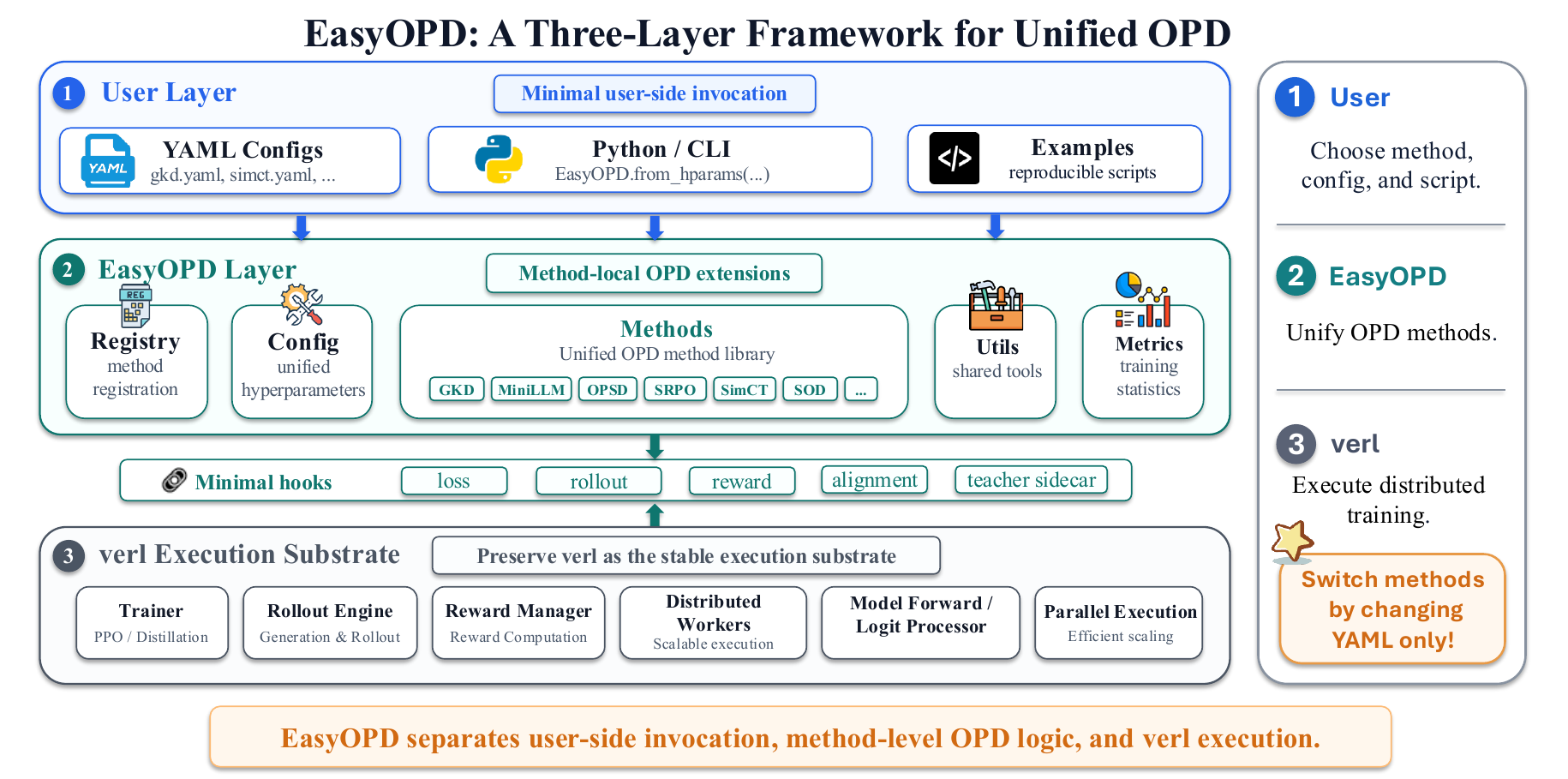
EasyOPD is a unified, method-oriented framework for On-Policy Distillation (OPD) built on top of verl. OPD methods differ widely in supervision form, tokenizer compatibility, teacher access, and supervision granularity, which usually leads to fragmented, hard-to-reproduce implementations. EasyOPD separates user-side configuration, method-local supervision logic, and verl-based distributed execution, so that heterogeneous OPD methods share one execution backend and are selected by simply switching a YAML config.
The framework instantiates representative methods across three settings — cross-tokenizer OPD, on-policy self-distillation, and step-wise OPD — together with their baselines, and its extension boundaries are designed to accommodate additional supervision forms (e.g. black-box / rubric-based feedback).
Table of Contents
- Architecture
- Installation
- Quick Start
- Configuring Secrets and Paths (
.env) - Supported Methods
- Reproducing the Paper Experiments
- Adding a New Method
- Project Structure
- Citation
- License
Architecture
EasyOPD adopts a three-layer design:
┌──────────────────────────────────────────────────────────────────┐
│  User Layer      YAML config + Python/CLI entry points             │
│                  EasyOPD.from_hparams("simct")  |  bash run_*.sh    │
├──────────────────────────────────────────────────────────────────┤
│  EasyOPD Layer   Registry · Config · Method-local supervision      │
│                  Thin hooks: loss · rollout · reward · alignment ·  │
│                  teacher-sidecar  +  supervision diagnostics        │
├──────────────────────────────────────────────────────────────────┤
│  verl Layer      Distributed rollout · FSDP/Megatron · vLLM/SGLang  │
│                  PPO/GRPO trainer · reward · optimization           │
└──────────────────────────────────────────────────────────────────┘
Users select a method through configuration; developers add a method by registering a method-local module with the hooks it needs, so the core trainer and workers reach method-specific supervision only through the shared dispatch layer. See Figure 1/2 of the paper for details.
Installation
Requires Python 3.11, CUDA 12.4, 8×GPU (H20 96GB validated). See requirements.txt for
pinned versions.
git clone https://github.com/lds-ustc/EasyOPD.git
cd EasyOPD

# torch / flash-attn / vLLM / sglang need dedicated index URLs, so prefer the
# one-click installer over a bare `pip install -r requirements.txt`:
bash scripts/install_easyopd_env.sh

# EasyOPD is provided in-repo; add it to PYTHONPATH (the launch scripts also do this):
export PYTHONPATH="$(pwd):${PYTHONPATH}"
import easyopdandimport verlboth resolve to this repository.
Quick Start
1. Discover methods (Python API)
from easyopd import EasyOPD

print(EasyOPD.list_methods())
# ['alm', 'dskd', 'echo_kd', 'g_opd', 'gad', 'gkd', 'lightning_opd', 'opcd',
#  'opsa', 'ropd', 'sdpo', 'sft', 'simct', 'simple', 'sod', 'uld', 'vision_opd']

# Load any method by name + YAML — only the name and config change:
simct = EasyOPD.from_hparams("simct", config_path="easyopd/config/simct.yaml", auto_resolve_data=False)
sdpo  = EasyOPD.from_hparams("sdpo",  config_path="easyopd/config/sdpo.yaml",  auto_resolve_data=False)
sod   = EasyOPD.from_hparams("sod",   config_path="easyopd/config/sod.yaml",   auto_resolve_data=False)
2. Interactive demo notebook
A short walkthrough of the unified entry point and the three settings, with real diagnostics from finished runs:
jupyter notebook examples/demo/demo.ipynb
The first
list_methods()call imports all method modules and can take ~2 minutes; subsequent calls are instant. The notebook derives all paths from the installedeasyopdpackage, so it runs from any working directory.
3. Launch training
Each method (and its baselines) has a single launch script. The config selects the method and the hooks it activates:
# Cross-tokenizer OPD  (SimCT; baselines: uld | alm | dskd)
bash examples/simct/run_simct.sh

# On-policy self-distillation  (SDPO; baseline: grpo)
bash examples/sdpo/run_sdpo.sh

# Step-wise OPD  (SOD; needs a code-execution sandbox — see .env below)
bash examples/sod/run_sod.sh
You can also use the unified CLI:
python scripts/run_easyopd.py --list-methods
python scripts/run_easyopd.py --method simct --config easyopd/config/simct.yaml
python scripts/run_easyopd.py --method sod --dry-run   # validate config without training
Configuring Secrets and Paths (.env)
Machine-specific values (a code-execution sandbox endpoint, model/data roots, W&B key) are not committed. Copy the template and fill in your own values:
cp .env.example .env
# then edit .env, e.g.:
#   SANDBOX_FUSION_URL="https://<your-sandbox-endpoint>/run_code"
#   WANDB_API_KEY=...
.env is git-ignored. The SOD / agentic launch scripts source it automatically and fall back to a placeholder
when a value is unset. Model and dataset paths in the launch scripts (STUDENT_MODEL, TEACHER_MODEL,
DATASET_DIR, …) are set to /path/to/... placeholders — edit them to point at your local checkpoints and data.
Supported Methods
Representative methods (evaluated in the paper) are in bold; the rest share the same interface.
| Method | Setting | Teacher | Key idea |
|---|---|---|---|
| simct | Cross-tokenizer OPD | External (different tokenizer) | Span-based virtual-vocabulary logits |
| uld | Cross-tokenizer OPD | External | Universal logit distillation |
| alm | Cross-tokenizer OPD | External | Adaptive logit matching |
| dskd | Cross-tokenizer OPD | External | Dual-space knowledge distillation |
| simple | Cross-tokenizer OPD | External | Overlap-vocabulary KL with char-level alignment |
| sdpo | On-policy self-distillation | Self (EMA + reprompt) | Self-distillation from high-reward trajectories |
| sod | Step-wise OPD | External | Step-level adaptive re-weighting for tool-use agents |
| gkd | Standard OPD | External (same tokenizer) | Generalized JSD with on-policy sampling |
| g_opd | Generalized OPD | External + context | Reward extrapolation + flexible reference |
| opcd | Context distillation | Self (context-conditioned) | Experience injection + KL minimization |
| opsa / ropd / vision_opd / … | Additional settings | — | See per-method notes under easyopd/methods/ |
grpo (standard RL, no distillation) is provided as a baseline in each experiment directory.
Reproducing the Paper Experiments
The paper's three case studies live under experiments/, each with per-method launch.sh scripts that prepare
data, (re)start Ray, train, merge checkpoints, and evaluate:
# Cross-tokenizer OPD (SimCT vs. ULD / ALM / DSKD), Qwen2.5-7B → Phi-4-mini
bash experiments/01_cross_tokenizer_opd/methods/simct/launch.sh

# On-policy self-distillation (SDPO vs. GRPO), Qwen3-8B
bash experiments/04_self_opd/methods/sdpo/launch.sh

# Step-wise OPD (SOD vs. response-level OPD / GRPO), Qwen3-1.7B student
bash experiments/02_agentic_opd/methods/sod/launch.sh
Edit the model/data paths at the top of each script (or export them as env vars) before running. Evaluation
results are written under each method's local results/ directory (git-ignored).
Adding a New Method
- Create
easyopd/methods/your_method/and implement the algorithm incore.py. - Implement the hook adapters you need in
hooks.py(loss / rollout / reward / alignment / teacher-sidecar). - Register it in
__init__.py:
from easyopd.registry import register_method

@register_method("your_method")
class YourMethod:
    name = "your_method"
    description = "Your OPD method"
    paper_url = "https://arxiv.org/abs/..."
- Add a default config
easyopd/config/your_method.yaml.
The core trainer and workers need no per-method branches — supervision is reached only through the shared hooks. See CONTRIBUTING.md.
Project Structure
EasyOPD/
├── easyopd/                 # Unified interface layer
│   ├── __init__.py          #   EasyOPD.from_hparams() / list_methods()
│   ├── registry.py          #   @register_method
│   ├── config/              #   default YAML per method (simct.yaml, sdpo.yaml, sod.yaml, ...)
│   └── methods/             #   method-local implementations (simct, sdpo, sod, ...)
├── verl/                    # verl backend (minimal, comment-bracketed EasyOPD hooks)
├── examples/                # per-method launch scripts + demo notebook (examples/demo/)
├── experiments/             # paper case studies (01_cross_tokenizer_opd, 02_agentic_opd, 04_self_opd, ...)
├── scripts/                 # run_easyopd.py / run_easyopd.sh / install_easyopd_env.sh
├── .env.example             # template for local secrets/paths (copy to .env)
├── requirements.txt
└── README.md
Citation
@article{easyopd2026,
  title={EasyOPD: An Easy-to-use On-Policy Distillation Framework for Large Language Models},
  author={Sun, Jie and Zheng, Mao and Song, Mingyang and Zhong, Qiyong and Li, Gengsheng and Hong, Zhepei and Wu, Chang and Liu, Pengfei and Fang, Junfeng and Wang, Xiang},
  journal={arXiv preprint arXiv:xxxx.xxxxx},
  year={2026}
}
Acknowledgments
EasyOPD is built on top of verl. We thank the verl team and the authors
of all integrated OPD methods. The original verl documentation is preserved in
README_VERL.md.
License
Apache License 2.0. See LICENSE.
Contributors
(top 30 of 436)




Similar repos


Languages
Python
91.0%
Shell
8.8%
EasyOPD make your OPD research easy!
See the codeREADME
EasyOPD: An Easy-to-use On-Policy Distillation Framework for Large Language Models
Click the image above to watch a short walkthrough of EasyOPD (hosted on Google Drive).
EasyOPD is a unified, method-oriented framework for On-Policy Distillation (OPD) built on top of verl. OPD methods differ widely in supervision form, tokenizer compatibility, teacher access, and supervision granularity, which usually leads to fragmented, hard-to-reproduce implementations. EasyOPD separates user-side configuration, method-local supervision logic, and verl-based distributed execution, so that heterogeneous OPD methods share one execution backend and are selected by simply switching a YAML config.
The framework instantiates representative methods across three settings — cross-tokenizer OPD, on-policy self-distillation, and step-wise OPD — together with their baselines, and its extension boundaries are designed to accommodate additional supervision forms (e.g. black-box / rubric-based feedback).
Table of Contents
- Architecture
- Installation
- Quick Start
- Configuring Secrets and Paths (
.env) - Supported Methods
- Reproducing the Paper Experiments
- Adding a New Method
- Project Structure
- Citation
- License
Architecture
EasyOPD adopts a three-layer design:
┌──────────────────────────────────────────────────────────────────┐
│  User Layer      YAML config + Python/CLI entry points             │
│                  EasyOPD.from_hparams("simct")  |  bash run_*.sh    │
├──────────────────────────────────────────────────────────────────┤
│  EasyOPD Layer   Registry · Config · Method-local supervision      │
│                  Thin hooks: loss · rollout · reward · alignment ·  │
│                  teacher-sidecar  +  supervision diagnostics        │
├──────────────────────────────────────────────────────────────────┤
│  verl Layer      Distributed rollout · FSDP/Megatron · vLLM/SGLang  │
│                  PPO/GRPO trainer · reward · optimization           │
└──────────────────────────────────────────────────────────────────┘
Users select a method through configuration; developers add a method by registering a method-local module with the hooks it needs, so the core trainer and workers reach method-specific supervision only through the shared dispatch layer. See Figure 1/2 of the paper for details.
Installation
Requires Python 3.11, CUDA 12.4, 8×GPU (H20 96GB validated). See requirements.txt for
pinned versions.
git clone https://github.com/lds-ustc/EasyOPD.git
cd EasyOPD

# torch / flash-attn / vLLM / sglang need dedicated index URLs, so prefer the
# one-click installer over a bare `pip install -r requirements.txt`:
bash scripts/install_easyopd_env.sh

# EasyOPD is provided in-repo; add it to PYTHONPATH (the launch scripts also do this):
export PYTHONPATH="$(pwd):${PYTHONPATH}"
import easyopdandimport verlboth resolve to this repository.
Quick Start
1. Discover methods (Python API)
from easyopd import EasyOPD

print(EasyOPD.list_methods())
# ['alm', 'dskd', 'echo_kd', 'g_opd', 'gad', 'gkd', 'lightning_opd', 'opcd',
#  'opsa', 'ropd', 'sdpo', 'sft', 'simct', 'simple', 'sod', 'uld', 'vision_opd']

# Load any method by name + YAML — only the name and config change:
simct = EasyOPD.from_hparams("simct", config_path="easyopd/config/simct.yaml", auto_resolve_data=False)
sdpo  = EasyOPD.from_hparams("sdpo",  config_path="easyopd/config/sdpo.yaml",  auto_resolve_data=False)
sod   = EasyOPD.from_hparams("sod",   config_path="easyopd/config/sod.yaml",   auto_resolve_data=False)
2. Interactive demo notebook
A short walkthrough of the unified entry point and the three settings, with real diagnostics from finished runs:
jupyter notebook examples/demo/demo.ipynb
The first
list_methods()call imports all method modules and can take ~2 minutes; subsequent calls are instant. The notebook derives all paths from the installedeasyopdpackage, so it runs from any working directory.
3. Launch training
Each method (and its baselines) has a single launch script. The config selects the method and the hooks it activates:
# Cross-tokenizer OPD  (SimCT; baselines: uld | alm | dskd)
bash examples/simct/run_simct.sh

# On-policy self-distillation  (SDPO; baseline: grpo)
bash examples/sdpo/run_sdpo.sh

# Step-wise OPD  (SOD; needs a code-execution sandbox — see .env below)
bash examples/sod/run_sod.sh
You can also use the unified CLI:
python scripts/run_easyopd.py --list-methods
python scripts/run_easyopd.py --method simct --config easyopd/config/simct.yaml
python scripts/run_easyopd.py --method sod --dry-run   # validate config without training
Configuring Secrets and Paths (.env)
Machine-specific values (a code-execution sandbox endpoint, model/data roots, W&B key) are not committed. Copy the template and fill in your own values:
cp .env.example .env
# then edit .env, e.g.:
#   SANDBOX_FUSION_URL="https://<your-sandbox-endpoint>/run_code"
#   WANDB_API_KEY=...
.env is git-ignored. The SOD / agentic launch scripts source it automatically and fall back to a placeholder
when a value is unset. Model and dataset paths in the launch scripts (STUDENT_MODEL, TEACHER_MODEL,
DATASET_DIR, …) are set to /path/to/... placeholders — edit them to point at your local checkpoints and data.
Supported Methods
Representative methods (evaluated in the paper) are in bold; the rest share the same interface.
| Method | Setting | Teacher | Key idea |
|---|---|---|---|
| simct | Cross-tokenizer OPD | External (different tokenizer) | Span-based virtual-vocabulary logits |
| uld | Cross-tokenizer OPD | External | Universal logit distillation |
| alm | Cross-tokenizer OPD | External | Adaptive logit matching |
| dskd | Cross-tokenizer OPD | External | Dual-space knowledge distillation |
| simple | Cross-tokenizer OPD | External | Overlap-vocabulary KL with char-level alignment |
| sdpo | On-policy self-distillation | Self (EMA + reprompt) | Self-distillation from high-reward trajectories |
| sod | Step-wise OPD | External | Step-level adaptive re-weighting for tool-use agents |
| gkd | Standard OPD | External (same tokenizer) | Generalized JSD with on-policy sampling |
| g_opd | Generalized OPD | External + context | Reward extrapolation + flexible reference |
| opcd | Context distillation | Self (context-conditioned) | Experience injection + KL minimization |
| opsa / ropd / vision_opd / … | Additional settings | — | See per-method notes under easyopd/methods/ |
grpo (standard RL, no distillation) is provided as a baseline in each experiment directory.
Reproducing the Paper Experiments
The paper's three case studies live under experiments/, each with per-method launch.sh scripts that prepare
data, (re)start Ray, train, merge checkpoints, and evaluate:
# Cross-tokenizer OPD (SimCT vs. ULD / ALM / DSKD), Qwen2.5-7B → Phi-4-mini
bash experiments/01_cross_tokenizer_opd/methods/simct/launch.sh

# On-policy self-distillation (SDPO vs. GRPO), Qwen3-8B
bash experiments/04_self_opd/methods/sdpo/launch.sh

# Step-wise OPD (SOD vs. response-level OPD / GRPO), Qwen3-1.7B student
bash experiments/02_agentic_opd/methods/sod/launch.sh
Edit the model/data paths at the top of each script (or export them as env vars) before running. Evaluation
results are written under each method's local results/ directory (git-ignored).
Adding a New Method
- Create
easyopd/methods/your_method/and implement the algorithm incore.py. - Implement the hook adapters you need in
hooks.py(loss / rollout / reward / alignment / teacher-sidecar). - Register it in
__init__.py:
from easyopd.registry import register_method

@register_method("your_method")
class YourMethod:
    name = "your_method"
    description = "Your OPD method"
    paper_url = "https://arxiv.org/abs/..."
- Add a default config
easyopd/config/your_method.yaml.
The core trainer and workers need no per-method branches — supervision is reached only through the shared hooks. See CONTRIBUTING.md.
Project Structure
EasyOPD/
├── easyopd/                 # Unified interface layer
│   ├── __init__.py          #   EasyOPD.from_hparams() / list_methods()
│   ├── registry.py          #   @register_method
│   ├── config/              #   default YAML per method (simct.yaml, sdpo.yaml, sod.yaml, ...)
│   └── methods/             #   method-local implementations (simct, sdpo, sod, ...)
├── verl/                    # verl backend (minimal, comment-bracketed EasyOPD hooks)
├── examples/                # per-method launch scripts + demo notebook (examples/demo/)
├── experiments/             # paper case studies (01_cross_tokenizer_opd, 02_agentic_opd, 04_self_opd, ...)
├── scripts/                 # run_easyopd.py / run_easyopd.sh / install_easyopd_env.sh
├── .env.example             # template for local secrets/paths (copy to .env)
├── requirements.txt
└── README.md
Citation
@article{easyopd2026,
  title={EasyOPD: An Easy-to-use On-Policy Distillation Framework for Large Language Models},
  author={Sun, Jie and Zheng, Mao and Song, Mingyang and Zhong, Qiyong and Li, Gengsheng and Hong, Zhepei and Wu, Chang and Liu, Pengfei and Fang, Junfeng and Wang, Xiang},
  journal={arXiv preprint arXiv:xxxx.xxxxx},
  year={2026}
}
Acknowledgments
EasyOPD is built on top of verl. We thank the verl team and the authors
of all integrated OPD methods. The original verl documentation is preserved in
README_VERL.md.
License
Apache License 2.0. See LICENSE.
Similar repos
Contributors
(top 30 of 436)
Languages
Python
91.0%
Shell
8.8%