
README

Mimalloc-bench
Suite for benchmarking malloc implementations, originally
developed for benchmarking mimalloc.
Collection of various benchmarks from the academic literature, together with
automated scripts to pull specific versions of benchmark programs and
allocators from Github and build them.
Due to the large variance in programs and allocators, the suite is currently
only developed for Unix-like systems, and specifically Ubuntu with apt-get, Fedora with dnf,
and macOS (for a limited set of allocators and benchmarks).
The only system-installed allocator used is glibc's implementation that ships as part of Linux's libc.
All other allocators are downloaded and built as part of build-bench-env.sh --
if you are looking to run these benchmarks on a different Linux distribution look at
the setup_packages function to see the packages required to build the full set of
allocators.
It is quite easy to add new benchmarks and allocator implementations -- please do so!.
Enjoy, Daan
Note that all the code in the bench directory is not part of
mimalloc-bench as such, and all programs in the bench directory are
governed under their own specific licenses and copyrights as detailed in
their README.md (or license.txt) files. They are just included here for convenience.
Benchmarking
The build-bench-env.sh script with the all argument will automatically pull
all needed benchmarks and allocators and build them in the extern directory:
~/dev/mimalloc-bench> ./build-bench-env.sh all
It starts installing packages and you will need to enter the sudo password.
All other programs are build in the mimalloc-bench/extern directory.
Use ./build-bench-env.sh -h to see all options.
If everything succeeded, you can run the full benchmark suite (from out/bench) as:
~/dev/mimalloc-bench> cd out/bench~/dev/mimalloc-bench/out/bench>../../bench.sh alla allt
Or just test mimalloc and tcmalloc on cfrac and larson with 16 threads:
~/dev/mimalloc-bench/out/bench>../../bench.sh --procs=16 mi tc cfrac larson
Or run the quick essential benchmark set (quickt) and append the matching
KQ benchmark group explicitly:
~/dev/mimalloc-bench/out/bench>../../bench.sh --procs=\nproc` -r=5 -n=1 -s=1 kq_09 je tc mi quickt kq_bench_09`
Generally, you can specify the allocators (mi, je,
tc, hd, sys (system allocator)) etc, and the benchmarks
, cfrac, espresso, barnes, lean, larson, alloc-test, cscratch, etc.
Or all allocators (alla) and tests (allt).
Use --procs=<n> to set the concurrency, and use --help to see all supported
allocators and benchmarks.
Current Allocators
Supported allocators are as follow, see build-bench-env.sh for the versions:
- dieharder: The DieHarder allocator is an error-resistant memory allocator for Windows, Linux, and Mac OS X.
- ff: ffmalloc, from the Usenix Security 21 paper
- fg: The FreeGuard allocator, from the CCS 17 paper
- gd: The Guarder allocator is a tunable secure allocator by the UTSA.
- hd: The Hoard allocator by Emery Berger [1]. This is one of the first multi-thread scalable allocators.
- hm: The Hardened Malloc from GrapheneOS, security-focused.
- iso: The Isoalloc allocator, isolation-based aiming at providing a reasonable level of security without sacrificing too much the performances.
- je: The jemalloc allocator by Jason Evans, now developed at Facebook and widely used in practice, for example in FreeBSD and Firefox.
- lf: The lockfree-malloc allocator, multi-thread scalability-focused.
- lp: The libpas allocator, used by WebKit.
- lt: The ltalloc allocator, a multi-threaded memory allocator based on free lists best suited for many small allocations.
- mesh: The mesh allocator, a memory allocator that automatically reduces the memory footprint of C/C++ applications. Also tested as nomesh with the meshing feature disabled.
- mi: The mimalloc allocator. We can also test the debug version as dmi (this can be used to check for any bugs in the benchmarks), and the secure version as smi.
- mng: musl's memory allocator.
- pa: The PartitionAlloc allocator used in Chromium.
- rp: The rpmalloc allocator uses 16-byte aligned allocations and is developed by Mattias Jansson at Epic Games, used for example in Haiku.
- sc: The scalloc allocator, a fast, multicore-scalable, low-fragmentation memory allocator
- scudo: The scudo allocator used by Fuschia and Android.
- sg: The slimguard allocator, designed to be secure and memory-efficient.
- sm: The Supermalloc allocator by Bradley Kuszmaul uses hardware transactional memory to speed up parallel operations.
- sn: The snmalloc allocator is a recent concurrent message passing allocator by Liétar et al. [8].
- tbb: The Intel TBB allocator that comes with the Thread Building Blocks (TBB) library [7].
- tc: The tcmalloc allocator which comes as part of the Google performance tools, now maintained by the commuity.
- tcg: The tcmalloc allocator, maintained and used by Google.
- yal: The yalloc yet another allocator aims at balancing safety and compactness.
- sys: The system allocator. Here we usually use the glibc allocator (which is originally based on Ptmalloc2).
Current Benchmarks
The first set of benchmarks are real world programs, or are trying to mimic some, and consists of:
- barnes: a hierarchical n-body particle solver [4], simulating the
gravitational forces between 163840 particles. It uses relatively few
allocations compared to
cfracandespressobut is multithreaded. - cfrac: by Dave Barrett, implementation of continued fraction factorization, using many small short-lived allocations.
- espresso: a programmable logic array analyzer, described by Grunwald, Zorn, and Henderson [3]. in the context of cache aware memory allocation.
- gs: have ghostscript process the entire Intel Software Developer’s Manual PDF, which is around 5000 pages.
- leanN: The Lean compiler by
de Moura et al, version 3.4.1,
compiling its own standard library concurrently using N threads
(
./lean --make -j N). Big real-world workload with intensive allocations. - redis: running redis-benchmark, with 1 million requests pushing 10 new list elements and then requesting the head 10 elements, and measures the requests handled per second. Simulates a real-world workload.
- larsonN: by Larson and Krishnan [2]. Simulates a server workload using 100 separate threads which each allocate and free many objects but leave some objects to be freed by other threads. Larson and Krishnan observe this behavior (which they call bleeding) in actual server applications, and the benchmark simulates this.
- larsonN-sized: same as the larsonN except it uses sized deallocation calls which have a fast path in some allocators.
- lua: compiling the lua interpreter.
- z3: perform some computations in z3.
The second set of benchmarks are stress tests and consist of:
- alloc-test: a modern allocator test developed by
OLogN Technologies AG (ITHare.com)
Simulates intensive allocation workloads with a Pareto size
distribution. The alloc-testN benchmark runs on N cores doing
100·10⁶ allocations per thread with objects up to 1KiB
in size. Using commit
94f6cb(master, 2018-07-04) - cache-scratch: by Emery Berger [1]. Introduced with the Hoard allocator to test for passive-false sharing of cache lines: first some small objects are allocated and given to each thread; the threads free that object and allocate immediately another one, and access that repeatedly. If an allocator allocates objects from different threads close to each other this will lead to cache-line contention.
- cache_trash: part of Hoard benchmarking suite, designed to exercise heap cache locality.
- glibc-simple and glibc-thread: benchmarks for the glibc.
- kq_bench_08/09/12: the
malloc_benchmarkbenchmark from boostkit/kqmalloc v0.19.0-beta0, built asextern/kq_benchwithmake clean kunpeng. These group aliases expand tokq_bench_<hip>_m0,kq_bench_<hip>_m1, andkq_bench_<hip>_m2; each item runs one mode with-threads N -affinity 0. - malloc-large: part of mimalloc benchmarking suite, designed to exercice large (several MiB) allocations.
- mleak: check that terminate threads don't "leak" memory.
- rptest: modified version of the rpmalloc-benchmark suite.
- mstress: simulates real-world server-like allocation patterns, using N threads with with allocations in powers of 2 where objects can migrate between threads and some have long life times. Not all threads have equal workloads and after each phase all threads are destroyed and new threads created where some objects survive between phases.
- rbstress: modified version of allocator_bench, allocates chunks in memory via ruby shenanigans.
- sh6bench: by MicroQuill as part of SmartHeap. Stress test where some of the objects are freed in a usual last-allocated, first-freed (LIFO) order, but others are freed in reverse order. Using the public source (retrieved 2019-01-02)
- sh8benchN: by MicroQuill as part of SmartHeap. Stress test for multi-threaded allocation (with N threads) where, just as in larson, some objects are freed by other threads, and some objects freed in reverse (as in sh6bench). Using the public source (retrieved 2019-01-02)
- xmalloc-testN: by Lever and Boreham [5] and Christian Eder. We use the updated version from the SuperMalloc repository. This is a more extreme version of the larson benchmark with 100 purely allocating threads, and 100 purely deallocating threads with objects of various sizes migrating between them. This asymmetric producer/consumer pattern is usually difficult to handle by allocators with thread-local caches.
- recommend-like: jemalloc-specific KPI bench simulating
search/recommendation request workloads — short-lived objects, high churn,
steady-state dirty pages. Reads 5 jemalloc stats via
mallctl(Allocated/RSS, Dirty/RSS, Metadata/Allocated, ChurnRate, 16-32K alloc count) and validates whether the bench shape matches real-service profiles. Three entry points:run_sanity.sh(single-run KPI PASS/FAIL),run.sh(B0 vs A multi-round compare with MAD/median noise floor), and the mainbench.sh recommend-likedriver — seebench/recommend-like/README.md. Jemalloc-only: the bench binary links jemalloc at compile time for the stats interface, sobench.shfiltersalloc_runagainst a jemalloc-family whitelist (je myje myje-base, overridable viaRECOMMEND_LIKE_ALLOCS) and warns + skips on other allocators to avoid writing meaningless KPI rows intobenchres.csv. Example:../../bench.sh je recommend-like(OK),../../bench.sh tc mi recommend-like(skipped).
Finally, there is a security benchmark aiming at checking basic security properties of allocators.
Benchmark Evaluation Dimensions
The full benchmark suite covers the following key evaluation dimensions:
| Dimension | Benchmarks |
|---|---|
| Single-thread throughput | cfrac, espresso, glibc-simple, alloc-test1 |
| Multi-thread scalability | leanN, alloc-testN, sh8bench, xmalloc-testN, glibc-thread |
| Cross-thread object migration | larson, sh8bench, xmalloc-test, mstress |
| Cache locality / false sharing | cache-scratch, cache-thrash, espresso |
| Large allocation efficiency | malloc-large |
| Memory footprint / fragmentation | all benchmarks (RSS peak recorded) |
| Thread-exit memory reclamation | mleak |
| Real-world application workloads | redis, gs, lean, lua, linux, rocksdb, z3, spec |
| Security properties | security (double-free, overflow, underflow, use-after-free, …) |
Benchmark Ranking: Generality and Discriminative Power
The table below ranks each benchmark by two criteria:
- Generality — how broadly representative the workload is of real-world usage
- Effectiveness — how well the benchmark differentiates allocator quality
| Rank | Benchmark | Generality | Effectiveness | Rationale |
|---|---|---|---|---|
| 1 | leanN | ★★★★★ | ★★★★★ | Large real-world multi-threaded compiler workload with intensive allocations; best at exposing practical performance differences |
| 2 | alloc-testN | ★★★★☆ | ★★★★★ | Pareto-distributed sizes mimic realistic programs; 100M allocs/thread sharply differentiates throughput |
| 3 | larson / larson-sized | ★★★★★ | ★★★★☆ | Classic server cross-thread "bleeding" pattern; used in nearly every allocator paper |
| 4 | cfrac | ★★★★☆ | ★★★★☆ | Canonical single-thread small-object benchmark; clearly exposes single-threaded allocation efficiency |
| 5 | xmalloc-testN | ★★★☆☆ | ★★★★★ | Extreme producer/consumer asymmetry; most effective at exposing weaknesses in thread-local caching strategies |
| 6 | cache-scratch | ★★★☆☆ | ★★★★★ | Precisely measures passive false sharing; the only test that effectively detects this critical issue |
| 7 | redis | ★★★★★ | ★★★☆☆ | High real-world relevance (server workload), but allocator differences are typically small |
| 8 | mstress | ★★★★☆ | ★★★★☆ | Multi-phase thread recreation with object migration; good all-round stress test |
| 9 | espresso | ★★★★☆ | ★★★☆☆ | Classic cache-locality benchmark, but single-threaded nature limits discriminative power |
| 10 | rptest | ★★★☆☆ | ★★★★☆ | Highly configurable; covers multiple dimensions, but use-case is narrower |
| 11 | linux | ★★★★★ | ★★★☆☆ | Most realistic build workload; allocator impact is often overshadowed by I/O |
| 12 | rocksdb | ★★★★☆ | ★★★☆☆ | Good database-workload coverage; bottleneck is often I/O rather than allocation |
| 13 | sh6bench / sh8bench | ★★★☆☆ | ★★★☆☆ | Classic stress tests with synthetic free-order patterns |
| 14 | malloc-large | ★★★☆☆ | ★★★☆☆ | Specific but important large-allocation scenario |
| 15 | barnes | ★★★☆☆ | ★★☆☆☆ | Too few allocations to meaningfully differentiate allocators |
| 16 | security (135 tests) | ★★★★☆ | ★★★★★ | Unique safety dimension; measures security properties rather than performance |
| 17 | mleak | ★★☆☆☆ | ★★★★☆ | Narrow scenario, but the thread-exit leak issue it detects is critical |
| 18 | spec | ★★★★★ | ★★★★☆ | Industry-standard suite; requires a separate SPEC CPU 2017 installation |
| 19 | glibc-simple / glibc-thread | ★★★☆☆ | ★★☆☆☆ | Simple glibc-derived patterns with limited discriminative power |
| 20 | z3, gs, lua, lean-mathlib, rbstress, cache-thrash | ★★☆☆☆ | ★★☆☆☆ | Supplementary tests covering long-tail scenarios |
Quick Benchmark Set (quickt)
For a fast but representative evaluation, use the quickt option and append
the matching KQ benchmark group explicitly:
~/dev/mimalloc-bench/out/bench> ../../bench.sh --procs=`nproc` -r=5 -n=1 -s=1 kq_09 je tc mi quickt kq_bench_09
This runs carefully selected benchmarks that together cover the most important and distinct evaluation dimensions:
| Benchmark | Key Dimension | Why Selected |
|---|---|---|
| cfrac | Single-thread small-object throughput | The canonical baseline for pure allocation speed; fast and low-noise |
| alloc-testN | Multi-thread scalability | Pareto size distribution; 100M allocs/thread yields the clearest throughput signal |
| larson-sized | Cross-thread object migration + sized deallocation | Represents server workloads where objects are freed by threads other than their allocator; also exercises the sized-free fast path |
| leanN | Real-world dense multi-thread allocation | Large-scale compiler workload; most predictive of real application performance |
| redis | Real-world single-threaded workload | High real-world relevance (server workload) |
| rocksdb | Real-world storage engine workload | Good database-workload coverage; bottleneck is often I/O rather than allocation; but particularly effective for validating memory usage characteristics |
| kq_bench_08/09/12 | KQ malloc stress modes | Optional group aliases that run the kqmalloc malloc_benchmark modes using explicit HIP08, HIP09, or HIP12 binaries |
These benchmarks cover single-threaded performance, multi-threaded scalability, cross-thread migration, real-world behavior, and memory usage - together giving a meaningful and well-rounded picture of allocator quality.
For a more thorough evaluation, add xmalloc-test, mstress, cache-scratch,
malloc-large, and security to cover extreme cross-thread patterns, large
allocations, false-sharing detection, and security properties.
One-shot runner: run_quickt.sh
run_quickt.sh is a convenience wrapper that runs the quickt set, appends
the CPU-matched kq_bench group, and immediately feeds the results through
scripts/analyze_bench.py (median, MAD, and ratio tables appended to
benchres.csv).
# Default: auto-detects KQ allocator and kq_bench variants from CPU part, plus je tc mi
./run_quickt.sh

# Explicit allocator list
./run_quickt.sh kq_09 je tc mi

# Override rounds and core count
ROUNDS=3 PROCS=4 ./run_quickt.sh kq_09 je tc mi
The script auto-detects the KQ allocator and matching kq_bench variant from
/proc/cpuinfo:
| CPU part | Allocator | kq_bench |
|---|---|---|
0xd06 | kq_12 | kq_bench_12 |
0xd02 | kq_09 | kq_bench_09 |
| other | kq_08 | kq_bench_08 |
After the run, scripts/analyze_bench.py prints median, MAD, and ratio
tables to stdout and appends them to out/bench/benchres.csv.
Example
Below is an example (Apr 2019) of the benchmark results on an HP Z4-G4 workstation with a 4-core Intel® Xeon® W2123 at 3.6 GHz with 16GB ECC memory, running Ubuntu 18.04.1 with LibC 2.27 and GCC 7.3.0.
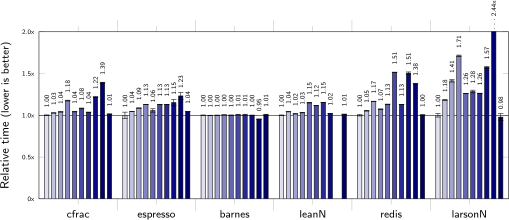
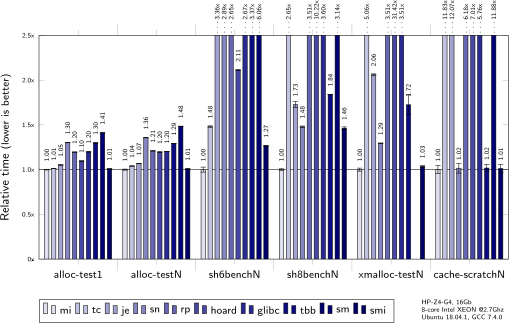
Memory usage:
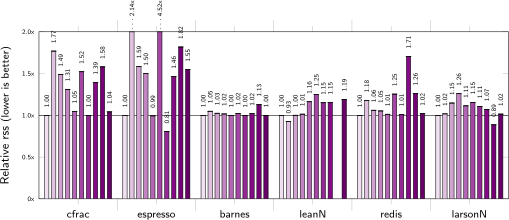
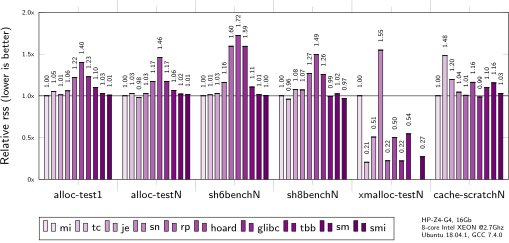
(note: the xmalloc-testN memory usage should be disregarded is it allocates more the faster the program runs. Unfortunately, there are no entries for SuperMalloc in the leanN and xmalloc-testN benchmarks as it faulted on those)
Results and notable usages
Improvements
- Minor performances improvement in isoalloc
- Parallel compilation support in DieHarder
- Portability improvement in Intel TBB malloc
- Various portability improvements in Google's tcmalloc
- Improved double-free detection in snmalloc
- Fixed compilation on modern glibc in SlimGuard
- A crash in isoalloc
- Caught a compilation issue in rpmalloc
- Portability issues in rpmalloc
Notable usages and papers
- Provided data for the glib allocator.
- Provided data for snmalloc hardening.
- Used as main benchmark suite by S2malloc: Statistically Secure Allocator for Use-After-Free Protection And More by Ruizhe Wang, Meng Xu and N. Asokan
- Used as benchmark suite by StarMalloc: Verifying a Modern, Hardened Memory Allocator by Antonin Reitz, Aymeric Fromherz, and Jonathan Protzenko
References
-
[1] Emery D. Berger, Kathryn S. McKinley, Robert D. Blumofe, and Paul R. Wilson. Hoard: A Scalable Memory Allocator for Multithreaded Applications the Ninth International Conference on Architectural Support for Programming Languages and Operating Systems (ASPLOS-IX). Cambridge, MA, November 2000. pdf
-
[2] P. Larson and M. Krishnan. Memory allocation for long-running server applications. In ISMM, Vancouver, B.C., Canada, 1998. pdf
-
[3] D. Grunwald, B. Zorn, and R. Henderson. Improving the cache locality of memory allocation. In R. Cartwright, editor, Proceedings of the Conference on Programming Language Design and Implementation, pages 177–186, New York, NY, USA, June 1993. pdf
-
[4] J. Barnes and P. Hut. A hierarchical O(n*log(n)) force-calculation algorithm. Nature, 324:446-449, 1986.
-
[5] C. Lever, and D. Boreham. Malloc() Performance in a Multithreaded Linux Environment. In USENIX Annual Technical Conference, Freenix Session. San Diego, CA. Jun. 2000. Available at https://github.com/kuszmaul/SuperMalloc/tree/master/tests
-
[6] Timothy Crundal. Reducing Active-False Sharing in TCMalloc. 2016. http://courses.cecs.anu.edu.au/courses/CSPROJECTS/16S1/Reports/Timothy*Crundal*Report.pdf. CS16S1 project at the Australian National University.
-
[7] Alexey Kukanov, and Michael J Voss. The Foundations for Scalable Multi-Core Software in Intel Threading Building Blocks. Intel Technology Journal 11 (4). 2007
-
[8] Paul Liétar, Theodore Butler, Sylvan Clebsch, Sophia Drossopoulou, Juliana Franco, Matthew J Parkinson, Alex Shamis, Christoph M Wintersteiger, and David Chisnall. Snmalloc: A Message Passing Allocator. In Proceedings of the 2019 ACM SIGPLAN International Symposium on Memory Management, 122–135. ACM. 2019.


Similar repos




Languages
C
81.4%
Shell
7.4%
C++
7.0%
Python
3.4%
README
Mimalloc-bench
Suite for benchmarking malloc implementations, originally
developed for benchmarking mimalloc.
Collection of various benchmarks from the academic literature, together with
automated scripts to pull specific versions of benchmark programs and
allocators from Github and build them.
Due to the large variance in programs and allocators, the suite is currently
only developed for Unix-like systems, and specifically Ubuntu with apt-get, Fedora with dnf,
and macOS (for a limited set of allocators and benchmarks).
The only system-installed allocator used is glibc's implementation that ships as part of Linux's libc.
All other allocators are downloaded and built as part of build-bench-env.sh --
if you are looking to run these benchmarks on a different Linux distribution look at
the setup_packages function to see the packages required to build the full set of
allocators.
It is quite easy to add new benchmarks and allocator implementations -- please do so!.
Enjoy, Daan
Note that all the code in the bench directory is not part of
mimalloc-bench as such, and all programs in the bench directory are
governed under their own specific licenses and copyrights as detailed in
their README.md (or license.txt) files. They are just included here for convenience.
Benchmarking
The build-bench-env.sh script with the all argument will automatically pull
all needed benchmarks and allocators and build them in the extern directory:
~/dev/mimalloc-bench> ./build-bench-env.sh all
It starts installing packages and you will need to enter the sudo password.
All other programs are build in the mimalloc-bench/extern directory.
Use ./build-bench-env.sh -h to see all options.
If everything succeeded, you can run the full benchmark suite (from out/bench) as:
~/dev/mimalloc-bench> cd out/bench~/dev/mimalloc-bench/out/bench>../../bench.sh alla allt
Or just test mimalloc and tcmalloc on cfrac and larson with 16 threads:
~/dev/mimalloc-bench/out/bench>../../bench.sh --procs=16 mi tc cfrac larson
Or run the quick essential benchmark set (quickt) and append the matching
KQ benchmark group explicitly:
~/dev/mimalloc-bench/out/bench>../../bench.sh --procs=\nproc` -r=5 -n=1 -s=1 kq_09 je tc mi quickt kq_bench_09`
Generally, you can specify the allocators (mi, je,
tc, hd, sys (system allocator)) etc, and the benchmarks
, cfrac, espresso, barnes, lean, larson, alloc-test, cscratch, etc.
Or all allocators (alla) and tests (allt).
Use --procs=<n> to set the concurrency, and use --help to see all supported
allocators and benchmarks.
Current Allocators
Supported allocators are as follow, see build-bench-env.sh for the versions:
- dieharder: The DieHarder allocator is an error-resistant memory allocator for Windows, Linux, and Mac OS X.
- ff: ffmalloc, from the Usenix Security 21 paper
- fg: The FreeGuard allocator, from the CCS 17 paper
- gd: The Guarder allocator is a tunable secure allocator by the UTSA.
- hd: The Hoard allocator by Emery Berger [1]. This is one of the first multi-thread scalable allocators.
- hm: The Hardened Malloc from GrapheneOS, security-focused.
- iso: The Isoalloc allocator, isolation-based aiming at providing a reasonable level of security without sacrificing too much the performances.
- je: The jemalloc allocator by Jason Evans, now developed at Facebook and widely used in practice, for example in FreeBSD and Firefox.
- lf: The lockfree-malloc allocator, multi-thread scalability-focused.
- lp: The libpas allocator, used by WebKit.
- lt: The ltalloc allocator, a multi-threaded memory allocator based on free lists best suited for many small allocations.
- mesh: The mesh allocator, a memory allocator that automatically reduces the memory footprint of C/C++ applications. Also tested as nomesh with the meshing feature disabled.
- mi: The mimalloc allocator. We can also test the debug version as dmi (this can be used to check for any bugs in the benchmarks), and the secure version as smi.
- mng: musl's memory allocator.
- pa: The PartitionAlloc allocator used in Chromium.
- rp: The rpmalloc allocator uses 16-byte aligned allocations and is developed by Mattias Jansson at Epic Games, used for example in Haiku.
- sc: The scalloc allocator, a fast, multicore-scalable, low-fragmentation memory allocator
- scudo: The scudo allocator used by Fuschia and Android.
- sg: The slimguard allocator, designed to be secure and memory-efficient.
- sm: The Supermalloc allocator by Bradley Kuszmaul uses hardware transactional memory to speed up parallel operations.
- sn: The snmalloc allocator is a recent concurrent message passing allocator by Liétar et al. [8].
- tbb: The Intel TBB allocator that comes with the Thread Building Blocks (TBB) library [7].
- tc: The tcmalloc allocator which comes as part of the Google performance tools, now maintained by the commuity.
- tcg: The tcmalloc allocator, maintained and used by Google.
- yal: The yalloc yet another allocator aims at balancing safety and compactness.
- sys: The system allocator. Here we usually use the glibc allocator (which is originally based on Ptmalloc2).
Current Benchmarks
The first set of benchmarks are real world programs, or are trying to mimic some, and consists of:
- barnes: a hierarchical n-body particle solver [4], simulating the
gravitational forces between 163840 particles. It uses relatively few
allocations compared to
cfracandespressobut is multithreaded. - cfrac: by Dave Barrett, implementation of continued fraction factorization, using many small short-lived allocations.
- espresso: a programmable logic array analyzer, described by Grunwald, Zorn, and Henderson [3]. in the context of cache aware memory allocation.
- gs: have ghostscript process the entire Intel Software Developer’s Manual PDF, which is around 5000 pages.
- leanN: The Lean compiler by
de Moura et al, version 3.4.1,
compiling its own standard library concurrently using N threads
(
./lean --make -j N). Big real-world workload with intensive allocations. - redis: running redis-benchmark, with 1 million requests pushing 10 new list elements and then requesting the head 10 elements, and measures the requests handled per second. Simulates a real-world workload.
- larsonN: by Larson and Krishnan [2]. Simulates a server workload using 100 separate threads which each allocate and free many objects but leave some objects to be freed by other threads. Larson and Krishnan observe this behavior (which they call bleeding) in actual server applications, and the benchmark simulates this.
- larsonN-sized: same as the larsonN except it uses sized deallocation calls which have a fast path in some allocators.
- lua: compiling the lua interpreter.
- z3: perform some computations in z3.
The second set of benchmarks are stress tests and consist of:
- alloc-test: a modern allocator test developed by
OLogN Technologies AG (ITHare.com)
Simulates intensive allocation workloads with a Pareto size
distribution. The alloc-testN benchmark runs on N cores doing
100·10⁶ allocations per thread with objects up to 1KiB
in size. Using commit
94f6cb(master, 2018-07-04) - cache-scratch: by Emery Berger [1]. Introduced with the Hoard allocator to test for passive-false sharing of cache lines: first some small objects are allocated and given to each thread; the threads free that object and allocate immediately another one, and access that repeatedly. If an allocator allocates objects from different threads close to each other this will lead to cache-line contention.
- cache_trash: part of Hoard benchmarking suite, designed to exercise heap cache locality.
- glibc-simple and glibc-thread: benchmarks for the glibc.
- kq_bench_08/09/12: the
malloc_benchmarkbenchmark from boostkit/kqmalloc v0.19.0-beta0, built asextern/kq_benchwithmake clean kunpeng. These group aliases expand tokq_bench_<hip>_m0,kq_bench_<hip>_m1, andkq_bench_<hip>_m2; each item runs one mode with-threads N -affinity 0. - malloc-large: part of mimalloc benchmarking suite, designed to exercice large (several MiB) allocations.
- mleak: check that terminate threads don't "leak" memory.
- rptest: modified version of the rpmalloc-benchmark suite.
- mstress: simulates real-world server-like allocation patterns, using N threads with with allocations in powers of 2 where objects can migrate between threads and some have long life times. Not all threads have equal workloads and after each phase all threads are destroyed and new threads created where some objects survive between phases.
- rbstress: modified version of allocator_bench, allocates chunks in memory via ruby shenanigans.
- sh6bench: by MicroQuill as part of SmartHeap. Stress test where some of the objects are freed in a usual last-allocated, first-freed (LIFO) order, but others are freed in reverse order. Using the public source (retrieved 2019-01-02)
- sh8benchN: by MicroQuill as part of SmartHeap. Stress test for multi-threaded allocation (with N threads) where, just as in larson, some objects are freed by other threads, and some objects freed in reverse (as in sh6bench). Using the public source (retrieved 2019-01-02)
- xmalloc-testN: by Lever and Boreham [5] and Christian Eder. We use the updated version from the SuperMalloc repository. This is a more extreme version of the larson benchmark with 100 purely allocating threads, and 100 purely deallocating threads with objects of various sizes migrating between them. This asymmetric producer/consumer pattern is usually difficult to handle by allocators with thread-local caches.
- recommend-like: jemalloc-specific KPI bench simulating
search/recommendation request workloads — short-lived objects, high churn,
steady-state dirty pages. Reads 5 jemalloc stats via
mallctl(Allocated/RSS, Dirty/RSS, Metadata/Allocated, ChurnRate, 16-32K alloc count) and validates whether the bench shape matches real-service profiles. Three entry points:run_sanity.sh(single-run KPI PASS/FAIL),run.sh(B0 vs A multi-round compare with MAD/median noise floor), and the mainbench.sh recommend-likedriver — seebench/recommend-like/README.md. Jemalloc-only: the bench binary links jemalloc at compile time for the stats interface, sobench.shfiltersalloc_runagainst a jemalloc-family whitelist (je myje myje-base, overridable viaRECOMMEND_LIKE_ALLOCS) and warns + skips on other allocators to avoid writing meaningless KPI rows intobenchres.csv. Example:../../bench.sh je recommend-like(OK),../../bench.sh tc mi recommend-like(skipped).
Finally, there is a security benchmark aiming at checking basic security properties of allocators.
Benchmark Evaluation Dimensions
The full benchmark suite covers the following key evaluation dimensions:
| Dimension | Benchmarks |
|---|---|
| Single-thread throughput | cfrac, espresso, glibc-simple, alloc-test1 |
| Multi-thread scalability | leanN, alloc-testN, sh8bench, xmalloc-testN, glibc-thread |
| Cross-thread object migration | larson, sh8bench, xmalloc-test, mstress |
| Cache locality / false sharing | cache-scratch, cache-thrash, espresso |
| Large allocation efficiency | malloc-large |
| Memory footprint / fragmentation | all benchmarks (RSS peak recorded) |
| Thread-exit memory reclamation | mleak |
| Real-world application workloads | redis, gs, lean, lua, linux, rocksdb, z3, spec |
| Security properties | security (double-free, overflow, underflow, use-after-free, …) |
Benchmark Ranking: Generality and Discriminative Power
The table below ranks each benchmark by two criteria:
- Generality — how broadly representative the workload is of real-world usage
- Effectiveness — how well the benchmark differentiates allocator quality
| Rank | Benchmark | Generality | Effectiveness | Rationale |
|---|---|---|---|---|
| 1 | leanN | ★★★★★ | ★★★★★ | Large real-world multi-threaded compiler workload with intensive allocations; best at exposing practical performance differences |
| 2 | alloc-testN | ★★★★☆ | ★★★★★ | Pareto-distributed sizes mimic realistic programs; 100M allocs/thread sharply differentiates throughput |
| 3 | larson / larson-sized | ★★★★★ | ★★★★☆ | Classic server cross-thread "bleeding" pattern; used in nearly every allocator paper |
| 4 | cfrac | ★★★★☆ | ★★★★☆ | Canonical single-thread small-object benchmark; clearly exposes single-threaded allocation efficiency |
| 5 | xmalloc-testN | ★★★☆☆ | ★★★★★ | Extreme producer/consumer asymmetry; most effective at exposing weaknesses in thread-local caching strategies |
| 6 | cache-scratch | ★★★☆☆ | ★★★★★ | Precisely measures passive false sharing; the only test that effectively detects this critical issue |
| 7 | redis | ★★★★★ | ★★★☆☆ | High real-world relevance (server workload), but allocator differences are typically small |
| 8 | mstress | ★★★★☆ | ★★★★☆ | Multi-phase thread recreation with object migration; good all-round stress test |
| 9 | espresso | ★★★★☆ | ★★★☆☆ | Classic cache-locality benchmark, but single-threaded nature limits discriminative power |
| 10 | rptest | ★★★☆☆ | ★★★★☆ | Highly configurable; covers multiple dimensions, but use-case is narrower |
| 11 | linux | ★★★★★ | ★★★☆☆ | Most realistic build workload; allocator impact is often overshadowed by I/O |
| 12 | rocksdb | ★★★★☆ | ★★★☆☆ | Good database-workload coverage; bottleneck is often I/O rather than allocation |
| 13 | sh6bench / sh8bench | ★★★☆☆ | ★★★☆☆ | Classic stress tests with synthetic free-order patterns |
| 14 | malloc-large | ★★★☆☆ | ★★★☆☆ | Specific but important large-allocation scenario |
| 15 | barnes | ★★★☆☆ | ★★☆☆☆ | Too few allocations to meaningfully differentiate allocators |
| 16 | security (135 tests) | ★★★★☆ | ★★★★★ | Unique safety dimension; measures security properties rather than performance |
| 17 | mleak | ★★☆☆☆ | ★★★★☆ | Narrow scenario, but the thread-exit leak issue it detects is critical |
| 18 | spec | ★★★★★ | ★★★★☆ | Industry-standard suite; requires a separate SPEC CPU 2017 installation |
| 19 | glibc-simple / glibc-thread | ★★★☆☆ | ★★☆☆☆ | Simple glibc-derived patterns with limited discriminative power |
| 20 | z3, gs, lua, lean-mathlib, rbstress, cache-thrash | ★★☆☆☆ | ★★☆☆☆ | Supplementary tests covering long-tail scenarios |
Quick Benchmark Set (quickt)
For a fast but representative evaluation, use the quickt option and append
the matching KQ benchmark group explicitly:
~/dev/mimalloc-bench/out/bench> ../../bench.sh --procs=`nproc` -r=5 -n=1 -s=1 kq_09 je tc mi quickt kq_bench_09
This runs carefully selected benchmarks that together cover the most important and distinct evaluation dimensions:
| Benchmark | Key Dimension | Why Selected |
|---|---|---|
| cfrac | Single-thread small-object throughput | The canonical baseline for pure allocation speed; fast and low-noise |
| alloc-testN | Multi-thread scalability | Pareto size distribution; 100M allocs/thread yields the clearest throughput signal |
| larson-sized | Cross-thread object migration + sized deallocation | Represents server workloads where objects are freed by threads other than their allocator; also exercises the sized-free fast path |
| leanN | Real-world dense multi-thread allocation | Large-scale compiler workload; most predictive of real application performance |
| redis | Real-world single-threaded workload | High real-world relevance (server workload) |
| rocksdb | Real-world storage engine workload | Good database-workload coverage; bottleneck is often I/O rather than allocation; but particularly effective for validating memory usage characteristics |
| kq_bench_08/09/12 | KQ malloc stress modes | Optional group aliases that run the kqmalloc malloc_benchmark modes using explicit HIP08, HIP09, or HIP12 binaries |
These benchmarks cover single-threaded performance, multi-threaded scalability, cross-thread migration, real-world behavior, and memory usage - together giving a meaningful and well-rounded picture of allocator quality.
For a more thorough evaluation, add xmalloc-test, mstress, cache-scratch,
malloc-large, and security to cover extreme cross-thread patterns, large
allocations, false-sharing detection, and security properties.
One-shot runner: run_quickt.sh
run_quickt.sh is a convenience wrapper that runs the quickt set, appends
the CPU-matched kq_bench group, and immediately feeds the results through
scripts/analyze_bench.py (median, MAD, and ratio tables appended to
benchres.csv).
# Default: auto-detects KQ allocator and kq_bench variants from CPU part, plus je tc mi
./run_quickt.sh

# Explicit allocator list
./run_quickt.sh kq_09 je tc mi

# Override rounds and core count
ROUNDS=3 PROCS=4 ./run_quickt.sh kq_09 je tc mi
The script auto-detects the KQ allocator and matching kq_bench variant from
/proc/cpuinfo:
| CPU part | Allocator | kq_bench |
|---|---|---|
0xd06 | kq_12 | kq_bench_12 |
0xd02 | kq_09 | kq_bench_09 |
| other | kq_08 | kq_bench_08 |
After the run, scripts/analyze_bench.py prints median, MAD, and ratio
tables to stdout and appends them to out/bench/benchres.csv.
Example
Below is an example (Apr 2019) of the benchmark results on an HP Z4-G4 workstation with a 4-core Intel® Xeon® W2123 at 3.6 GHz with 16GB ECC memory, running Ubuntu 18.04.1 with LibC 2.27 and GCC 7.3.0.
Memory usage:
(note: the xmalloc-testN memory usage should be disregarded is it allocates more the faster the program runs. Unfortunately, there are no entries for SuperMalloc in the leanN and xmalloc-testN benchmarks as it faulted on those)
Results and notable usages
Improvements
- Minor performances improvement in isoalloc
- Parallel compilation support in DieHarder
- Portability improvement in Intel TBB malloc
- Various portability improvements in Google's tcmalloc
- Improved double-free detection in snmalloc
- Fixed compilation on modern glibc in SlimGuard
- A crash in isoalloc
- Caught a compilation issue in rpmalloc
- Portability issues in rpmalloc
Notable usages and papers
- Provided data for the glib allocator.
- Provided data for snmalloc hardening.
- Used as main benchmark suite by S2malloc: Statistically Secure Allocator for Use-After-Free Protection And More by Ruizhe Wang, Meng Xu and N. Asokan
- Used as benchmark suite by StarMalloc: Verifying a Modern, Hardened Memory Allocator by Antonin Reitz, Aymeric Fromherz, and Jonathan Protzenko
References
-
[1] Emery D. Berger, Kathryn S. McKinley, Robert D. Blumofe, and Paul R. Wilson. Hoard: A Scalable Memory Allocator for Multithreaded Applications the Ninth International Conference on Architectural Support for Programming Languages and Operating Systems (ASPLOS-IX). Cambridge, MA, November 2000. pdf
-
[2] P. Larson and M. Krishnan. Memory allocation for long-running server applications. In ISMM, Vancouver, B.C., Canada, 1998. pdf
-
[3] D. Grunwald, B. Zorn, and R. Henderson. Improving the cache locality of memory allocation. In R. Cartwright, editor, Proceedings of the Conference on Programming Language Design and Implementation, pages 177–186, New York, NY, USA, June 1993. pdf
-
[4] J. Barnes and P. Hut. A hierarchical O(n*log(n)) force-calculation algorithm. Nature, 324:446-449, 1986.
-
[5] C. Lever, and D. Boreham. Malloc() Performance in a Multithreaded Linux Environment. In USENIX Annual Technical Conference, Freenix Session. San Diego, CA. Jun. 2000. Available at https://github.com/kuszmaul/SuperMalloc/tree/master/tests
-
[6] Timothy Crundal. Reducing Active-False Sharing in TCMalloc. 2016. http://courses.cecs.anu.edu.au/courses/CSPROJECTS/16S1/Reports/Timothy*Crundal*Report.pdf. CS16S1 project at the Australian National University.
-
[7] Alexey Kukanov, and Michael J Voss. The Foundations for Scalable Multi-Core Software in Intel Threading Building Blocks. Intel Technology Journal 11 (4). 2007
-
[8] Paul Liétar, Theodore Butler, Sylvan Clebsch, Sophia Drossopoulou, Juliana Franco, Matthew J Parkinson, Alex Shamis, Christoph M Wintersteiger, and David Chisnall. Snmalloc: A Message Passing Allocator. In Proceedings of the 2019 ACM SIGPLAN International Symposium on Memory Management, 122–135. ACM. 2019.
Similar repos
Languages
C
81.4%
Shell
7.4%
C++
7.0%
Python
3.4%