A Multimodal RAG system using Nomic AI's text-image retrieval model and Qwen2.5 VL to search PDFs and webpages on Zotero.
Jupyter Notebook
11
5 commits
updated Jan 26, 2026
Adding web pages 🌐 and arXiv papers 📄 to Zotero is pretty straightforward with the Firefox or Chrome plugins. Zotero makes it easy to organize documents into collections and tag them 🗂️—but when it comes to searching through them or answering deeper questions, it falls short.
To fix this, we can think of:
This means we need a multimodal approach. By combining Nomic AI’s text-image retrieval model with Qwen2.5 VL, we can build a multimodal RAG system 🤖 that actually understands both text and images.
This repo walks you through building a minimal app that runs on Google Colab ⚡.
This code has only been tested on Ubuntu/WSL. First install the following packages on linux:
$ sudo apt-get update
$ sudo apt-get install --quiet -y poppler-utils
Then create the and activate a conda environment using environment.yml, or run the following commands with pip:
$ pip install git+https://github.com/krishanr/zoterorag
$ pip install git+https://github.com/illuin-tech/colpali
Then follow the steps for getting a zotero API key and add it to your .env file under the variable ZOTERO_API_KEY. Also add your HUGGINGFACE_ACCESS_TOKEN to your .env file.
Once the installation steps are complete, the demo can be run in the notebook zotero_rag.ipynb.
Example data used for data ingestion:
items = [{'version': 283,
  'library': {'type': 'user'},
  'meta': {'creatorSummary': 'Faysse et al.',
   'parsedDate': '2025-02-28',
   'numChildren': 3},
  'data': {'version': 283,
   'itemType': 'preprint',
   'title': 'ColPali: Efficient Document Retrieval with Vision Language Models',
   'creators': [{'creatorType': 'author',
     'firstName': 'Manuel',
     'lastName': 'Faysse'},
    {'creatorType': 'author', 'firstName': 'Hugues', 'lastName': 'Sibille'},
    {'creatorType': 'author', 'firstName': 'Tony', 'lastName': 'Wu'},
    {'creatorType': 'author', 'firstName': 'Bilel', 'lastName': 'Omrani'},
    {'creatorType': 'author', 'firstName': 'Gautier', 'lastName': 'Viaud'},
    {'creatorType': 'author', 'firstName': 'Céline', 'lastName': 'Hudelot'},
    {'creatorType': 'author', 'firstName': 'Pierre', 'lastName': 'Colombo'}],
   'abstractNote': 'Documents are visually rich structures that convey information through text, but also figures, page layouts, tables, or even fonts. Since modern retrieval systems mainly rely on the textual information they extract from document pages to index documents -often through lengthy and brittle processes-, they struggle to exploit key visual cues efficiently. This limits their capabilities in many practical document retrieval applications such as Retrieval Augmented Generation (RAG). To benchmark current systems on visually rich document retrieval, we introduce the Visual Document Retrieval Benchmark ViDoRe, composed of various page-level retrieval tasks spanning multiple domains, languages, and practical settings. The inherent complexity and performance shortcomings of modern systems motivate a new concept; doing document retrieval by directly embedding the images of the document pages. We release ColPali, a Vision Language Model trained to produce high-quality multi-vector embeddings from images of document pages. Combined with a late interaction matching mechanism, ColPali largely outperforms modern document retrieval pipelines while being drastically simpler, faster and end-to-end trainable. We release models, data, code and benchmarks under open licenses at https://hf.co/vidore.',
   'genre': '',
   'repository': 'arXiv',
   'archiveID': 'arXiv:2407.01449',
   'place': '',
   'date': '2025-02-28',
   'series': '',
   'seriesNumber': '',
   'DOI': '10.48550/arXiv.2407.01449',
   'citationKey': '',
   'url': 'http://arxiv.org/abs/2407.01449',
   'accessDate': '2025-08-12T23:29:26Z',
   'archive': '',
   'archiveLocation': '',
   'shortTitle': 'ColPali',
   'language': '',
   'libraryCatalog': 'arXiv.org',
   'callNumber': '',
   'rights': '',
   'extra': 'arXiv:2407.01449 [cs]',
   'tags': [{'tag': 'Computer Science - Computation and Language', 'type': 1},
    {'tag': 'Computer Science - Computer Vision and Pattern Recognition',
     'type': 1},
    {'tag': 'Computer Science - Information Retrieval', 'type': 1}],
   'collections': [],
   'relations': {},
   'dateAdded': '2025-08-12T23:29:26Z',
   'dateModified': '2025-08-12T23:29:26Z'}},]
The above data is from the ColPali article available on arXiv. It was downloaded from zotero using pyzotero to demo the RAG app.
In the following code, run a RAG query by changing the query_text variable
and running the corresponding cell. The output will be streamed
in real time by the call to rag.generate.
query_text = "How does ColPali compare with BM25?"
search_result = rag.search(query_text, top_k=10)

# Show image thumbnails
images = rag.get_images(search_result)
if images:
    show_thumbnails(images[:3],thumb_size=(500, 500))

_, text_query = rag.generate(query_text, search_result, top_k_text=3)
The images below are examples of search results for the above query. First we see 3 relevant pages that were retrieved by the nomic embed multimodal retriever.
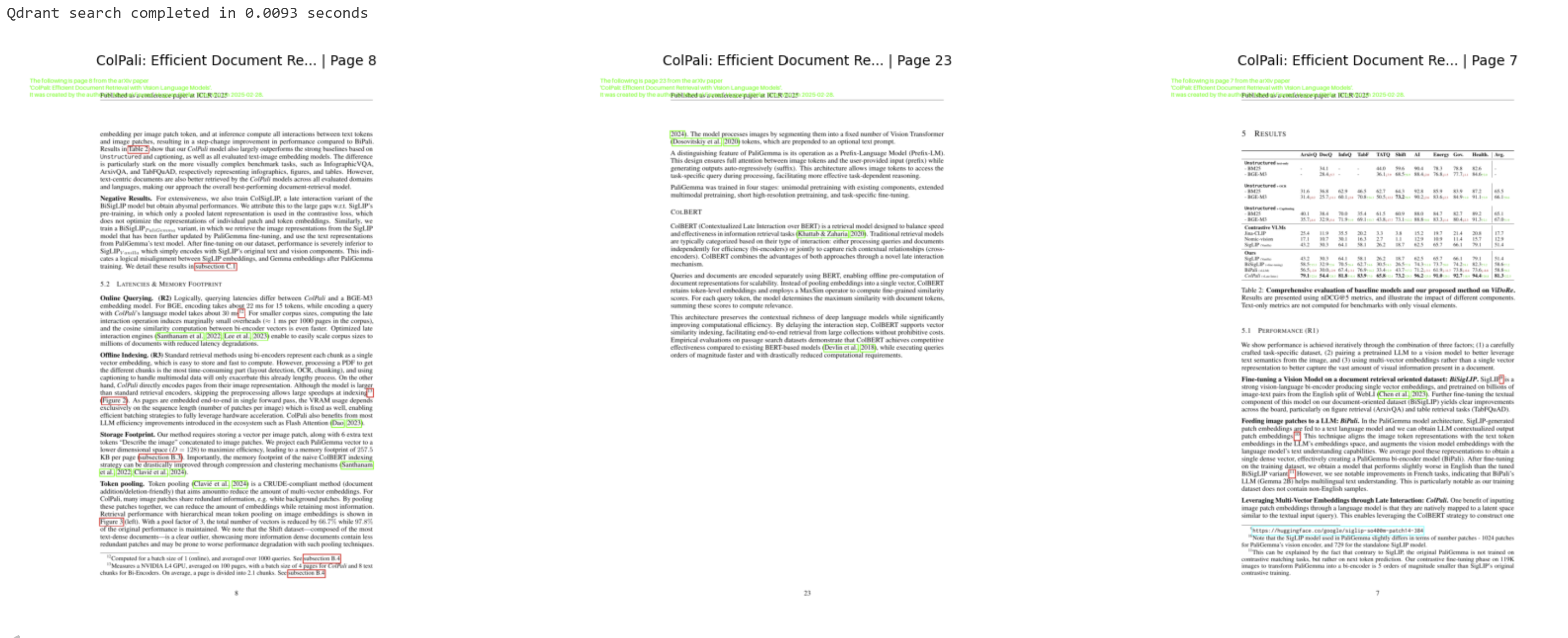
After that, the length of the query is output, followed by models response.

Despite using 3B models, unsloth, 4bit quantization, and a key-value cache for inference, the generation speed is still quite slow. It takes anywhere from 30 seconds to 1 minute per query.
Streaming the output improves the experience but a better solution will be useful.
This repo builds on Nomic Embeds notebook for building a multimodal RAG system using their embedding model:
A Multimodal RAG system using Nomic AI's text-image retrieval model and Qwen2.5 VL to search PDFs and webpages on Zotero.
Jupyter Notebook
11
5 commits
updated Jan 26, 2026
Adding web pages 🌐 and arXiv papers 📄 to Zotero is pretty straightforward with the Firefox or Chrome plugins. Zotero makes it easy to organize documents into collections and tag them 🗂️—but when it comes to searching through them or answering deeper questions, it falls short.
To fix this, we can think of:
This means we need a multimodal approach. By combining Nomic AI’s text-image retrieval model with Qwen2.5 VL, we can build a multimodal RAG system 🤖 that actually understands both text and images.
This repo walks you through building a minimal app that runs on Google Colab ⚡.
This code has only been tested on Ubuntu/WSL. First install the following packages on linux:
$ sudo apt-get update
$ sudo apt-get install --quiet -y poppler-utils
Then create the and activate a conda environment using environment.yml, or run the following commands with pip:
$ pip install git+https://github.com/krishanr/zoterorag
$ pip install git+https://github.com/illuin-tech/colpali
Then follow the steps for getting a zotero API key and add it to your .env file under the variable ZOTERO_API_KEY. Also add your HUGGINGFACE_ACCESS_TOKEN to your .env file.
Once the installation steps are complete, the demo can be run in the notebook zotero_rag.ipynb.
Example data used for data ingestion:
items = [{'version': 283,
  'library': {'type': 'user'},
  'meta': {'creatorSummary': 'Faysse et al.',
   'parsedDate': '2025-02-28',
   'numChildren': 3},
  'data': {'version': 283,
   'itemType': 'preprint',
   'title': 'ColPali: Efficient Document Retrieval with Vision Language Models',
   'creators': [{'creatorType': 'author',
     'firstName': 'Manuel',
     'lastName': 'Faysse'},
    {'creatorType': 'author', 'firstName': 'Hugues', 'lastName': 'Sibille'},
    {'creatorType': 'author', 'firstName': 'Tony', 'lastName': 'Wu'},
    {'creatorType': 'author', 'firstName': 'Bilel', 'lastName': 'Omrani'},
    {'creatorType': 'author', 'firstName': 'Gautier', 'lastName': 'Viaud'},
    {'creatorType': 'author', 'firstName': 'Céline', 'lastName': 'Hudelot'},
    {'creatorType': 'author', 'firstName': 'Pierre', 'lastName': 'Colombo'}],
   'abstractNote': 'Documents are visually rich structures that convey information through text, but also figures, page layouts, tables, or even fonts. Since modern retrieval systems mainly rely on the textual information they extract from document pages to index documents -often through lengthy and brittle processes-, they struggle to exploit key visual cues efficiently. This limits their capabilities in many practical document retrieval applications such as Retrieval Augmented Generation (RAG). To benchmark current systems on visually rich document retrieval, we introduce the Visual Document Retrieval Benchmark ViDoRe, composed of various page-level retrieval tasks spanning multiple domains, languages, and practical settings. The inherent complexity and performance shortcomings of modern systems motivate a new concept; doing document retrieval by directly embedding the images of the document pages. We release ColPali, a Vision Language Model trained to produce high-quality multi-vector embeddings from images of document pages. Combined with a late interaction matching mechanism, ColPali largely outperforms modern document retrieval pipelines while being drastically simpler, faster and end-to-end trainable. We release models, data, code and benchmarks under open licenses at https://hf.co/vidore.',
   'genre': '',
   'repository': 'arXiv',
   'archiveID': 'arXiv:2407.01449',
   'place': '',
   'date': '2025-02-28',
   'series': '',
   'seriesNumber': '',
   'DOI': '10.48550/arXiv.2407.01449',
   'citationKey': '',
   'url': 'http://arxiv.org/abs/2407.01449',
   'accessDate': '2025-08-12T23:29:26Z',
   'archive': '',
   'archiveLocation': '',
   'shortTitle': 'ColPali',
   'language': '',
   'libraryCatalog': 'arXiv.org',
   'callNumber': '',
   'rights': '',
   'extra': 'arXiv:2407.01449 [cs]',
   'tags': [{'tag': 'Computer Science - Computation and Language', 'type': 1},
    {'tag': 'Computer Science - Computer Vision and Pattern Recognition',
     'type': 1},
    {'tag': 'Computer Science - Information Retrieval', 'type': 1}],
   'collections': [],
   'relations': {},
   'dateAdded': '2025-08-12T23:29:26Z',
   'dateModified': '2025-08-12T23:29:26Z'}},]
The above data is from the ColPali article available on arXiv. It was downloaded from zotero using pyzotero to demo the RAG app.
In the following code, run a RAG query by changing the query_text variable
and running the corresponding cell. The output will be streamed
in real time by the call to rag.generate.
query_text = "How does ColPali compare with BM25?"
search_result = rag.search(query_text, top_k=10)

# Show image thumbnails
images = rag.get_images(search_result)
if images:
    show_thumbnails(images[:3],thumb_size=(500, 500))

_, text_query = rag.generate(query_text, search_result, top_k_text=3)
The images below are examples of search results for the above query. First we see 3 relevant pages that were retrieved by the nomic embed multimodal retriever.
After that, the length of the query is output, followed by models response.
Despite using 3B models, unsloth, 4bit quantization, and a key-value cache for inference, the generation speed is still quite slow. It takes anywhere from 30 seconds to 1 minute per query.
Streaming the output improves the experience but a better solution will be useful.
This repo builds on Nomic Embeds notebook for building a multimodal RAG system using their embedding model:



