
A sub-millisecond, drop-in OpenAI-compatible LLM gateway in C++
3
stars
29
commits
C++
primary language
Sep 14, 2026
updated
README
llmbridge
A sub-millisecond, drop-in OpenAI-compatible LLM gateway in C++. Microsecond translation overhead, dependency-free default build (TLS uses OpenSSL), p99 < 1 ms at 1,000 RPS.



What it does
llmbridge is a sub-millisecond LLM gateway. It sits between your app and a model provider: clients speak the OpenAI API to it, and it translates each request to the upstream provider's dialect (Anthropic, Gemini, Cohere, ...) and the response back, adding microseconds, not milliseconds. Run it as a standalone binary, or embed the translation calls directly in your own C++. It's the work gateways like LiteLLM, Bifrost, and Helicone do internally, rebuilt to High Frequency Trading (HFT) latency standards.
Three properties that matter:
- Drop-in OpenAI-compatible. Point an existing OpenAI client at
llmbridgeand route to a different provider with one flag. No app changes. - Microsecond overhead. p99 well under 1 ms at 1,000 RPS on a single core (see Benchmarks); ~84k RPS single-thread ceiling. No GC pauses. Built for the workloads where the request path is the budget: agent loops, voice, trading agents.
- Dependency-free default build. The C++20 translator library and default gateway have no third-party runtime dependencies. The optional TLS build uses OpenSSL >= 3.0.
Open-core. This repo is the fast gateway core: translate and proxy to a single upstream. Multi-provider routing, the live provider price/latency book, observability, SSO, and the managed cloud are the commercial layer from Kottos AI (see the bottom of this README).
Current provider support for chat completions:
- OpenAI ↔ Anthropic, non-streaming and streaming (SSE, token-by-token), incl.
stream_options.include_usage - OpenAI ↔ Google Gemini and OpenAI ↔ Cohere, non-streaming only
- OpenAI-compatible providers (Groq, Together, Fireworks, DeepInfra, Mistral, ...), passthrough, no body translation needed
- Tool calling, declarations,
tool_choice, parallel calls andtool_resultround-trip, streaming and non-streaming (OpenAI ↔ Anthropic) - Prompt caching.
cache_controlbreakpoints are forwarded byte for byte on text parts, on tools and on the system block; a malformed breakpoint is refused - TLS to the provider (
--upstream https://..., opt-in build) and credential passthrough, enough to frontapi.anthropic.comdirectly - Per-request timing headers (
--timing-headers), what the gateway cost vs what the provider cost - An Anthropic-speaking client reaching an Anthropic upstream byte-forwards, which is how an Anthropic SDK or Claude Code runs through it unchanged
- Not yet shipped, and refused with a message that says so instead of ignored: vision, audio and file content parts; streaming for Gemini and Cohere; Bedrock streaming; and the Anthropic-to-OpenAI translator, for a client speaking Anthropic to an OpenAI-dialect upstream (distinct from the byte-forward above)
Benchmarks
An independent harness: nine gateways, one methodology
We run llmbridge inside the AI gateway reproducible benchmark
by Jakub A. Wąsek of ENTERPILOT,
the author of GoModel: every gateway from its public Docker image, one at a time,
against the same in-memory mock, 20,000 requests per variant at concurrency 10, five
trials in randomised order, a separate throughput sweep. Chat completions, added p50
over the harness's no-gateway baseline, one llmbridge worker, reference laptop:
| gateway | version | cores | non-streaming | streaming | peak req/s | req/s per CPU% | memory |
|---|---|---|---|---|---|---|---|
| socat byte pipe | 1.8.1.3 | 2.17 | 0.06 ms | 0.27 ms | 43,973 | 157 | 5 MB |
| llmbridge | v0.53.0 | 0.98 | 0.07 ms | 0.18 ms | 40,677 | 354 | 32 MB |
| llmbridge, translating to Anthropic | v0.53.0 | 1.02 | 0.10 ms | 0.56 ms | 35,298 | 300 | 30 MB |
| GoModel | 0.1.86 | 5.96 | 0.47 ms | 0.75 ms | 16,468 | 23 | 77 MB |
| Bifrost | 2.0.0 | 7.90 | 0.80 ms | 2.77 ms | 10,043 | 11 | 493 MB |
| Portkey | 1.15.2 | 1.20 | 7.56 ms | 27.60 ms | 1,232 | 10 | 198 MB |
| LiteLLM | 1.99.1 | 7.05 | 10.77 ms | 46.06 ms | 880 | 1 | 9,528 MB |
The byte pipe is a socat relay that parses nothing: it measures the cost of being in
the path at all, and llmbridge sits on it, on one core against the Go gateways' six to
eight. Requests per percent of CPU is the harness's own column, throughput under load
divided by the CPU it took, and it is the only one that compares a single-threaded gateway
with ones that take every core. TensorZero and OmniRoute ran too and are left out here as misconfigured (41 ms
and 58 req/s). Two divergences from the published harness, stated because they matter:
Docker's default seccomp filter is off for every gateway (it blocks io_uring, so under
it llmbridge runs epoll), and the host is a 12-CPU laptop and not their c7i.large, so
these figures compare within this table and never with enterpilot.io's. Every variant,
the raw data, the versions and digests are in bench/results/enterpilot/20260904-023214/,
the reading rules in BENCHMARKS.md, and bench/run_enterpilot.sh
reproduces it.
Our own harness: equal-work against LiteLLM
Equal-work head-to-head: both llmbridge and LiteLLM do the full OpenAI↔Anthropic translation against the same 200 ms mock backend, driven by the same open-loop, coordinated-omission-corrected load generator. Single Linux host (i7-9750H, 6cores/12threads), all processes co-located, so absolute tails are a dev-box upper bound. This measures gateway overhead, not end-to-end LLM latency.
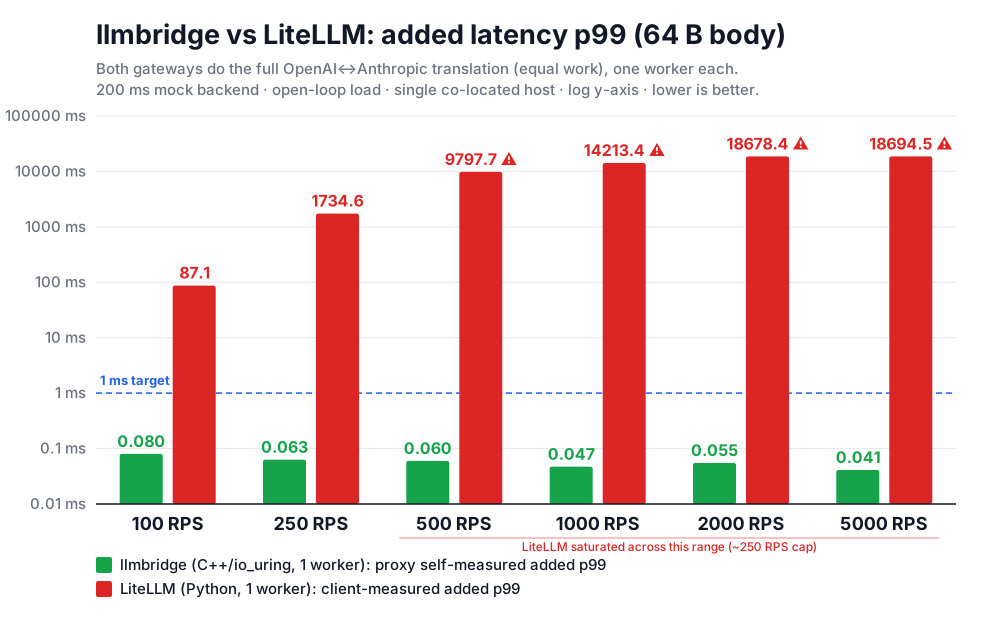
At the unsaturated 100 RPS apples-to-apples point, llmbridge adds 80 µs p99 (self-measured) vs LiteLLM 1.95.0's 87 ms (~1,000×; LiteLLM 1.99 cuts its own p99 to 24-30 ms, so ~300x against a current release, see bench/BENCHMARK-CONFIG.md), and llmbridge holds 41–80 µs p99 across 100–5,000 RPS while LiteLLM (1 uvicorn worker) saturates around ~246 RPS.
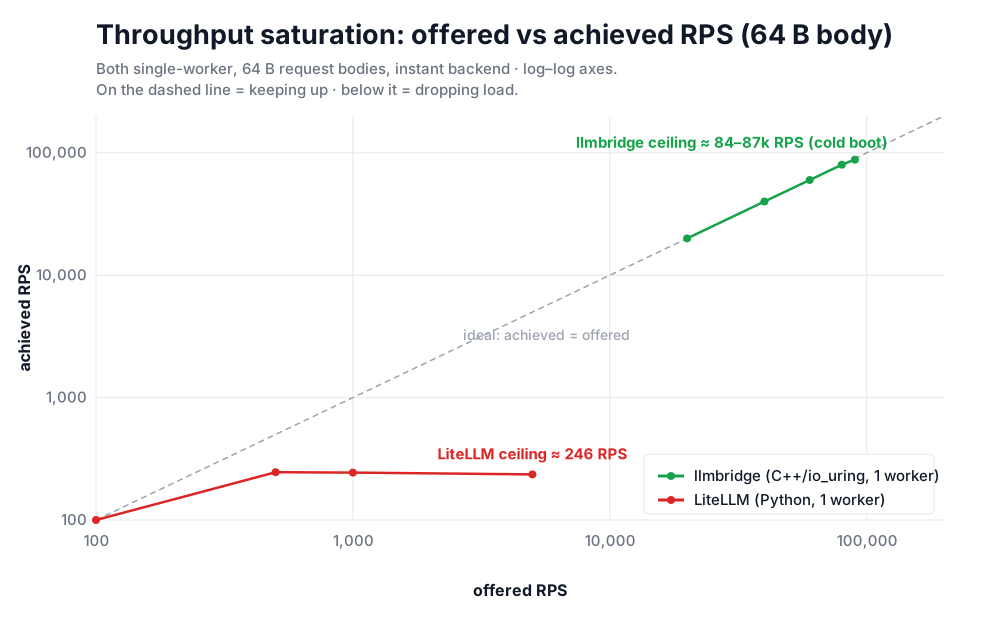
Single-thread throughput ceiling is ~84k RPS (best single run 87k; mean of three 84.8k).
What sets it. llmbridge runs as one thread, so its hard ceiling is one CPU core. At saturation that thread is 87–92% busy, effectively out of headroom, and that is
the cap. (The machine meanwhile reports ~95% idle, because one busy core out of 12
logical CPUs is only ~8% of the box. It cannot use the other 11 cores because it is
single-threaded; that is what --workers N is for.)
Profiling that thread with perf splits its own CPU time as: ~89% executing Linux
kernel code and ~7% executing llmbridge code. The largest single slice of the kernel
side is the TCP stack at 32.7%, the unavoidable price of being a TCP proxy. In short:
nine of every ten cycles the gateway burns are in the kernel's networking path, not in
ours.
Two consequences. Making our own code twice as fast would raise the ceiling by at most
~7%, whereas --workers 2 nearly doubles it. And the figure is thermally dependent, i.e.
the same build measures 87k cold and 82k once the package reaches 85 °C on this laptop.
Bifrost, GoModel, Portkey and five others are measured on a third-party harness below.
Helicone is not measured.
Streaming (SSE)
A separate benchmark, because it measures a different unit of work: one token, not one request. Both gateways translate the same Anthropic event stream into OpenAI chunks at 50 tok/s per stream, measured by the same client-side instrument (neither gateway self-reports), against a no-gateway control run at the same concurrency. Median of 3 runs per concurrency level, which is what the charts below plot.
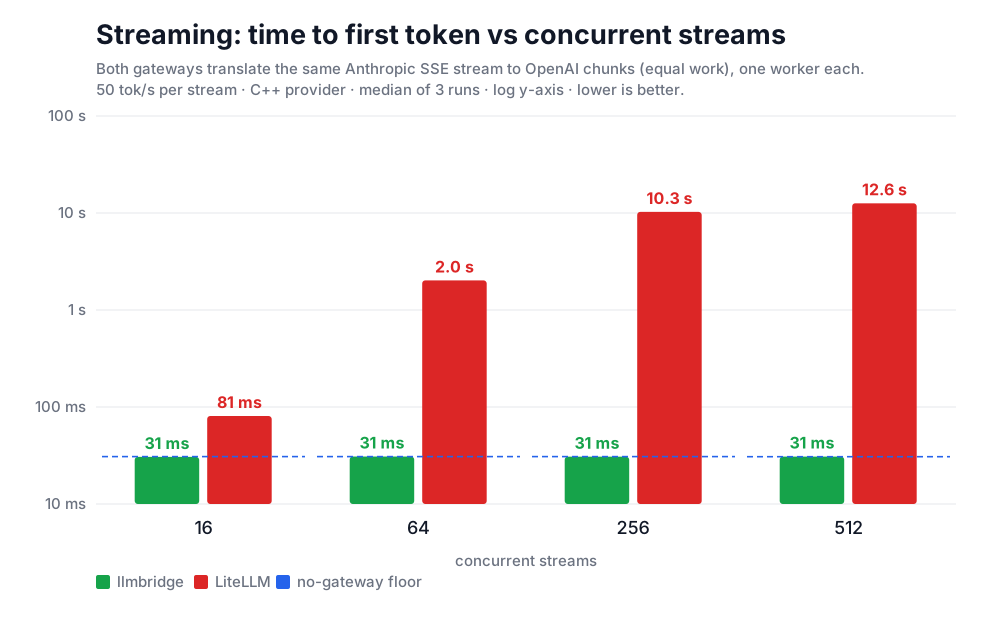
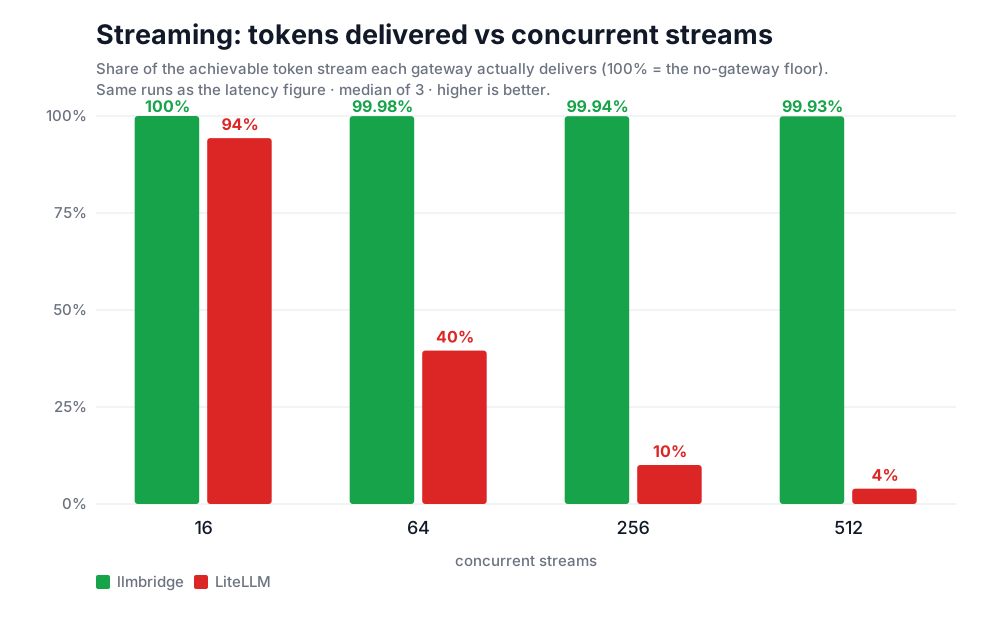
"Concurrent streams" means responses in flight at once through one gateway process. For instance, 512 streams is 512 simultaneous voice agents or chat responses, each receiving a token every 20 ms.
llmbridge's time to first token stays on the no-gateway floor (~30.8 ms) through 512 concurrent streams while delivering 99.93–100% of the achievable token stream, adding ~55–131 µs per token (against a 20 ms inter-token interval, under 1% of the budget). A single LiteLLM worker holds at 16 streams (94% delivered), then queues: at 512 streams it delivers 4% of the tokens with ~13 s to first token.
16,384 concurrent streams on a single worker, using a third of one CPU core and 189 MB: 32,756 of 32,768 offered tokens/s delivered (99.96%), zero client-side failures, p50 36–48 µs, p99 under 0.6 ms, holding 32,774 sockets open. Eight independent load generators agree within 5%. (This capacity run is the one figure here with no committed harness or CSV behind it yet; BENCHMARKS.md says so in place.)
Pushed further to 24,576 streams it still delivers 99.93% with zero failures, at 42–47% of one core and 272 MB (p50 50–58 µs, p99 ~1.2 ms). That is not llmbridge's ceiling; it is the host's: 49,152 of the 55,536 available ephemeral ports are in use, and going higher needs the load generator spread across multiple loopback addresses. No number above 24,576 is claimed.
Do not mix the two sets of numbers. "requests/sec" is not a streaming axis, and "tokens/sec" says nothing about non-streaming throughput.
Reproduce. The host configuration matters as much as the commands; the full runbook
is bench/BENCHMARK-CONFIG.md:
sudo sysctl -w net.ipv4.tcp_max_syn_backlog=8192 net.core.somaxconn=8192
sudo sysctl -w net.ipv4.ip_local_port_range="10000 65535"
sudo cpupower frequency-set -g performance

BACKENDS=4 ./bench/saturate.sh 5 2 90000 130000                 # throughput ceiling
./bench/run_headtohead.sh 200 15 4 100 250 500 1000 2000 5000   # non-streaming vs LiteLLM
./bench/run_stream_headtohead.sh 60 20 20 6 "16 64 256 512"     # streaming vs LiteLLM
BACKENDS=4 is not optional: at the default of 1 the mock backend is the ceiling
(~65k), not the gateway. Full methodology and fairness controls in
BENCHMARKS.md. Caveats: the benchmark runs against a localhost mock over plain HTTP. TLS and
WAN latency are deliberately excluded so the figure isolates gateway overhead (the
gateway itself does support TLS upstreams); single worker/thread each; dev-box
co-location; llmbridge is proxy-self-measured, LiteLLM client-measured (e2e − backend).
Quick start
Build it first
git clone https://github.com/kottos-ai/llmbridge && cd llmbridge
cmake -B build -DCMAKE_BUILD_TYPE=Release          # add -DLLMBRIDGE_TLS=ON for https upstreams
cmake --build build -j
./build/bin/llmbridge --help
Needs CMake 3.20+ and GCC 13+ or Clang 16+ on Linux. The translator alone also builds on macOS; the gateway is Linux-only by design (epoll, io_uring). Full options and the library install are under Installation.
C++: translate a request/response body
#include "provider/translate.hpp"

// An OpenAI-shaped chat-completion request body from your client:
std::string openai_request = R"({
    "model": "claude-3-5-sonnet-latest",
    "messages": [{"role": "user", "content": "Hello"}]
})";

// Translate it to the Anthropic Messages dialect (returns "" on parse failure):
std::string anthropic_request =
    llmbridge::provider::openai_to_anthropic_request(openai_request);

// ...send anthropic_request to Anthropic, then translate the reply back:
std::string openai_response =
    llmbridge::provider::anthropic_to_openai_response(provider_reply);
Also available: openai_to_gemini_request / gemini_to_openai_response and
openai_to_cohere_request / cohere_to_openai_response.
As a gateway
Run the binary in front of an upstream and translate on the fly:
llmbridge --listen 8088 --upstream 127.0.0.1:9001 --upstream-dialect anthropic
#          --upstream also takes HOST:PORT or http(s)://HOST[:PORT][/BASE]
#                                (resolved at startup; /BASE for providers serving
#                                 an OpenAI-compatible API below the root)
#                                                  --upstream-dialect openai|anthropic|gemini|cohere
#          --upstream-timeout 120   # seconds of upstream silence before aborting (0 = off)
Clients POST OpenAI-shaped requests to :8088; llmbridge translates to the upstream
dialect and back.
Against a real provider, build with TLS and point it at the hosted endpoint:
cmake -B build -DLLMBRIDGE_TLS=ON        # OpenSSL ≥ 3.0; OFF by default so the
cmake --build build -j                   # default build stays dependency-free

llmbridge --upstream https://api.anthropic.com --upstream-dialect anthropic --listen 8088
Your client keeps sending its own key as Authorization: Bearer ...; the gateway maps it
to the dialect the provider expects (x-api-key for Anthropic, x-goog-api-key for
Gemini) and forwards only that; no other client header crosses into the rebuilt
upstream request. Certificate and hostname verification are always on and cannot be
disabled.
Logging
The gateway logs to stderr. --log-level trace|debug|info|warn|error|off (default
info), or runtime.log_level in a config file.
2026-08-13T15:05:40.315Z WARN  worker/0 gateway.cpp:2881 CAP stream buffer exceeded,
    dropping the stream ClientConnection#1(fd=6,cid=1) buffered=8389260 limit=8388608
Three subjects lead every message so a line can be attributed at a glance:
ClientConnection#N, UpstreamConnection#N, Request#N. The instance number is
process-unique and never reused, unlike the file descriptor, which the kernel recycles
as soon as a connection closes. Each line also names the worker thread.
DEBUG carries the per-request trace (request line, chosen upstream and whether it
came from the pool, response status), and is compiled out by default so the
published latency numbers are measured on exactly what ships. Build with
-DLLMBRIDGE_LOG_LEVEL=debug to compile it in; raising --log-level at runtime cannot
resurrect a line the build omitted.
WARN is reserved for things an operator should act on: every error with its cause,
TLS handshake failures with the OpenSSL reason, and every configured limit when it is
hit (pool cap, the 8 MiB streaming cap, back-pressure, buffer exhaustion, the three
timeouts), each carrying the measured value against the limit.
No credential appears at any level. Header names and lengths are logged, never values.
Configuration file
Everything above is also settable from a JSON file, which is where this is heading: multi-upstream routing needs an ordered list with per-upstream fields, and flat flags cannot express that.
llmbridge --config /etc/llmbridge/llmbridge.json
An annotated example is in app/llmbridge.example.json. Three
properties worth knowing:
- Flags still work and override the file, so a one-off change needs no edit.
Precedence is not positional: a flag wins whether it appears before or after
--config. Passing--configtwice is refused instead of silently using one. - Unknown keys are a startup error. A misspelled setting that is silently ignored is how you end up believing a value took effect when it did not, and a file has no command line to inspect. Wrong types and out-of-range values are refused the same way, each naming the key.
- Paths, never secrets.
certandkeyare filenames. Do not put provider API keys in it; those travel per request, from the client.
Running in a container: unblock io_uring
The gateway picks io_uring on a kernel that has it and falls back to epoll otherwise. Docker's default seccomp profile blocks the io_uring syscalls, so a container run with the defaults gets the epoll path, on a machine that could have done better. It starts up saying so:
WARN  io_uring unavailable, using epoll. Inside a container this is usually the
      default seccomp profile blocking io_uring_setup ...
INFO  backend requested=auto active=epoll
Give it a profile that permits the io_uring syscalls, or lift the filter entirely:
docker run --security-opt seccomp=unconfined ... llmbridge --listen 8080 --upstream ...
Measured on one box, the epoll fallback served about a quarter less throughput than
io_uring at the same concurrency. Lifting seccomp widens the container's syscall
surface, so on a shared host prefer a custom profile that allows io_uring_setup,
io_uring_enter and io_uring_register and nothing else.
Inbound TLS: terminating the client's connection
The same build also terminates TLS for clients, so the gateway can be a remote endpoint instead of only a loopback sidecar:
llmbridge --listen 8443 --listen-tls --tls-cert cert.pem --tls-key key.pem \
          --upstream https://api.anthropic.com --upstream-dialect anthropic
One listener, one mode. --listen-tls makes the single listener TLS-only; there is
no second plaintext port, so "am I exposed in the clear?" is answered by reading the
command line. The private key must not be readable beyond its owner, an expired
certificate is refused at startup, and a build without TLS refuses --listen-tls
instead of quietly serving plaintext.
Choose the deployment deliberately. Two are supported and they differ in one thing only, who may connect:
- Loopback sidecar, on
127.0.0.1beside your app. Nothing to observe, so plaintext inbound is fine and TLS is unnecessary. Simplest, and the default.- Remote endpoint, reachable from another machine. Requires
--listen-tls, andllmbridgeauthenticates nobody: anything that can reach the listener can use it with its own key. Put an authenticating layer in front, or restrict who can reach the port. TLS keeps the credential off the wire; it does not decide who may connect.A non-loopback plaintext upstream prints a startup warning; there is no equivalent warning for a plaintext listener, because the gateway cannot tell whether it is reachable from outside the host. See SECURITY.md.
What's supported
Today. chat completions, via --upstream-dialect or the provider:: API:
| Provider dialect | OpenAI → provider | provider → OpenAI |
|---|---|---|
| Anthropic Messages | ✅ | ✅ |
Google Gemini (generateContent) | ✅ | ✅ |
| Cohere Chat v2 | ✅ | ✅ |
| OpenAI-compatible (Groq / Together / Fireworks / ...) | passthrough | passthrough |
Per-dialect coverage is the common chat path: model, system prompt, user/assistant
turns, max_tokens / temperature / top_p; and on the response, content /
finish-reason / usage.
Streaming (SSE) is supported for OpenAI ⇄ Anthropic: send "stream": true and the
gateway translates the Anthropic event stream into OpenAI chat.completion.chunks
token-by-token, including the final usage chunk when the request sets
stream_options: {"include_usage": true}. Both event-loop backends (epoll and
io_uring) implement it, with back-pressure and an upstream idle timeout.
Tool calling is supported streaming and non-streaming, OpenAI ⇄ Anthropic:
tools declarations (the JSON Schema is forwarded byte-for-byte, never rebuilt), all
tool_choice forms, parallel calls, and the tool_result round-trip. OpenAI's
role: "tool" messages become an Anthropic user turn with tool_result blocks, and
tool_use blocks come back as OpenAI tool_calls. Over SSE, Anthropic's
content_block_start / input_json_delta events become OpenAI tool_calls deltas
that a client concatenates into the call, so an agent loop works while streaming.
TLS and credentials. Build with -DLLMBRIDGE_TLS=ON (OpenSSL ≥ 3.0; off by
default so the standard build stays dependency-free) and --upstream https://host
connects to a real provider with certificate and hostname verification, which cannot
be disabled. The client's own key is mapped across the dialect boundary
(Authorization: Bearer → x-api-key / x-goog-api-key) and forwarded on a strict
whitelist; no other client header enters the rebuilt upstream request. Credentials are
never logged, never placed in an error body, and pooled connection buffers are scrubbed
on release. --listen-tls terminates the client's TLS too, so the gateway can be a
remote endpoint; it still authenticates nobody, so put something in front of it or keep
it on loopback.
Observability. --timing-headers (opt-in) adds x-llmbridge-* response headers
splitting a request into four disjoint spans: gateway compute, the TCP+TLS handshake
(exactly 0 on a pooled connection), the upstream write(), and provider time. It also
returns an orderable arrival timestamp, a monotonic sequence number, and the provider's
own token counts. Metadata only: no prompt or completion text. Every one of those numbers
is defined precisely in LATENCY.md: which stamps bound it, what is
excluded, and why the handshake is never counted as our overhead. For how the proxy works inside, on both event-loop backends, see GATEWAY-INTERNALS.md.
Direction. Today llmbridge runs in OpenAI-in mode: your code speaks the
OpenAI API and the gateway fronts a provider. Each request is translated in both
directions, OpenAI → provider on the way out and provider → OpenAI on the way back,
so "forward/reverse" would be ambiguous. The mode is named for the API your code
speaks.
Anthropic-in mode, an app written against the Anthropic SDK running unchanged
against an OpenAI-compatible upstream, is planned, and is the harder direction because
Anthropic's streaming protocol is richer, so the events must be synthesised instead of
discarded.
Planned: vision / image inputs, streaming for the Gemini / Cohere dialects, and Anthropic-in mode. Google Vertex additionally needs OAuth2 request signing. Embeddings and audio (Whisper / TTS) are out of scope for now.
AWS Bedrock (SigV4, v0.23.0) and Azure OpenAI (v0.24.0, including the api-version
query on the upstream target) already ship: --upstream-dialect bedrock and
--upstream-dialect azure.
Installation
From source (C++)
git clone https://github.com/kottos-ai/llmbridge.git
cd llmbridge
cmake -B build -DCMAKE_BUILD_TYPE=Release
cmake --build build -j
sudo cmake --install build
Requires C++20 (GCC 13+, Clang 16+). CI builds and tests every push on Ubuntu 24.04 LTS (kernel 6.8+) against GCC 13, GCC 14, Clang 16, Clang 17 and Clang 18. The translator library is portable and is additionally built and tested on macOS; the gateway is Linux-only by design; it is built on epoll and io_uring, and there is no portable substitute worth the complexity. Older Linux distributions work if you supply a GCC 13+ / Clang 16+ toolchain; the distribution itself is not the constraint, the compiler is. The translator library and default gateway have no third-party runtime dependencies. Enabling TLS with -DLLMBRIDGE_TLS=ON adds OpenSSL >= 3.0. Build-time tools (testing, benchmarking) have their own dependencies but are not linked into the distributed library.
The default build is portable; it does not use
-march=native. To reproduce the published benchmark numbers, tune for your CPU with-DLLMBRIDGE_NATIVE_ARCH=ON.
Embed the translator as a library
cmake --install also installs a package config, so a downstream CMake project can:
find_package(llmbridge CONFIG REQUIRED)
target_link_libraries(myapp PRIVATE llmbridge::provider)
#include "provider/translate.hpp"
std::string anthropic = llmbridge::provider::openai_to_anthropic_request(openai_body);
Design
llmbridge is written in modern C++20 with these principles:
- Lean hot path. Zero-copy
string_viewover the input buffer; the translation builds its output in one growable buffer. (It's allocation-light, not allocation-free: the JSON DOM allocates its node vectors and each request builds an output string; a per-connection slab arena to cut the remaining allocations is staged for the multi-loop phase.) - Hand-rolled, dependency-free JSON. A small recursive-descent parser into an ordered DOM plus a string-append builder, scoped to the chat-completion shapes we translate, not a general-purpose library. No
nlohmann::json,jsoncpp, orsimdjsonin the shipped binary. - Hardened, fuzzed parsers. Both hand-rolled parsers are continuously fuzzed under ASan/UBSan (see
fuzz/): the JSON parser is depth-limited (no stack-overflow bombs), request bodies are size-capped, and the HTTP framer is smuggling-safe. Content-Length only, withTransfer-Encodingand conflicting duplicateContent-Lengthrejected. - No GC pauses (it's C++). Tail latency is bounded by
malloc, not garbage collection. - No locks on the hot path. A single-threaded
io_uringevent loop (multishot accept/recv + provided buffers;epollfallback for older kernels) with a keep-alive upstream connection pool and no shared mutable state. One core sustains ~84k RPS (non-streaming); scale out withSO_REUSEPORT. Token-by-token SSE streaming runs on the same loop, with client back-pressure and an upstream idle timeout.
The implementation is small and commented; see the net/, provider/, and gateway/ modules, and DESIGN.md for the full architecture, threading/memory model, and benchmark methodology.
Project status
Alpha. API is unstable; expect breaking changes before v1.0. Built and maintained by Kottos AI, which uses it as the foundation for a hosted inference gateway.
We follow semantic versioning. Pre-1.0 versions may break the API across minor versions. The 1.0 commitment will come after at least six months of public use and at least one production deployment with stable feedback.
License
Apache License 2.0. See LICENSE.
Copyright © 2026 Kottos AI, Inc.
Trademarks
"Kottos AI"™ and "llmbridge"™, and the Kottos AI logo, are trademarks of Kottos AI, Inc. The Apache 2.0 license covers the source code in this repository; per its Section 6 it does not grant any right to use these names or logos. See TRADEMARKS.md for what's permitted.
Contributions
This project is maintained by Kottos AI and does not currently accept external code contributions. We do welcome bug reports, feature suggestions, and questions.
See CONTRIBUTING.md for details on how to engage with the project.
Security
For responsible disclosure of security vulnerabilities, see SECURITY.md or email security@kottos.ai.
About Kottos AI
llmbridge is developed and sponsored by Kottos AI, Inc., which builds exchange-grade inference infrastructure for AI applications. If you need this kind of performance at scale, with managed routing across providers, observability, and enterprise features. get in touch.
Contributors

28 commits

1 commits
See what people are saying
Similar repos


Languages
C++
89.2%
Python
4.8%
Shell
4.3%
CMake
1.6%
A sub-millisecond, drop-in OpenAI-compatible LLM gateway in C++
3
stars
29
commits
C++
primary language
Sep 14, 2026
updated
README
llmbridge
A sub-millisecond, drop-in OpenAI-compatible LLM gateway in C++. Microsecond translation overhead, dependency-free default build (TLS uses OpenSSL), p99 < 1 ms at 1,000 RPS.
What it does
llmbridge is a sub-millisecond LLM gateway. It sits between your app and a model provider: clients speak the OpenAI API to it, and it translates each request to the upstream provider's dialect (Anthropic, Gemini, Cohere, ...) and the response back, adding microseconds, not milliseconds. Run it as a standalone binary, or embed the translation calls directly in your own C++. It's the work gateways like LiteLLM, Bifrost, and Helicone do internally, rebuilt to High Frequency Trading (HFT) latency standards.
Three properties that matter:
- Drop-in OpenAI-compatible. Point an existing OpenAI client at
llmbridgeand route to a different provider with one flag. No app changes. - Microsecond overhead. p99 well under 1 ms at 1,000 RPS on a single core (see Benchmarks); ~84k RPS single-thread ceiling. No GC pauses. Built for the workloads where the request path is the budget: agent loops, voice, trading agents.
- Dependency-free default build. The C++20 translator library and default gateway have no third-party runtime dependencies. The optional TLS build uses OpenSSL >= 3.0.
Open-core. This repo is the fast gateway core: translate and proxy to a single upstream. Multi-provider routing, the live provider price/latency book, observability, SSO, and the managed cloud are the commercial layer from Kottos AI (see the bottom of this README).
Current provider support for chat completions:
- OpenAI ↔ Anthropic, non-streaming and streaming (SSE, token-by-token), incl.
stream_options.include_usage - OpenAI ↔ Google Gemini and OpenAI ↔ Cohere, non-streaming only
- OpenAI-compatible providers (Groq, Together, Fireworks, DeepInfra, Mistral, ...), passthrough, no body translation needed
- Tool calling, declarations,
tool_choice, parallel calls andtool_resultround-trip, streaming and non-streaming (OpenAI ↔ Anthropic) - Prompt caching.
cache_controlbreakpoints are forwarded byte for byte on text parts, on tools and on the system block; a malformed breakpoint is refused - TLS to the provider (
--upstream https://..., opt-in build) and credential passthrough, enough to frontapi.anthropic.comdirectly - Per-request timing headers (
--timing-headers), what the gateway cost vs what the provider cost - An Anthropic-speaking client reaching an Anthropic upstream byte-forwards, which is how an Anthropic SDK or Claude Code runs through it unchanged
- Not yet shipped, and refused with a message that says so instead of ignored: vision, audio and file content parts; streaming for Gemini and Cohere; Bedrock streaming; and the Anthropic-to-OpenAI translator, for a client speaking Anthropic to an OpenAI-dialect upstream (distinct from the byte-forward above)
Benchmarks
An independent harness: nine gateways, one methodology
We run llmbridge inside the AI gateway reproducible benchmark
by Jakub A. Wąsek of ENTERPILOT,
the author of GoModel: every gateway from its public Docker image, one at a time,
against the same in-memory mock, 20,000 requests per variant at concurrency 10, five
trials in randomised order, a separate throughput sweep. Chat completions, added p50
over the harness's no-gateway baseline, one llmbridge worker, reference laptop:
| gateway | version | cores | non-streaming | streaming | peak req/s | req/s per CPU% | memory |
|---|---|---|---|---|---|---|---|
| socat byte pipe | 1.8.1.3 | 2.17 | 0.06 ms | 0.27 ms | 43,973 | 157 | 5 MB |
| llmbridge | v0.53.0 | 0.98 | 0.07 ms | 0.18 ms | 40,677 | 354 | 32 MB |
| llmbridge, translating to Anthropic | v0.53.0 | 1.02 | 0.10 ms | 0.56 ms | 35,298 | 300 | 30 MB |
| GoModel | 0.1.86 | 5.96 | 0.47 ms | 0.75 ms | 16,468 | 23 | 77 MB |
| Bifrost | 2.0.0 | 7.90 | 0.80 ms | 2.77 ms | 10,043 | 11 | 493 MB |
| Portkey | 1.15.2 | 1.20 | 7.56 ms | 27.60 ms | 1,232 | 10 | 198 MB |
| LiteLLM | 1.99.1 | 7.05 | 10.77 ms | 46.06 ms | 880 | 1 | 9,528 MB |
The byte pipe is a socat relay that parses nothing: it measures the cost of being in
the path at all, and llmbridge sits on it, on one core against the Go gateways' six to
eight. Requests per percent of CPU is the harness's own column, throughput under load
divided by the CPU it took, and it is the only one that compares a single-threaded gateway
with ones that take every core. TensorZero and OmniRoute ran too and are left out here as misconfigured (41 ms
and 58 req/s). Two divergences from the published harness, stated because they matter:
Docker's default seccomp filter is off for every gateway (it blocks io_uring, so under
it llmbridge runs epoll), and the host is a 12-CPU laptop and not their c7i.large, so
these figures compare within this table and never with enterpilot.io's. Every variant,
the raw data, the versions and digests are in bench/results/enterpilot/20260904-023214/,
the reading rules in BENCHMARKS.md, and bench/run_enterpilot.sh
reproduces it.
Our own harness: equal-work against LiteLLM
Equal-work head-to-head: both llmbridge and LiteLLM do the full OpenAI↔Anthropic translation against the same 200 ms mock backend, driven by the same open-loop, coordinated-omission-corrected load generator. Single Linux host (i7-9750H, 6cores/12threads), all processes co-located, so absolute tails are a dev-box upper bound. This measures gateway overhead, not end-to-end LLM latency.
At the unsaturated 100 RPS apples-to-apples point, llmbridge adds 80 µs p99 (self-measured) vs LiteLLM 1.95.0's 87 ms (~1,000×; LiteLLM 1.99 cuts its own p99 to 24-30 ms, so ~300x against a current release, see bench/BENCHMARK-CONFIG.md), and llmbridge holds 41–80 µs p99 across 100–5,000 RPS while LiteLLM (1 uvicorn worker) saturates around ~246 RPS.
Single-thread throughput ceiling is ~84k RPS (best single run 87k; mean of three 84.8k).
What sets it. llmbridge runs as one thread, so its hard ceiling is one CPU core. At saturation that thread is 87–92% busy, effectively out of headroom, and that is
the cap. (The machine meanwhile reports ~95% idle, because one busy core out of 12
logical CPUs is only ~8% of the box. It cannot use the other 11 cores because it is
single-threaded; that is what --workers N is for.)
Profiling that thread with perf splits its own CPU time as: ~89% executing Linux
kernel code and ~7% executing llmbridge code. The largest single slice of the kernel
side is the TCP stack at 32.7%, the unavoidable price of being a TCP proxy. In short:
nine of every ten cycles the gateway burns are in the kernel's networking path, not in
ours.
Two consequences. Making our own code twice as fast would raise the ceiling by at most
~7%, whereas --workers 2 nearly doubles it. And the figure is thermally dependent, i.e.
the same build measures 87k cold and 82k once the package reaches 85 °C on this laptop.
Bifrost, GoModel, Portkey and five others are measured on a third-party harness below.
Helicone is not measured.
Streaming (SSE)
A separate benchmark, because it measures a different unit of work: one token, not one request. Both gateways translate the same Anthropic event stream into OpenAI chunks at 50 tok/s per stream, measured by the same client-side instrument (neither gateway self-reports), against a no-gateway control run at the same concurrency. Median of 3 runs per concurrency level, which is what the charts below plot.
"Concurrent streams" means responses in flight at once through one gateway process. For instance, 512 streams is 512 simultaneous voice agents or chat responses, each receiving a token every 20 ms.
llmbridge's time to first token stays on the no-gateway floor (~30.8 ms) through 512 concurrent streams while delivering 99.93–100% of the achievable token stream, adding ~55–131 µs per token (against a 20 ms inter-token interval, under 1% of the budget). A single LiteLLM worker holds at 16 streams (94% delivered), then queues: at 512 streams it delivers 4% of the tokens with ~13 s to first token.
16,384 concurrent streams on a single worker, using a third of one CPU core and 189 MB: 32,756 of 32,768 offered tokens/s delivered (99.96%), zero client-side failures, p50 36–48 µs, p99 under 0.6 ms, holding 32,774 sockets open. Eight independent load generators agree within 5%. (This capacity run is the one figure here with no committed harness or CSV behind it yet; BENCHMARKS.md says so in place.)
Pushed further to 24,576 streams it still delivers 99.93% with zero failures, at 42–47% of one core and 272 MB (p50 50–58 µs, p99 ~1.2 ms). That is not llmbridge's ceiling; it is the host's: 49,152 of the 55,536 available ephemeral ports are in use, and going higher needs the load generator spread across multiple loopback addresses. No number above 24,576 is claimed.
Do not mix the two sets of numbers. "requests/sec" is not a streaming axis, and "tokens/sec" says nothing about non-streaming throughput.
Reproduce. The host configuration matters as much as the commands; the full runbook
is bench/BENCHMARK-CONFIG.md:
sudo sysctl -w net.ipv4.tcp_max_syn_backlog=8192 net.core.somaxconn=8192
sudo sysctl -w net.ipv4.ip_local_port_range="10000 65535"
sudo cpupower frequency-set -g performance

BACKENDS=4 ./bench/saturate.sh 5 2 90000 130000                 # throughput ceiling
./bench/run_headtohead.sh 200 15 4 100 250 500 1000 2000 5000   # non-streaming vs LiteLLM
./bench/run_stream_headtohead.sh 60 20 20 6 "16 64 256 512"     # streaming vs LiteLLM
BACKENDS=4 is not optional: at the default of 1 the mock backend is the ceiling
(~65k), not the gateway. Full methodology and fairness controls in
BENCHMARKS.md. Caveats: the benchmark runs against a localhost mock over plain HTTP. TLS and
WAN latency are deliberately excluded so the figure isolates gateway overhead (the
gateway itself does support TLS upstreams); single worker/thread each; dev-box
co-location; llmbridge is proxy-self-measured, LiteLLM client-measured (e2e − backend).
Quick start
Build it first
git clone https://github.com/kottos-ai/llmbridge && cd llmbridge
cmake -B build -DCMAKE_BUILD_TYPE=Release          # add -DLLMBRIDGE_TLS=ON for https upstreams
cmake --build build -j
./build/bin/llmbridge --help
Needs CMake 3.20+ and GCC 13+ or Clang 16+ on Linux. The translator alone also builds on macOS; the gateway is Linux-only by design (epoll, io_uring). Full options and the library install are under Installation.
C++: translate a request/response body
#include "provider/translate.hpp"

// An OpenAI-shaped chat-completion request body from your client:
std::string openai_request = R"({
    "model": "claude-3-5-sonnet-latest",
    "messages": [{"role": "user", "content": "Hello"}]
})";

// Translate it to the Anthropic Messages dialect (returns "" on parse failure):
std::string anthropic_request =
    llmbridge::provider::openai_to_anthropic_request(openai_request);

// ...send anthropic_request to Anthropic, then translate the reply back:
std::string openai_response =
    llmbridge::provider::anthropic_to_openai_response(provider_reply);
Also available: openai_to_gemini_request / gemini_to_openai_response and
openai_to_cohere_request / cohere_to_openai_response.
As a gateway
Run the binary in front of an upstream and translate on the fly:
llmbridge --listen 8088 --upstream 127.0.0.1:9001 --upstream-dialect anthropic
#          --upstream also takes HOST:PORT or http(s)://HOST[:PORT][/BASE]
#                                (resolved at startup; /BASE for providers serving
#                                 an OpenAI-compatible API below the root)
#                                                  --upstream-dialect openai|anthropic|gemini|cohere
#          --upstream-timeout 120   # seconds of upstream silence before aborting (0 = off)
Clients POST OpenAI-shaped requests to :8088; llmbridge translates to the upstream
dialect and back.
Against a real provider, build with TLS and point it at the hosted endpoint:
cmake -B build -DLLMBRIDGE_TLS=ON        # OpenSSL ≥ 3.0; OFF by default so the
cmake --build build -j                   # default build stays dependency-free

llmbridge --upstream https://api.anthropic.com --upstream-dialect anthropic --listen 8088
Your client keeps sending its own key as Authorization: Bearer ...; the gateway maps it
to the dialect the provider expects (x-api-key for Anthropic, x-goog-api-key for
Gemini) and forwards only that; no other client header crosses into the rebuilt
upstream request. Certificate and hostname verification are always on and cannot be
disabled.
Logging
The gateway logs to stderr. --log-level trace|debug|info|warn|error|off (default
info), or runtime.log_level in a config file.
2026-08-13T15:05:40.315Z WARN  worker/0 gateway.cpp:2881 CAP stream buffer exceeded,
    dropping the stream ClientConnection#1(fd=6,cid=1) buffered=8389260 limit=8388608
Three subjects lead every message so a line can be attributed at a glance:
ClientConnection#N, UpstreamConnection#N, Request#N. The instance number is
process-unique and never reused, unlike the file descriptor, which the kernel recycles
as soon as a connection closes. Each line also names the worker thread.
DEBUG carries the per-request trace (request line, chosen upstream and whether it
came from the pool, response status), and is compiled out by default so the
published latency numbers are measured on exactly what ships. Build with
-DLLMBRIDGE_LOG_LEVEL=debug to compile it in; raising --log-level at runtime cannot
resurrect a line the build omitted.
WARN is reserved for things an operator should act on: every error with its cause,
TLS handshake failures with the OpenSSL reason, and every configured limit when it is
hit (pool cap, the 8 MiB streaming cap, back-pressure, buffer exhaustion, the three
timeouts), each carrying the measured value against the limit.
No credential appears at any level. Header names and lengths are logged, never values.
Configuration file
Everything above is also settable from a JSON file, which is where this is heading: multi-upstream routing needs an ordered list with per-upstream fields, and flat flags cannot express that.
llmbridge --config /etc/llmbridge/llmbridge.json
An annotated example is in app/llmbridge.example.json. Three
properties worth knowing:
- Flags still work and override the file, so a one-off change needs no edit.
Precedence is not positional: a flag wins whether it appears before or after
--config. Passing--configtwice is refused instead of silently using one. - Unknown keys are a startup error. A misspelled setting that is silently ignored is how you end up believing a value took effect when it did not, and a file has no command line to inspect. Wrong types and out-of-range values are refused the same way, each naming the key.
- Paths, never secrets.
certandkeyare filenames. Do not put provider API keys in it; those travel per request, from the client.
Running in a container: unblock io_uring
The gateway picks io_uring on a kernel that has it and falls back to epoll otherwise. Docker's default seccomp profile blocks the io_uring syscalls, so a container run with the defaults gets the epoll path, on a machine that could have done better. It starts up saying so:
WARN  io_uring unavailable, using epoll. Inside a container this is usually the
      default seccomp profile blocking io_uring_setup ...
INFO  backend requested=auto active=epoll
Give it a profile that permits the io_uring syscalls, or lift the filter entirely:
docker run --security-opt seccomp=unconfined ... llmbridge --listen 8080 --upstream ...
Measured on one box, the epoll fallback served about a quarter less throughput than
io_uring at the same concurrency. Lifting seccomp widens the container's syscall
surface, so on a shared host prefer a custom profile that allows io_uring_setup,
io_uring_enter and io_uring_register and nothing else.
Inbound TLS: terminating the client's connection
The same build also terminates TLS for clients, so the gateway can be a remote endpoint instead of only a loopback sidecar:
llmbridge --listen 8443 --listen-tls --tls-cert cert.pem --tls-key key.pem \
          --upstream https://api.anthropic.com --upstream-dialect anthropic
One listener, one mode. --listen-tls makes the single listener TLS-only; there is
no second plaintext port, so "am I exposed in the clear?" is answered by reading the
command line. The private key must not be readable beyond its owner, an expired
certificate is refused at startup, and a build without TLS refuses --listen-tls
instead of quietly serving plaintext.
Choose the deployment deliberately. Two are supported and they differ in one thing only, who may connect:
- Loopback sidecar, on
127.0.0.1beside your app. Nothing to observe, so plaintext inbound is fine and TLS is unnecessary. Simplest, and the default.- Remote endpoint, reachable from another machine. Requires
--listen-tls, andllmbridgeauthenticates nobody: anything that can reach the listener can use it with its own key. Put an authenticating layer in front, or restrict who can reach the port. TLS keeps the credential off the wire; it does not decide who may connect.A non-loopback plaintext upstream prints a startup warning; there is no equivalent warning for a plaintext listener, because the gateway cannot tell whether it is reachable from outside the host. See SECURITY.md.
What's supported
Today. chat completions, via --upstream-dialect or the provider:: API:
| Provider dialect | OpenAI → provider | provider → OpenAI |
|---|---|---|
| Anthropic Messages | ✅ | ✅ |
Google Gemini (generateContent) | ✅ | ✅ |
| Cohere Chat v2 | ✅ | ✅ |
| OpenAI-compatible (Groq / Together / Fireworks / ...) | passthrough | passthrough |
Per-dialect coverage is the common chat path: model, system prompt, user/assistant
turns, max_tokens / temperature / top_p; and on the response, content /
finish-reason / usage.
Streaming (SSE) is supported for OpenAI ⇄ Anthropic: send "stream": true and the
gateway translates the Anthropic event stream into OpenAI chat.completion.chunks
token-by-token, including the final usage chunk when the request sets
stream_options: {"include_usage": true}. Both event-loop backends (epoll and
io_uring) implement it, with back-pressure and an upstream idle timeout.
Tool calling is supported streaming and non-streaming, OpenAI ⇄ Anthropic:
tools declarations (the JSON Schema is forwarded byte-for-byte, never rebuilt), all
tool_choice forms, parallel calls, and the tool_result round-trip. OpenAI's
role: "tool" messages become an Anthropic user turn with tool_result blocks, and
tool_use blocks come back as OpenAI tool_calls. Over SSE, Anthropic's
content_block_start / input_json_delta events become OpenAI tool_calls deltas
that a client concatenates into the call, so an agent loop works while streaming.
TLS and credentials. Build with -DLLMBRIDGE_TLS=ON (OpenSSL ≥ 3.0; off by
default so the standard build stays dependency-free) and --upstream https://host
connects to a real provider with certificate and hostname verification, which cannot
be disabled. The client's own key is mapped across the dialect boundary
(Authorization: Bearer → x-api-key / x-goog-api-key) and forwarded on a strict
whitelist; no other client header enters the rebuilt upstream request. Credentials are
never logged, never placed in an error body, and pooled connection buffers are scrubbed
on release. --listen-tls terminates the client's TLS too, so the gateway can be a
remote endpoint; it still authenticates nobody, so put something in front of it or keep
it on loopback.
Observability. --timing-headers (opt-in) adds x-llmbridge-* response headers
splitting a request into four disjoint spans: gateway compute, the TCP+TLS handshake
(exactly 0 on a pooled connection), the upstream write(), and provider time. It also
returns an orderable arrival timestamp, a monotonic sequence number, and the provider's
own token counts. Metadata only: no prompt or completion text. Every one of those numbers
is defined precisely in LATENCY.md: which stamps bound it, what is
excluded, and why the handshake is never counted as our overhead. For how the proxy works inside, on both event-loop backends, see GATEWAY-INTERNALS.md.
Direction. Today llmbridge runs in OpenAI-in mode: your code speaks the
OpenAI API and the gateway fronts a provider. Each request is translated in both
directions, OpenAI → provider on the way out and provider → OpenAI on the way back,
so "forward/reverse" would be ambiguous. The mode is named for the API your code
speaks.
Anthropic-in mode, an app written against the Anthropic SDK running unchanged
against an OpenAI-compatible upstream, is planned, and is the harder direction because
Anthropic's streaming protocol is richer, so the events must be synthesised instead of
discarded.
Planned: vision / image inputs, streaming for the Gemini / Cohere dialects, and Anthropic-in mode. Google Vertex additionally needs OAuth2 request signing. Embeddings and audio (Whisper / TTS) are out of scope for now.
AWS Bedrock (SigV4, v0.23.0) and Azure OpenAI (v0.24.0, including the api-version
query on the upstream target) already ship: --upstream-dialect bedrock and
--upstream-dialect azure.
Installation
From source (C++)
git clone https://github.com/kottos-ai/llmbridge.git
cd llmbridge
cmake -B build -DCMAKE_BUILD_TYPE=Release
cmake --build build -j
sudo cmake --install build
Requires C++20 (GCC 13+, Clang 16+). CI builds and tests every push on Ubuntu 24.04 LTS (kernel 6.8+) against GCC 13, GCC 14, Clang 16, Clang 17 and Clang 18. The translator library is portable and is additionally built and tested on macOS; the gateway is Linux-only by design; it is built on epoll and io_uring, and there is no portable substitute worth the complexity. Older Linux distributions work if you supply a GCC 13+ / Clang 16+ toolchain; the distribution itself is not the constraint, the compiler is. The translator library and default gateway have no third-party runtime dependencies. Enabling TLS with -DLLMBRIDGE_TLS=ON adds OpenSSL >= 3.0. Build-time tools (testing, benchmarking) have their own dependencies but are not linked into the distributed library.
The default build is portable; it does not use
-march=native. To reproduce the published benchmark numbers, tune for your CPU with-DLLMBRIDGE_NATIVE_ARCH=ON.
Embed the translator as a library
cmake --install also installs a package config, so a downstream CMake project can:
find_package(llmbridge CONFIG REQUIRED)
target_link_libraries(myapp PRIVATE llmbridge::provider)
#include "provider/translate.hpp"
std::string anthropic = llmbridge::provider::openai_to_anthropic_request(openai_body);
Design
llmbridge is written in modern C++20 with these principles:
- Lean hot path. Zero-copy
string_viewover the input buffer; the translation builds its output in one growable buffer. (It's allocation-light, not allocation-free: the JSON DOM allocates its node vectors and each request builds an output string; a per-connection slab arena to cut the remaining allocations is staged for the multi-loop phase.) - Hand-rolled, dependency-free JSON. A small recursive-descent parser into an ordered DOM plus a string-append builder, scoped to the chat-completion shapes we translate, not a general-purpose library. No
nlohmann::json,jsoncpp, orsimdjsonin the shipped binary. - Hardened, fuzzed parsers. Both hand-rolled parsers are continuously fuzzed under ASan/UBSan (see
fuzz/): the JSON parser is depth-limited (no stack-overflow bombs), request bodies are size-capped, and the HTTP framer is smuggling-safe. Content-Length only, withTransfer-Encodingand conflicting duplicateContent-Lengthrejected. - No GC pauses (it's C++). Tail latency is bounded by
malloc, not garbage collection. - No locks on the hot path. A single-threaded
io_uringevent loop (multishot accept/recv + provided buffers;epollfallback for older kernels) with a keep-alive upstream connection pool and no shared mutable state. One core sustains ~84k RPS (non-streaming); scale out withSO_REUSEPORT. Token-by-token SSE streaming runs on the same loop, with client back-pressure and an upstream idle timeout.
The implementation is small and commented; see the net/, provider/, and gateway/ modules, and DESIGN.md for the full architecture, threading/memory model, and benchmark methodology.
Project status
Alpha. API is unstable; expect breaking changes before v1.0. Built and maintained by Kottos AI, which uses it as the foundation for a hosted inference gateway.
We follow semantic versioning. Pre-1.0 versions may break the API across minor versions. The 1.0 commitment will come after at least six months of public use and at least one production deployment with stable feedback.
License
Apache License 2.0. See LICENSE.
Copyright © 2026 Kottos AI, Inc.
Trademarks
"Kottos AI"™ and "llmbridge"™, and the Kottos AI logo, are trademarks of Kottos AI, Inc. The Apache 2.0 license covers the source code in this repository; per its Section 6 it does not grant any right to use these names or logos. See TRADEMARKS.md for what's permitted.
Contributions
This project is maintained by Kottos AI and does not currently accept external code contributions. We do welcome bug reports, feature suggestions, and questions.
See CONTRIBUTING.md for details on how to engage with the project.
Security
For responsible disclosure of security vulnerabilities, see SECURITY.md or email security@kottos.ai.
About Kottos AI
llmbridge is developed and sponsored by Kottos AI, Inc., which builds exchange-grade inference infrastructure for AI applications. If you need this kind of performance at scale, with managed routing across providers, observability, and enterprise features. get in touch.
See what people are saying
Similar repos
Contributors
28 commits
1 commits
Languages
C++
89.2%
Python
4.8%
Shell
4.3%
CMake
1.6%