One Line To Build Zero-Data Classifiers in Minutes
Python
64
56 commits
updated Sep 25, 2024

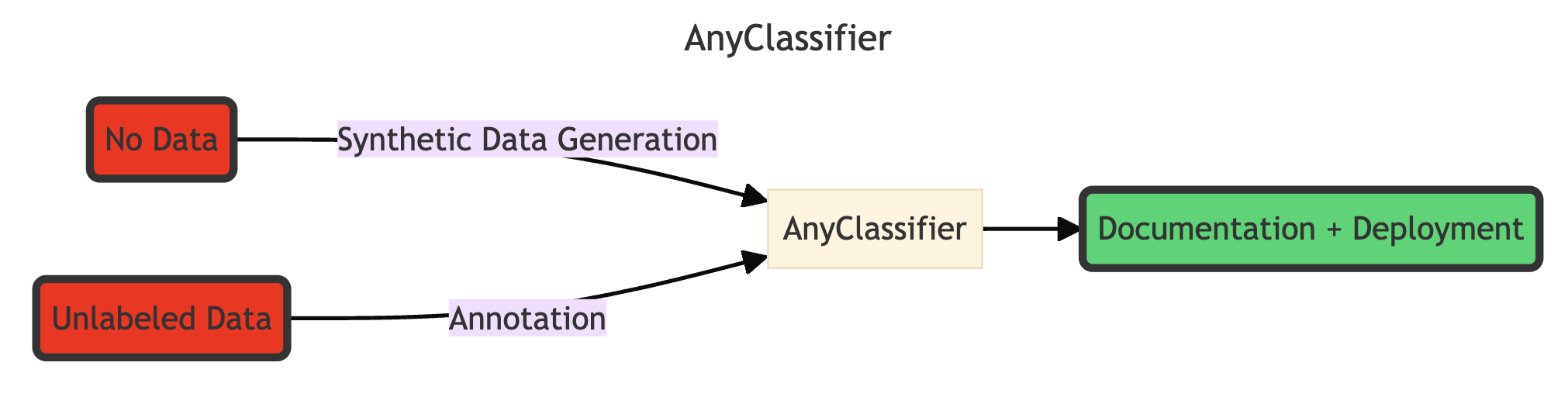
Have you ever wanted/ been requested to build a classifier without any data? What it takes now is just one line 🤯.
AnyClassifier is a framework that empowers you to create high-performance classifiers without any labels or data, using minimal code. It's designed to revolutionize the machine learning development process by eliminating the need for extensive data curation and labeling.
As machine learning engineers, we understand the challenges of building and curating high-quality labeled datasets.
The challenge amplifies when you want to build a multilingual dataset.
AnyClassifier eliminates this bottleneck, allowing you to focus on what matters most - solving real-world problems.
# install (cp39 = python3.9, other valid values are cp310, cp311, cp312)
curl -L -O https://github.com/abetlen/llama-cpp-python/releases/download/v0.2.88-metal/llama_cpp_python-0.2.88-cp39-cp39-macosx_11_0_arm64.whl
pip install llama_cpp_python-0.2.88-cp39-cp39-macosx_11_0_arm64.whl
rm llama_cpp_python-0.2.88-cp39-cp39-macosx_11_0_arm64.whl
pip install anyclassifier
# run
cd examples
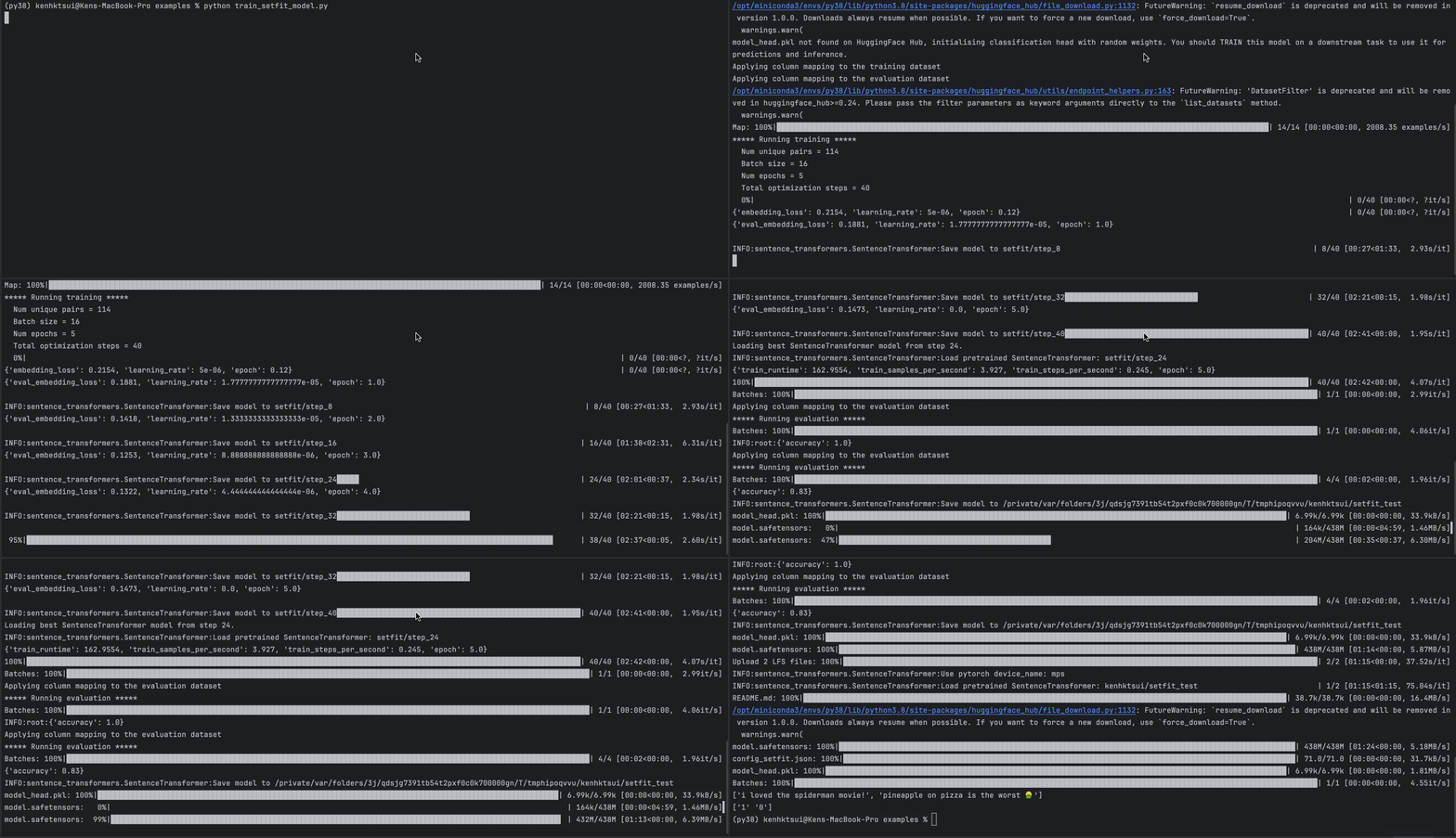
python train_setfit_model_imdb.py
| Dataset | Colab Link |
|---|---|
| No Data! |  |
| imdb sentiment classification | |
meta-llama/Meta-Llama-3.1-8B-Instruct
google/gemma-2-9b
from huggingface_hub import hf_hub_download

# meta-llama/Meta-Llama-3.1-8B-Instruct
hf_hub_download("lmstudio-community/Meta-Llama-3.1-8B-Instruct-GGUF", "Meta-Llama-3.1-8B-Instruct-Q8_0.gguf")

# google/gemma-2-9b
hf_hub_download("lmstudio-community/gemma-2-9b-it-GGUF", "gemma-2-9b-it-Q8_0.gguf")
from huggingface_hub import hf_hub_download
from anyclassifier import train_anyclassifier
from anyclassifier.llm.llm_client import LlamaCppClient
from anyclassifier.schema import Label

# Magic One Line!
trainer = train_anyclassifier(
  "Classify a text's sentiment.",
  [
    Label(id=1, desc='positive sentiment'),
    Label(id=0, desc='negative sentiment')
  ],
  LlamaCppClient(hf_hub_download(
    "lmstudio-community/Meta-Llama-3.1-8B-Instruct-GGUF", "Meta-Llama-3.1-8B-Instruct-Q8_0.gguf" # as you like
  ))
)
# Share Your Model!
trainer.push_to_hub("user_id/any_model")
from huggingface_hub import hf_hub_download
from anyclassifier import train_anyclassifier
from anyclassifier.llm.llm_client import LlamaCppClient
from anyclassifier.schema import Label

unlabeled_dataset  # a huggingface datasets.Dataset class can be from your local json/ csv, or from huggingface hub.

# Magic One Line!
trainer = train_anyclassifier(
  "Classify a text's sentiment.",
  [
    Label(id=1, desc='positive sentiment'),
    Label(id=0, desc='negative sentiment')
  ],
  LlamaCppClient(hf_hub_download(
    "lmstudio-community/Meta-Llama-3.1-8B-Instruct-GGUF", "Meta-Llama-3.1-8B-Instruct-Q8_0.gguf" # as you like
  )),
  unlabeled_dataset
)
# Share Your Model!
trainer.push_to_hub("user_id/any_model")
# SetFit
from setfit import SetFitModel

model = SetFitModel.from_pretrained("user_id/any_model")
preds = model.predict(["i loved the spiderman movie!", "pineapple on pizza is the worst 🤮"])
print(preds)

# FastText
from anyclassifier.fasttext_wrapper import FastTextForSequenceClassification

model = FastTextForSequenceClassification.from_pretrained("user_id/any_model")
preds = model.predict(["i loved the spiderman movie!", "pineapple on pizza is the worst 🤮"])
print(preds)
It is using llama.cpp as backend, and build wheel can take a lot of time (10min+), as such, we also provide an instruction to install with pre-built wheel.
curl -L -O https://github.com/abetlen/llama-cpp-python/releases/download/v0.2.88-metal/llama_cpp_python-0.2.88-cp39-cp39-macosx_11_0_arm64.whl
pip install llama_cpp_python-0.2.88-cp39-cp39-macosx_11_0_arm64.whl
rm llama_cpp_python-0.2.88-cp39-cp39-macosx_11_0_arm64.whl
pip install anyclassifier
curl -L -O https://github.com/abetlen/llama-cpp-python/releases/download/v0.2.88-cu124/llama_cpp_python-0.2.88-cp310-cp310-linux_x86_64.whl
pip install llama_cpp_python-0.2.88-cp310-cp310-linux_x86_64.whl
rm llama_cpp_python-0.2.88-cp310-cp310-linux_x86_64.whl
pip install anyclassifier
CMAKE_ARGS="-DGGML_METAL=on" pip install anyclassifier
CMAKE_ARGS="-DGGML_BLAS=ON -DGGML_BLAS_VENDOR=OpenBLAS" pip install anyclassifier
pip install -e .
from anyclassifier.schema import Label
from anyclassifier.llm.llm_client import OpenAIClient
from anyclassifier.train_any import train_anyclassifier

trainer = train_anyclassifier(
  "Classify a text's sentiment.",
  [
    Label(id=1, desc='positive sentiment'),
    Label(id=0, desc='negative sentiment')
  ],
  OpenAIClient(api_key="<YOUR_OPENAI_API_KEY>", model="gpt-4o-mini"),
  generation_concurrency=10,
  labeling_concurrency=10
)
from datasets import load_dataset
from anyclassifier.annotation.prompt import AnnotationPrompt
from anyclassifier.llm.llm_client import LlamaCppClient
from anyclassifier.schema import Label
from anyclassifier.annotation.annotator import LLMAnnotator

unlabeled_dataset = load_dataset("somepath")
prompt = AnnotationPrompt(
  task_description="Classify a text's sentiment.",
  label_definition=[
      Label(id=0, desc='negative sentiment'),
      Label(id=1, desc='positive sentiment')
  ]
)
annotator = LLMAnnotator(LlamaCppClient(), prompt)
label_dataset = annotator.annotate_dataset(unlabeled_dataset, n_record=1000)
label_dataset.push_to_hub('user_id/any_data')
from anyclassifier.schema import Label
from anyclassifier.synthetic_data_generation import SyntheticDataGeneratorForSequenceClassification
from anyclassifier.llm.llm_client import LlamaCppClient

tree_constructor = SyntheticDataGeneratorForSequenceClassification(LlamaCppClient())
dataset = tree_constructor.generate(
    "Classify a text's sentiment.",
    [
        Label(id=0, desc='negative sentiment'),
        Label(id=1, desc='positive sentiment')
    ]
)
dataset.push_to_hub('user_id/any_data')
See more examples in examples
| dataset | approach | model_type | example | resulting model | dataset |
|---|---|---|---|---|---|
| "stanfordnlp/imdb" like | synthetic data generation | setfit | link | link | link |
| stanfordnlp/imdb | annotation | setfit | link | link | link |
| "zeroshot/twitter-financial-news-sentiment" like | synthetic data generation | setfit | link | link | link |
| zeroshot/twitter-financial-news-sentiment | annotation | setfit | link | link | link |
| "ccdv/arxiv-classification" like | synthetic data generation | setfit | link | link | link |
| ccdv/arxiv-classification | annotation | setfit | link | link | link |
| "lmsys/toxic-chat, toxicchat0124" like | synthetic data generation | setfit | link | link | link |
| lmsys/toxic-chat, toxicchat0124 | annotation | setfit | link | link | link |
| "fancyzhx/ag_news" like | synthetic data generation | setfit | link | link | link |
| fancyzhx/ag_news | annotation | setfit | link | link | link |
| chinese sentiment | synthetic data generation | N/A | link | - | link |
The objective is to see if synthetic data is performing as well as real data (annotation). Full training dataset indicates the upper limit of performance as more data is available.
Model performance of synthetic data is at par with/ close to that of real data, which is not bad because the testing data is usually by design more similar to training (real) data than synthetic data.
We also note that synthetic data is also advantageous when class is highly imbalanced like the toxic chat problem.
Our benchmark implies the synthetic data generated is close to the distribution of test data, showing the effectiveness of this synthetic data generation approach, without using any real data.
All models finetune on sentence-transformers/paraphrase-mpnet-base-v2 (109M). The performance can be boosted by using a larger base model and generating more data.
| dataset | metric | synthetic data generation | annotation | full training dataset | full training reference |
|---|---|---|---|---|---|
| stanfordnlp/imdb | accuracy | 0.878 | 0.908 | 0.928 | lvwerra/distilbert-imdb |
| zeroshot/twitter-financial-news-sentiment | f1 (weighted) | 0.631 | 0.676 | 0.866 | nickmuchi/finbert-tone-finetuned-fintwitter-classification |
| ccdv/arxiv-classification | accuracy | 0.618 | 0.566 | 0.805 | paper |
| lmsys/toxic-chat, toxicchat0124 | f1 (binary) | 0.362 | 0.00* | 0.822 | lmsys/toxicchat-t5-large-v1.0 |
| fancyzhx/ag_news | accuracy | 0.768 | 0.765 | 0.938 | fabriceyhc/bert-base-uncased-ag_news |
* Out of 42 annotations, only 2 labels is positive, making learning hard.
Codes to replicate is stored in examples. We will continue to add more benchmark on other datasets.
See docs on our detailed methodology and documentation.
AnyClassifier is released under the MIT License.
Without these open source models and libraries, this project would not have been possible.
If you like this work, please cite:
@software{Tsui_AnyClassifier_2024,
author = {Tsui, Ken},
month = {8},
title = {{AnyClassifier}},
url = {https://github.com/kenhktsui/anyclassifier},
year = {2024}
}
One Line To Build Zero-Data Classifiers in Minutes
Python
64
56 commits
updated Sep 25, 2024
Have you ever wanted/ been requested to build a classifier without any data? What it takes now is just one line 🤯.
AnyClassifier is a framework that empowers you to create high-performance classifiers without any labels or data, using minimal code. It's designed to revolutionize the machine learning development process by eliminating the need for extensive data curation and labeling.
As machine learning engineers, we understand the challenges of building and curating high-quality labeled datasets.
The challenge amplifies when you want to build a multilingual dataset.
AnyClassifier eliminates this bottleneck, allowing you to focus on what matters most - solving real-world problems.
# install (cp39 = python3.9, other valid values are cp310, cp311, cp312)
curl -L -O https://github.com/abetlen/llama-cpp-python/releases/download/v0.2.88-metal/llama_cpp_python-0.2.88-cp39-cp39-macosx_11_0_arm64.whl
pip install llama_cpp_python-0.2.88-cp39-cp39-macosx_11_0_arm64.whl
rm llama_cpp_python-0.2.88-cp39-cp39-macosx_11_0_arm64.whl
pip install anyclassifier
# run
cd examples
python train_setfit_model_imdb.py
| Dataset | Colab Link |
|---|---|
| No Data! | |
| imdb sentiment classification | |
meta-llama/Meta-Llama-3.1-8B-Instruct
google/gemma-2-9b
from huggingface_hub import hf_hub_download

# meta-llama/Meta-Llama-3.1-8B-Instruct
hf_hub_download("lmstudio-community/Meta-Llama-3.1-8B-Instruct-GGUF", "Meta-Llama-3.1-8B-Instruct-Q8_0.gguf")

# google/gemma-2-9b
hf_hub_download("lmstudio-community/gemma-2-9b-it-GGUF", "gemma-2-9b-it-Q8_0.gguf")
from huggingface_hub import hf_hub_download
from anyclassifier import train_anyclassifier
from anyclassifier.llm.llm_client import LlamaCppClient
from anyclassifier.schema import Label

# Magic One Line!
trainer = train_anyclassifier(
  "Classify a text's sentiment.",
  [
    Label(id=1, desc='positive sentiment'),
    Label(id=0, desc='negative sentiment')
  ],
  LlamaCppClient(hf_hub_download(
    "lmstudio-community/Meta-Llama-3.1-8B-Instruct-GGUF", "Meta-Llama-3.1-8B-Instruct-Q8_0.gguf" # as you like
  ))
)
# Share Your Model!
trainer.push_to_hub("user_id/any_model")
from huggingface_hub import hf_hub_download
from anyclassifier import train_anyclassifier
from anyclassifier.llm.llm_client import LlamaCppClient
from anyclassifier.schema import Label

unlabeled_dataset  # a huggingface datasets.Dataset class can be from your local json/ csv, or from huggingface hub.

# Magic One Line!
trainer = train_anyclassifier(
  "Classify a text's sentiment.",
  [
    Label(id=1, desc='positive sentiment'),
    Label(id=0, desc='negative sentiment')
  ],
  LlamaCppClient(hf_hub_download(
    "lmstudio-community/Meta-Llama-3.1-8B-Instruct-GGUF", "Meta-Llama-3.1-8B-Instruct-Q8_0.gguf" # as you like
  )),
  unlabeled_dataset
)
# Share Your Model!
trainer.push_to_hub("user_id/any_model")
# SetFit
from setfit import SetFitModel

model = SetFitModel.from_pretrained("user_id/any_model")
preds = model.predict(["i loved the spiderman movie!", "pineapple on pizza is the worst 🤮"])
print(preds)

# FastText
from anyclassifier.fasttext_wrapper import FastTextForSequenceClassification

model = FastTextForSequenceClassification.from_pretrained("user_id/any_model")
preds = model.predict(["i loved the spiderman movie!", "pineapple on pizza is the worst 🤮"])
print(preds)
It is using llama.cpp as backend, and build wheel can take a lot of time (10min+), as such, we also provide an instruction to install with pre-built wheel.
curl -L -O https://github.com/abetlen/llama-cpp-python/releases/download/v0.2.88-metal/llama_cpp_python-0.2.88-cp39-cp39-macosx_11_0_arm64.whl
pip install llama_cpp_python-0.2.88-cp39-cp39-macosx_11_0_arm64.whl
rm llama_cpp_python-0.2.88-cp39-cp39-macosx_11_0_arm64.whl
pip install anyclassifier
curl -L -O https://github.com/abetlen/llama-cpp-python/releases/download/v0.2.88-cu124/llama_cpp_python-0.2.88-cp310-cp310-linux_x86_64.whl
pip install llama_cpp_python-0.2.88-cp310-cp310-linux_x86_64.whl
rm llama_cpp_python-0.2.88-cp310-cp310-linux_x86_64.whl
pip install anyclassifier
CMAKE_ARGS="-DGGML_METAL=on" pip install anyclassifier
CMAKE_ARGS="-DGGML_BLAS=ON -DGGML_BLAS_VENDOR=OpenBLAS" pip install anyclassifier
pip install -e .
from anyclassifier.schema import Label
from anyclassifier.llm.llm_client import OpenAIClient
from anyclassifier.train_any import train_anyclassifier

trainer = train_anyclassifier(
  "Classify a text's sentiment.",
  [
    Label(id=1, desc='positive sentiment'),
    Label(id=0, desc='negative sentiment')
  ],
  OpenAIClient(api_key="<YOUR_OPENAI_API_KEY>", model="gpt-4o-mini"),
  generation_concurrency=10,
  labeling_concurrency=10
)
from datasets import load_dataset
from anyclassifier.annotation.prompt import AnnotationPrompt
from anyclassifier.llm.llm_client import LlamaCppClient
from anyclassifier.schema import Label
from anyclassifier.annotation.annotator import LLMAnnotator

unlabeled_dataset = load_dataset("somepath")
prompt = AnnotationPrompt(
  task_description="Classify a text's sentiment.",
  label_definition=[
      Label(id=0, desc='negative sentiment'),
      Label(id=1, desc='positive sentiment')
  ]
)
annotator = LLMAnnotator(LlamaCppClient(), prompt)
label_dataset = annotator.annotate_dataset(unlabeled_dataset, n_record=1000)
label_dataset.push_to_hub('user_id/any_data')
from anyclassifier.schema import Label
from anyclassifier.synthetic_data_generation import SyntheticDataGeneratorForSequenceClassification
from anyclassifier.llm.llm_client import LlamaCppClient

tree_constructor = SyntheticDataGeneratorForSequenceClassification(LlamaCppClient())
dataset = tree_constructor.generate(
    "Classify a text's sentiment.",
    [
        Label(id=0, desc='negative sentiment'),
        Label(id=1, desc='positive sentiment')
    ]
)
dataset.push_to_hub('user_id/any_data')
See more examples in examples
| dataset | approach | model_type | example | resulting model | dataset |
|---|---|---|---|---|---|
| "stanfordnlp/imdb" like | synthetic data generation | setfit | link | link | link |
| stanfordnlp/imdb | annotation | setfit | link | link | link |
| "zeroshot/twitter-financial-news-sentiment" like | synthetic data generation | setfit | link | link | link |
| zeroshot/twitter-financial-news-sentiment | annotation | setfit | link | link | link |
| "ccdv/arxiv-classification" like | synthetic data generation | setfit | link | link | link |
| ccdv/arxiv-classification | annotation | setfit | link | link | link |
| "lmsys/toxic-chat, toxicchat0124" like | synthetic data generation | setfit | link | link | link |
| lmsys/toxic-chat, toxicchat0124 | annotation | setfit | link | link | link |
| "fancyzhx/ag_news" like | synthetic data generation | setfit | link | link | link |
| fancyzhx/ag_news | annotation | setfit | link | link | link |
| chinese sentiment | synthetic data generation | N/A | link | - | link |
The objective is to see if synthetic data is performing as well as real data (annotation). Full training dataset indicates the upper limit of performance as more data is available.
Model performance of synthetic data is at par with/ close to that of real data, which is not bad because the testing data is usually by design more similar to training (real) data than synthetic data.
We also note that synthetic data is also advantageous when class is highly imbalanced like the toxic chat problem.
Our benchmark implies the synthetic data generated is close to the distribution of test data, showing the effectiveness of this synthetic data generation approach, without using any real data.
All models finetune on sentence-transformers/paraphrase-mpnet-base-v2 (109M). The performance can be boosted by using a larger base model and generating more data.
| dataset | metric | synthetic data generation | annotation | full training dataset | full training reference |
|---|---|---|---|---|---|
| stanfordnlp/imdb | accuracy | 0.878 | 0.908 | 0.928 | lvwerra/distilbert-imdb |
| zeroshot/twitter-financial-news-sentiment | f1 (weighted) | 0.631 | 0.676 | 0.866 | nickmuchi/finbert-tone-finetuned-fintwitter-classification |
| ccdv/arxiv-classification | accuracy | 0.618 | 0.566 | 0.805 | paper |
| lmsys/toxic-chat, toxicchat0124 | f1 (binary) | 0.362 | 0.00* | 0.822 | lmsys/toxicchat-t5-large-v1.0 |
| fancyzhx/ag_news | accuracy | 0.768 | 0.765 | 0.938 | fabriceyhc/bert-base-uncased-ag_news |
* Out of 42 annotations, only 2 labels is positive, making learning hard.
Codes to replicate is stored in examples. We will continue to add more benchmark on other datasets.
See docs on our detailed methodology and documentation.
AnyClassifier is released under the MIT License.
Without these open source models and libraries, this project would not have been possible.
If you like this work, please cite:
@software{Tsui_AnyClassifier_2024,
author = {Tsui, Ken},
month = {8},
title = {{AnyClassifier}},
url = {https://github.com/kenhktsui/anyclassifier},
year = {2024}
}
302 followers · starred Apr 2025