
Takt, a manual-grounded, multimodal product agent (chat + live voice)
0
stars
100
commits
TypeScript
primary language
Jul 14, 2026
updated
README
Takt
An AI that actually understands your product, and answers, shows, and talks like it.
Live demo: yashwanttth-takt.hf.space (bring your own model key at /admin; the demo product is the Prusa MK4S handbook).
Takt takes a product's scattered docs (manuals, spec sheets, diagrams, photos, video, 3D models) and turns them into a typed knowledge graph plus readable markdown Profiles. The graph holds parts, specs with their exact values, symptoms, procedures, and warnings, cross-linked to the figures, 3D parts, and video clips that show them. Ask a question in chat or by voice and you get an answer grounded in the real docs, cited to the exact page, laid out as a designed full-page answer when a picture beats a paragraph.
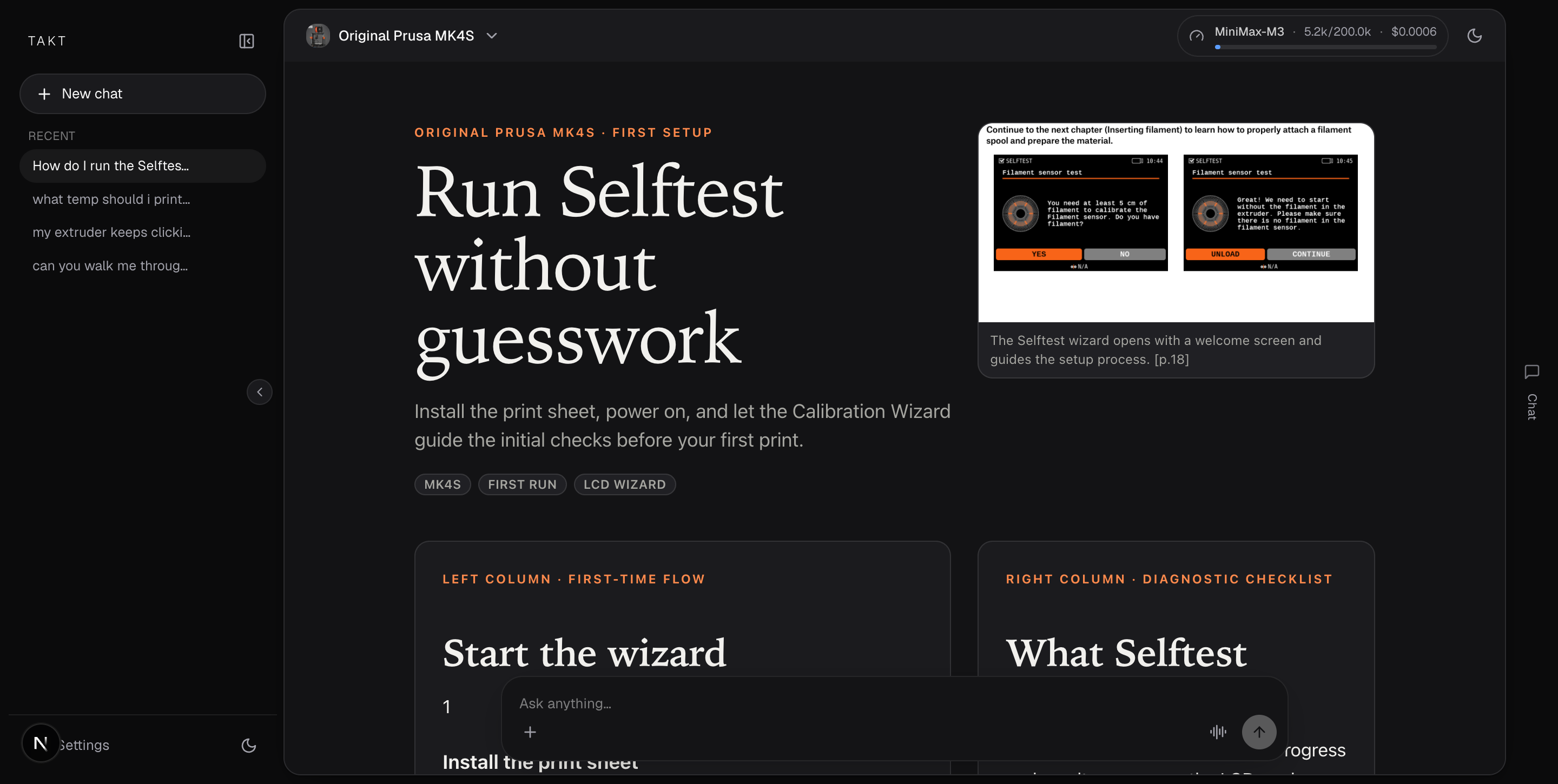
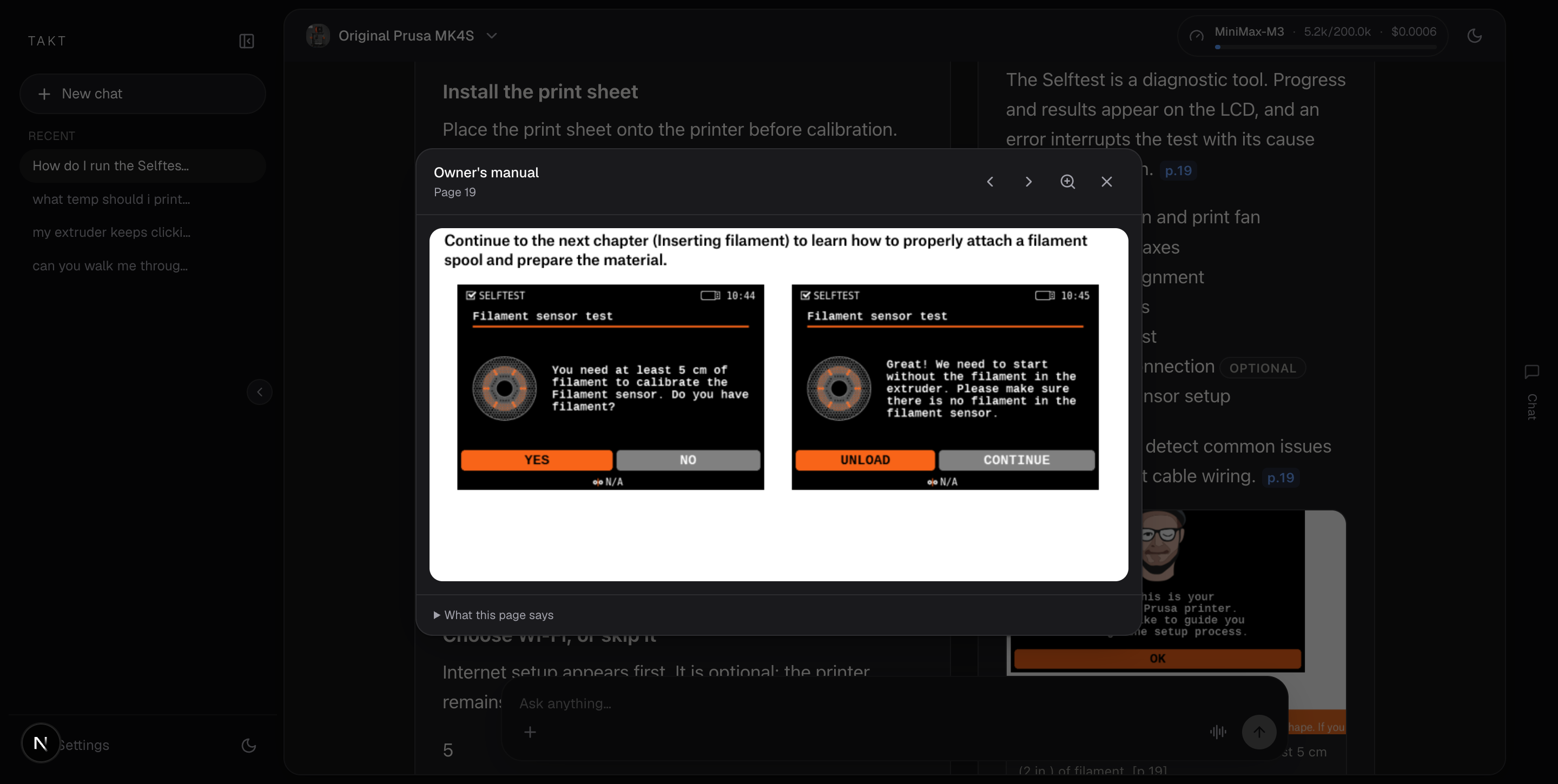
Every citation is real. Click one and the exact manual page opens, so you can check the source yourself:
The idea underneath: product knowledge should stay inspectable and regenerable. A vision pass reads every page into structured entities and captions. A deterministic build (no LLM) compiles them into the graph, so the same input always produces the same graph. The markdown Profiles stay plain files you can open, edit, and re-ingest.
What it does
- Grounded, cited answers. Every spec, setting, or step comes from the product's own docs and is cited to its page. Nothing is guessed. If the docs don't cover it, Takt says so.
- Shows the real page. Diagrams, schematics, duty-cycle tables, control panels: Takt surfaces the actual manual page and crops the exact region that matters.
- Reads the images too. The vision pass transcribes tables, describes diagrams, and records what each figure answers, so image-only content becomes searchable.
- Designs the answer, full-page. Instead of a wall of text, Takt writes a raw HTML page (headline, cropped and annotated figures, the interactive 3D part, spec tables, step-by-step guides, live calculators) and renders it in a sandboxed iframe, held to a consistent design system.
- Talks, fully on-device. Live voice runs the whole voice stack in your browser (Silero VAD, Whisper, Kokoro TTS). No audio leaves your machine. The composer becomes a voice bar, you talk, it talks back, and it stops the moment you interrupt. Turn the camera on and it watches what you show it.
- Shows things while it talks. In a live call the agent can pin visuals over your view: the rotatable 3D part (with AR on phones), the exact manual figure, a repair clip, or a pointer note anchored to your camera view.
- Asks before guessing. When a choice would change the answer, it asks a short multiple-choice question first, sometimes with its own little diagram.
- Multi-product. Point it at one product, or let it answer and compare across your whole catalog.
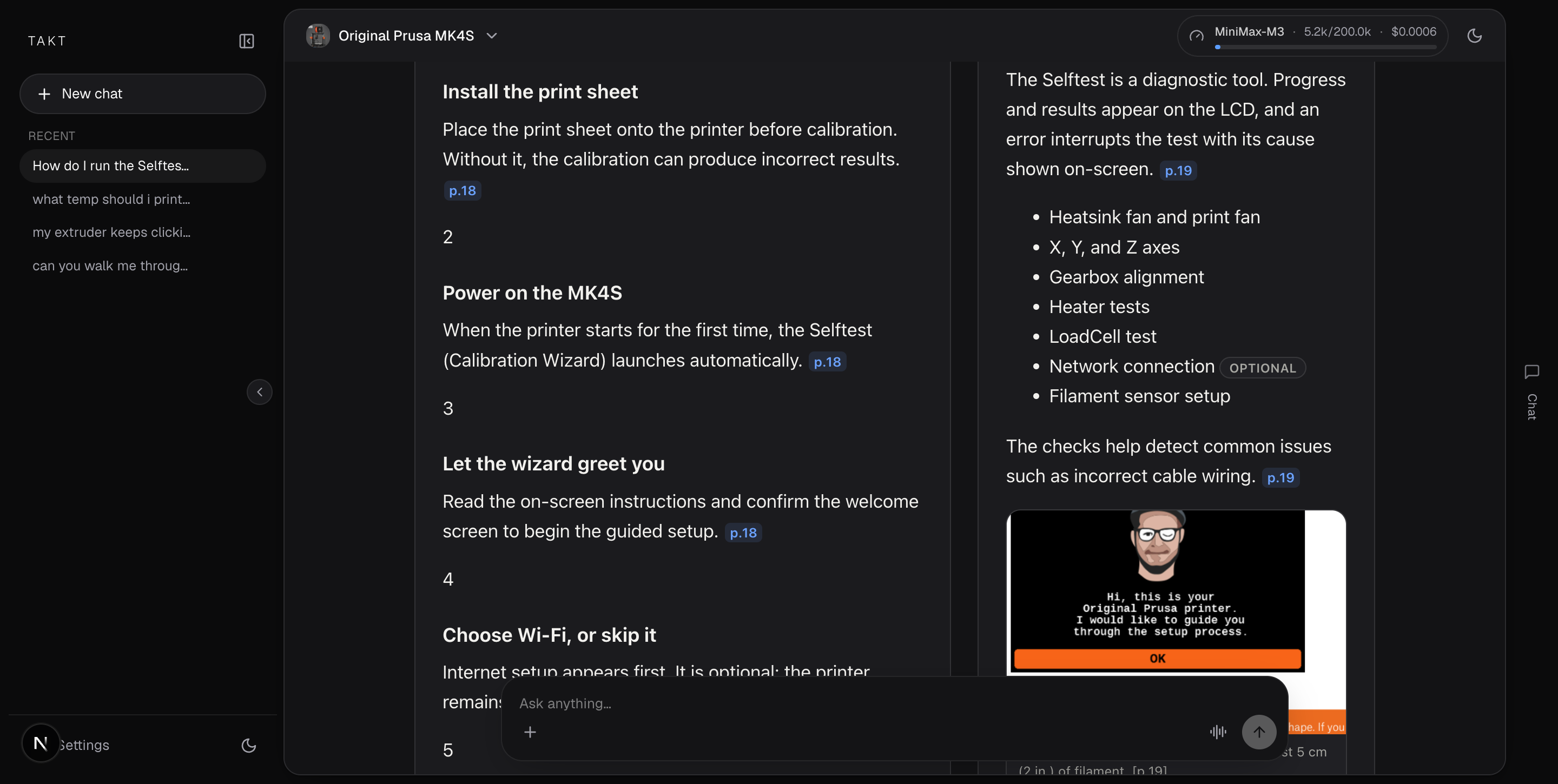 | 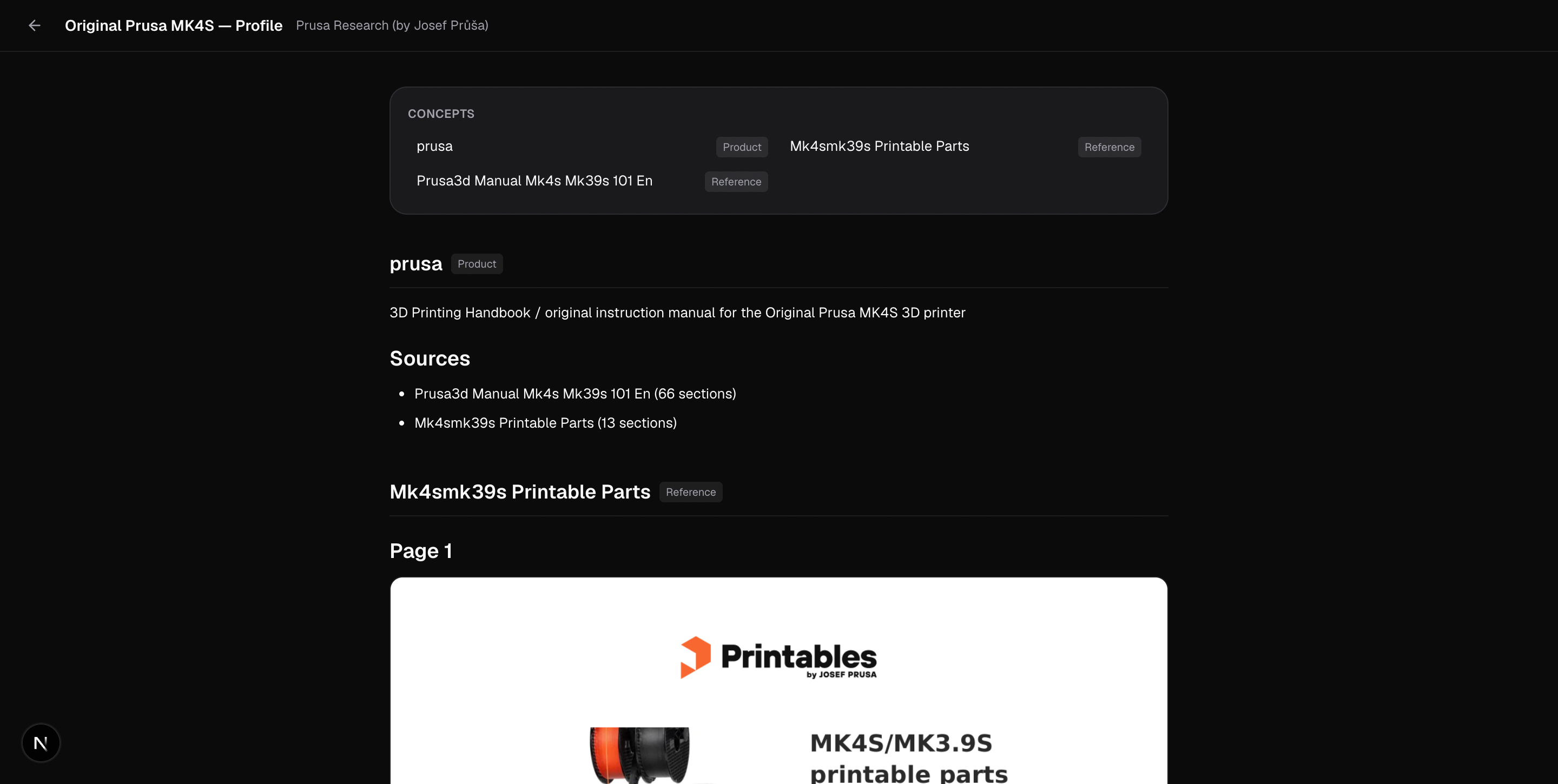 |
| Composes designed, full-page answers on the canvas, each fact cited to its page | Every product's knowledge is readable markdown you can edit |
The idea: a graph compiled deterministically, markdown you can read
Each product's knowledge is built twice from the same ingest.
The knowledge graph lives in SQLite. Typed entities (part, spec, symptom, procedure,
warning, figure, 3D part, video clip) carry their measured values, typed edges (fixes,
references, shown_in, depicts), page-text chunks, and media. Every row carries its own
local embedding (Xenova/bge-small-en-v1.5, 384-dim, no API key) plus FTS5. The build is
deterministic, no LLM in the compile, so the same part on five pages collapses to one node
and re-ingest is stable. A linking cascade then connects media across modalities (the 3D
mesh depicts the part, the video references the procedure).
The Profile is a folder of OKF-style markdown at
data/products/<slug>/, one concept per source, with vision captions inlined next to their
page images. It's human-readable and editable, and the agent's read_profile serves it
verbatim.
You can browse the whole graph right on the landing page. Drag to pan, scroll to zoom, click a node to read it and hop through its connections. This is the same graph every answer walks.
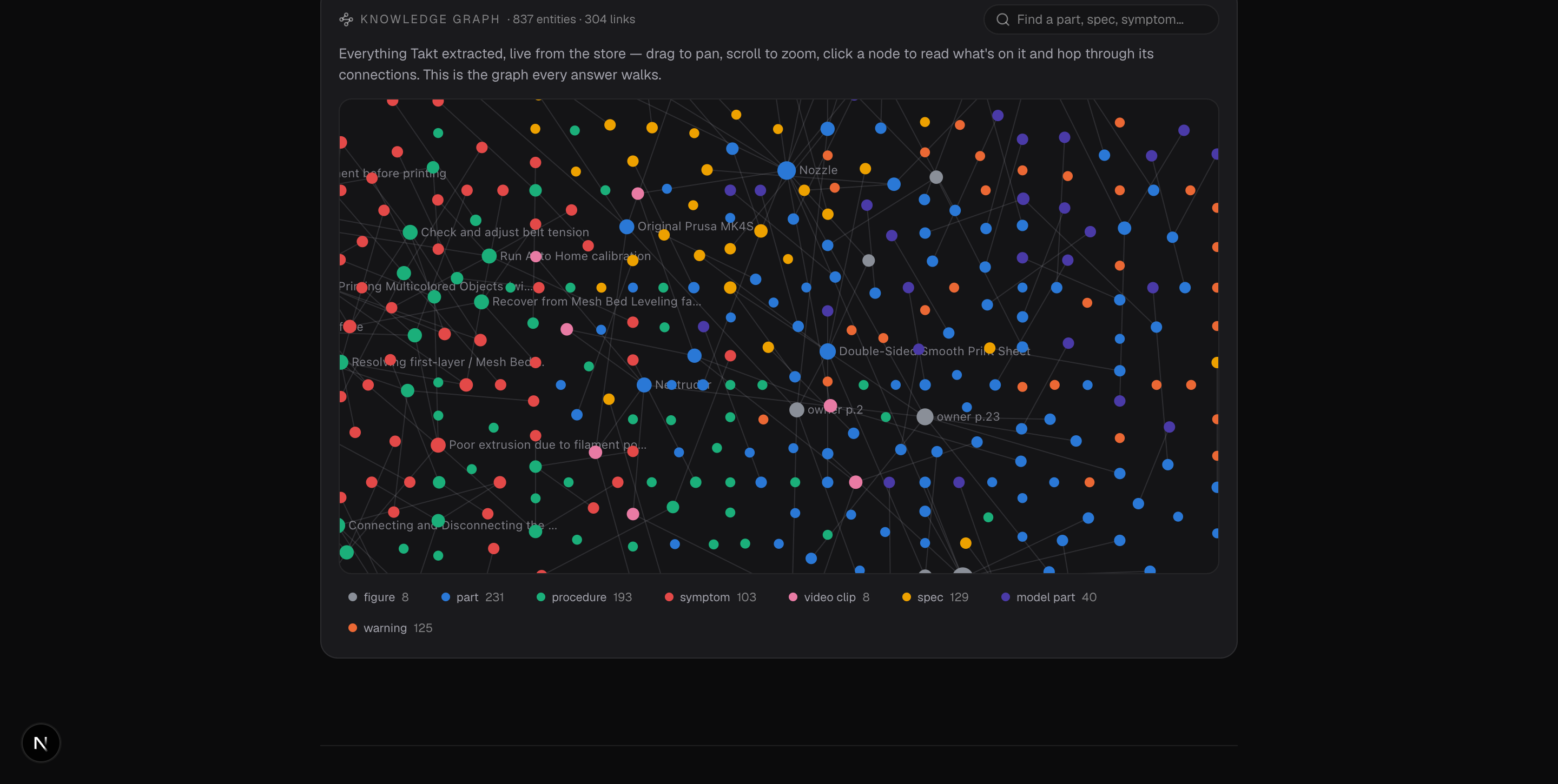
Retrieval is hybrid: FTS5 catches exact codes and part numbers, embedding cosine catches
fuzzy symptoms in the user's words, and results are re-ranked so query-term coverage
dominates. The agent doesn't just search, it walks the graph: resolve "clicking noise" to the
symptom, hop fixes to the procedure, shown_in to the figure, depicts to the 3D part.
Everything is regenerable, since re-ingest rebuilds the whole graph transactionally. How
ingestion builds all this, and how it's stored, is in
docs/ingestion.md.
Try it
Open the live demo at yashwanttth-takt.hf.space and set two things at /admin: paste your own model key under Models & API keys (Anthropic, OpenAI, or MiniMax), and add a product under Products & ingestion. The demo set is the Prusa MK4S handbook. A free Space resets its catalog when it redeploys, so if it's empty, add the product there. If the Space has been idle, the first hit takes 30 to 60s to wake.
Questions to try:
- "How do I run the Selftest calibration wizard?"
- "Which flexible print sheet should I use first?"
- "My extruder keeps clicking and filament won't come out. What should I check?"
Then hit the waveform to talk to it, turn on your camera, and point it at the printer. It draws on the live feed to show you what it means, and pins the 3D part right over what you're holding:
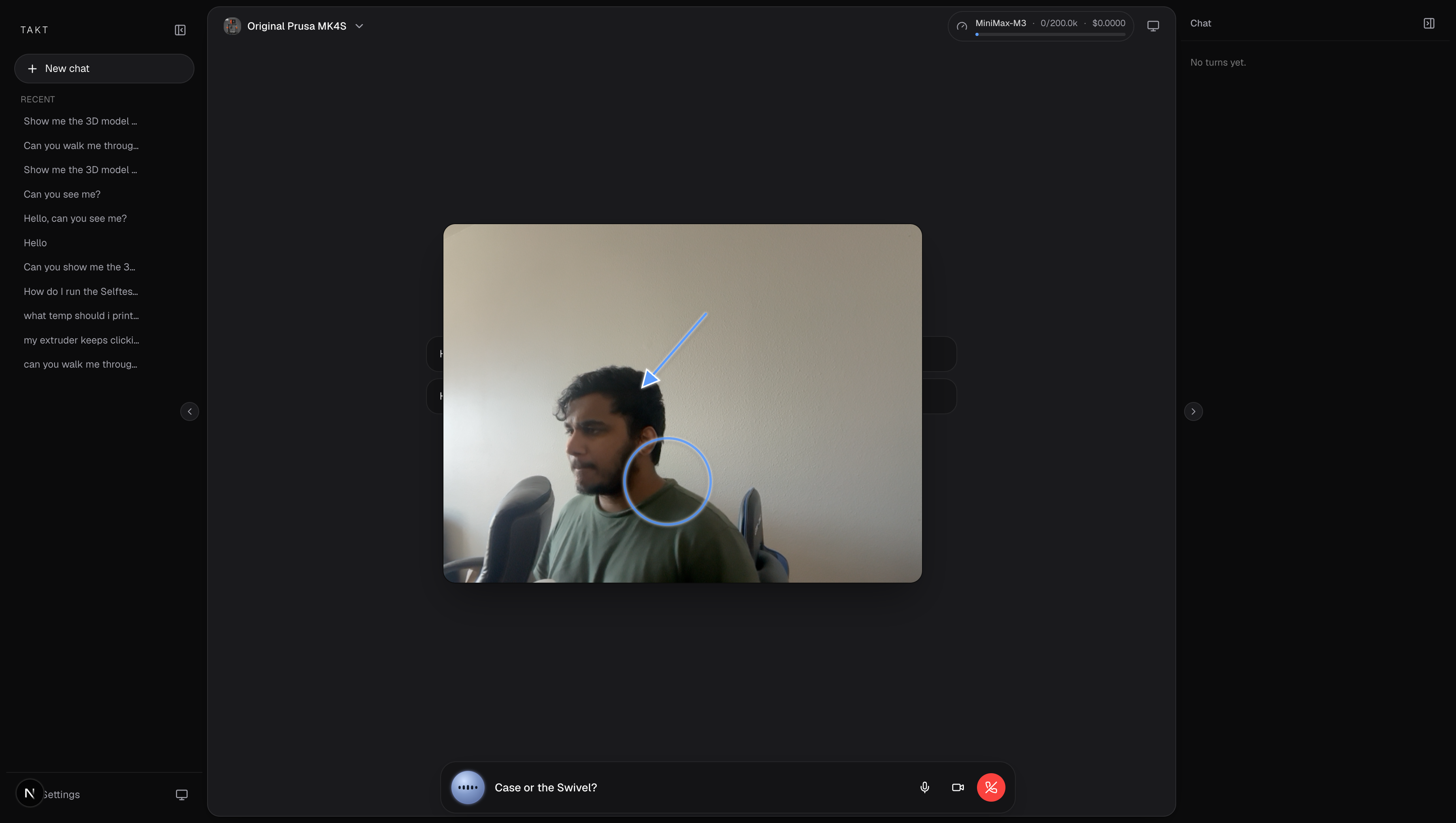 | 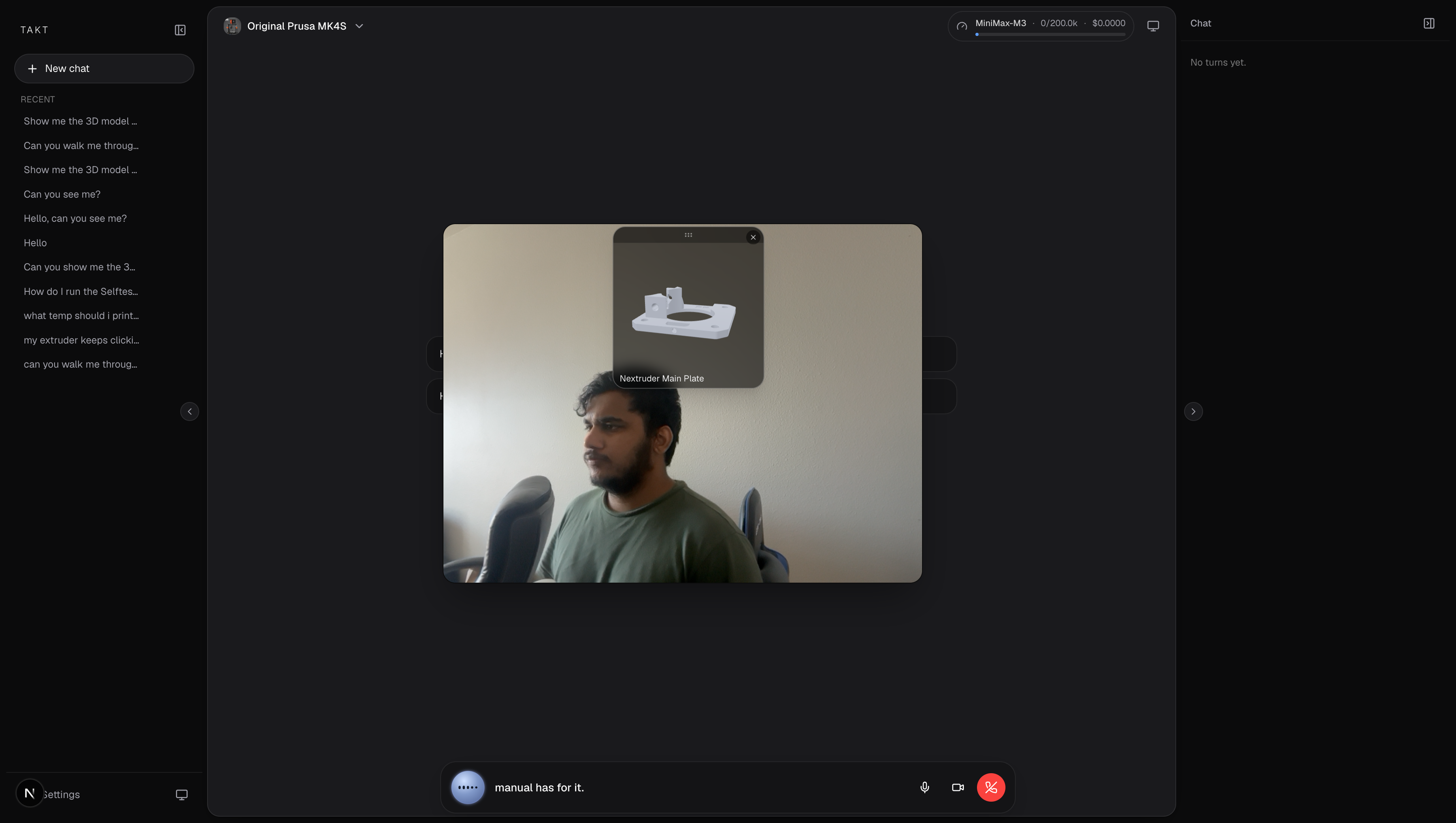 |
| Draws marks straight on the camera feed, tracked to the object | Pins the rotatable 3D part in the frame (AR on phones) |
Live mode does more than talk: on-device VAD, Whisper, and Kokoro; semantic end-of-turn detection; barge-in with echo cancellation; and server-side grounding so a fast model still cites the right page. The whole feature set is in docs/live-mode.md.
Run it locally
git clone <this-repo> && cd takt
cp .env.example .env          # add one of ANTHROPIC_/OPENAI_/MINIMAX_API_KEY for ingest
pnpm install
pnpm dev                      # web on :3000, agent on :8787
Open http://localhost:3000. A fresh clone ships with an empty catalog, so add a product from
/admin or pnpm ingest <folder> (see Add a product), then pick it and
ask. To deploy your own Space, see docs/hosting.md.
Add a product
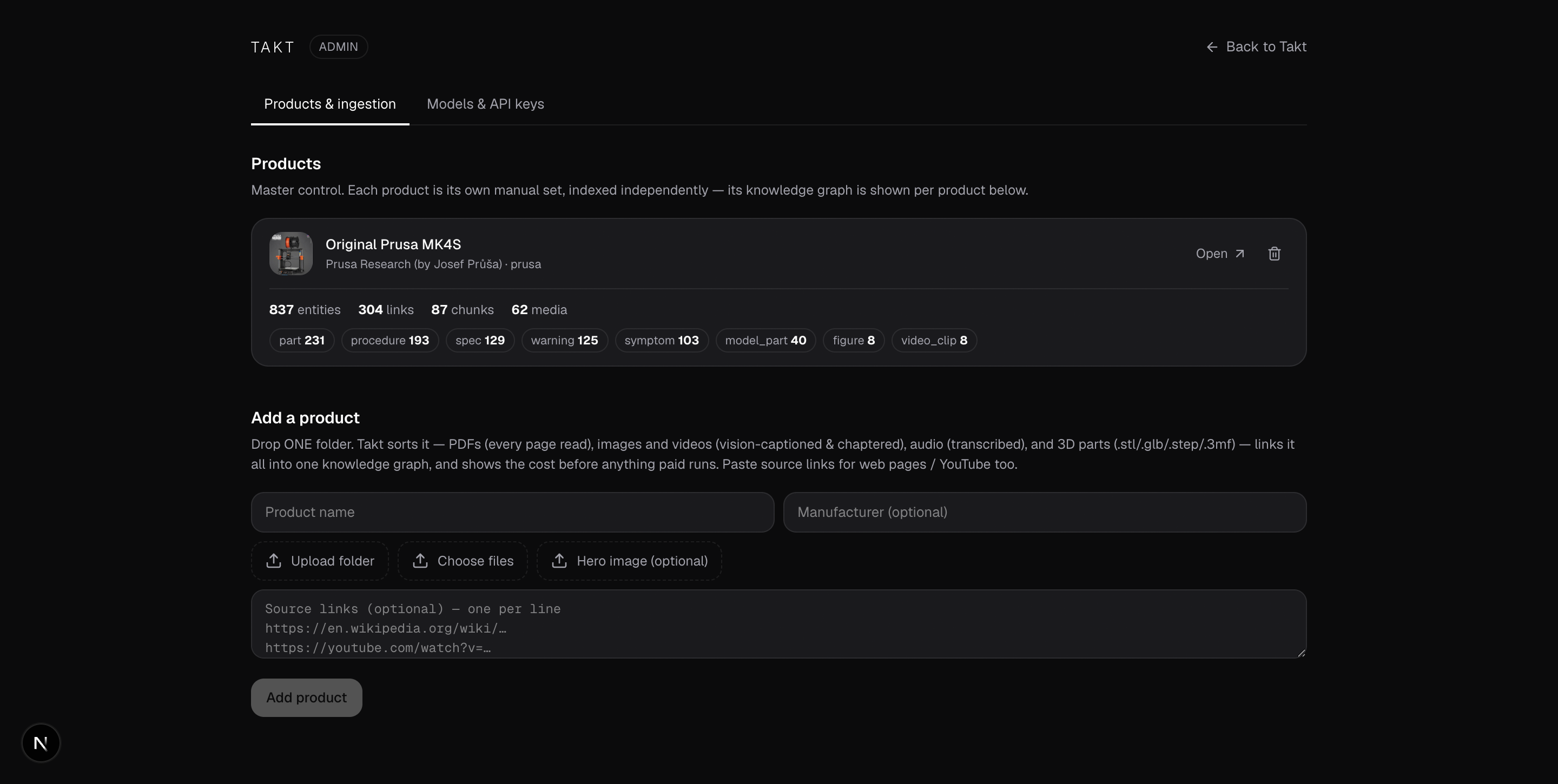
Two ways in, both fully automatic. Drop one folder holding everything (PDF manuals, STL 3D models in subsystem subfolders, a walkthrough video, images, gcode) and Takt sorts it, reads it, and builds the index.
From the browser: go to /admin → Products & ingestion, name the product, drop the folder (or pick files), optionally paste source links for web pages or YouTube, and add it. Takt shows the vision cost before anything paid runs, then streams live progress.
From the CLI:
pnpm ingest ./path/to/product-folder
Either way it auto-detects each file type, vision-detects the product identity (name, maker, summary from the manual cover), renders and captions every page, authors the Profile markdown, and builds the search + media index. Runtime does zero processing. Override anything it guesses with flags:
pnpm ingest ./path/to/product-folder \
  --name "<Name>" --manufacturer "<Maker>" --summary "<one line>" \
  --hero ./photo.webp --provider openai --model gpt-5-mini
The product shows up in the picker immediately, no redeploy. Full details in docs/adding-a-product.md.
Connect over MCP
Takt exposes its grounded tools as an MCP server over Streamable HTTP, so Claude, ChatGPT, or
any MCP client can query a product's knowledge graph with the same tools the agent uses
(list_products, find_entity, explore_entity, trace_path, search_product,
get_media, read_profile). Point a client at the hosted server, or with Claude Code:
claude mcp add --transport http takt https://yashwanttth-takt.hf.space/mcp
Running locally, it's http://localhost:3000/mcp.
Configure models and keys
Everything sensitive lives at /admin (typed URL
only, gated by TAKT_ADMIN_TOKEN when deployed, open in local dev). The Models & API keys
tab is where you paste provider keys
and choose the model for each job: a chat model for gathering, a compose model for the canvas,
a live-voice model, an ingestion (vision) model, and the reasoning effort. Keys are encrypted
at rest and only the last 4 digits are shown.
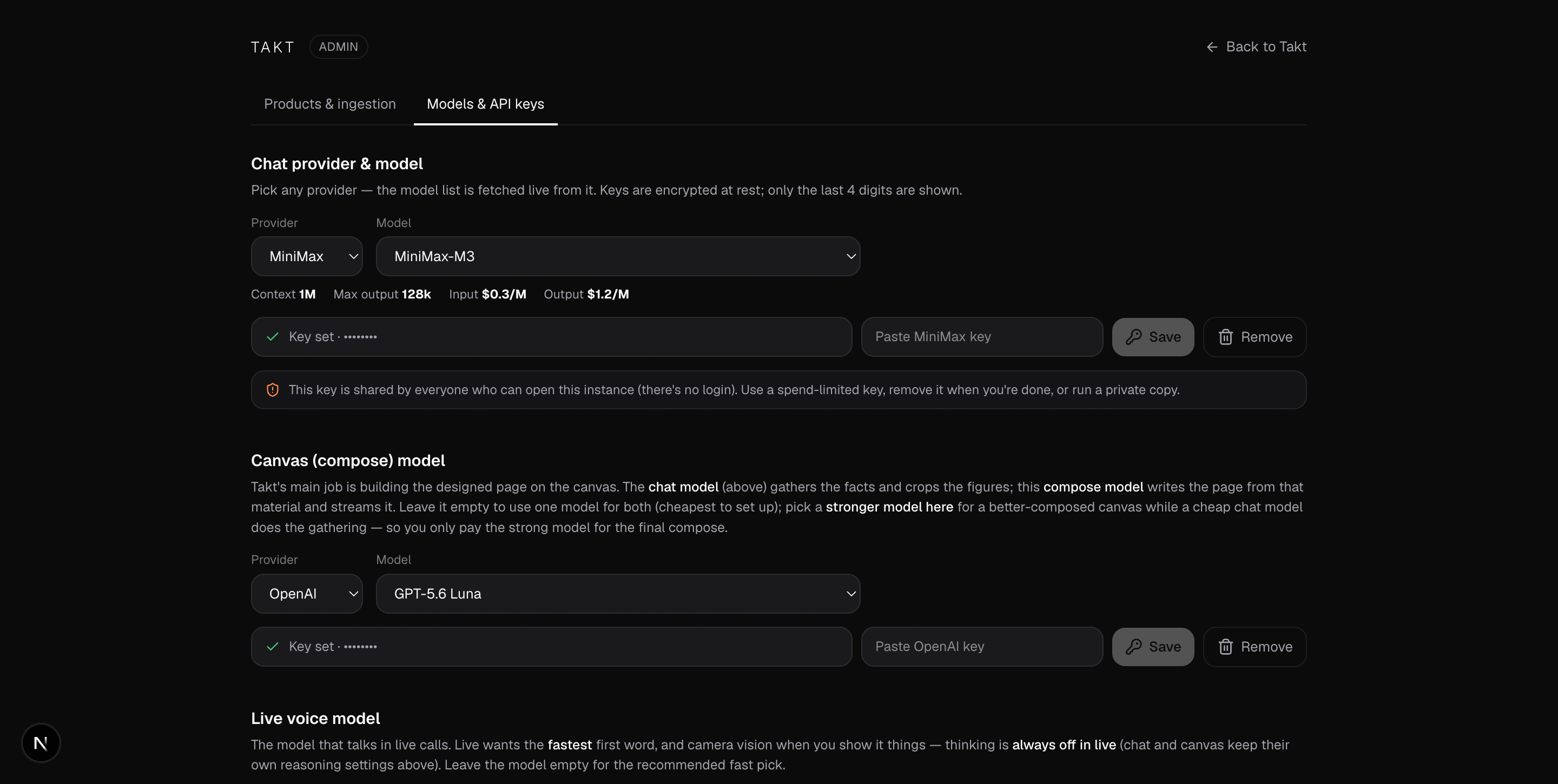
The end-user Settings dialog (the gear in the app) only lets people pick among providers that
already have a key. Adding keys and ingesting products stay behind /admin.
Under the hood
A pnpm monorepo:
apps/web | Next.js UI, API routes, the on-device voice stack, and the MCP server |
services/agent | the agent loop, tools, and live-voice WebSocket (Hono) |
pipeline/ingest | offline loader: one folder to Profile + knowledge graph |
packages/db | SQLite: the graph (entities/edges/chunks/media + FTS5), catalog, chats, encrypted keys |
packages/harness | LLM provider adapters (Anthropic / OpenAI / MiniMax) |
packages/profile | the OKF Profile store, local embeddings, hybrid graph retrieval |
packages/shared | shared types and the SSE + live-voice wire protocols |
The web app also runs the on-device voice stack (apps/web/src/lib/live/: Silero VAD, Whisper,
Kokoro, Smart-Turn, with the heavy models in a Web Worker) and the live UI
(apps/web/src/components/live/).
Docs
- architecture.md: the whole system, with diagrams. Processes, the chat and live flows, the canvas, and the SSE protocol.
- ingestion.md: how a folder becomes a knowledge graph, and how it's stored (the pipeline, the vision parse, the graph build, the SQLite schema).
- live-mode.md: the full live voice feature set, on-device stack, and
the
/liveprotocol. - adding-a-product.md: the file-type table and the ingest flags.
- design-standard.md: the canvas design system.
- hosting.md: deploying your own on a free Hugging Face Space (operator guide).
License
See LICENSE.
Contributors

100 commits
Similar repos


Languages
TypeScript
91.5%
JavaScript
5.0%
CSS
2.4%
Takt, a manual-grounded, multimodal product agent (chat + live voice)
0
stars
100
commits
TypeScript
primary language
Jul 14, 2026
updated
README
Takt
An AI that actually understands your product, and answers, shows, and talks like it.
Live demo: yashwanttth-takt.hf.space (bring your own model key at /admin; the demo product is the Prusa MK4S handbook).
Takt takes a product's scattered docs (manuals, spec sheets, diagrams, photos, video, 3D models) and turns them into a typed knowledge graph plus readable markdown Profiles. The graph holds parts, specs with their exact values, symptoms, procedures, and warnings, cross-linked to the figures, 3D parts, and video clips that show them. Ask a question in chat or by voice and you get an answer grounded in the real docs, cited to the exact page, laid out as a designed full-page answer when a picture beats a paragraph.
Every citation is real. Click one and the exact manual page opens, so you can check the source yourself:
The idea underneath: product knowledge should stay inspectable and regenerable. A vision pass reads every page into structured entities and captions. A deterministic build (no LLM) compiles them into the graph, so the same input always produces the same graph. The markdown Profiles stay plain files you can open, edit, and re-ingest.
What it does
- Grounded, cited answers. Every spec, setting, or step comes from the product's own docs and is cited to its page. Nothing is guessed. If the docs don't cover it, Takt says so.
- Shows the real page. Diagrams, schematics, duty-cycle tables, control panels: Takt surfaces the actual manual page and crops the exact region that matters.
- Reads the images too. The vision pass transcribes tables, describes diagrams, and records what each figure answers, so image-only content becomes searchable.
- Designs the answer, full-page. Instead of a wall of text, Takt writes a raw HTML page (headline, cropped and annotated figures, the interactive 3D part, spec tables, step-by-step guides, live calculators) and renders it in a sandboxed iframe, held to a consistent design system.
- Talks, fully on-device. Live voice runs the whole voice stack in your browser (Silero VAD, Whisper, Kokoro TTS). No audio leaves your machine. The composer becomes a voice bar, you talk, it talks back, and it stops the moment you interrupt. Turn the camera on and it watches what you show it.
- Shows things while it talks. In a live call the agent can pin visuals over your view: the rotatable 3D part (with AR on phones), the exact manual figure, a repair clip, or a pointer note anchored to your camera view.
- Asks before guessing. When a choice would change the answer, it asks a short multiple-choice question first, sometimes with its own little diagram.
- Multi-product. Point it at one product, or let it answer and compare across your whole catalog.
| |
| Composes designed, full-page answers on the canvas, each fact cited to its page | Every product's knowledge is readable markdown you can edit |
The idea: a graph compiled deterministically, markdown you can read
Each product's knowledge is built twice from the same ingest.
The knowledge graph lives in SQLite. Typed entities (part, spec, symptom, procedure,
warning, figure, 3D part, video clip) carry their measured values, typed edges (fixes,
references, shown_in, depicts), page-text chunks, and media. Every row carries its own
local embedding (Xenova/bge-small-en-v1.5, 384-dim, no API key) plus FTS5. The build is
deterministic, no LLM in the compile, so the same part on five pages collapses to one node
and re-ingest is stable. A linking cascade then connects media across modalities (the 3D
mesh depicts the part, the video references the procedure).
The Profile is a folder of OKF-style markdown at
data/products/<slug>/, one concept per source, with vision captions inlined next to their
page images. It's human-readable and editable, and the agent's read_profile serves it
verbatim.
You can browse the whole graph right on the landing page. Drag to pan, scroll to zoom, click a node to read it and hop through its connections. This is the same graph every answer walks.
Retrieval is hybrid: FTS5 catches exact codes and part numbers, embedding cosine catches
fuzzy symptoms in the user's words, and results are re-ranked so query-term coverage
dominates. The agent doesn't just search, it walks the graph: resolve "clicking noise" to the
symptom, hop fixes to the procedure, shown_in to the figure, depicts to the 3D part.
Everything is regenerable, since re-ingest rebuilds the whole graph transactionally. How
ingestion builds all this, and how it's stored, is in
docs/ingestion.md.
Try it
Open the live demo at yashwanttth-takt.hf.space and set two things at /admin: paste your own model key under Models & API keys (Anthropic, OpenAI, or MiniMax), and add a product under Products & ingestion. The demo set is the Prusa MK4S handbook. A free Space resets its catalog when it redeploys, so if it's empty, add the product there. If the Space has been idle, the first hit takes 30 to 60s to wake.
Questions to try:
- "How do I run the Selftest calibration wizard?"
- "Which flexible print sheet should I use first?"
- "My extruder keeps clicking and filament won't come out. What should I check?"
Then hit the waveform to talk to it, turn on your camera, and point it at the printer. It draws on the live feed to show you what it means, and pins the 3D part right over what you're holding:
| |
| Draws marks straight on the camera feed, tracked to the object | Pins the rotatable 3D part in the frame (AR on phones) |
Live mode does more than talk: on-device VAD, Whisper, and Kokoro; semantic end-of-turn detection; barge-in with echo cancellation; and server-side grounding so a fast model still cites the right page. The whole feature set is in docs/live-mode.md.
Run it locally
git clone <this-repo> && cd takt
cp .env.example .env          # add one of ANTHROPIC_/OPENAI_/MINIMAX_API_KEY for ingest
pnpm install
pnpm dev                      # web on :3000, agent on :8787
Open http://localhost:3000. A fresh clone ships with an empty catalog, so add a product from
/admin or pnpm ingest <folder> (see Add a product), then pick it and
ask. To deploy your own Space, see docs/hosting.md.
Add a product
Two ways in, both fully automatic. Drop one folder holding everything (PDF manuals, STL 3D models in subsystem subfolders, a walkthrough video, images, gcode) and Takt sorts it, reads it, and builds the index.
From the browser: go to /admin → Products & ingestion, name the product, drop the folder (or pick files), optionally paste source links for web pages or YouTube, and add it. Takt shows the vision cost before anything paid runs, then streams live progress.
From the CLI:
pnpm ingest ./path/to/product-folder
Either way it auto-detects each file type, vision-detects the product identity (name, maker, summary from the manual cover), renders and captions every page, authors the Profile markdown, and builds the search + media index. Runtime does zero processing. Override anything it guesses with flags:
pnpm ingest ./path/to/product-folder \
  --name "<Name>" --manufacturer "<Maker>" --summary "<one line>" \
  --hero ./photo.webp --provider openai --model gpt-5-mini
The product shows up in the picker immediately, no redeploy. Full details in docs/adding-a-product.md.
Connect over MCP
Takt exposes its grounded tools as an MCP server over Streamable HTTP, so Claude, ChatGPT, or
any MCP client can query a product's knowledge graph with the same tools the agent uses
(list_products, find_entity, explore_entity, trace_path, search_product,
get_media, read_profile). Point a client at the hosted server, or with Claude Code:
claude mcp add --transport http takt https://yashwanttth-takt.hf.space/mcp
Running locally, it's http://localhost:3000/mcp.
Configure models and keys
Everything sensitive lives at /admin (typed URL
only, gated by TAKT_ADMIN_TOKEN when deployed, open in local dev). The Models & API keys
tab is where you paste provider keys
and choose the model for each job: a chat model for gathering, a compose model for the canvas,
a live-voice model, an ingestion (vision) model, and the reasoning effort. Keys are encrypted
at rest and only the last 4 digits are shown.
The end-user Settings dialog (the gear in the app) only lets people pick among providers that
already have a key. Adding keys and ingesting products stay behind /admin.
Under the hood
A pnpm monorepo:
apps/web | Next.js UI, API routes, the on-device voice stack, and the MCP server |
services/agent | the agent loop, tools, and live-voice WebSocket (Hono) |
pipeline/ingest | offline loader: one folder to Profile + knowledge graph |
packages/db | SQLite: the graph (entities/edges/chunks/media + FTS5), catalog, chats, encrypted keys |
packages/harness | LLM provider adapters (Anthropic / OpenAI / MiniMax) |
packages/profile | the OKF Profile store, local embeddings, hybrid graph retrieval |
packages/shared | shared types and the SSE + live-voice wire protocols |
The web app also runs the on-device voice stack (apps/web/src/lib/live/: Silero VAD, Whisper,
Kokoro, Smart-Turn, with the heavy models in a Web Worker) and the live UI
(apps/web/src/components/live/).
Docs
- architecture.md: the whole system, with diagrams. Processes, the chat and live flows, the canvas, and the SSE protocol.
- ingestion.md: how a folder becomes a knowledge graph, and how it's stored (the pipeline, the vision parse, the graph build, the SQLite schema).
- live-mode.md: the full live voice feature set, on-device stack, and
the
/liveprotocol. - adding-a-product.md: the file-type table and the ingest flags.
- design-standard.md: the canvas design system.
- hosting.md: deploying your own on a free Hugging Face Space (operator guide).
License
See LICENSE.
Similar repos
Contributors
100 commits
Languages
TypeScript
91.5%
JavaScript
5.0%
CSS
2.4%