
README
terrafmt





A tool for extracting and formatting Terraform configuration embedded in other files, primarily intended to help with provider development.
Install
Homebrew
brew install katbyte/tap/terrafmt
Pre-built binaries
Binaries for linux, macOS, windows, freebsd, openbsd, and solaris are attached to each release.
Go
go install github.com/katbyte/terrafmt@latest
Usage
Information about usage and options can be found by using the help command:
terrafmt help
terrafmt finds terraform blocks embedded in files, runs the equivalent of terraform fmt on them, and can display the difference or update them in place. It understands:
- Markdown (
.md,.markdown, and other non-go files): fenced code blocks opened with```hcl,```tf, or```terraform - reStructuredText (
.rst):.. code:: terraformdirectives (block indentation is preserved) - Go (
.go): multiline string literals that look like terraform configuration, e.g. acceptance test configs returned byfmt.Sprintf
Extract Terraform Blocks
Use the blocks command to extract blocks from a file:
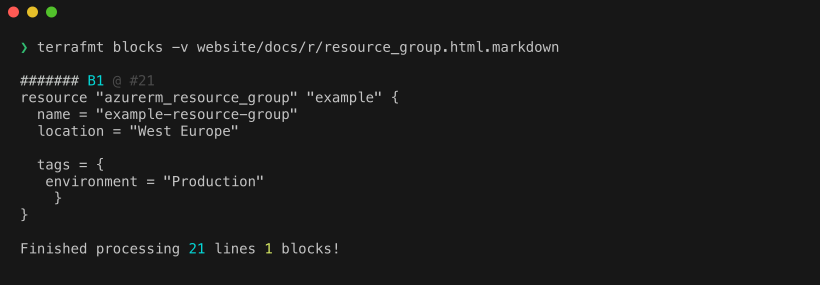
To output only the block content, separated by the null character, use --zero-terminated/-z.
To output the blocks as JSON, use --json/-j:
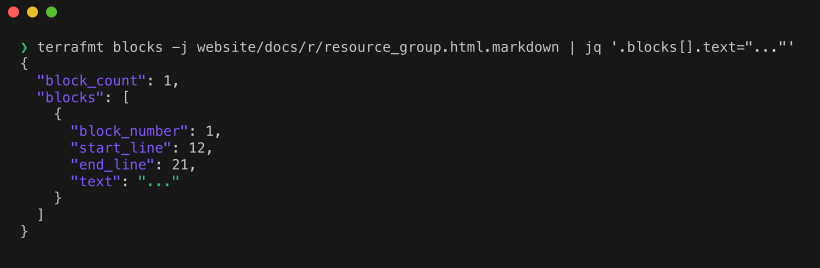
Go format verbs (%s, %d, %[1]q, ...) can be escaped in the output blocks with --fmtcompat/-f.
Show What Format Would Do
Use the diff command to see what would be formatted (files can also be piped in on stdin):
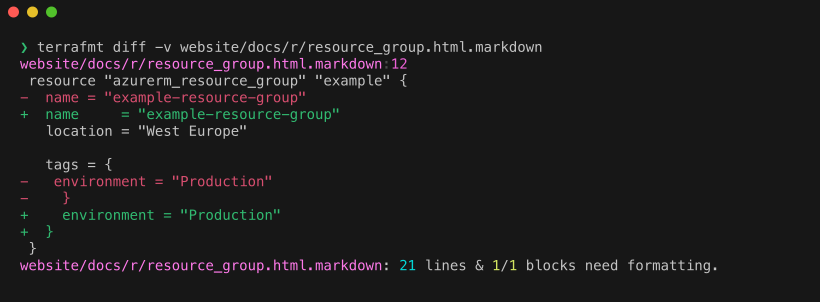
For go files containing format verbs use the -f switch:
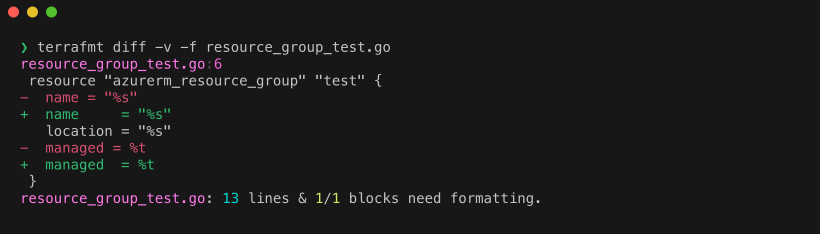
Format Files
Use the fmt command to format blocks in place. It accepts a single file, stdin, or a directory to walk — combine with --pattern/-p to filter by file name:

terrafmt fmt ./website --pattern '*.markdown'
terrafmt fmt ./internal --pattern '*_test.go' -f
Exit codes
To help usage of terrafmt in workflows, some commands return actionable exit codes.
If a terraform parsing error is encountered in a block, the exit code is 2.
If the diff command with the --check flag enabled encounters a formatting difference, it will return 4. If a file contains both blocks with parsing errors and a formatting difference, the codes combine to 6. These can be tested using bitwise checks.
Otherwise, terrafmt returns 1 on an error.
Environment variables & config file
Most flags can also be set with an environment variable, or persisted in a .terrafmt config file in the current directory or your home directory. Flags take precedence over environment variables, which take precedence over the config file.
| Flag | Environment variable |
|---|---|
--fmtcompat/-f | TERRAFMT_FMTCOMPAT |
--check/-c | TERRAFMT_CHECK |
--verbose/-v | TERRAFMT_VERBOSE |
--quiet/-q | TERRAFMT_QUIET |
--uncoloured/-u | TERRAFMT_UNCOLOURED |
--pattern/-p | TERRAFMT_PATTERN |
--fix-finish-lines | TERRAFMT_FIX_FINISH_LINES |
The config file uses key=value lines with the flag names as keys, for example:
fmtcompat=true
pattern=*.markdown
Development
This project uses Go Modules with a vendored vendor/ directory. Dev tools are pinned in .tools/go.mod and built into .tools/bin on demand by make.
make help       # list all targets
make build      # build the binary
make test       # run the tests (with -race)
make lint       # run golangci-lint (custom build incl. azproviderlint)
make lint-fix   # run golangci-lint and apply autofixes
make fmt        # gofmt/gofumpt/goimports the source
make actionlint # lint the github workflows
make yamllint   # lint the repo's YAML
make shellcheck # lint the shell scripts
make depscheck  # verify go.mod/go.sum/vendor/.tools are consistent
make check-all  # build + test + all linters + depscheck
When updating dependencies, re-vendor:
go get <module>
go mod tidy
go mod vendor
Releasing
Releases are cut by pushing a semver tag; CI (goreleaser) builds the binaries, publishes the GitHub release, and updates the homebrew tap formula:
git tag v0.6.0
git push origin v0.6.0
Contributors



Similar repos


Languages
Go
91.1%
Makefile
5.3%
Shell
3.6%
README
terrafmt
A tool for extracting and formatting Terraform configuration embedded in other files, primarily intended to help with provider development.
Install
Homebrew
brew install katbyte/tap/terrafmt
Pre-built binaries
Binaries for linux, macOS, windows, freebsd, openbsd, and solaris are attached to each release.
Go
go install github.com/katbyte/terrafmt@latest
Usage
Information about usage and options can be found by using the help command:
terrafmt help
terrafmt finds terraform blocks embedded in files, runs the equivalent of terraform fmt on them, and can display the difference or update them in place. It understands:
- Markdown (
.md,.markdown, and other non-go files): fenced code blocks opened with```hcl,```tf, or```terraform - reStructuredText (
.rst):.. code:: terraformdirectives (block indentation is preserved) - Go (
.go): multiline string literals that look like terraform configuration, e.g. acceptance test configs returned byfmt.Sprintf
Extract Terraform Blocks
Use the blocks command to extract blocks from a file:
To output only the block content, separated by the null character, use --zero-terminated/-z.
To output the blocks as JSON, use --json/-j:
Go format verbs (%s, %d, %[1]q, ...) can be escaped in the output blocks with --fmtcompat/-f.
Show What Format Would Do
Use the diff command to see what would be formatted (files can also be piped in on stdin):
For go files containing format verbs use the -f switch:
Format Files
Use the fmt command to format blocks in place. It accepts a single file, stdin, or a directory to walk — combine with --pattern/-p to filter by file name:
terrafmt fmt ./website --pattern '*.markdown'
terrafmt fmt ./internal --pattern '*_test.go' -f
Exit codes
To help usage of terrafmt in workflows, some commands return actionable exit codes.
If a terraform parsing error is encountered in a block, the exit code is 2.
If the diff command with the --check flag enabled encounters a formatting difference, it will return 4. If a file contains both blocks with parsing errors and a formatting difference, the codes combine to 6. These can be tested using bitwise checks.
Otherwise, terrafmt returns 1 on an error.
Environment variables & config file
Most flags can also be set with an environment variable, or persisted in a .terrafmt config file in the current directory or your home directory. Flags take precedence over environment variables, which take precedence over the config file.
| Flag | Environment variable |
|---|---|
--fmtcompat/-f | TERRAFMT_FMTCOMPAT |
--check/-c | TERRAFMT_CHECK |
--verbose/-v | TERRAFMT_VERBOSE |
--quiet/-q | TERRAFMT_QUIET |
--uncoloured/-u | TERRAFMT_UNCOLOURED |
--pattern/-p | TERRAFMT_PATTERN |
--fix-finish-lines | TERRAFMT_FIX_FINISH_LINES |
The config file uses key=value lines with the flag names as keys, for example:
fmtcompat=true
pattern=*.markdown
Development
This project uses Go Modules with a vendored vendor/ directory. Dev tools are pinned in .tools/go.mod and built into .tools/bin on demand by make.
make help       # list all targets
make build      # build the binary
make test       # run the tests (with -race)
make lint       # run golangci-lint (custom build incl. azproviderlint)
make lint-fix   # run golangci-lint and apply autofixes
make fmt        # gofmt/gofumpt/goimports the source
make actionlint # lint the github workflows
make yamllint   # lint the repo's YAML
make shellcheck # lint the shell scripts
make depscheck  # verify go.mod/go.sum/vendor/.tools are consistent
make check-all  # build + test + all linters + depscheck
When updating dependencies, re-vendor:
go get <module>
go mod tidy
go mod vendor
Releasing
Releases are cut by pushing a semver tag; CI (goreleaser) builds the binaries, publishes the GitHub release, and updates the homebrew tap formula:
git tag v0.6.0
git push origin v0.6.0
Similar repos
Contributors
Languages
Go
91.1%
Makefile
5.3%
Shell
3.6%