This repo contains the source code of Uni-LoRA: One Vector is All You Need.
Uni-LoRA has been merged into the official 🤗 Hugging Face PEFT library and is now available in the PEFT Uni-LoRA API reference. It follows the standard PEFT interface, allowing users to directly use UniLoraConfig and get_peft_model for seamless integration into existing parameter-efficient fine-tuning workflows.
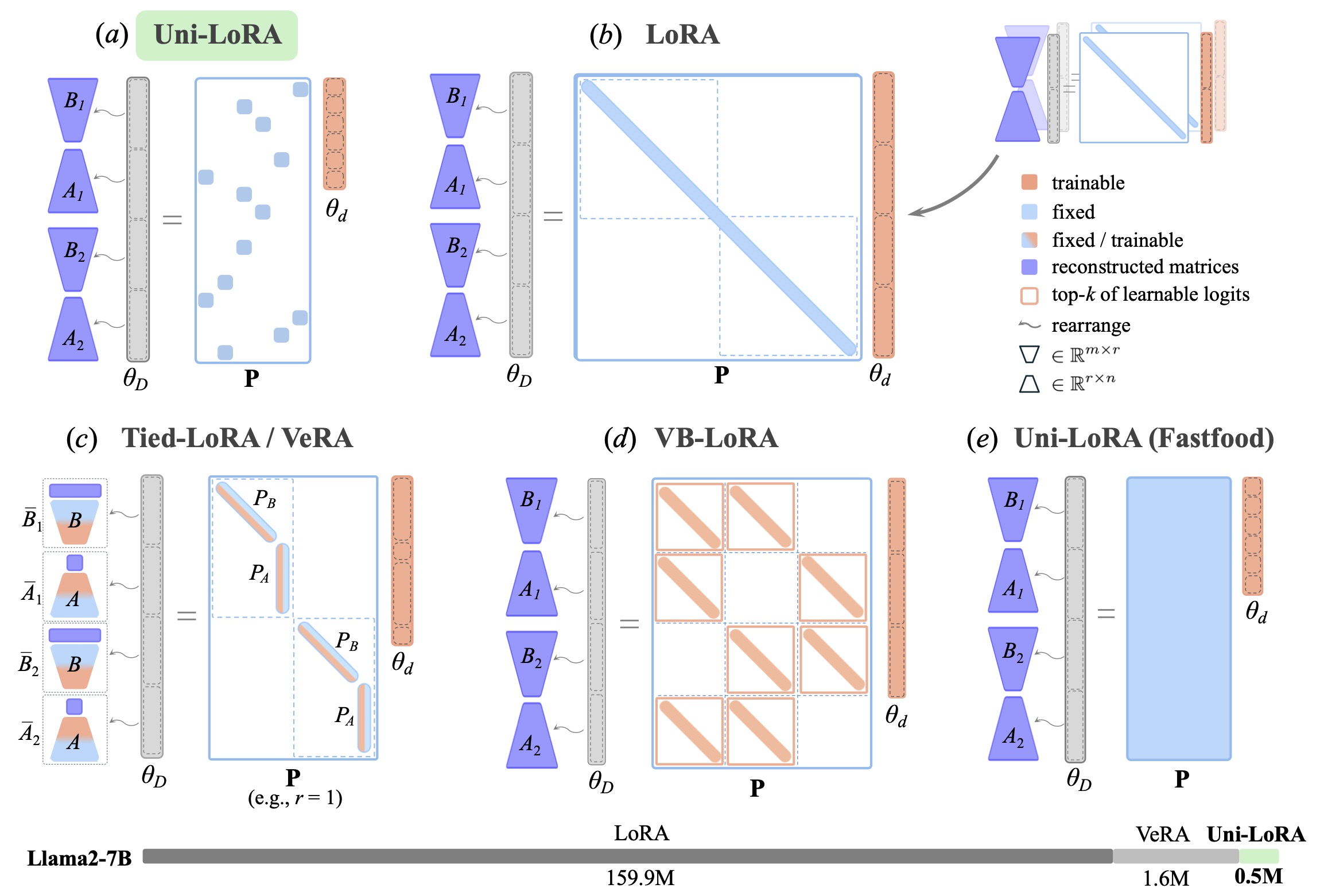
Low-Rank Adaptation (LoRA) has become the de facto parameter-efficient fine-tuning (PEFT) method for large language models (LLMs) by constraining weight updates to low-rank matrices. Recent works such as Tied-LoRA, VeRA, and VB-LoRA push efficiency further by introducing additional constraints to reduce the trainable parameter space. In this paper, we show that the parameter space reduction strategies employed by these LoRA variants can be formulated within a unified framework, Uni-LoRA, where the LoRA parameter space, flattened as a high-dimensional vector space $\mathbb{R}^{D}$, can be reconstructed through a projection from a subspace $\mathbb{R}^{d}$, with $d\ll D$. We demonstrate that the fundamental difference among various LoRA methods lies in the choice of the projection matrix, $P \in \mathbb{R}^{D\times d}$. Most existing LoRA variants rely on layer-wise or structure-specific projections that limit cross-layer parameter sharing, thereby compromising parameter efficiency. In light of this, we introduce an efficient and theoretically grounded projection matrix that is isometric, enabling global parameter sharing and reducing computation overhead. Furthermore, under the unified view of Uni-LoRA, this design requires only a single trainable vector to reconstruct LoRA parameters for the entire LLM — making Uni-LoRA both a unified framework and a "one-vector-only" solution. Extensive experiments on GLUE, mathematical reasoning, and instruction tuning benchmarks demonstrate that Uni-LoRA achieves state-of-the-art parameter efficiency while outperforming or matching prior approaches in predictive performance.
Empirically, Uni-LoRA matches the performance of standard LoRA while updating only 0.52M parameters on GEMMA-7B — only 0.0061% of the base model size and 0.26% of the LoRA parameter count.
cd NLU/peft
pip install -e .、
cd NLU/peft/examples/sequence_classification/
./run.sh
cd NLU/peft/examples/sequence_classification/
python summarize_lr.py
Note: In the original Uni-LoRA paper, the hyperparameters in Table 8 correspond to the NLU_legacy setting. After upgrading the codebase to match HuggingFace PEFT, the performance remains consistent, but the Learning Rate (Head) should be updated to the values below.
| Model | cola | sst2 | mrpc | qnli | rte | stsb |
|---|---|---|---|---|---|---|
| roberta-base | 2e-2 | 5e-4 | 1e-3 | 1e-3 | 1e-2 | 2e-4 |
| roberta-large | 5e-3 | 1e-3 | 2e-4 | 5e-4 | 5e-3 | 2e-4 |
cd instruction_tuning
conda create -n instruction_tuning python==3.10
conda activate instruction_tuning
pip install -r requirements.txt
cd peft
pip install -e .
The scripts are located in the "instruction_tuning/scripts" folder.
For example,
cd instruction_tuning
./scripts/finetune_llama2_7b_unilora.sh
For evaluation, please use LLM Judge.
cd math_instruction_tuning
conda create -n math_instruction_tuning python==3.8.13
conda activate math_instruction_tuning
pip install -r requirements.txt
cd peft
pip install -e .
The scripts are located in the "instruction_tuning/scripts" folder.
For example,
cd math_instruction_tuning
./run_instruction_tuning_unilora.sh
cd math_instruction_tuning
conda create -n ViT_tuning python==3.8.13
conda activate ViT_tuning
pip install -r requirements.txt
cd peft
pip install -e .
./run_vit_base.sh
./run_vit_large.sh
cd NLU/NLU
conda env create -f environment.yml
conda activate Uni_LoRA_NLU
uni-lora:
pip install -e ..
NLU:
pip install -e .
The scripts are located in the "NLU/scripts_unilora_qv".
For example,
./scripts_unilora_qv/roberta_base_mrpc.sh
If you found this code useful, please cite our paper.
@inproceedings{li2025unilora,
      title={Uni-LoRA: One Vector is All You Need},
      author={Kaiyang Li and Shaobo Han and Qing Su and Wei Li and Zhipeng Cai and Shihao Ji},
      booktitle={The 39th Conference on Neural Information Processing Systems (NeurIPS)},
      year={2025}
}
Our Fastfood projection implementation used in the ablation study is based on the implementation from rojagtap/intrinsic-dimension-lm-fine-tuning. We sincerely thank the authors for making their code publicly available.
This repo contains the source code of Uni-LoRA: One Vector is All You Need.
Uni-LoRA has been merged into the official 🤗 Hugging Face PEFT library and is now available in the PEFT Uni-LoRA API reference. It follows the standard PEFT interface, allowing users to directly use UniLoraConfig and get_peft_model for seamless integration into existing parameter-efficient fine-tuning workflows.
Low-Rank Adaptation (LoRA) has become the de facto parameter-efficient fine-tuning (PEFT) method for large language models (LLMs) by constraining weight updates to low-rank matrices. Recent works such as Tied-LoRA, VeRA, and VB-LoRA push efficiency further by introducing additional constraints to reduce the trainable parameter space. In this paper, we show that the parameter space reduction strategies employed by these LoRA variants can be formulated within a unified framework, Uni-LoRA, where the LoRA parameter space, flattened as a high-dimensional vector space $\mathbb{R}^{D}$, can be reconstructed through a projection from a subspace $\mathbb{R}^{d}$, with $d\ll D$. We demonstrate that the fundamental difference among various LoRA methods lies in the choice of the projection matrix, $P \in \mathbb{R}^{D\times d}$. Most existing LoRA variants rely on layer-wise or structure-specific projections that limit cross-layer parameter sharing, thereby compromising parameter efficiency. In light of this, we introduce an efficient and theoretically grounded projection matrix that is isometric, enabling global parameter sharing and reducing computation overhead. Furthermore, under the unified view of Uni-LoRA, this design requires only a single trainable vector to reconstruct LoRA parameters for the entire LLM — making Uni-LoRA both a unified framework and a "one-vector-only" solution. Extensive experiments on GLUE, mathematical reasoning, and instruction tuning benchmarks demonstrate that Uni-LoRA achieves state-of-the-art parameter efficiency while outperforming or matching prior approaches in predictive performance.
Empirically, Uni-LoRA matches the performance of standard LoRA while updating only 0.52M parameters on GEMMA-7B — only 0.0061% of the base model size and 0.26% of the LoRA parameter count.
cd NLU/peft
pip install -e .、
cd NLU/peft/examples/sequence_classification/
./run.sh
cd NLU/peft/examples/sequence_classification/
python summarize_lr.py
Note: In the original Uni-LoRA paper, the hyperparameters in Table 8 correspond to the NLU_legacy setting. After upgrading the codebase to match HuggingFace PEFT, the performance remains consistent, but the Learning Rate (Head) should be updated to the values below.
| Model | cola | sst2 | mrpc | qnli | rte | stsb |
|---|---|---|---|---|---|---|
| roberta-base | 2e-2 | 5e-4 | 1e-3 | 1e-3 | 1e-2 | 2e-4 |
| roberta-large | 5e-3 | 1e-3 | 2e-4 | 5e-4 | 5e-3 | 2e-4 |
cd instruction_tuning
conda create -n instruction_tuning python==3.10
conda activate instruction_tuning
pip install -r requirements.txt
cd peft
pip install -e .
The scripts are located in the "instruction_tuning/scripts" folder.
For example,
cd instruction_tuning
./scripts/finetune_llama2_7b_unilora.sh
For evaluation, please use LLM Judge.
cd math_instruction_tuning
conda create -n math_instruction_tuning python==3.8.13
conda activate math_instruction_tuning
pip install -r requirements.txt
cd peft
pip install -e .
The scripts are located in the "instruction_tuning/scripts" folder.
For example,
cd math_instruction_tuning
./run_instruction_tuning_unilora.sh
cd math_instruction_tuning
conda create -n ViT_tuning python==3.8.13
conda activate ViT_tuning
pip install -r requirements.txt
cd peft
pip install -e .
./run_vit_base.sh
./run_vit_large.sh
cd NLU/NLU
conda env create -f environment.yml
conda activate Uni_LoRA_NLU
uni-lora:
pip install -e ..
NLU:
pip install -e .
The scripts are located in the "NLU/scripts_unilora_qv".
For example,
./scripts_unilora_qv/roberta_base_mrpc.sh
If you found this code useful, please cite our paper.
@inproceedings{li2025unilora,
      title={Uni-LoRA: One Vector is All You Need},
      author={Kaiyang Li and Shaobo Han and Qing Su and Wei Li and Zhipeng Cai and Shihao Ji},
      booktitle={The 39th Conference on Neural Information Processing Systems (NeurIPS)},
      year={2025}
}
Our Fastfood projection implementation used in the ablation study is based on the implementation from rojagtap/intrinsic-dimension-lm-fine-tuning. We sincerely thank the authors for making their code publicly available.



