
README

tiny-speculators
A from-scratch implementation of speculative decoding model training.





Overview
tiny-speculators is a compact, from-scratch implementation for training speculative decoding models such as EAGLE-3. It covers the full pipeline ranging from dataset preparation to vLLM-compatible checkpoint export.
End-to-End Process
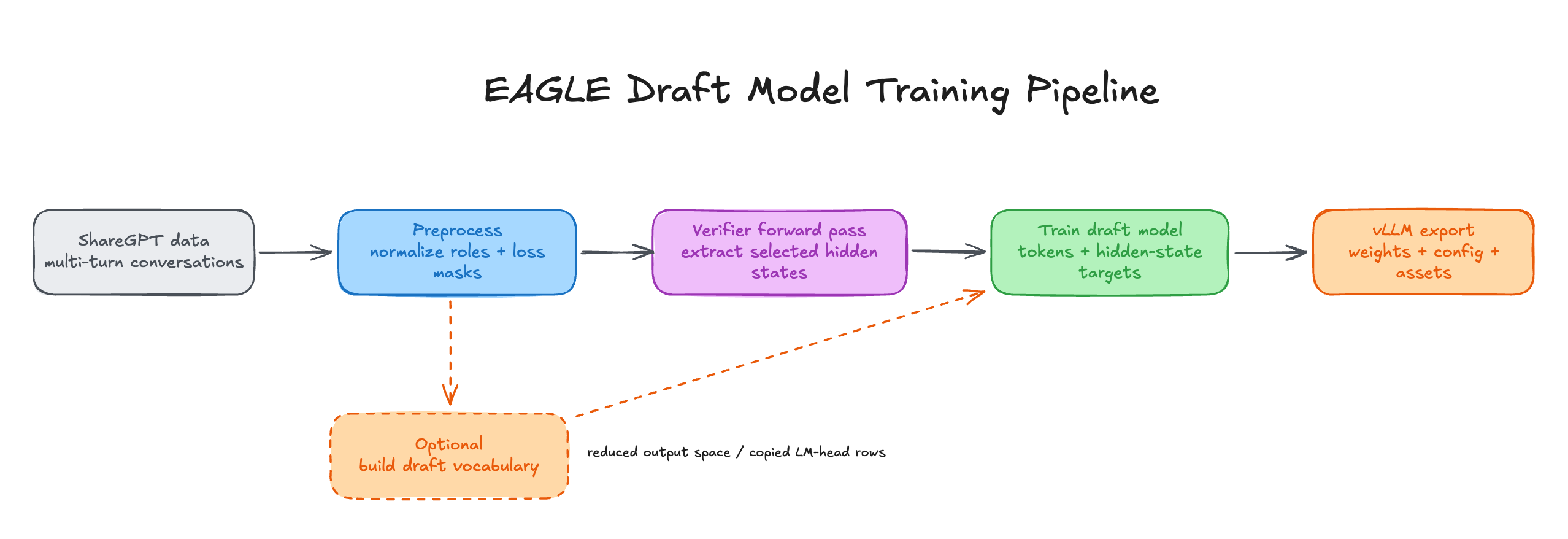
The full sequence is orchestrated by
pipeline.py.
- Prepare data: apply the Qwen3 chat template, tokenize each conversation, and prepare loss masks.
See:
prepare_data.py - Build the draft vocabulary: select frequently used target tokens and
create mappings between the smaller draft vocabulary and the verifier.
See:
vocab_mapping.py,vocab.py - Extract hidden states: run the frozen verifier with vLLM and save its
early, middle, late, and final-layer states for each sample.
See:
generate_hidden_states.py - Train the draft: fuse the first three states, run the three-step TTT
rollout, and distill the verifier's token distribution into the draft.
See:
train_eagle3.py,model.py,attention.py - Export: convert the checkpoint to vLLM's Speculators format.
See:
export_vllm.py
EAGLE-3 Draft Model Architecture
Speculative decoding pairs a small draft model with the original verifier (target) model. The draft proposes several future tokens cheaply, and the verifier checks them in parallel, accepting correct proposals and replacing the rest.
EAGLE-3 is a draft-model architecture that predicts tokens directly from the current token and hidden states collected from early, middle, and late layers of the frozen verifier. This multi-layer feature fusion gives the small, single-layer draft richer context while keeping drafting inexpensive.
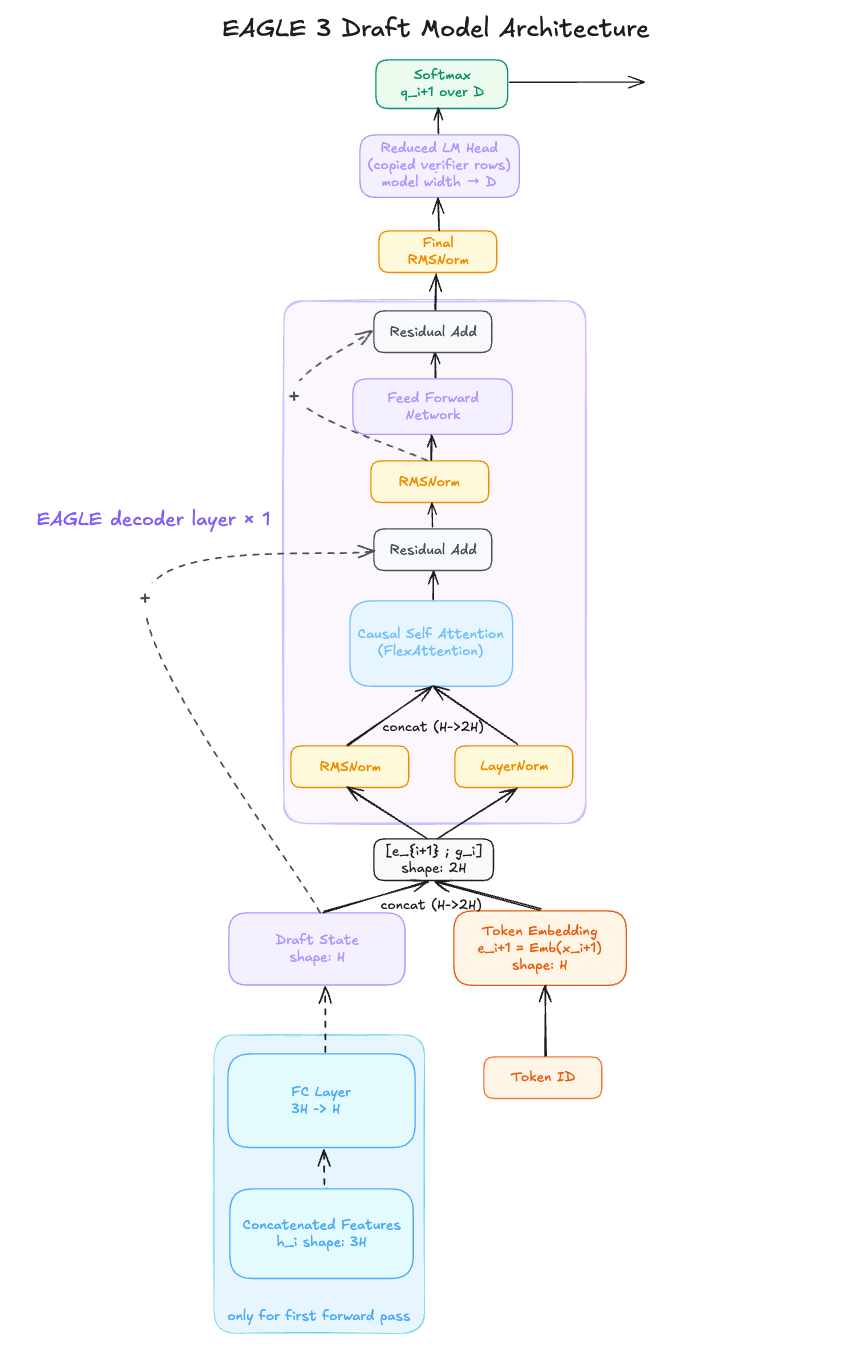
To explain it in more detail, for each token position in a document, the model takes the previous step’s hidden states from three verifier layers—early, middle, and late—along with the verifier’s final hidden state.
The three intermediate hidden states are concatenated and projected into the draft state ($3H \rightarrow H$). Meanwhile, the verifier’s final hidden state is passed through the LM head to produce logits, from which a token ID is selected.
The resulting token embedding is concatenated with the projected draft state and passed into the draft model’s decoder.
The decoder follows the structure shown above - RMSNorm/LayerNorm → Attention (more explained below) → residual connection → RMSNorm → FFN → residual connection.
In EAGLE-3, we pass through a single decoder layer at each draft step. Finally, the output goes through RMSNorm and the LM head to produce logits. Softmax converts these logits into the probability distribution used to select the next draft token.
Check eagle3/model.py to see this in actual code.
Training-Time Test
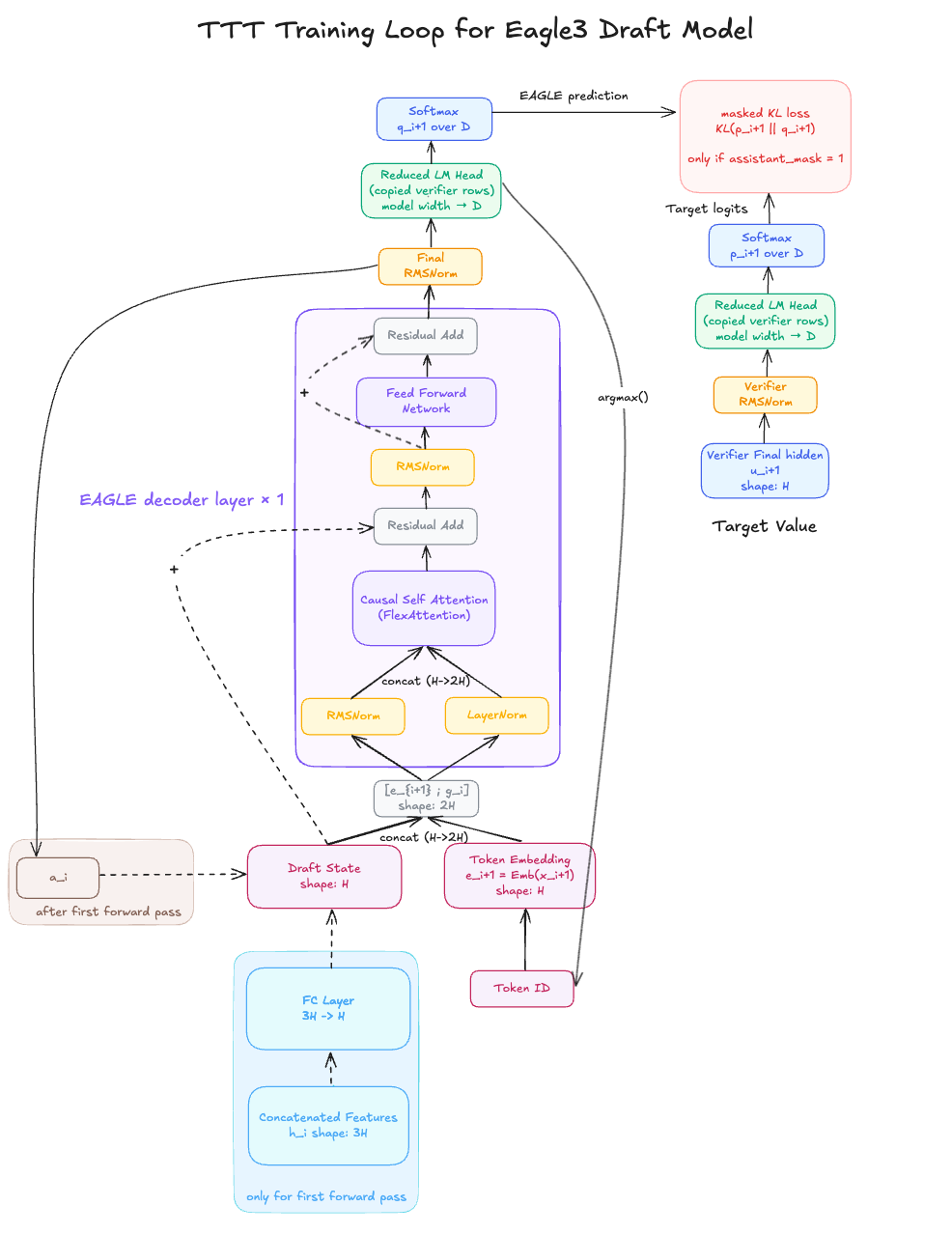
Another important technique introduced in the paper is Training-Time Test (TTT).
During training, instead of learning only one-step next-token prediction, the draft model feeds its own predicted token back as the input for the next step and learns across several consecutive draft steps.
This mirrors the autoregressive conditions encountered during inference and helps the model remain accurate even after making an imperfect prediction. This repository uses three TTT steps (ttt_steps=3) by default.
FlexAttention
TTT requires a custom attention pattern instead of standard causal mask. Since each assistant's token position in a document is rolled out for ttt_steps, the KV cache contains ttt_steps times as many states. Also, each query must attend only to the relevant context: causal tokens from the same packed document and its matching anchor across TTT steps.
PyTorch FlexAttention lets to express this pattern as a block-sparse BlockMask without materializing a full dense attention mask.
create_ttt_block_mask() isolates packed documents, preserves causal attention within each document, and allows each token to attend to its matching anchor across TTT steps.
See eagle3/attention.py for the implementation.
Notes on training and performance
I trained 10k and 60k checkpoints from ShareGPT subsets on a single NVIDIA H200 using Modal.
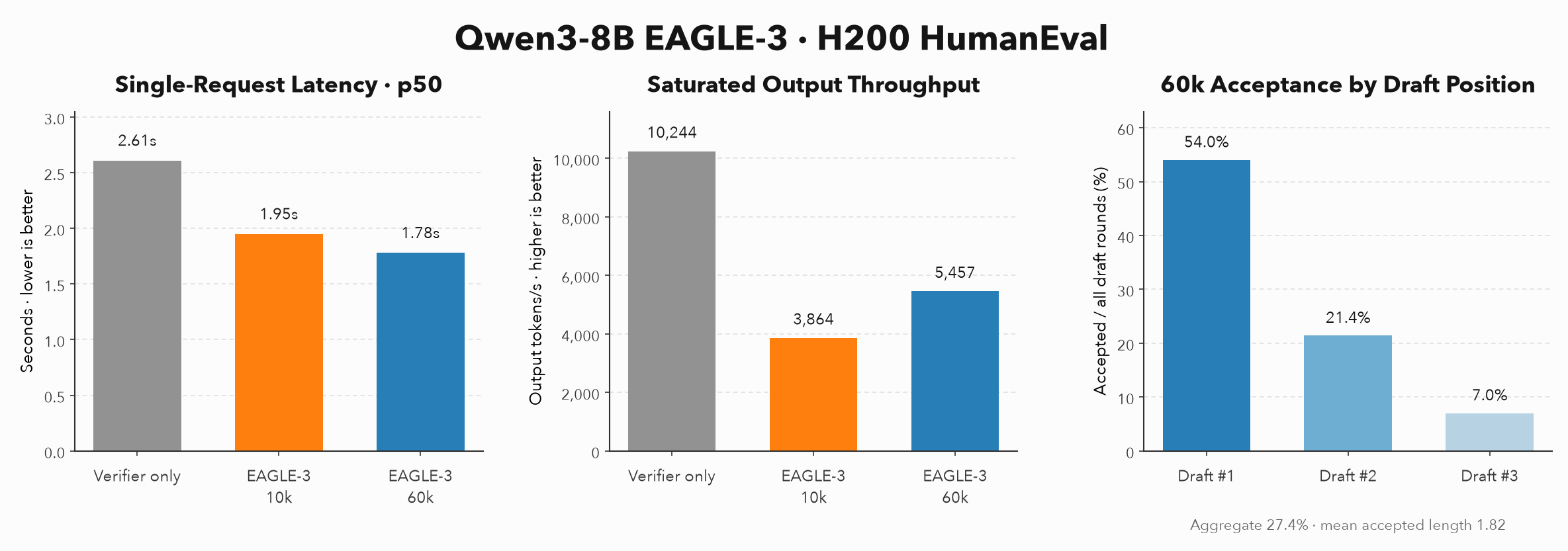
H200 HumanEval latency, saturated throughput, and 60k draft acceptance.
On HumanEval dataset, the EAGLE-3 60k checkpoint accepted 27.4% of proposed draft tokens (mean accepted length 1.82) and reduced single-request p50 latency from 2.61s to 1.78s. On saturated output case (many requests) throughput remained below verifier-only serving.
Quick start
Create a fresh environment and install the dependencies:
uv venv --python 3.12 --seed
source .venv/bin/activate
uv pip install vllm==0.25.1 --torch-backend=auto
uv pip install -e .
Run the full pipeline:
python -m tiny_speculators.scripts.pipeline \
  --max-samples <num_max_samples>
This runs the full pipeline - prepare ShareGPT dataset, extract verifier hidden states, train the draft, and export a vLLM-compatible checkpoint.
Future Works
Contributors

12 commits
Similar repos





Languages
Python
100.0%
README
tiny-speculators
A from-scratch implementation of speculative decoding model training.
Overview
tiny-speculators is a compact, from-scratch implementation for training speculative decoding models such as EAGLE-3. It covers the full pipeline ranging from dataset preparation to vLLM-compatible checkpoint export.
End-to-End Process
The full sequence is orchestrated by
pipeline.py.
- Prepare data: apply the Qwen3 chat template, tokenize each conversation, and prepare loss masks.
See:
prepare_data.py - Build the draft vocabulary: select frequently used target tokens and
create mappings between the smaller draft vocabulary and the verifier.
See:
vocab_mapping.py,vocab.py - Extract hidden states: run the frozen verifier with vLLM and save its
early, middle, late, and final-layer states for each sample.
See:
generate_hidden_states.py - Train the draft: fuse the first three states, run the three-step TTT
rollout, and distill the verifier's token distribution into the draft.
See:
train_eagle3.py,model.py,attention.py - Export: convert the checkpoint to vLLM's Speculators format.
See:
export_vllm.py
EAGLE-3 Draft Model Architecture
Speculative decoding pairs a small draft model with the original verifier (target) model. The draft proposes several future tokens cheaply, and the verifier checks them in parallel, accepting correct proposals and replacing the rest.
EAGLE-3 is a draft-model architecture that predicts tokens directly from the current token and hidden states collected from early, middle, and late layers of the frozen verifier. This multi-layer feature fusion gives the small, single-layer draft richer context while keeping drafting inexpensive.
To explain it in more detail, for each token position in a document, the model takes the previous step’s hidden states from three verifier layers—early, middle, and late—along with the verifier’s final hidden state.
The three intermediate hidden states are concatenated and projected into the draft state ($3H \rightarrow H$). Meanwhile, the verifier’s final hidden state is passed through the LM head to produce logits, from which a token ID is selected.
The resulting token embedding is concatenated with the projected draft state and passed into the draft model’s decoder.
The decoder follows the structure shown above - RMSNorm/LayerNorm → Attention (more explained below) → residual connection → RMSNorm → FFN → residual connection.
In EAGLE-3, we pass through a single decoder layer at each draft step. Finally, the output goes through RMSNorm and the LM head to produce logits. Softmax converts these logits into the probability distribution used to select the next draft token.
Check eagle3/model.py to see this in actual code.
Training-Time Test
Another important technique introduced in the paper is Training-Time Test (TTT).
During training, instead of learning only one-step next-token prediction, the draft model feeds its own predicted token back as the input for the next step and learns across several consecutive draft steps.
This mirrors the autoregressive conditions encountered during inference and helps the model remain accurate even after making an imperfect prediction. This repository uses three TTT steps (ttt_steps=3) by default.
FlexAttention
TTT requires a custom attention pattern instead of standard causal mask. Since each assistant's token position in a document is rolled out for ttt_steps, the KV cache contains ttt_steps times as many states. Also, each query must attend only to the relevant context: causal tokens from the same packed document and its matching anchor across TTT steps.
PyTorch FlexAttention lets to express this pattern as a block-sparse BlockMask without materializing a full dense attention mask.
create_ttt_block_mask() isolates packed documents, preserves causal attention within each document, and allows each token to attend to its matching anchor across TTT steps.
See eagle3/attention.py for the implementation.
Notes on training and performance
I trained 10k and 60k checkpoints from ShareGPT subsets on a single NVIDIA H200 using Modal.
H200 HumanEval latency, saturated throughput, and 60k draft acceptance.
On HumanEval dataset, the EAGLE-3 60k checkpoint accepted 27.4% of proposed draft tokens (mean accepted length 1.82) and reduced single-request p50 latency from 2.61s to 1.78s. On saturated output case (many requests) throughput remained below verifier-only serving.
Quick start
Create a fresh environment and install the dependencies:
uv venv --python 3.12 --seed
source .venv/bin/activate
uv pip install vllm==0.25.1 --torch-backend=auto
uv pip install -e .
Run the full pipeline:
python -m tiny_speculators.scripts.pipeline \
  --max-samples <num_max_samples>
This runs the full pipeline - prepare ShareGPT dataset, extract verifier hidden states, train the draft, and export a vLLM-compatible checkpoint.
Future Works
Similar repos
Contributors
12 commits
Languages
Python
100.0%