language:
License: CC BY 4.0. Free to use, share and adapt, including commercially, with attribution. See License.
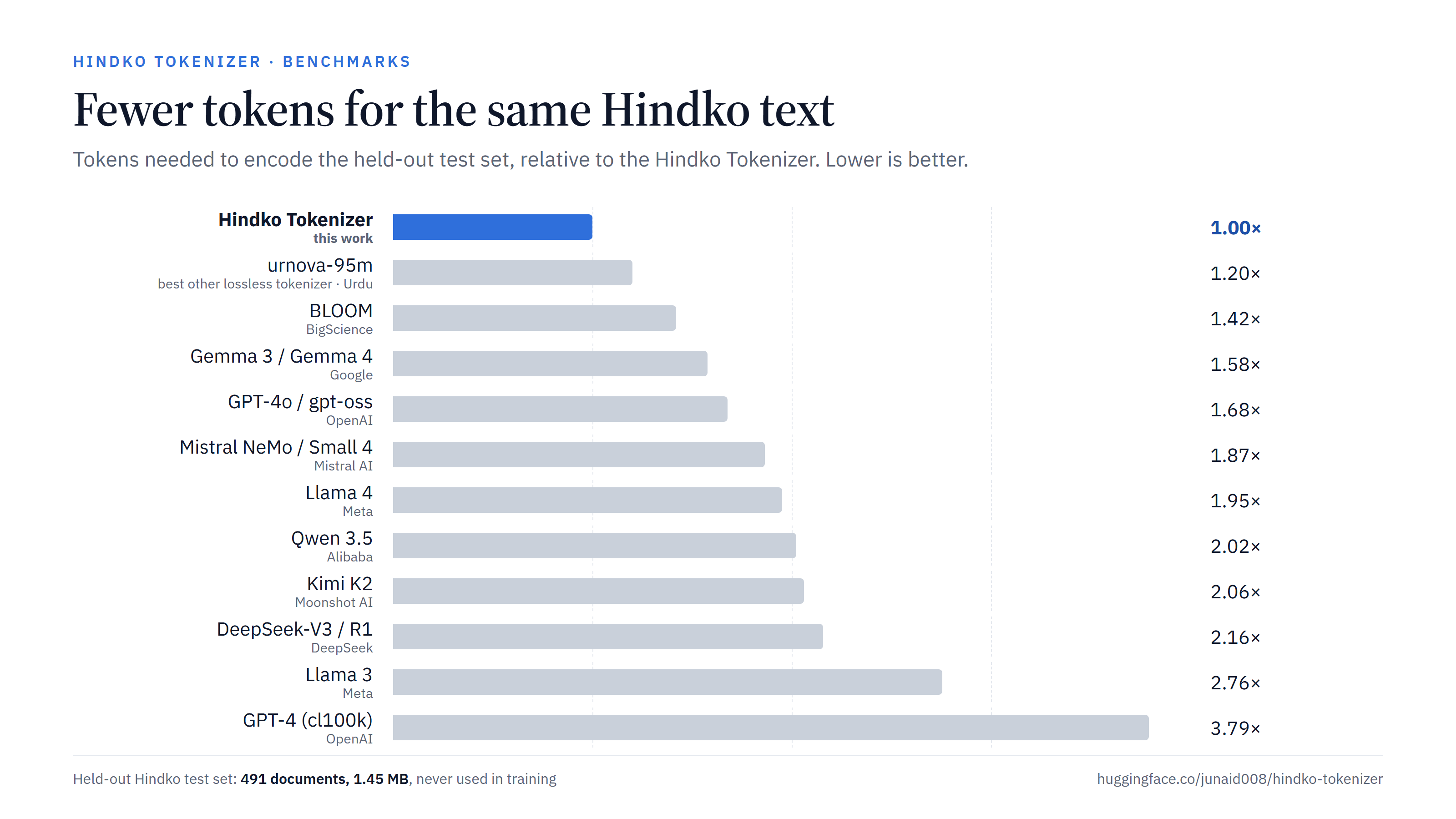
A 32,768-id SentencePiece Unigram tokenizer for Hindko (Northern hno and Southern hnd), the Indo-Aryan language of Peshawar, Hazara and neighbouring districts of Pakistan, written in Urdu (Perso-Arabic) script. Its algorithm and settings were selected by language-model experiments: small GPT-style models were trained from scratch with each candidate tokenizer, and held-out bits per byte decided under a pre-registered protocol with a sealed test split; this tokenizer is in the statistically tied top set and was chosen within it by a documented amendment (the pre-registered pick was MinGram 48k). On held-out Hindko, GPT-4o's tokenizer needs 1.68x as many tokens for the same text and Qwen 3.5's 2.02x, and this tokenizer round-trips the text exactly. It is a tokenizer, not a model: it turns text into ids for a model you train or adapt with it.
| Type | SentencePiece Unigram with byte fallback; canonical encoder tokenizer.json (Hugging Face tokenizers) |
| Vocabulary | 32,768 ids: 32,441 learned pieces, 256 byte pieces, 64 reserved special tokens, newline, <unk>, 5 placeholders |
| Languages | Hindko (hno, hnd). Also efficient on Urdu, Punjabi (Shahmukhi) and Saraiki; not suited to Pashto, English or code |
| Training text | 11,066 documents, 26.3 MB of strict-quality Hindko (newspaper, books, web); dev and test splits held out |
| Held-out bytes per token | 7.277 on the strict test split (491 documents, 1.45 MB), i.e. about 4.07 characters per token |
| Fertility (tokens per word, harness definition) | 1.135 on the test split (plain tokens / whitespace words: 1.161) |
| Lossless | decode(encode(x)) == x on 491/491 test documents and on every document of the train and dev splits |
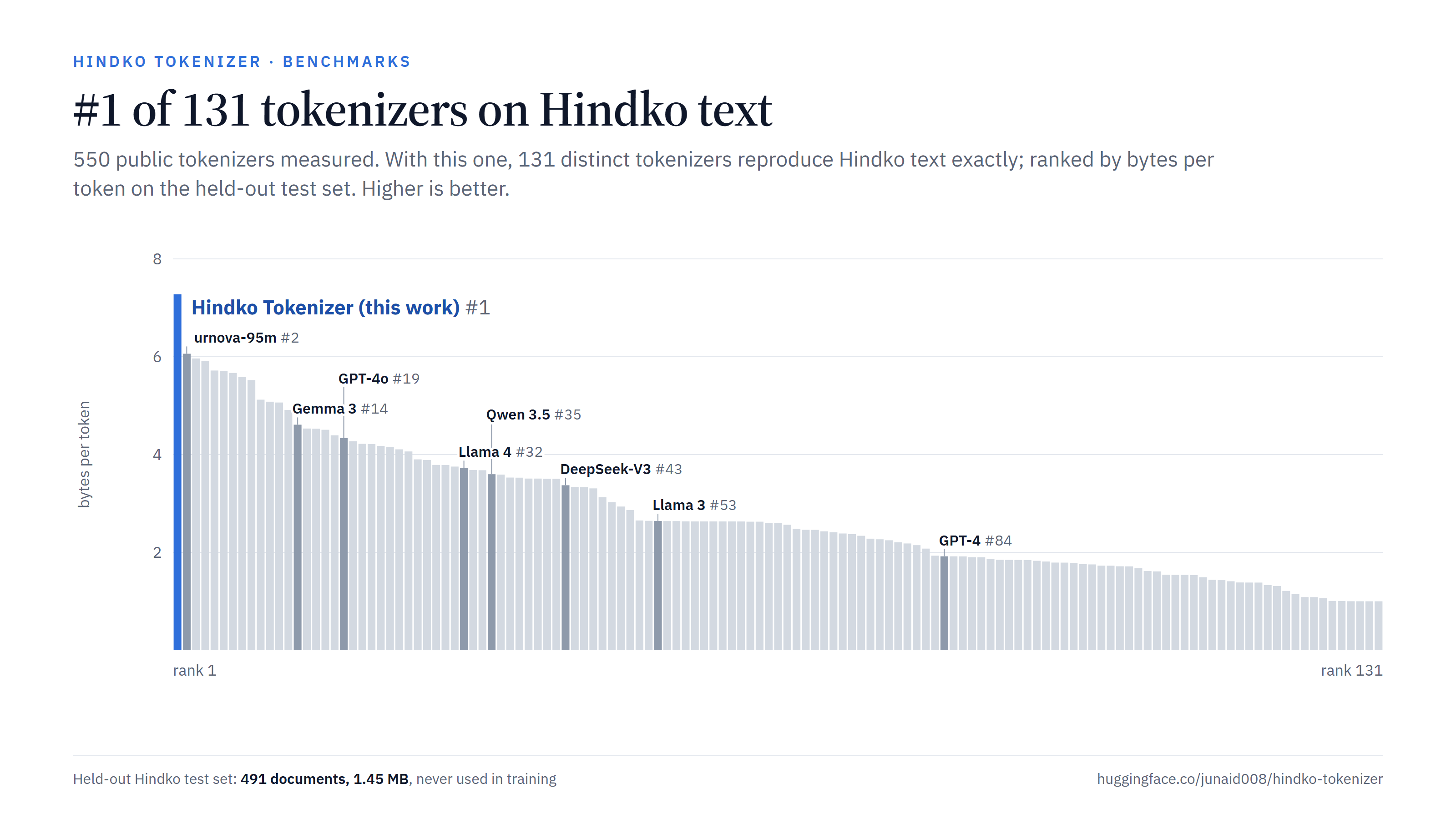
| External comparison | Fewest tokens of the 131 distinct lossless tokenizers compared on the test split (550 external tokenizer files, deduplicated, plus this one) |
| Nearest external tokenizer | ProximaAI/urnova-95m at 6.061 bytes/token: this tokenizer uses 16.7 % fewer tokens |
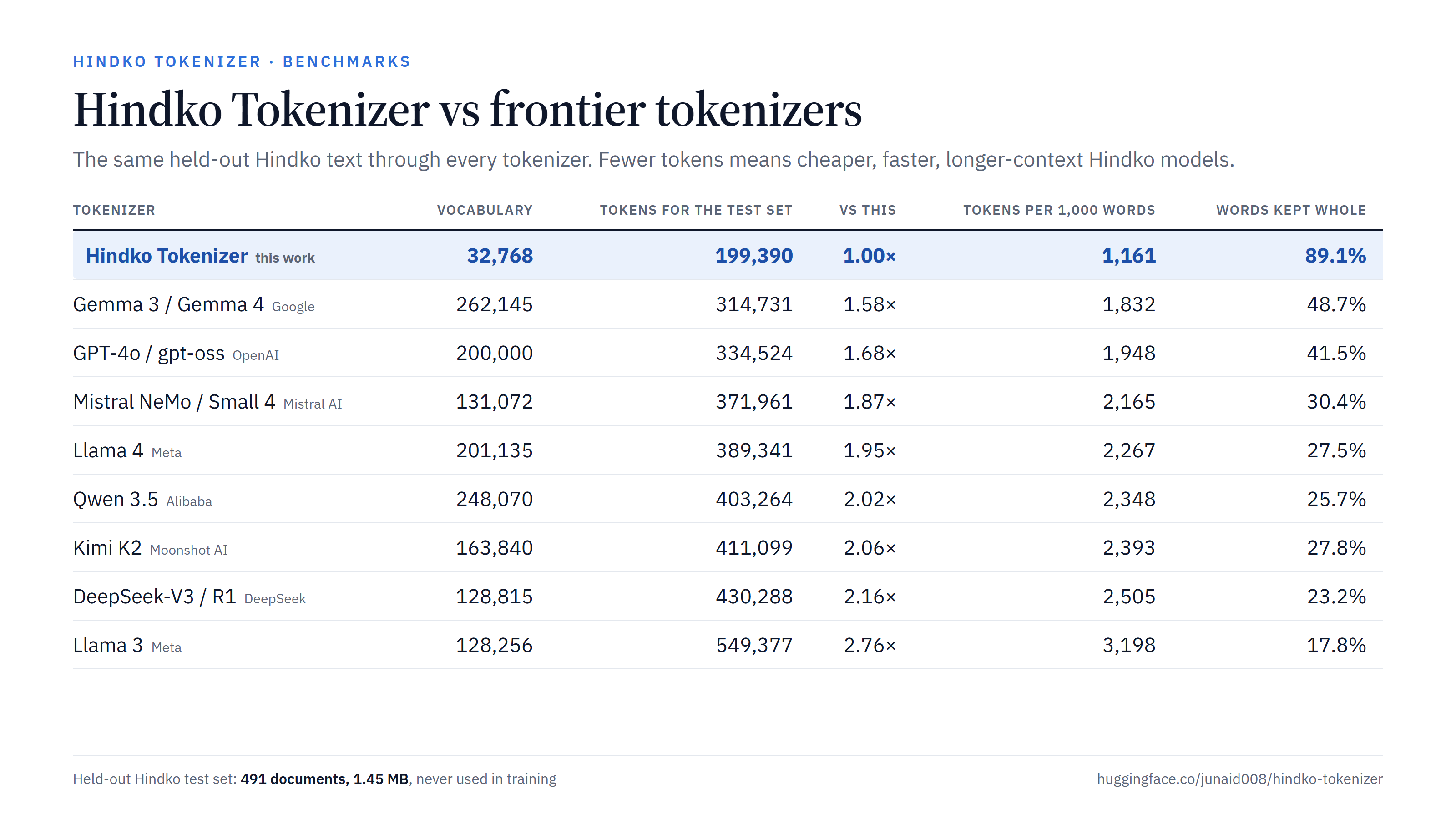
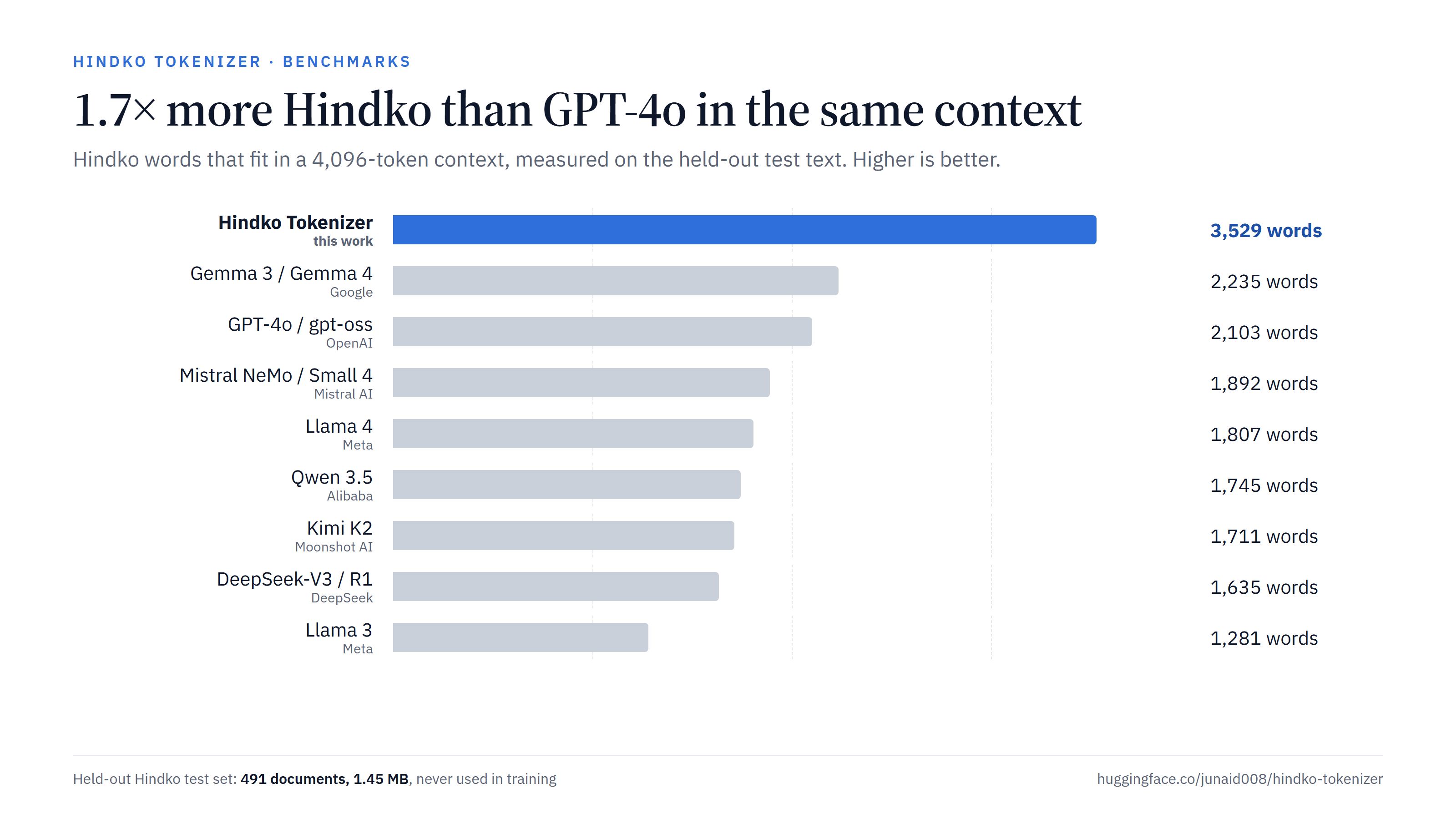
| Frontier tokenizers | 36.6 % fewer tokens than Gemma 3/4, 40.4 % fewer than GPT-4o, 48.8 % fewer than Llama 4, 50.6 % fewer than Qwen 3.5, 53.7 % fewer than DeepSeek-V3 |
| LM evidence (test, pre-registered scale) | −1.01 % bits per byte vs the standard BPE recipe, 95 % CI [−1.33, −0.72] |
| Known weak spot | +92 % tokens on text typed with an Arabic keyboard layout (Arabic letters in place of the Urdu yeh, kaf and heh: ي ك ه for ی ک ہ); normalize first (see Quickstart) |
| Version | 1.0.0, 2026-09-27 |
| Code | Corpus pipeline, study and evaluation code: github.com/junaidaslam2006/Hindko-Tokenizer |
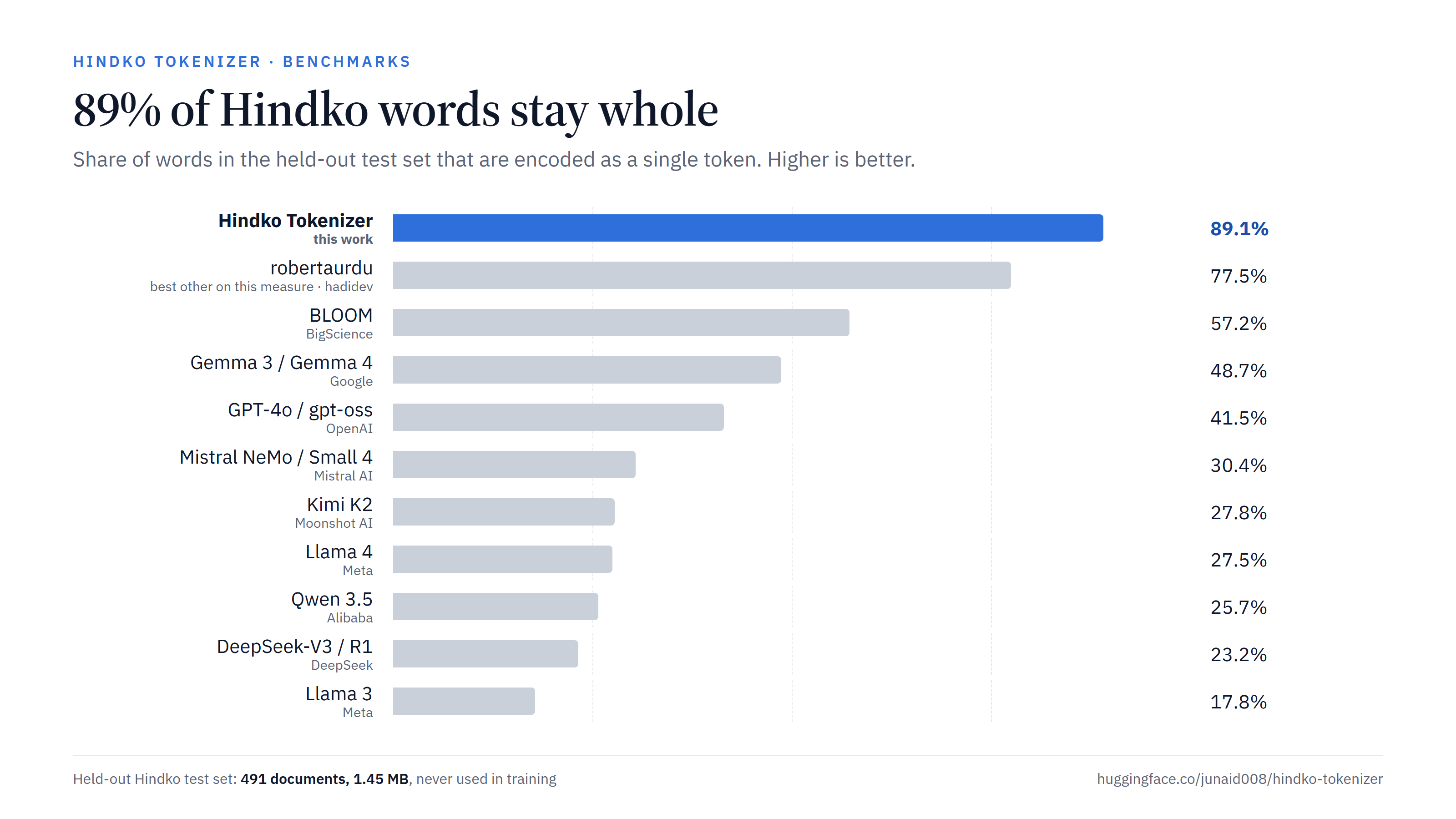
Every tokenizer below encodes the same held-out Hindko text (491 documents, 1.45 MB, never used in training) with its own encoder. The numbers come from the files in eval/; the images are in benchmarks/ (3200 x 1800 PNG, free to reuse under the licence).
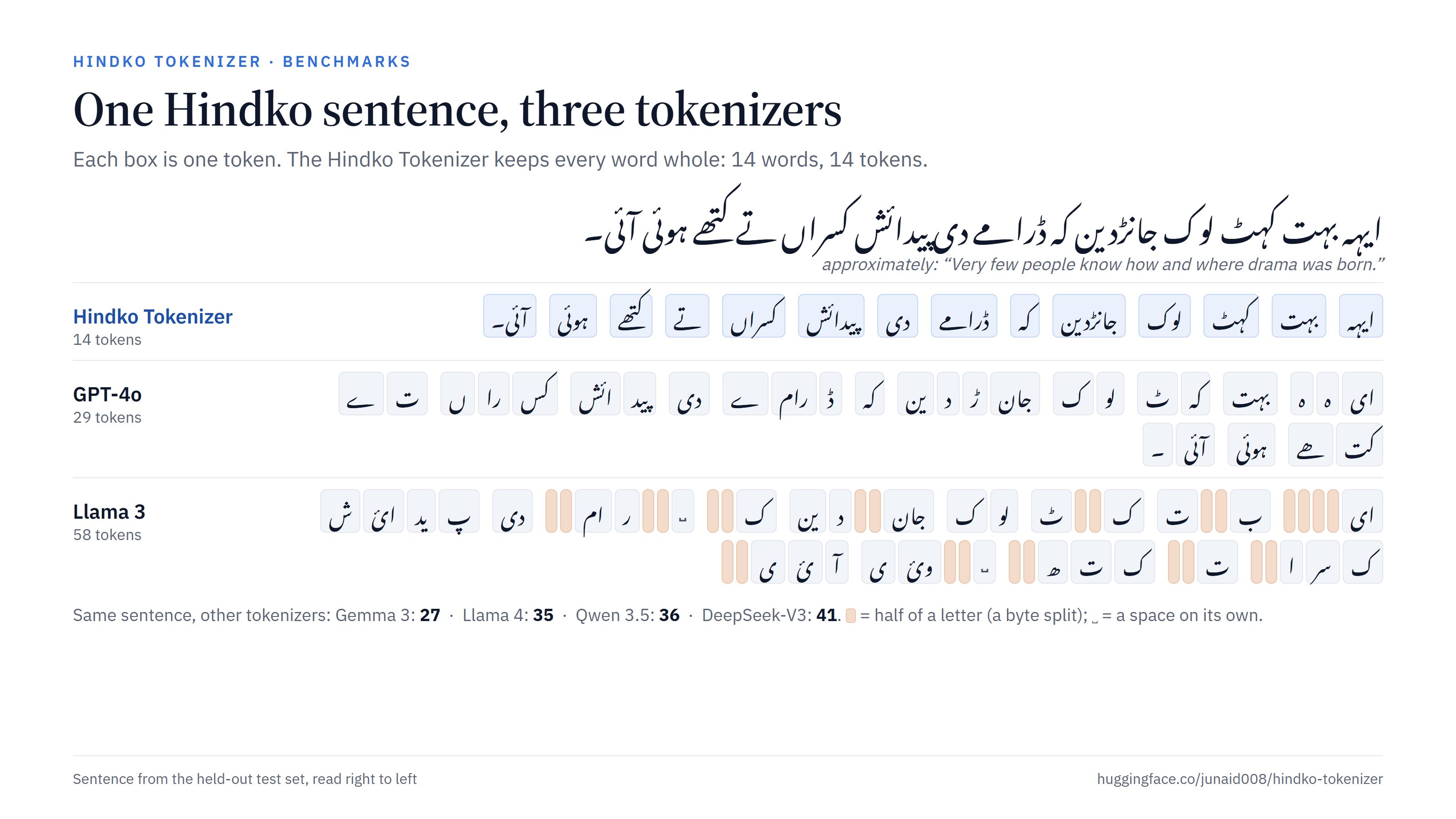
General-purpose tokenizers are trained mostly on English, Chinese and code. They cut Hindko words into short fragments, and byte-level ones sometimes split a single Urdu letter into two tokens. Three natural sentences from the held-out test split:
| Tokenizer | Sentence 1 (14 words) | Sentence 2 (20 words) | Sentence 3 (20 words) | Total | Tokens vs this |
|---|---|---|---|---|---|
| This tokenizer | 14 | 20 | 20 | 54 | 1.00x |
| Gemma 3 / Gemma 4 | 27 | 36 | 35 | 98 | 1.81x |
| GPT-4o (o200k) | 29 | 39 | 38 | 106 | 1.96x |
| Llama 4 | 35 | 42 | 42 | 119 | 2.20x |
| Qwen 3.5 | 36 | 47 | 45 | 128 | 2.37x |
| DeepSeek-V3 | 41 | 47 | 43 | 131 | 2.43x |
| Llama 3 | 58 | 66 | 53 | 177 | 3.28x |
Sentence 1: ایہہ بہت کہٹ لوک جانڑدین کہ ڈرامے دی پیدائش کسراں تے کتھے ہوئی آئی۔ (approximately: "Very few people know how and where drama was born.")
| Tokenizer | Tokens | Split (token boundaries shown as |) |
|---|---|---|
| This tokenizer | 14 | ▁ایہہ | ▁بہت | ▁کہٹ | ▁لوک | ▁جانڑدین | ▁کہ | ▁ڈرامے | ▁دی | ▁پیدائش | ▁کسراں | ▁تے | ▁کتھے | ▁ہوئی | ▁آئی۔ |
| Gemma 3 / Gemma 4 | 27 | ایہ | ہ | ▁بہت | ▁کہ | ٹ | ▁لو | ک | ▁جان | ڑ | د | ین | ▁کہ | ▁ڈ | رام | ے | ▁دی | ▁پید | ائش | ▁کس | را | ں | ▁تے | ▁کت | ھے | ▁ہوئی | ▁آئی | ۔ |
| GPT-4o (o200k) | 29 | ای | ہ | ہ | ▁بہت | ▁کہ | ٹ | ▁لو | ک | ▁جان | ڑ | د | ین | ▁کہ | ▁ڈ | رام | ے | ▁دی | ▁پید | ائش | ▁کس | را | ں | ▁ت | ے | ▁کت | ھے | ▁ہوئی | ▁آئی | ۔ |
| Llama 4 | 35 | ای | ہ | ہ | ▁بہت | ▁کہ | ٹ | ▁لو | ک | ▁جان | ڑ | د | ین | ▁کہ | ▁ڈ | ر | ام | ے | ▁دی | ▁پید | ائ | ش | ▁ک | سر | اں | ▁ت | ے | ▁ک | ت | ھ | ے | ▁ہو | ئی | ▁آ | ئی | ۔ |
| Qwen 3.5 | 36 | ای | ہ | ہ | ▁بہ | ت | ▁کہ | ٹ | ▁لو | ک | ▁جان | ڑ | د | ین | ▁کہ | ▁ڈ | رام | ے | ▁دی | ▁پ | ید | ائ | ش | ▁ک | س | را | ں | ▁ت | ے | ▁ک | ت | ھے | ▁ہو | ئی | ▁آ | ئی | ۔ |
| DeepSeek-V3 | 41 | ای | ہ | ہ | ▁ب | ہ | ت | ▁ک | ہ | ٹ | ▁لو | ک | ▁جان | ڑ | د | ین | ▁ک | ہ | ▁ | ڈ | ر | ام | ے | ▁دی | ▁پید | ائ | ش | ▁ک | سر | اں | ▁ت | ے | ▁ک | ت | ھ | ے | ▁ہ | وئ | ی | ▁آ | ئی | ۔ |
| Llama 3 | 58 | ای | ▯ | ▯ | ▯ | ▯ | ▁ب | ▯ | ▯ | ت | ▁ک | ▯ | ▯ | ٹ | ▁لو | ک | ▁جان | ▯ | ▯ | د | ین | ▁ک | ▯ | ▯ | ▁ | ▯ | ▯ | ر | ام | ▯ | ▯ | ▁دی | ▁پ | ید | ائ | ش | ▁ک | سر | ا | ▯ | ▯ | ▁ت | ▯ | ▯ | ▁ک | ت | ھ | ▯ | ▯ | ▁ | ▯ | ▯ | وئ | ی | ▁آ | ئ | ی | ▯ | ▯ |
Sentence 2: اج اساں اگر آپڑیں بزرگاں دی انہاں گلاں تے غور نہ کیتا تے پچھتاوے دے سوا کج ہتھ نہ آسی۔ (approximately: "If we do not reflect on these words of our elders today, we will be left with nothing but regret.")
| Tokenizer | Tokens | Split (token boundaries shown as |) |
|---|---|---|
| This tokenizer | 20 | ▁اج | ▁اساں | ▁اگر | ▁آپڑیں | ▁بزرگاں | ▁دی | ▁انہاں | ▁گلاں | ▁تے | ▁غور | ▁نہ | ▁کیتا | ▁تے | ▁پچھتاوے | ▁دے | ▁سوا | ▁کج | ▁ہتھ | ▁نہ | ▁آسی۔ |
| Gemma 3 / Gemma 4 | 36 | اج | ▁اس | اں | ▁اگر | ▁آپ | ڑ | یں | ▁بزرگ | اں | ▁دی | ▁انہ | اں | ▁گ | لا | ں | ▁تے | ▁غور | ▁نہ | ▁کی | تا | ▁تے | ▁پ | چھ | تا | و | ے | ▁دے | ▁سوا | ▁ک | ج | ▁ہ | ت | ھ | ▁نہ | ▁آسی | ۔ |
| GPT-4o (o200k) | 39 | اج | ▁اس | اں | ▁اگر | ▁آپ | ڑ | یں | ▁بزرگ | اں | ▁دی | ▁انہ | اں | ▁گ | لا | ں | ▁ت | ے | ▁غور | ▁نہ | ▁کی | تا | ▁ت | ے | ▁پ | چھ | تا | و | ے | ▁دے | ▁س | وا | ▁ک | ج | ▁ہ | ت | ھ | ▁نہ | ▁آسی | ۔ |
| Llama 4 | 42 | اج | ▁اس | اں | ▁اگر | ▁آپ | ڑ | یں | ▁بزرگ | اں | ▁دی | ▁انہ | اں | ▁گ | لا | ں | ▁ت | ے | ▁غ | ور | ▁نہ | ▁ک | یت | ا | ▁ت | ے | ▁پ | چھ | ت | او | ے | ▁د | ے | ▁س | وا | ▁ک | ج | ▁ہ | ت | ھ | ▁نہ | ▁آسی | ۔ |
| Qwen 3.5 | 47 | اج | ▁اسا | ں | ▁اگر | ▁آپ | ڑ | یں | ▁ب | زر | گا | ں | ▁دی | ▁ان | ہ | ا | ں | ▁گ | لا | ں | ▁ت | ے | ▁غ | ور | ▁نہ | ▁ک | یت | ا | ▁ت | ے | ▁پ | چ | ھ | تا | و | ے | ▁د | ے | ▁س | وا | ▁ک | ج | ▁ہ | ت | ھ | ▁نہ | ▁آسی | ۔ |
| DeepSeek-V3 | 47 | اج | ▁اس | اں | ▁اگر | ▁آ | پ | ڑ | ی | ں | ▁بزرگ | اں | ▁دی | ▁ان | ہ | اں | ▁گ | لا | ں | ▁ت | ے | ▁غ | ور | ▁ن | ہ | ▁ک | یت | ا | ▁ت | ے | ▁پ | چ | ھ | ت | او | ے | ▁دے | ▁س | وا | ▁ک | ج | ▁ہ | ت | ھ | ▁ن | ہ | ▁آسی | ۔ |
| Llama 3 | 66 | اج | ▁اس | ا | ▯ | ▯ | ▁اگر | ▁آپ | ▯ | ▯ | ی | ▯ | ▯ | ▁بزرگ | ا | ▯ | ▯ | ▁دی | ▁ان | ▯ | ▯ | ا | ▯ | ▯ | ▁گ | لا | ▯ | ▯ | ▁ت | ▯ | ▯ | ▁غ | ور | ▁ن | ▯ | ▯ | ▁ک | یت | ا | ▁ت | ▯ | ▯ | ▁پ | چ | ھ | ت | او | ▯ | ▯ | ▁د | ▯ | ▯ | ▁س | وا | ▁ک | ج | ▁ | ▯ | ▯ | ت | ھ | ▁ن | ▯ | ▯ | ▁آسی | ▯ | ▯ |
Sentence 3: اسی طراں خیبر پختونخوا اچ بولی جانڑیں ولی دیگر زباناں دے ادب و ثقافت دی بی نمائندگی کیتی گئی اَئی۔ (approximately: "In the same way, the literature and culture of the other languages spoken in Khyber Pakhtunkhwa were also represented.")
| Tokenizer | Tokens | Split (token boundaries shown as |) |
|---|---|---|
| This tokenizer | 20 | ▁اسی | ▁طراں | ▁خیبر | ▁پختونخوا | ▁اچ | ▁بولی | ▁جانڑیں | ▁ولی | ▁دیگر | ▁زباناں | ▁دے | ▁ادب | ▁و | ▁ثقافت | ▁دی | ▁بی | ▁نمائندگی | ▁کیتی | ▁گئی | ▁اَئی۔ |
| Gemma 3 / Gemma 4 | 35 | اسی | ▁ط | را | ں | ▁خی | بر | ▁پ | خت | ون | خوا | ▁اچ | ▁بولی | ▁جان | ڑ | یں | ▁ولی | ▁دیگر | ▁زبان | اں | ▁دے | ▁ادب | ▁و | ▁ثقاف | ت | ▁دی | ▁بی | ▁نمائ | ندگی | ▁کی | تی | ▁گئی | ▁ا | َ | ئی | ۔ |
| GPT-4o (o200k) | 38 | اسی | ▁ط | را | ں | ▁خی | بر | ▁پ | خت | ون | خوا | ▁اچ | ▁بول | ی | ▁جان | ڑ | یں | ▁ولی | ▁دیگر | ▁ز | ب | انا | ں | ▁دے | ▁ادب | ▁و | ▁ثق | افت | ▁دی | ▁بی | ▁نمائ | ندگی | ▁کی | تی | ▁گئی | ▁ا | َ | ئی | ۔ |
| Llama 4 | 42 | اسی | ▁ط | را | ں | ▁خی | بر | ▁پ | خت | ون | خ | وا | ▁ا | چ | ▁ب | ولی | ▁جان | ڑ | یں | ▁ولی | ▁دیگر | ▁زبان | اں | ▁د | ے | ▁اد | ب | ▁و | ▁ث | ق | افت | ▁دی | ▁بی | ▁نم | ائ | ندگی | ▁کی | تی | ▁گئی | ▁ا▯ | ▯ | ئی | ۔ |
| Qwen 3.5 | 45 | اس | ی | ▁ط | را | ں | ▁خی | بر | ▁پ | خت | ون | خوا | ▁ا | چ | ▁ب | ولی | ▁جان | ڑ | یں | ▁ولی | ▁دیگر | ▁ز | ب | انا | ں | ▁د | ے | ▁اد | ب | ▁و | ▁ثق | افت | ▁دی | ▁بی | ▁نم | ائ | ند | گی | ▁ک | یتی | ▁گ | ئی | ▁ا | َ | ئی | ۔ |
| DeepSeek-V3 | 43 | اسی | ▁طر | اں | ▁خ | ی | بر | ▁پ | خت | ون | خ | وا | ▁ا | چ | ▁ب | ولی | ▁جان | ڑ | ی | ں | ▁ولی | ▁دیگر | ▁زبان | اں | ▁دے | ▁اد | ب | ▁و | ▁ث | ق | افت | ▁دی | ▁بی | ▁نم | ائ | ندگی | ▁ک | یتی | ▁گ | ئی | ▁ا | َ | ئی | ۔ |
| Llama 3 | 53 | اسی | ▁طر | ا | ▯ | ▯ | ▁خی | بر | ▁پ | خت | ون | خ | وا | ▁ا | چ | ▁ب | ولی | ▁جان | ▯ | ▯ | ی | ▯ | ▯ | ▁ولی | ▁دیگر | ▁زبان | ا | ▯ | ▯ | ▁د | ▯ | ▯ | ▁اد | ب | ▁و | ▁ث | ق | افت | ▁دی | ▁بی | ▁نم | ائ | ندگی | ▁ک | یتی | ▁گ | ئ | ی | ▁ا | َ | ئ | ی | ▯ | ▯ |
▁ marks a word start; ▯ is one byte of a letter that a byte-level tokenizer split in two. The text is right-to-left. Splits for 11 tokenizers are in eval/examples_segmentations.json.
What fewer tokens means in practice. These gains apply to a model that is trained or adapted with this tokenizer. The tokenizer cannot be plugged into an existing model such as GPT-4o or Llama.
| Effect of needing fewer tokens for the same Hindko text | |
|---|---|
| Cost | Training compute and per-token API prices scale with token count. The same Hindko text is 1.68x as many tokens with GPT-4o's tokenizer and 2.02x with Qwen 3.5's. |
| Context length | A fixed window holds more text: 4,096 tokens cover about 29.8 KB of Hindko here, against about 17.8 KB with GPT-4o's tokenizer. |
| Speed | Generation emits one token per step, so a sentence takes fewer steps (14 instead of 29 for sentence 1 vs GPT-4o's tokenizer). The 32,768-row embedding and output layers are also smaller than the 128k–262k rows of frontier vocabularies. |
| Consistency | 89.1 % of test words are a single token, so a model sees most words as whole units. |
pip install tokenizers transformers huggingface_hub # sentencepiece is optional
Load it from the Hugging Face Hub, or clone this repository and load it from the folder:
from transformers import AutoTokenizer

tok = AutoTokenizer.from_pretrained("junaid008/hindko-tokenizer")   # from the Hub
tok = AutoTokenizer.from_pretrained("./Hindko-Tokenizer")           # from a git clone of this repository
from transformers import AutoTokenizer

tok = AutoTokenizer.from_pretrained("junaid008/hindko-tokenizer")

text = "ایہہ بہت کہٹ لوک جانڑدین کہ ڈرامے دی پیدائش کسراں تے کتھے ہوئی آئی۔"
ids = tok(text)["input_ids"]                  # 14 ids; nothing is added (no BOS/EOS)
assert tok.decode(ids, skip_special_tokens=False) == text
add_bos_token and add_eos_token are false. The study's language models saw each document as <|bos|> (id 1) + text + <|endoftext|> (id 0). Add them yourself, or set tok.add_bos_token = True.▁, so decode([a]) + decode([b]) can lose a space that decode([a, b]) keeps. For streaming, decode everything so far and emit the new suffix (as TextStreamer does).from tokenizers import Tokenizer
tk = Tokenizer.from_pretrained("junaid008/hindko-tokenizer")
text = "ایہہ بہت کہٹ لوک جانڑدین کہ ڈرامے دی پیدائش کسراں تے کتھے ہوئی آئی۔"
enc = tk.encode(text)
enc.ids, enc.tokens
assert tk.decode(enc.ids, skip_special_tokens=False) == text
tokenizer_config.json ships a ChatML template:
from transformers import AutoTokenizer

tok = AutoTokenizer.from_pretrained("junaid008/hindko-tokenizer")
msgs = [{"role": "user", "content": "سلام! تساں کیہہ حال اے؟"}]
tok.apply_chat_template(msgs, tokenize=False, add_generation_prompt=True)
# '<|bos|><|im_start|>user\nسلام! تساں کیہہ حال اے؟<|im_end|>\n<|im_start|>assistant\n'
Chat formatting was not part of the evaluated protocol; the study's models saw plain documents only.
sp.model gives the same ids as tokenizer.json only if you apply the newline convention: split the text at \n, encode each line, and join with the newline piece (id 64).
import sentencepiece as spm
from huggingface_hub import hf_hub_download

sp = spm.SentencePieceProcessor(model_file=hf_hub_download("junaid008/hindko-tokenizer", "sp.model"))
NL = sp.piece_to_id("\n")                                   # 64

def sp_encode(text):
    out = []
    for k, ids in enumerate(sp.encode(text.split("\n"))):
        if k:
            out.append(NL)
        out.extend(ids)
    return out
sp.encode(text) on multi-line text: each \n becomes byte pieces and the next line loses its word-start marker.tokenizer.json when ids must be canonical.<|...|> strings as special tokens; tokenizer.json does.The tokenizer itself normalizes nothing, so it is lossless. It was trained and evaluated on text in a canonical form. examples/quickstart.py contains a self-contained normalize() that produces that form: NFC, CRLF to LF, removal of invisible and control characters (ZWSP, bidi marks, BOM, kashida), collapsed spaces, Arabic presentation forms to letters, and Arabic-keyboard YEH/KAF folded only inside words that are provably Urdu/Hindko spelling. It never merges letters that differ in Hindko.
import os, sys
from huggingface_hub import hf_hub_download
from transformers import AutoTokenizer
qs = hf_hub_download("junaid008/hindko-tokenizer", "examples/quickstart.py")
sys.path.insert(0, os.path.dirname(qs))
from quickstart import normalize, fold_arabic_yeh_kaf
tok = AutoTokenizer.from_pretrained("junaid008/hindko-tokenizer")
raw_text = "ایہہ بہت کہٹ لوک۔\r\n" # any input: double space, ZWSP, CRLF are cleaned
ids = tok(normalize(raw_text))["input_ids"]
Arabic-keyboard caveat. Text typed on an Arabic keyboard layout, with ي ك ه in place of ی ک ہ, costs this tokenizer +92 % tokens on the test split, because its training text almost never uses those code points (only 9 of 32,768 pieces contain them).
normalize()recovers part of this (+61 % remains). If the input is known to be Hindko or Urdu, also fold every ي→ی and ك→ک withfold_arabic_yeh_kaf(): +26 % remains, and the tokenizer again needs fewer tokens than every external tokenizer tested on the same text. ه cannot be folded blindly, because such typists use it for both ہ and ھ.
normalize() is not reversible. Do not apply it where whitespace must be kept exactly (code, tables, verbatim quotes). It matches the project's reference implementation (hp.normalize 1.0.1) on 2,194 dev documents, 86,516 stress strings and 50,000 fuzz strings.
All numbers are on the strict test split: 491 documents, 1,451,026 bytes, never used for training or selection of the tokenizer. The split of every corpus record (record IDs only, no text) is published as split_manifest.jsonl (sha256 76582d3a1e0afefe…), so the split can be reproduced exactly. Every tokenizer runs with its own native encoder and no special tokens added.
We measured 550 external tokenizer files: 65 study baselines of frontier and regional models, plus 485 found by a search of the Hugging Face Hub (14,856 repositories found, 2,608 represented by a measured tokenizer). Identical encoders were merged, leaving 528 distinct encodings, 130 of them lossless. This tokenizer ranks first of the 131 lossless ones on both bytes per token and fertility. Tokenizers that cannot reproduce the text (lossy) are not ranked: several emit <unk> for most words, which inflates their raw numbers.
| # | Tokenizer | Provider | Vocab | Bytes/token | Fertility | This uses fewer tokens |
|---|---|---|---|---|---|---|
| 1 | This tokenizer | junaid008 | 32,768 | 7.277 | 1.135 | – |
| 2 | ProximaAI/urnova-95m | ProximaAI | 50,048 | 6.061 | 1.373 | 16.7 % |
| 3 | DunbaaBERT/DunbaaBERT_52k_base | DunbaaBERT | 52,010 | 5.964 | 1.395 | 18.0 % |
| 4 | orature/ALIF-Base-100M | orature | 32,000 | 5.912 | 1.405 | 18.8 % |
| 5 | DunbaaBERT/DunbaaBERT_32k_base | DunbaaBERT | 32,010 | 5.718 | 1.456 | 21.4 % |
| 6 | urduhack/roberta-urdu-small | UrduHack | 52,000 | 5.709 | 1.459 | 21.6 % |
| 7 | ibm-research/ia-multilingual-original-script-roberta | IBM Research | 110,000 | 5.668 | 1.469 | 22.1 % |
| 8 | mahwizzzz/urdu-dummy | community | 25,000 | 5.586 | 1.491 | 23.2 % |
| 9 | hadidev/robertaurdu | community | 59,458 | 5.523 | 1.501 | 24.1 % |
| 10 | BLOOM | BigScience | 250,680 | 5.122 | 1.633 | 29.6 % |
| 11 | MADLAD-400 | Google (via santhosh/madlad400-3b-ct2) | 256,000 | 5.080 | 1.599 | 30.2 % |
| 12 | K2-Horizon-MoVA | mlx-community | 250,624 | 5.064 | 1.651 | 30.4 % |
Frontier model tokenizers on the same text:
| Tokenizer (identical encoders) | Provider | Vocab | Bytes/token | Fertility | This uses fewer tokens |
|---|---|---|---|---|---|
| Gemma 3 (= Gemma 4, Sarvam-30B) | 262,145 | 4.610 | 1.807 | 36.6 % | |
| GPT-4o o200k (= gpt-oss, Phi-4-mini) | OpenAI | 200,000 | 4.338 | 1.931 | 40.4 % |
| Mistral Tekken (= Mistral NeMo, Mistral Small 4; also Apertus, Nemotron 3) | Mistral AI | 131,072 | 3.901 | 2.149 | 46.4 % |
| Llama 4 | Meta | 201,135 | 3.727 | 2.251 | 48.8 % |
| Qwen 3.5 | Alibaba | 248,070 | 3.598 | 2.323 | 50.6 % |
| Kimi K2 | Moonshot AI | 163,840 | 3.530 | 2.375 | 51.5 % |
| DeepSeek-V3 (= R1, V4, V4.1) | DeepSeek | 128,815 | 3.372 | 2.476 | 53.7 % |
| Llama 3 (= Alif-1.0, Qalb-1.0) | Meta | 128,256 | 2.641 | 3.119 | 63.7 % |
Full table of all 528 encodings: eval/competitors_test_strict.csv; summary and search coverage: eval/competitors_summary.json.
Scope of this comparison.
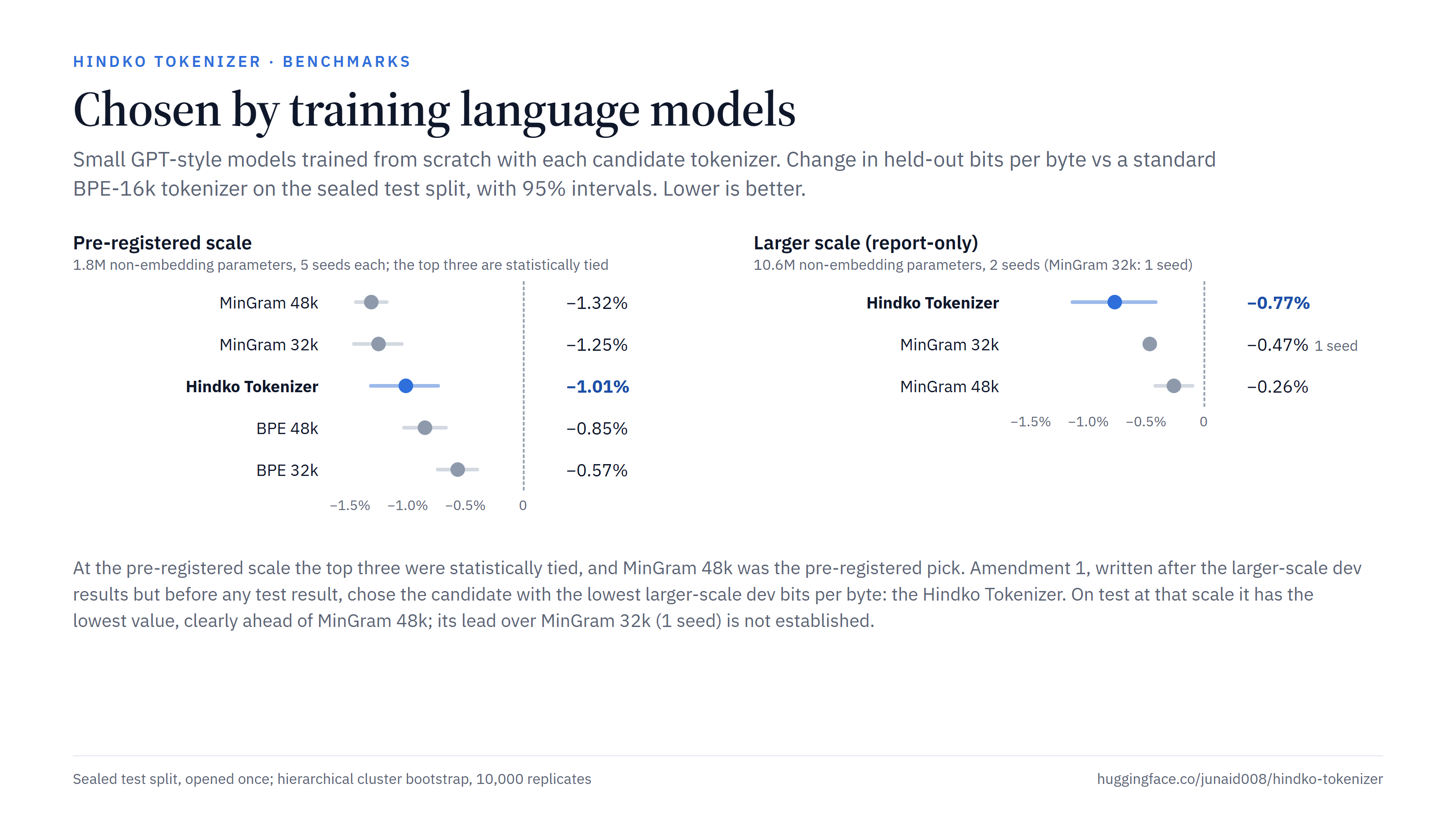
Each candidate tokenizer was used to train small GPT-style language models from scratch on the same 45 MB of Hindko, with the same bytes of context and the same bytes per step. The score is held-out bits per byte (bpb), which is comparable across tokenizers. Confidence intervals come from a hierarchical cluster bootstrap over newspaper editions, books and web sites (10,000 replicates). The baseline is the standard recipe, byte-level BPE with a 16k vocabulary.
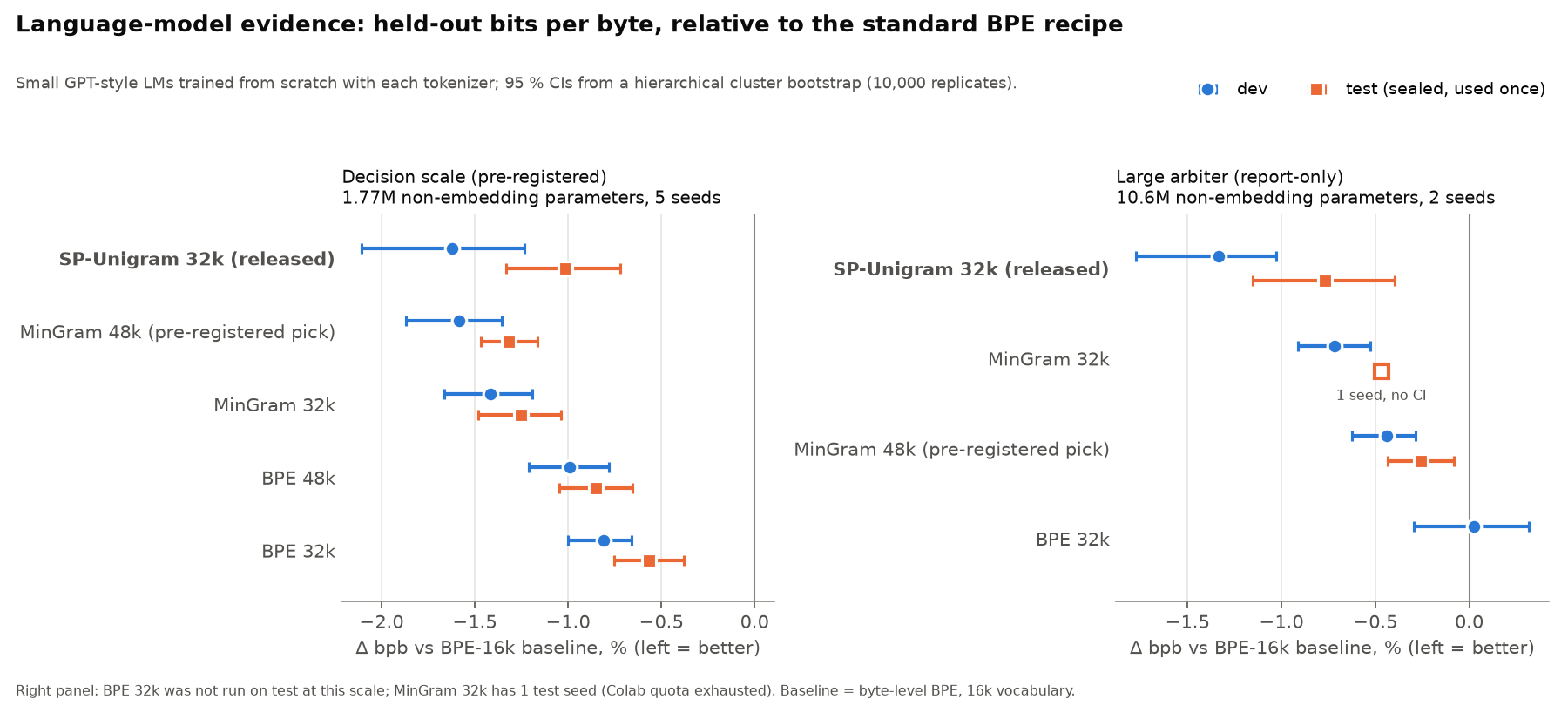
Decision scale (pre-registered; 1.77M non-embedding parameters, 5 seeds).
| Tokenizer | Dev bpb | Dev Δ vs baseline | Test bpb | Test Δ vs baseline |
|---|---|---|---|---|
| This tokenizer (SP-Unigram 32k) | 1.22584 (rank 1 of 17) | −1.62 % [−2.11, −1.24] | 1.20911 | −1.01 % [−1.33, −0.72] |
| MinGram 48k (the pre-registered pick) | 1.22636 | −1.58 % [−1.87, −1.36] | 1.20543 | −1.32 % [−1.47, −1.16] |
| MinGram 32k | 1.22844 | −1.41 % [−1.66, −1.19] | 1.20620 | −1.25 % [−1.48, −1.04] |
| BPE 48k | 1.23374 | −0.99 % [−1.21, −0.78] | 1.21111 | −0.85 % [−1.05, −0.65] |
| BPE 32k | 1.23597 | −0.81 % [−1.00, −0.66] | 1.21459 | −0.57 % [−0.75, −0.38] |
| Baseline: BPE 16k | 1.24607 | – | 1.22150 | – |
Large arbiter (report-only; 10.6M non-embedding parameters, 2 seeds). Amendment 1, written before any test LM number existed, chose the released tokenizer from the tied top set by the lowest dev bpb at this larger scale.
| Tokenizer | Dev bpb | Dev Δ vs baseline | Test bpb | Test Δ vs baseline |
|---|---|---|---|---|
| This tokenizer | 1.13373 | −1.34 % [−1.78, −1.03] | 1.11898 | −0.77 % [−1.15, −0.40] |
| MinGram 32k | 1.14086 | −0.72 % [−0.91, −0.52] | 1.12240 (1 seed) | −0.47 % (no CI) |
| MinGram 48k (the pre-registered pick) | 1.14407 | −0.44 % [−0.62, −0.29] | 1.12477 | −0.26 % [−0.44, −0.08] |
| BPE 32k | 1.14940 | +0.03 % [−0.30, +0.32] | not run | – |
| Baseline: BPE 16k | 1.14908 | – | 1.12767 | – |
What this supports. The algorithm and settings were selected by language-model experiments, and the released tokenizer is in the statistically tied top set at the pre-registered scale. It is not claimed to be the best tokenizer on test: at the pre-registered scale it is third of the three tied members, and the larger-scale result that favours it is report-only, with 1–2 seeds. Full tables: eval/dev_lm_confirm_ranking.csv, eval/test_lm_confirm.csv, eval/dev_lm_large.csv, eval/test_lm_large.csv, eval/lm_key_contrasts.json.
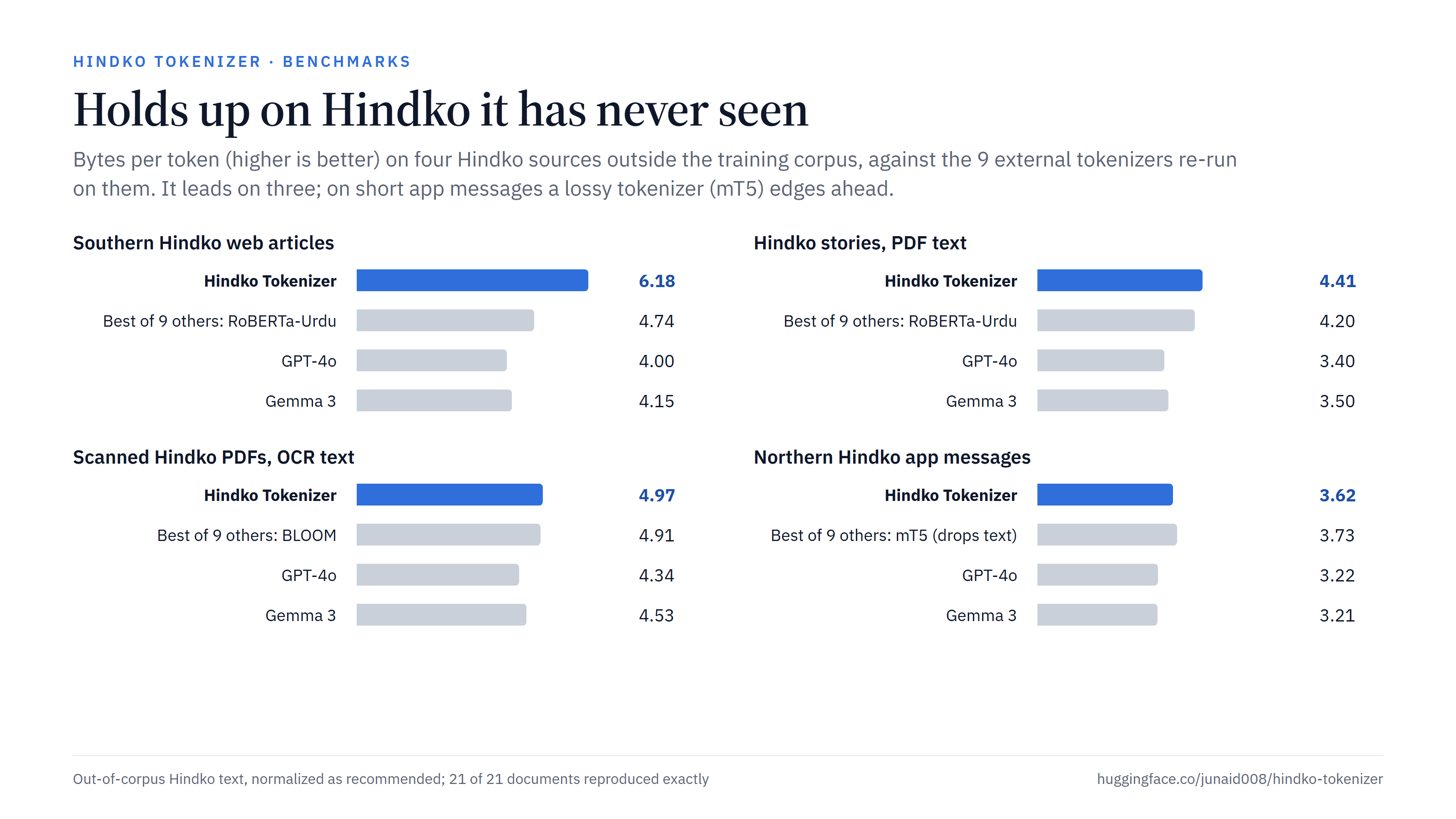
Ten comparison tokenizers were re-run on text outside the training corpus and under realistic spelling and typing changes (input normalized as recommended above).
| Test | This tokenizer | Best external | Result |
|---|---|---|---|
| Southern Hindko web articles (not in the corpus; 6.7 % of words unseen in training) | 6.18 bytes/token | 4.74 (RoBERTa-Urdu) | 23 % fewer tokens; 35 % fewer than GPT-4o |
| Hindko stories, PDF text layer | 4.41 | 4.20 (RoBERTa-Urdu) | 4.6 % fewer tokens |
| hindko.org PDFs, OCR (noisy letters) | 4.97 | 4.91 (BLOOM) | 1.2 % fewer tokens |
| Northern Hindko interface messages (translatewiki) | 3.62 | 3.73 (mT5, which does not round-trip) | 2.9 % more tokens |
| Code-mixed Hindko + Urdu + English (100 synthetic lines) | 5.66 | 5.55 (BLOOM) | ahead on whole lines; the inserted English/Urdu costs 2.77 bytes/token vs 5.93 for GPT-4o |
| Lossless on all robustness sets | 1,692/1,692 docs | – | – |
| Spelling or typing change (whole test split) | Token change, this | Range, 9 external |
|---|---|---|
| Harakat removed | −0.45 % | −8.61 % to −1.69 % |
| Digit script swapped (ASCII / Urdu) | −0.45 % | −0.17 % to +0.39 % |
| ZWNJ inserted in compounds | +0.49 % | +0.01 % to +0.16 % |
| Retroflex nasal نڑ written ݨ / ن | +2.76 % / +0.40 % | −0.36 % to +1.60 % / −1.56 % to −1.09 % |
| Space before ۔ and ، | +7.58 % | 0.00 % to +1.78 % |
| Arabic-keyboard ي ك ه for ی ک ہ | +92.15 % | −9.25 % to +101.60 % |
… then normalize() | +60.72 % | −9.55 % to +68.29 % |
| … then also fold ي→ی, ك→ک | +25.8 % | −10.5 % to +24.3 % |
After each of the six changes above the Arabic-keyboard row, this tokenizer still needs fewer tokens than every external tokenizer. On Arabic-keyboard text as typed, it needs more tokens than GPT-4o, Gemma 3, BLOOM and mT5; after normalize() and the YEH/KAF fold it again needs fewer than all of them.
Other languages (bytes/token; higher is better):
| Urdu | Punjabi (Shahmukhi) | Saraiki | Pashto | English prose | Python code | |
|---|---|---|---|---|---|---|
| This tokenizer | 6.59 | 6.53 | 4.95 | 3.21 | 1.82 | 1.37 |
| Best external | 6.96 (RoBERTa-Urdu) | 5.83 (RoBERTa-Urdu) | 4.42 (RoBERTa-Urdu) | 4.86 (GPT-4o) | 4.76 (Llama 4) | 4.16 (Llama 3) |
| Rank among 11 | 3 | 2 | 2 | 10 | 11 | 11 |
Details: eval/robustness_summary.json.
A run that trains the same small language model with this tokenizer and with the GPT-4o, Gemma 3, Llama 3 and other frontier tokenizers, and compares held-out bits per byte on the test split, is prepared but not yet run (the free GPU quota is exhausted). Until then, the comparison with frontier tokenizers rests on token counts only (a), and no statement is made about which tokenizer would give a better model.
Data. The strict-quality tier of the train split of a Hindko text corpus assembled for this project: issues of the Weekly Hindkowan (Peshawar), the Gandhara Hindko Academy book series (much of it poetry, dictionaries and literary prose; 61.8 % of the characters) and a small amount of web text.
| Training text (D2) | Documents | Characters | UTF-8 bytes |
|---|---|---|---|
| Books | 6,037 | 9,110,441 | 16,279,682 |
| Newspaper | 4,748 | 5,279,372 | 9,444,696 |
| Web | 281 | 342,102 | 606,085 |
| Total | 11,066 | 14,731,915 | 26,330,463 |
The split is 90/5/5 by words per source and assigns whole newspaper editions, books and web sites to one side, with one exception: 230 leak-prone records from 40 evaluation groups were moved to train, so those groups are not 100 % held out. Near-duplicate leakage into dev and test was checked (0 leaking records). Contact details in the corpus were masked as <PHONE>, <EMAIL> and <ID_NUMBER> before training.
Normalization. All text was put in the canonical form of normalize() (see Quickstart); the tokenizer itself applies no normalization.
Algorithm. SentencePiece 0.2.1 Unigram, vocab_size 32,768, character_coverage 1.0, byte fallback, splits at whitespace, script changes and numbers, maximum piece length 16, identity normalization, every training line used. Pieces never contain a space. Five pieces that the encoder could never produce were replaced in place by never-used placeholders (a pre-declared remedy); no other id moved. Retraining gives a byte-identical model. The Hugging Face tokenizer.json was exported and verified to give the SentencePiece ids on 100 % of the dev, test and train documents.
Selection, in plain terms.
Besides the tokenizer files, this repository holds the code that built the corpus and trained, selected and evaluated the tokenizer.
| Folder | What it does |
|---|---|
pipeline/ | Corpus pipeline: InPage decoding, OCR, segmentation, cleaning, deduplication, quality gates, PII masking and the dataset build (pipeline/hp/build.py). See pipeline/README.md. |
web/ | Web collection: crawling Hindko sites, FineWeb-2 extraction, Wayback recovery and the language-ID classifier that separates Hindko from Urdu, Punjabi, Saraiki and Pashto. |
tokenizer/research/ | The pre-registered study plan (PLAN.md) and the literature review (SOTA_TOKENIZATION.md). |
tokenizer/splits/, tokenizer/data/ | Group-disjoint train/dev/test splits and the training views. |
tokenizer/normalization/ | The canonical text normalization and its regression tests. |
tokenizer/candidates/ | The 75 candidate builds: BPE, SentencePiece BPE and Unigram, and reimplementations of SuperBPE, PickyBPE and MinGram. |
tokenizer/eval/, tokenizer/baselines/ | The intrinsic evaluation harness and the external baselines. |
tokenizer/lm/, tokenizer/colab/ | The language-model arbiter (hk_lm.py) and the Colab runners. |
tokenizer/analysis/ | Statistics and the decision: DECISION.md, AMENDMENT_1.md, TEST_RESULTS.md. |
tokenizer/release_build/ | Building and verifying the released tokenizer.json. |
tokenizer/sota/ | The comparison against 550 public tokenizers, robustness tests and the vocabulary audit. |
tokenizer/trackb/ | Hindko vocabulary extensions for existing LLM tokenizers (Llama, Qwen, Gemma). |
docs/ | The release technical card. |
Not in this repository: the corpus and any data files (the Hindko texts belong to their publishers and authors), third-party tokenizers (downloaded by tokenizer/baselines/scripts), and the GPL-3.0 InPage glyph table glyph_map.py, which is fetched separately (see pipeline/README.md).
| Ids | Content | Notes |
|---|---|---|
| 0 | <|endoftext|> | end of document; eos_token |
| 1 | <|bos|> | start of document; bos_token |
| 2 | <|pad|> | pad_token |
| 3, 4 | <|im_start|>, <|im_end|> | ChatML turn markers |
| 5–63 | <|reserved_0|> … <|reserved_58|> | free for future use |
| 64 | \n | newline piece (added token, not special) |
| 65 | <unk> | never produced (byte fallback covers every character); unk_token is unset |
| 66–321 | <0x00> … <0xFF> | UTF-8 byte fallback |
| 322–32,767 | 32,441 learned pieces | ▁ marks a word-initial piece |
| 7183, 16359, 16629, 16924, 19063 | <|unused_0|> … <|unused_4|> | never produced by text |
▁۱۹۸۵), so ۲۰۲۴ is one token while 2024 at a word start is five (a standalone ▁ plus four digits).۔ is fused with the preceding word (▁آئی۔), because SentencePiece treats it as Arabic script; ، and ؟ are split off.| File | Purpose | sha256 |
|---|---|---|
tokenizer.json | canonical encoder | 49f301c52363a09a1fc1925359af3ddabd7887495de02354cfa4092cba51da41 |
tokenizer_config.json | transformers config, chat template, no automatic BOS/EOS | 2d51e3597741b9d1f4b4fa450000ae76d400f4d3f0b2c3a9f8aec546e58e31b3 |
special_tokens_map.json | special-token roles | f91a7115d847b2c524407f8da7eaff58392ea046f654400e894a585bde09c8a2 |
sp.model | SentencePiece convenience copy (see caveats) | b91854fedcb25c9d520a444a2c902f148d0ffe65a73330d7b4483ad2d594cc92 |
sp.vocab | piece list with scores | c40b7e1846a4a0daefdeab6cfebd5e355223d27a934833a09e49d14d0d89548f |
gauge.json | per-character score offsets; rounded log-probability of a piece = score − Σ w(c) | b136a83222425872f3332e408eaf75c4e44493e970238c9ec28ba6b8cb2b6b16 |
normalize(), +26 % after the YEH/KAF fold.۔/، costs +7.6 % tokens (external tokenizers: at most +1.8 %), because many pieces end in the full stop. Digit-script swaps and ZWNJ insertion re-segment most of the words they touch.<|im_start|> and so on) are matched as special tokens by tokenizer.json and transformers; split_special_tokens=True does not prevent this with this tokenizer. Strip or escape <|...|> in untrusted text, or insert special tokens only as ids.▁ (U+2581) in input decodes as a space.@ is @. The masks have no dedicated piece. One probable unmasked phone number in the training text is encoded with generic digit pieces and is not in the vocabulary. Names in the vocabulary are of public, historical or literary figures, fictional characters, places and common given names; the audit found no piece that singles out a private individual.Creative Commons Attribution 4.0 International (CC BY 4.0); full text in LICENSE.
@misc{hindko_tokenizer_2026,
  title        = {Hindko Tokenizer: a 32,768-id SentencePiece Unigram tokenizer for Hindko},
  author       = {junaid008},
  year         = {2026},
  version      = {1.0.0},
  howpublished = {\url{https://huggingface.co/junaid008/hindko-tokenizer}},
  note         = {CC BY 4.0. In the statistically tied top set by held-out bits-per-byte of language models under a pre-registered protocol; chosen within that set by a documented amendment (the pre-registered pick was MinGram 48k)}
}
Authors: Junaid Aslam (junaid008) and Muhammad Ozair. For questions or errors, open an issue on this repository or a discussion on the Hugging Face repository.
| Version | Date | Changes |
|---|---|---|
| 1.0.0 (card update) | 2026-09-27 | Licence set to CC BY 4.0; benchmark images added in benchmarks/. Tokenizer files unchanged. |
| 1.0.0 | 2026-09-27 | First release: SentencePiece Unigram, 32,768 ids (R2-A4-SPnat-D2-32k); tokenizer.json canonical; evaluation tables and charts; examples/quickstart.py with normalize(). |
language:
License: CC BY 4.0. Free to use, share and adapt, including commercially, with attribution. See License.
A 32,768-id SentencePiece Unigram tokenizer for Hindko (Northern hno and Southern hnd), the Indo-Aryan language of Peshawar, Hazara and neighbouring districts of Pakistan, written in Urdu (Perso-Arabic) script. Its algorithm and settings were selected by language-model experiments: small GPT-style models were trained from scratch with each candidate tokenizer, and held-out bits per byte decided under a pre-registered protocol with a sealed test split; this tokenizer is in the statistically tied top set and was chosen within it by a documented amendment (the pre-registered pick was MinGram 48k). On held-out Hindko, GPT-4o's tokenizer needs 1.68x as many tokens for the same text and Qwen 3.5's 2.02x, and this tokenizer round-trips the text exactly. It is a tokenizer, not a model: it turns text into ids for a model you train or adapt with it.
| Type | SentencePiece Unigram with byte fallback; canonical encoder tokenizer.json (Hugging Face tokenizers) |
| Vocabulary | 32,768 ids: 32,441 learned pieces, 256 byte pieces, 64 reserved special tokens, newline, <unk>, 5 placeholders |
| Languages | Hindko (hno, hnd). Also efficient on Urdu, Punjabi (Shahmukhi) and Saraiki; not suited to Pashto, English or code |
| Training text | 11,066 documents, 26.3 MB of strict-quality Hindko (newspaper, books, web); dev and test splits held out |
| Held-out bytes per token | 7.277 on the strict test split (491 documents, 1.45 MB), i.e. about 4.07 characters per token |
| Fertility (tokens per word, harness definition) | 1.135 on the test split (plain tokens / whitespace words: 1.161) |
| Lossless | decode(encode(x)) == x on 491/491 test documents and on every document of the train and dev splits |
| External comparison | Fewest tokens of the 131 distinct lossless tokenizers compared on the test split (550 external tokenizer files, deduplicated, plus this one) |
| Nearest external tokenizer | ProximaAI/urnova-95m at 6.061 bytes/token: this tokenizer uses 16.7 % fewer tokens |
| Frontier tokenizers | 36.6 % fewer tokens than Gemma 3/4, 40.4 % fewer than GPT-4o, 48.8 % fewer than Llama 4, 50.6 % fewer than Qwen 3.5, 53.7 % fewer than DeepSeek-V3 |
| LM evidence (test, pre-registered scale) | −1.01 % bits per byte vs the standard BPE recipe, 95 % CI [−1.33, −0.72] |
| Known weak spot | +92 % tokens on text typed with an Arabic keyboard layout (Arabic letters in place of the Urdu yeh, kaf and heh: ي ك ه for ی ک ہ); normalize first (see Quickstart) |
| Version | 1.0.0, 2026-09-27 |
| Code | Corpus pipeline, study and evaluation code: github.com/junaidaslam2006/Hindko-Tokenizer |
Every tokenizer below encodes the same held-out Hindko text (491 documents, 1.45 MB, never used in training) with its own encoder. The numbers come from the files in eval/; the images are in benchmarks/ (3200 x 1800 PNG, free to reuse under the licence).
General-purpose tokenizers are trained mostly on English, Chinese and code. They cut Hindko words into short fragments, and byte-level ones sometimes split a single Urdu letter into two tokens. Three natural sentences from the held-out test split:
| Tokenizer | Sentence 1 (14 words) | Sentence 2 (20 words) | Sentence 3 (20 words) | Total | Tokens vs this |
|---|---|---|---|---|---|
| This tokenizer | 14 | 20 | 20 | 54 | 1.00x |
| Gemma 3 / Gemma 4 | 27 | 36 | 35 | 98 | 1.81x |
| GPT-4o (o200k) | 29 | 39 | 38 | 106 | 1.96x |
| Llama 4 | 35 | 42 | 42 | 119 | 2.20x |
| Qwen 3.5 | 36 | 47 | 45 | 128 | 2.37x |
| DeepSeek-V3 | 41 | 47 | 43 | 131 | 2.43x |
| Llama 3 | 58 | 66 | 53 | 177 | 3.28x |
Sentence 1: ایہہ بہت کہٹ لوک جانڑدین کہ ڈرامے دی پیدائش کسراں تے کتھے ہوئی آئی۔ (approximately: "Very few people know how and where drama was born.")
| Tokenizer | Tokens | Split (token boundaries shown as |) |
|---|---|---|
| This tokenizer | 14 | ▁ایہہ | ▁بہت | ▁کہٹ | ▁لوک | ▁جانڑدین | ▁کہ | ▁ڈرامے | ▁دی | ▁پیدائش | ▁کسراں | ▁تے | ▁کتھے | ▁ہوئی | ▁آئی۔ |
| Gemma 3 / Gemma 4 | 27 | ایہ | ہ | ▁بہت | ▁کہ | ٹ | ▁لو | ک | ▁جان | ڑ | د | ین | ▁کہ | ▁ڈ | رام | ے | ▁دی | ▁پید | ائش | ▁کس | را | ں | ▁تے | ▁کت | ھے | ▁ہوئی | ▁آئی | ۔ |
| GPT-4o (o200k) | 29 | ای | ہ | ہ | ▁بہت | ▁کہ | ٹ | ▁لو | ک | ▁جان | ڑ | د | ین | ▁کہ | ▁ڈ | رام | ے | ▁دی | ▁پید | ائش | ▁کس | را | ں | ▁ت | ے | ▁کت | ھے | ▁ہوئی | ▁آئی | ۔ |
| Llama 4 | 35 | ای | ہ | ہ | ▁بہت | ▁کہ | ٹ | ▁لو | ک | ▁جان | ڑ | د | ین | ▁کہ | ▁ڈ | ر | ام | ے | ▁دی | ▁پید | ائ | ش | ▁ک | سر | اں | ▁ت | ے | ▁ک | ت | ھ | ے | ▁ہو | ئی | ▁آ | ئی | ۔ |
| Qwen 3.5 | 36 | ای | ہ | ہ | ▁بہ | ت | ▁کہ | ٹ | ▁لو | ک | ▁جان | ڑ | د | ین | ▁کہ | ▁ڈ | رام | ے | ▁دی | ▁پ | ید | ائ | ش | ▁ک | س | را | ں | ▁ت | ے | ▁ک | ت | ھے | ▁ہو | ئی | ▁آ | ئی | ۔ |
| DeepSeek-V3 | 41 | ای | ہ | ہ | ▁ب | ہ | ت | ▁ک | ہ | ٹ | ▁لو | ک | ▁جان | ڑ | د | ین | ▁ک | ہ | ▁ | ڈ | ر | ام | ے | ▁دی | ▁پید | ائ | ش | ▁ک | سر | اں | ▁ت | ے | ▁ک | ت | ھ | ے | ▁ہ | وئ | ی | ▁آ | ئی | ۔ |
| Llama 3 | 58 | ای | ▯ | ▯ | ▯ | ▯ | ▁ب | ▯ | ▯ | ت | ▁ک | ▯ | ▯ | ٹ | ▁لو | ک | ▁جان | ▯ | ▯ | د | ین | ▁ک | ▯ | ▯ | ▁ | ▯ | ▯ | ر | ام | ▯ | ▯ | ▁دی | ▁پ | ید | ائ | ش | ▁ک | سر | ا | ▯ | ▯ | ▁ت | ▯ | ▯ | ▁ک | ت | ھ | ▯ | ▯ | ▁ | ▯ | ▯ | وئ | ی | ▁آ | ئ | ی | ▯ | ▯ |
Sentence 2: اج اساں اگر آپڑیں بزرگاں دی انہاں گلاں تے غور نہ کیتا تے پچھتاوے دے سوا کج ہتھ نہ آسی۔ (approximately: "If we do not reflect on these words of our elders today, we will be left with nothing but regret.")
| Tokenizer | Tokens | Split (token boundaries shown as |) |
|---|---|---|
| This tokenizer | 20 | ▁اج | ▁اساں | ▁اگر | ▁آپڑیں | ▁بزرگاں | ▁دی | ▁انہاں | ▁گلاں | ▁تے | ▁غور | ▁نہ | ▁کیتا | ▁تے | ▁پچھتاوے | ▁دے | ▁سوا | ▁کج | ▁ہتھ | ▁نہ | ▁آسی۔ |
| Gemma 3 / Gemma 4 | 36 | اج | ▁اس | اں | ▁اگر | ▁آپ | ڑ | یں | ▁بزرگ | اں | ▁دی | ▁انہ | اں | ▁گ | لا | ں | ▁تے | ▁غور | ▁نہ | ▁کی | تا | ▁تے | ▁پ | چھ | تا | و | ے | ▁دے | ▁سوا | ▁ک | ج | ▁ہ | ت | ھ | ▁نہ | ▁آسی | ۔ |
| GPT-4o (o200k) | 39 | اج | ▁اس | اں | ▁اگر | ▁آپ | ڑ | یں | ▁بزرگ | اں | ▁دی | ▁انہ | اں | ▁گ | لا | ں | ▁ت | ے | ▁غور | ▁نہ | ▁کی | تا | ▁ت | ے | ▁پ | چھ | تا | و | ے | ▁دے | ▁س | وا | ▁ک | ج | ▁ہ | ت | ھ | ▁نہ | ▁آسی | ۔ |
| Llama 4 | 42 | اج | ▁اس | اں | ▁اگر | ▁آپ | ڑ | یں | ▁بزرگ | اں | ▁دی | ▁انہ | اں | ▁گ | لا | ں | ▁ت | ے | ▁غ | ور | ▁نہ | ▁ک | یت | ا | ▁ت | ے | ▁پ | چھ | ت | او | ے | ▁د | ے | ▁س | وا | ▁ک | ج | ▁ہ | ت | ھ | ▁نہ | ▁آسی | ۔ |
| Qwen 3.5 | 47 | اج | ▁اسا | ں | ▁اگر | ▁آپ | ڑ | یں | ▁ب | زر | گا | ں | ▁دی | ▁ان | ہ | ا | ں | ▁گ | لا | ں | ▁ت | ے | ▁غ | ور | ▁نہ | ▁ک | یت | ا | ▁ت | ے | ▁پ | چ | ھ | تا | و | ے | ▁د | ے | ▁س | وا | ▁ک | ج | ▁ہ | ت | ھ | ▁نہ | ▁آسی | ۔ |
| DeepSeek-V3 | 47 | اج | ▁اس | اں | ▁اگر | ▁آ | پ | ڑ | ی | ں | ▁بزرگ | اں | ▁دی | ▁ان | ہ | اں | ▁گ | لا | ں | ▁ت | ے | ▁غ | ور | ▁ن | ہ | ▁ک | یت | ا | ▁ت | ے | ▁پ | چ | ھ | ت | او | ے | ▁دے | ▁س | وا | ▁ک | ج | ▁ہ | ت | ھ | ▁ن | ہ | ▁آسی | ۔ |
| Llama 3 | 66 | اج | ▁اس | ا | ▯ | ▯ | ▁اگر | ▁آپ | ▯ | ▯ | ی | ▯ | ▯ | ▁بزرگ | ا | ▯ | ▯ | ▁دی | ▁ان | ▯ | ▯ | ا | ▯ | ▯ | ▁گ | لا | ▯ | ▯ | ▁ت | ▯ | ▯ | ▁غ | ور | ▁ن | ▯ | ▯ | ▁ک | یت | ا | ▁ت | ▯ | ▯ | ▁پ | چ | ھ | ت | او | ▯ | ▯ | ▁د | ▯ | ▯ | ▁س | وا | ▁ک | ج | ▁ | ▯ | ▯ | ت | ھ | ▁ن | ▯ | ▯ | ▁آسی | ▯ | ▯ |
Sentence 3: اسی طراں خیبر پختونخوا اچ بولی جانڑیں ولی دیگر زباناں دے ادب و ثقافت دی بی نمائندگی کیتی گئی اَئی۔ (approximately: "In the same way, the literature and culture of the other languages spoken in Khyber Pakhtunkhwa were also represented.")
| Tokenizer | Tokens | Split (token boundaries shown as |) |
|---|---|---|
| This tokenizer | 20 | ▁اسی | ▁طراں | ▁خیبر | ▁پختونخوا | ▁اچ | ▁بولی | ▁جانڑیں | ▁ولی | ▁دیگر | ▁زباناں | ▁دے | ▁ادب | ▁و | ▁ثقافت | ▁دی | ▁بی | ▁نمائندگی | ▁کیتی | ▁گئی | ▁اَئی۔ |
| Gemma 3 / Gemma 4 | 35 | اسی | ▁ط | را | ں | ▁خی | بر | ▁پ | خت | ون | خوا | ▁اچ | ▁بولی | ▁جان | ڑ | یں | ▁ولی | ▁دیگر | ▁زبان | اں | ▁دے | ▁ادب | ▁و | ▁ثقاف | ت | ▁دی | ▁بی | ▁نمائ | ندگی | ▁کی | تی | ▁گئی | ▁ا | َ | ئی | ۔ |
| GPT-4o (o200k) | 38 | اسی | ▁ط | را | ں | ▁خی | بر | ▁پ | خت | ون | خوا | ▁اچ | ▁بول | ی | ▁جان | ڑ | یں | ▁ولی | ▁دیگر | ▁ز | ب | انا | ں | ▁دے | ▁ادب | ▁و | ▁ثق | افت | ▁دی | ▁بی | ▁نمائ | ندگی | ▁کی | تی | ▁گئی | ▁ا | َ | ئی | ۔ |
| Llama 4 | 42 | اسی | ▁ط | را | ں | ▁خی | بر | ▁پ | خت | ون | خ | وا | ▁ا | چ | ▁ب | ولی | ▁جان | ڑ | یں | ▁ولی | ▁دیگر | ▁زبان | اں | ▁د | ے | ▁اد | ب | ▁و | ▁ث | ق | افت | ▁دی | ▁بی | ▁نم | ائ | ندگی | ▁کی | تی | ▁گئی | ▁ا▯ | ▯ | ئی | ۔ |
| Qwen 3.5 | 45 | اس | ی | ▁ط | را | ں | ▁خی | بر | ▁پ | خت | ون | خوا | ▁ا | چ | ▁ب | ولی | ▁جان | ڑ | یں | ▁ولی | ▁دیگر | ▁ز | ب | انا | ں | ▁د | ے | ▁اد | ب | ▁و | ▁ثق | افت | ▁دی | ▁بی | ▁نم | ائ | ند | گی | ▁ک | یتی | ▁گ | ئی | ▁ا | َ | ئی | ۔ |
| DeepSeek-V3 | 43 | اسی | ▁طر | اں | ▁خ | ی | بر | ▁پ | خت | ون | خ | وا | ▁ا | چ | ▁ب | ولی | ▁جان | ڑ | ی | ں | ▁ولی | ▁دیگر | ▁زبان | اں | ▁دے | ▁اد | ب | ▁و | ▁ث | ق | افت | ▁دی | ▁بی | ▁نم | ائ | ندگی | ▁ک | یتی | ▁گ | ئی | ▁ا | َ | ئی | ۔ |
| Llama 3 | 53 | اسی | ▁طر | ا | ▯ | ▯ | ▁خی | بر | ▁پ | خت | ون | خ | وا | ▁ا | چ | ▁ب | ولی | ▁جان | ▯ | ▯ | ی | ▯ | ▯ | ▁ولی | ▁دیگر | ▁زبان | ا | ▯ | ▯ | ▁د | ▯ | ▯ | ▁اد | ب | ▁و | ▁ث | ق | افت | ▁دی | ▁بی | ▁نم | ائ | ندگی | ▁ک | یتی | ▁گ | ئ | ی | ▁ا | َ | ئ | ی | ▯ | ▯ |
▁ marks a word start; ▯ is one byte of a letter that a byte-level tokenizer split in two. The text is right-to-left. Splits for 11 tokenizers are in eval/examples_segmentations.json.
What fewer tokens means in practice. These gains apply to a model that is trained or adapted with this tokenizer. The tokenizer cannot be plugged into an existing model such as GPT-4o or Llama.
| Effect of needing fewer tokens for the same Hindko text | |
|---|---|
| Cost | Training compute and per-token API prices scale with token count. The same Hindko text is 1.68x as many tokens with GPT-4o's tokenizer and 2.02x with Qwen 3.5's. |
| Context length | A fixed window holds more text: 4,096 tokens cover about 29.8 KB of Hindko here, against about 17.8 KB with GPT-4o's tokenizer. |
| Speed | Generation emits one token per step, so a sentence takes fewer steps (14 instead of 29 for sentence 1 vs GPT-4o's tokenizer). The 32,768-row embedding and output layers are also smaller than the 128k–262k rows of frontier vocabularies. |
| Consistency | 89.1 % of test words are a single token, so a model sees most words as whole units. |
pip install tokenizers transformers huggingface_hub # sentencepiece is optional
Load it from the Hugging Face Hub, or clone this repository and load it from the folder:
from transformers import AutoTokenizer

tok = AutoTokenizer.from_pretrained("junaid008/hindko-tokenizer")   # from the Hub
tok = AutoTokenizer.from_pretrained("./Hindko-Tokenizer")           # from a git clone of this repository
from transformers import AutoTokenizer

tok = AutoTokenizer.from_pretrained("junaid008/hindko-tokenizer")

text = "ایہہ بہت کہٹ لوک جانڑدین کہ ڈرامے دی پیدائش کسراں تے کتھے ہوئی آئی۔"
ids = tok(text)["input_ids"]                  # 14 ids; nothing is added (no BOS/EOS)
assert tok.decode(ids, skip_special_tokens=False) == text
add_bos_token and add_eos_token are false. The study's language models saw each document as <|bos|> (id 1) + text + <|endoftext|> (id 0). Add them yourself, or set tok.add_bos_token = True.▁, so decode([a]) + decode([b]) can lose a space that decode([a, b]) keeps. For streaming, decode everything so far and emit the new suffix (as TextStreamer does).from tokenizers import Tokenizer
tk = Tokenizer.from_pretrained("junaid008/hindko-tokenizer")
text = "ایہہ بہت کہٹ لوک جانڑدین کہ ڈرامے دی پیدائش کسراں تے کتھے ہوئی آئی۔"
enc = tk.encode(text)
enc.ids, enc.tokens
assert tk.decode(enc.ids, skip_special_tokens=False) == text
tokenizer_config.json ships a ChatML template:
from transformers import AutoTokenizer

tok = AutoTokenizer.from_pretrained("junaid008/hindko-tokenizer")
msgs = [{"role": "user", "content": "سلام! تساں کیہہ حال اے؟"}]
tok.apply_chat_template(msgs, tokenize=False, add_generation_prompt=True)
# '<|bos|><|im_start|>user\nسلام! تساں کیہہ حال اے؟<|im_end|>\n<|im_start|>assistant\n'
Chat formatting was not part of the evaluated protocol; the study's models saw plain documents only.
sp.model gives the same ids as tokenizer.json only if you apply the newline convention: split the text at \n, encode each line, and join with the newline piece (id 64).
import sentencepiece as spm
from huggingface_hub import hf_hub_download

sp = spm.SentencePieceProcessor(model_file=hf_hub_download("junaid008/hindko-tokenizer", "sp.model"))
NL = sp.piece_to_id("\n")                                   # 64

def sp_encode(text):
    out = []
    for k, ids in enumerate(sp.encode(text.split("\n"))):
        if k:
            out.append(NL)
        out.extend(ids)
    return out
sp.encode(text) on multi-line text: each \n becomes byte pieces and the next line loses its word-start marker.tokenizer.json when ids must be canonical.<|...|> strings as special tokens; tokenizer.json does.The tokenizer itself normalizes nothing, so it is lossless. It was trained and evaluated on text in a canonical form. examples/quickstart.py contains a self-contained normalize() that produces that form: NFC, CRLF to LF, removal of invisible and control characters (ZWSP, bidi marks, BOM, kashida), collapsed spaces, Arabic presentation forms to letters, and Arabic-keyboard YEH/KAF folded only inside words that are provably Urdu/Hindko spelling. It never merges letters that differ in Hindko.
import os, sys
from huggingface_hub import hf_hub_download
from transformers import AutoTokenizer
qs = hf_hub_download("junaid008/hindko-tokenizer", "examples/quickstart.py")
sys.path.insert(0, os.path.dirname(qs))
from quickstart import normalize, fold_arabic_yeh_kaf
tok = AutoTokenizer.from_pretrained("junaid008/hindko-tokenizer")
raw_text = "ایہہ بہت کہٹ لوک۔\r\n" # any input: double space, ZWSP, CRLF are cleaned
ids = tok(normalize(raw_text))["input_ids"]
Arabic-keyboard caveat. Text typed on an Arabic keyboard layout, with ي ك ه in place of ی ک ہ, costs this tokenizer +92 % tokens on the test split, because its training text almost never uses those code points (only 9 of 32,768 pieces contain them).
normalize()recovers part of this (+61 % remains). If the input is known to be Hindko or Urdu, also fold every ي→ی and ك→ک withfold_arabic_yeh_kaf(): +26 % remains, and the tokenizer again needs fewer tokens than every external tokenizer tested on the same text. ه cannot be folded blindly, because such typists use it for both ہ and ھ.
normalize() is not reversible. Do not apply it where whitespace must be kept exactly (code, tables, verbatim quotes). It matches the project's reference implementation (hp.normalize 1.0.1) on 2,194 dev documents, 86,516 stress strings and 50,000 fuzz strings.
All numbers are on the strict test split: 491 documents, 1,451,026 bytes, never used for training or selection of the tokenizer. The split of every corpus record (record IDs only, no text) is published as split_manifest.jsonl (sha256 76582d3a1e0afefe…), so the split can be reproduced exactly. Every tokenizer runs with its own native encoder and no special tokens added.
We measured 550 external tokenizer files: 65 study baselines of frontier and regional models, plus 485 found by a search of the Hugging Face Hub (14,856 repositories found, 2,608 represented by a measured tokenizer). Identical encoders were merged, leaving 528 distinct encodings, 130 of them lossless. This tokenizer ranks first of the 131 lossless ones on both bytes per token and fertility. Tokenizers that cannot reproduce the text (lossy) are not ranked: several emit <unk> for most words, which inflates their raw numbers.
| # | Tokenizer | Provider | Vocab | Bytes/token | Fertility | This uses fewer tokens |
|---|---|---|---|---|---|---|
| 1 | This tokenizer | junaid008 | 32,768 | 7.277 | 1.135 | – |
| 2 | ProximaAI/urnova-95m | ProximaAI | 50,048 | 6.061 | 1.373 | 16.7 % |
| 3 | DunbaaBERT/DunbaaBERT_52k_base | DunbaaBERT | 52,010 | 5.964 | 1.395 | 18.0 % |
| 4 | orature/ALIF-Base-100M | orature | 32,000 | 5.912 | 1.405 | 18.8 % |
| 5 | DunbaaBERT/DunbaaBERT_32k_base | DunbaaBERT | 32,010 | 5.718 | 1.456 | 21.4 % |
| 6 | urduhack/roberta-urdu-small | UrduHack | 52,000 | 5.709 | 1.459 | 21.6 % |
| 7 | ibm-research/ia-multilingual-original-script-roberta | IBM Research | 110,000 | 5.668 | 1.469 | 22.1 % |
| 8 | mahwizzzz/urdu-dummy | community | 25,000 | 5.586 | 1.491 | 23.2 % |
| 9 | hadidev/robertaurdu | community | 59,458 | 5.523 | 1.501 | 24.1 % |
| 10 | BLOOM | BigScience | 250,680 | 5.122 | 1.633 | 29.6 % |
| 11 | MADLAD-400 | Google (via santhosh/madlad400-3b-ct2) | 256,000 | 5.080 | 1.599 | 30.2 % |
| 12 | K2-Horizon-MoVA | mlx-community | 250,624 | 5.064 | 1.651 | 30.4 % |
Frontier model tokenizers on the same text:
| Tokenizer (identical encoders) | Provider | Vocab | Bytes/token | Fertility | This uses fewer tokens |
|---|---|---|---|---|---|
| Gemma 3 (= Gemma 4, Sarvam-30B) | 262,145 | 4.610 | 1.807 | 36.6 % | |
| GPT-4o o200k (= gpt-oss, Phi-4-mini) | OpenAI | 200,000 | 4.338 | 1.931 | 40.4 % |
| Mistral Tekken (= Mistral NeMo, Mistral Small 4; also Apertus, Nemotron 3) | Mistral AI | 131,072 | 3.901 | 2.149 | 46.4 % |
| Llama 4 | Meta | 201,135 | 3.727 | 2.251 | 48.8 % |
| Qwen 3.5 | Alibaba | 248,070 | 3.598 | 2.323 | 50.6 % |
| Kimi K2 | Moonshot AI | 163,840 | 3.530 | 2.375 | 51.5 % |
| DeepSeek-V3 (= R1, V4, V4.1) | DeepSeek | 128,815 | 3.372 | 2.476 | 53.7 % |
| Llama 3 (= Alif-1.0, Qalb-1.0) | Meta | 128,256 | 2.641 | 3.119 | 63.7 % |
Full table of all 528 encodings: eval/competitors_test_strict.csv; summary and search coverage: eval/competitors_summary.json.
Scope of this comparison.
Each candidate tokenizer was used to train small GPT-style language models from scratch on the same 45 MB of Hindko, with the same bytes of context and the same bytes per step. The score is held-out bits per byte (bpb), which is comparable across tokenizers. Confidence intervals come from a hierarchical cluster bootstrap over newspaper editions, books and web sites (10,000 replicates). The baseline is the standard recipe, byte-level BPE with a 16k vocabulary.
Decision scale (pre-registered; 1.77M non-embedding parameters, 5 seeds).
| Tokenizer | Dev bpb | Dev Δ vs baseline | Test bpb | Test Δ vs baseline |
|---|---|---|---|---|
| This tokenizer (SP-Unigram 32k) | 1.22584 (rank 1 of 17) | −1.62 % [−2.11, −1.24] | 1.20911 | −1.01 % [−1.33, −0.72] |
| MinGram 48k (the pre-registered pick) | 1.22636 | −1.58 % [−1.87, −1.36] | 1.20543 | −1.32 % [−1.47, −1.16] |
| MinGram 32k | 1.22844 | −1.41 % [−1.66, −1.19] | 1.20620 | −1.25 % [−1.48, −1.04] |
| BPE 48k | 1.23374 | −0.99 % [−1.21, −0.78] | 1.21111 | −0.85 % [−1.05, −0.65] |
| BPE 32k | 1.23597 | −0.81 % [−1.00, −0.66] | 1.21459 | −0.57 % [−0.75, −0.38] |
| Baseline: BPE 16k | 1.24607 | – | 1.22150 | – |
Large arbiter (report-only; 10.6M non-embedding parameters, 2 seeds). Amendment 1, written before any test LM number existed, chose the released tokenizer from the tied top set by the lowest dev bpb at this larger scale.
| Tokenizer | Dev bpb | Dev Δ vs baseline | Test bpb | Test Δ vs baseline |
|---|---|---|---|---|
| This tokenizer | 1.13373 | −1.34 % [−1.78, −1.03] | 1.11898 | −0.77 % [−1.15, −0.40] |
| MinGram 32k | 1.14086 | −0.72 % [−0.91, −0.52] | 1.12240 (1 seed) | −0.47 % (no CI) |
| MinGram 48k (the pre-registered pick) | 1.14407 | −0.44 % [−0.62, −0.29] | 1.12477 | −0.26 % [−0.44, −0.08] |
| BPE 32k | 1.14940 | +0.03 % [−0.30, +0.32] | not run | – |
| Baseline: BPE 16k | 1.14908 | – | 1.12767 | – |
What this supports. The algorithm and settings were selected by language-model experiments, and the released tokenizer is in the statistically tied top set at the pre-registered scale. It is not claimed to be the best tokenizer on test: at the pre-registered scale it is third of the three tied members, and the larger-scale result that favours it is report-only, with 1–2 seeds. Full tables: eval/dev_lm_confirm_ranking.csv, eval/test_lm_confirm.csv, eval/dev_lm_large.csv, eval/test_lm_large.csv, eval/lm_key_contrasts.json.
Ten comparison tokenizers were re-run on text outside the training corpus and under realistic spelling and typing changes (input normalized as recommended above).
| Test | This tokenizer | Best external | Result |
|---|---|---|---|
| Southern Hindko web articles (not in the corpus; 6.7 % of words unseen in training) | 6.18 bytes/token | 4.74 (RoBERTa-Urdu) | 23 % fewer tokens; 35 % fewer than GPT-4o |
| Hindko stories, PDF text layer | 4.41 | 4.20 (RoBERTa-Urdu) | 4.6 % fewer tokens |
| hindko.org PDFs, OCR (noisy letters) | 4.97 | 4.91 (BLOOM) | 1.2 % fewer tokens |
| Northern Hindko interface messages (translatewiki) | 3.62 | 3.73 (mT5, which does not round-trip) | 2.9 % more tokens |
| Code-mixed Hindko + Urdu + English (100 synthetic lines) | 5.66 | 5.55 (BLOOM) | ahead on whole lines; the inserted English/Urdu costs 2.77 bytes/token vs 5.93 for GPT-4o |
| Lossless on all robustness sets | 1,692/1,692 docs | – | – |
| Spelling or typing change (whole test split) | Token change, this | Range, 9 external |
|---|---|---|
| Harakat removed | −0.45 % | −8.61 % to −1.69 % |
| Digit script swapped (ASCII / Urdu) | −0.45 % | −0.17 % to +0.39 % |
| ZWNJ inserted in compounds | +0.49 % | +0.01 % to +0.16 % |
| Retroflex nasal نڑ written ݨ / ن | +2.76 % / +0.40 % | −0.36 % to +1.60 % / −1.56 % to −1.09 % |
| Space before ۔ and ، | +7.58 % | 0.00 % to +1.78 % |
| Arabic-keyboard ي ك ه for ی ک ہ | +92.15 % | −9.25 % to +101.60 % |
… then normalize() | +60.72 % | −9.55 % to +68.29 % |
| … then also fold ي→ی, ك→ک | +25.8 % | −10.5 % to +24.3 % |
After each of the six changes above the Arabic-keyboard row, this tokenizer still needs fewer tokens than every external tokenizer. On Arabic-keyboard text as typed, it needs more tokens than GPT-4o, Gemma 3, BLOOM and mT5; after normalize() and the YEH/KAF fold it again needs fewer than all of them.
Other languages (bytes/token; higher is better):
| Urdu | Punjabi (Shahmukhi) | Saraiki | Pashto | English prose | Python code | |
|---|---|---|---|---|---|---|
| This tokenizer | 6.59 | 6.53 | 4.95 | 3.21 | 1.82 | 1.37 |
| Best external | 6.96 (RoBERTa-Urdu) | 5.83 (RoBERTa-Urdu) | 4.42 (RoBERTa-Urdu) | 4.86 (GPT-4o) | 4.76 (Llama 4) | 4.16 (Llama 3) |
| Rank among 11 | 3 | 2 | 2 | 10 | 11 | 11 |
Details: eval/robustness_summary.json.
A run that trains the same small language model with this tokenizer and with the GPT-4o, Gemma 3, Llama 3 and other frontier tokenizers, and compares held-out bits per byte on the test split, is prepared but not yet run (the free GPU quota is exhausted). Until then, the comparison with frontier tokenizers rests on token counts only (a), and no statement is made about which tokenizer would give a better model.
Data. The strict-quality tier of the train split of a Hindko text corpus assembled for this project: issues of the Weekly Hindkowan (Peshawar), the Gandhara Hindko Academy book series (much of it poetry, dictionaries and literary prose; 61.8 % of the characters) and a small amount of web text.
| Training text (D2) | Documents | Characters | UTF-8 bytes |
|---|---|---|---|
| Books | 6,037 | 9,110,441 | 16,279,682 |
| Newspaper | 4,748 | 5,279,372 | 9,444,696 |
| Web | 281 | 342,102 | 606,085 |
| Total | 11,066 | 14,731,915 | 26,330,463 |
The split is 90/5/5 by words per source and assigns whole newspaper editions, books and web sites to one side, with one exception: 230 leak-prone records from 40 evaluation groups were moved to train, so those groups are not 100 % held out. Near-duplicate leakage into dev and test was checked (0 leaking records). Contact details in the corpus were masked as <PHONE>, <EMAIL> and <ID_NUMBER> before training.
Normalization. All text was put in the canonical form of normalize() (see Quickstart); the tokenizer itself applies no normalization.
Algorithm. SentencePiece 0.2.1 Unigram, vocab_size 32,768, character_coverage 1.0, byte fallback, splits at whitespace, script changes and numbers, maximum piece length 16, identity normalization, every training line used. Pieces never contain a space. Five pieces that the encoder could never produce were replaced in place by never-used placeholders (a pre-declared remedy); no other id moved. Retraining gives a byte-identical model. The Hugging Face tokenizer.json was exported and verified to give the SentencePiece ids on 100 % of the dev, test and train documents.
Selection, in plain terms.
Besides the tokenizer files, this repository holds the code that built the corpus and trained, selected and evaluated the tokenizer.
| Folder | What it does |
|---|---|
pipeline/ | Corpus pipeline: InPage decoding, OCR, segmentation, cleaning, deduplication, quality gates, PII masking and the dataset build (pipeline/hp/build.py). See pipeline/README.md. |
web/ | Web collection: crawling Hindko sites, FineWeb-2 extraction, Wayback recovery and the language-ID classifier that separates Hindko from Urdu, Punjabi, Saraiki and Pashto. |
tokenizer/research/ | The pre-registered study plan (PLAN.md) and the literature review (SOTA_TOKENIZATION.md). |
tokenizer/splits/, tokenizer/data/ | Group-disjoint train/dev/test splits and the training views. |
tokenizer/normalization/ | The canonical text normalization and its regression tests. |
tokenizer/candidates/ | The 75 candidate builds: BPE, SentencePiece BPE and Unigram, and reimplementations of SuperBPE, PickyBPE and MinGram. |
tokenizer/eval/, tokenizer/baselines/ | The intrinsic evaluation harness and the external baselines. |
tokenizer/lm/, tokenizer/colab/ | The language-model arbiter (hk_lm.py) and the Colab runners. |
tokenizer/analysis/ | Statistics and the decision: DECISION.md, AMENDMENT_1.md, TEST_RESULTS.md. |
tokenizer/release_build/ | Building and verifying the released tokenizer.json. |
tokenizer/sota/ | The comparison against 550 public tokenizers, robustness tests and the vocabulary audit. |
tokenizer/trackb/ | Hindko vocabulary extensions for existing LLM tokenizers (Llama, Qwen, Gemma). |
docs/ | The release technical card. |
Not in this repository: the corpus and any data files (the Hindko texts belong to their publishers and authors), third-party tokenizers (downloaded by tokenizer/baselines/scripts), and the GPL-3.0 InPage glyph table glyph_map.py, which is fetched separately (see pipeline/README.md).
| Ids | Content | Notes |
|---|---|---|
| 0 | <|endoftext|> | end of document; eos_token |
| 1 | <|bos|> | start of document; bos_token |
| 2 | <|pad|> | pad_token |
| 3, 4 | <|im_start|>, <|im_end|> | ChatML turn markers |
| 5–63 | <|reserved_0|> … <|reserved_58|> | free for future use |
| 64 | \n | newline piece (added token, not special) |
| 65 | <unk> | never produced (byte fallback covers every character); unk_token is unset |
| 66–321 | <0x00> … <0xFF> | UTF-8 byte fallback |
| 322–32,767 | 32,441 learned pieces | ▁ marks a word-initial piece |
| 7183, 16359, 16629, 16924, 19063 | <|unused_0|> … <|unused_4|> | never produced by text |
▁۱۹۸۵), so ۲۰۲۴ is one token while 2024 at a word start is five (a standalone ▁ plus four digits).۔ is fused with the preceding word (▁آئی۔), because SentencePiece treats it as Arabic script; ، and ؟ are split off.| File | Purpose | sha256 |
|---|---|---|
tokenizer.json | canonical encoder | 49f301c52363a09a1fc1925359af3ddabd7887495de02354cfa4092cba51da41 |
tokenizer_config.json | transformers config, chat template, no automatic BOS/EOS | 2d51e3597741b9d1f4b4fa450000ae76d400f4d3f0b2c3a9f8aec546e58e31b3 |
special_tokens_map.json | special-token roles | f91a7115d847b2c524407f8da7eaff58392ea046f654400e894a585bde09c8a2 |
sp.model | SentencePiece convenience copy (see caveats) | b91854fedcb25c9d520a444a2c902f148d0ffe65a73330d7b4483ad2d594cc92 |
sp.vocab | piece list with scores | c40b7e1846a4a0daefdeab6cfebd5e355223d27a934833a09e49d14d0d89548f |
gauge.json | per-character score offsets; rounded log-probability of a piece = score − Σ w(c) | b136a83222425872f3332e408eaf75c4e44493e970238c9ec28ba6b8cb2b6b16 |
normalize(), +26 % after the YEH/KAF fold.۔/، costs +7.6 % tokens (external tokenizers: at most +1.8 %), because many pieces end in the full stop. Digit-script swaps and ZWNJ insertion re-segment most of the words they touch.<|im_start|> and so on) are matched as special tokens by tokenizer.json and transformers; split_special_tokens=True does not prevent this with this tokenizer. Strip or escape <|...|> in untrusted text, or insert special tokens only as ids.▁ (U+2581) in input decodes as a space.@ is @. The masks have no dedicated piece. One probable unmasked phone number in the training text is encoded with generic digit pieces and is not in the vocabulary. Names in the vocabulary are of public, historical or literary figures, fictional characters, places and common given names; the audit found no piece that singles out a private individual.Creative Commons Attribution 4.0 International (CC BY 4.0); full text in LICENSE.
@misc{hindko_tokenizer_2026,
  title        = {Hindko Tokenizer: a 32,768-id SentencePiece Unigram tokenizer for Hindko},
  author       = {junaid008},
  year         = {2026},
  version      = {1.0.0},
  howpublished = {\url{https://huggingface.co/junaid008/hindko-tokenizer}},
  note         = {CC BY 4.0. In the statistically tied top set by held-out bits-per-byte of language models under a pre-registered protocol; chosen within that set by a documented amendment (the pre-registered pick was MinGram 48k)}
}
Authors: Junaid Aslam (junaid008) and Muhammad Ozair. For questions or errors, open an issue on this repository or a discussion on the Hugging Face repository.
| Version | Date | Changes |
|---|---|---|
| 1.0.0 (card update) | 2026-09-27 | Licence set to CC BY 4.0; benchmark images added in benchmarks/. Tokenizer files unchanged. |
| 1.0.0 | 2026-09-27 | First release: SentencePiece Unigram, 32,768 ids (R2-A4-SPnat-D2-32k); tokenizer.json canonical; evaluation tables and charts; examples/quickstart.py with normalize(). |