
An offline-first photo manager for large local libraries
See the codeREADME

Lap - Private Local Photo Manager
Open-source desktop photo manager for macOS, Windows, and Linux.



English | Deutsch | Français | Español | Português | Русский | 简体中文 | 日本語 | 한국어
Lap is an open-source, local-first photo manager for browsing family albums, finding old photos quickly, and managing large personal media libraries offline. It is a privacy-focused alternative to cloud photo services: no forced upload, local AI search, folder-first workflow, and free to use.
Download Lap
Open the latest release page, then download the file that matches your system:
| Platform | Package | Note |
|---|---|---|
| macOS (Apple Silicon / Intel) | _aarch64.dmg / _x64.dmg | Notarized by Apple |
| Windows 10/11 (x64 / ARM64) | _x64_en-US.msi / _arm64_en-US.msi | Unsigned — if SmartScreen blocks the download, click Keep anyway |
| Linux (x64 / ARM64) | _amd64.deb / _arm64.deb | For Debian-based distros (Ubuntu, Debian, Linux Mint, etc.) |
| Linux (x64 / ARM64) | _amd64.AppImage / _aarch64.AppImage | Make the file executable, then double-click to run |
macOS with Homebrew
brew tap julyx10/lap
brew install --cask lap
Screenshots
Why Lap
- Local-first by design: your photos stay on your own disk, with no required cloud account or upload.
- No library lock-in: work directly with your existing folders instead of importing everything into a closed database.
- Private AI tools: search, similarity, smart tags, and face features run locally on your machine.
- Built for large collections: optimized for smooth browsing and organization across libraries with 100k+ files.
- Open source and free: no subscription, no forced ecosystem, and code you can inspect.
Features
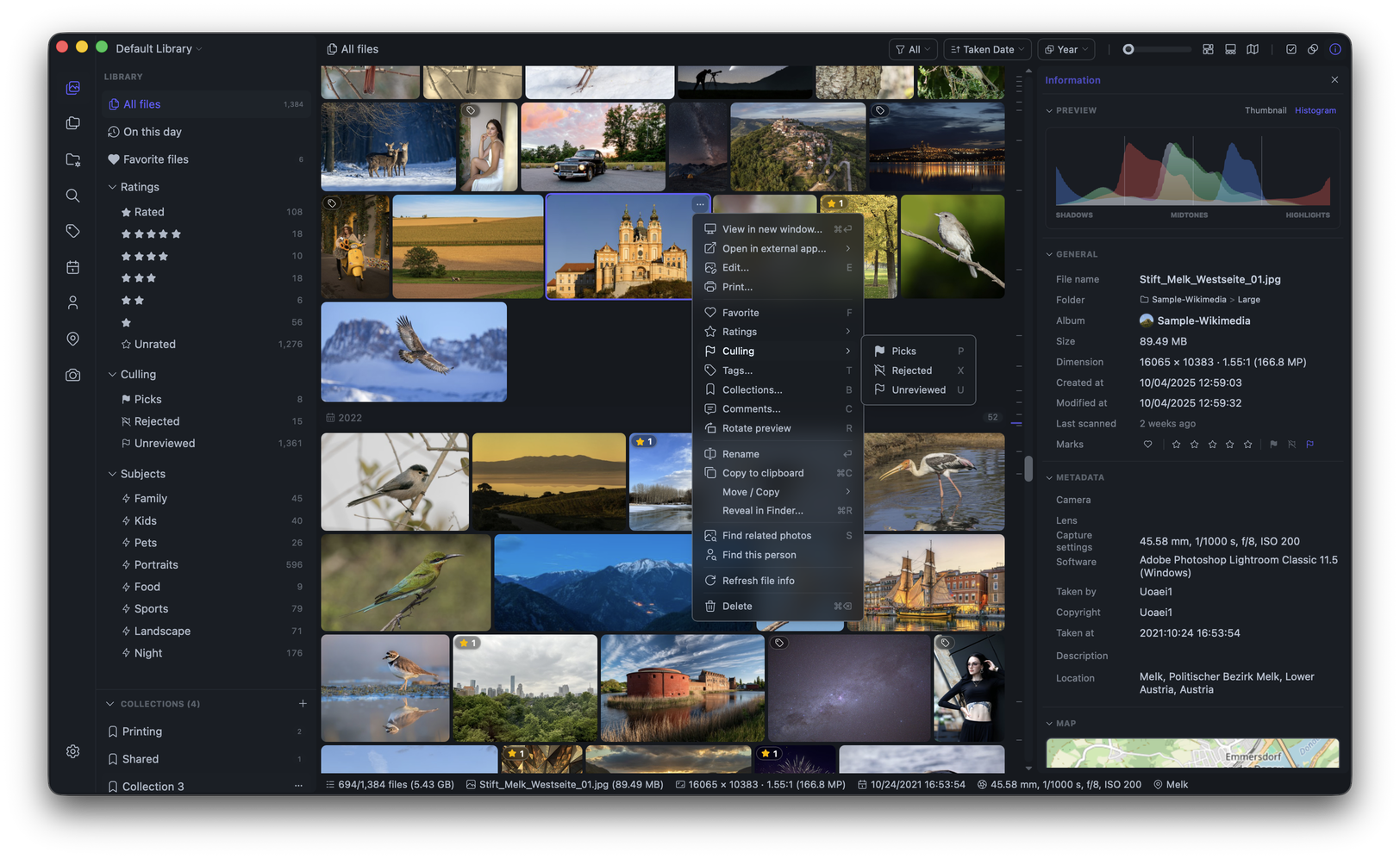
- Flexible library browsing by date, folder, location, camera, lens, tags, ratings, and faces, with random sorting and a small-image filter.
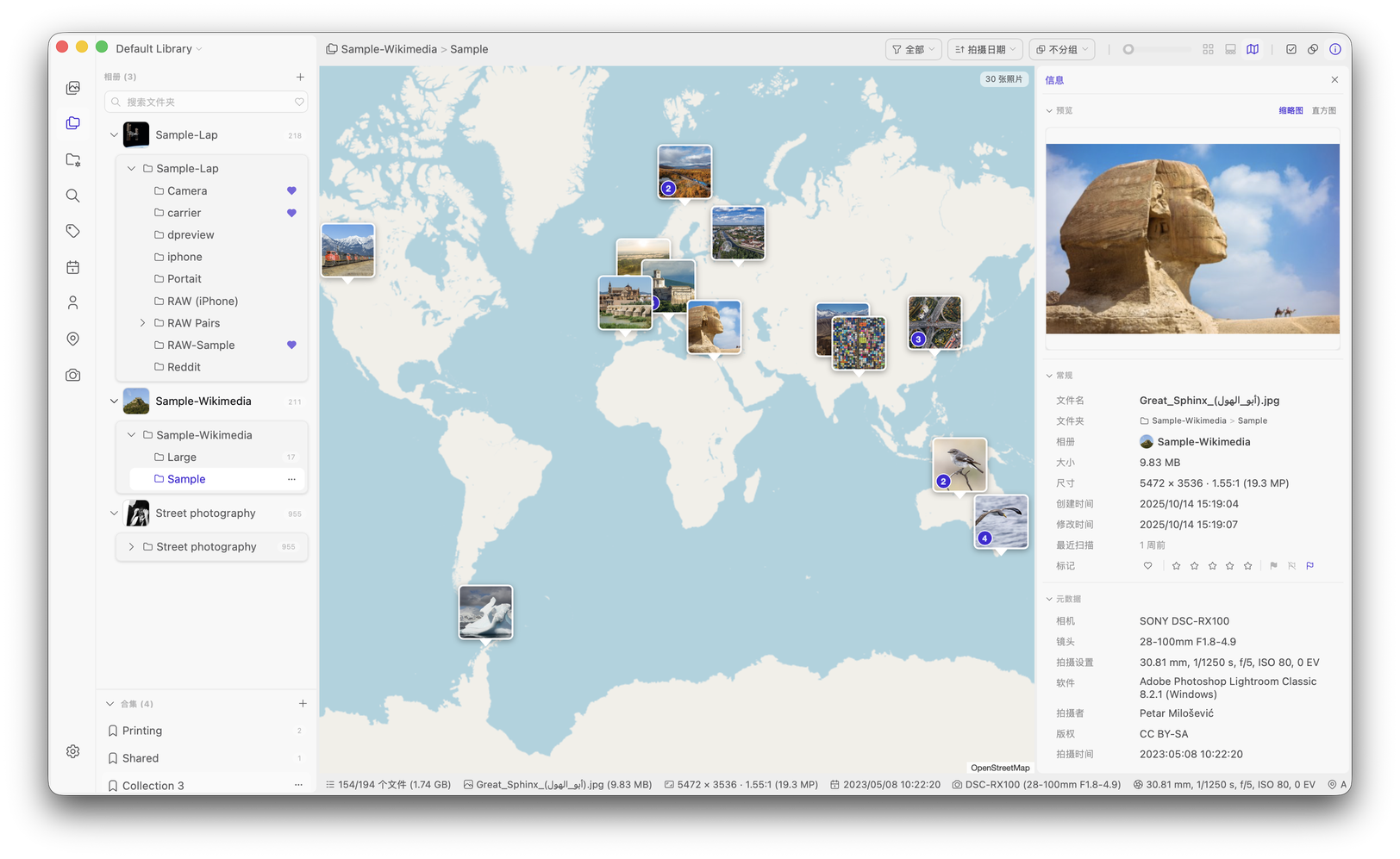
- Interactive Map View to explore geotagged photos and videos in clusters that follow your current filters.
- Smart Albums save rule-based views with custom grouping and sorting.
- Collections and tags to organize selected files in bulk without moving or duplicating the originals.
- Local AI search for text prompts, visual similarity, subjects, face clustering, and optional multilingual search in 50+ languages.
- Apple Live Photos and Google Motion Photos with motion playback and a unified Smart Album filter.
- RAW + JPEG/HEIC pairs displayed as one item, with linked files kept together during file operations.
- Configurable RAW thumbnails and previews using RAW rendering or the camera's embedded preview.
- Folder-first workflow with multiple libraries, drag-and-drop import, copy-paste import, filesystem sync, and safe move/copy/delete operations.
- Date-organized import with day, month, year, or single-folder layouts, original filenames, and duplicate skipping.
- Culling and comparison tools including a four-pane image comparison viewer.
- Duplicate cleanup with reclaimable-space summaries and bulk removal across duplicate sets.
- Customizable viewing with thumbnails up to 1024 px, adjustable grid sizes and corners, and Quick Preview or separate viewer windows.
- Desktop integration with multiple external apps and wallpaper selection on macOS, Windows, and GNOME Linux.
- Built-in editing for crop, rotate, flip, resize, and basic image adjustments.
- Broad format support for 60+ photo, RAW, and video formats.
Metadata, Collections, and Moving Files
Lap is folder-first, but not every piece of information shown in Lap is embedded in the original file. This distinction matters when you also manage the same folders in Finder, Explorer, or another photo app.
What stays with the file
- Your original photos and videos always remain ordinary files in their existing folders.
- File metadata already embedded in a file, such as EXIF capture date, camera, lens, GPS, and orientation, is read from that file when Lap indexes it.
- Saving a built-in image edit writes the resulting image to the selected destination.
- When you rename, move, copy, or delete files in Lap, Lap updates its local catalog at the same time. It also keeps supported grouped assets, such as Apple Live Photo components, AAE sidecars, and enabled RAW + JPEG/HEIC pairs, together.
What is stored locally by Lap
The following are Lap library data. They are stored in Lap's local database or library configuration, not written into EXIF, IPTC, or XMP sidecars:
- Collections, Tags, Comments, Favorites, Ratings, and Culling states (including Picks and Rejects)
- Smart Albums and their rules, grouping, sorting, and ordering
- AI search data, face data, thumbnails, and other index/cache data
This data does not travel with a file when it is copied, exported, or moved outside Lap, and it is not available automatically to other applications.
Working with files outside Lap
Lap can rescan folders and detect many filesystem changes. But changes made outside Lap—such as renaming, moving, replacing, or copying files—can disrupt organization that is stored only in Lap.
For the most reliable results, rename and move files in Lap whenever you rely on Collections, Tags, Comments, Favorites, Ratings, or culling states. If you also manage files outside Lap, back up Lap's database and configuration together with your photos. You can manage the database location and create a backup in Settings → Storage.
Deleting Lap's database or configuration removes this local organization and index data, but does not delete your original media files.
Uninstall Lap
Lap works directly with your existing photo folders. Uninstalling Lap, or deleting its database and cache files, does not delete your original photos.
The standard uninstall steps remove the application. To remove Lap completely, quit Lap first, uninstall the application, then delete its local database, thumbnail cache, and configuration files using the cleanup command for your platform.
macOS
If you installed Lap with Homebrew:
brew uninstall --cask lap
For a manual installation, quit Lap and move Lap.app from the Applications folder to the Trash.
To remove all Lap database, cache, and configuration files:
rm -rf "$HOME/Library/Application Support/com.julyx10.lap" \
       "$HOME/Library/Caches/com.julyx10.lap" \
       "$HOME/Library/WebKit/com.julyx10.lap"
rm -f "$HOME/Library/Preferences/com.julyx10.lap.plist"
Windows
Open Settings > Apps > Installed apps, find Lap, and select Uninstall.
Then open PowerShell and remove all Lap database, cache, and configuration files:
Remove-Item -Recurse -Force -ErrorAction SilentlyContinue "$env:LOCALAPPDATA\com.julyx10.lap"
Remove-Item -Recurse -Force -ErrorAction SilentlyContinue "$env:APPDATA\com.julyx10.lap"
Linux
For DEB installations, uninstall the package:
sudo apt remove lap
For AppImage installations, quit Lap and delete the downloaded .AppImage file.
Then remove all Lap database, cache, and configuration files:
rm -rf "$HOME/.local/share/com.julyx10.lap" \
       "$HOME/.cache/com.julyx10.lap" \
       "$HOME/.config/com.julyx10.lap"
If you selected a custom database storage directory in Lap settings, delete that directory separately after confirming that it contains only Lap database files.
Build from Source
Requirements: Node.js 20+, pnpm, Rust stable.
# macOS system deps
xcode-select --install
brew install nasm pkg-config autoconf automake libtool cmake

# Linux system deps
# sudo apt install libwebkit2gtk-4.1-dev libappindicator3-dev librsvg2-dev \
#   patchelf nasm clang pkg-config autoconf automake libtool cmake

# Clone and build
git clone --recursive https://github.com/julyx10/lap.git
cd lap
git submodule update --init --recursive
cargo install tauri-cli --version "^2.0.0" --locked
./scripts/download_models.sh            # Windows: .\scripts\download_models.ps1
./scripts/download_ffmpeg_sidecar.sh    # Windows: .\scripts\download_ffmpeg_sidecar.ps1
cd src-vite && pnpm install && cd ..
cargo tauri dev
Supported Formats
Lap supports 60+ photo, RAW, and video formats.
| Type | Formats |
|---|---|
| Images | JPG/JPEG/JFIF, PNG, GIF, BMP, TIFF, WebP, HEIC/HEIF/HIF, AVIF, JXL, PSD, EXR, HDR/RGBE, TGA, JPEG 2000 (JP2/J2K/J2C/JPC/JPF/JPX), DDS, DPX, QOI |
| RAW photos | CR2, CR3, CRW, NEF, NRW, ARW, SRF, SR2, RAF, RW2, ORF, PEF, DNG, SRW, RWL, MRW, 3FR, MOS, DCR, KDC, ERF, MEF, RAW, MDC |
| Videos | MP4, MOV, M4V, MKV, AVI, FLV, TS/M2TS, WMV, WebM, 3GP/3G2, F4V, VOB, MPG/MPEG, ASF, DIVX and more. H.264 playback is supported on all platforms, with automatic compatibility processing when native playback is unavailable. HEVC/H.265 and VP9 are natively supported on macOS. |
Linux Video Playback
Lap uses system GStreamer plugins for video playback, including in the AppImage. If videos fail to play on Ubuntu, Debian, or Linux Mint, install:
sudo apt install gstreamer1.0-libav gstreamer1.0-plugins-good
Architecture
- Core: Tauri + Rust
- Frontend: Vue + Vite + Tailwind CSS
- Data: SQLite
Key Libraries
| Library | Purpose |
|---|---|
| LibRaw | RAW image decoding and thumbnail extraction |
| libheif | HEIC/HEIF/HIF image decoding and preview generation |
| libjpeg-turbo | Fast JPEG decoding and thumbnail generation |
| FFmpeg | Video processing and thumbnail generation |
| Video.js | Cross-platform video playback UI |
| ONNX Runtime | Local AI model inference engine |
| CLIP | Image-text similarity search |
| InsightFace | Face detection and recognition |
| Leaflet | Interactive map for geotagged photos |
| daisyUI | UI component library |
License
GPL-3.0-or-later. See LICENSE.
Privacy
Read the Privacy Policy for details on data handling and optional online services.
Contributors



Similar repos


Languages
Vue
51.8%
Rust
39.4%
JavaScript
3.9%
TypeScript
3.4%
An offline-first photo manager for large local libraries
See the codeREADME
Lap - Private Local Photo Manager
Open-source desktop photo manager for macOS, Windows, and Linux.
English | Deutsch | Français | Español | Português | Русский | 简体中文 | 日本語 | 한국어
Lap is an open-source, local-first photo manager for browsing family albums, finding old photos quickly, and managing large personal media libraries offline. It is a privacy-focused alternative to cloud photo services: no forced upload, local AI search, folder-first workflow, and free to use.
Download Lap
Open the latest release page, then download the file that matches your system:
| Platform | Package | Note |
|---|---|---|
| macOS (Apple Silicon / Intel) | _aarch64.dmg / _x64.dmg | Notarized by Apple |
| Windows 10/11 (x64 / ARM64) | _x64_en-US.msi / _arm64_en-US.msi | Unsigned — if SmartScreen blocks the download, click Keep anyway |
| Linux (x64 / ARM64) | _amd64.deb / _arm64.deb | For Debian-based distros (Ubuntu, Debian, Linux Mint, etc.) |
| Linux (x64 / ARM64) | _amd64.AppImage / _aarch64.AppImage | Make the file executable, then double-click to run |
macOS with Homebrew
brew tap julyx10/lap
brew install --cask lap
Screenshots
Why Lap
- Local-first by design: your photos stay on your own disk, with no required cloud account or upload.
- No library lock-in: work directly with your existing folders instead of importing everything into a closed database.
- Private AI tools: search, similarity, smart tags, and face features run locally on your machine.
- Built for large collections: optimized for smooth browsing and organization across libraries with 100k+ files.
- Open source and free: no subscription, no forced ecosystem, and code you can inspect.
Features
- Flexible library browsing by date, folder, location, camera, lens, tags, ratings, and faces, with random sorting and a small-image filter.
- Interactive Map View to explore geotagged photos and videos in clusters that follow your current filters.
- Smart Albums save rule-based views with custom grouping and sorting.
- Collections and tags to organize selected files in bulk without moving or duplicating the originals.
- Local AI search for text prompts, visual similarity, subjects, face clustering, and optional multilingual search in 50+ languages.
- Apple Live Photos and Google Motion Photos with motion playback and a unified Smart Album filter.
- RAW + JPEG/HEIC pairs displayed as one item, with linked files kept together during file operations.
- Configurable RAW thumbnails and previews using RAW rendering or the camera's embedded preview.
- Folder-first workflow with multiple libraries, drag-and-drop import, copy-paste import, filesystem sync, and safe move/copy/delete operations.
- Date-organized import with day, month, year, or single-folder layouts, original filenames, and duplicate skipping.
- Culling and comparison tools including a four-pane image comparison viewer.
- Duplicate cleanup with reclaimable-space summaries and bulk removal across duplicate sets.
- Customizable viewing with thumbnails up to 1024 px, adjustable grid sizes and corners, and Quick Preview or separate viewer windows.
- Desktop integration with multiple external apps and wallpaper selection on macOS, Windows, and GNOME Linux.
- Built-in editing for crop, rotate, flip, resize, and basic image adjustments.
- Broad format support for 60+ photo, RAW, and video formats.
Metadata, Collections, and Moving Files
Lap is folder-first, but not every piece of information shown in Lap is embedded in the original file. This distinction matters when you also manage the same folders in Finder, Explorer, or another photo app.
What stays with the file
- Your original photos and videos always remain ordinary files in their existing folders.
- File metadata already embedded in a file, such as EXIF capture date, camera, lens, GPS, and orientation, is read from that file when Lap indexes it.
- Saving a built-in image edit writes the resulting image to the selected destination.
- When you rename, move, copy, or delete files in Lap, Lap updates its local catalog at the same time. It also keeps supported grouped assets, such as Apple Live Photo components, AAE sidecars, and enabled RAW + JPEG/HEIC pairs, together.
What is stored locally by Lap
The following are Lap library data. They are stored in Lap's local database or library configuration, not written into EXIF, IPTC, or XMP sidecars:
- Collections, Tags, Comments, Favorites, Ratings, and Culling states (including Picks and Rejects)
- Smart Albums and their rules, grouping, sorting, and ordering
- AI search data, face data, thumbnails, and other index/cache data
This data does not travel with a file when it is copied, exported, or moved outside Lap, and it is not available automatically to other applications.
Working with files outside Lap
Lap can rescan folders and detect many filesystem changes. But changes made outside Lap—such as renaming, moving, replacing, or copying files—can disrupt organization that is stored only in Lap.
For the most reliable results, rename and move files in Lap whenever you rely on Collections, Tags, Comments, Favorites, Ratings, or culling states. If you also manage files outside Lap, back up Lap's database and configuration together with your photos. You can manage the database location and create a backup in Settings → Storage.
Deleting Lap's database or configuration removes this local organization and index data, but does not delete your original media files.
Uninstall Lap
Lap works directly with your existing photo folders. Uninstalling Lap, or deleting its database and cache files, does not delete your original photos.
The standard uninstall steps remove the application. To remove Lap completely, quit Lap first, uninstall the application, then delete its local database, thumbnail cache, and configuration files using the cleanup command for your platform.
macOS
If you installed Lap with Homebrew:
brew uninstall --cask lap
For a manual installation, quit Lap and move Lap.app from the Applications folder to the Trash.
To remove all Lap database, cache, and configuration files:
rm -rf "$HOME/Library/Application Support/com.julyx10.lap" \
       "$HOME/Library/Caches/com.julyx10.lap" \
       "$HOME/Library/WebKit/com.julyx10.lap"
rm -f "$HOME/Library/Preferences/com.julyx10.lap.plist"
Windows
Open Settings > Apps > Installed apps, find Lap, and select Uninstall.
Then open PowerShell and remove all Lap database, cache, and configuration files:
Remove-Item -Recurse -Force -ErrorAction SilentlyContinue "$env:LOCALAPPDATA\com.julyx10.lap"
Remove-Item -Recurse -Force -ErrorAction SilentlyContinue "$env:APPDATA\com.julyx10.lap"
Linux
For DEB installations, uninstall the package:
sudo apt remove lap
For AppImage installations, quit Lap and delete the downloaded .AppImage file.
Then remove all Lap database, cache, and configuration files:
rm -rf "$HOME/.local/share/com.julyx10.lap" \
       "$HOME/.cache/com.julyx10.lap" \
       "$HOME/.config/com.julyx10.lap"
If you selected a custom database storage directory in Lap settings, delete that directory separately after confirming that it contains only Lap database files.
Build from Source
Requirements: Node.js 20+, pnpm, Rust stable.
# macOS system deps
xcode-select --install
brew install nasm pkg-config autoconf automake libtool cmake

# Linux system deps
# sudo apt install libwebkit2gtk-4.1-dev libappindicator3-dev librsvg2-dev \
#   patchelf nasm clang pkg-config autoconf automake libtool cmake

# Clone and build
git clone --recursive https://github.com/julyx10/lap.git
cd lap
git submodule update --init --recursive
cargo install tauri-cli --version "^2.0.0" --locked
./scripts/download_models.sh            # Windows: .\scripts\download_models.ps1
./scripts/download_ffmpeg_sidecar.sh    # Windows: .\scripts\download_ffmpeg_sidecar.ps1
cd src-vite && pnpm install && cd ..
cargo tauri dev
Supported Formats
Lap supports 60+ photo, RAW, and video formats.
| Type | Formats |
|---|---|
| Images | JPG/JPEG/JFIF, PNG, GIF, BMP, TIFF, WebP, HEIC/HEIF/HIF, AVIF, JXL, PSD, EXR, HDR/RGBE, TGA, JPEG 2000 (JP2/J2K/J2C/JPC/JPF/JPX), DDS, DPX, QOI |
| RAW photos | CR2, CR3, CRW, NEF, NRW, ARW, SRF, SR2, RAF, RW2, ORF, PEF, DNG, SRW, RWL, MRW, 3FR, MOS, DCR, KDC, ERF, MEF, RAW, MDC |
| Videos | MP4, MOV, M4V, MKV, AVI, FLV, TS/M2TS, WMV, WebM, 3GP/3G2, F4V, VOB, MPG/MPEG, ASF, DIVX and more. H.264 playback is supported on all platforms, with automatic compatibility processing when native playback is unavailable. HEVC/H.265 and VP9 are natively supported on macOS. |
Linux Video Playback
Lap uses system GStreamer plugins for video playback, including in the AppImage. If videos fail to play on Ubuntu, Debian, or Linux Mint, install:
sudo apt install gstreamer1.0-libav gstreamer1.0-plugins-good
Architecture
- Core: Tauri + Rust
- Frontend: Vue + Vite + Tailwind CSS
- Data: SQLite
Key Libraries
| Library | Purpose |
|---|---|
| LibRaw | RAW image decoding and thumbnail extraction |
| libheif | HEIC/HEIF/HIF image decoding and preview generation |
| libjpeg-turbo | Fast JPEG decoding and thumbnail generation |
| FFmpeg | Video processing and thumbnail generation |
| Video.js | Cross-platform video playback UI |
| ONNX Runtime | Local AI model inference engine |
| CLIP | Image-text similarity search |
| InsightFace | Face detection and recognition |
| Leaflet | Interactive map for geotagged photos |
| daisyUI | UI component library |
License
GPL-3.0-or-later. See LICENSE.
Privacy
Read the Privacy Policy for details on data handling and optional online services.
Similar repos
Contributors
Languages
Vue
51.8%
Rust
39.4%
JavaScript
3.9%
TypeScript
3.4%