Steering discrete diffusion models with labeled data for protein fitness optimization
Jupyter Notebook
31
68 commits
updated Nov 1, 2025
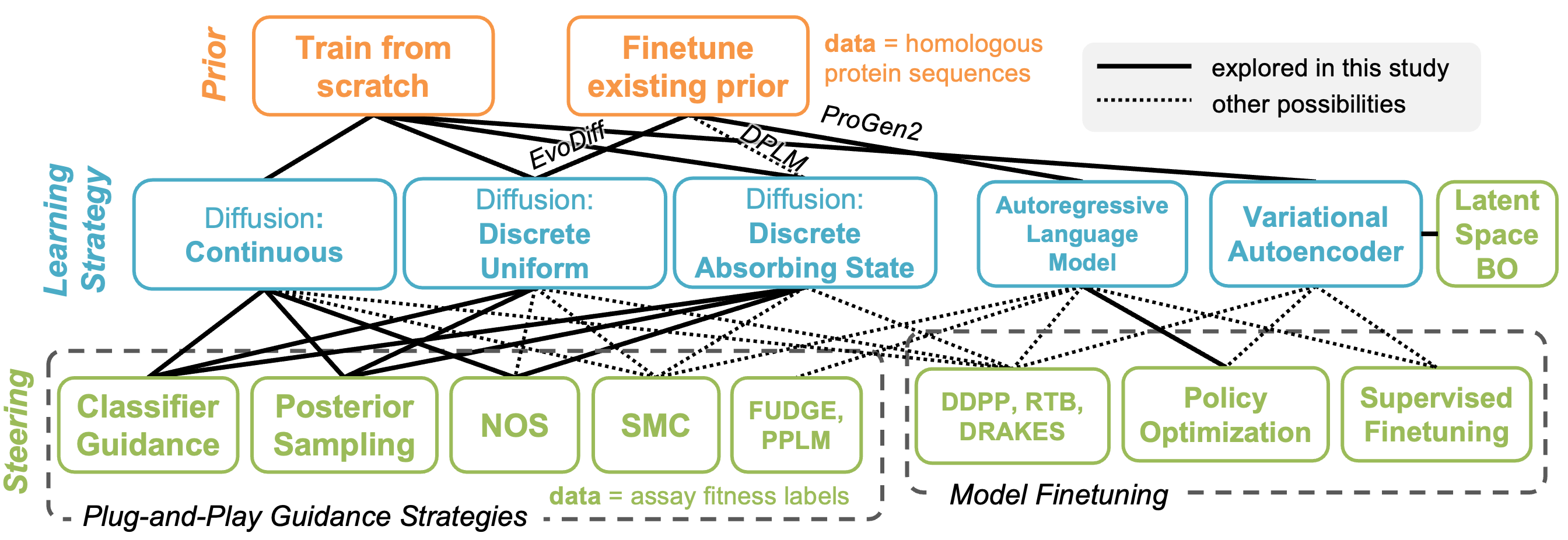 Repository for protein fitness optimization by guiding the generations from discrete diffusion models using various pretrained priors and guidance strategies, or finetuning autoregressive language models. Accompanies the paper "Steering Generative Models with Experimental Data for Protein Fitness Optimization."
conda env create -f environment.yaml #transformers version 4.48.1 recommended
conda activate SGPO
pip install evodiff
pip install flash-attn
Processed MSA sequences (for training the prior) and fitness data (for guidance) for TrpB and CreiLOV are preloaded in this repo under data. Raw data, pretrained model checkpoints, and experimental outputs can be downloaded from huggingface.
APEXGo/: code for reproducing the APEXGo baseline for latent space BO, based on the original repository.configs/: hydra config files for running experimentsdata/: processed data files and code for data processingdataset/: dataset objects for training value functions used in guidanceexps/: outputs from experiments, mainly generated sequences and associated fitness valuesmodels/: diffusion models, denoising model architectures are provided in models/pretraining/model/oracle/: oracle checkpoints for evaluating "ground truth" fitness and code for training and running the oraclesampling/: code for inference-time sampling using various guidance algorithmsscripts/: shell scripts for running many experiments at oncetraining/: code for training the value functions used in guidancePretrained models are available on huggingface and can be copied over into checkpoints. Alternatively, commands used to run pretraining are provided in scripts/run_pretraining.sh. Pretraining should take less than 1 hour for each diffusion model and several hours for each language model on a single H100.
Example command:
python pretrain.py pretrain_model={pretrain_model} data={data}
continuous, continuous_ESM, d3pm, d3pm_finetune, udlm, mdlm, causalLM_finetuneTrpB, CreiLOV, GB1Commands to sample unconditionally from a pretrained prior without guidance are provided in scripts/run_prior_sample.sh. These samples are only mutated at the positions under study in the case of TrpB. Each command should take minutes on a single H100.
Example command:
python prior_sample.py pretrained_ckpt={pretrain_model}/{data} data={data} model={model}
TrpB, CreiLOV, GB1Supported prior models:
| Model | pretrain_model (checkpoint name) | model (prior model type) |
|---|---|---|
| Continuous | continuous | continuous |
| Continuous over ESM embeddings | continuous_ESM | continuous |
| Discrete D3PM | d3pm | d3pm |
| Discrete D3PM (finetuned from EvoDiff) | d3pm_finetune | d3pm |
| Discrete UDLM | udlm | udlm |
| Discrete MDLM | mdlm | mdlm |
| Autoregressive Language Model (finetuned from ProGen2-Small) | causalLM_finetune | causalLM |
Output will be saved under exps:
generated.fasta with generated sequences.summary.csv samples generated over multiple rounds and repeats, with associated fitness values. Serves as a baseline.Alternatively, sampling raw sequences with no post processing can be accomplished with example commands found in scripts/run_uncond_sample.sh.
python perplexity_calculation.py
Calculates the perplexities of unconditionally generated sequences using ProGen2-base. Output will be saved to exps/protein/{data}/perplexity/perplexity.csv.
Supported combinations of model and guidance strategy:
| Model | Guidance | model (prior model type) | problem (specifies how value function is trained) | algorithm (specifies sampling strategy) |
|---|---|---|---|---|
| Continuous | Classifier Guidance | continuous | protein_classifier_continuous | cls_guidance_continuous |
| Continuous | DAPS | continuous | protein_classifier_continuous | daps_continuous |
| Continuous | NOS | continuous | protein_NOS_continuous | NOS_continuous |
| D3PM | Classifier Guidance | d3pm | protein_classifier_discrete | cls_guidance_discrete |
| D3PM | DAPS | d3pm | protein_classifier_discrete | daps_discrete |
| MDLM | Classifier Guidance | mdlm | protein_classifier_discrete | cls_guidance_discrete |
| MDLM | DAPS | mdlm | protein_classifier_discrete | daps_discrete |
| MDLM | NOS | mldm | protein_NOS_discrete | NOS_discrete |
| Language Model | DPO | causalLM | protein_DPO | DPO |
Samples from guided generation, over multiple guidance strengths and multiple repeats, showing the tradeoff between having high diversity and high fitness. Example commands are given in scripts/run_pareto.sh. Each command should take less than one hour on a single H100.
Template command:
python pareto.py pretrained_ckpt={pretrain_model}/{data} data={data} model={model} problem={problem} algorithm={algorithm}
Output will be saved under exps:
summary.csv with generated sequences and associated fitness values.Note: for NOS runs, if you would like to do a more extensive hyperparameter search, please use pareto_NOS_hyperparameter.py instead.
Using a fixed guidance strength, simulates batch "Bayesian optimization" over multiple rounds of guidance. An ensemble of value functions models is trained between each round, and "Thompson sampling" is used to select a value function for guiding generated samples. Commands are given in scripts/run_iterative.sh. Each command should take less than one hour on a single H100.
Template command:
python iterativeBO.py pretrained_ckpt={pretrain_model}/{data} data={data} model={model} problem={problem} algorithm={algorithm}
Output will be saved under exps:
summary.csv with generated sequences and associated fitness values.exps/.../modelsThe processed data and oracle models needed to run downstream experiments are preloaded to this repository, but processing from raw data can be reproduced following the instructions below.
Jackhmmer was used to search for homologous proteins and generate a multiple sequence alignment (MSA). The steps to perform the Jackhmmer search and process the outputs is provided in data/hmmer_processing.ipynb. The inputs to this model are (1) a parent sequence as a target and (2) all sequences in Uniref90 (December 2024). Jackhmmer outputs have been uploaded to huggingface.
Raw fitness data were downloaded from the CreiLOV, TrpB, and GB1 datasets, respectively, and have been uploaded to huggingface. These data were normalized and processed using the steps provided in data/process_fitness.ipynb.
Pretrained oracles are uploaded to oracle/checkpoints. Alternatively, oracle training can be reproduced with the command
python oracle/train_oracle.py
Visualizations for evaluating the oracle: oracle_analysis.ipynb
Outputs from the experiments demonstrated in our paper can be downloaded from huggingface to replace the exps directory. Visualizations are provided in analysis.ipynb.
Generates random samples for downstream analysis.
python baseline_sample.py
Steering discrete diffusion models with labeled data for protein fitness optimization
Jupyter Notebook
31
68 commits
updated Nov 1, 2025
Repository for protein fitness optimization by guiding the generations from discrete diffusion models using various pretrained priors and guidance strategies, or finetuning autoregressive language models. Accompanies the paper "Steering Generative Models with Experimental Data for Protein Fitness Optimization."
conda env create -f environment.yaml #transformers version 4.48.1 recommended
conda activate SGPO
pip install evodiff
pip install flash-attn
Processed MSA sequences (for training the prior) and fitness data (for guidance) for TrpB and CreiLOV are preloaded in this repo under data. Raw data, pretrained model checkpoints, and experimental outputs can be downloaded from huggingface.
APEXGo/: code for reproducing the APEXGo baseline for latent space BO, based on the original repository.configs/: hydra config files for running experimentsdata/: processed data files and code for data processingdataset/: dataset objects for training value functions used in guidanceexps/: outputs from experiments, mainly generated sequences and associated fitness valuesmodels/: diffusion models, denoising model architectures are provided in models/pretraining/model/oracle/: oracle checkpoints for evaluating "ground truth" fitness and code for training and running the oraclesampling/: code for inference-time sampling using various guidance algorithmsscripts/: shell scripts for running many experiments at oncetraining/: code for training the value functions used in guidancePretrained models are available on huggingface and can be copied over into checkpoints. Alternatively, commands used to run pretraining are provided in scripts/run_pretraining.sh. Pretraining should take less than 1 hour for each diffusion model and several hours for each language model on a single H100.
Example command:
python pretrain.py pretrain_model={pretrain_model} data={data}
continuous, continuous_ESM, d3pm, d3pm_finetune, udlm, mdlm, causalLM_finetuneTrpB, CreiLOV, GB1Commands to sample unconditionally from a pretrained prior without guidance are provided in scripts/run_prior_sample.sh. These samples are only mutated at the positions under study in the case of TrpB. Each command should take minutes on a single H100.
Example command:
python prior_sample.py pretrained_ckpt={pretrain_model}/{data} data={data} model={model}
TrpB, CreiLOV, GB1Supported prior models:
| Model | pretrain_model (checkpoint name) | model (prior model type) |
|---|---|---|
| Continuous | continuous | continuous |
| Continuous over ESM embeddings | continuous_ESM | continuous |
| Discrete D3PM | d3pm | d3pm |
| Discrete D3PM (finetuned from EvoDiff) | d3pm_finetune | d3pm |
| Discrete UDLM | udlm | udlm |
| Discrete MDLM | mdlm | mdlm |
| Autoregressive Language Model (finetuned from ProGen2-Small) | causalLM_finetune | causalLM |
Output will be saved under exps:
generated.fasta with generated sequences.summary.csv samples generated over multiple rounds and repeats, with associated fitness values. Serves as a baseline.Alternatively, sampling raw sequences with no post processing can be accomplished with example commands found in scripts/run_uncond_sample.sh.
python perplexity_calculation.py
Calculates the perplexities of unconditionally generated sequences using ProGen2-base. Output will be saved to exps/protein/{data}/perplexity/perplexity.csv.
Supported combinations of model and guidance strategy:
| Model | Guidance | model (prior model type) | problem (specifies how value function is trained) | algorithm (specifies sampling strategy) |
|---|---|---|---|---|
| Continuous | Classifier Guidance | continuous | protein_classifier_continuous | cls_guidance_continuous |
| Continuous | DAPS | continuous | protein_classifier_continuous | daps_continuous |
| Continuous | NOS | continuous | protein_NOS_continuous | NOS_continuous |
| D3PM | Classifier Guidance | d3pm | protein_classifier_discrete | cls_guidance_discrete |
| D3PM | DAPS | d3pm | protein_classifier_discrete | daps_discrete |
| MDLM | Classifier Guidance | mdlm | protein_classifier_discrete | cls_guidance_discrete |
| MDLM | DAPS | mdlm | protein_classifier_discrete | daps_discrete |
| MDLM | NOS | mldm | protein_NOS_discrete | NOS_discrete |
| Language Model | DPO | causalLM | protein_DPO | DPO |
Samples from guided generation, over multiple guidance strengths and multiple repeats, showing the tradeoff between having high diversity and high fitness. Example commands are given in scripts/run_pareto.sh. Each command should take less than one hour on a single H100.
Template command:
python pareto.py pretrained_ckpt={pretrain_model}/{data} data={data} model={model} problem={problem} algorithm={algorithm}
Output will be saved under exps:
summary.csv with generated sequences and associated fitness values.Note: for NOS runs, if you would like to do a more extensive hyperparameter search, please use pareto_NOS_hyperparameter.py instead.
Using a fixed guidance strength, simulates batch "Bayesian optimization" over multiple rounds of guidance. An ensemble of value functions models is trained between each round, and "Thompson sampling" is used to select a value function for guiding generated samples. Commands are given in scripts/run_iterative.sh. Each command should take less than one hour on a single H100.
Template command:
python iterativeBO.py pretrained_ckpt={pretrain_model}/{data} data={data} model={model} problem={problem} algorithm={algorithm}
Output will be saved under exps:
summary.csv with generated sequences and associated fitness values.exps/.../modelsThe processed data and oracle models needed to run downstream experiments are preloaded to this repository, but processing from raw data can be reproduced following the instructions below.
Jackhmmer was used to search for homologous proteins and generate a multiple sequence alignment (MSA). The steps to perform the Jackhmmer search and process the outputs is provided in data/hmmer_processing.ipynb. The inputs to this model are (1) a parent sequence as a target and (2) all sequences in Uniref90 (December 2024). Jackhmmer outputs have been uploaded to huggingface.
Raw fitness data were downloaded from the CreiLOV, TrpB, and GB1 datasets, respectively, and have been uploaded to huggingface. These data were normalized and processed using the steps provided in data/process_fitness.ipynb.
Pretrained oracles are uploaded to oracle/checkpoints. Alternatively, oracle training can be reproduced with the command
python oracle/train_oracle.py
Visualizations for evaluating the oracle: oracle_analysis.ipynb
Outputs from the experiments demonstrated in our paper can be downloaded from huggingface to replace the exps directory. Visualizations are provided in analysis.ipynb.
Generates random samples for downstream analysis.
python baseline_sample.py



