
[ICLR 2025] SOTA discrete acoustic codec models with 40/75 tokens per second for audio language modeling
Python
1,321
32 commits
updated Mar 2, 2025
README
WavTokenizer
SOTA Discrete Codec Models With Forty Tokens Per Second for Audio Language Modeling



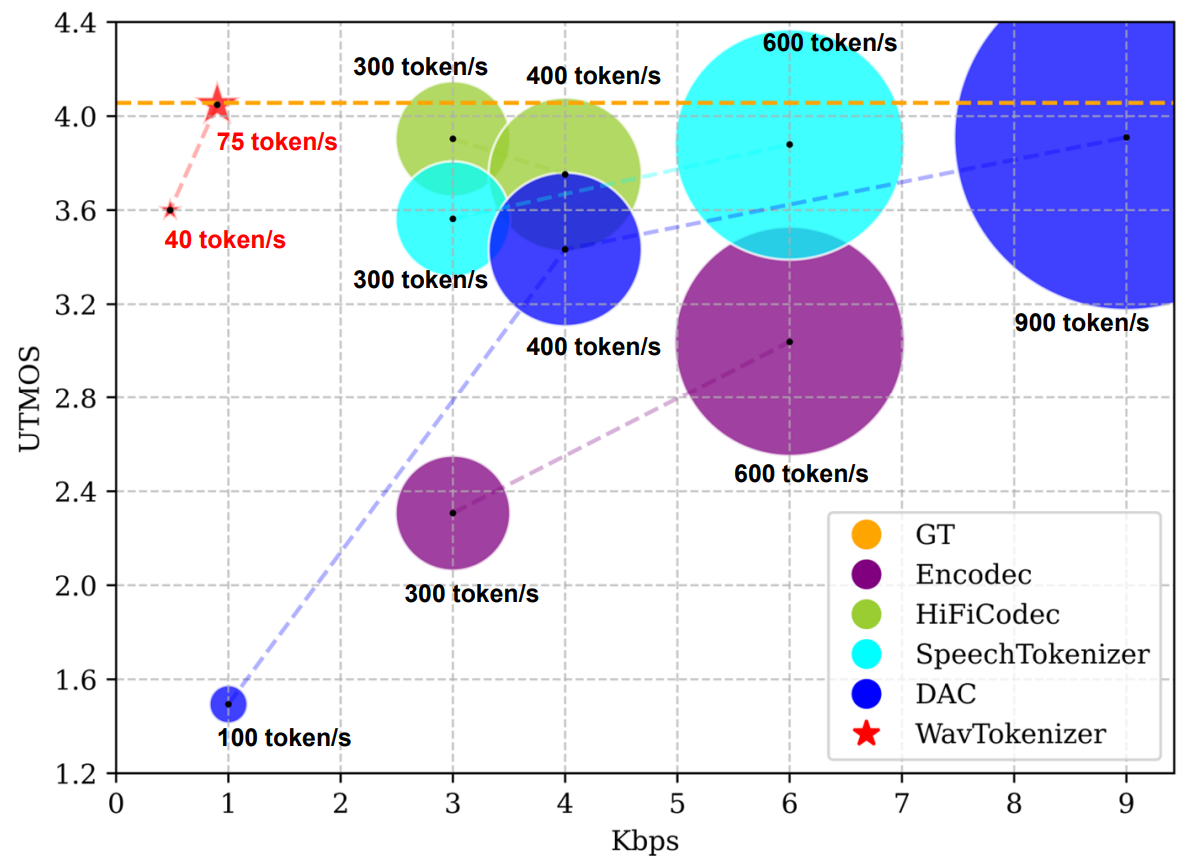
🎉🎉 with WavTokenizer, you can represent speech, music, and audio with only 40 tokens per second!
🎉🎉 with WavTokenizer, You can get strong reconstruction results.
🎉🎉 WavTokenizer owns rich semantic information and is build for audio language models such as GPT-4o.
🔥 News
- 2025.02.25: We update WavTokenizer camera ready version for ICLR 2025 and update WavTokenizer-large-v2 checkpoint on huggingface.
- 2024.10.22: We update WavTokenizer on arxiv and release WavTokenizer-Large checkpoint.
- 2024.09.09: We release WavTokenizer-medium checkpoint on huggingface.
- 2024.08.31: We release WavTokenizer on arxiv.
Installation
To use WavTokenizer, install it using:
conda create -n wavtokenizer python=3.9
conda activate wavtokenizer
pip install -r requirements.txt
Infer
Part1: Reconstruct audio from raw wav
from encoder.utils import convert_audio
import torchaudio
import torch
from decoder.pretrained import WavTokenizer


device=torch.device('cpu')

config_path = "./configs/xxx.yaml"
model_path = "./xxx.ckpt"
audio_outpath = "xxx"

wavtokenizer = WavTokenizer.from_pretrained0802(config_path, model_path)
wavtokenizer = wavtokenizer.to(device)


wav, sr = torchaudio.load(audio_path)
wav = convert_audio(wav, sr, 24000, 1)
bandwidth_id = torch.tensor([0])
wav=wav.to(device)
features,discrete_code= wavtokenizer.encode_infer(wav, bandwidth_id=bandwidth_id)
audio_out = wavtokenizer.decode(features, bandwidth_id=bandwidth_id)
torchaudio.save(audio_outpath, audio_out, sample_rate=24000, encoding='PCM_S', bits_per_sample=16)
Part2: Generating discrete codecs
from encoder.utils import convert_audio
import torchaudio
import torch
from decoder.pretrained import WavTokenizer

device=torch.device('cpu')

config_path = "./configs/xxx.yaml"
model_path = "./xxx.ckpt"

wavtokenizer = WavTokenizer.from_pretrained0802(config_path, model_path)
wavtokenizer = wavtokenizer.to(device)

wav, sr = torchaudio.load(audio_path)
wav = convert_audio(wav, sr, 24000, 1)
bandwidth_id = torch.tensor([0])
wav=wav.to(device)
_,discrete_code= wavtokenizer.encode_infer(wav, bandwidth_id=bandwidth_id)
print(discrete_code)
Part3: Audio reconstruction through codecs
# audio_tokens [n_q,1,t]/[n_q,t]
features = wavtokenizer.codes_to_features(audio_tokens)
bandwidth_id = torch.tensor([0])
audio_out = wavtokenizer.decode(features, bandwidth_id=bandwidth_id)
Available models
🤗 links to the Huggingface model hub.
| Model name | HuggingFace | Corpus | Token/s | Domain | Open-Source |
|---|---|---|---|---|---|
| WavTokenizer-small-600-24k-4096 | 🤗 | LibriTTS | 40 | Speech | √ |
| WavTokenizer-small-320-24k-4096 | 🤗 | LibriTTS | 75 | Speech | √ |
| WavTokenizer-medium-320-24k-4096 | 🤗 | 10000 Hours | 75 | Speech, Audio, Music | √ |
| WavTokenizer-large-600-24k-4096 | 🤗 | 80000 Hours | 40 | Speech, Audio, Music | √ |
| WavTokenizer-large-320-24k-4096 | 🤗 | 80000 Hours | 75 | Speech, Audio, Music | √ |
Training
Step1: Prepare train dataset
# Process the data into a form similar to ./data/demo.txt
Step2: Modifying configuration files
# ./configs/xxx.yaml
# Modify the values of parameters such as batch_size, filelist_path, save_dir, device
Step3: Start training process
Refer to Pytorch Lightning documentation for details about customizing the training pipeline.
cd ./WavTokenizer
python train.py fit --config ./configs/xxx.yaml
Citation
If this code contributes to your research, please cite our work, Language-Codec and WavTokenizer:
@article{ji2024wavtokenizer,
  title={Wavtokenizer: an efficient acoustic discrete codec tokenizer for audio language modeling},
  author={Ji, Shengpeng and Jiang, Ziyue and Wang, Wen and Chen, Yifu and Fang, Minghui and Zuo, Jialong and Yang, Qian and Cheng, Xize and Wang, Zehan and Li, Ruiqi and others},
  journal={arXiv preprint arXiv:2408.16532},
  year={2024}
}

@article{ji2024language,
  title={Language-codec: Reducing the gaps between discrete codec representation and speech language models},
  author={Ji, Shengpeng and Fang, Minghui and Jiang, Ziyue and Huang, Rongjie and Zuo, Jialung and Wang, Shulei and Zhao, Zhou},
  journal={arXiv preprint arXiv:2402.12208},
  year={2024}
}
Contributors

32 commits
Similar repos



Languages
Python
100.0%
[ICLR 2025] SOTA discrete acoustic codec models with 40/75 tokens per second for audio language modeling
Python
1,321
32 commits
updated Mar 2, 2025
README
WavTokenizer
SOTA Discrete Codec Models With Forty Tokens Per Second for Audio Language Modeling
🎉🎉 with WavTokenizer, you can represent speech, music, and audio with only 40 tokens per second!
🎉🎉 with WavTokenizer, You can get strong reconstruction results.
🎉🎉 WavTokenizer owns rich semantic information and is build for audio language models such as GPT-4o.
🔥 News
- 2025.02.25: We update WavTokenizer camera ready version for ICLR 2025 and update WavTokenizer-large-v2 checkpoint on huggingface.
- 2024.10.22: We update WavTokenizer on arxiv and release WavTokenizer-Large checkpoint.
- 2024.09.09: We release WavTokenizer-medium checkpoint on huggingface.
- 2024.08.31: We release WavTokenizer on arxiv.
Installation
To use WavTokenizer, install it using:
conda create -n wavtokenizer python=3.9
conda activate wavtokenizer
pip install -r requirements.txt
Infer
Part1: Reconstruct audio from raw wav
from encoder.utils import convert_audio
import torchaudio
import torch
from decoder.pretrained import WavTokenizer


device=torch.device('cpu')

config_path = "./configs/xxx.yaml"
model_path = "./xxx.ckpt"
audio_outpath = "xxx"

wavtokenizer = WavTokenizer.from_pretrained0802(config_path, model_path)
wavtokenizer = wavtokenizer.to(device)


wav, sr = torchaudio.load(audio_path)
wav = convert_audio(wav, sr, 24000, 1)
bandwidth_id = torch.tensor([0])
wav=wav.to(device)
features,discrete_code= wavtokenizer.encode_infer(wav, bandwidth_id=bandwidth_id)
audio_out = wavtokenizer.decode(features, bandwidth_id=bandwidth_id)
torchaudio.save(audio_outpath, audio_out, sample_rate=24000, encoding='PCM_S', bits_per_sample=16)
Part2: Generating discrete codecs
from encoder.utils import convert_audio
import torchaudio
import torch
from decoder.pretrained import WavTokenizer

device=torch.device('cpu')

config_path = "./configs/xxx.yaml"
model_path = "./xxx.ckpt"

wavtokenizer = WavTokenizer.from_pretrained0802(config_path, model_path)
wavtokenizer = wavtokenizer.to(device)

wav, sr = torchaudio.load(audio_path)
wav = convert_audio(wav, sr, 24000, 1)
bandwidth_id = torch.tensor([0])
wav=wav.to(device)
_,discrete_code= wavtokenizer.encode_infer(wav, bandwidth_id=bandwidth_id)
print(discrete_code)
Part3: Audio reconstruction through codecs
# audio_tokens [n_q,1,t]/[n_q,t]
features = wavtokenizer.codes_to_features(audio_tokens)
bandwidth_id = torch.tensor([0])
audio_out = wavtokenizer.decode(features, bandwidth_id=bandwidth_id)
Available models
🤗 links to the Huggingface model hub.
| Model name | HuggingFace | Corpus | Token/s | Domain | Open-Source |
|---|---|---|---|---|---|
| WavTokenizer-small-600-24k-4096 | 🤗 | LibriTTS | 40 | Speech | √ |
| WavTokenizer-small-320-24k-4096 | 🤗 | LibriTTS | 75 | Speech | √ |
| WavTokenizer-medium-320-24k-4096 | 🤗 | 10000 Hours | 75 | Speech, Audio, Music | √ |
| WavTokenizer-large-600-24k-4096 | 🤗 | 80000 Hours | 40 | Speech, Audio, Music | √ |
| WavTokenizer-large-320-24k-4096 | 🤗 | 80000 Hours | 75 | Speech, Audio, Music | √ |
Training
Step1: Prepare train dataset
# Process the data into a form similar to ./data/demo.txt
Step2: Modifying configuration files
# ./configs/xxx.yaml
# Modify the values of parameters such as batch_size, filelist_path, save_dir, device
Step3: Start training process
Refer to Pytorch Lightning documentation for details about customizing the training pipeline.
cd ./WavTokenizer
python train.py fit --config ./configs/xxx.yaml
Citation
If this code contributes to your research, please cite our work, Language-Codec and WavTokenizer:
@article{ji2024wavtokenizer,
  title={Wavtokenizer: an efficient acoustic discrete codec tokenizer for audio language modeling},
  author={Ji, Shengpeng and Jiang, Ziyue and Wang, Wen and Chen, Yifu and Fang, Minghui and Zuo, Jialong and Yang, Qian and Cheng, Xize and Wang, Zehan and Li, Ruiqi and others},
  journal={arXiv preprint arXiv:2408.16532},
  year={2024}
}

@article{ji2024language,
  title={Language-codec: Reducing the gaps between discrete codec representation and speech language models},
  author={Ji, Shengpeng and Fang, Minghui and Jiang, Ziyue and Huang, Rongjie and Zuo, Jialung and Wang, Shulei and Zhao, Zhou},
  journal={arXiv preprint arXiv:2402.12208},
  year={2024}
}
Similar repos
Contributors
32 commits
Languages
Python
100.0%