See the model. Stress the assumptions. Understand the behavior.
NOTEBOOKS → VISUAL EXPERIMENTS → PROJECTS → QUESTIONS




This repository is Ming Jin's workshop floor for ECE 4424 / CS 4824: Machine Learning. The notebooks favor experiments, visual explanations, and real systems over long stretches of passive theory. Curiosity is required; advanced mathematics is not.
[!TIP] Looking for the polished course experience? Visit the course site. Looking to tinker? Pick a notebook below and make something behave strangely.
| Arc | # | Topic | Notebook | Companion material |
|---|---|---|---|---|
| Let's predict | 00 | Environment setup | open | setup guide |
| 01 | What is machine learning? | open | course page · notes | |
| 02 | k-Nearest Neighbors | open | course page · notes | |
| 03 | Linear Regression | open | course page · environment | |
| 04 | Gradient Descent & Optimization | open | course page · teaching notes | |
| 05 | Probabilistic Classification | open | course page | |
| Let's understand | 06 | Evaluation Pitfalls & Data Visualization | open | course page |
| 07 | Regularization & Generalization | open | course page · environment | |
| 08 | Modern Decision Trees | open | course page | |
| 09 | Ensemble Methods | open | course page | |
| 10 | Kernel Methods & Gaussian Processes | open | course page | |
| Let's discover | 11 | K-Means Clustering | open | course page |
| 12 | PCA & Dimensionality Reduction | open | course page · quickstart | |
| 13 | Neural Network Architecture | open | course page | |
| 14 | Understanding Transformers | open | course page | |
| Let's see & chat | 15 | Convolutional Neural Networks | open | course page |
| 16 | Recurrent Neural Networks | open | course page | |
| 17 | LLM Agents & Tool Use | open | course page | |
| 18 | Vision-Language Models | open | course page |
Three projects, three ways to make a model reveal what it is doing.
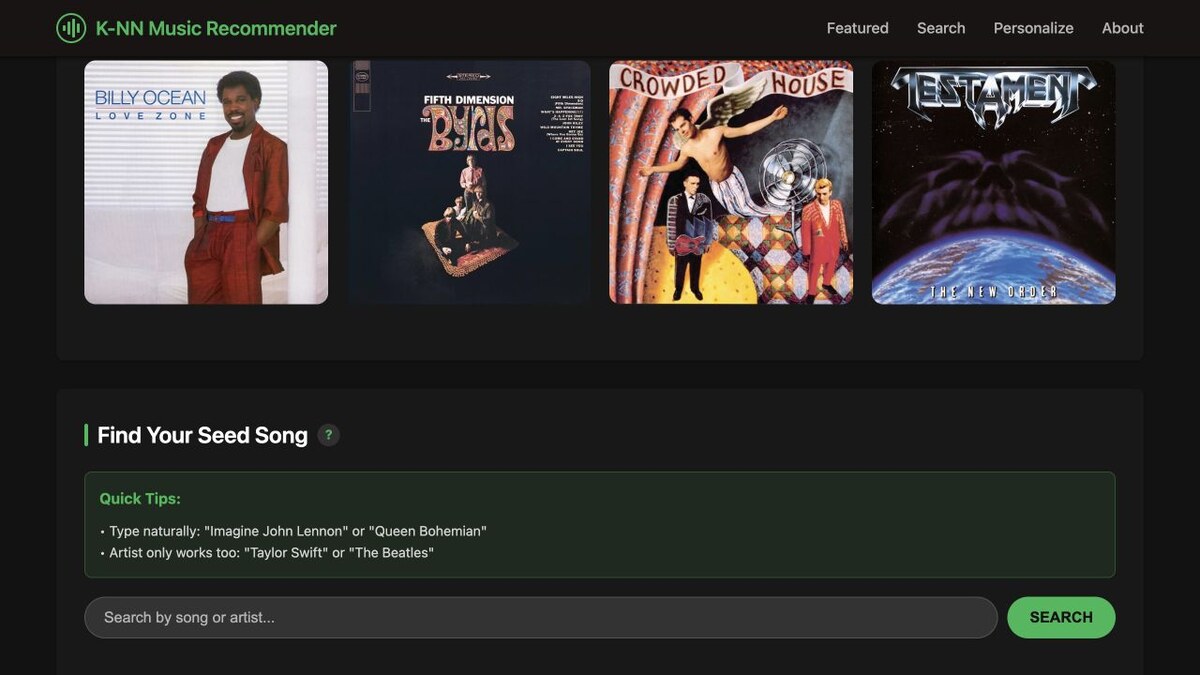
01 · KNN Music RecommenderSearch a real music catalog, define what “similar” means, and listen critically when nearest neighbors get strange. |
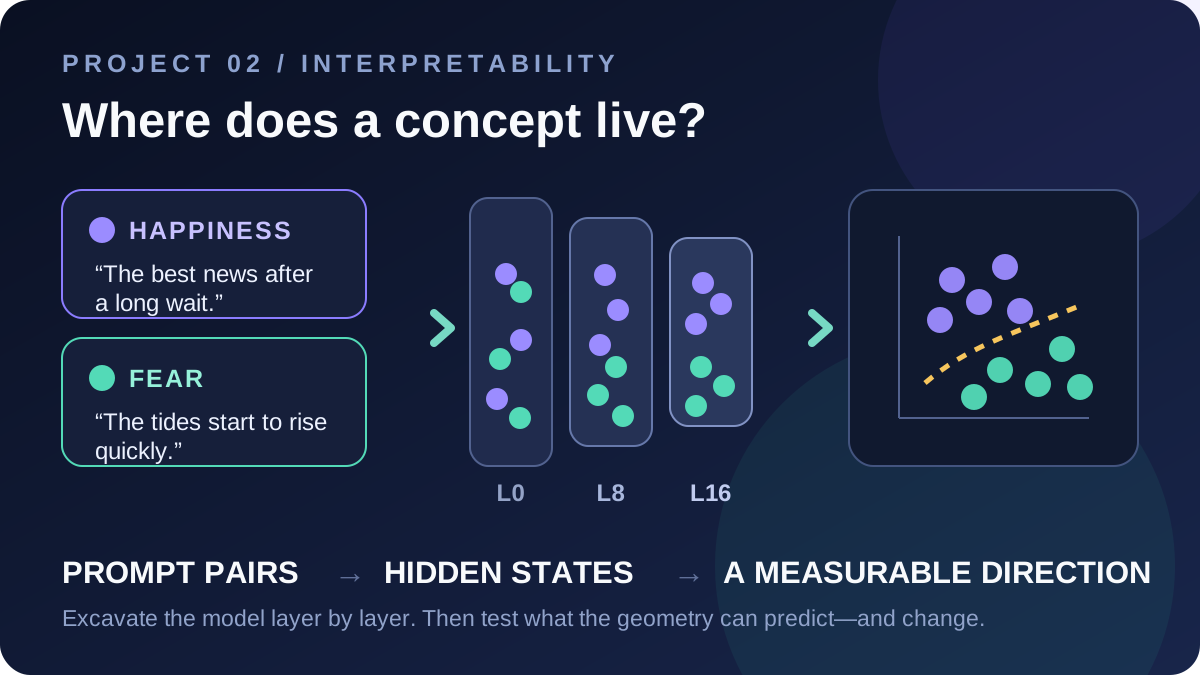
02 · Neural ArchaeologyExcavate hidden states layer by layer, find the geometry of a concept, and test whether it can predict—or change—behavior. |
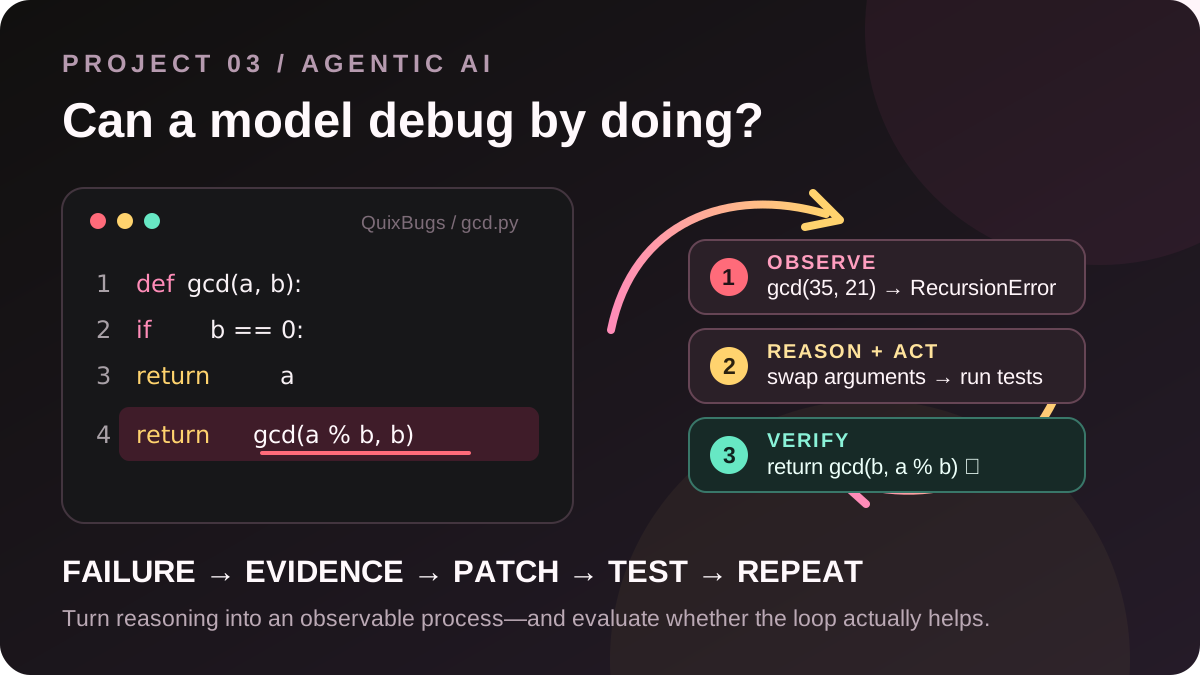
03 · Thought CascadeGive a small language model tools and feedback, then measure when a reasoning-and-action loop actually repairs broken code. |
git clone https://github.com/jinming99/learn-ml-by-building.git
cd learn-ml-by-building

python3 -m venv ml_lectures_env
source ml_lectures_env/bin/activate
python -m pip install --upgrade pip
python -m pip install -r requirements.txt

jupyter notebook
For platform-specific help, begin with the environment setup guide. Basic Python, high-school mathematics, and a willingness to poke at models are enough to start.
These materials were directed, reviewed, and validated by the instructor. AI-assisted tools were used during development to model transparent, modern technical practice. Released under the MIT License.
See the model. Stress the assumptions. Understand the behavior.
NOTEBOOKS → VISUAL EXPERIMENTS → PROJECTS → QUESTIONS
This repository is Ming Jin's workshop floor for ECE 4424 / CS 4824: Machine Learning. The notebooks favor experiments, visual explanations, and real systems over long stretches of passive theory. Curiosity is required; advanced mathematics is not.
[!TIP] Looking for the polished course experience? Visit the course site. Looking to tinker? Pick a notebook below and make something behave strangely.
| Arc | # | Topic | Notebook | Companion material |
|---|---|---|---|---|
| Let's predict | 00 | Environment setup | open | setup guide |
| 01 | What is machine learning? | open | course page · notes | |
| 02 | k-Nearest Neighbors | open | course page · notes | |
| 03 | Linear Regression | open | course page · environment | |
| 04 | Gradient Descent & Optimization | open | course page · teaching notes | |
| 05 | Probabilistic Classification | open | course page | |
| Let's understand | 06 | Evaluation Pitfalls & Data Visualization | open | course page |
| 07 | Regularization & Generalization | open | course page · environment | |
| 08 | Modern Decision Trees | open | course page | |
| 09 | Ensemble Methods | open | course page | |
| 10 | Kernel Methods & Gaussian Processes | open | course page | |
| Let's discover | 11 | K-Means Clustering | open | course page |
| 12 | PCA & Dimensionality Reduction | open | course page · quickstart | |
| 13 | Neural Network Architecture | open | course page | |
| 14 | Understanding Transformers | open | course page | |
| Let's see & chat | 15 | Convolutional Neural Networks | open | course page |
| 16 | Recurrent Neural Networks | open | course page | |
| 17 | LLM Agents & Tool Use | open | course page | |
| 18 | Vision-Language Models | open | course page |
Three projects, three ways to make a model reveal what it is doing.
01 · KNN Music RecommenderSearch a real music catalog, define what “similar” means, and listen critically when nearest neighbors get strange. |
02 · Neural ArchaeologyExcavate hidden states layer by layer, find the geometry of a concept, and test whether it can predict—or change—behavior. |
03 · Thought CascadeGive a small language model tools and feedback, then measure when a reasoning-and-action loop actually repairs broken code. |
git clone https://github.com/jinming99/learn-ml-by-building.git
cd learn-ml-by-building

python3 -m venv ml_lectures_env
source ml_lectures_env/bin/activate
python -m pip install --upgrade pip
python -m pip install -r requirements.txt

jupyter notebook
For platform-specific help, begin with the environment setup guide. Basic Python, high-school mathematics, and a willingness to poke at models are enough to start.
These materials were directed, reviewed, and validated by the instructor. AI-assisted tools were used during development to model transparent, modern technical practice. Released under the MIT License.





