
README
Official Implementation of JHCodec




Reconstruct! Don't Encode: Self-Supervised Representation Reconstruction Loss for High-Intelligibility and Low-Latency Streaming Neural Audio Codec

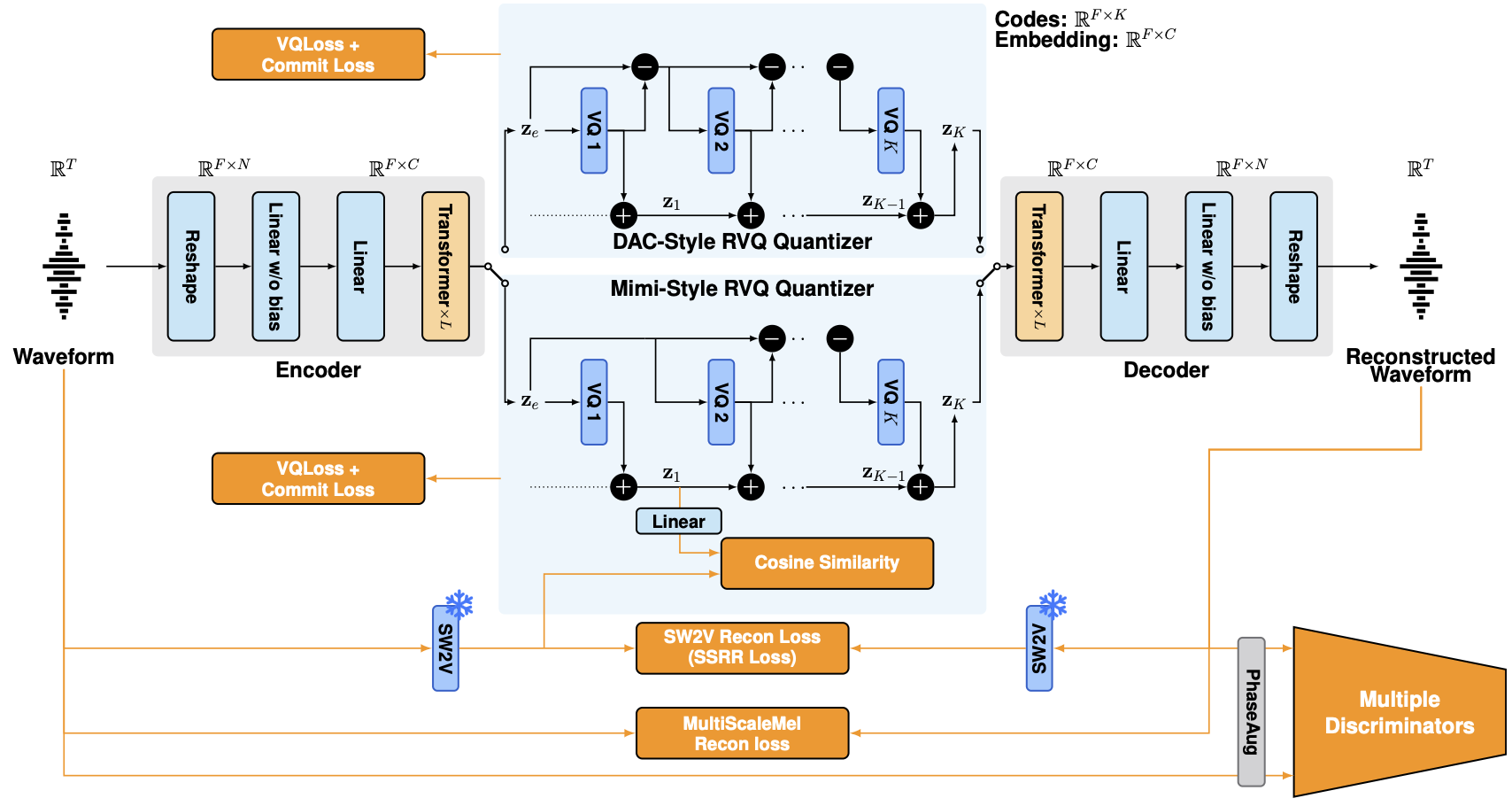
JHCodec is a pure Transformer decoder based neural audio codec with residual vector quantization. It shows state-of-the-art performance with minimal latency.
New Checkpoint
JHCodec-1.4M (jhcodec/jhcodec_1.4m,
jhcodec_mimi_1400000.pt) is now the default checkpoint, trained for 1.4M steps.
It is a drop-in replacement for the 1M release — same architecture, same
state_dict keys, same 20 ms / 320-sample framing.
python jhcodec/inference.py --from_hf \
    --input_file /path/to/input.wav --output_file /path/to/output.wav
--from_hf downloads it automatically. To stay on the previous 1M checkpoint,
pass --repo_id jhcodec/jhcodec (or load_pretrained_jhcodec(repo_id='jhcodec/jhcodec')).
See Official Checkpoints for the full list.
Overview
This repository contains the implementation for training and inference neural audio codecs with end-to-end training capabilities. The codec supports:
- Multiple RVQ architectures (DAC, MIMI)
- Supports end-to-end training leveraging (distilled) w2v-bert-2.0 semantic features
- SSRR and non-SSRR variants
TODO
- Revise Readme
- Upload checkpoint
- Upload to HuggingFace
- Auto-download from HuggingFace
- Upload to PyPI (probably after the review)
- Make non-anonymous (after the review)
Installation
pip install -e .
Requirements
- Python >= 3.10 (required for using the
X | Noneunion type syntax in type hints; see PEP 604), or manually remove this syntax if using an older Python version - PyTorch/TorchAudio with CUDA support: tested with
torch==2.6.0+cu124andtorch==2.9.1+cu128 - omegaconf==2.3.0: for configuration management
- Flash-Attention: For fast train/inference. We tested with
flash-attn==2.7.4.post1andflash-attn==2.8.3. - HF transformers: Required only for running baselines and w2v-bert2.0. JHCodec inference has no dependency on it.
- huggingface_hub: Required only if you want to use
--from_hfto auto-download official checkpoints/configs. - MLX: Apple Silicon only, and only for
jhcodec/model/codec_mlx.py. Not needed for the CUDA or CPU paths. - A CUDA toolkit with
nvccplus ninja (pip install ninja): only for the fused CUDA step kernels, which are JIT-compiled on first use. Without them the code falls back to the unfused path automatically.
We have provided a Shell Script to help set up the environment. PLEASE DO NOT RUN It Directly. INSTEAD, REVIEW THE SCRIPT AND MODIFY IT AS NEEDED FOR YOUR SYSTEM.
OUR MODEL REQUIRES ONLY THE MINIMUM DEPENDENCIES LISTED ABOVE.
Fixed: CPU reconstruction quality. Earlier releases produced degraded audio when run without CUDA. The cause was the pure-torch rotary fallback: it built the rotated tensor but never wrote it back, so on any non-CUDA device the model ran with no positional information at all. The CUDA path was never affected — it uses the Triton kernel, which was always correct. On a 16 kHz test clip at 8 codebooks, the fix moves CPU round-trip SNR from 4.6 dB to 12.8 dB (waveform correlation 0.853 to 0.975).
For training
To install both required libraries, run:
pip install omegaconf==2.3.0
pip install alias-free-torch==0.0.6 phaseaug
Flash-Attention should be installed carefully. Please read the official README.
Official Checkpoints
| Model | Description | Link |
|---|---|---|
| JHCodec (1.4M) | Streaming RVQ Codec, JHCodec-M (1.4M), default | jhcodec/jhcodec_1.4m |
| JHCodec (1M) | Streaming RVQ Codec, JHCodec-M (1M) | jhcodec/jhcodec |
| SW2V (60k) | Streaming Speech Representation Extractor | jhcodec/sw2v_60k |
| SW2V (120k) | Streaming Speech Representation Extractor, more robust to noise | jhcodec/sw2v_120k |
Project Structure
codec_paper/
├── jhcodec/                      # Main package
│   ├── model/                    # Model implementations
│   │   ├── codec.py              # Main codec models (JHCodec, JHCodecMimi)
│   │   ├── sw2v.py               # streaming wav2vec encoder
│   │   ├── attention.py          # Transformer decoder stack, RoPE attention, KV cache
│   │   ├── discriminator.py      # Discriminator for adversarial training
│   │   ├── vq.py                 # Vector quantization modules
│   │   ├── attention_cudagraph.py # CUDA-graph capture for the transformer stack
│   │   ├── codec_cudagraph.py    # CUDA-graph streaming codec (JHCodecMimiCudaGraph)
│   │   ├── sw2v_cudagraph.py     # CUDA-graph streaming sw2v encoders
│   │   └── codec_mlx.py          # MLX port of JHCodecMimi inference (Apple Silicon)
│   ├── kernel/                   # Custom kernels
│   │   ├── rotary_kernel.py      # Rotary positional embedding's kernel, adopted from FlashAttn
│   │   ├── vq_kernel.py          # Vector quantization kernel (Triton)
│   │   ├── fused_step.py         # JIT loader for the fused CUDA step kernels
│   │   └── cuda/                 # Raw CUDA sources for the per-frame decode step
│   │       ├── fused_step_kernels.cu
│   │       └── fused_step_binding.cpp
│   ├── loss/                     # Custom loss functions
│   │   └── multiscalemelspec.py  # Implements MultiScaleMelSpectrogramLoss used for perceptual audio training
│   ├── train_codec_e2e_w2v.py    # End-to-end training script
│   ├── decode_eval.py            # Decoding and evaluation script
│   └── dataloader.py             # Data loading utilities
├── config/                       # Configuration files
│   ├── config_dac_norecon.json   # without SED without reconstruction
│   ├── config_dac_recon.json     # without SED with reconstruction
│   ├── config_mimi_norecon.json  # with SED without reconstruction
│   └── config_mimi_recon.json    # with SED with reconstruction
└── setup.py
Training
Training Command:
Data Preparation Using the main of jhcodec/dataloader.py
The main block of dataloader.py demonstrates how to construct and inspect an AudioDataset:
from jhcodec.dataloader import AudioDataset, collate_fn
from torch.utils.data import DataLoader

dataset = AudioDataset(
    audio_dir='./data',                  # Path to your data
    sample_rate=16000,
    segment_duration=10.24,
    training=True,
    init_dataset=False,                  # Use True to scan files initially (slow), or False to load from cache
    cache_dir='cache_dir/dataloader/v9', # location of the cache
    use_mel=False,                       # Set True to return also Mel features
)
Notes:
- Initial dataset caching may take a while; once done, restart with
init_dataset=Falsefor faster loading. - Requires all dependencies (see top part of
jhcodec/dataloader.py). - You can add a custom dataset by modifying the dictionary at the top of
dataloader.py.
For DAC with reconstruction:
python jhcodec/train_codec_e2e_w2v.py \
    --experiment_name paper/dac_recon \
    --config config/config_dac_recon.json \
    --resume # if resume
For MIMI with reconstruction:
python jhcodec/train_codec_e2e_w2v.py \
    --experiment_name paper/mimi_recon \
    --config config/config_mimi_recon.json \
    --resume
Available Configurations:
config_dac_norecon.json- DAC without reconstructionconfig_dac_recon.json- DAC with reconstructionconfig_mimi_norecon.json- MIMI without reconstructionconfig_mimi_recon.json- MIMI with reconstruction (main)
Training Parameters
Key training parameters (configurable in JSON config files):
learning_rate: 1e-4batch_size: 42num_epochs: 100warmup_steps: 1000discriminator_start_steps: 10000- Loss weights for reconstruction, VQ, commit, feature matching, and adversarial losses
Decoding
Single Files
python jhcodec/inference.py \
    --from_hf \
    --input_file /path/to/input.wav \
    --output_file /path/to/output.wav \
    --num_codebooks 8 \
    --device 'cuda'
--from_hf downloads jhcodec/jhcodec_1.4m
by default. Pass --repo_id jhcodec/jhcodec to use the 1M model instead.
Single Files (load from a local checkpoint)
python jhcodec/inference.py \
    --config config/config_mimi_recon.json \
    --checkpoint jhcodec_mimi_1400000.pt \
    --input_file /path/to/input.wav \
    --output_file /path/to/output.wav \
    --num_codebooks 8 \
    --device 'cuda'
Multiple Files
python jhcodec/decode_eval.py \
    --config config/config_dac_norecon.json \
    --checkpoint /path/to/checkpoint_300000.pt \
    --name jhcodec_dac_norecon \
    --glob_pattern "/path/to/audio/*.wav" \
    --out_dir "out_dir" \
    --hierarchy 4
Arguments:
--config: Path to configuration file--checkpoint: Path to model checkpoint--name: Model name for output directory--glob_pattern: Glob pattern for input audio files--hierarchy: Depth of quantization hierarchy (default: 4)--out_dir: Output directory
Supported Datasets
The decoding script supports various audio datasets:
- LibriSpeech:
/data/LibriSpeech/test-other/*/*/*.flac - TITW:
/data/titw/titw_hard/test/*.wav - MLS:
/data/MLS/mls_*/test/audio/*/*/*.flac
Use in Python
See jhcodec/inference.py for the full script. The model operates on 16 kHz mono
audio in frames of FRAME_SIZE = 320 samples (20 ms), so the input length must be a
multiple of 320.
Offline (whole utterance at once)
import torch
import torch.nn.functional as F
import torchaudio
from jhcodec.utils import load_pretrained_jhcodec

DEVICE = 'cuda'
SAMPLE_RATE = 16000
FRAME_SIZE = 320       # 20 ms hop; input length must be a multiple of this
NUM_CODEBOOKS = 8      # <= config.model.rvq.num_codebooks

codec = load_pretrained_jhcodec(repo_id='jhcodec/jhcodec_1.4m').to(DEVICE).eval()

x, sr = torchaudio.load('input.wav')
if sr != SAMPLE_RATE:
    x = torchaudio.transforms.Resample(sr, SAMPLE_RATE)(x)
x = x[0, :].view(1, -1).to(DEVICE)               # [1, T], mono
if x.shape[1] % FRAME_SIZE != 0:
    x = F.pad(x, (0, FRAME_SIZE - x.shape[1] % FRAME_SIZE))

# encode/decode are already decorated with @torch.no_grad()
n_codebooks = torch.tensor([NUM_CODEBOOKS], device=DEVICE)
indices, _ = codec.encode(x, n_codebooks, inference_cache=None)       # [1, T//320, NUM_CODEBOOKS]
decoded, _ = codec.decode(indices, n_codebooks, inference_cache=None) # [1, T]

torchaudio.save('output.wav', decoded.detach().cpu(), SAMPLE_RATE)
Streaming (frame by frame)
Pass the returned inference_cache back in on every call. The encoder and the
decoder each keep their own cache, so use two separate variables and start both
at None.
encoder_cache = None
indices = []
for i in range(0, x.shape[1], FRAME_SIZE):
    frame_indices, encoder_cache = codec.encode(
        x[:, i:i + FRAME_SIZE], n_codebooks, inference_cache=encoder_cache)
    indices.append(frame_indices)                 # each [1, 1, NUM_CODEBOOKS]

decoder_cache = None
chunks = []
for frame_indices in indices:
    audio_chunk, decoder_cache = codec.decode(
        frame_indices, n_codebooks, inference_cache=decoder_cache)
    chunks.append(audio_chunk)                    # each [1, 320]
decoded = torch.cat(chunks, dim=1)                # [1, T]
To load a local checkpoint instead of the Hugging Face one:
import omegaconf
import jhcodec.utils as utils
from jhcodec.model.codec import JHCodecMimi

config = omegaconf.OmegaConf.load('config/config_mimi_recon.json')
codec = JHCodecMimi(config.model, training=False)
utils.load_checkpoint(codec, None, None, 'jhcodec_mimi_1400000.pt', strict_model=True)
codec = codec.to(DEVICE).eval()
CUDA Graph Streaming
For per-frame streaming, the Python/launch overhead of many tiny kernels dominates
the step time. jhcodec/model/codec_cudagraph.py captures the whole per-frame
pipeline into a single CUDA graph and replays it, which removes that overhead.
JHCodecMimiCudaGraph subclasses JHCodecMimi and only swaps the transformer
stacks for graph-capable equivalents, so the state_dict is identical — an
existing checkpoint loads unchanged, and the eager encode / decode methods
still work as a reference.
Requirements and constraints:
- CUDA +
flash-attn(CudaGraphStreamasserts on this; there is no CPU path). - Strict order: construct → load checkpoint →
.to(device)→.eval()→make_*_stream.RVQMimi.train(False)(i.e..eval()) callsregister_up_vq(), which bakes the current codebook weights through theuplinears into lookup-only VQ modules. Loading a checkpoint after.eval()leaves those tables holding the randomly initialized weights, andload_state_dict(..., strict=True)will also fail on the extraup_vqs.*/semantic_up_vq.*keys the model now has. The module itself warns about this:DO NOT USE EVAL BEFORE LOADING CHECKPOINT. Capture must then come after.eval(), since the graph traces whichever decode path is active. If you ever call.train()again the tables are dropped (up_vqs = None) and any captured stream is stale — re-eval()and re-capture. - Each captured graph is specialized to one
(batch, n_codebooks, max_frames). Callmake_*_streamagain to specialize differently. - The KV cache is bounded by
max_frames; exceeding it raises. Callstream.reset()to start a new utterance. step()returns the static output buffer, overwritten on the nextstep(). Passclone=Trueif you keep the result around.
import torch
import omegaconf
import jhcodec.utils as utils
from jhcodec.model.codec_cudagraph import JHCodecMimiCudaGraph

DEVICE = torch.device('cuda')
config = omegaconf.OmegaConf.load('config/config_mimi_recon.json')

# 1. construct
model = JHCodecMimiCudaGraph(config.model, training=False)
# 2. load -- same checkpoint as JHCodecMimi, the state_dict keys are identical.
#    This MUST happen before .eval().
utils.load_checkpoint(model, None, None, 'jhcodec_mimi_1400000.pt', strict_model=True)
# 3. move, then 4. eval() -- registers the fused up+VQ tables from the loaded weights
model = model.to(DEVICE).eval()

FRAME = model.feature_size        # 320 samples
N_CB = model.num_codebooks
B, MAX_FRAMES = 1, 1600           # 1600 frames = 32 s at 20 ms/frame

# 5. capture, only now that the model is loaded and in eval mode
# encode: step(x=[B, FRAME]) -> indices [B, 1, N_CB]
enc_stream = model.make_encode_stream(B, MAX_FRAMES, N_CB, DEVICE)
# decode: step(indices=[B, 1, N_CB]) -> audio [B, FRAME]
dec_stream = model.make_decode_stream(B, MAX_FRAMES, N_CB, DEVICE)

x = torch.randn(B, 200 * FRAME, device=DEVICE)   # your streaming source

indices = []
for t in range(x.shape[1] // FRAME):
    indices.append(enc_stream.step(x=x[:, t * FRAME:(t + 1) * FRAME], clone=True))

chunks = []
for frame_indices in indices:
    chunks.append(dec_stream.step(indices=frame_indices, clone=True))
decoded = torch.cat(chunks, dim=1)               # [B, T]

enc_stream.reset()   # rewind both streams before the next utterance
dec_stream.reset()
To use an already-loaded eager model (e.g. from load_pretrained_jhcodec, which
returns a plain JHCodecMimi), copy the weights across — the keys match:
from jhcodec.utils import load_pretrained_jhcodec

eager = load_pretrained_jhcodec(repo_id='jhcodec/jhcodec_1.4m')
model = JHCodecMimiCudaGraph(config.model, training=False)
model.load_state_dict(eager.state_dict())
model = model.to(DEVICE).eval()
The SW2V encoders have the same interface via
AudioEncoderCudaGraph / AudioEncoderPhonemicCudaGraph in
jhcodec/model/sw2v_cudagraph.py — make_encode_stream(batch, max_frames, device),
then step(x=[B, in_features]) returning [B, 1, rvq_dim].
Running the modules directly checks graph output against the eager frame-by-frame path and prints the per-step speedup:
python jhcodec/model/attention_cudagraph.py   # decoder stack: graph vs eager max diff
python jhcodec/model/codec_cudagraph.py       # full codec: index mismatch, audio diff, latency
python jhcodec/model/sw2v_cudagraph.py        # sw2v encoder
Fused CUDA Step Kernels
On top of the graph capture, the per-frame decode step runs through a small raw-CUDA
extension in jhcodec/kernel/cuda/, loaded lazily by jhcodec/kernel/fused_step.py.
It is compiled on first use with torch's cpp_extension.load (cached under
~/.cache/torch_extensions), so it needs nvcc and ninja available at runtime.
Nothing about this is required: if the extension cannot be built the loader logs a
warning and the unfused graph path is used instead, with identical outputs.
What is fused:
fused_attn_step— rotary + KV-append + windowed attention in one kernel, replacing the triton rotary, the casts/copies, and FA2's splitkv+combine for a 1-token query.- bf16 warp-per-row GEMV with fused epilogues (SwiGLU, residual-add + norm), replacing the fp32 cuBLAS GEMVs that dominated the step (the weight read is the bottleneck at M=1).
fused_rvq_encode/fused_rvq_decode— the whole semantic + residual codebook loop as one persistent block per token, instead of ~60 tiny kernels.RVQMimi.encodeuses this in eager mode too.- LayerNorm and RMSNorm, with the norm affine and the residual-branch scales folded into the neighbouring projections at capture time (exact, done in fp32).
Attention spans are routed per layer at capture: the custom attention tail is linear in the
key count, so layers whose worst-case span exceeds JHCODEC_FUSED_ATTN_MAX_KEYS fall back
to FA2's splitkv kvcache kernel while keeping the GEMV/fold/add+LN fusions.
Measured on an idle H200 with config_mimi_recon.json, batch 1: the decode step goes from
655 us (graph baseline) to 279 us — 2.3x over the captured graph and ~9x over eager — with
reconstruction SNR/L1 unchanged on the trained checkpoint.
| Env var | Default | Effect |
|---|---|---|
JHCODEC_FUSED_STEP | 1 | 0 disables the extension entirely (unfused graph path) |
JHCODEC_GEMV_ADDLN | 1 | 0 disables the custom GEMV / fused add+norm epilogues |
JHCODEC_FUSED_ATTN_MAX_KEYS | 128 | Span above which a layer routes attention to FA2 instead |
inference_optimization_path.md records the full path, the per-stage measurements, and the
negative results.
Apple Silicon (MLX)
jhcodec/model/codec_mlx.py is an MLX port of
JHCodecMimi inference for Apple Silicon. It mirrors the torch model operation for
operation, so a torch checkpoint loads unchanged and produces the same indices and
audio — there is no separate MLX checkpoint. Inference only; training stays on the torch
path. Both the whole-utterance and the frame-by-frame paths are implemented.
import mlx.core as mx
import omegaconf
from jhcodec.model.codec_mlx import JHCodecMimiMLX

config = omegaconf.OmegaConf.load('config/config_mimi_recon.json')
model = JHCodecMimiMLX.from_torch_checkpoint('jhcodec_mimi_1400000.pt', config.model)
# or JHCodecMimiMLX.from_torch_state_dict(state_dict, config.model)

indices = model.encode(audio)          # [B, T // 320, n_codebooks], mx.int32
audio_out = model.decode(indices)      # [B, T]

model.fuse()                           # optional, exact: folds norm affine + branch scales
model.quantize(bits=8)                 # optional, ~2x faster per frame; must come after fuse()

state = model.decoder_state()          # frame by frame
frame = model.decode_step(indices[:, t:t + 1], state)      # [B, 320]
fuse()folds the LayerNorm affine and the residual-branch scales into the neighbouring matmuls. Exact — the same arithmetic, done once on the weights rather than every frame.quantize(bits=8)quantizes only the large projections and routes them throughmx.quantized_matmul, roughly halving the per-frame cost. The RVQ codebooks, the smalllatent_dim=16down/up projections, and every bias / norm parameter are left in full precision, since quantization error there lands straight on the nearest-code decision. It must run afterfuse(), which rewrites the weights it packs.- Measured on an M3 Pro, batch 1, per 20 ms frame: ~6 ms encode and ~6 ms decode.
fuse()and the ring buffer are exactness/memory wins rather than speedups — a single-frame step is limited by GEMV efficiency at M=1, not by the elementwise ops around it.
Running the module directly checks the MLX output against torch and the streaming path against the whole-utterance path:
python jhcodec/model/codec_mlx.py
Configuration
Configuration files are JSON-based and include:
- Model Architecture: Encoder/decoder layers, attention heads, embedding dimensions
- Vector Quantization: Codebook size, number of codebooks, embedding dimensions
- Training: Learning rate, batch size, loss weights, discriminator settings
- Data: Sample rate, segment duration, data directories
- Logging: Checkpoint intervals, tensorboard settings
Example configuration structure:
{
    "model": {
        "encoder": {...},
        "decoder": {...},
        "rvq": {
            "type": "dac",
            "num_codebooks": 8,
            "codebook_size": 1024
        }
    },
    "training": {...},
    "loss": {...},
    "data": {...}
}
Citation
If you find this work useful, please cite:
@article{lee2026reconstruct,
  title={Reconstruct! Don't Encode: Self-Supervised Representation Reconstruction Loss for High-Intelligibility and Low-Latency Streaming Neural Audio Codec},
  author={Lee, Junhyeok and He, Xiluo and Lee, Jihwan and Wang, Helin and Narayanan, Shrikanth and Thebaud, Thomas and Moro-Velazquez, Laureano and Villalba, Jes{\'u}s and Dehak, Najim},
  journal={arXiv preprint arXiv:2603.05887},
  year={2026}
}
Main Contact
Anonymous. Contact: jhcodec843@gmail.com Submitted to Interspeech 2026
References
License
MIT License
Contributors

14 commits
Similar repos


Languages
Python
88.6%
Cuda
7.7%
C++
3.6%
README
Official Implementation of JHCodec
Reconstruct! Don't Encode: Self-Supervised Representation Reconstruction Loss for High-Intelligibility and Low-Latency Streaming Neural Audio Codec
JHCodec is a pure Transformer decoder based neural audio codec with residual vector quantization. It shows state-of-the-art performance with minimal latency.
New Checkpoint
JHCodec-1.4M (jhcodec/jhcodec_1.4m,
jhcodec_mimi_1400000.pt) is now the default checkpoint, trained for 1.4M steps.
It is a drop-in replacement for the 1M release — same architecture, same
state_dict keys, same 20 ms / 320-sample framing.
python jhcodec/inference.py --from_hf \
    --input_file /path/to/input.wav --output_file /path/to/output.wav
--from_hf downloads it automatically. To stay on the previous 1M checkpoint,
pass --repo_id jhcodec/jhcodec (or load_pretrained_jhcodec(repo_id='jhcodec/jhcodec')).
See Official Checkpoints for the full list.
Overview
This repository contains the implementation for training and inference neural audio codecs with end-to-end training capabilities. The codec supports:
- Multiple RVQ architectures (DAC, MIMI)
- Supports end-to-end training leveraging (distilled) w2v-bert-2.0 semantic features
- SSRR and non-SSRR variants
TODO
- Revise Readme
- Upload checkpoint
- Upload to HuggingFace
- Auto-download from HuggingFace
- Upload to PyPI (probably after the review)
- Make non-anonymous (after the review)
Installation
pip install -e .
Requirements
- Python >= 3.10 (required for using the
X | Noneunion type syntax in type hints; see PEP 604), or manually remove this syntax if using an older Python version - PyTorch/TorchAudio with CUDA support: tested with
torch==2.6.0+cu124andtorch==2.9.1+cu128 - omegaconf==2.3.0: for configuration management
- Flash-Attention: For fast train/inference. We tested with
flash-attn==2.7.4.post1andflash-attn==2.8.3. - HF transformers: Required only for running baselines and w2v-bert2.0. JHCodec inference has no dependency on it.
- huggingface_hub: Required only if you want to use
--from_hfto auto-download official checkpoints/configs. - MLX: Apple Silicon only, and only for
jhcodec/model/codec_mlx.py. Not needed for the CUDA or CPU paths. - A CUDA toolkit with
nvccplus ninja (pip install ninja): only for the fused CUDA step kernels, which are JIT-compiled on first use. Without them the code falls back to the unfused path automatically.
We have provided a Shell Script to help set up the environment. PLEASE DO NOT RUN It Directly. INSTEAD, REVIEW THE SCRIPT AND MODIFY IT AS NEEDED FOR YOUR SYSTEM.
OUR MODEL REQUIRES ONLY THE MINIMUM DEPENDENCIES LISTED ABOVE.
Fixed: CPU reconstruction quality. Earlier releases produced degraded audio when run without CUDA. The cause was the pure-torch rotary fallback: it built the rotated tensor but never wrote it back, so on any non-CUDA device the model ran with no positional information at all. The CUDA path was never affected — it uses the Triton kernel, which was always correct. On a 16 kHz test clip at 8 codebooks, the fix moves CPU round-trip SNR from 4.6 dB to 12.8 dB (waveform correlation 0.853 to 0.975).
For training
To install both required libraries, run:
pip install omegaconf==2.3.0
pip install alias-free-torch==0.0.6 phaseaug
Flash-Attention should be installed carefully. Please read the official README.
Official Checkpoints
| Model | Description | Link |
|---|---|---|
| JHCodec (1.4M) | Streaming RVQ Codec, JHCodec-M (1.4M), default | jhcodec/jhcodec_1.4m |
| JHCodec (1M) | Streaming RVQ Codec, JHCodec-M (1M) | jhcodec/jhcodec |
| SW2V (60k) | Streaming Speech Representation Extractor | jhcodec/sw2v_60k |
| SW2V (120k) | Streaming Speech Representation Extractor, more robust to noise | jhcodec/sw2v_120k |
Project Structure
codec_paper/
├── jhcodec/                      # Main package
│   ├── model/                    # Model implementations
│   │   ├── codec.py              # Main codec models (JHCodec, JHCodecMimi)
│   │   ├── sw2v.py               # streaming wav2vec encoder
│   │   ├── attention.py          # Transformer decoder stack, RoPE attention, KV cache
│   │   ├── discriminator.py      # Discriminator for adversarial training
│   │   ├── vq.py                 # Vector quantization modules
│   │   ├── attention_cudagraph.py # CUDA-graph capture for the transformer stack
│   │   ├── codec_cudagraph.py    # CUDA-graph streaming codec (JHCodecMimiCudaGraph)
│   │   ├── sw2v_cudagraph.py     # CUDA-graph streaming sw2v encoders
│   │   └── codec_mlx.py          # MLX port of JHCodecMimi inference (Apple Silicon)
│   ├── kernel/                   # Custom kernels
│   │   ├── rotary_kernel.py      # Rotary positional embedding's kernel, adopted from FlashAttn
│   │   ├── vq_kernel.py          # Vector quantization kernel (Triton)
│   │   ├── fused_step.py         # JIT loader for the fused CUDA step kernels
│   │   └── cuda/                 # Raw CUDA sources for the per-frame decode step
│   │       ├── fused_step_kernels.cu
│   │       └── fused_step_binding.cpp
│   ├── loss/                     # Custom loss functions
│   │   └── multiscalemelspec.py  # Implements MultiScaleMelSpectrogramLoss used for perceptual audio training
│   ├── train_codec_e2e_w2v.py    # End-to-end training script
│   ├── decode_eval.py            # Decoding and evaluation script
│   └── dataloader.py             # Data loading utilities
├── config/                       # Configuration files
│   ├── config_dac_norecon.json   # without SED without reconstruction
│   ├── config_dac_recon.json     # without SED with reconstruction
│   ├── config_mimi_norecon.json  # with SED without reconstruction
│   └── config_mimi_recon.json    # with SED with reconstruction
└── setup.py
Training
Training Command:
Data Preparation Using the main of jhcodec/dataloader.py
The main block of dataloader.py demonstrates how to construct and inspect an AudioDataset:
from jhcodec.dataloader import AudioDataset, collate_fn
from torch.utils.data import DataLoader

dataset = AudioDataset(
    audio_dir='./data',                  # Path to your data
    sample_rate=16000,
    segment_duration=10.24,
    training=True,
    init_dataset=False,                  # Use True to scan files initially (slow), or False to load from cache
    cache_dir='cache_dir/dataloader/v9', # location of the cache
    use_mel=False,                       # Set True to return also Mel features
)
Notes:
- Initial dataset caching may take a while; once done, restart with
init_dataset=Falsefor faster loading. - Requires all dependencies (see top part of
jhcodec/dataloader.py). - You can add a custom dataset by modifying the dictionary at the top of
dataloader.py.
For DAC with reconstruction:
python jhcodec/train_codec_e2e_w2v.py \
    --experiment_name paper/dac_recon \
    --config config/config_dac_recon.json \
    --resume # if resume
For MIMI with reconstruction:
python jhcodec/train_codec_e2e_w2v.py \
    --experiment_name paper/mimi_recon \
    --config config/config_mimi_recon.json \
    --resume
Available Configurations:
config_dac_norecon.json- DAC without reconstructionconfig_dac_recon.json- DAC with reconstructionconfig_mimi_norecon.json- MIMI without reconstructionconfig_mimi_recon.json- MIMI with reconstruction (main)
Training Parameters
Key training parameters (configurable in JSON config files):
learning_rate: 1e-4batch_size: 42num_epochs: 100warmup_steps: 1000discriminator_start_steps: 10000- Loss weights for reconstruction, VQ, commit, feature matching, and adversarial losses
Decoding
Single Files
python jhcodec/inference.py \
    --from_hf \
    --input_file /path/to/input.wav \
    --output_file /path/to/output.wav \
    --num_codebooks 8 \
    --device 'cuda'
--from_hf downloads jhcodec/jhcodec_1.4m
by default. Pass --repo_id jhcodec/jhcodec to use the 1M model instead.
Single Files (load from a local checkpoint)
python jhcodec/inference.py \
    --config config/config_mimi_recon.json \
    --checkpoint jhcodec_mimi_1400000.pt \
    --input_file /path/to/input.wav \
    --output_file /path/to/output.wav \
    --num_codebooks 8 \
    --device 'cuda'
Multiple Files
python jhcodec/decode_eval.py \
    --config config/config_dac_norecon.json \
    --checkpoint /path/to/checkpoint_300000.pt \
    --name jhcodec_dac_norecon \
    --glob_pattern "/path/to/audio/*.wav" \
    --out_dir "out_dir" \
    --hierarchy 4
Arguments:
--config: Path to configuration file--checkpoint: Path to model checkpoint--name: Model name for output directory--glob_pattern: Glob pattern for input audio files--hierarchy: Depth of quantization hierarchy (default: 4)--out_dir: Output directory
Supported Datasets
The decoding script supports various audio datasets:
- LibriSpeech:
/data/LibriSpeech/test-other/*/*/*.flac - TITW:
/data/titw/titw_hard/test/*.wav - MLS:
/data/MLS/mls_*/test/audio/*/*/*.flac
Use in Python
See jhcodec/inference.py for the full script. The model operates on 16 kHz mono
audio in frames of FRAME_SIZE = 320 samples (20 ms), so the input length must be a
multiple of 320.
Offline (whole utterance at once)
import torch
import torch.nn.functional as F
import torchaudio
from jhcodec.utils import load_pretrained_jhcodec

DEVICE = 'cuda'
SAMPLE_RATE = 16000
FRAME_SIZE = 320       # 20 ms hop; input length must be a multiple of this
NUM_CODEBOOKS = 8      # <= config.model.rvq.num_codebooks

codec = load_pretrained_jhcodec(repo_id='jhcodec/jhcodec_1.4m').to(DEVICE).eval()

x, sr = torchaudio.load('input.wav')
if sr != SAMPLE_RATE:
    x = torchaudio.transforms.Resample(sr, SAMPLE_RATE)(x)
x = x[0, :].view(1, -1).to(DEVICE)               # [1, T], mono
if x.shape[1] % FRAME_SIZE != 0:
    x = F.pad(x, (0, FRAME_SIZE - x.shape[1] % FRAME_SIZE))

# encode/decode are already decorated with @torch.no_grad()
n_codebooks = torch.tensor([NUM_CODEBOOKS], device=DEVICE)
indices, _ = codec.encode(x, n_codebooks, inference_cache=None)       # [1, T//320, NUM_CODEBOOKS]
decoded, _ = codec.decode(indices, n_codebooks, inference_cache=None) # [1, T]

torchaudio.save('output.wav', decoded.detach().cpu(), SAMPLE_RATE)
Streaming (frame by frame)
Pass the returned inference_cache back in on every call. The encoder and the
decoder each keep their own cache, so use two separate variables and start both
at None.
encoder_cache = None
indices = []
for i in range(0, x.shape[1], FRAME_SIZE):
    frame_indices, encoder_cache = codec.encode(
        x[:, i:i + FRAME_SIZE], n_codebooks, inference_cache=encoder_cache)
    indices.append(frame_indices)                 # each [1, 1, NUM_CODEBOOKS]

decoder_cache = None
chunks = []
for frame_indices in indices:
    audio_chunk, decoder_cache = codec.decode(
        frame_indices, n_codebooks, inference_cache=decoder_cache)
    chunks.append(audio_chunk)                    # each [1, 320]
decoded = torch.cat(chunks, dim=1)                # [1, T]
To load a local checkpoint instead of the Hugging Face one:
import omegaconf
import jhcodec.utils as utils
from jhcodec.model.codec import JHCodecMimi

config = omegaconf.OmegaConf.load('config/config_mimi_recon.json')
codec = JHCodecMimi(config.model, training=False)
utils.load_checkpoint(codec, None, None, 'jhcodec_mimi_1400000.pt', strict_model=True)
codec = codec.to(DEVICE).eval()
CUDA Graph Streaming
For per-frame streaming, the Python/launch overhead of many tiny kernels dominates
the step time. jhcodec/model/codec_cudagraph.py captures the whole per-frame
pipeline into a single CUDA graph and replays it, which removes that overhead.
JHCodecMimiCudaGraph subclasses JHCodecMimi and only swaps the transformer
stacks for graph-capable equivalents, so the state_dict is identical — an
existing checkpoint loads unchanged, and the eager encode / decode methods
still work as a reference.
Requirements and constraints:
- CUDA +
flash-attn(CudaGraphStreamasserts on this; there is no CPU path). - Strict order: construct → load checkpoint →
.to(device)→.eval()→make_*_stream.RVQMimi.train(False)(i.e..eval()) callsregister_up_vq(), which bakes the current codebook weights through theuplinears into lookup-only VQ modules. Loading a checkpoint after.eval()leaves those tables holding the randomly initialized weights, andload_state_dict(..., strict=True)will also fail on the extraup_vqs.*/semantic_up_vq.*keys the model now has. The module itself warns about this:DO NOT USE EVAL BEFORE LOADING CHECKPOINT. Capture must then come after.eval(), since the graph traces whichever decode path is active. If you ever call.train()again the tables are dropped (up_vqs = None) and any captured stream is stale — re-eval()and re-capture. - Each captured graph is specialized to one
(batch, n_codebooks, max_frames). Callmake_*_streamagain to specialize differently. - The KV cache is bounded by
max_frames; exceeding it raises. Callstream.reset()to start a new utterance. step()returns the static output buffer, overwritten on the nextstep(). Passclone=Trueif you keep the result around.
import torch
import omegaconf
import jhcodec.utils as utils
from jhcodec.model.codec_cudagraph import JHCodecMimiCudaGraph

DEVICE = torch.device('cuda')
config = omegaconf.OmegaConf.load('config/config_mimi_recon.json')

# 1. construct
model = JHCodecMimiCudaGraph(config.model, training=False)
# 2. load -- same checkpoint as JHCodecMimi, the state_dict keys are identical.
#    This MUST happen before .eval().
utils.load_checkpoint(model, None, None, 'jhcodec_mimi_1400000.pt', strict_model=True)
# 3. move, then 4. eval() -- registers the fused up+VQ tables from the loaded weights
model = model.to(DEVICE).eval()

FRAME = model.feature_size        # 320 samples
N_CB = model.num_codebooks
B, MAX_FRAMES = 1, 1600           # 1600 frames = 32 s at 20 ms/frame

# 5. capture, only now that the model is loaded and in eval mode
# encode: step(x=[B, FRAME]) -> indices [B, 1, N_CB]
enc_stream = model.make_encode_stream(B, MAX_FRAMES, N_CB, DEVICE)
# decode: step(indices=[B, 1, N_CB]) -> audio [B, FRAME]
dec_stream = model.make_decode_stream(B, MAX_FRAMES, N_CB, DEVICE)

x = torch.randn(B, 200 * FRAME, device=DEVICE)   # your streaming source

indices = []
for t in range(x.shape[1] // FRAME):
    indices.append(enc_stream.step(x=x[:, t * FRAME:(t + 1) * FRAME], clone=True))

chunks = []
for frame_indices in indices:
    chunks.append(dec_stream.step(indices=frame_indices, clone=True))
decoded = torch.cat(chunks, dim=1)               # [B, T]

enc_stream.reset()   # rewind both streams before the next utterance
dec_stream.reset()
To use an already-loaded eager model (e.g. from load_pretrained_jhcodec, which
returns a plain JHCodecMimi), copy the weights across — the keys match:
from jhcodec.utils import load_pretrained_jhcodec

eager = load_pretrained_jhcodec(repo_id='jhcodec/jhcodec_1.4m')
model = JHCodecMimiCudaGraph(config.model, training=False)
model.load_state_dict(eager.state_dict())
model = model.to(DEVICE).eval()
The SW2V encoders have the same interface via
AudioEncoderCudaGraph / AudioEncoderPhonemicCudaGraph in
jhcodec/model/sw2v_cudagraph.py — make_encode_stream(batch, max_frames, device),
then step(x=[B, in_features]) returning [B, 1, rvq_dim].
Running the modules directly checks graph output against the eager frame-by-frame path and prints the per-step speedup:
python jhcodec/model/attention_cudagraph.py   # decoder stack: graph vs eager max diff
python jhcodec/model/codec_cudagraph.py       # full codec: index mismatch, audio diff, latency
python jhcodec/model/sw2v_cudagraph.py        # sw2v encoder
Fused CUDA Step Kernels
On top of the graph capture, the per-frame decode step runs through a small raw-CUDA
extension in jhcodec/kernel/cuda/, loaded lazily by jhcodec/kernel/fused_step.py.
It is compiled on first use with torch's cpp_extension.load (cached under
~/.cache/torch_extensions), so it needs nvcc and ninja available at runtime.
Nothing about this is required: if the extension cannot be built the loader logs a
warning and the unfused graph path is used instead, with identical outputs.
What is fused:
fused_attn_step— rotary + KV-append + windowed attention in one kernel, replacing the triton rotary, the casts/copies, and FA2's splitkv+combine for a 1-token query.- bf16 warp-per-row GEMV with fused epilogues (SwiGLU, residual-add + norm), replacing the fp32 cuBLAS GEMVs that dominated the step (the weight read is the bottleneck at M=1).
fused_rvq_encode/fused_rvq_decode— the whole semantic + residual codebook loop as one persistent block per token, instead of ~60 tiny kernels.RVQMimi.encodeuses this in eager mode too.- LayerNorm and RMSNorm, with the norm affine and the residual-branch scales folded into the neighbouring projections at capture time (exact, done in fp32).
Attention spans are routed per layer at capture: the custom attention tail is linear in the
key count, so layers whose worst-case span exceeds JHCODEC_FUSED_ATTN_MAX_KEYS fall back
to FA2's splitkv kvcache kernel while keeping the GEMV/fold/add+LN fusions.
Measured on an idle H200 with config_mimi_recon.json, batch 1: the decode step goes from
655 us (graph baseline) to 279 us — 2.3x over the captured graph and ~9x over eager — with
reconstruction SNR/L1 unchanged on the trained checkpoint.
| Env var | Default | Effect |
|---|---|---|
JHCODEC_FUSED_STEP | 1 | 0 disables the extension entirely (unfused graph path) |
JHCODEC_GEMV_ADDLN | 1 | 0 disables the custom GEMV / fused add+norm epilogues |
JHCODEC_FUSED_ATTN_MAX_KEYS | 128 | Span above which a layer routes attention to FA2 instead |
inference_optimization_path.md records the full path, the per-stage measurements, and the
negative results.
Apple Silicon (MLX)
jhcodec/model/codec_mlx.py is an MLX port of
JHCodecMimi inference for Apple Silicon. It mirrors the torch model operation for
operation, so a torch checkpoint loads unchanged and produces the same indices and
audio — there is no separate MLX checkpoint. Inference only; training stays on the torch
path. Both the whole-utterance and the frame-by-frame paths are implemented.
import mlx.core as mx
import omegaconf
from jhcodec.model.codec_mlx import JHCodecMimiMLX

config = omegaconf.OmegaConf.load('config/config_mimi_recon.json')
model = JHCodecMimiMLX.from_torch_checkpoint('jhcodec_mimi_1400000.pt', config.model)
# or JHCodecMimiMLX.from_torch_state_dict(state_dict, config.model)

indices = model.encode(audio)          # [B, T // 320, n_codebooks], mx.int32
audio_out = model.decode(indices)      # [B, T]

model.fuse()                           # optional, exact: folds norm affine + branch scales
model.quantize(bits=8)                 # optional, ~2x faster per frame; must come after fuse()

state = model.decoder_state()          # frame by frame
frame = model.decode_step(indices[:, t:t + 1], state)      # [B, 320]
fuse()folds the LayerNorm affine and the residual-branch scales into the neighbouring matmuls. Exact — the same arithmetic, done once on the weights rather than every frame.quantize(bits=8)quantizes only the large projections and routes them throughmx.quantized_matmul, roughly halving the per-frame cost. The RVQ codebooks, the smalllatent_dim=16down/up projections, and every bias / norm parameter are left in full precision, since quantization error there lands straight on the nearest-code decision. It must run afterfuse(), which rewrites the weights it packs.- Measured on an M3 Pro, batch 1, per 20 ms frame: ~6 ms encode and ~6 ms decode.
fuse()and the ring buffer are exactness/memory wins rather than speedups — a single-frame step is limited by GEMV efficiency at M=1, not by the elementwise ops around it.
Running the module directly checks the MLX output against torch and the streaming path against the whole-utterance path:
python jhcodec/model/codec_mlx.py
Configuration
Configuration files are JSON-based and include:
- Model Architecture: Encoder/decoder layers, attention heads, embedding dimensions
- Vector Quantization: Codebook size, number of codebooks, embedding dimensions
- Training: Learning rate, batch size, loss weights, discriminator settings
- Data: Sample rate, segment duration, data directories
- Logging: Checkpoint intervals, tensorboard settings
Example configuration structure:
{
    "model": {
        "encoder": {...},
        "decoder": {...},
        "rvq": {
            "type": "dac",
            "num_codebooks": 8,
            "codebook_size": 1024
        }
    },
    "training": {...},
    "loss": {...},
    "data": {...}
}
Citation
If you find this work useful, please cite:
@article{lee2026reconstruct,
  title={Reconstruct! Don't Encode: Self-Supervised Representation Reconstruction Loss for High-Intelligibility and Low-Latency Streaming Neural Audio Codec},
  author={Lee, Junhyeok and He, Xiluo and Lee, Jihwan and Wang, Helin and Narayanan, Shrikanth and Thebaud, Thomas and Moro-Velazquez, Laureano and Villalba, Jes{\'u}s and Dehak, Najim},
  journal={arXiv preprint arXiv:2603.05887},
  year={2026}
}
Main Contact
Anonymous. Contact: jhcodec843@gmail.com Submitted to Interspeech 2026
References
License
MIT License
Similar repos
Contributors
14 commits
Languages
Python
88.6%
Cuda
7.7%
C++
3.6%