Header-only dependency-free BVH construction and traversal library.
See the codeHeader-only BVH construction and traversal library written in C++14 / "Sane C++" (or "C with classes"). C++17 is used for threading. This library has no dependencies.
TinyBVH is fast. Here is, in a nutshell, how it compares to Intel's Embree and Madmann91's BVH library.
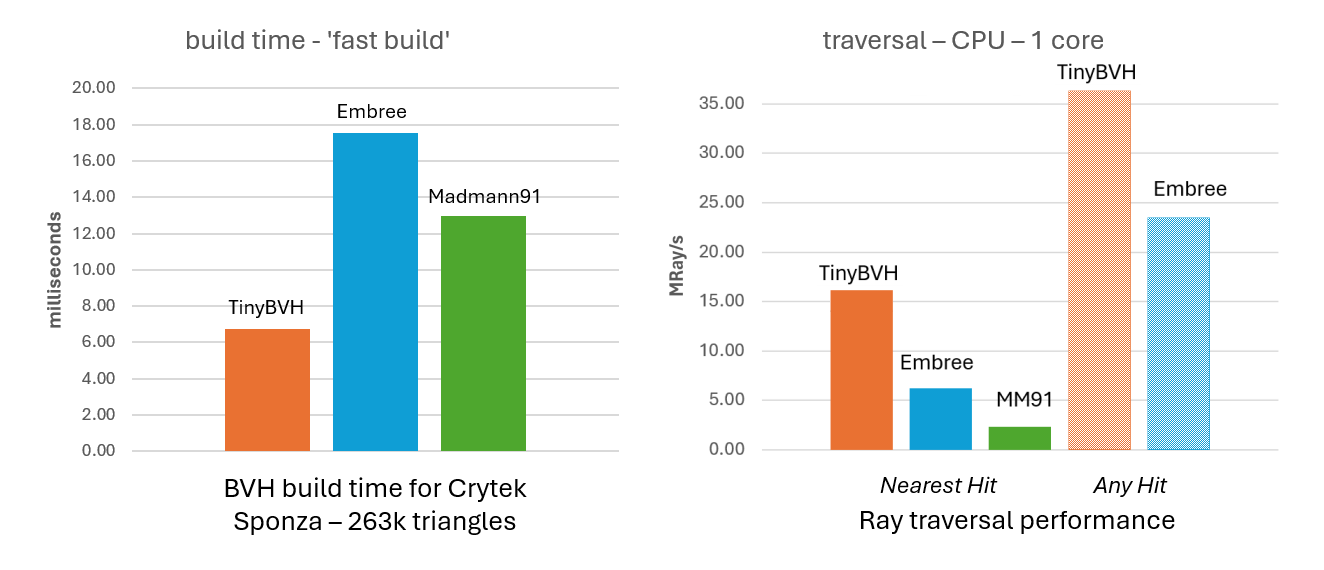 TinyBVH currently builds a SAH BVH faster than Embree and Madmann91. It also traces individual primary and 'any hit' rays faster than those libraries. Note: These results are based on the new
 tiny_bvh_benchmark.cpp application and are cautiously presented as 'preliminary'. Single-ray traversal is only a small part of Embree. If you suspect an imperfection in the experiment setup, please let me know.
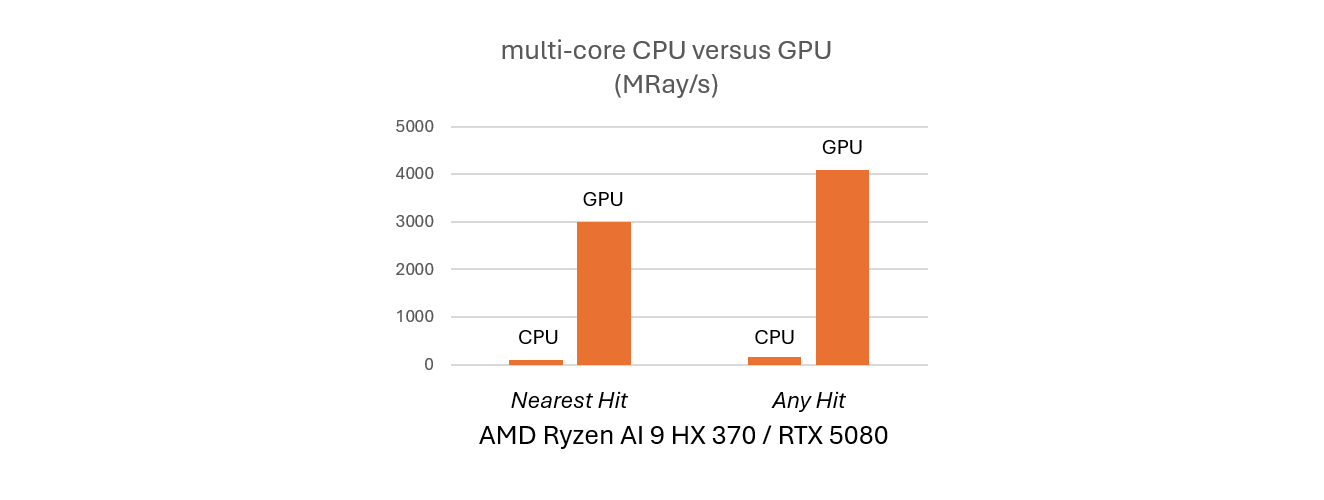 When tracing rays on the GPU, (multicore) CPU performance is dwarfed. On an RTX 5080 laptop GPU, TinyBVH traces up to 5 billion rays per second in Crytek's Sponza scene using the basic binary BVH format, regardless of graphics API and without using specialized ray tracing hardware. That is 5 rays per pixel at 4k@120Hz, enough for most purposes.
TinyBVH GPU ray traversal examples are available for OpenCL, OpenGL with compute shaders, DirectX12 and Vulkan. For OpenCL support, TinyOCL is provided: a single-header OpenCL library, which helps you select and initialize a compute device. It also loads, compiles and runs kernels, with several convenient features:
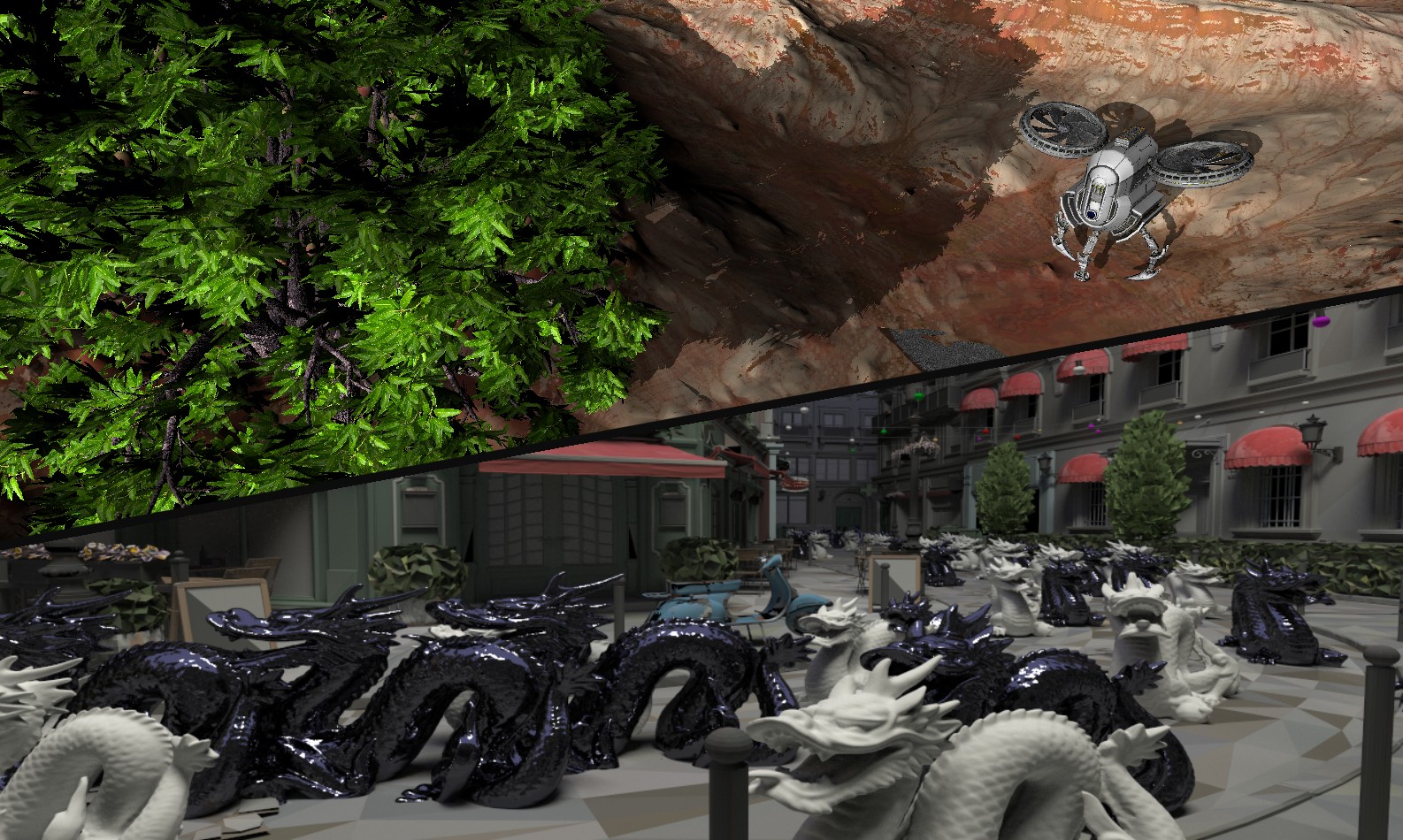
To use TinyOCL, just include tiny_ocl.h; this will automatically cause linking with OpenCL.lib in the 'external' folder, which in turn passes on work to vendor-specific driver code.
Note that the tiny_bvh.h library will work without tiny_ocl.h and remains dependency-free. The new tiny_ocl.h is only needed in projects that wish to trace rays on the GPU using BVHs created by tiny_bvh.h.
A Bounding Volume Hierarchy is a data structure used to quickly find intersections in a virtual scene; most commonly between a ray and a group of triangles. You can read more about this in a series of articles on the subject: https://jacco.ompf2.com/2022/04/13/how-to-build-a-bvh-part-1-basics .
To build a BVH using TinyBVH, simply call BVH::Build on an instantiated BVH. See tiny_bvh_minimal.cpp for a (really) small example.
Internally, the call is forwarded to a specialized builder. There are fast builders, builders for 'high quality' BVHs and experimental builders for research and development.
A constructed BVH can be used to intersect a ray with geometry, using BVH::Intersect or BVH::IsOccluded, for shadow (aka any hit) rays.
Apart from the default BVH layout (simply named BVH), several other layouts are available, which all serve one or more specific purposes. You can create a BVH in the desired layout by instantiating the appropriate class. The available layouts are:
BVH : A compact format that stores the AABB for a node, along with child pointers and leaf information in a cross-platform-friendly way. The 32-byte size allows for cache-line alignment.BVH_Double : Double-precision version of BVH.BVH4_Double : Double-precision version of BVH4_CPU, with AVX2 and NEON traversal kernels.MBVH<M> : In this (templated) format, each node stores M child pointers, reducing the depth of the tree. This improves performance for divergent rays. Based on the 2008 paper by Ingo Wald et al.BVH4_CPU : AVX2/NEON-optimized wide BVH traversal ("WiVe"). This is the fastest option on CPU.BVH8_CPU : AVX2/NEON-optimized wide BVH traversal ("WiVe"). BVH4_CPU is now faster; this format is left in for reference.BVH_GPU : This format uses 64 bytes per node and stores the AABBs of the two child nodes. This is the format presented in the 2009 Aila & Laine paper. It can be traversed with a simple GPU kernel.BVH4_GPU : A compact 4-wide BVH format, which may be faster for GPU ray tracing.BVH8_CWBVH : An advanced 80-byte representation of the 8-wide BVH, for state-of-the-art GPU rendering, based on the 2017 paper by Ylitie et al. and code by AlanIWBFT.A BVH in any format can be rebuilt at any time by calling the Build method on the changed triangle data. A BVH may also be refitted, in case the triangles moved, using BVH::Refit. Refitting is substantially faster than rebuilding and works well if the animation is subtle. Refitting does not work if polygon counts change.
Most layouts may be serialized and de-serialized via ::Save and ::Load.
TinyBVH also supports construction of a Top-Level Acceleration Structure (TLAS). The TLAS is a BVH over Bottom-Level Acceleration Structures (BLASes), where each BLAS is a BVH, with a 4x4 matrix transform. Different layouts can be combined under a single TLAS. The TLAS can be used for cheap rigid animation (by changing the transforms) as well as instancing.
A more complete overview of TinyBVH functionality can be found in the Basic Use Manual and the Advanced Topics Manual.
The library consists of tiny_bvh.h and the tiny_bvh_*.h headers next to it; keep them together and include only tiny_bvh.h. It is designed to be easy to use. Please have a look at tiny_bvh_minimal.cpp for an example. A Visual Studio 'solution' (.sln/.vcxproj) is included, as well as a CMake file. That being said: Most examples consist of only a single source file, which can be compiled with clang or g++, e.g.:
g++ examples/tiny_bvh_minimal.cpp
The cross-platform fenster-based single-source bitmap renderer can be compiled with
g++ -mwindows -O3 examples/tiny_bvh_fenster.cpp -o tiny_bvh_fenster (on Linux and Windows)
c++ --std=c++17 -framework Cocoa -O3 examples/tiny_bvh_fenster.cpp -o tiny_bvh_fenster (on macOS)
The multi-threaded path tracing demo can be compiled with
g++ -mwindows -O3 examples/tiny_bvh_pt.cpp -o tiny_bvh_pt (on Linux and Windows)
c++ --std=c++17 -framework Cocoa -O3 examples/tiny_bvh_pt.cpp -o tiny_bvh_pt (on macOS)
The performance measurement tool can be compiled with:
g++ -mavx2 -mfma -Ofast tiny_bvh_speedtest.cpp -o tiny_bvh_speedtest (on Linux and Windows)
c++ --std=c++17 -framework OpenCL -Ofast tiny_bvh_speedtest.cpp -o tiny_bvh_speedtest (on macOS)
Note: A new, more advanced benchmark tool is now available. See build.bat and build_debug.bat for an example of a command line to compile it using gcc.
Many additional demos are provided, demonstrating features of the library in small source files.
Basic use:
BVH bvh;
bvh.Build( (bvhvec4*)myTriData, triangleCount );
bvh.Intersect( ray );
To build a BVH for indexed vertices, use the new indexed interface:
BVH bvh;
bvh.Build( (bvhvec4*)vertices, (uint32_t*)indices, triangleCount );
New in 1.7.3: BVH build settings are now in BVHBase::settings:
struct BVHBuildSettings
{
    bool usePresplitting = false;	// pre-split triangles before building the BVH.
    bool useSpatialSplits = false;	// consider spatial splits during construction (SBVH).
    bool presplitPostPass = true;	// attempt to un-split primitives in leaves after a presplit build.
    float presplitFactor = 0.3f;	// presplit budget relative to input data size.
    bool useFullSweep = false;		// for experiments only; full-sweep SAH builder.
    bool postOptimize = false;		// optimize generated BVH using tree rotations.
    int optimizeIterations = 50;	// default optimization iterations.
    bool useSIMDifavailable = true;	// set to false to use the scalar reference builder.
};
This supersedes the calls to ::BuildHQ and ::BuildSIMD, which are now invoked from ::Build based on the hints in BVHBuildSettings. The old interface also remains available for now.
This version of the library includes the following functionality:
Besides basic examples demonstrating usage of the library, these more advanced examples are provided:
Advanced / exotic features of the library include:
The API of the library is stable. Changes may happen but should be limited.
TinyBVH is a cross-platform library and should build on any platform that supports C++17 (the '17' bit is for threading). That being said, several platforms are specifically supported:
x86-64 Windows/Linux: These platforms benefit from highly optimized SSE/AVX/AVX2 traversal kernels.OPENCL: Although TinyBVH does not directly use OpenCL, GPU-specific BVHs can be constructed and example code for BLAS/TLAS traversal in OpenCL is provided.OpenGL/compute: Example compute shader code for BLAS traversal is also provided.DirectX12: Benchmark code is provided to directly compare DXR against TinyBVH.Vulkan: Benchmark code is provided to directly compare Vulkan Ray Tracing against TinyBVH.ARM_NEON: Efficient BVH construction code is provided for ARM NEON. Several layouts use NEON intrinsics for fast traversal.ANDROID: This platform benefits from ARM NEON support as well as aligned memory allocation.APPLE: This platform benefits from ARM NEON support, dedicated paths in GPU example code and specialized support in TinyBVH itself.A list of projects using TinyBVH:
The TinyBVH library can now also be used from Rust, with the Rust bindings provided by David Peicho.
Florent Le Moël created Python bindings for TinyBVH. You can find details in the pytinybvh repository on GitHub.
Anders Forsgren provides TinyBVHNet, a .NET wrapper for TinyBVH, targeting net48 and net10.0. Get it via NuGet.
Created or know about other projects? Let me know!
TinyBVH received features and bug fixes from 34 contributors so far. Thanks! Feel free to submit PRs; please do so in the development branch for a good workflow.
Questions, remarks? Contact me at bikker.j@protonmail.com or bikker.j@gmail.com or Bluesky: @jbikker.bsky.social .
This library is made available under the MIT license, which starts as follows: "Permission is hereby granted, free of charge, .. , to deal in the Software without restriction". Enjoy. If you are using this work in your research, please cite TinyBVH: Details are available in BibTeX and APA format, see the 'About' section for this repo on GitHub.
The development of this library is supported by an AMD hardware grant.
The development of TinyBVH involves the use of AI tools. Specifically, AI is used to steer refactoring, where it recommends improvements which are then manually processed. AI is also occasionally used to translate between ISAs and APIs, e.g. between x86-64 and NEON and between DirectX12 and Vulkan.
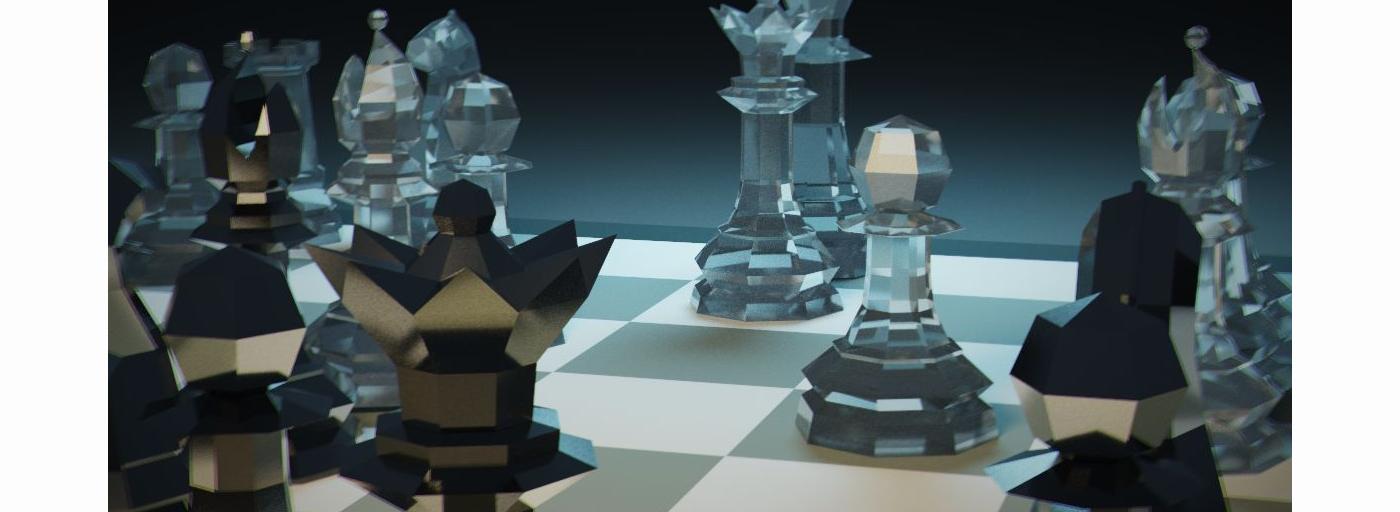
Image credit: Tamara Heeffer, IGAD / Breda University
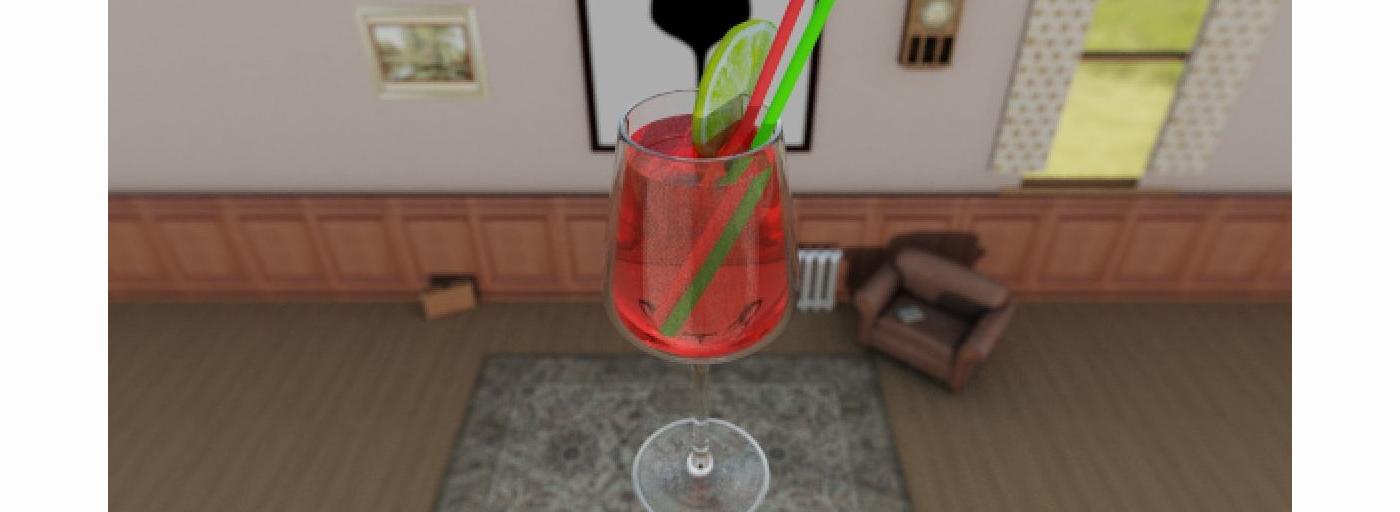
Image credit: Hesam Ghadimi, IGAD / Breda University
(top 24 of 30)
305 followers · starred Jun 2025
717 followers · starred Oct 2024
122 followers · starred Oct 2024
528 followers · starred Oct 2024
Header-only dependency-free BVH construction and traversal library.
See the codeHeader-only BVH construction and traversal library written in C++14 / "Sane C++" (or "C with classes"). C++17 is used for threading. This library has no dependencies.
TinyBVH is fast. Here is, in a nutshell, how it compares to Intel's Embree and Madmann91's BVH library.
TinyBVH currently builds a SAH BVH faster than Embree and Madmann91. It also traces individual primary and 'any hit' rays faster than those libraries. Note: These results are based on the new tiny_bvh_benchmark.cpp application and are cautiously presented as 'preliminary'. Single-ray traversal is only a small part of Embree. If you suspect an imperfection in the experiment setup, please let me know.
When tracing rays on the GPU, (multicore) CPU performance is dwarfed. On an RTX 5080 laptop GPU, TinyBVH traces up to 5 billion rays per second in Crytek's Sponza scene using the basic binary BVH format, regardless of graphics API and without using specialized ray tracing hardware. That is 5 rays per pixel at 4k@120Hz, enough for most purposes.
TinyBVH GPU ray traversal examples are available for OpenCL, OpenGL with compute shaders, DirectX12 and Vulkan. For OpenCL support, TinyOCL is provided: a single-header OpenCL library, which helps you select and initialize a compute device. It also loads, compiles and runs kernels, with several convenient features:
To use TinyOCL, just include tiny_ocl.h; this will automatically cause linking with OpenCL.lib in the 'external' folder, which in turn passes on work to vendor-specific driver code.
Note that the tiny_bvh.h library will work without tiny_ocl.h and remains dependency-free. The new tiny_ocl.h is only needed in projects that wish to trace rays on the GPU using BVHs created by tiny_bvh.h.
A Bounding Volume Hierarchy is a data structure used to quickly find intersections in a virtual scene; most commonly between a ray and a group of triangles. You can read more about this in a series of articles on the subject: https://jacco.ompf2.com/2022/04/13/how-to-build-a-bvh-part-1-basics .
To build a BVH using TinyBVH, simply call BVH::Build on an instantiated BVH. See tiny_bvh_minimal.cpp for a (really) small example.
Internally, the call is forwarded to a specialized builder. There are fast builders, builders for 'high quality' BVHs and experimental builders for research and development.
A constructed BVH can be used to intersect a ray with geometry, using BVH::Intersect or BVH::IsOccluded, for shadow (aka any hit) rays.
Apart from the default BVH layout (simply named BVH), several other layouts are available, which all serve one or more specific purposes. You can create a BVH in the desired layout by instantiating the appropriate class. The available layouts are:
BVH : A compact format that stores the AABB for a node, along with child pointers and leaf information in a cross-platform-friendly way. The 32-byte size allows for cache-line alignment.BVH_Double : Double-precision version of BVH.BVH4_Double : Double-precision version of BVH4_CPU, with AVX2 and NEON traversal kernels.MBVH<M> : In this (templated) format, each node stores M child pointers, reducing the depth of the tree. This improves performance for divergent rays. Based on the 2008 paper by Ingo Wald et al.BVH4_CPU : AVX2/NEON-optimized wide BVH traversal ("WiVe"). This is the fastest option on CPU.BVH8_CPU : AVX2/NEON-optimized wide BVH traversal ("WiVe"). BVH4_CPU is now faster; this format is left in for reference.BVH_GPU : This format uses 64 bytes per node and stores the AABBs of the two child nodes. This is the format presented in the 2009 Aila & Laine paper. It can be traversed with a simple GPU kernel.BVH4_GPU : A compact 4-wide BVH format, which may be faster for GPU ray tracing.BVH8_CWBVH : An advanced 80-byte representation of the 8-wide BVH, for state-of-the-art GPU rendering, based on the 2017 paper by Ylitie et al. and code by AlanIWBFT.A BVH in any format can be rebuilt at any time by calling the Build method on the changed triangle data. A BVH may also be refitted, in case the triangles moved, using BVH::Refit. Refitting is substantially faster than rebuilding and works well if the animation is subtle. Refitting does not work if polygon counts change.
Most layouts may be serialized and de-serialized via ::Save and ::Load.
TinyBVH also supports construction of a Top-Level Acceleration Structure (TLAS). The TLAS is a BVH over Bottom-Level Acceleration Structures (BLASes), where each BLAS is a BVH, with a 4x4 matrix transform. Different layouts can be combined under a single TLAS. The TLAS can be used for cheap rigid animation (by changing the transforms) as well as instancing.
A more complete overview of TinyBVH functionality can be found in the Basic Use Manual and the Advanced Topics Manual.
The library consists of tiny_bvh.h and the tiny_bvh_*.h headers next to it; keep them together and include only tiny_bvh.h. It is designed to be easy to use. Please have a look at tiny_bvh_minimal.cpp for an example. A Visual Studio 'solution' (.sln/.vcxproj) is included, as well as a CMake file. That being said: Most examples consist of only a single source file, which can be compiled with clang or g++, e.g.:
g++ examples/tiny_bvh_minimal.cpp
The cross-platform fenster-based single-source bitmap renderer can be compiled with
g++ -mwindows -O3 examples/tiny_bvh_fenster.cpp -o tiny_bvh_fenster (on Linux and Windows)
c++ --std=c++17 -framework Cocoa -O3 examples/tiny_bvh_fenster.cpp -o tiny_bvh_fenster (on macOS)
The multi-threaded path tracing demo can be compiled with
g++ -mwindows -O3 examples/tiny_bvh_pt.cpp -o tiny_bvh_pt (on Linux and Windows)
c++ --std=c++17 -framework Cocoa -O3 examples/tiny_bvh_pt.cpp -o tiny_bvh_pt (on macOS)
The performance measurement tool can be compiled with:
g++ -mavx2 -mfma -Ofast tiny_bvh_speedtest.cpp -o tiny_bvh_speedtest (on Linux and Windows)
c++ --std=c++17 -framework OpenCL -Ofast tiny_bvh_speedtest.cpp -o tiny_bvh_speedtest (on macOS)
Note: A new, more advanced benchmark tool is now available. See build.bat and build_debug.bat for an example of a command line to compile it using gcc.
Many additional demos are provided, demonstrating features of the library in small source files.
Basic use:
BVH bvh;
bvh.Build( (bvhvec4*)myTriData, triangleCount );
bvh.Intersect( ray );
To build a BVH for indexed vertices, use the new indexed interface:
BVH bvh;
bvh.Build( (bvhvec4*)vertices, (uint32_t*)indices, triangleCount );
New in 1.7.3: BVH build settings are now in BVHBase::settings:
struct BVHBuildSettings
{
    bool usePresplitting = false;	// pre-split triangles before building the BVH.
    bool useSpatialSplits = false;	// consider spatial splits during construction (SBVH).
    bool presplitPostPass = true;	// attempt to un-split primitives in leaves after a presplit build.
    float presplitFactor = 0.3f;	// presplit budget relative to input data size.
    bool useFullSweep = false;		// for experiments only; full-sweep SAH builder.
    bool postOptimize = false;		// optimize generated BVH using tree rotations.
    int optimizeIterations = 50;	// default optimization iterations.
    bool useSIMDifavailable = true;	// set to false to use the scalar reference builder.
};
This supersedes the calls to ::BuildHQ and ::BuildSIMD, which are now invoked from ::Build based on the hints in BVHBuildSettings. The old interface also remains available for now.
This version of the library includes the following functionality:
Besides basic examples demonstrating usage of the library, these more advanced examples are provided:
Advanced / exotic features of the library include:
The API of the library is stable. Changes may happen but should be limited.
TinyBVH is a cross-platform library and should build on any platform that supports C++17 (the '17' bit is for threading). That being said, several platforms are specifically supported:
x86-64 Windows/Linux: These platforms benefit from highly optimized SSE/AVX/AVX2 traversal kernels.OPENCL: Although TinyBVH does not directly use OpenCL, GPU-specific BVHs can be constructed and example code for BLAS/TLAS traversal in OpenCL is provided.OpenGL/compute: Example compute shader code for BLAS traversal is also provided.DirectX12: Benchmark code is provided to directly compare DXR against TinyBVH.Vulkan: Benchmark code is provided to directly compare Vulkan Ray Tracing against TinyBVH.ARM_NEON: Efficient BVH construction code is provided for ARM NEON. Several layouts use NEON intrinsics for fast traversal.ANDROID: This platform benefits from ARM NEON support as well as aligned memory allocation.APPLE: This platform benefits from ARM NEON support, dedicated paths in GPU example code and specialized support in TinyBVH itself.A list of projects using TinyBVH:
The TinyBVH library can now also be used from Rust, with the Rust bindings provided by David Peicho.
Florent Le Moël created Python bindings for TinyBVH. You can find details in the pytinybvh repository on GitHub.
Anders Forsgren provides TinyBVHNet, a .NET wrapper for TinyBVH, targeting net48 and net10.0. Get it via NuGet.
Created or know about other projects? Let me know!
TinyBVH received features and bug fixes from 34 contributors so far. Thanks! Feel free to submit PRs; please do so in the development branch for a good workflow.
Questions, remarks? Contact me at bikker.j@protonmail.com or bikker.j@gmail.com or Bluesky: @jbikker.bsky.social .
This library is made available under the MIT license, which starts as follows: "Permission is hereby granted, free of charge, .. , to deal in the Software without restriction". Enjoy. If you are using this work in your research, please cite TinyBVH: Details are available in BibTeX and APA format, see the 'About' section for this repo on GitHub.
The development of this library is supported by an AMD hardware grant.
The development of TinyBVH involves the use of AI tools. Specifically, AI is used to steer refactoring, where it recommends improvements which are then manually processed. AI is also occasionally used to translate between ISAs and APIs, e.g. between x86-64 and NEON and between DirectX12 and Vulkan.
Image credit: Tamara Heeffer, IGAD / Breda University
Image credit: Hesam Ghadimi, IGAD / Breda University
(top 24 of 30)
305 followers · starred Jun 2025
717 followers · starred Oct 2024
122 followers · starred Oct 2024
528 followers · starred Oct 2024



