
README
PatchWing
Verified bug fixing — not vulnerability discovery.
PatchWing takes a known bug — an advisory, a Semgrep hit, a fuzzer crash on code you already own — and produces a fix a maintainer can merge in a few minutes: a reproducer that fails before the fix and passes after, the patch itself, the project's own test suite still green, a byte-exact rollback proof, and a container anyone can re-run to check the whole thing by hand.
The patch is the cheap part — a model will write a plausible one on demand. The product is the evidence that the patch closes the specific bug and that removing it brings the bug back. Nobody merges an AI patch on faith; PatchWing is built to make the review cheaper than ignoring the finding.
Finding bugs at scale is a solved-enough problem. Fixing them at the same scale, with proof, is not. PatchWing is built for the fixing half.
What it costs: the decompress CVE below was reproduced, patched, and verified for ≈ $1.28
on a hosted endpoint (~4¢ on a cheap model tier, ~$0 self-hosted) — under a $25 ceiling it never
approached. The average data breach costs $4.99M (IBM 2026).
Full breakdown: Why PatchWing → The economics are lopsided.
Documentation
New here? Start with Why PatchWing for the case, then the User Manual to install and run.
| Document | What it covers |
|---|---|
| Why PatchWing | The case: finding isn't the bottleneck, verified fixing is — and why nothing else covers it. Read this first. |
| The economics | The business case on one page: what a fix really costs (~$1.28) against what a breach costs ($4.99M), with an illustrative calculator. |
| User Manual (Word) | The full manual with screenshots — install, configure, run, read the output. |
| Tutorial | Install → point it at your own endpoint → add & run a finding → read the bundle. |
| Worked example | A real CVE (decompress Zip-Slip) closed end-to-end, with the actual diff and red→green→revert→red chain. |
| Evidence package | Anatomy of the output bundle — the provenance and the apply/verify/rollback scripts a maintainer runs. |
| Release notes & field report | What works today, honest model-performance notes, a failed run written up in full, and what to expect operating PatchWing through an AI agent. |
| Example bundle | A complete, real evidence bundle (126 files) you can inspect and re-run offline. |
Status — September 2026
Read this before anything else. It is deliberately un-varnished.
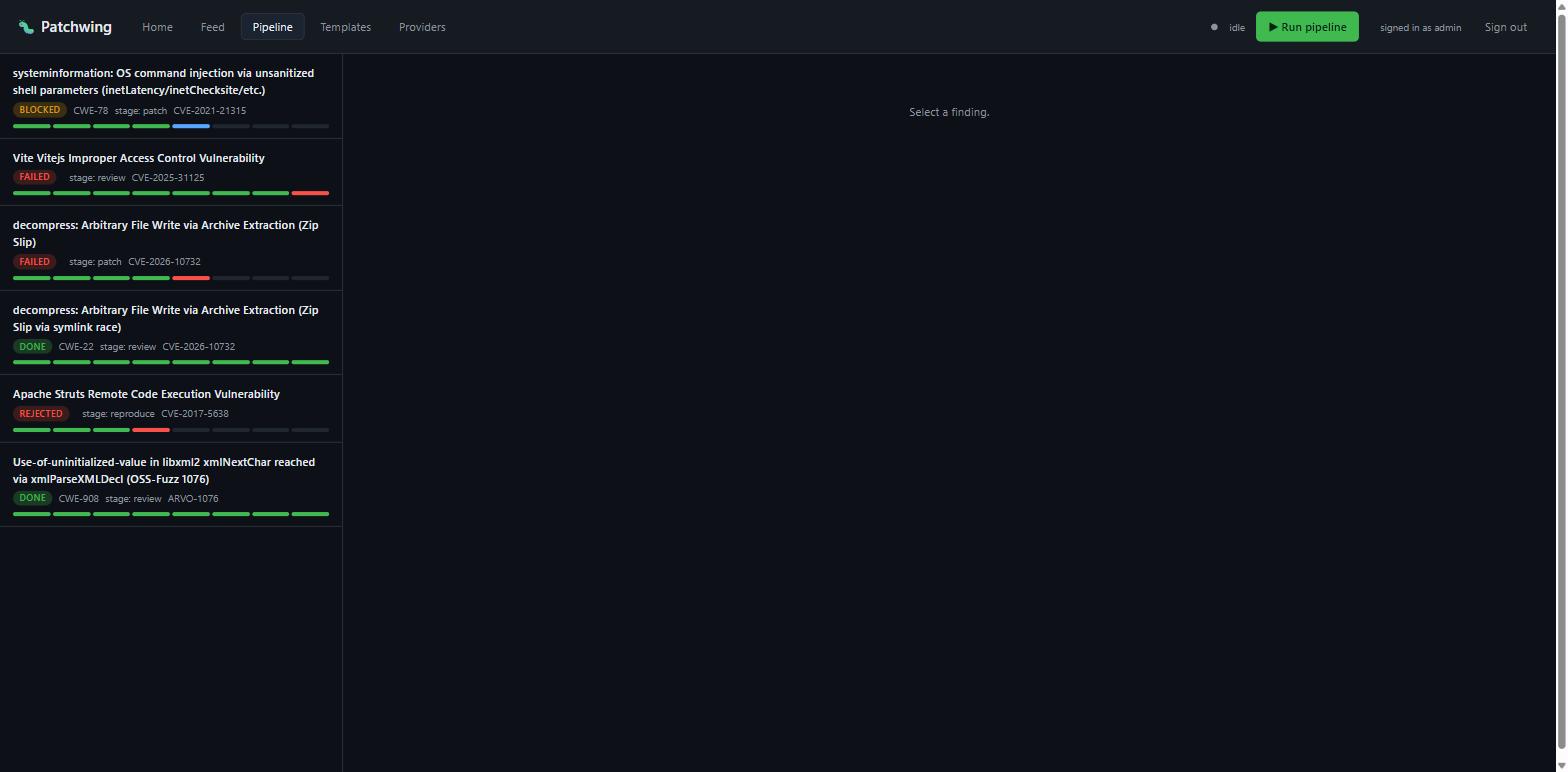
- The pipeline runs end-to-end. Three real CVEs have been carried
ingest → localize → reproduce → patch → verify → package, each producing a full evidence bundle (see Worked examples). - All three completed the full chain —
red → patch → green → rollback → red again. Vite got there last: the verifier first refused to certify a rollback it could not actually observe (harness_fault, not a fake red), which surfaced a genuine harness bug — a long-lived dev-server reproducer reused a stale server across the rollback leg. Once that was fixed (a pre-rollback daemon reset), Vite's chain closed too. The refusal doing its job — exposing a real defect instead of papering over it — is the system working as designed. - It is still early. Single-operator development deployment. All three model seats currently run the same model, so the "independent second opinion" is advisory only — and the tool says so, in the evidence itself. No upstream pull request has been submitted anywhere yet, and the disclosure policy is not finalised. (The licence is: released under Apache 2.0.)
- What it does not do yet: prove a patch is globally correct (only that the frozen reproducer flips and the suite stays green), run a genuinely different-family verifier, or operate unattended against repositories you do not control.
If a claim here is not backed by an artifact you can recompute, it is a bug in this document.
What it is not
- Not exploit discovery. Reproducers stay at Definition A: a trigger input plus an observable boundary violation. It stops at "the bad outcome happened" and never proceeds to "and here is what an attacker does next."
- Not a scanner. Discovery is an input. You run your own fuzzers (AFL++) and sanitiser builds (ASan/MSan/UBSan) on code you own; PatchWing consumes the crash or the advisory and fixes it. It never goes hunting on systems the operator does not control.
- Not autonomous. A machine never signs off its own patch. The terminal stage is a human reading a prepared package.
- Not "auto-remediation." That term now means dependency version-bumping (GitLab, Snyk, Dependabot) — swapping to a fixed release when one already exists. PatchWing's whole reason to exist is the bugs where there is no version to bump to because nobody has written the fix yet.
The pipeline
ingest     validate the finding has enough to work with
localize   narrow to the files holding the flaw
reproduce  build a reproducer that FAILS on the unpatched code, then FREEZE it
patch      generate the fix (a minimal diff) plus, where possible, a regression test
verify     in a sandbox: apply, reproducer passes, project suite stays green,
           then roll back and prove the bug returns
package    assemble the evidence bundle a human will read
review     human sign-off — a machine never signs its own work off
Each finding is a row in a SQLite database; each stage is a function; progress is a loop. There is no workflow engine. The deployment target is a customer's VPC with no outbound network, and shipping a server, a database and a UI into a security review is a liability.
The bar for the output is a single sentence: a PatchWing PR must be cheaper to review than to ignore. If review takes more than a few minutes, we have added load to the maintainers who are the real bottleneck, not removed it.
How a "green" is actually decided
This is the load-bearing part of PatchWing and the reason its "pass" is worth anything. The intuitive version — "run the reproducer, check the exit code" — is wrong in two ways that matter.
1. The verdict is read from the reproducer's output, never its exit code
verify runs the reproducer inside the pod, captures stdout+stderr, and classifies that
text. Exit code is secondary, consulted only when there is no marker — because real targets
lie about exit codes: an ASan build under one harness exits 1 on everything, MemorySanitizer
with abort_on_error=0 exits 0 on a genuine failure, and a missing mount also exits 1.
Under a naive "non-zero = bug reproduced" rule, every malfunction reads as a successful
reproduction — and at rollback the assertion literally is "red again," so any malfunction
would satisfy it. A check that cannot fail.
So a red is: a sanitizer marker plus a matching crash identity (DEDUP_TOKEN), or for an
HTTP-shaped finding, the operator's declared evidence rule firing against the parsed wire
output.
2. There are four states, never two
| state | meaning |
|---|---|
confirmed_red | marker/rule present and the crash identity matches the pristine reproducer |
confirmed_green | clean, no marker, and every declared rule was affirmatively reached with a non-vulnerable reading |
different_bug | a marker fired, but the crash identity does not match — this is not our bug |
harness_fault | no marker + non-zero exit, or a timeout, or a reading too fast to be real |
different_bug and harness_fault are neither red nor green and must never fold into
either. The whole module exists to prevent one failure mode, stated four different ways in
four different files:
Absence must never wear failure's face. A timeout is not a rejection. Exit-1-with-no-marker is not a reproduction. A broken build is not a verdict on the patch. An infrastructure error is not a judgement.
Every terminal path that is not a real verdict carries patch_evaluated: false.
3. The chain: red → apply → green → revert → red again
All inside one persistent container (a deliberate, narrow exception to one-container-per-attempt — a fresh pod would reintroduce every variable the rollback exists to hold still):
- hash the target file (before_patch)
- apply the fix, hash again (after_patch)
- re-hash the frozen reproducer files — any change voids the run (the "wall")
- build, run the reproducer, classify → must be
confirmed_green - only then, the rollback leg: revert to the exact pre-patch bytes, hash (after_revert),
and assert
after_revert == before_patchbyte for byte (the §6a hash triple); rebuild, re-run → must readconfirmed_redagain.
There is deliberately no "re-apply and leave it green" step. The proof is the chain itself: it shows both that the fix closes the bug and that the fix is what closed it (removing it brings the bug back). The green fix lives in the patch artifact and the evidence bundle, never in the container's final state, which is torn down.
Rollback is evidence, not a gate. If the revert does not come back red, that does not
reject the patch — the container already ruled green. A green-then-not-red result indicts the
undo mechanism or the oracle, not the fix, and is recorded honestly as
verify_green_rollback_not_red. The one outcome the whole design exists to produce is
verify_green_rollback_red — the full chain.
4. The wall
The reproducer's files are frozen under sha256 before any patch exists and re-checked after the patch is applied and again after the suite runs. If any byte changed, the run is void. So a "pass" cannot have been obtained by weakening the test. Every evidence bundle prints the frozen hashes so a reviewer can recompute them.
Worked examples
These are real findings closed by the running pipeline. Each is reproduced in examples/
with the full evidence bundle; the diffs and readings below are copied verbatim from the
database.
1. decompress — CVE-2026-10732, Zip Slip via symlink race (full chain) ✅
CWE-22 · npm · kevva/decompress — an archive
with two entries at the same path (a symlink to an arbitrary target, then a regular file)
writes the file's content through the symlink, outside the output directory. Root cause: the
symlink guard runs concurrently via Promise.all(files.map(...)), so it checks for the
symlink before the earlier entry has finished creating it.
The fix serialises extraction so each entry is fully written before the next entry's safety checks run:
--- a/node_modules/decompress/index.js
+++ b/node_modules/decompress/index.js
@@ -73,7 +73,7 @@
 		return files;
 	}

-	return Promise.all(files.map(x => {
+	return files.reduce((promise, x) => promise.then(() => {
 		const dest = path.join(output, x.path);
 		const mode = x.mode & ~process.umask();
 		const now = new Date();
@@ -125,7 +125,7 @@
 			.then(() => x.type === 'file' && fsP.utimes(dest, now, x.mtime))
 			.then(() => x);
-	}));
+	}), Promise.resolve()).then(() => files);
 });
The chain, verbatim:
UNPATCHED  →  {"status":"extracted","zipslip_pwned":"True",...}     confirmed_red
PATCHED    →  {"status":"error","error":"Refusing to write into a
               symlink","zipslip_pwned":"False"}                    confirmed_green
REVERTED   →  {"status":"extracted","zipslip_pwned":"True",...}     confirmed_red  (again)

§6a hash triple:  8829ae54… → 9029a6d8… → 8829ae54…   after_revert == before_patch ✓
wall: 3 files, sha256, intact          outcome: verify_green_rollback_red
The honest caveat, from the bundle itself. The advisory reviewer (see below) marked this
patch "concerns": the serial fix closes the reproduced race, but it flagged residual
CWE-22 surface the reproducer does not exercise — a broken indexOf-based path-containment
prefix check, symlink targets never validated against the output root, and a residual TOCTOU
window. This is exactly the boundary of what a container can prove: the reproducer is
demonstrably closed; that the patch is globally correct is not, and the bundle says so
rather than implying otherwise.
2. libxml2 — OSS-Fuzz 1076, use-of-uninitialised-value (full chain, native) ✅
CWE-908 · C · ASan/MSan. The sanitizer-kind counterpart, to show the pipeline is not
HTTP-only. The reproducer is a 699-byte input; the pristine reading is
SUMMARY: MemorySanitizer: use-of-uninitialized-value, exit 77, with a DEDUP_TOKEN crash
identity. The full chain completed: patched build clears the sanitizer, reverting brings the
same DEDUP_TOKEN back at exit 77 — verify_green_rollback_red. The verdict is read from the
sanitizer marker and token, never the exit code (which is a non-distinctive 1 or 77 on
this target).
3. Vite — CVE-2025-31125, fs.deny bypass (full chain — and how it got there) ✅
npm · vitejs/vite — ?raw?import / ?inline&import
requests served file content past the server.fs.deny allow-list. The fix adds a serving-access
check for those import requests:
--- a/packages/vite/src/node/server/middlewares/transform.ts
+++ b/packages/vite/src/node/server/middlewares/transform.ts
@@ -72,6 +72,17 @@
     const withoutQuery = cleanUrl(url)

+    if (
+      (/[?&]raw(?:[?&]|$)/.test(url) || /[?&]inline(?:[?&]|$)/.test(url)) &&
+      isImportRequest(req)
+    ) {
+      if (!ensureServingAccess(url, server)) {
+        return next()
+      }
+    }
+
     try {
- Red, proven: unpatched, the dev server returned
HTTP/1.1 200serving the planted canaryexport default "PW-VITE-SIDECHANNEL-a3f9b1c7-LEAKED"—confirmed_red. - Green, proven: patched,
HTTP/1.1 403 Forbidden … outside of Vite serving allow list, canary not leaked —confirmed_green. Theafter_revert == before_patchhash triple passed. - Rollback, at first not certified: on the reverted tree the rebuilt server still
returned 403, so the classifier called it
harness_fault— it refused to record a red it could not actually observe — and the outcome wasverify_green_rollback_not_red. Root cause (proven by PID reuse): the reproducer starts the Vite dev server with a "start only if not already running" guard, so the green leg's server — still holding the patched code in memory — was reused on the rollback run instead of relaunching against the reverted code. - Rollback, fixed and certified: a pre-rollback daemon reset in the verify leg kills the
lingering server so the reproducer's own guard relaunches it fresh against the reverted
dist. The rollback then read
confirmed_red(the canary leaked again) →verify_green_rollback_red, full chain. Re-verified live at zero model spend.
We keep this example because of how it was found. The four-state classifier refused to fake a red it couldn't observe, and that refusal is exactly what surfaced the harness bug. A "non-zero = reproduced" oracle would have rubber-stamped a green-looking rollback and hidden the defect; the honest one turned it into a fix.
The evidence package ("documents for people to do it")
Every closed finding emits a single reviewable bundle. It is designed so a maintainer who has never heard of PatchWing can accept or reject it without trusting us. It contains:
- What was wrong and why this fix closes it, in plain prose.
- The reproducer, and the
confirmed_redreading it produced on the unpatched code. - The patch (minimal diff) and the
confirmed_greenreading after it. - The chain — the §6a hash triple and the red-again reading (or an honest note that it was not certified).
- Re-run it yourself — the exact sandbox to reproduce by hand:
backend : podman image : patchwing-provisioned-<finding-id> network : none (disabled, so nothing can phone home mid-run) reproduce : cd <target> && bash reproduce.sh - Reproducer attestation — the frozen sha256 of every reproducer file, to recompute.
- Advisory review — a model's opinion on the patch, clearly stamped "an opinion, not a verdict; it did not and cannot change the pass/fail decided by the container," printed with the exact model, endpoint, temperature and independence caveat that produced it, because a verdict has been observed to flip on a single flag.
- Cost — calls, tokens and dollars per seat.
Design decisions
- Findings are rows, stages are functions, progress is a loop. No Temporal/Airflow/Argo. When durable cross-machine retries genuinely become necessary, the stage contract ports without callers changing.
- All state in one SQLite file. The flow must be inspectable by a human without running
PatchWing —
sqlite3 patchwing.dbbeats any dashboard. - Patches are never rebased. Every artifact records the commit it was generated against. If the repo moved while a finding sat in review, the patch is stale by definition and the stage regenerates it. This eliminates PR-time desync as a class of bug.
- Models are per-role and swappable.
provision,patchandverifyeach get their own endpoint, model and key. Everything speaks OpenAI-compatible, so Together, Z.ai, vLLM, Ollama and llama.cpp are config, not code. The fix-writer is interchangeable by design: the container decides whether a patch is accepted, not the model's reputation. - No default provider. Point it at your own inference server. When Hugging Face was breached in July 2026, commercial frontier models refused to analyse the attack logs — guardrails could not distinguish an attacker building an exploit from a defender detecting one — and HF ran an open-weight model inside their own perimeter instead. PatchWing assumes that posture from the start.
Usage
cp patchwing.example.toml patchwing.toml       # then edit it
export PATCHWING_PATCH_KEY=...                 # keys live in the environment, never the file

python -m patchwing.cli config                 # show what resolved (keys masked)
python -m patchwing.cli preflight              # probe endpoints before spending

python -m patchwing.cli add https://github.com/org/proj \
    --source advisory --ref GHSA-xxxx-1111 --cwe CWE-787 \
    --title "Heap overflow in parser"

python -m patchwing.cli run                    # advance everything that is ready
python -m patchwing.cli status                 # stage × state matrix
python -m patchwing.cli list --state blocked
python -m patchwing.cli show <id>              # artifacts, events, staleness
python -m patchwing.cli unblock <id> --note "reviewed"
The pipeline runs with no models configured — stages needing one block with a reason — so you can see its shape before committing a key.
Preflight
Before a campaign, preflight checks every configured role for reachability, structured-output
adherence, and whether the endpoint will engage with a plainly defensive security question.
Non-zero exit if any role fails, so it drops into CI. That third check exists because it is the
failure that stopped Hugging Face's blue team: learning your endpoint refuses benign defensive
prompts is free at startup and expensive three hours into a batch.
Configuration shape
Per-role model config, plus sandbox and per-finding limits (keys resolve from the environment):
[models.patch]
endpoint    = "https://your-endpoint/v1"
model       = "your-model"
temperature = 0.2          # retry variance for stuck patches
max_tokens  = 65536
api_key_env = "PATCHWING_PATCH_KEY"

[models.verify]
temperature = 0.0          # maximum determinism for the verdict seat
# ... endpoint / model / api_key_env as above

[sandbox]
backend           = "podman"
network           = "none"     # the reproducer pod cannot reach the network
provision_network = "bridge"   # only the build phase may fetch dependencies
cpus              = 2.0
memory            = "2g"

[pipeline]
max_attempts           = 4
max_usd_per_finding    = 25.0
max_patch_bytes        = 65536
reproducer_scope       = "definition_a"   # the scope boundary, enforced
Model stack
The discovery-adjacent half can run entirely on open weights, air-gapped; only the fixer needs a large model.
| role | component | licence | notes |
|---|---|---|---|
| prefilter | Semgrep CE | LGPL | cheap, deterministic, noisy |
| crash discovery | AFL++ / ASan | OSS | uncontaminated by construction |
| localization | small open localizer | Apache-2.0 | ranking aid |
| fixer | a large open-weight code model (e.g. GLM-5.2, MIT) | MIT | the only stage needing a big model |
| verifier | should be a different family than the fixer | — | see limitations |
Avoid CodeQL (commercially restricted) for anything you intend to redistribute.
Sandbox posture
Containers are the default sandbox; the repo's own Dockerfile / .devcontainer.json defines
the environment. The reproducer pod runs with network: none; only the build/provision phase
is allowed a bridge, and even that logs every host it resolves so an egress allowlist can be
built from observed traffic. Firecracker microVMs are the stronger-isolation option for
deployments with nested virtualisation available.
Evaluation & the contamination trap
Ground truth comes from known CVE-fix pairs: the pre-patch commit is the bug, the upstream diff is the answer. Contamination is the trap that would silently invalidate everything — GHSA advisories and their fixes are in the training data of every candidate model, so a high score can measure memorisation rather than capability. Mitigations: weight toward advisories published after model cutoffs, use fresh fuzzer crashes with no public fix, and keep a blind set that is never iterated on. Harnesses worth reusing: ZeroDayBench (built specifically against contamination), ARVO (real reproduced OSS-Fuzz bugs — closest to PatchWing's task; grade on the reproducer flip, never on commit-match, since ARVO's fix labels are noisy).
Security & scope
PatchWing is defensive-only. It fixes bugs in code the operator controls or is authorised to fix; it does not scan, hunt, or probe third-party systems, and its reproducers stop at Definition A (an observable boundary violation), never at a weaponised exploit chain. The worked examples above use CVEs that are already public and already fixed upstream — they are evaluation targets, not disclosures.
If you find a security issue in PatchWing itself, please open a private report rather than a
public issue. (A standalone SECURITY.md accompanies this README with the reporting address.)
Limitations (the honest list)
- Correctness ≠ test-passing. The container proves the frozen reproducer flips and the
suite stays green. It does not prove the patch is semantically correct in general — see
the residual CWE-22 the reviewer flagged on the
decompresspatch. This is the real open research problem in the stack. - The verifier currently shares a model family with the fixer. All three seats run one
model today, so the "adversarial second opinion" is advisory only and its errors correlate
with the fixer's. The evidence bundle stamps this as
independence: WEAKrather than hiding it. A genuinely different-family verifier is the intended state. - Long-lived-server reproducers need a clean restart between the green and rollback legs. A daemon reproducer that reuses an already-running server would read the patched server on the rollback run; the verify leg now resets lingering listeners before the rollback reproduce so the reproducer relaunches against the reverted code (fixed; see Vite). The general principle stands: when the tool genuinely cannot observe a red, it records the honest outcome rather than faking one.
- Single-operator dev deployment. Not multi-tenant; the admin web plane is unhardened and intended for localhost / a trusted host only. Harden before any networked use.
- No upstream PR has been submitted anywhere. The receipts are self-contained bundles, not merged fixes — yet.
Licence
Apache License 2.0. Free to use for any purpose, including commercial and
enterprise use, with an explicit patent grant. Attribution is appreciated but not required —
see NOTICE; if PatchWing is useful to you, a link back is welcome.
Nothing in the fixer/verifier stack forces a copyleft licence (GLM-5.2 is MIT; the small open models are Apache-2.0). Avoid bundling anything commercially restricted (e.g. CodeQL) if you redistribute.
Every evidence bundle is generated by PatchWing and then reviewed by a human before submission. The fix is tested, not trusted: which model wrote it does not affect the verdict.
See what people are saying
Similar repos


Languages
Python
92.9%
HTML
7.1%
README
PatchWing
Verified bug fixing — not vulnerability discovery.
PatchWing takes a known bug — an advisory, a Semgrep hit, a fuzzer crash on code you already own — and produces a fix a maintainer can merge in a few minutes: a reproducer that fails before the fix and passes after, the patch itself, the project's own test suite still green, a byte-exact rollback proof, and a container anyone can re-run to check the whole thing by hand.
The patch is the cheap part — a model will write a plausible one on demand. The product is the evidence that the patch closes the specific bug and that removing it brings the bug back. Nobody merges an AI patch on faith; PatchWing is built to make the review cheaper than ignoring the finding.
Finding bugs at scale is a solved-enough problem. Fixing them at the same scale, with proof, is not. PatchWing is built for the fixing half.
What it costs: the decompress CVE below was reproduced, patched, and verified for ≈ $1.28
on a hosted endpoint (~4¢ on a cheap model tier, ~$0 self-hosted) — under a $25 ceiling it never
approached. The average data breach costs $4.99M (IBM 2026).
Full breakdown: Why PatchWing → The economics are lopsided.
Documentation
New here? Start with Why PatchWing for the case, then the User Manual to install and run.
| Document | What it covers |
|---|---|
| Why PatchWing | The case: finding isn't the bottleneck, verified fixing is — and why nothing else covers it. Read this first. |
| The economics | The business case on one page: what a fix really costs (~$1.28) against what a breach costs ($4.99M), with an illustrative calculator. |
| User Manual (Word) | The full manual with screenshots — install, configure, run, read the output. |
| Tutorial | Install → point it at your own endpoint → add & run a finding → read the bundle. |
| Worked example | A real CVE (decompress Zip-Slip) closed end-to-end, with the actual diff and red→green→revert→red chain. |
| Evidence package | Anatomy of the output bundle — the provenance and the apply/verify/rollback scripts a maintainer runs. |
| Release notes & field report | What works today, honest model-performance notes, a failed run written up in full, and what to expect operating PatchWing through an AI agent. |
| Example bundle | A complete, real evidence bundle (126 files) you can inspect and re-run offline. |
Status — September 2026
Read this before anything else. It is deliberately un-varnished.
- The pipeline runs end-to-end. Three real CVEs have been carried
ingest → localize → reproduce → patch → verify → package, each producing a full evidence bundle (see Worked examples). - All three completed the full chain —
red → patch → green → rollback → red again. Vite got there last: the verifier first refused to certify a rollback it could not actually observe (harness_fault, not a fake red), which surfaced a genuine harness bug — a long-lived dev-server reproducer reused a stale server across the rollback leg. Once that was fixed (a pre-rollback daemon reset), Vite's chain closed too. The refusal doing its job — exposing a real defect instead of papering over it — is the system working as designed. - It is still early. Single-operator development deployment. All three model seats currently run the same model, so the "independent second opinion" is advisory only — and the tool says so, in the evidence itself. No upstream pull request has been submitted anywhere yet, and the disclosure policy is not finalised. (The licence is: released under Apache 2.0.)
- What it does not do yet: prove a patch is globally correct (only that the frozen reproducer flips and the suite stays green), run a genuinely different-family verifier, or operate unattended against repositories you do not control.
If a claim here is not backed by an artifact you can recompute, it is a bug in this document.
What it is not
- Not exploit discovery. Reproducers stay at Definition A: a trigger input plus an observable boundary violation. It stops at "the bad outcome happened" and never proceeds to "and here is what an attacker does next."
- Not a scanner. Discovery is an input. You run your own fuzzers (AFL++) and sanitiser builds (ASan/MSan/UBSan) on code you own; PatchWing consumes the crash or the advisory and fixes it. It never goes hunting on systems the operator does not control.
- Not autonomous. A machine never signs off its own patch. The terminal stage is a human reading a prepared package.
- Not "auto-remediation." That term now means dependency version-bumping (GitLab, Snyk, Dependabot) — swapping to a fixed release when one already exists. PatchWing's whole reason to exist is the bugs where there is no version to bump to because nobody has written the fix yet.
The pipeline
ingest     validate the finding has enough to work with
localize   narrow to the files holding the flaw
reproduce  build a reproducer that FAILS on the unpatched code, then FREEZE it
patch      generate the fix (a minimal diff) plus, where possible, a regression test
verify     in a sandbox: apply, reproducer passes, project suite stays green,
           then roll back and prove the bug returns
package    assemble the evidence bundle a human will read
review     human sign-off — a machine never signs its own work off
Each finding is a row in a SQLite database; each stage is a function; progress is a loop. There is no workflow engine. The deployment target is a customer's VPC with no outbound network, and shipping a server, a database and a UI into a security review is a liability.
The bar for the output is a single sentence: a PatchWing PR must be cheaper to review than to ignore. If review takes more than a few minutes, we have added load to the maintainers who are the real bottleneck, not removed it.
How a "green" is actually decided
This is the load-bearing part of PatchWing and the reason its "pass" is worth anything. The intuitive version — "run the reproducer, check the exit code" — is wrong in two ways that matter.
1. The verdict is read from the reproducer's output, never its exit code
verify runs the reproducer inside the pod, captures stdout+stderr, and classifies that
text. Exit code is secondary, consulted only when there is no marker — because real targets
lie about exit codes: an ASan build under one harness exits 1 on everything, MemorySanitizer
with abort_on_error=0 exits 0 on a genuine failure, and a missing mount also exits 1.
Under a naive "non-zero = bug reproduced" rule, every malfunction reads as a successful
reproduction — and at rollback the assertion literally is "red again," so any malfunction
would satisfy it. A check that cannot fail.
So a red is: a sanitizer marker plus a matching crash identity (DEDUP_TOKEN), or for an
HTTP-shaped finding, the operator's declared evidence rule firing against the parsed wire
output.
2. There are four states, never two
| state | meaning |
|---|---|
confirmed_red | marker/rule present and the crash identity matches the pristine reproducer |
confirmed_green | clean, no marker, and every declared rule was affirmatively reached with a non-vulnerable reading |
different_bug | a marker fired, but the crash identity does not match — this is not our bug |
harness_fault | no marker + non-zero exit, or a timeout, or a reading too fast to be real |
different_bug and harness_fault are neither red nor green and must never fold into
either. The whole module exists to prevent one failure mode, stated four different ways in
four different files:
Absence must never wear failure's face. A timeout is not a rejection. Exit-1-with-no-marker is not a reproduction. A broken build is not a verdict on the patch. An infrastructure error is not a judgement.
Every terminal path that is not a real verdict carries patch_evaluated: false.
3. The chain: red → apply → green → revert → red again
All inside one persistent container (a deliberate, narrow exception to one-container-per-attempt — a fresh pod would reintroduce every variable the rollback exists to hold still):
- hash the target file (before_patch)
- apply the fix, hash again (after_patch)
- re-hash the frozen reproducer files — any change voids the run (the "wall")
- build, run the reproducer, classify → must be
confirmed_green - only then, the rollback leg: revert to the exact pre-patch bytes, hash (after_revert),
and assert
after_revert == before_patchbyte for byte (the §6a hash triple); rebuild, re-run → must readconfirmed_redagain.
There is deliberately no "re-apply and leave it green" step. The proof is the chain itself: it shows both that the fix closes the bug and that the fix is what closed it (removing it brings the bug back). The green fix lives in the patch artifact and the evidence bundle, never in the container's final state, which is torn down.
Rollback is evidence, not a gate. If the revert does not come back red, that does not
reject the patch — the container already ruled green. A green-then-not-red result indicts the
undo mechanism or the oracle, not the fix, and is recorded honestly as
verify_green_rollback_not_red. The one outcome the whole design exists to produce is
verify_green_rollback_red — the full chain.
4. The wall
The reproducer's files are frozen under sha256 before any patch exists and re-checked after the patch is applied and again after the suite runs. If any byte changed, the run is void. So a "pass" cannot have been obtained by weakening the test. Every evidence bundle prints the frozen hashes so a reviewer can recompute them.
Worked examples
These are real findings closed by the running pipeline. Each is reproduced in examples/
with the full evidence bundle; the diffs and readings below are copied verbatim from the
database.
1. decompress — CVE-2026-10732, Zip Slip via symlink race (full chain) ✅
CWE-22 · npm · kevva/decompress — an archive
with two entries at the same path (a symlink to an arbitrary target, then a regular file)
writes the file's content through the symlink, outside the output directory. Root cause: the
symlink guard runs concurrently via Promise.all(files.map(...)), so it checks for the
symlink before the earlier entry has finished creating it.
The fix serialises extraction so each entry is fully written before the next entry's safety checks run:
--- a/node_modules/decompress/index.js
+++ b/node_modules/decompress/index.js
@@ -73,7 +73,7 @@
 		return files;
 	}

-	return Promise.all(files.map(x => {
+	return files.reduce((promise, x) => promise.then(() => {
 		const dest = path.join(output, x.path);
 		const mode = x.mode & ~process.umask();
 		const now = new Date();
@@ -125,7 +125,7 @@
 			.then(() => x.type === 'file' && fsP.utimes(dest, now, x.mtime))
 			.then(() => x);
-	}));
+	}), Promise.resolve()).then(() => files);
 });
The chain, verbatim:
UNPATCHED  →  {"status":"extracted","zipslip_pwned":"True",...}     confirmed_red
PATCHED    →  {"status":"error","error":"Refusing to write into a
               symlink","zipslip_pwned":"False"}                    confirmed_green
REVERTED   →  {"status":"extracted","zipslip_pwned":"True",...}     confirmed_red  (again)

§6a hash triple:  8829ae54… → 9029a6d8… → 8829ae54…   after_revert == before_patch ✓
wall: 3 files, sha256, intact          outcome: verify_green_rollback_red
The honest caveat, from the bundle itself. The advisory reviewer (see below) marked this
patch "concerns": the serial fix closes the reproduced race, but it flagged residual
CWE-22 surface the reproducer does not exercise — a broken indexOf-based path-containment
prefix check, symlink targets never validated against the output root, and a residual TOCTOU
window. This is exactly the boundary of what a container can prove: the reproducer is
demonstrably closed; that the patch is globally correct is not, and the bundle says so
rather than implying otherwise.
2. libxml2 — OSS-Fuzz 1076, use-of-uninitialised-value (full chain, native) ✅
CWE-908 · C · ASan/MSan. The sanitizer-kind counterpart, to show the pipeline is not
HTTP-only. The reproducer is a 699-byte input; the pristine reading is
SUMMARY: MemorySanitizer: use-of-uninitialized-value, exit 77, with a DEDUP_TOKEN crash
identity. The full chain completed: patched build clears the sanitizer, reverting brings the
same DEDUP_TOKEN back at exit 77 — verify_green_rollback_red. The verdict is read from the
sanitizer marker and token, never the exit code (which is a non-distinctive 1 or 77 on
this target).
3. Vite — CVE-2025-31125, fs.deny bypass (full chain — and how it got there) ✅
npm · vitejs/vite — ?raw?import / ?inline&import
requests served file content past the server.fs.deny allow-list. The fix adds a serving-access
check for those import requests:
--- a/packages/vite/src/node/server/middlewares/transform.ts
+++ b/packages/vite/src/node/server/middlewares/transform.ts
@@ -72,6 +72,17 @@
     const withoutQuery = cleanUrl(url)

+    if (
+      (/[?&]raw(?:[?&]|$)/.test(url) || /[?&]inline(?:[?&]|$)/.test(url)) &&
+      isImportRequest(req)
+    ) {
+      if (!ensureServingAccess(url, server)) {
+        return next()
+      }
+    }
+
     try {
- Red, proven: unpatched, the dev server returned
HTTP/1.1 200serving the planted canaryexport default "PW-VITE-SIDECHANNEL-a3f9b1c7-LEAKED"—confirmed_red. - Green, proven: patched,
HTTP/1.1 403 Forbidden … outside of Vite serving allow list, canary not leaked —confirmed_green. Theafter_revert == before_patchhash triple passed. - Rollback, at first not certified: on the reverted tree the rebuilt server still
returned 403, so the classifier called it
harness_fault— it refused to record a red it could not actually observe — and the outcome wasverify_green_rollback_not_red. Root cause (proven by PID reuse): the reproducer starts the Vite dev server with a "start only if not already running" guard, so the green leg's server — still holding the patched code in memory — was reused on the rollback run instead of relaunching against the reverted code. - Rollback, fixed and certified: a pre-rollback daemon reset in the verify leg kills the
lingering server so the reproducer's own guard relaunches it fresh against the reverted
dist. The rollback then read
confirmed_red(the canary leaked again) →verify_green_rollback_red, full chain. Re-verified live at zero model spend.
We keep this example because of how it was found. The four-state classifier refused to fake a red it couldn't observe, and that refusal is exactly what surfaced the harness bug. A "non-zero = reproduced" oracle would have rubber-stamped a green-looking rollback and hidden the defect; the honest one turned it into a fix.
The evidence package ("documents for people to do it")
Every closed finding emits a single reviewable bundle. It is designed so a maintainer who has never heard of PatchWing can accept or reject it without trusting us. It contains:
- What was wrong and why this fix closes it, in plain prose.
- The reproducer, and the
confirmed_redreading it produced on the unpatched code. - The patch (minimal diff) and the
confirmed_greenreading after it. - The chain — the §6a hash triple and the red-again reading (or an honest note that it was not certified).
- Re-run it yourself — the exact sandbox to reproduce by hand:
backend : podman image : patchwing-provisioned-<finding-id> network : none (disabled, so nothing can phone home mid-run) reproduce : cd <target> && bash reproduce.sh - Reproducer attestation — the frozen sha256 of every reproducer file, to recompute.
- Advisory review — a model's opinion on the patch, clearly stamped "an opinion, not a verdict; it did not and cannot change the pass/fail decided by the container," printed with the exact model, endpoint, temperature and independence caveat that produced it, because a verdict has been observed to flip on a single flag.
- Cost — calls, tokens and dollars per seat.
Design decisions
- Findings are rows, stages are functions, progress is a loop. No Temporal/Airflow/Argo. When durable cross-machine retries genuinely become necessary, the stage contract ports without callers changing.
- All state in one SQLite file. The flow must be inspectable by a human without running
PatchWing —
sqlite3 patchwing.dbbeats any dashboard. - Patches are never rebased. Every artifact records the commit it was generated against. If the repo moved while a finding sat in review, the patch is stale by definition and the stage regenerates it. This eliminates PR-time desync as a class of bug.
- Models are per-role and swappable.
provision,patchandverifyeach get their own endpoint, model and key. Everything speaks OpenAI-compatible, so Together, Z.ai, vLLM, Ollama and llama.cpp are config, not code. The fix-writer is interchangeable by design: the container decides whether a patch is accepted, not the model's reputation. - No default provider. Point it at your own inference server. When Hugging Face was breached in July 2026, commercial frontier models refused to analyse the attack logs — guardrails could not distinguish an attacker building an exploit from a defender detecting one — and HF ran an open-weight model inside their own perimeter instead. PatchWing assumes that posture from the start.
Usage
cp patchwing.example.toml patchwing.toml       # then edit it
export PATCHWING_PATCH_KEY=...                 # keys live in the environment, never the file

python -m patchwing.cli config                 # show what resolved (keys masked)
python -m patchwing.cli preflight              # probe endpoints before spending

python -m patchwing.cli add https://github.com/org/proj \
    --source advisory --ref GHSA-xxxx-1111 --cwe CWE-787 \
    --title "Heap overflow in parser"

python -m patchwing.cli run                    # advance everything that is ready
python -m patchwing.cli status                 # stage × state matrix
python -m patchwing.cli list --state blocked
python -m patchwing.cli show <id>              # artifacts, events, staleness
python -m patchwing.cli unblock <id> --note "reviewed"
The pipeline runs with no models configured — stages needing one block with a reason — so you can see its shape before committing a key.
Preflight
Before a campaign, preflight checks every configured role for reachability, structured-output
adherence, and whether the endpoint will engage with a plainly defensive security question.
Non-zero exit if any role fails, so it drops into CI. That third check exists because it is the
failure that stopped Hugging Face's blue team: learning your endpoint refuses benign defensive
prompts is free at startup and expensive three hours into a batch.
Configuration shape
Per-role model config, plus sandbox and per-finding limits (keys resolve from the environment):
[models.patch]
endpoint    = "https://your-endpoint/v1"
model       = "your-model"
temperature = 0.2          # retry variance for stuck patches
max_tokens  = 65536
api_key_env = "PATCHWING_PATCH_KEY"

[models.verify]
temperature = 0.0          # maximum determinism for the verdict seat
# ... endpoint / model / api_key_env as above

[sandbox]
backend           = "podman"
network           = "none"     # the reproducer pod cannot reach the network
provision_network = "bridge"   # only the build phase may fetch dependencies
cpus              = 2.0
memory            = "2g"

[pipeline]
max_attempts           = 4
max_usd_per_finding    = 25.0
max_patch_bytes        = 65536
reproducer_scope       = "definition_a"   # the scope boundary, enforced
Model stack
The discovery-adjacent half can run entirely on open weights, air-gapped; only the fixer needs a large model.
| role | component | licence | notes |
|---|---|---|---|
| prefilter | Semgrep CE | LGPL | cheap, deterministic, noisy |
| crash discovery | AFL++ / ASan | OSS | uncontaminated by construction |
| localization | small open localizer | Apache-2.0 | ranking aid |
| fixer | a large open-weight code model (e.g. GLM-5.2, MIT) | MIT | the only stage needing a big model |
| verifier | should be a different family than the fixer | — | see limitations |
Avoid CodeQL (commercially restricted) for anything you intend to redistribute.
Sandbox posture
Containers are the default sandbox; the repo's own Dockerfile / .devcontainer.json defines
the environment. The reproducer pod runs with network: none; only the build/provision phase
is allowed a bridge, and even that logs every host it resolves so an egress allowlist can be
built from observed traffic. Firecracker microVMs are the stronger-isolation option for
deployments with nested virtualisation available.
Evaluation & the contamination trap
Ground truth comes from known CVE-fix pairs: the pre-patch commit is the bug, the upstream diff is the answer. Contamination is the trap that would silently invalidate everything — GHSA advisories and their fixes are in the training data of every candidate model, so a high score can measure memorisation rather than capability. Mitigations: weight toward advisories published after model cutoffs, use fresh fuzzer crashes with no public fix, and keep a blind set that is never iterated on. Harnesses worth reusing: ZeroDayBench (built specifically against contamination), ARVO (real reproduced OSS-Fuzz bugs — closest to PatchWing's task; grade on the reproducer flip, never on commit-match, since ARVO's fix labels are noisy).
Security & scope
PatchWing is defensive-only. It fixes bugs in code the operator controls or is authorised to fix; it does not scan, hunt, or probe third-party systems, and its reproducers stop at Definition A (an observable boundary violation), never at a weaponised exploit chain. The worked examples above use CVEs that are already public and already fixed upstream — they are evaluation targets, not disclosures.
If you find a security issue in PatchWing itself, please open a private report rather than a
public issue. (A standalone SECURITY.md accompanies this README with the reporting address.)
Limitations (the honest list)
- Correctness ≠ test-passing. The container proves the frozen reproducer flips and the
suite stays green. It does not prove the patch is semantically correct in general — see
the residual CWE-22 the reviewer flagged on the
decompresspatch. This is the real open research problem in the stack. - The verifier currently shares a model family with the fixer. All three seats run one
model today, so the "adversarial second opinion" is advisory only and its errors correlate
with the fixer's. The evidence bundle stamps this as
independence: WEAKrather than hiding it. A genuinely different-family verifier is the intended state. - Long-lived-server reproducers need a clean restart between the green and rollback legs. A daemon reproducer that reuses an already-running server would read the patched server on the rollback run; the verify leg now resets lingering listeners before the rollback reproduce so the reproducer relaunches against the reverted code (fixed; see Vite). The general principle stands: when the tool genuinely cannot observe a red, it records the honest outcome rather than faking one.
- Single-operator dev deployment. Not multi-tenant; the admin web plane is unhardened and intended for localhost / a trusted host only. Harden before any networked use.
- No upstream PR has been submitted anywhere. The receipts are self-contained bundles, not merged fixes — yet.
Licence
Apache License 2.0. Free to use for any purpose, including commercial and
enterprise use, with an explicit patent grant. Attribution is appreciated but not required —
see NOTICE; if PatchWing is useful to you, a link back is welcome.
Nothing in the fixer/verifier stack forces a copyleft licence (GLM-5.2 is MIT; the small open models are Apache-2.0). Avoid bundling anything commercially restricted (e.g. CodeQL) if you redistribute.
Every evidence bundle is generated by PatchWing and then reviewed by a human before submission. The fix is tested, not trusted: which model wrote it does not affect the verdict.
See what people are saying
Similar repos
Languages
Python
92.9%
HTML
7.1%