
Offline-first mood journal PWA with in-browser emotion classification. All data stays private on your device.
0
stars
40
commits
TypeScript
primary language
Jul 1, 2026
updated
README
Mood Journal
Offline-first Progressive Web App (PWA) for multi-label emotion classification and journaling. Emotion classification is powered by a fine-tuned SetFit model using MiniLM embeddings, with inference running entirely client-side via ONNX Runtime Web and Transformers.js
FastAPI serves the web application and model assets; all inference is executed locally in the browser.
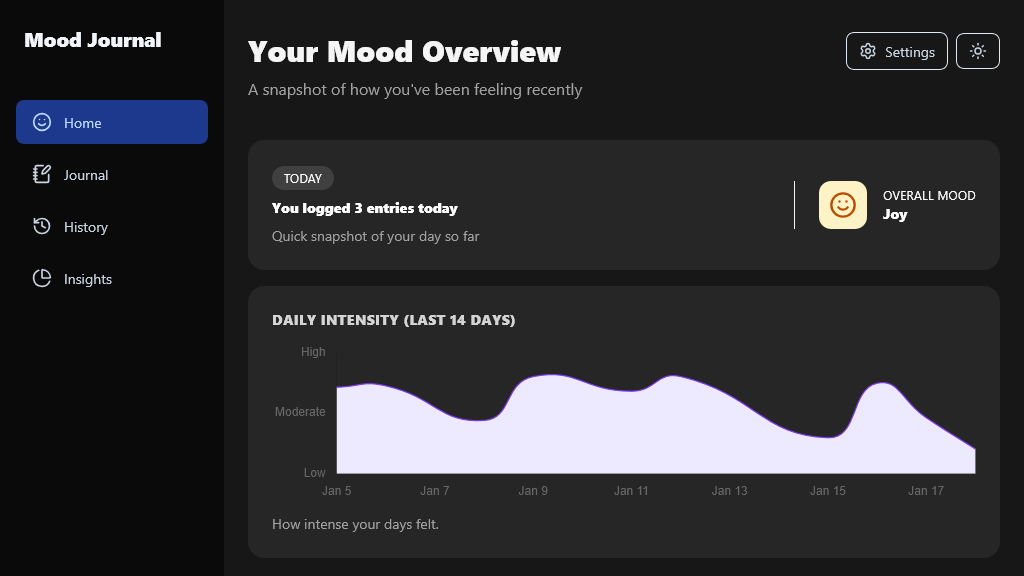
Key Features
- Offline-first PWA
- All inference and journaling run fully client-side via a service worker and Transformers.js
- Emotion analysis is performed locally in the browser so no user data or journal entries ever leave the device
- Service worker powered by Workbox
- Pre-caches the ONNX model and tokenizer assets required for offline inference
- After first load, all features (including ML) work fully offline (offline-first caching strategy)
- Multi-label emotion classification
- Fine-tuned SetFit (MiniLM) classifier predicts multiple emotions from a single journal entry
- SetFit was selected because it provides strong performance on limited labeled datasets
Tech Stack
Backend/ML: Python, FastAPI, PyTorch, Transformers, ONNX Runtime
Frontend: React, TypeScript, Vite, Tailwind CSS, Workbox
Demo
- Live demo: https://mood-tracker.projects.jaisawhney.me/
Project Structure
├── apps/
│   ├── api/            # FastAPI backend
│   └── web/            # React/Vite frontend
├── docker/             # Container configuration
├── images/             # README assets
├── ml/
│   ├── config.py       # Typed config loader
│   ├── config.yaml     # Project configuration
│   ├── data.py         # Dataset loading
│   ├── datasets/       # Train/validation/test datasets
│   ├── export.py       # ONNX export pipeline
│   ├── inference.py    # Document-level inference
│   ├── evaluate.py     # Model benchmarking
│   ├── trainer.py      # SetFit training
│   └── validate.py     # Model evaluation
├── notebooks/          # Experimentation
├── tests/              # Test suite
├── pyproject.toml
└── README.md
Model Performance
| Metric | Score |
|---|---|
| Macro F1 | 0.417 |
| Micro F1 | 0.548 |
| Macro ROC AUC | 0.804 |
| Hamming Loss | 0.176 |
The dataset is highly imbalanced across emotion labels. Despite class rebalancing and hyperparameter optimization, minority classes remain the main source of prediction error.
The underlying classifier predicts a broader set of emotion labels than are exposed in the web app. To improve usability, the web app presents a curated subset of emotions that are most relevant to mood journaling while continuing to predict the full set internally.
Datasets
- Lemotif (Li & Parikh, arXiv 2019): Journaling dataset derived from personal journal entries, used for fine-tuning and evaluation
Data Preprocessing:
- Undersampling of majority classes to reduce class imbalance
Notebooks
01_dataset_exploration.ipynb: Exploratory Data Analysis02_data_preprocessing.ipynb: Data Preprocessing & Class Rebalancing03_hyperparameter_optimization.ipynb: Hyperparameter Optimization (Optuna)04_final_model_evaluation.ipynb: Final Model Evaluation
Installation & Usage
Prerequisites
- Python 3.10+
- Node.js 18+ (for frontend dev)
Install Python dependencies
pip install -e ".[api,ml,dev]"
Train the model
python -m ml.trainer
FastAPI (development)
uvicorn apps.api.main:app --reload
API docs: http://localhost:8000/docs
Frontend (development)
cd apps/web
npm install
npm run dev
Docker
Start locally with docker-compose (models mounted from MODELS_DIR):
export MODELS_DIR=/path/to/models
docker compose up --build -d
Model files from MODELS_DIR are served inside the container at /api/models.
Testing
pytest
References
- Dataset:
lemotif(Li & Parikh, arXiv 2019)
Contributors

40 commits
Similar repos


Languages
TypeScript
79.0%
Python
15.4%
CSS
4.1%
Offline-first mood journal PWA with in-browser emotion classification. All data stays private on your device.
0
stars
40
commits
TypeScript
primary language
Jul 1, 2026
updated
README
Mood Journal
Offline-first Progressive Web App (PWA) for multi-label emotion classification and journaling. Emotion classification is powered by a fine-tuned SetFit model using MiniLM embeddings, with inference running entirely client-side via ONNX Runtime Web and Transformers.js
FastAPI serves the web application and model assets; all inference is executed locally in the browser.
Key Features
- Offline-first PWA
- All inference and journaling run fully client-side via a service worker and Transformers.js
- Emotion analysis is performed locally in the browser so no user data or journal entries ever leave the device
- Service worker powered by Workbox
- Pre-caches the ONNX model and tokenizer assets required for offline inference
- After first load, all features (including ML) work fully offline (offline-first caching strategy)
- Multi-label emotion classification
- Fine-tuned SetFit (MiniLM) classifier predicts multiple emotions from a single journal entry
- SetFit was selected because it provides strong performance on limited labeled datasets
Tech Stack
Backend/ML: Python, FastAPI, PyTorch, Transformers, ONNX Runtime
Frontend: React, TypeScript, Vite, Tailwind CSS, Workbox
Demo
- Live demo: https://mood-tracker.projects.jaisawhney.me/
Project Structure
├── apps/
│   ├── api/            # FastAPI backend
│   └── web/            # React/Vite frontend
├── docker/             # Container configuration
├── images/             # README assets
├── ml/
│   ├── config.py       # Typed config loader
│   ├── config.yaml     # Project configuration
│   ├── data.py         # Dataset loading
│   ├── datasets/       # Train/validation/test datasets
│   ├── export.py       # ONNX export pipeline
│   ├── inference.py    # Document-level inference
│   ├── evaluate.py     # Model benchmarking
│   ├── trainer.py      # SetFit training
│   └── validate.py     # Model evaluation
├── notebooks/          # Experimentation
├── tests/              # Test suite
├── pyproject.toml
└── README.md
Model Performance
| Metric | Score |
|---|---|
| Macro F1 | 0.417 |
| Micro F1 | 0.548 |
| Macro ROC AUC | 0.804 |
| Hamming Loss | 0.176 |
The dataset is highly imbalanced across emotion labels. Despite class rebalancing and hyperparameter optimization, minority classes remain the main source of prediction error.
The underlying classifier predicts a broader set of emotion labels than are exposed in the web app. To improve usability, the web app presents a curated subset of emotions that are most relevant to mood journaling while continuing to predict the full set internally.
Datasets
- Lemotif (Li & Parikh, arXiv 2019): Journaling dataset derived from personal journal entries, used for fine-tuning and evaluation
Data Preprocessing:
- Undersampling of majority classes to reduce class imbalance
Notebooks
01_dataset_exploration.ipynb: Exploratory Data Analysis02_data_preprocessing.ipynb: Data Preprocessing & Class Rebalancing03_hyperparameter_optimization.ipynb: Hyperparameter Optimization (Optuna)04_final_model_evaluation.ipynb: Final Model Evaluation
Installation & Usage
Prerequisites
- Python 3.10+
- Node.js 18+ (for frontend dev)
Install Python dependencies
pip install -e ".[api,ml,dev]"
Train the model
python -m ml.trainer
FastAPI (development)
uvicorn apps.api.main:app --reload
API docs: http://localhost:8000/docs
Frontend (development)
cd apps/web
npm install
npm run dev
Docker
Start locally with docker-compose (models mounted from MODELS_DIR):
export MODELS_DIR=/path/to/models
docker compose up --build -d
Model files from MODELS_DIR are served inside the container at /api/models.
Testing
pytest
References
- Dataset:
lemotif(Li & Parikh, arXiv 2019)
Similar repos
Contributors
40 commits
Languages
TypeScript
79.0%
Python
15.4%
CSS
4.1%