
Open-source Prompt Firewall — deflect up to 95% of redundant LLM traffic before it leaves your infrastructure. Documents: https://isartor-ai.github.io/Isartor/index.html
See the codeREADME

Isartor
Open-source Prompt Firewall — deflect up to 95% of redundant LLM traffic before it leaves your infrastructure.
Pure Rust · Single Binary · Zero Hidden Telemetry · Air-Gappable








Why teams pick Isartor
- Reduce waste before it reaches the cloud with exact cache, semantic cache, local SLM routing, and context compression.
- Stay easy to deploy with a single Rust binary, optional air-gapped operation, and no hidden telemetry.
- Fit real coding workflows with connectors for Copilot, Claude, Cursor, OpenClaw, Codex, Gemini, and generic OpenAI-compatible clients.
- Keep cloud routing flexible with multi-provider fallback chains, model aliases, quota policies, and provider health visibility.
Quick Start
The best first-run path is:
curl -fsSL https://raw.githubusercontent.com/isartor-ai/Isartor/main/install.sh | sh
isartor setup
isartor check
isartor demo
isartor up
isartor connect copilot
That path gives you a working install, provider verification, a demo run, and a tool connection in a few minutes.
Pick your setup path
| If you want to... | Use |
|---|---|
| Get started with the fewest decisions | isartor setup |
| Configure a provider with static API keys | isartor set-key -p <provider> |
| Use encrypted stored credentials | isartor auth <provider> |
| Sync shareable config across machines | isartor sync init / push / pull |
| Connect a coding tool | isartor connect <tool> |
Common first-run commands
# Guided setup
isartor setup

# Provider checks and demo
isartor check
isartor providers
isartor demo

# Start the gateway
isartor up
isartor up --detach

# Connect your tool
isartor connect copilot
isartor connect claude
isartor connect cursor
isartor connect openclaw
isartor connect codex
isartor connect gemini
isartor connect claude-copilot
What you get out of the box
- Provider auth options — use static keys or encrypted local credentials in
~/.isartor/tokens/. Copilot, Gemini, and Kiro support device flow; OpenAI and Anthropic use the same encrypted store for pasted keys. - Provider routing controls — define model aliases like
fast,smart, orcode, add ordered[[fallback_providers]], and use key pools withround_robinorpriorityrotation plus cooldowns after rate limits or quota failures. - Broad client compatibility — Isartor accepts six client wire formats with isolated cache namespaces, including Cursor and Kiro traffic on
/v1/chat/completions. - Operational guardrails — add per-provider
[quota.<provider>]limits, inspect live provider health viaisartor providersorGET /debug/providers, and confirm which upstream served a request viax-isartor-provider. - Optional encrypted sync —
isartor synckeeps the shareable parts ofisartor.tomlin sync across machines without exposing plaintext keys or local runtime state. - Optional Layer 0.5 routing — add a MiniLM classifier pass before cache lookup to steer request shapes toward preferred providers/models.
Helpful operator notes
- For request/response troubleshooting, set
ISARTOR__ENABLE_REQUEST_LOGS=truetemporarily and inspect the JSONL stream withisartor logs --requests. Auth headers are redacted automatically, but prompts may still contain sensitive data. - The provider registry includes a broad OpenAI-compatible set out of the box, including
cerebras,nebius,siliconflow,fireworks,nvidia, andchutes. - If you already know your credentials, the explicit flow still works exactly as before:
auth,set-key,check, andconnect.
MiniLM Classifier Routing
Enable the feature with a classifier artifact plus one or more routing rules:
[classifier_routing]
enabled = true
artifacts_path = "./minilm-routing-artifact.json"
confidence_threshold = 0.60
fallback_to_existing_routing = true

[[classifier_routing.rules]]
name = "codegen-backend-builder"
task_type = "codegen"
complexity = "complex"
persona = "builder"
domain = "backend"
provider = "groq"
model = "llama-3.3-70b-versatile"
Model Matrix (visual grid shorthand)
Instead of (or alongside) flat rules, you can use a model matrix — a 2D grid that maps complexity × task_type to a provider/model target. Matrix entries compile into rules at startup; explicit rules always take priority.
[classifier_routing.matrix.complex]
code_generation = "groq/llama-3.3-70b-versatile"
analysis        = "anthropic/claude-sonnet-4-20250514"
conversation    = "openai/gpt-4o"
default         = "groq/llama-3.3-70b-versatile"

[classifier_routing.matrix.simple]
code_generation = "groq/llama-3.1-8b-instant"
analysis        = "groq/llama-3.1-8b-instant"
default         = "local"
- Rows =
complexitylabels, columns =task_typelabels. "provider/model"pins both;"provider"alone pins only the provider."local"= stay on the cache/SLM path (no L3 provider override)."default"in either dimension acts as a wildcard (matches any label).- More-specific cells are tried first:
complex/codegen→complex/default→default/default.
The runtime classification contract is:
{
  "task_type": { "label": "codegen", "confidence": 0.97 },
  "complexity": { "label": "complex", "confidence": 0.91 },
  "persona": { "label": "builder", "confidence": 0.94 },
  "domain": { "label": "backend", "confidence": 0.89 },
  "overall_confidence": 0.93
}
Input is extracted from the buffered request body: native prompt, OpenAI/Anthropic/Gemini user messages, and surrounding agent/tool context via extract_classifier_context(). If fallback_to_existing_routing = false, Isartor fails closed with 503 when the classifier artifact is unavailable, classification fails, or no rule matches.
Bootstrap a starter artifact with the included scaffold:
python3 scripts/train_minilm_classifier.py \
  --input benchmarks/fixtures/minilm_multi_head_training.jsonl \
  --output ./minilm-routing-artifact.json
Watch x-isartor-provider, isartor stats, GET /debug/providers, and opt-in request logs to confirm the selected route in production.
See Isartor in the Terminal
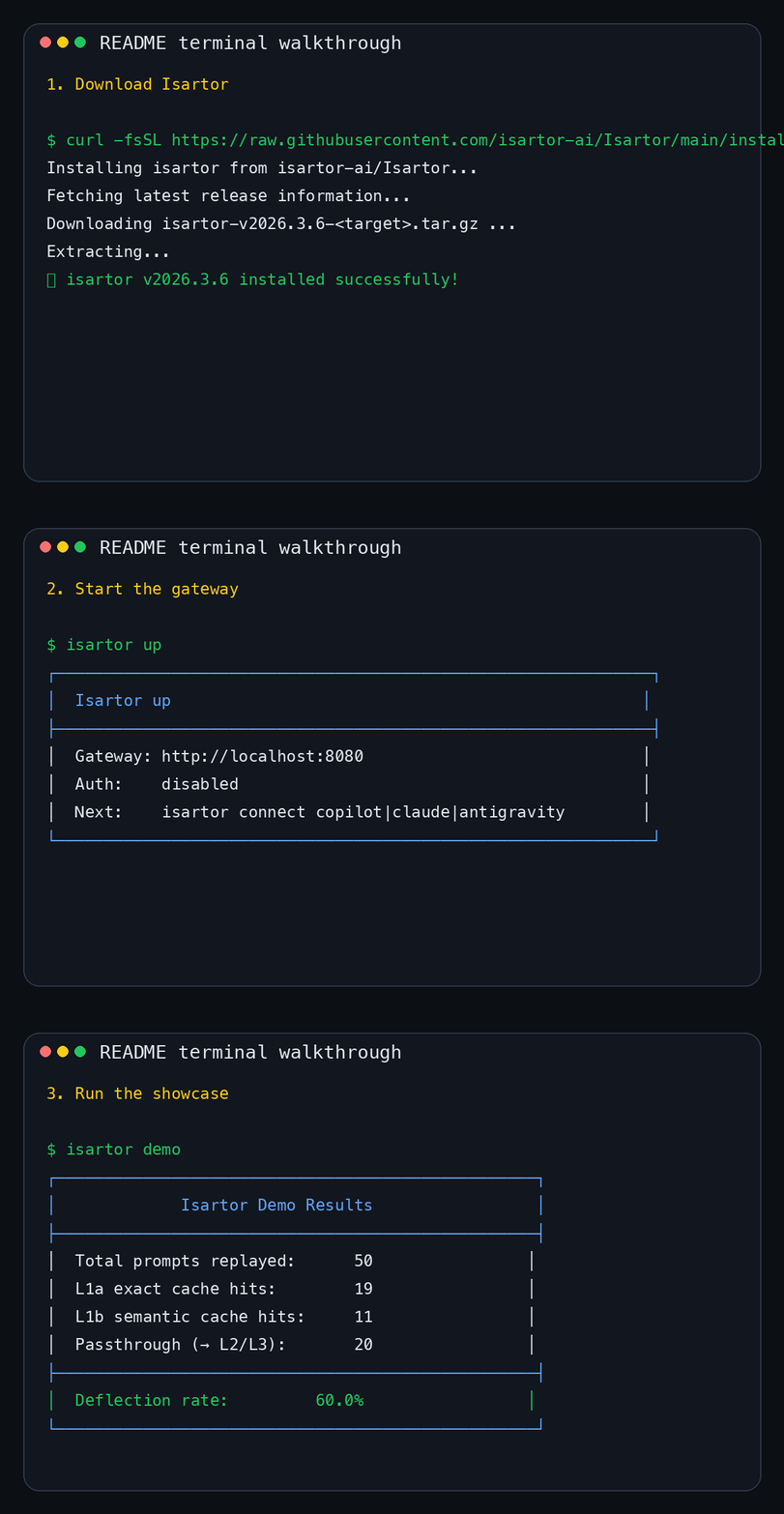
Terminal walkthrough: install Isartor, start the gateway, then run the demo showcase.
More install options (Docker · Windows · Build from source)
Docker
docker run -p 8080:8080 \
  -e HF_HOME=/tmp/huggingface \
  -v isartor-hf:/tmp/huggingface \
  ghcr.io/isartor-ai/isartor:latest
~120 MB compressed. Includes the
all-MiniLM-L6-v2embedding model and a statically linked Rust binary.
Windows (PowerShell)
irm https://raw.githubusercontent.com/isartor-ai/Isartor/main/install.ps1 | iex
Build from source
git clone https://github.com/isartor-ai/Isartor.git
cd Isartor && cargo build --release
./target/release/isartor up
How It Works
Isartor sits between your AI tools and upstream LLM providers. Every request goes through a local deflection stack first:
- Route the request shape if Layer 0.5 classifier routing is enabled.
- Trap repeats with exact cache and semantic cache.
- Answer simple requests locally with the embedded SLM router.
- Compress repeated instructions before sending anything upstream.
- Fall through to the cloud only when the request still needs a full model.
The result is lower cost, lower latency, less prompt leakage, and better control over how coding-agent traffic reaches external providers.
Why Isartor?
AI coding agents and personal assistants repeat themselves — a lot. Copilot, Claude Code, Cursor, and OpenClaw send the same system instructions, the same context preambles, and often the same user prompts across every turn of a conversation. Standard API gateways forward all of it to cloud LLMs regardless.
Isartor sits between your tools and the cloud. It intercepts every prompt and runs a cascade of local algorithms — from sub-millisecond hashing to in-process neural inference — to resolve requests before they reach the network. Only the genuinely hard prompts make it through.
The result: lower costs, lower latency, and less data leaving your perimeter.
| Without Isartor | With Isartor | |
|---|---|---|
| Repeated prompts | Full cloud round-trip every time | Answered locally in < 1 ms |
| Similar prompts ("Price?" / "Cost?") | Full cloud round-trip every time | Matched semantically, answered locally in 1–5 ms |
| System instructions (CLAUDE.md, copilot-instructions) | Sent in full on every request | Deduplicated and compressed per session |
| Simple FAQ / data extraction | Routed to GPT-4 / Claude | Resolved by embedded SLM in 50–200 ms |
| Complex reasoning | Routed to cloud | Routed to cloud ✓ |
The Deflection Stack
Every request passes through the deflection stack. Only prompts that survive the full stack reach the cloud.
Request ──► L0.5 MiniLM Router ──► L1a Exact Cache ──► L1b Semantic Cache ──► L2 SLM Router ──► L2.5 Context Optimiser ──► L3 Cloud
                   │ route                  │ hit                │ hit                 │ simple             │ compressed               │
                   ▼                        ▼                    ▼                     ▼                    ▼                          ▼
            Provider / Model           Instant             Instant             Local Answer      Smaller Prompt             Cloud Answer
| Layer | What It Does | How | Latency |
|---|---|---|---|
| L0.5 MiniLM Router | Classifies task shape for route hints | all-MiniLM-L6-v2 embedder + lightweight linear heads | 2–10 ms |
| L1a Exact Cache | Traps duplicate prompts and agent loops | ahash deterministic hashing | < 1 ms |
| L1b Semantic Cache | Catches paraphrases ("Price?" ≈ "Cost?") | Cosine similarity via pure-Rust candle embeddings | 1–5 ms |
| L2 SLM Router | Resolves simple queries locally | Embedded Small Language Model (Qwen-1.5B via candle GGUF) | 50–200 ms |
| L2.5 Context Optimiser | Compresses repeated instructions per session | Dedup + minify (CLAUDE.md, copilot-instructions) | < 1 ms |
| L3 Cloud Logic | Routes complex prompts to OpenAI / Anthropic / Azure | Ordered multi-provider fallback plus per-provider key rotation/cooldown | Network-bound |
Benchmark results
| Workload | Deflection Rate | Detail |
|---|---|---|
| Warm agent session (Claude Code, 20 prompts) | 95% | L1a 80% · L1b 10% · L2 5% · L3 5% |
| Repetitive FAQ loop (1,000 prompts) | 60% | L1a 41% · L1b 19% · L3 40% |
| Diverse code-generation tasks (78 prompts) | 38% | Exact-match duplicates only; all unique tasks route to L3 |
P50 latency for a cache hit: 0.3 ms. Full benchmark methodology →
AI Tool Integrations
One command connects your favourite tool. No proxy, no MITM, no CA certificates.
| Tool | Command | Mechanism |
|---|---|---|
| GitHub Copilot CLI | isartor connect copilot | MCP server (stdio or HTTP/SSE at /mcp/) |
| GitHub Copilot in VS Code | isartor connect copilot-vscode | Managed settings.json debug overrides |
| OpenClaw | isartor connect openclaw | Managed OpenClaw provider config (openclaw.json) |
| Claude Code | isartor connect claude | ANTHROPIC_BASE_URL override |
| Claude Desktop | isartor connect claude-desktop | Managed local MCP registration (isartor mcp) |
| Claude Code + Copilot | isartor connect claude-copilot | Claude base URL + Copilot-backed L3 |
| Cursor IDE | isartor connect cursor | Base URL + MCP registration at /mcp/ |
| OpenAI Codex CLI | isartor connect codex | OPENAI_BASE_URL override |
| Gemini CLI | isartor connect gemini | GEMINI_API_BASE_URL override to Gemini-native /v1beta/models/* routes |
| OpenCode | isartor connect opencode | Global provider + auth config |
| Any OpenAI-compatible tool | isartor connect generic | Configurable env var override |
OpenClaw note: use Isartor's OpenAI-compatible /v1 base path, not the root :8080 URL. If you change Isartor's gateway API key later, rerun isartor connect openclaw so OpenClaw's per-agent model registry refreshes too.
How Isartor Compares
This is the honest version: Isartor is not trying to be every kind of AI platform. It is optimized for local-first prompt deflection in front of coding tools and OpenAI-compatible clients.
| Product | Public positioning | Best fit | Where Isartor differs |
|---|---|---|---|
| Isartor | Open-source prompt firewall and local deflection gateway | Teams that want redundant prompt traffic resolved locally before it hits the cloud | Single Rust binary, client connectors, exact+semantic cache, context compression, coding-agent-first workflow |
| LiteLLM | Open-source multi-provider LLM gateway with routing, fallbacks, and spend tracking | Teams that want one OpenAI-style API across many providers and models | LiteLLM is gateway/routing-first; Isartor is deflection-first and focuses on reducing traffic before cloud routing |
| Portkey | AI gateway, observability, guardrails, governance, and prompt management platform | Teams that want a broader managed production control plane for GenAI apps | Portkey emphasizes platform governance and observability; Isartor emphasizes local cache/SLM deflection in a self-hosted binary |
| Bifrost | Enterprise AI gateway with governance, guardrails, and MCP gateway positioning | Teams that want enterprise control, security, and production gateway features | Bifrost is enterprise-gateway oriented; Isartor is optimized for prompt firewall behavior and lightweight local deployment |
| Helicone | Routing, debugging, and observability for AI apps | Teams that primarily want analytics, traces, and request inspection | Helicone is observability-first; Isartor is designed to stop repeat traffic from leaving your perimeter in the first place |
The short version:
- choose Isartor when your problem is repeated coding-agent traffic, prompt firewalling, and local-first savings
- choose LiteLLM when your main problem is multi-provider routing and unified model access
- choose Portkey / Bifrost / Helicone when your center of gravity is broader gateway control, observability, or enterprise governance
Drop-In for Any OpenAI SDK
Isartor is fully OpenAI-compatible and Anthropic-compatible. Point any existing SDK at it by changing one URL:
import openai

client = openai.OpenAI(
    base_url="http://localhost:8080/v1",
    api_key="your-isartor-api-key",
)

# First call → routed to cloud (L3), cached on return
response = client.chat.completions.create(
    model="gpt-4",
    messages=[{"role": "user", "content": "Explain the builder pattern in Rust"}],
)

# Second identical call → answered from L1a cache in < 1 ms
response = client.chat.completions.create(
    model="gpt-4",
    messages=[{"role": "user", "content": "Explain the builder pattern in Rust"}],
)
Works with the official Python/Node SDKs, LangChain, LlamaIndex, AutoGen, CrewAI, OpenClaw, or any OpenAI-compatible client.
If you prefer friendly names over provider model IDs, add aliases in isartor.toml:
[model_aliases]
fast = "gpt-4o-mini"
smart = "gpt-4o"
Then clients can send model="fast" and Isartor will route it as gpt-4o-mini.
Scales from Laptop to Cluster
The same binary adapts from a developer laptop to a multi-replica Kubernetes deployment. Switch modes entirely through environment variables — no code changes, no recompilation.
| Component | Laptop (Single Binary) | Enterprise (K8s) |
|---|---|---|
| L1a Cache | In-memory LRU | Redis cluster (shared across replicas) |
| L1b Embeddings | In-process candle BertModel | External TEI sidecar |
| L2 SLM | Embedded candle GGUF inference | Remote vLLM / TGI (GPU pool) |
| L2.5 Optimiser | In-process | In-process |
| L3 Cloud | Direct to provider | Direct to provider |
# Flip to enterprise mode — just env vars, same binary
export ISARTOR__CACHE_BACKEND=redis
export ISARTOR__REDIS_URL=redis://redis-cluster.svc:6379
export ISARTOR__ROUTER_BACKEND=vllm
export ISARTOR__VLLM_URL=http://vllm.svc:8000
Observability
Built-in OpenTelemetry traces and Prometheus metrics — no extra instrumentation.
- Distributed traces — root span
gateway_requestwith child spans per layer (l1a_exact_cache,l1b_semantic_cache,l2_classify_intent,context_optimise,l3_cloud_llm). - Prometheus metrics —
isartor_request_duration_seconds,isartor_layer_duration_seconds,isartor_requests_total. - ROI tracking —
isartor_tokens_saved_totalcounts tokens that never left your infrastructure. Pipe it into Grafana to prove savings.
export ISARTOR__ENABLE_MONITORING=true
export ISARTOR__OTEL_EXPORTER_ENDPOINT=http://otel-collector:4317
Trusted By
Today, Isartor is dogfooded by the Isartor AI engineering team for:
- connector development across Copilot, Claude, Cursor, and OpenClaw flows
- benchmark and release validation runs
- local-first prompt deflection testing during coding-agent workflows
We are keeping this section intentionally conservative until external teams explicitly opt in to being listed.
CLI Reference
isartor up                     Start the API gateway
isartor up --detach            Start in background
isartor logs --follow          Follow detached Isartor logs
isartor up copilot             Start gateway + Copilot CONNECT proxy
isartor stop                   Stop a running instance
isartor demo                   Run the post-install showcase (cache-only or live + cache)
isartor init                   Generate a commented config scaffold
isartor auth <provider>        Authenticate and store encrypted provider credentials
isartor auth status            Show stored credential status by provider
isartor auth logout <provider> Remove stored provider credentials
isartor sync init              Create a local encrypted sync profile
isartor sync push              Encrypt and upload syncable config
isartor sync pull              Download and merge syncable config
isartor sync status            Show current sync profile and timestamps
isartor sync serve             Run the self-hostable zero-knowledge sync server
isartor set-key -p openai      Configure your LLM provider API key
isartor providers             Show active provider config + in-memory health
isartor stats                  Prompt totals, layer hits, routing history
isartor stats --by-tool        Per-tool cache hits, latency, errors
isartor stats --usage          Provider/model token and cost breakdown
isartor update                 Self-update to the latest release
isartor connect <tool>         Connect an AI tool (see integrations above)
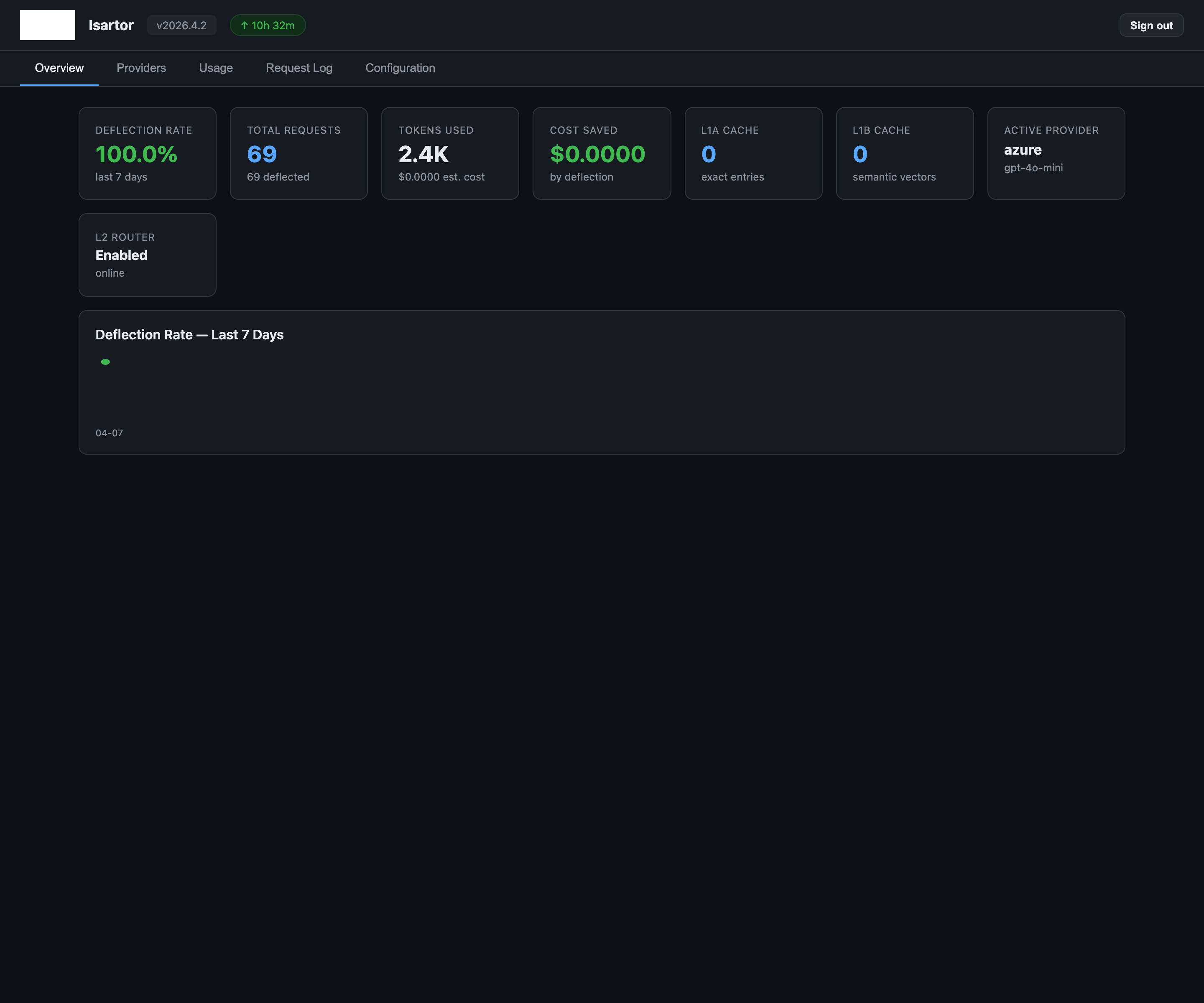
Open the web dashboard at http://localhost:8080/dashboard for a full browser-based management UI — five tabs covering Overview (deflection rate sparkline, uptime, cache stats, quota warnings), Providers (health, connectivity test, add/edit/remove/reorder provider, manual test updates health immediately), Usage (per-provider/model breakdown, quota status), Request Log (expandable rows), and Configuration (edit isartor.toml with validation, including the provider-health ping interval plus the classifier-routing matrix and explicit-rule editor). Sign in with your gateway API key.
Documentation
📚 isartor-ai.github.io/Isartor
| Getting Started | Installation, first request, config basics |
| Architecture | Deflection Stack deep dive, trait provider pattern |
| Integrations | Copilot, Cursor, Claude, Codex, Gemini, generic |
| Deployment | Minimal → Sidecar → Enterprise (K8s) → Air-Gapped |
| Configuration | Every environment variable and config key |
| Observability | Spans, metrics, Grafana dashboards |
| Performance Tuning | Deflection measurement, SLO/SLA templates |
| Troubleshooting | Common issues, diagnostics, FAQ |
| Contributing | Dev setup, PR guidelines |
| Governance | Independence, license stability, decision-making |
Contributing
Contributions welcome! See CONTRIBUTING.md for dev setup and PR guidelines.
cargo build && cargo test --all-features
cargo clippy --all-targets --all-features -- -D warnings
License
Apache License, Version 2.0 — see LICENSE.
Isartor is and will remain open source. No bait-and-switch relicensing. See GOVERNANCE.md for the full commitment.
If Isartor saves you tokens, consider giving it a ⭐
Contributors


Similar repos


Languages
Rust
83.4%
Python
10.2%
Shell
2.9%
HTML
2.9%
Open-source Prompt Firewall — deflect up to 95% of redundant LLM traffic before it leaves your infrastructure. Documents: https://isartor-ai.github.io/Isartor/index.html
See the codeREADME
Isartor
Open-source Prompt Firewall — deflect up to 95% of redundant LLM traffic before it leaves your infrastructure.
Pure Rust · Single Binary · Zero Hidden Telemetry · Air-Gappable
Why teams pick Isartor
- Reduce waste before it reaches the cloud with exact cache, semantic cache, local SLM routing, and context compression.
- Stay easy to deploy with a single Rust binary, optional air-gapped operation, and no hidden telemetry.
- Fit real coding workflows with connectors for Copilot, Claude, Cursor, OpenClaw, Codex, Gemini, and generic OpenAI-compatible clients.
- Keep cloud routing flexible with multi-provider fallback chains, model aliases, quota policies, and provider health visibility.
Quick Start
The best first-run path is:
curl -fsSL https://raw.githubusercontent.com/isartor-ai/Isartor/main/install.sh | sh
isartor setup
isartor check
isartor demo
isartor up
isartor connect copilot
That path gives you a working install, provider verification, a demo run, and a tool connection in a few minutes.
Pick your setup path
| If you want to... | Use |
|---|---|
| Get started with the fewest decisions | isartor setup |
| Configure a provider with static API keys | isartor set-key -p <provider> |
| Use encrypted stored credentials | isartor auth <provider> |
| Sync shareable config across machines | isartor sync init / push / pull |
| Connect a coding tool | isartor connect <tool> |
Common first-run commands
# Guided setup
isartor setup

# Provider checks and demo
isartor check
isartor providers
isartor demo

# Start the gateway
isartor up
isartor up --detach

# Connect your tool
isartor connect copilot
isartor connect claude
isartor connect cursor
isartor connect openclaw
isartor connect codex
isartor connect gemini
isartor connect claude-copilot
What you get out of the box
- Provider auth options — use static keys or encrypted local credentials in
~/.isartor/tokens/. Copilot, Gemini, and Kiro support device flow; OpenAI and Anthropic use the same encrypted store for pasted keys. - Provider routing controls — define model aliases like
fast,smart, orcode, add ordered[[fallback_providers]], and use key pools withround_robinorpriorityrotation plus cooldowns after rate limits or quota failures. - Broad client compatibility — Isartor accepts six client wire formats with isolated cache namespaces, including Cursor and Kiro traffic on
/v1/chat/completions. - Operational guardrails — add per-provider
[quota.<provider>]limits, inspect live provider health viaisartor providersorGET /debug/providers, and confirm which upstream served a request viax-isartor-provider. - Optional encrypted sync —
isartor synckeeps the shareable parts ofisartor.tomlin sync across machines without exposing plaintext keys or local runtime state. - Optional Layer 0.5 routing — add a MiniLM classifier pass before cache lookup to steer request shapes toward preferred providers/models.
Helpful operator notes
- For request/response troubleshooting, set
ISARTOR__ENABLE_REQUEST_LOGS=truetemporarily and inspect the JSONL stream withisartor logs --requests. Auth headers are redacted automatically, but prompts may still contain sensitive data. - The provider registry includes a broad OpenAI-compatible set out of the box, including
cerebras,nebius,siliconflow,fireworks,nvidia, andchutes. - If you already know your credentials, the explicit flow still works exactly as before:
auth,set-key,check, andconnect.
MiniLM Classifier Routing
Enable the feature with a classifier artifact plus one or more routing rules:
[classifier_routing]
enabled = true
artifacts_path = "./minilm-routing-artifact.json"
confidence_threshold = 0.60
fallback_to_existing_routing = true

[[classifier_routing.rules]]
name = "codegen-backend-builder"
task_type = "codegen"
complexity = "complex"
persona = "builder"
domain = "backend"
provider = "groq"
model = "llama-3.3-70b-versatile"
Model Matrix (visual grid shorthand)
Instead of (or alongside) flat rules, you can use a model matrix — a 2D grid that maps complexity × task_type to a provider/model target. Matrix entries compile into rules at startup; explicit rules always take priority.
[classifier_routing.matrix.complex]
code_generation = "groq/llama-3.3-70b-versatile"
analysis        = "anthropic/claude-sonnet-4-20250514"
conversation    = "openai/gpt-4o"
default         = "groq/llama-3.3-70b-versatile"

[classifier_routing.matrix.simple]
code_generation = "groq/llama-3.1-8b-instant"
analysis        = "groq/llama-3.1-8b-instant"
default         = "local"
- Rows =
complexitylabels, columns =task_typelabels. "provider/model"pins both;"provider"alone pins only the provider."local"= stay on the cache/SLM path (no L3 provider override)."default"in either dimension acts as a wildcard (matches any label).- More-specific cells are tried first:
complex/codegen→complex/default→default/default.
The runtime classification contract is:
{
  "task_type": { "label": "codegen", "confidence": 0.97 },
  "complexity": { "label": "complex", "confidence": 0.91 },
  "persona": { "label": "builder", "confidence": 0.94 },
  "domain": { "label": "backend", "confidence": 0.89 },
  "overall_confidence": 0.93
}
Input is extracted from the buffered request body: native prompt, OpenAI/Anthropic/Gemini user messages, and surrounding agent/tool context via extract_classifier_context(). If fallback_to_existing_routing = false, Isartor fails closed with 503 when the classifier artifact is unavailable, classification fails, or no rule matches.
Bootstrap a starter artifact with the included scaffold:
python3 scripts/train_minilm_classifier.py \
  --input benchmarks/fixtures/minilm_multi_head_training.jsonl \
  --output ./minilm-routing-artifact.json
Watch x-isartor-provider, isartor stats, GET /debug/providers, and opt-in request logs to confirm the selected route in production.
See Isartor in the Terminal
Terminal walkthrough: install Isartor, start the gateway, then run the demo showcase.
More install options (Docker · Windows · Build from source)
Docker
docker run -p 8080:8080 \
  -e HF_HOME=/tmp/huggingface \
  -v isartor-hf:/tmp/huggingface \
  ghcr.io/isartor-ai/isartor:latest
~120 MB compressed. Includes the
all-MiniLM-L6-v2embedding model and a statically linked Rust binary.
Windows (PowerShell)
irm https://raw.githubusercontent.com/isartor-ai/Isartor/main/install.ps1 | iex
Build from source
git clone https://github.com/isartor-ai/Isartor.git
cd Isartor && cargo build --release
./target/release/isartor up
How It Works
Isartor sits between your AI tools and upstream LLM providers. Every request goes through a local deflection stack first:
- Route the request shape if Layer 0.5 classifier routing is enabled.
- Trap repeats with exact cache and semantic cache.
- Answer simple requests locally with the embedded SLM router.
- Compress repeated instructions before sending anything upstream.
- Fall through to the cloud only when the request still needs a full model.
The result is lower cost, lower latency, less prompt leakage, and better control over how coding-agent traffic reaches external providers.
Why Isartor?
AI coding agents and personal assistants repeat themselves — a lot. Copilot, Claude Code, Cursor, and OpenClaw send the same system instructions, the same context preambles, and often the same user prompts across every turn of a conversation. Standard API gateways forward all of it to cloud LLMs regardless.
Isartor sits between your tools and the cloud. It intercepts every prompt and runs a cascade of local algorithms — from sub-millisecond hashing to in-process neural inference — to resolve requests before they reach the network. Only the genuinely hard prompts make it through.
The result: lower costs, lower latency, and less data leaving your perimeter.
| Without Isartor | With Isartor | |
|---|---|---|
| Repeated prompts | Full cloud round-trip every time | Answered locally in < 1 ms |
| Similar prompts ("Price?" / "Cost?") | Full cloud round-trip every time | Matched semantically, answered locally in 1–5 ms |
| System instructions (CLAUDE.md, copilot-instructions) | Sent in full on every request | Deduplicated and compressed per session |
| Simple FAQ / data extraction | Routed to GPT-4 / Claude | Resolved by embedded SLM in 50–200 ms |
| Complex reasoning | Routed to cloud | Routed to cloud ✓ |
The Deflection Stack
Every request passes through the deflection stack. Only prompts that survive the full stack reach the cloud.
Request ──► L0.5 MiniLM Router ──► L1a Exact Cache ──► L1b Semantic Cache ──► L2 SLM Router ──► L2.5 Context Optimiser ──► L3 Cloud
                   │ route                  │ hit                │ hit                 │ simple             │ compressed               │
                   ▼                        ▼                    ▼                     ▼                    ▼                          ▼
            Provider / Model           Instant             Instant             Local Answer      Smaller Prompt             Cloud Answer
| Layer | What It Does | How | Latency |
|---|---|---|---|
| L0.5 MiniLM Router | Classifies task shape for route hints | all-MiniLM-L6-v2 embedder + lightweight linear heads | 2–10 ms |
| L1a Exact Cache | Traps duplicate prompts and agent loops | ahash deterministic hashing | < 1 ms |
| L1b Semantic Cache | Catches paraphrases ("Price?" ≈ "Cost?") | Cosine similarity via pure-Rust candle embeddings | 1–5 ms |
| L2 SLM Router | Resolves simple queries locally | Embedded Small Language Model (Qwen-1.5B via candle GGUF) | 50–200 ms |
| L2.5 Context Optimiser | Compresses repeated instructions per session | Dedup + minify (CLAUDE.md, copilot-instructions) | < 1 ms |
| L3 Cloud Logic | Routes complex prompts to OpenAI / Anthropic / Azure | Ordered multi-provider fallback plus per-provider key rotation/cooldown | Network-bound |
Benchmark results
| Workload | Deflection Rate | Detail |
|---|---|---|
| Warm agent session (Claude Code, 20 prompts) | 95% | L1a 80% · L1b 10% · L2 5% · L3 5% |
| Repetitive FAQ loop (1,000 prompts) | 60% | L1a 41% · L1b 19% · L3 40% |
| Diverse code-generation tasks (78 prompts) | 38% | Exact-match duplicates only; all unique tasks route to L3 |
P50 latency for a cache hit: 0.3 ms. Full benchmark methodology →
AI Tool Integrations
One command connects your favourite tool. No proxy, no MITM, no CA certificates.
| Tool | Command | Mechanism |
|---|---|---|
| GitHub Copilot CLI | isartor connect copilot | MCP server (stdio or HTTP/SSE at /mcp/) |
| GitHub Copilot in VS Code | isartor connect copilot-vscode | Managed settings.json debug overrides |
| OpenClaw | isartor connect openclaw | Managed OpenClaw provider config (openclaw.json) |
| Claude Code | isartor connect claude | ANTHROPIC_BASE_URL override |
| Claude Desktop | isartor connect claude-desktop | Managed local MCP registration (isartor mcp) |
| Claude Code + Copilot | isartor connect claude-copilot | Claude base URL + Copilot-backed L3 |
| Cursor IDE | isartor connect cursor | Base URL + MCP registration at /mcp/ |
| OpenAI Codex CLI | isartor connect codex | OPENAI_BASE_URL override |
| Gemini CLI | isartor connect gemini | GEMINI_API_BASE_URL override to Gemini-native /v1beta/models/* routes |
| OpenCode | isartor connect opencode | Global provider + auth config |
| Any OpenAI-compatible tool | isartor connect generic | Configurable env var override |
OpenClaw note: use Isartor's OpenAI-compatible /v1 base path, not the root :8080 URL. If you change Isartor's gateway API key later, rerun isartor connect openclaw so OpenClaw's per-agent model registry refreshes too.
How Isartor Compares
This is the honest version: Isartor is not trying to be every kind of AI platform. It is optimized for local-first prompt deflection in front of coding tools and OpenAI-compatible clients.
| Product | Public positioning | Best fit | Where Isartor differs |
|---|---|---|---|
| Isartor | Open-source prompt firewall and local deflection gateway | Teams that want redundant prompt traffic resolved locally before it hits the cloud | Single Rust binary, client connectors, exact+semantic cache, context compression, coding-agent-first workflow |
| LiteLLM | Open-source multi-provider LLM gateway with routing, fallbacks, and spend tracking | Teams that want one OpenAI-style API across many providers and models | LiteLLM is gateway/routing-first; Isartor is deflection-first and focuses on reducing traffic before cloud routing |
| Portkey | AI gateway, observability, guardrails, governance, and prompt management platform | Teams that want a broader managed production control plane for GenAI apps | Portkey emphasizes platform governance and observability; Isartor emphasizes local cache/SLM deflection in a self-hosted binary |
| Bifrost | Enterprise AI gateway with governance, guardrails, and MCP gateway positioning | Teams that want enterprise control, security, and production gateway features | Bifrost is enterprise-gateway oriented; Isartor is optimized for prompt firewall behavior and lightweight local deployment |
| Helicone | Routing, debugging, and observability for AI apps | Teams that primarily want analytics, traces, and request inspection | Helicone is observability-first; Isartor is designed to stop repeat traffic from leaving your perimeter in the first place |
The short version:
- choose Isartor when your problem is repeated coding-agent traffic, prompt firewalling, and local-first savings
- choose LiteLLM when your main problem is multi-provider routing and unified model access
- choose Portkey / Bifrost / Helicone when your center of gravity is broader gateway control, observability, or enterprise governance
Drop-In for Any OpenAI SDK
Isartor is fully OpenAI-compatible and Anthropic-compatible. Point any existing SDK at it by changing one URL:
import openai

client = openai.OpenAI(
    base_url="http://localhost:8080/v1",
    api_key="your-isartor-api-key",
)

# First call → routed to cloud (L3), cached on return
response = client.chat.completions.create(
    model="gpt-4",
    messages=[{"role": "user", "content": "Explain the builder pattern in Rust"}],
)

# Second identical call → answered from L1a cache in < 1 ms
response = client.chat.completions.create(
    model="gpt-4",
    messages=[{"role": "user", "content": "Explain the builder pattern in Rust"}],
)
Works with the official Python/Node SDKs, LangChain, LlamaIndex, AutoGen, CrewAI, OpenClaw, or any OpenAI-compatible client.
If you prefer friendly names over provider model IDs, add aliases in isartor.toml:
[model_aliases]
fast = "gpt-4o-mini"
smart = "gpt-4o"
Then clients can send model="fast" and Isartor will route it as gpt-4o-mini.
Scales from Laptop to Cluster
The same binary adapts from a developer laptop to a multi-replica Kubernetes deployment. Switch modes entirely through environment variables — no code changes, no recompilation.
| Component | Laptop (Single Binary) | Enterprise (K8s) |
|---|---|---|
| L1a Cache | In-memory LRU | Redis cluster (shared across replicas) |
| L1b Embeddings | In-process candle BertModel | External TEI sidecar |
| L2 SLM | Embedded candle GGUF inference | Remote vLLM / TGI (GPU pool) |
| L2.5 Optimiser | In-process | In-process |
| L3 Cloud | Direct to provider | Direct to provider |
# Flip to enterprise mode — just env vars, same binary
export ISARTOR__CACHE_BACKEND=redis
export ISARTOR__REDIS_URL=redis://redis-cluster.svc:6379
export ISARTOR__ROUTER_BACKEND=vllm
export ISARTOR__VLLM_URL=http://vllm.svc:8000
Observability
Built-in OpenTelemetry traces and Prometheus metrics — no extra instrumentation.
- Distributed traces — root span
gateway_requestwith child spans per layer (l1a_exact_cache,l1b_semantic_cache,l2_classify_intent,context_optimise,l3_cloud_llm). - Prometheus metrics —
isartor_request_duration_seconds,isartor_layer_duration_seconds,isartor_requests_total. - ROI tracking —
isartor_tokens_saved_totalcounts tokens that never left your infrastructure. Pipe it into Grafana to prove savings.
export ISARTOR__ENABLE_MONITORING=true
export ISARTOR__OTEL_EXPORTER_ENDPOINT=http://otel-collector:4317
Trusted By
Today, Isartor is dogfooded by the Isartor AI engineering team for:
- connector development across Copilot, Claude, Cursor, and OpenClaw flows
- benchmark and release validation runs
- local-first prompt deflection testing during coding-agent workflows
We are keeping this section intentionally conservative until external teams explicitly opt in to being listed.
CLI Reference
isartor up                     Start the API gateway
isartor up --detach            Start in background
isartor logs --follow          Follow detached Isartor logs
isartor up copilot             Start gateway + Copilot CONNECT proxy
isartor stop                   Stop a running instance
isartor demo                   Run the post-install showcase (cache-only or live + cache)
isartor init                   Generate a commented config scaffold
isartor auth <provider>        Authenticate and store encrypted provider credentials
isartor auth status            Show stored credential status by provider
isartor auth logout <provider> Remove stored provider credentials
isartor sync init              Create a local encrypted sync profile
isartor sync push              Encrypt and upload syncable config
isartor sync pull              Download and merge syncable config
isartor sync status            Show current sync profile and timestamps
isartor sync serve             Run the self-hostable zero-knowledge sync server
isartor set-key -p openai      Configure your LLM provider API key
isartor providers             Show active provider config + in-memory health
isartor stats                  Prompt totals, layer hits, routing history
isartor stats --by-tool        Per-tool cache hits, latency, errors
isartor stats --usage          Provider/model token and cost breakdown
isartor update                 Self-update to the latest release
isartor connect <tool>         Connect an AI tool (see integrations above)
Open the web dashboard at http://localhost:8080/dashboard for a full browser-based management UI — five tabs covering Overview (deflection rate sparkline, uptime, cache stats, quota warnings), Providers (health, connectivity test, add/edit/remove/reorder provider, manual test updates health immediately), Usage (per-provider/model breakdown, quota status), Request Log (expandable rows), and Configuration (edit isartor.toml with validation, including the provider-health ping interval plus the classifier-routing matrix and explicit-rule editor). Sign in with your gateway API key.
Documentation
📚 isartor-ai.github.io/Isartor
| Getting Started | Installation, first request, config basics |
| Architecture | Deflection Stack deep dive, trait provider pattern |
| Integrations | Copilot, Cursor, Claude, Codex, Gemini, generic |
| Deployment | Minimal → Sidecar → Enterprise (K8s) → Air-Gapped |
| Configuration | Every environment variable and config key |
| Observability | Spans, metrics, Grafana dashboards |
| Performance Tuning | Deflection measurement, SLO/SLA templates |
| Troubleshooting | Common issues, diagnostics, FAQ |
| Contributing | Dev setup, PR guidelines |
| Governance | Independence, license stability, decision-making |
Contributing
Contributions welcome! See CONTRIBUTING.md for dev setup and PR guidelines.
cargo build && cargo test --all-features
cargo clippy --all-targets --all-features -- -D warnings
License
Apache License, Version 2.0 — see LICENSE.
Isartor is and will remain open source. No bait-and-switch relicensing. See GOVERNANCE.md for the full commitment.
If Isartor saves you tokens, consider giving it a ⭐
Similar repos
Contributors
Languages
Rust
83.4%
Python
10.2%
Shell
2.9%
HTML
2.9%