
Experiments with DSPy — declarative, trainable LLM pipelines. Notebooks and demos for evaluating, composing, and optimizing LLM workflows (code-gen, company valuation, market analysis).
Jupyter Notebook
10
8 commits
updated Jun 24, 2026
README
DSPy Research
Treating prompt engineering as a machine-learning problem — modular, trainable LLM pipelines built and optimized with DSPy.





A hands-on exploration of DSPy, the Stanford framework that reframes LLM orchestration as a machine-learning workflow: instead of hand-tuning brittle prompt strings, you declare signatures, compose them into modules, and let DSPy's optimizers (teleprompters) compile the pipeline against a dataset and a metric. This repo collects the notebooks, diagrams, and reference papers used to evaluate that approach on real tasks — code generation/evaluation, company valuation, and multi-stage market analysis.
📺 Video walkthrough: https://www.youtube.com/watch?v=NXI2l0wJNBY
Why DSPy
Conventional prompt engineering is manual, brittle, and hard to reproduce or scale. DSPy turns the same goals into an optimization problem:
- Declarative signatures — describe what a step should do (
question -> valuation, date, raised), not the exact wording of the prompt. - Composable modules —
Predict,ChainOfThought,ReAct, retrieval (RAG) and custom modules snap together into larger programs. - Compilation / optimization — teleprompters such as
BootstrapFewShotandBootstrapFewShotWithRandomSearchautomatically bootstrap demonstrations and tune the program against a training set and an evaluation metric. - Built-in evaluation —
dspy.Evaluateruns a program over a dev set and scores it, so improvements are measured, not guessed.
The payoff: fewer manual iterations, reproducible pipelines, and measurable score gains before vs. after compilation.
Notebooks
Each notebook is a self-contained experiment. They share a common setup — an OpenAI LM
(gpt-3.5-turbo) plus a You.com retriever (YouRM) for grounding — and progressively
introduce evaluation, RAG, and compilation.
| Notebook | What it demonstrates |
|---|---|
notebooks/code-evaluation.ipynb | End-to-end code-generation pipeline on the HumanEval dataset. Uses a typed pydantic signature to emit valid Python, runs generated code through a sandboxed REPL with a timeout, defines a pass/fail metric, evaluates with dspy.Evaluate, then compiles the program with BootstrapFewShotWithRandomSearch and re-scores it. Includes a worked detour through JSON-escaping pitfalls in LM output. |
notebooks/company-valuation.ipynb | A company-valuation pipeline that retrieves funding facts and extracts structured fields (valuation, date, amount raised, round, VCs). Builds a custom AssessValuation LLM-as-judge metric, contrasts a plain Predict baseline against a RAG module, then compiles the RAG program with BootstrapFewShot to lift the score. |
notebooks/market-analyst.ipynb | A comparative market-analysis module that compares two companies across valuation, headcount, founding year, and public perception — the building block for the multi-stage architecture below. |
Supporting code:
notebooks/repl/code.py— a small process-isolated Python REPL (execute_code) with a timeout, used to safely run model-generated solutions.notebooks/code-samples.py,notebooks/test.py— scratch task/solution samples and a debug harness used while building the notebooks.
System designs
The diagrams below trace the progression from a naive pipeline to a composed, compiled multi-stage system.
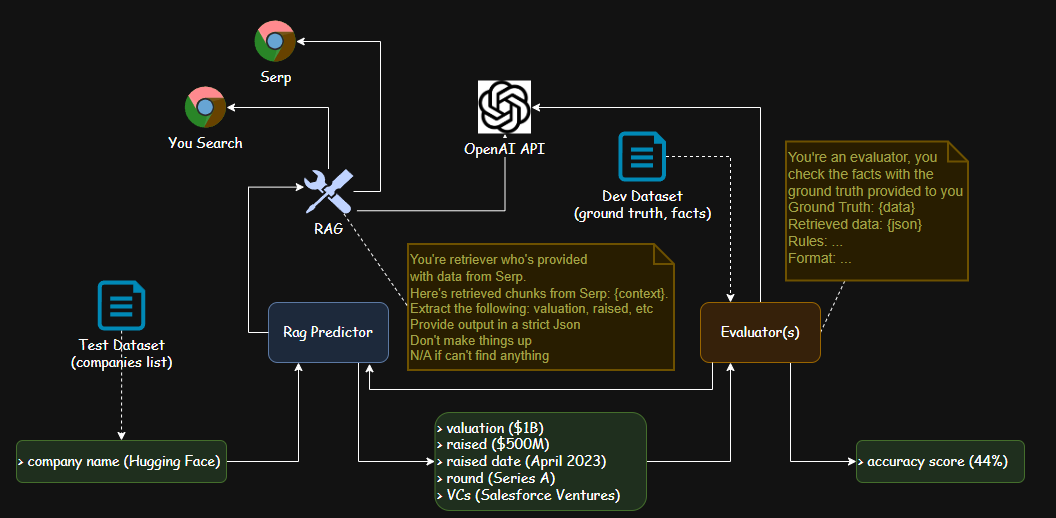 | 1 · Basic company analysis (no compilation). A straightforward declarative pipeline — inputs in, outputs out — with no automated optimization. The baseline. |
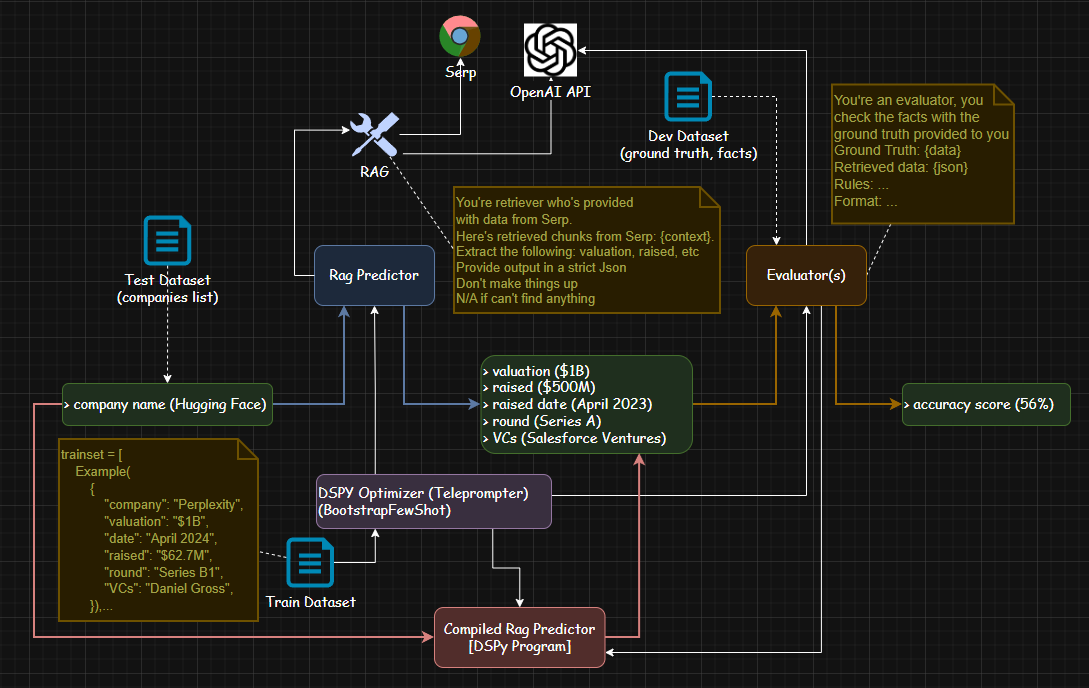 | 2 · Compiled & optimized company analysis. The same pipeline after DSPy compilation: demonstrations and module parameters are tuned against a dataset and metric for better accuracy and efficiency. |
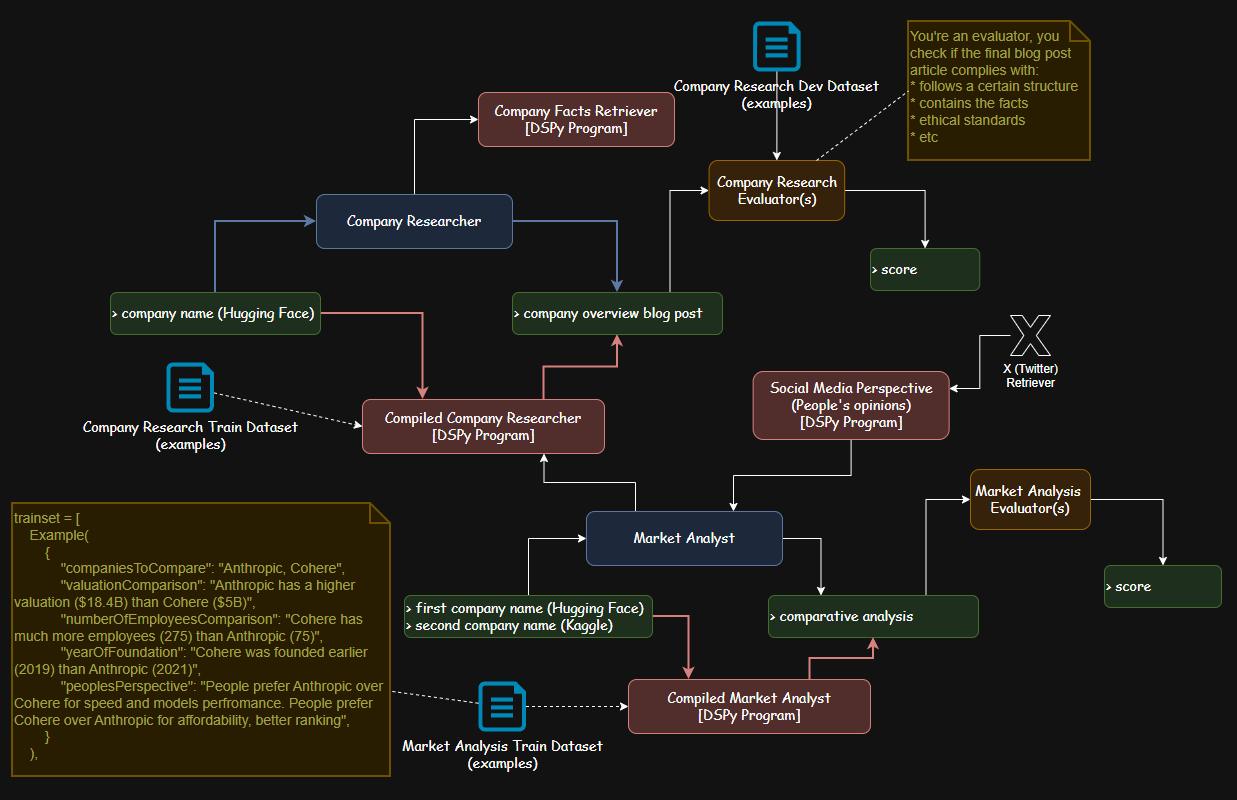 | 3 · Composable multi-stage pipeline. A Company Researcher and Market Analyst are each compiled into reusable DSPy programs, wired together with fact retrieval, social-media (X) perspective, comparative analysis, and evaluator-based scoring. |
Additional reference diagrams (regular vs. compiled RAG, program composition) live in docs/.
Tech stack
- Python 3.10
- DSPy — signatures, modules (
Predict,ChainOfThought,ReAct, RAG), teleprompters (BootstrapFewShot,BootstrapFewShotWithRandomSearch), andEvaluate. - OpenAI (
gpt-3.5-turbo) as the language model. - Retrieval: You.com
YouRM(ClarifaiClarifaiRMalso wired up). - Datasets: Hugging Face
datasets(HumanEval; HotPotQA loader available). pydanticfor typed signatures, Jupyter for the experiments.
Repository layout
dspy-research/
├── notebooks/
│   ├── code-evaluation.ipynb      # HumanEval code-gen + evaluate + compile
│   ├── company-valuation.ipynb    # RAG valuation pipeline + LLM-judge metric + compile
│   ├── market-analyst.ipynb       # comparative two-company analysis module
│   ├── repl/code.py               # sandboxed code-execution REPL (timeout)
│   ├── code-samples.py            # scratch task/solution samples
│   └── test.py                    # debug harness
├── images/                        # system-design diagrams (1–3)
├── docs/                          # RAG / composition reference diagrams
├── papers/                        # the two foundational DSPy papers (PDF)
├── dspy.md                        # environment & install notes
└── .env.example                   # API-key template
Getting started
The notebooks call hosted APIs (OpenAI, You.com), so you'll need the corresponding keys.
git clone https://github.com/iliazlobin/dspy-research.git
cd dspy-research

# create an environment (conda or venv)
python -m venv .venv && source .venv/bin/activate

# DSPy and the data tooling used by the notebooks
pip install dspy datasets pydantic python-dotenv jupyter

# configure credentials
cp .env.example .env   # then fill in OPENAI_API_KEY, YDC_API_KEY, etc.

jupyter notebook notebooks/code-evaluation.ipynb
.env.example lists every key the notebooks expect:
YDC_API_KEY=          # You.com retriever
OPENAI_API_KEY=       # OpenAI LM
CLARIFAI_USER_ID=     # optional: Clarifai retriever
CLARIFAI_APP_ID=
CLARIFAI_PAT=
Related papers
The foundational DSPy papers are mirrored in papers/:
- DSPy: Compiling Declarative Language Model Calls into Self-Improving Pipelines
- DSPy Assertions: Computational Constraints for Self-Refining Language Model Pipelines
Links
- 📺 Walkthrough: https://www.youtube.com/watch?v=NXI2l0wJNBY
- 🧩 DSPy: https://github.com/stanfordnlp/dspy
- 🌐 Portfolio: https://iliazlobin.com/portfolio
- 👤 Author: Ilia Zlobin — Principal Software Engineer
License
Released under the MIT License.
Contributors

8 commits
Similar repos





Languages
Jupyter Notebook
96.9%
Python
3.1%
Experiments with DSPy — declarative, trainable LLM pipelines. Notebooks and demos for evaluating, composing, and optimizing LLM workflows (code-gen, company valuation, market analysis).
Jupyter Notebook
10
8 commits
updated Jun 24, 2026
README
DSPy Research
Treating prompt engineering as a machine-learning problem — modular, trainable LLM pipelines built and optimized with DSPy.
A hands-on exploration of DSPy, the Stanford framework that reframes LLM orchestration as a machine-learning workflow: instead of hand-tuning brittle prompt strings, you declare signatures, compose them into modules, and let DSPy's optimizers (teleprompters) compile the pipeline against a dataset and a metric. This repo collects the notebooks, diagrams, and reference papers used to evaluate that approach on real tasks — code generation/evaluation, company valuation, and multi-stage market analysis.
📺 Video walkthrough: https://www.youtube.com/watch?v=NXI2l0wJNBY
Why DSPy
Conventional prompt engineering is manual, brittle, and hard to reproduce or scale. DSPy turns the same goals into an optimization problem:
- Declarative signatures — describe what a step should do (
question -> valuation, date, raised), not the exact wording of the prompt. - Composable modules —
Predict,ChainOfThought,ReAct, retrieval (RAG) and custom modules snap together into larger programs. - Compilation / optimization — teleprompters such as
BootstrapFewShotandBootstrapFewShotWithRandomSearchautomatically bootstrap demonstrations and tune the program against a training set and an evaluation metric. - Built-in evaluation —
dspy.Evaluateruns a program over a dev set and scores it, so improvements are measured, not guessed.
The payoff: fewer manual iterations, reproducible pipelines, and measurable score gains before vs. after compilation.
Notebooks
Each notebook is a self-contained experiment. They share a common setup — an OpenAI LM
(gpt-3.5-turbo) plus a You.com retriever (YouRM) for grounding — and progressively
introduce evaluation, RAG, and compilation.
| Notebook | What it demonstrates |
|---|---|
notebooks/code-evaluation.ipynb | End-to-end code-generation pipeline on the HumanEval dataset. Uses a typed pydantic signature to emit valid Python, runs generated code through a sandboxed REPL with a timeout, defines a pass/fail metric, evaluates with dspy.Evaluate, then compiles the program with BootstrapFewShotWithRandomSearch and re-scores it. Includes a worked detour through JSON-escaping pitfalls in LM output. |
notebooks/company-valuation.ipynb | A company-valuation pipeline that retrieves funding facts and extracts structured fields (valuation, date, amount raised, round, VCs). Builds a custom AssessValuation LLM-as-judge metric, contrasts a plain Predict baseline against a RAG module, then compiles the RAG program with BootstrapFewShot to lift the score. |
notebooks/market-analyst.ipynb | A comparative market-analysis module that compares two companies across valuation, headcount, founding year, and public perception — the building block for the multi-stage architecture below. |
Supporting code:
notebooks/repl/code.py— a small process-isolated Python REPL (execute_code) with a timeout, used to safely run model-generated solutions.notebooks/code-samples.py,notebooks/test.py— scratch task/solution samples and a debug harness used while building the notebooks.
System designs
The diagrams below trace the progression from a naive pipeline to a composed, compiled multi-stage system.
| 1 · Basic company analysis (no compilation). A straightforward declarative pipeline — inputs in, outputs out — with no automated optimization. The baseline. |
| 2 · Compiled & optimized company analysis. The same pipeline after DSPy compilation: demonstrations and module parameters are tuned against a dataset and metric for better accuracy and efficiency. |
| 3 · Composable multi-stage pipeline. A Company Researcher and Market Analyst are each compiled into reusable DSPy programs, wired together with fact retrieval, social-media (X) perspective, comparative analysis, and evaluator-based scoring. |
Additional reference diagrams (regular vs. compiled RAG, program composition) live in docs/.
Tech stack
- Python 3.10
- DSPy — signatures, modules (
Predict,ChainOfThought,ReAct, RAG), teleprompters (BootstrapFewShot,BootstrapFewShotWithRandomSearch), andEvaluate. - OpenAI (
gpt-3.5-turbo) as the language model. - Retrieval: You.com
YouRM(ClarifaiClarifaiRMalso wired up). - Datasets: Hugging Face
datasets(HumanEval; HotPotQA loader available). pydanticfor typed signatures, Jupyter for the experiments.
Repository layout
dspy-research/
├── notebooks/
│   ├── code-evaluation.ipynb      # HumanEval code-gen + evaluate + compile
│   ├── company-valuation.ipynb    # RAG valuation pipeline + LLM-judge metric + compile
│   ├── market-analyst.ipynb       # comparative two-company analysis module
│   ├── repl/code.py               # sandboxed code-execution REPL (timeout)
│   ├── code-samples.py            # scratch task/solution samples
│   └── test.py                    # debug harness
├── images/                        # system-design diagrams (1–3)
├── docs/                          # RAG / composition reference diagrams
├── papers/                        # the two foundational DSPy papers (PDF)
├── dspy.md                        # environment & install notes
└── .env.example                   # API-key template
Getting started
The notebooks call hosted APIs (OpenAI, You.com), so you'll need the corresponding keys.
git clone https://github.com/iliazlobin/dspy-research.git
cd dspy-research

# create an environment (conda or venv)
python -m venv .venv && source .venv/bin/activate

# DSPy and the data tooling used by the notebooks
pip install dspy datasets pydantic python-dotenv jupyter

# configure credentials
cp .env.example .env   # then fill in OPENAI_API_KEY, YDC_API_KEY, etc.

jupyter notebook notebooks/code-evaluation.ipynb
.env.example lists every key the notebooks expect:
YDC_API_KEY=          # You.com retriever
OPENAI_API_KEY=       # OpenAI LM
CLARIFAI_USER_ID=     # optional: Clarifai retriever
CLARIFAI_APP_ID=
CLARIFAI_PAT=
Related papers
The foundational DSPy papers are mirrored in papers/:
- DSPy: Compiling Declarative Language Model Calls into Self-Improving Pipelines
- DSPy Assertions: Computational Constraints for Self-Refining Language Model Pipelines
Links
- 📺 Walkthrough: https://www.youtube.com/watch?v=NXI2l0wJNBY
- 🧩 DSPy: https://github.com/stanfordnlp/dspy
- 🌐 Portfolio: https://iliazlobin.com/portfolio
- 👤 Author: Ilia Zlobin — Principal Software Engineer
License
Released under the MIT License.
Similar repos
Contributors
8 commits
Languages
Jupyter Notebook
96.9%
Python
3.1%