
This is the repository of DEER, a Dynamic Early Exit in Reasoning method for Large Reasoning Language Models.
Python
208
18 commits
updated Jul 7, 2025
README
DEER 🦌: Dynamic Early Exit in Reasoning Models





This is the repository of our paper: Dynamic Early Exit in Reasoning Models.
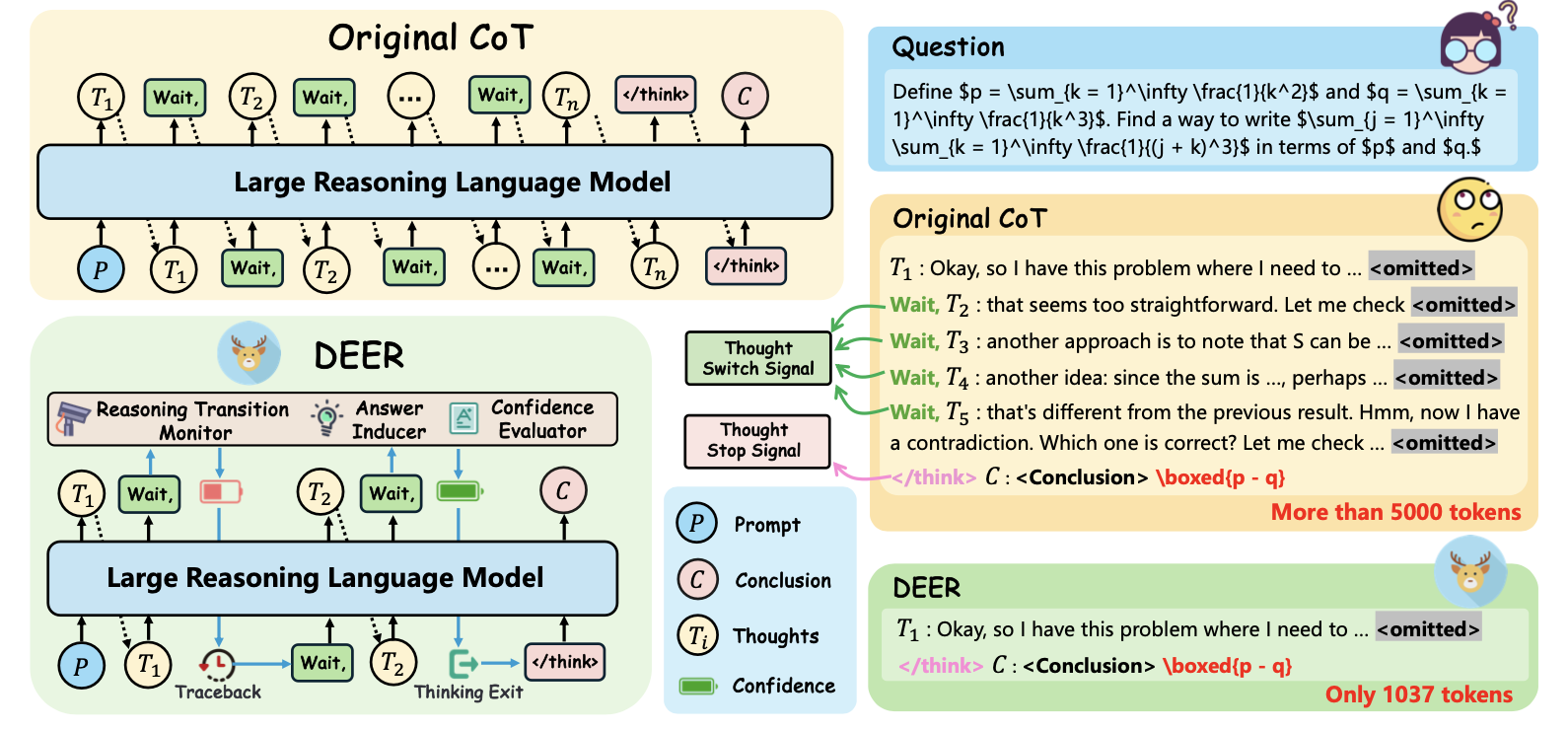
DEER monitors model behavior at potential reasoning transition points and dynamically terminates the next reasoning chain’s generation when the model exhibits high confidence in a trial answer. It is consistently effective on 11 cutting-edge reasoning LLMs of varying series and sizes, reducing the length of CoT sequences by an average of 19.1% - 80.1% while improving accuracy by 0.3% - 5.0%.
🔥 Latest Updates
- [2025/05/20] Released DEER code for mathematical reasoning tasks (HuggingFace & vLLM).
- [Coming Soon] DEER for code generation tasks & Branch-Parallel Decoding Acceleration.
🎯 Key Results
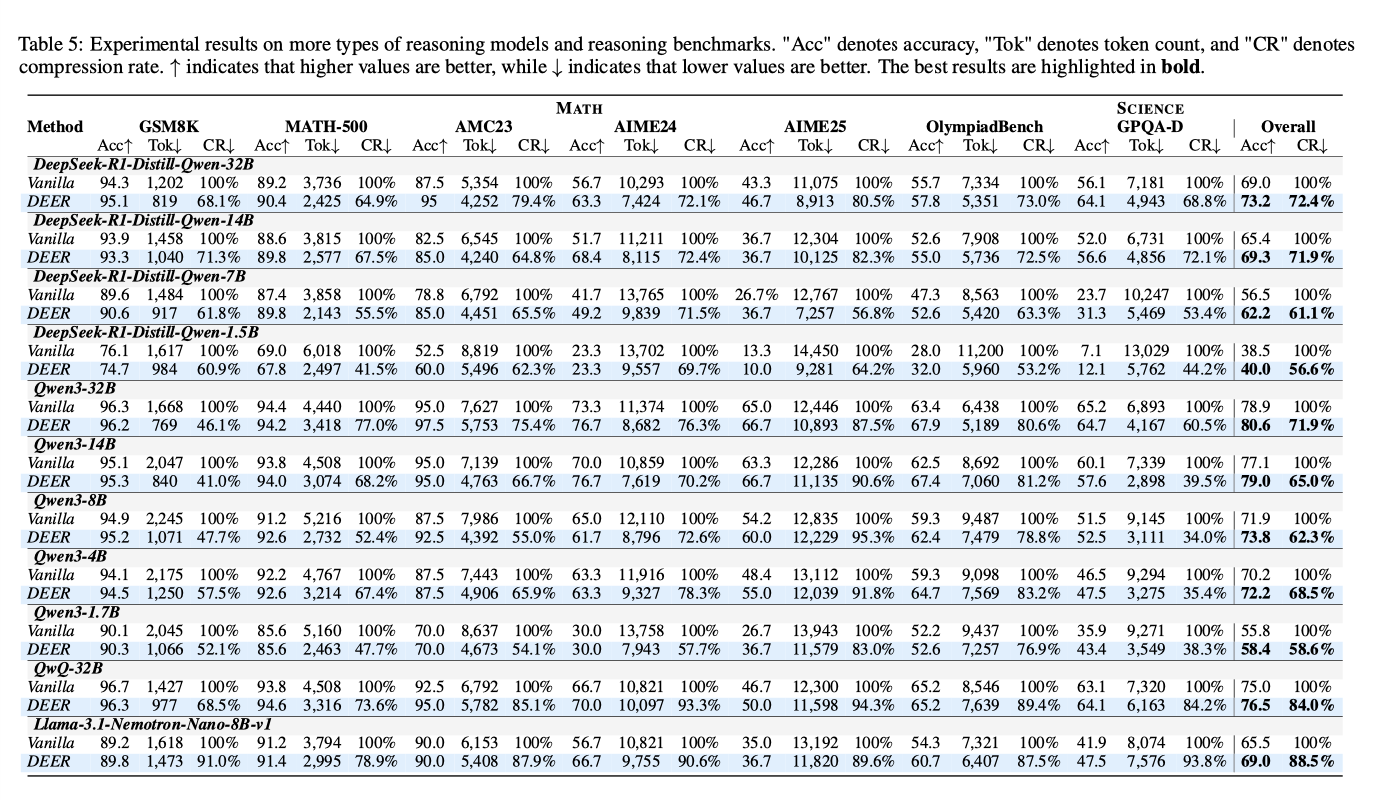
Results on 11 reasoning models with 16k token budgets. "Acc" denotes accuracy, "Tok" denotes token count, and "CR" denotes compression rate.
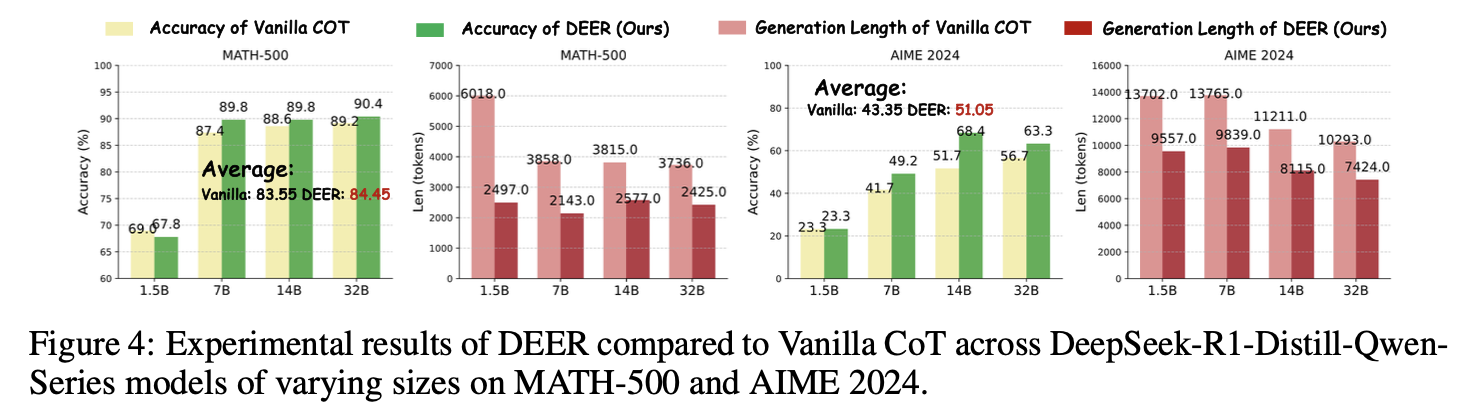
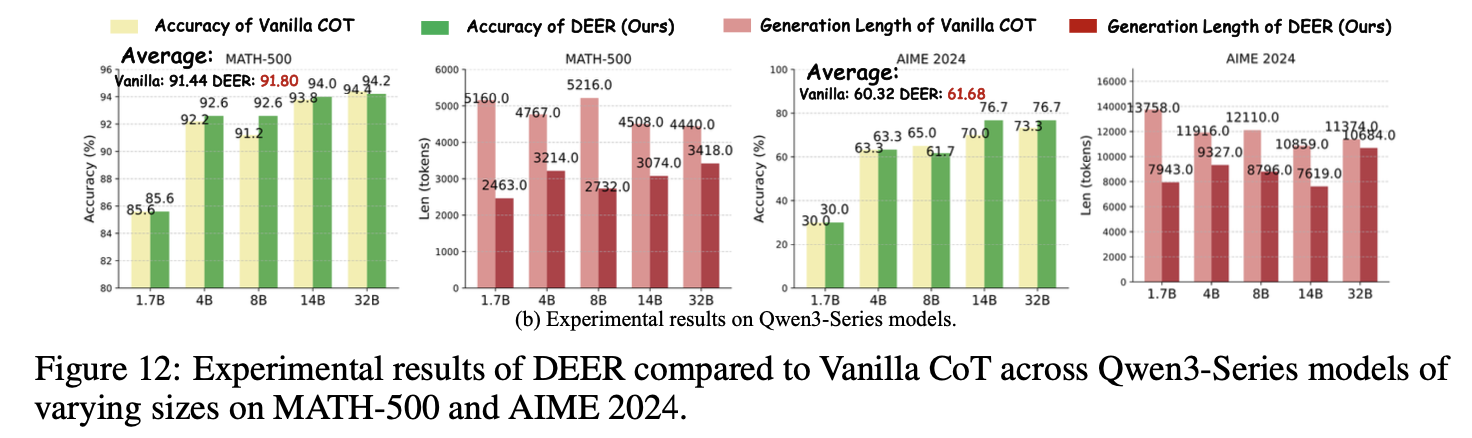
Experimental results presented in bar charts.
🚀 Quick Start
1. Installation
git clone https://github.com/yourusername/DEER.git
cd DEER
pip install -r requirements.txt
2. DEER on vLLM (Recommended)
Considering efficiency, we recommend reproducing the results using the code based on the vLLM framework.
For Most Reasoning Models
CUDA_VISIBLE_DEVICES=1 python ../vllm-deer.py \
    --model_name_or_path "./DeepSeek-R1-Distill-Qwen-14B" \
    --dataset_dir "./data/" \
    --output_path "./outputs" \
    --dataset "math" \
    --threshold 0.95 \
    --max_generated_tokens 16000 \
    --think_ratio 0.6 \
    --batch_size 2000 \
    --policy avg1 \
    --dtype bfloat16 \
    --gpu-memory-utilization 0.9 \
or run:
bash ./bashes/bash-vllm-deer.sh.
For Qwen3 Models
CUDA_VISIBLE_DEVICES=1 python ../vllm-deer-qwen3.py \
    --model_name_or_path "./Qwen3-4B" \
    --dataset_dir "./data/" \
    --output_path "./outputs" \
    --dataset "math" \
    --threshold 0.95 \
    --max_generated_tokens 16000 \
    --think_ratio 0.8 \
    --batch_size 2000 \
    --dtype bfloat16 \
    --policy avg2 \
    --gpu-memory-utilization 0.9 \
or run:
bash ./bashes/bash-vllm-deer-qwen3.sh.
In our experiments, we found that Qwen3-series models tend to be over-confident in confidence prediction, so we made some modifications to its implementation.
- The calculation of answer confidence was changed from arithmetic mean to geometric mean.
- An additional condition must be satisfied for early exit: the model must generate </think> after the trial answer.
3. DEER on Transformers
For inference using HuggingFace Transformers (without vLLM), run:
bash ./bashes/bash-vanilla-deer.sh
📊 Evaluation
DEER currently supports evaluation on 7 reasoning benchmarks. The rule-based evaluation for these benchmarks is based on the code implementation from the project LIMO.
python ../check.py \
    --model_name_or_path "./DeepSeek-R1-Distill-Qwen-14B" \
    --data_name "math" \
    --generation_path "your_output.jsonl" \
or run
bash ./bashes/bash-check-correct.sh
📜 Citation
If you use DEER in your research, please cite our paper:
@article{yang2025dynamic,
  title={Dynamic Early Exit in Reasoning Models},
  author={Yang, Chenxu and Si, Qingyi and Duan, Yongjie and Zhu, Zheliang and Zhu, Chenyu and Lin, Zheng and Cao, Li and Wang, Weiping},
  journal={arXiv preprint arXiv:2504.15895},
  year={2025}
}
💬 Community
Join our WeChat group for discussions:

Significant stargazers

21 followers · starred Jun 2025
Similar repos




Languages
Python
99.4%
This is the repository of DEER, a Dynamic Early Exit in Reasoning method for Large Reasoning Language Models.
Python
208
18 commits
updated Jul 7, 2025
README
DEER 🦌: Dynamic Early Exit in Reasoning Models
This is the repository of our paper: Dynamic Early Exit in Reasoning Models.
DEER monitors model behavior at potential reasoning transition points and dynamically terminates the next reasoning chain’s generation when the model exhibits high confidence in a trial answer. It is consistently effective on 11 cutting-edge reasoning LLMs of varying series and sizes, reducing the length of CoT sequences by an average of 19.1% - 80.1% while improving accuracy by 0.3% - 5.0%.
🔥 Latest Updates
- [2025/05/20] Released DEER code for mathematical reasoning tasks (HuggingFace & vLLM).
- [Coming Soon] DEER for code generation tasks & Branch-Parallel Decoding Acceleration.
🎯 Key Results
Results on 11 reasoning models with 16k token budgets. "Acc" denotes accuracy, "Tok" denotes token count, and "CR" denotes compression rate.
Experimental results presented in bar charts.
🚀 Quick Start
1. Installation
git clone https://github.com/yourusername/DEER.git
cd DEER
pip install -r requirements.txt
2. DEER on vLLM (Recommended)
Considering efficiency, we recommend reproducing the results using the code based on the vLLM framework.
For Most Reasoning Models
CUDA_VISIBLE_DEVICES=1 python ../vllm-deer.py \
    --model_name_or_path "./DeepSeek-R1-Distill-Qwen-14B" \
    --dataset_dir "./data/" \
    --output_path "./outputs" \
    --dataset "math" \
    --threshold 0.95 \
    --max_generated_tokens 16000 \
    --think_ratio 0.6 \
    --batch_size 2000 \
    --policy avg1 \
    --dtype bfloat16 \
    --gpu-memory-utilization 0.9 \
or run:
bash ./bashes/bash-vllm-deer.sh.
For Qwen3 Models
CUDA_VISIBLE_DEVICES=1 python ../vllm-deer-qwen3.py \
    --model_name_or_path "./Qwen3-4B" \
    --dataset_dir "./data/" \
    --output_path "./outputs" \
    --dataset "math" \
    --threshold 0.95 \
    --max_generated_tokens 16000 \
    --think_ratio 0.8 \
    --batch_size 2000 \
    --dtype bfloat16 \
    --policy avg2 \
    --gpu-memory-utilization 0.9 \
or run:
bash ./bashes/bash-vllm-deer-qwen3.sh.
In our experiments, we found that Qwen3-series models tend to be over-confident in confidence prediction, so we made some modifications to its implementation.
- The calculation of answer confidence was changed from arithmetic mean to geometric mean.
- An additional condition must be satisfied for early exit: the model must generate </think> after the trial answer.
3. DEER on Transformers
For inference using HuggingFace Transformers (without vLLM), run:
bash ./bashes/bash-vanilla-deer.sh
📊 Evaluation
DEER currently supports evaluation on 7 reasoning benchmarks. The rule-based evaluation for these benchmarks is based on the code implementation from the project LIMO.
python ../check.py \
    --model_name_or_path "./DeepSeek-R1-Distill-Qwen-14B" \
    --data_name "math" \
    --generation_path "your_output.jsonl" \
or run
bash ./bashes/bash-check-correct.sh
📜 Citation
If you use DEER in your research, please cite our paper:
@article{yang2025dynamic,
  title={Dynamic Early Exit in Reasoning Models},
  author={Yang, Chenxu and Si, Qingyi and Duan, Yongjie and Zhu, Zheliang and Zhu, Chenyu and Lin, Zheng and Cao, Li and Wang, Weiping},
  journal={arXiv preprint arXiv:2504.15895},
  year={2025}
}
💬 Community
Join our WeChat group for discussions:
Similar repos
Significant stargazers
21 followers · starred Jun 2025
Languages
Python
99.4%