
fab, the fast agentic browser: a CLI that lets AI agents browse, sign in, fill forms and scrape the web in plain English, with JSON output. Faster, cheaper and more accurate than LLM + chrome-devtools-mcp.
HTML
0
5 commits
updated Sep 29, 2026
See what people are saying
README
fast-agentic-browser (fab)
Ever noticed how painfully sluggish it is for agents to use a web browser?
fab's sole mission is to fix that. A beacon of perf in the hellscape of clunky
agentic browser tooling. It's also cheaper and more accurate than the
alternatives.
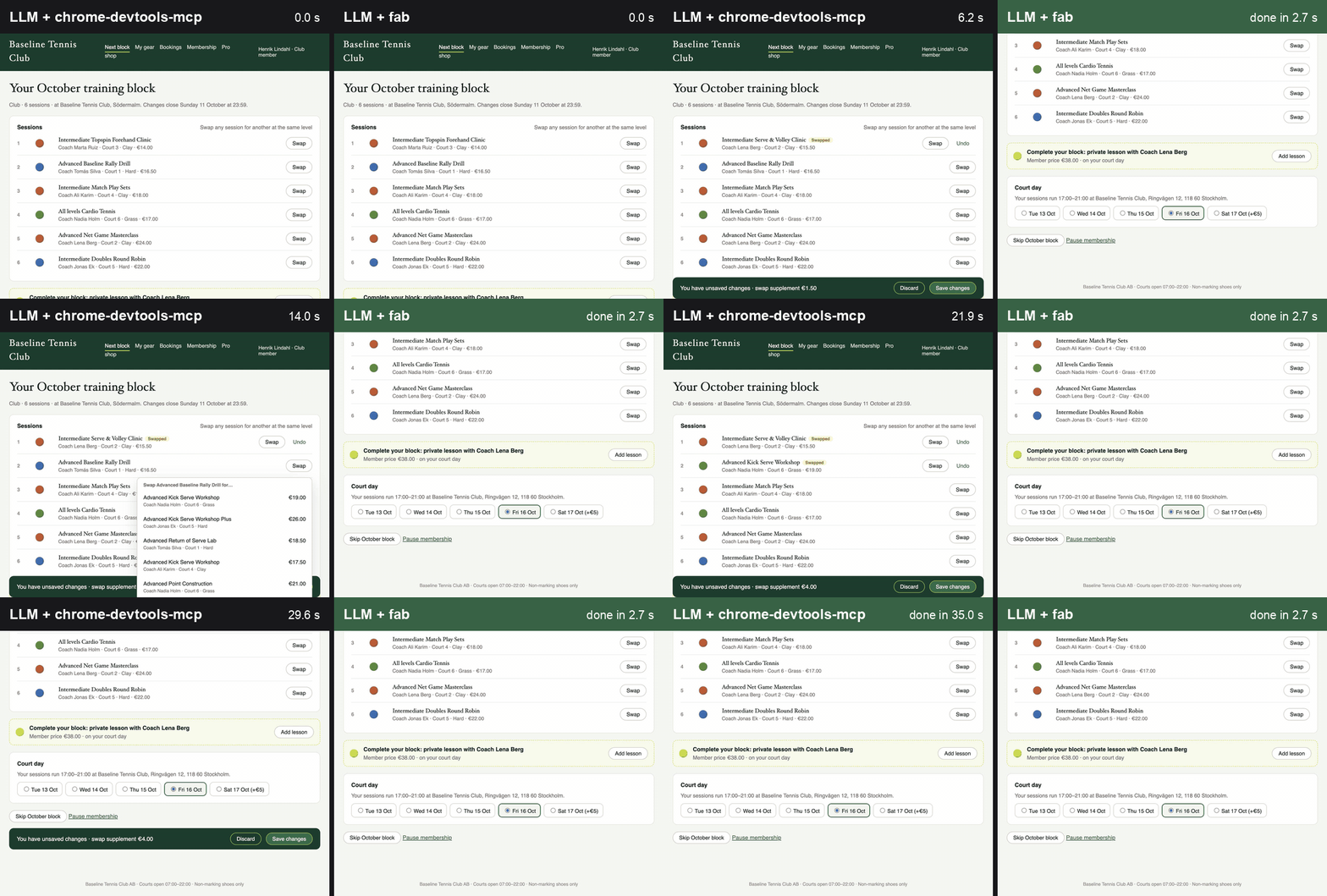
"Customize my October training block": two session swaps among look-alikes, a new court day, save. Same LLM (mercury-2.5), real time. Left: the LLM driving chrome-devtools-mcp, 35.0 s. Right: fab, 2.7 s.
Your agent says what it wants done, in words. fab does the clicking, typing, reading and signing in, and hands back the result.
| LLM + chrome-devtools-mcp | fab | |
|---|---|---|
| tasks passed | 73.1% | 92.5% |
| median time per task | 40.7 s | 16.6 s |
| cost per task | $0.0133 | $0.0044 |
A blind suite of 40 tasks on 20 unseen apps, same planner LLM, strict
outcome checks, measured 2026-09-24. How it's measured: bench/LOG.md
("Blind gate: held-out-3").
Use it
fab do "open news.ycombinator.com and tell me the top story and its points"
fab do "search for Ada Lovelace and tell me when she was born" --url en.wikipedia.org
fab do "log in to github.com"                                  # your saved login, 2FA included
fab do "what's the total of refunded orders?" --url localhost:3000/orders    # exact, across every page
fab do "pay with {{card number}}, expiry {{expiry}}, CVC {{CVC}}, but don't place the order"
fab do 'sign up as "qa+1@acme.dev" with {{new password}}' --url localhost:3000/signup
fab do '{"do": "every job on all pages", "url": "jobs.example.com",
         "records": {"properties": {"title": {"type": "string"}, "salary": {"type": ["number", "null"]}}}}'
fab close
Agents declare what they want back as JSON Schema and get exactly that shape (docs/output.md); words are for people.
Is this an MCP and/or extension?
No, and there never will be. For the first time in history, the dreams of the Unix philosophy are finally being realized by LLMs. One-shotting bash pipelines is viable now. This is an extremely powerful way to shape data, and MCP prevents that. Just let the LLMs use bash, sheesh.
One output format. Every command prints JSON Lines: a start event, a
record per result, and one end with the answer or a typed error, on success
and failure alike (docs/output.md).
Scrape in plain English. Ask for data from a list and fab streams a record per item as it pages through it, opening each item's page when a field lives there:
fab do "every job on all pages: title, company, and the salary from its page" --url jobs.example.com \
  | jq -c 'select(.t=="record").data' > jobs.jsonl
fab writes the request's logic as a small program (loops, conditions, limits;
--print shows it, fab run runs one). The items, fields, pages and detail
pages are handled by code in the page: an LLM maps each page layout to its fields
once, detail pages are fetched in parallel, and values are copied exactly. The
eval (bench/scrape, 20 cases on generated sites, 1,746 records: numbered
pages, Next buttons, Load more, endless scroll, two-row records, 3-level
nesting, client-rendered details, sponsored items, missing fields) is exact on
all 20 in most runs, with an occasional miss where the LLM maps a field
wrong; 1,000 products with their pages take about 20 s.
Secrets never reach your agent.
- Logins come from 1Password, Bitwarden or the macOS Keychain, and are typed only on the site they're saved for.
{{plain words}}stands for anything else in your password manager. Passwords, codes, card numbers and keys stay••••everywhere, and fab asks you once per site before it uses a card, an identity or a key.- A
{{new password}}is generated and saved before it's typed. fab secretsshows what's connected.
Install
cargo install --locked fast-agentic-browser
fab doctor
High-level steps need an OPENROUTER_API_KEY (in the environment or
~/.config/fab/env).
Agents drive fab through the CLI:
- The CLI skill:
fab --skillprints it,fab --skill --installadds it to Claude Code, and--install codex|agents|<dir>puts it elsewhere. Commands on one session (-s NAME, defaultdefault) share one browser window and its logins. - Concurrency: requests that overlap (several
fab doat once) run side by side in tabs of the same browser, sharing its logins; each caller's next step continues on its own tab (name callers withFAB_CLIENT). At mostFAB_POOL_MAXtabs (default 4) — more requests wait their turn — and idle tabs close afterFAB_POOL_IDLEseconds (60). - Durable tasks: a request survives a crash.
fab tasks listshows them,fab tasks resume IDcontinues one from its last confirmed step, andfab tasks resolvesettles a step whose outcome is uncertain (did the click land?) before anything is repeated.
Browser. fab uses your default browser (Chrome, Edge, Brave, Firefox, …) in
a window you can watch, with its own profile. --headless hides the window,
--browser firefox picks one, and --connect auto works in your running Chrome.
Development
fab-bench runs the suites, races and the decision dataset
(fab-bench bench --mode agent --suite bench/heldout3.toml), and the scrape
eval (fab-bench scrape run). scripts/demo opens a live browser with a
terminal wired to it, for trying requests by hand. The history of
every change and its measured effect is in bench/LOG.md.
License
Licensed under either of Apache License, Version 2.0 or MIT license at your option.
Similar repos


Languages
HTML
61.1%
Rust
33.7%
JavaScript
4.6%
fab, the fast agentic browser: a CLI that lets AI agents browse, sign in, fill forms and scrape the web in plain English, with JSON output. Faster, cheaper and more accurate than LLM + chrome-devtools-mcp.
HTML
0
5 commits
updated Sep 29, 2026
See what people are saying
README
fast-agentic-browser (fab)
Ever noticed how painfully sluggish it is for agents to use a web browser?
fab's sole mission is to fix that. A beacon of perf in the hellscape of clunky
agentic browser tooling. It's also cheaper and more accurate than the
alternatives.
"Customize my October training block": two session swaps among look-alikes, a new court day, save. Same LLM (mercury-2.5), real time. Left: the LLM driving chrome-devtools-mcp, 35.0 s. Right: fab, 2.7 s.
Your agent says what it wants done, in words. fab does the clicking, typing, reading and signing in, and hands back the result.
| LLM + chrome-devtools-mcp | fab | |
|---|---|---|
| tasks passed | 73.1% | 92.5% |
| median time per task | 40.7 s | 16.6 s |
| cost per task | $0.0133 | $0.0044 |
A blind suite of 40 tasks on 20 unseen apps, same planner LLM, strict
outcome checks, measured 2026-09-24. How it's measured: bench/LOG.md
("Blind gate: held-out-3").
Use it
fab do "open news.ycombinator.com and tell me the top story and its points"
fab do "search for Ada Lovelace and tell me when she was born" --url en.wikipedia.org
fab do "log in to github.com"                                  # your saved login, 2FA included
fab do "what's the total of refunded orders?" --url localhost:3000/orders    # exact, across every page
fab do "pay with {{card number}}, expiry {{expiry}}, CVC {{CVC}}, but don't place the order"
fab do 'sign up as "qa+1@acme.dev" with {{new password}}' --url localhost:3000/signup
fab do '{"do": "every job on all pages", "url": "jobs.example.com",
         "records": {"properties": {"title": {"type": "string"}, "salary": {"type": ["number", "null"]}}}}'
fab close
Agents declare what they want back as JSON Schema and get exactly that shape (docs/output.md); words are for people.
Is this an MCP and/or extension?
No, and there never will be. For the first time in history, the dreams of the Unix philosophy are finally being realized by LLMs. One-shotting bash pipelines is viable now. This is an extremely powerful way to shape data, and MCP prevents that. Just let the LLMs use bash, sheesh.
One output format. Every command prints JSON Lines: a start event, a
record per result, and one end with the answer or a typed error, on success
and failure alike (docs/output.md).
Scrape in plain English. Ask for data from a list and fab streams a record per item as it pages through it, opening each item's page when a field lives there:
fab do "every job on all pages: title, company, and the salary from its page" --url jobs.example.com \
  | jq -c 'select(.t=="record").data' > jobs.jsonl
fab writes the request's logic as a small program (loops, conditions, limits;
--print shows it, fab run runs one). The items, fields, pages and detail
pages are handled by code in the page: an LLM maps each page layout to its fields
once, detail pages are fetched in parallel, and values are copied exactly. The
eval (bench/scrape, 20 cases on generated sites, 1,746 records: numbered
pages, Next buttons, Load more, endless scroll, two-row records, 3-level
nesting, client-rendered details, sponsored items, missing fields) is exact on
all 20 in most runs, with an occasional miss where the LLM maps a field
wrong; 1,000 products with their pages take about 20 s.
Secrets never reach your agent.
- Logins come from 1Password, Bitwarden or the macOS Keychain, and are typed only on the site they're saved for.
{{plain words}}stands for anything else in your password manager. Passwords, codes, card numbers and keys stay••••everywhere, and fab asks you once per site before it uses a card, an identity or a key.- A
{{new password}}is generated and saved before it's typed. fab secretsshows what's connected.
Install
cargo install --locked fast-agentic-browser
fab doctor
High-level steps need an OPENROUTER_API_KEY (in the environment or
~/.config/fab/env).
Agents drive fab through the CLI:
- The CLI skill:
fab --skillprints it,fab --skill --installadds it to Claude Code, and--install codex|agents|<dir>puts it elsewhere. Commands on one session (-s NAME, defaultdefault) share one browser window and its logins. - Concurrency: requests that overlap (several
fab doat once) run side by side in tabs of the same browser, sharing its logins; each caller's next step continues on its own tab (name callers withFAB_CLIENT). At mostFAB_POOL_MAXtabs (default 4) — more requests wait their turn — and idle tabs close afterFAB_POOL_IDLEseconds (60). - Durable tasks: a request survives a crash.
fab tasks listshows them,fab tasks resume IDcontinues one from its last confirmed step, andfab tasks resolvesettles a step whose outcome is uncertain (did the click land?) before anything is repeated.
Browser. fab uses your default browser (Chrome, Edge, Brave, Firefox, …) in
a window you can watch, with its own profile. --headless hides the window,
--browser firefox picks one, and --connect auto works in your running Chrome.
Development
fab-bench runs the suites, races and the decision dataset
(fab-bench bench --mode agent --suite bench/heldout3.toml), and the scrape
eval (fab-bench scrape run). scripts/demo opens a live browser with a
terminal wired to it, for trying requests by hand. The history of
every change and its measured effect is in bench/LOG.md.
License
Licensed under either of Apache License, Version 2.0 or MIT license at your option.
Similar repos
Languages
HTML
61.1%
Rust
33.7%
JavaScript
4.6%