Abhishek Basu1*, Fahad Shamshad1*, Karthik Nandakumar1,2
1Mohamed bin Zayed University of Artificial Intelligence (MBZUAI)
2Michigan State University (MSU)


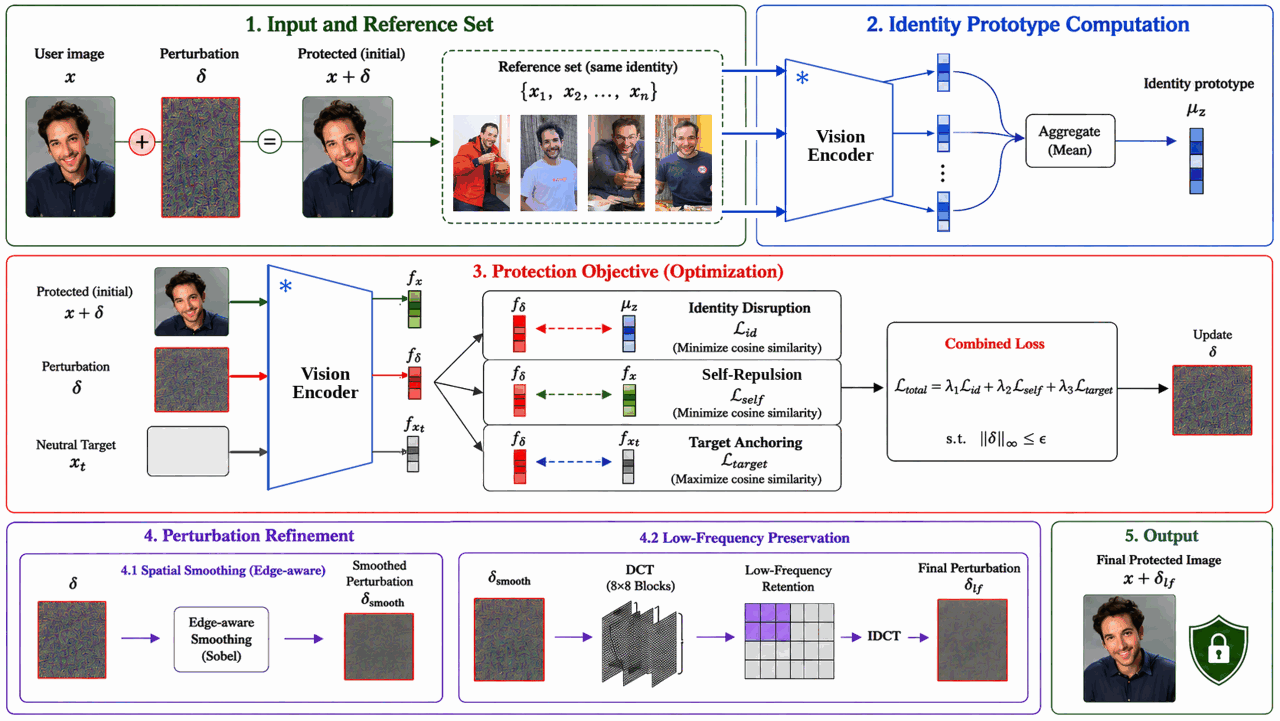
Personalized large vision-language models (LVLMs) — e.g. Yo'LLaVA and MyVLM — learn a user-specific concept (a person's identity) from only a handful of reference images, then answer natural-language queries about that concept. The same capability is a privacy risk: an adversary can bind a target identity to an off-the-shelf LVLM and later detect that person in arbitrary images through simple prompts, turning a general-purpose model into a targeted identity recognizer without consent.
Anti-Persona is an image-level defense against this recognition-based personalization. Unlike defenses for generative misuse (Anti-DreamBooth, Glaze, PhotoGuard), which prevent a model from synthesizing a subject, our goal is to prevent identity binding and detection. We optimize an imperceptible perturbation in the vision-encoder representation space — the shared interface through which both token-based (Yo'LLaVA) and concept-head (MyVLM) personalization read identity evidence. The key observation is that identity binding relies on cues that stay consistent across multiple reference images; we therefore attack an aggregated identity prototype rather than each image in isolation, which yields stronger protection and better black-box transfer.
bash setup_env.sh          # conda env `anti-persona` + deps + OpenAI CLIP
conda activate anti-persona
conda create -n anti-persona python=3.10 -y
conda activate anti-persona
pip install -r requirements.txt
pip install git+https://github.com/openai/CLIP.git   # imported as `clip`
The protection attack is self-contained on CLIP. The victim code is vendored
under victims/ for plug-and-play reproduction (see Licensing):
| Victim | Personalization | Vendored at | Upstream |
|---|---|---|---|
| Yo'LLaVA | token-based ($\langle sks \rangle$ + prefix tokens) | victims/yollava/ (llava + scripts) | WisconsinAIVision/YoLLaVA |
| MyVLM | concept head on the frozen encoder | victims/myvlm/ | snap-research/MyVLM |
| Component | Setting |
|---|---|
| Victim vision encoder | OpenAI CLIP ViT-L/14 @ 336px |
| Base LVLM | LLaVA-1.5-13B (liuhaotian/llava-v1.5-13b) |
| MyVLM face-recognition head | CVLface AdaFace IR-101 (WebFace12M) recognizer + CVLface DFA-MobileNet aligner (minchul/*, HuggingFace) — an open-source FR model, replacing MyVLM's default InsightFace buffalo_l |
| Black-box surrogates | CLIP ViT-B/16, CLIP ViT-L/14@224, OpenCLIP ViT-L/14, CLIPA ViT-L/14@336 |
| Dataset | Yo'LLaVA benchmark — 10 identities, ~15–20 images each |
anti-persona/
├── anti_persona/             # the protection attack (self-contained on CLIP)
│   ├── attack.py             # ★ objective (L_id + λ1·L_self + λ2·L_target) + PGD + refinements
│   ├── protect.py            # CLI: build the identity prototype, write protected images
│   └── assets/gray_image.png # neutral target anchor x_t (used by default)
├── scripts/
│   ├── protect.sh                    # run the attack (paper config)
│   ├── reproduce_table1_reactive.sh  # Table 1 (reactive)
│   └── reproduce_table2_proactive.sh # Table 2 (proactive)
├── victims/                  # vendored victim code (see Licensing)
│   ├── yollava/              # Apache-2.0: llava/ + personalize.py + evaluate.py
│   └── myvlm/                # Snap non-commercial: myvlm/, concept_heads/ (CVLface FR), ...
├── configs/ours.yaml         # canonical hyperparameters
├── docs/REPRODUCE.md         # step-by-step reproduction
├── licenses/                 # Apache-2.0, Snap MyVLM, third-party notices
└── setup_env.sh  requirements.txt  LICENSE
The victim personalization / recognition scripts live under victims/ and are
run in their own conda environments (they need heavier deps — llava, myvlm,
CVLface). See docs/REPRODUCE.md.
Let $f_\phi$ be the frozen vision encoder and $\mathcal{R}_s={x_1,\dots,x_n}$ the reference set for identity $s$. We form an identity prototype as the centroid of the reference embeddings,
$$\mu_s = \frac{1}{n}\sum_{i=1}^{n} f_\phi(x_i),$$
and optimize a perturbation $\delta$ for a user image $x$ (protected image $\tilde{x}=x+\delta$) with a three-term objective:
$$\min_{\delta};; \underbrace{\cos!\big(f_\phi(\tilde{x}),\mu_s\big)}{\mathcal{L}{\text{id}}} +\lambda_1\underbrace{\cos!\big(f_\phi(\tilde{x}),f_\phi(x)\big)}{\mathcal{L}{\text{self}}} +\lambda_2\underbrace{\big(1-\cos(f_\phi(\tilde{x}),f_\phi(x_t))\big)}{\mathcal{L}{\text{target}}} \quad\text{s.t.}\quad \lVert\delta\rVert_\infty\le\epsilon,$$
where $\mathcal{L}{\text{id}}$ disrupts the shared identity prototype,
$\mathcal{L}{\text{self}}$ suppresses residual similarity to the clean image,
and $\mathcal{L}{\text{target}}$ anchors the representation toward a neutral gray
target $x_t$ for stable optimization. We minimize by projected gradient descent
(sign updates) under the $\ell\infty$ budget. After each step, two refinements
improve fidelity and compression robustness: spatial smoothing of $\delta$
under a Sobel edge mask, and low-frequency preservation via a patch-wise DCT
low-pass. The neutral anchor and hyperparameters are in configs/ours.yaml:
| $\epsilon$ | steps $T$ | lr | $\lambda_2$ | smoothing $\sigma$ | DCT keep | encoder |
|---|---|---|---|---|---|---|
| 4/255 | 500 | 0.5 | 2.0 | 0.8 | 5 | CLIP ViT-L/14@336 |
Generate protected images:
bash scripts/protect.sh <input_dir> <output_dir>
# equivalently:
python anti_persona/protect.py --input_dir <in> --output_dir <out> \
    --model openai/clip-vit-large-patch14-336 \
    --epsilon 4 --num_iters 500 --lr 0.5 --seed 42 \
    --averageloss_lambda 2.0 --gaussian_sigma 0.8 --dct_keep 5
A neutral gray anchor (anti_persona/assets/gray_image.png) is used by default;
override with --target_path. Run --help for the full option list.
bash scripts/reproduce_table1_reactive.sh <gpu>
bash scripts/reproduce_table2_proactive.sh <gpu>
The reactive victims are the authors' 9 Yo'LLaVA checkpoints plus a retrained
seed-7 yuheng; hosting and the exact commands are in
docs/REPRODUCE.md. The Protection Rate (percentage of
queries the personalized LVLM fails to recognize) is the per-category
x.xxx (c/t) line printed by test-sks-acc.py.
Verified on a single NVIDIA RTX A6000 (48 GB), python 3.10 · torch 2.1.2+cu121:
| Check | Result |
|---|---|
| Protected-image fidelity | PSNR 39.4 dB, $\lVert\delta\rVert_\infty = 4/255$ |
Reactive protection (thao, Ours, authors' checkpoint) | 10/10 = 100% (matches paper) |
The evaluation is deterministic; the PGD attack is not bit-reproducible across hardware, so pooled Ours protection may vary by a couple of borderline images (≈ 91–93 %).
@inproceedings{basu2027antipersona,
  title     = {Anti-Persona: Disrupting Unauthorized Identity Binding and Recognition in Personalized Vision--Language Models},
  author    = {Basu, Abhishek and Shamshad, Fahad and Nandakumar, Karthik},
  year      = {2027}
}
Built on Yo'LLaVA, MyVLM, LLaVA, and OpenCLIP.
This repository is mixed-license — see
licenses/THIRD_PARTY_NOTICES.md:
anti_persona/, scripts/, configs/, docs/) — MIT.victims/yollava/ — Apache-2.0 (LLaVA / Yo'LLaVA).victims/myvlm/ — Snap Inc. non-commercial, academic-use-only license
(redistributed with Snap's notice retained). ⚠️ The MyVLM component may not be
used for commercial purposes. For a permissive subset, use anti_persona/ +
victims/yollava/ only.Abhishek Basu1*, Fahad Shamshad1*, Karthik Nandakumar1,2
1Mohamed bin Zayed University of Artificial Intelligence (MBZUAI)
2Michigan State University (MSU)
Personalized large vision-language models (LVLMs) — e.g. Yo'LLaVA and MyVLM — learn a user-specific concept (a person's identity) from only a handful of reference images, then answer natural-language queries about that concept. The same capability is a privacy risk: an adversary can bind a target identity to an off-the-shelf LVLM and later detect that person in arbitrary images through simple prompts, turning a general-purpose model into a targeted identity recognizer without consent.
Anti-Persona is an image-level defense against this recognition-based personalization. Unlike defenses for generative misuse (Anti-DreamBooth, Glaze, PhotoGuard), which prevent a model from synthesizing a subject, our goal is to prevent identity binding and detection. We optimize an imperceptible perturbation in the vision-encoder representation space — the shared interface through which both token-based (Yo'LLaVA) and concept-head (MyVLM) personalization read identity evidence. The key observation is that identity binding relies on cues that stay consistent across multiple reference images; we therefore attack an aggregated identity prototype rather than each image in isolation, which yields stronger protection and better black-box transfer.
bash setup_env.sh          # conda env `anti-persona` + deps + OpenAI CLIP
conda activate anti-persona
conda create -n anti-persona python=3.10 -y
conda activate anti-persona
pip install -r requirements.txt
pip install git+https://github.com/openai/CLIP.git   # imported as `clip`
The protection attack is self-contained on CLIP. The victim code is vendored
under victims/ for plug-and-play reproduction (see Licensing):
| Victim | Personalization | Vendored at | Upstream |
|---|---|---|---|
| Yo'LLaVA | token-based ($\langle sks \rangle$ + prefix tokens) | victims/yollava/ (llava + scripts) | WisconsinAIVision/YoLLaVA |
| MyVLM | concept head on the frozen encoder | victims/myvlm/ | snap-research/MyVLM |
| Component | Setting |
|---|---|
| Victim vision encoder | OpenAI CLIP ViT-L/14 @ 336px |
| Base LVLM | LLaVA-1.5-13B (liuhaotian/llava-v1.5-13b) |
| MyVLM face-recognition head | CVLface AdaFace IR-101 (WebFace12M) recognizer + CVLface DFA-MobileNet aligner (minchul/*, HuggingFace) — an open-source FR model, replacing MyVLM's default InsightFace buffalo_l |
| Black-box surrogates | CLIP ViT-B/16, CLIP ViT-L/14@224, OpenCLIP ViT-L/14, CLIPA ViT-L/14@336 |
| Dataset | Yo'LLaVA benchmark — 10 identities, ~15–20 images each |
anti-persona/
├── anti_persona/             # the protection attack (self-contained on CLIP)
│   ├── attack.py             # ★ objective (L_id + λ1·L_self + λ2·L_target) + PGD + refinements
│   ├── protect.py            # CLI: build the identity prototype, write protected images
│   └── assets/gray_image.png # neutral target anchor x_t (used by default)
├── scripts/
│   ├── protect.sh                    # run the attack (paper config)
│   ├── reproduce_table1_reactive.sh  # Table 1 (reactive)
│   └── reproduce_table2_proactive.sh # Table 2 (proactive)
├── victims/                  # vendored victim code (see Licensing)
│   ├── yollava/              # Apache-2.0: llava/ + personalize.py + evaluate.py
│   └── myvlm/                # Snap non-commercial: myvlm/, concept_heads/ (CVLface FR), ...
├── configs/ours.yaml         # canonical hyperparameters
├── docs/REPRODUCE.md         # step-by-step reproduction
├── licenses/                 # Apache-2.0, Snap MyVLM, third-party notices
└── setup_env.sh  requirements.txt  LICENSE
The victim personalization / recognition scripts live under victims/ and are
run in their own conda environments (they need heavier deps — llava, myvlm,
CVLface). See docs/REPRODUCE.md.
Let $f_\phi$ be the frozen vision encoder and $\mathcal{R}_s={x_1,\dots,x_n}$ the reference set for identity $s$. We form an identity prototype as the centroid of the reference embeddings,
$$\mu_s = \frac{1}{n}\sum_{i=1}^{n} f_\phi(x_i),$$
and optimize a perturbation $\delta$ for a user image $x$ (protected image $\tilde{x}=x+\delta$) with a three-term objective:
$$\min_{\delta};; \underbrace{\cos!\big(f_\phi(\tilde{x}),\mu_s\big)}{\mathcal{L}{\text{id}}} +\lambda_1\underbrace{\cos!\big(f_\phi(\tilde{x}),f_\phi(x)\big)}{\mathcal{L}{\text{self}}} +\lambda_2\underbrace{\big(1-\cos(f_\phi(\tilde{x}),f_\phi(x_t))\big)}{\mathcal{L}{\text{target}}} \quad\text{s.t.}\quad \lVert\delta\rVert_\infty\le\epsilon,$$
where $\mathcal{L}{\text{id}}$ disrupts the shared identity prototype,
$\mathcal{L}{\text{self}}$ suppresses residual similarity to the clean image,
and $\mathcal{L}{\text{target}}$ anchors the representation toward a neutral gray
target $x_t$ for stable optimization. We minimize by projected gradient descent
(sign updates) under the $\ell\infty$ budget. After each step, two refinements
improve fidelity and compression robustness: spatial smoothing of $\delta$
under a Sobel edge mask, and low-frequency preservation via a patch-wise DCT
low-pass. The neutral anchor and hyperparameters are in configs/ours.yaml:
| $\epsilon$ | steps $T$ | lr | $\lambda_2$ | smoothing $\sigma$ | DCT keep | encoder |
|---|---|---|---|---|---|---|
| 4/255 | 500 | 0.5 | 2.0 | 0.8 | 5 | CLIP ViT-L/14@336 |
Generate protected images:
bash scripts/protect.sh <input_dir> <output_dir>
# equivalently:
python anti_persona/protect.py --input_dir <in> --output_dir <out> \
    --model openai/clip-vit-large-patch14-336 \
    --epsilon 4 --num_iters 500 --lr 0.5 --seed 42 \
    --averageloss_lambda 2.0 --gaussian_sigma 0.8 --dct_keep 5
A neutral gray anchor (anti_persona/assets/gray_image.png) is used by default;
override with --target_path. Run --help for the full option list.
bash scripts/reproduce_table1_reactive.sh <gpu>
bash scripts/reproduce_table2_proactive.sh <gpu>
The reactive victims are the authors' 9 Yo'LLaVA checkpoints plus a retrained
seed-7 yuheng; hosting and the exact commands are in
docs/REPRODUCE.md. The Protection Rate (percentage of
queries the personalized LVLM fails to recognize) is the per-category
x.xxx (c/t) line printed by test-sks-acc.py.
Verified on a single NVIDIA RTX A6000 (48 GB), python 3.10 · torch 2.1.2+cu121:
| Check | Result |
|---|---|
| Protected-image fidelity | PSNR 39.4 dB, $\lVert\delta\rVert_\infty = 4/255$ |
Reactive protection (thao, Ours, authors' checkpoint) | 10/10 = 100% (matches paper) |
The evaluation is deterministic; the PGD attack is not bit-reproducible across hardware, so pooled Ours protection may vary by a couple of borderline images (≈ 91–93 %).
@inproceedings{basu2027antipersona,
  title     = {Anti-Persona: Disrupting Unauthorized Identity Binding and Recognition in Personalized Vision--Language Models},
  author    = {Basu, Abhishek and Shamshad, Fahad and Nandakumar, Karthik},
  year      = {2027}
}
Built on Yo'LLaVA, MyVLM, LLaVA, and OpenCLIP.
This repository is mixed-license — see
licenses/THIRD_PARTY_NOTICES.md:
anti_persona/, scripts/, configs/, docs/) — MIT.victims/yollava/ — Apache-2.0 (LLaVA / Yo'LLaVA).victims/myvlm/ — Snap Inc. non-commercial, academic-use-only license
(redistributed with Snap's notice retained). ⚠️ The MyVLM component may not be
used for commercial purposes. For a permissive subset, use anti_persona/ +
victims/yollava/ only.


