AI Browser Automation
See the code
Intelligent Browser Automation with LLMs



Hyperagent is Playwright supercharged with AI. No more brittle scripts, just powerful natural language commands. Just looking for scalable headless browsers or scraping infra? Go to Hyperbrowser to get started for free!
View HyperAgent docs here: https://www.hyperbrowser.ai/docs/hyperagent/introduction
page.ai(), page.extract() and executeTask() for any AI automation# Using npm
npm install @hyperbrowser/agent
# Using yarn
yarn add @hyperbrowser/agent
$ npx @hyperbrowser/agent -c "Find a route from Miami to New Orleans, and provide the detailed route information."
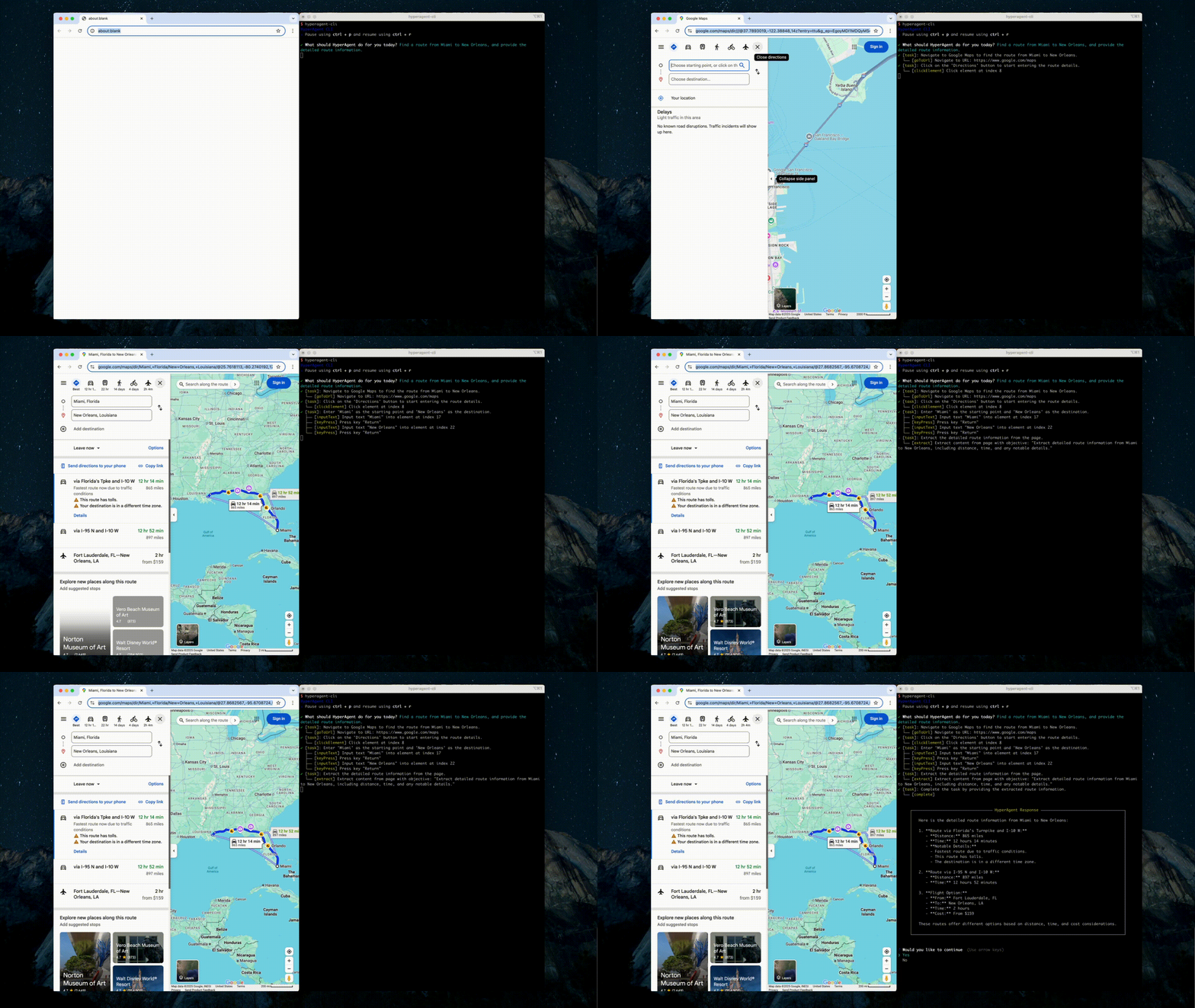
The CLI supports options for debugging or using hyperbrowser instead of a local browser
-d, --debug                       Enable debug mode
-c, --command <task description>  Command to run
--hyperbrowser                    Use Hyperbrowser for the browser provider
import { HyperAgent } from "@hyperbrowser/agent";
import { z } from "zod";

// Initialize the agent
const agent = new HyperAgent({
  llm: {
    provider: "openai",
    model: "gpt-4o",
  },
});

// Execute a task
const result = await agent.executeTask(
  "Navigate to amazon.com, search for 'laptop', and extract the prices of the first 5 results"
);
console.log(result.output);

// Use page.ai, page.perform, and page.extract
const page = await agent.newPage();
await page.goto("https://flights.google.com", { waitUntil: "load" });
await page.ai("search for flights from Rio to LAX from July 16 to July 22");
await page.perform("click the search button");
const res = await page.extract(
  "give me the flight options",
  z.object({
    flights: z.array(
      z.object({
        price: z.number(),
        departure: z.string(),
        arrival: z.string(),
      })
    ),
  })
);
console.log(res);

// Clean up
await agent.closeAgent();
HyperAgent provides two complementary APIs optimized for different use cases:
page.perform() - Single Granular Actions
page.aiAction()is deprecated and remains available as an alias; preferpage.perform()going forward.
Best for: Single, specific actions like "click login", "fill email with test@example.com"
Advantages:
Example:
const page = await agent.newPage();
await page.goto("https://example.com/login");

// Fast, reliable single actions
await page.perform("fill email with user@example.com");
await page.perform("fill password with mypassword");
await page.perform("click the login button");
page.ai() - Complex Multi-Step TasksBest for: Complex workflows requiring multiple steps and visual context
Advantages:
Parameters:
useDomCache (boolean): Reuse DOM snapshots for speedenableVisualMode (boolean): Enable screenshots and overlays (default: false)Example:
const page = await agent.newPage();
await page.goto("https://flights.google.com");

// Complex task with multiple steps handled automatically
await page.ai("search for flights from Miami to New Orleans on July 16", {
  useDomCache: true,
});
Combine both APIs for optimal performance:
// Use perform for fast, reliable individual actions
await page.perform("click the search button");
await page.perform("type laptop into search");

// Use ai() for complex, multi-step workflows
await page.ai("filter results by price under $1000 and sort by rating");

// Extract structured data
const products = await page.extract(
  "get the top 5 products",
  z.object({
    products: z.array(z.object({ name: z.string(), price: z.number() }))
  })
);
You can scale HyperAgent with cloud headless browsers using Hyperbrowser
HYPERBROWSER_API_KEYbrowserProvider to "Hyperbrowser"const agent = new HyperAgent({
browserProvider: "Hyperbrowser",
});
const response = await agent.executeTask(
"Go to hackernews, and list me the 5 most recent article titles"
);
console.log(response);
await agent.closeAgent();
// Create and manage multiple pages
const page1 = await agent.newPage();
const page2 = await agent.newPage();

// Execute tasks on specific pages
const page1Response = await page1.ai(
  "Go to google.com/travel/explore and set the starting location to New York. Then, return to me the first recommended destination that shows up. Return to me only the name of the location."
);
const page2Response = await page2.ai(
  `I want to plan a trip to ${page1Response.output}. Recommend me places to visit there.`
);

console.log(page2Response.output);

// Get all active pages
const pages = await agent.getPages();
await agent.closeAgent();
HyperAgent can extract data in a specified schema. The schema can be passed in at a per-task level
import { z } from "zod";

const agent = new HyperAgent();
const agentResponse = await agent.executeTask(
  "Navigate to imdb.com, search for 'The Matrix', and extract the director, release year, and rating",
  {
    outputSchema: z.object({
      director: z.string().describe("The name of the movie director"),
      releaseYear: z.number().describe("The year the movie was released"),
      rating: z.string().describe("The IMDb rating of the movie"),
    }),
  }
);
console.log(agentResponse.output);
await agent.closeAgent();
{
  "director": "Lana Wachowski, Lilly Wachowski",
  "releaseYear": 1999,
  "rating": "8.7/10"
}
Hyperagent supports multiple LLM providers with native SDKs for better performance and reliability.
// Using OpenAI
const agent = new HyperAgent({
  llm: {
    provider: "openai",
    model: "gpt-4o",
  },
});

// Using Anthropic's Claude
const agent = new HyperAgent({
  llm: {
    provider: "anthropic",
    model: "claude-sonnet-4-0",
  },
});

// Using Google Gemini
const agent = new HyperAgent({
  llm: {
    provider: "gemini",
    model: "gemini-2.5-flash",
  },
});

// Using DeepSeek
const agent = new HyperAgent({
  llm: {
    provider: "deepseek",
    model: "deepseek-chat",
  },
});
HyperAgent functions as a fully functional MCP client. For best results, we recommend using
gpt-4o as your LLM.
Here is an example which reads from wikipedia, and inserts information into a google sheet using the composio Google Sheet MCP. For the full example, see here
const agent = new HyperAgent({
  llm: llm,
  debug: true,
});

await agent.initializeMCPClient({
  servers: [
    {
      command: "npx",
      args: [
        "@composio/mcp@latest",
        "start",
        "--url",
        "https://mcp.composio.dev/googlesheets/...",
      ],
      env: {
        npm_config_yes: "true",
      },
    },
  ],
});

const response = await agent.executeTask(
  "Go to https://en.wikipedia.org/wiki/List_of_U.S._states_and_territories_by_population and get the data on the top 5 most populous states from the table. Then insert that data into a google sheet. You may need to first check if there is an active connection to google sheet, and if there isn't connect to it and present me with the link to sign in. "
);

console.log(response);
await agent.closeAgent();
HyperAgent's capabilities can be extended with custom actions. Custom actions require 3 things:
Here is an example that performs a search using Exa
const exaInstance = new Exa(process.env.EXA_API_KEY);

export const RunSearchActionDefinition: AgentActionDefinition = {
  type: "perform_search",
  actionParams: z.object({
    search: z
      .string()
      .describe(
        "The search query for something you want to search about. Keep the search query concise and to-the-point."
      ),
  }).describe("Search and return the results for a given query."),
  run: async function (
    ctx: ActionContext,
    params: { search: string }
  ): Promise<ActionOutput> {
    const results = (await exaInstance.search(params.search, {})).results
      .map(
        (res) =>
          `title: ${res.title} || url: ${res.url} || relevance: ${res.score}`
      )
      .join("\n");

    return {
      success: true,
      message: `Successfully performed search for query ${params.search}. Got results: \n${results}`,
    };
  },
};

const agent = new HyperAgent({
  customActions: [RunSearchActionDefinition],
});

const result = await agent.executeTask(
  "Search about the news for today in New York"
);
HyperAgent automatically records every action during page.ai() runs, capturing XPaths, frame indices, and execution details. This enables deterministic replay without LLM calls—perfect for regression testing, CI pipelines, and cost optimization.
Every page.ai() run produces an actionCache containing the exact sequence of actions performed:
const page = await agent.newPage();
const { actionCache } = await page.ai(
  "Go to flights.google.com and search for flights from Rio to LAX"
);

// actionCache contains the recorded steps
console.log(actionCache);
Example cache entry:
{
  "taskId": "86d13abe-b9f3-4ca3-a9bb-bdeddf234cd1",
  "createdAt": "2025-12-06T05:44:52.257Z",
  "status": "completed",
  "steps": [
    {
      "stepIndex": 0,
      "instruction": "Click on the departure field",
      "elementId": "0-138",
      "method": "click",
      "arguments": [],
      "frameIndex": 0,
      "xpath": "/html[1]/body[1]/div[1]/input[1]",
      "actionType": "actElement",
      "success": true
    }
  ]
}
Replay a recorded session using runFromActionCache(). It attempts XPath-based execution first (no LLM calls), falling back to LLM only if the page structure has changed:
import { ActionCacheOutput } from "@hyperbrowser/agent";
import fs from "fs";

// Load a previously saved action cache
const cache: ActionCacheOutput = JSON.parse(
  fs.readFileSync("action-cache.json", "utf-8")
);

const agent = new HyperAgent();
const page = await agent.newPage();

// Replay the cached actions
const replay = await page.runFromActionCache(cache, {
  maxXPathRetries: 3,  // Retry XPath resolution up to 3 times before LLM fallback
  debug: true,
});

console.log(replay);
// {
//   replayId: "...",
//   sourceTaskId: "86d13abe-...",
//   status: "completed",
//   steps: [{ stepIndex: 0, usedXPath: true, fallbackUsed: false, success: true }]
// }

await agent.closeAgent();
Generate a standalone TypeScript script from an action cache for easy integration into your test suite:
const { actionCache } = await page.ai("search for flights from Miami to NYC");

// Generate a replay script
const script = agent.createScriptFromActionCache(actionCache.steps);
console.log(script);
This produces a script using typed helper methods like performClick(), performType(), etc., that can be run independently.
HyperAgent speaks Chrome DevTools Protocol natively. Element lookup, scrolling, typing, frame management, and screenshots all go through CDP so every action has exact coordinates, execution contexts, and browser events. This allows for more custom commands and deep iframe tracking.
HyperAgent integrates seamlessly with Playwright, so you can still use familiar commands, while the actions take full advantage of native CDP protocol with fast locators and advanced iframe tracking.
Key Features:
Keep in mind that CDP is still experimental, and stability is not guaranteed. If you'd like the agent to use Playwright's native locators/actions instead, set cdpActions: false when you create the agent and it will fall back automatically.
The CDP layer is still evolving—expect rapid polish (and the occasional sharp edge). If you hit something quirky you can toggle CDP off for that workflow and drop us a bug report.
We welcome contributions to Hyperagent! Here's how you can help:
git checkout -b feature/AmazingFeature)git commit -m 'Add some AmazingFeature')git push origin feature/AmazingFeature)354 followers · starred May 2026
22 followers · starred Feb 2026
170 followers · starred Mar 2026
21 followers · starred Apr 2025
AI Browser Automation
See the code
Intelligent Browser Automation with LLMs
Hyperagent is Playwright supercharged with AI. No more brittle scripts, just powerful natural language commands. Just looking for scalable headless browsers or scraping infra? Go to Hyperbrowser to get started for free!
View HyperAgent docs here: https://www.hyperbrowser.ai/docs/hyperagent/introduction
page.ai(), page.extract() and executeTask() for any AI automation# Using npm
npm install @hyperbrowser/agent
# Using yarn
yarn add @hyperbrowser/agent
$ npx @hyperbrowser/agent -c "Find a route from Miami to New Orleans, and provide the detailed route information."
The CLI supports options for debugging or using hyperbrowser instead of a local browser
-d, --debug                       Enable debug mode
-c, --command <task description>  Command to run
--hyperbrowser                    Use Hyperbrowser for the browser provider
import { HyperAgent } from "@hyperbrowser/agent";
import { z } from "zod";

// Initialize the agent
const agent = new HyperAgent({
  llm: {
    provider: "openai",
    model: "gpt-4o",
  },
});

// Execute a task
const result = await agent.executeTask(
  "Navigate to amazon.com, search for 'laptop', and extract the prices of the first 5 results"
);
console.log(result.output);

// Use page.ai, page.perform, and page.extract
const page = await agent.newPage();
await page.goto("https://flights.google.com", { waitUntil: "load" });
await page.ai("search for flights from Rio to LAX from July 16 to July 22");
await page.perform("click the search button");
const res = await page.extract(
  "give me the flight options",
  z.object({
    flights: z.array(
      z.object({
        price: z.number(),
        departure: z.string(),
        arrival: z.string(),
      })
    ),
  })
);
console.log(res);

// Clean up
await agent.closeAgent();
HyperAgent provides two complementary APIs optimized for different use cases:
page.perform() - Single Granular Actions
page.aiAction()is deprecated and remains available as an alias; preferpage.perform()going forward.
Best for: Single, specific actions like "click login", "fill email with test@example.com"
Advantages:
Example:
const page = await agent.newPage();
await page.goto("https://example.com/login");

// Fast, reliable single actions
await page.perform("fill email with user@example.com");
await page.perform("fill password with mypassword");
await page.perform("click the login button");
page.ai() - Complex Multi-Step TasksBest for: Complex workflows requiring multiple steps and visual context
Advantages:
Parameters:
useDomCache (boolean): Reuse DOM snapshots for speedenableVisualMode (boolean): Enable screenshots and overlays (default: false)Example:
const page = await agent.newPage();
await page.goto("https://flights.google.com");

// Complex task with multiple steps handled automatically
await page.ai("search for flights from Miami to New Orleans on July 16", {
  useDomCache: true,
});
Combine both APIs for optimal performance:
// Use perform for fast, reliable individual actions
await page.perform("click the search button");
await page.perform("type laptop into search");

// Use ai() for complex, multi-step workflows
await page.ai("filter results by price under $1000 and sort by rating");

// Extract structured data
const products = await page.extract(
  "get the top 5 products",
  z.object({
    products: z.array(z.object({ name: z.string(), price: z.number() }))
  })
);
You can scale HyperAgent with cloud headless browsers using Hyperbrowser
HYPERBROWSER_API_KEYbrowserProvider to "Hyperbrowser"const agent = new HyperAgent({
browserProvider: "Hyperbrowser",
});
const response = await agent.executeTask(
"Go to hackernews, and list me the 5 most recent article titles"
);
console.log(response);
await agent.closeAgent();
// Create and manage multiple pages
const page1 = await agent.newPage();
const page2 = await agent.newPage();

// Execute tasks on specific pages
const page1Response = await page1.ai(
  "Go to google.com/travel/explore and set the starting location to New York. Then, return to me the first recommended destination that shows up. Return to me only the name of the location."
);
const page2Response = await page2.ai(
  `I want to plan a trip to ${page1Response.output}. Recommend me places to visit there.`
);

console.log(page2Response.output);

// Get all active pages
const pages = await agent.getPages();
await agent.closeAgent();
HyperAgent can extract data in a specified schema. The schema can be passed in at a per-task level
import { z } from "zod";

const agent = new HyperAgent();
const agentResponse = await agent.executeTask(
  "Navigate to imdb.com, search for 'The Matrix', and extract the director, release year, and rating",
  {
    outputSchema: z.object({
      director: z.string().describe("The name of the movie director"),
      releaseYear: z.number().describe("The year the movie was released"),
      rating: z.string().describe("The IMDb rating of the movie"),
    }),
  }
);
console.log(agentResponse.output);
await agent.closeAgent();
{
  "director": "Lana Wachowski, Lilly Wachowski",
  "releaseYear": 1999,
  "rating": "8.7/10"
}
Hyperagent supports multiple LLM providers with native SDKs for better performance and reliability.
// Using OpenAI
const agent = new HyperAgent({
  llm: {
    provider: "openai",
    model: "gpt-4o",
  },
});

// Using Anthropic's Claude
const agent = new HyperAgent({
  llm: {
    provider: "anthropic",
    model: "claude-sonnet-4-0",
  },
});

// Using Google Gemini
const agent = new HyperAgent({
  llm: {
    provider: "gemini",
    model: "gemini-2.5-flash",
  },
});

// Using DeepSeek
const agent = new HyperAgent({
  llm: {
    provider: "deepseek",
    model: "deepseek-chat",
  },
});
HyperAgent functions as a fully functional MCP client. For best results, we recommend using
gpt-4o as your LLM.
Here is an example which reads from wikipedia, and inserts information into a google sheet using the composio Google Sheet MCP. For the full example, see here
const agent = new HyperAgent({
  llm: llm,
  debug: true,
});

await agent.initializeMCPClient({
  servers: [
    {
      command: "npx",
      args: [
        "@composio/mcp@latest",
        "start",
        "--url",
        "https://mcp.composio.dev/googlesheets/...",
      ],
      env: {
        npm_config_yes: "true",
      },
    },
  ],
});

const response = await agent.executeTask(
  "Go to https://en.wikipedia.org/wiki/List_of_U.S._states_and_territories_by_population and get the data on the top 5 most populous states from the table. Then insert that data into a google sheet. You may need to first check if there is an active connection to google sheet, and if there isn't connect to it and present me with the link to sign in. "
);

console.log(response);
await agent.closeAgent();
HyperAgent's capabilities can be extended with custom actions. Custom actions require 3 things:
Here is an example that performs a search using Exa
const exaInstance = new Exa(process.env.EXA_API_KEY);

export const RunSearchActionDefinition: AgentActionDefinition = {
  type: "perform_search",
  actionParams: z.object({
    search: z
      .string()
      .describe(
        "The search query for something you want to search about. Keep the search query concise and to-the-point."
      ),
  }).describe("Search and return the results for a given query."),
  run: async function (
    ctx: ActionContext,
    params: { search: string }
  ): Promise<ActionOutput> {
    const results = (await exaInstance.search(params.search, {})).results
      .map(
        (res) =>
          `title: ${res.title} || url: ${res.url} || relevance: ${res.score}`
      )
      .join("\n");

    return {
      success: true,
      message: `Successfully performed search for query ${params.search}. Got results: \n${results}`,
    };
  },
};

const agent = new HyperAgent({
  customActions: [RunSearchActionDefinition],
});

const result = await agent.executeTask(
  "Search about the news for today in New York"
);
HyperAgent automatically records every action during page.ai() runs, capturing XPaths, frame indices, and execution details. This enables deterministic replay without LLM calls—perfect for regression testing, CI pipelines, and cost optimization.
Every page.ai() run produces an actionCache containing the exact sequence of actions performed:
const page = await agent.newPage();
const { actionCache } = await page.ai(
  "Go to flights.google.com and search for flights from Rio to LAX"
);

// actionCache contains the recorded steps
console.log(actionCache);
Example cache entry:
{
  "taskId": "86d13abe-b9f3-4ca3-a9bb-bdeddf234cd1",
  "createdAt": "2025-12-06T05:44:52.257Z",
  "status": "completed",
  "steps": [
    {
      "stepIndex": 0,
      "instruction": "Click on the departure field",
      "elementId": "0-138",
      "method": "click",
      "arguments": [],
      "frameIndex": 0,
      "xpath": "/html[1]/body[1]/div[1]/input[1]",
      "actionType": "actElement",
      "success": true
    }
  ]
}
Replay a recorded session using runFromActionCache(). It attempts XPath-based execution first (no LLM calls), falling back to LLM only if the page structure has changed:
import { ActionCacheOutput } from "@hyperbrowser/agent";
import fs from "fs";

// Load a previously saved action cache
const cache: ActionCacheOutput = JSON.parse(
  fs.readFileSync("action-cache.json", "utf-8")
);

const agent = new HyperAgent();
const page = await agent.newPage();

// Replay the cached actions
const replay = await page.runFromActionCache(cache, {
  maxXPathRetries: 3,  // Retry XPath resolution up to 3 times before LLM fallback
  debug: true,
});

console.log(replay);
// {
//   replayId: "...",
//   sourceTaskId: "86d13abe-...",
//   status: "completed",
//   steps: [{ stepIndex: 0, usedXPath: true, fallbackUsed: false, success: true }]
// }

await agent.closeAgent();
Generate a standalone TypeScript script from an action cache for easy integration into your test suite:
const { actionCache } = await page.ai("search for flights from Miami to NYC");

// Generate a replay script
const script = agent.createScriptFromActionCache(actionCache.steps);
console.log(script);
This produces a script using typed helper methods like performClick(), performType(), etc., that can be run independently.
HyperAgent speaks Chrome DevTools Protocol natively. Element lookup, scrolling, typing, frame management, and screenshots all go through CDP so every action has exact coordinates, execution contexts, and browser events. This allows for more custom commands and deep iframe tracking.
HyperAgent integrates seamlessly with Playwright, so you can still use familiar commands, while the actions take full advantage of native CDP protocol with fast locators and advanced iframe tracking.
Key Features:
Keep in mind that CDP is still experimental, and stability is not guaranteed. If you'd like the agent to use Playwright's native locators/actions instead, set cdpActions: false when you create the agent and it will fall back automatically.
The CDP layer is still evolving—expect rapid polish (and the occasional sharp edge). If you hit something quirky you can toggle CDP off for that workflow and drop us a bug report.
We welcome contributions to Hyperagent! Here's how you can help:
git checkout -b feature/AmazingFeature)git commit -m 'Add some AmazingFeature')git push origin feature/AmazingFeature)354 followers · starred May 2026
22 followers · starred Feb 2026
170 followers · starred Mar 2026
21 followers · starred Apr 2025



