
[NeurIPS 2026] InfiniteVL: Synergizing Linear and Sparse Attention for Highly-Efficient, Unlimited-Input Vision-Language Models
Python
118
15 commits
updated Sep 24, 2026
README

InfiniteVL: Synergizing Linear and Sparse Attention for Highly-Efficient, Unlimited-Input Vision-Language Models
Hongyuan Tao1, Bencheng Liao1, Shaoyu Chen2, Haoran Yin2, Qian Zhang2, Wenyu Liu1, Xinggang Wang1,✉️
1Huazhong University of Science and Technology, 2Horizon Robotics
(✉️) corresponding author: xgwang@hust.edu.cn


🔥 [Aug. 2026] GLM-5.3 & Qwen3.8-next both adopt linear + sparse attention as their core architecture.
InfiniteVL is one of the first fully open-source implementations of this design — with paper, training code, and checkpoints.
Introduction
InfiniteVL is an efficient Vision-Language Model that combines linear attention for compact long-term memory with sparse attention for precise visual perception. It achieves Transformer-level multimodal performance while supporting highly efficient long-context processing.
Based on InfiniteVL, we develop two specialized variants:
- Sparse InfiniteVL for offline long-video understanding, using dynamic sparse retrieval to preserve fine-grained visual information.
- Streaming InfiniteVL for continuous scene perception, enabling real-time streaming with bounded memory usage.
✨ Key Highlights
- 🚀 Efficient Foundation: InfiniteVL achieves Transformer-level multimodal performance with a 1.7× decoding speedup.
- 🔎 Sparse Long-Context Retrieval: Sparse InfiniteVL achieves a 5× prefill speedup at 256K context.
- ⚡ Real-Time Streaming: Streaming InfiniteVL sustains 25 FPS with a constant O(1) memory footprint.
- 🧠 Precise and Long-Range: Sparse attention preserves critical visual details, while linear attention efficiently maintains long-term context.
News
Sep. 25th, 2026: InfiniteVL has been accepted by NeurIPS 2026! 🎉🎉🎉Aug. 28th, 2026: 🔥 Today's released GLM-5.3 and Qwen3.8-next both adopt linear + sparse attention as their core architecture — the design InfiniteVL explored and fully open-sourced (paper + training code + checkpoints) last year. If you want to understand, reproduce, or build on this architecture, this repo is a complete starting point!Feb. 2nd, 2026: 🚀 We have released the full training code and scripts! You can now reproduce our results following the Training Strategy.Dec. 10th, 2025: We release the InfiniteVL model weights and inference code! Please check Model Zoo.Dec. 10th, 2025: We release our paper on Arxiv.
Getting Started
🛠️ Environment Setup
We recommend using Anaconda or Miniconda to manage the environment. The code is tested on Python 3.11 + PyTorch 2.6.0 + CUDA 12.1.
1. Clone the repository:
git clone https://github.com/hustvl/InfiniteVL.git
cd InfiniteVL
2. Create and activate a virtual environment:
conda create -n infinitevl python=3.11 -y
conda activate infinitevl
3. Install Environment:
pip install -r requirements.txt
Table of Contents
- Introduction
- Getting started
- Architecture & Training
- Performance & Main Results
- Model Zoo
- Advanced Usage (Streaming)
- Qualitative Analysis & Visualization
- Citation
- Acknowledgement
Architecture & Training
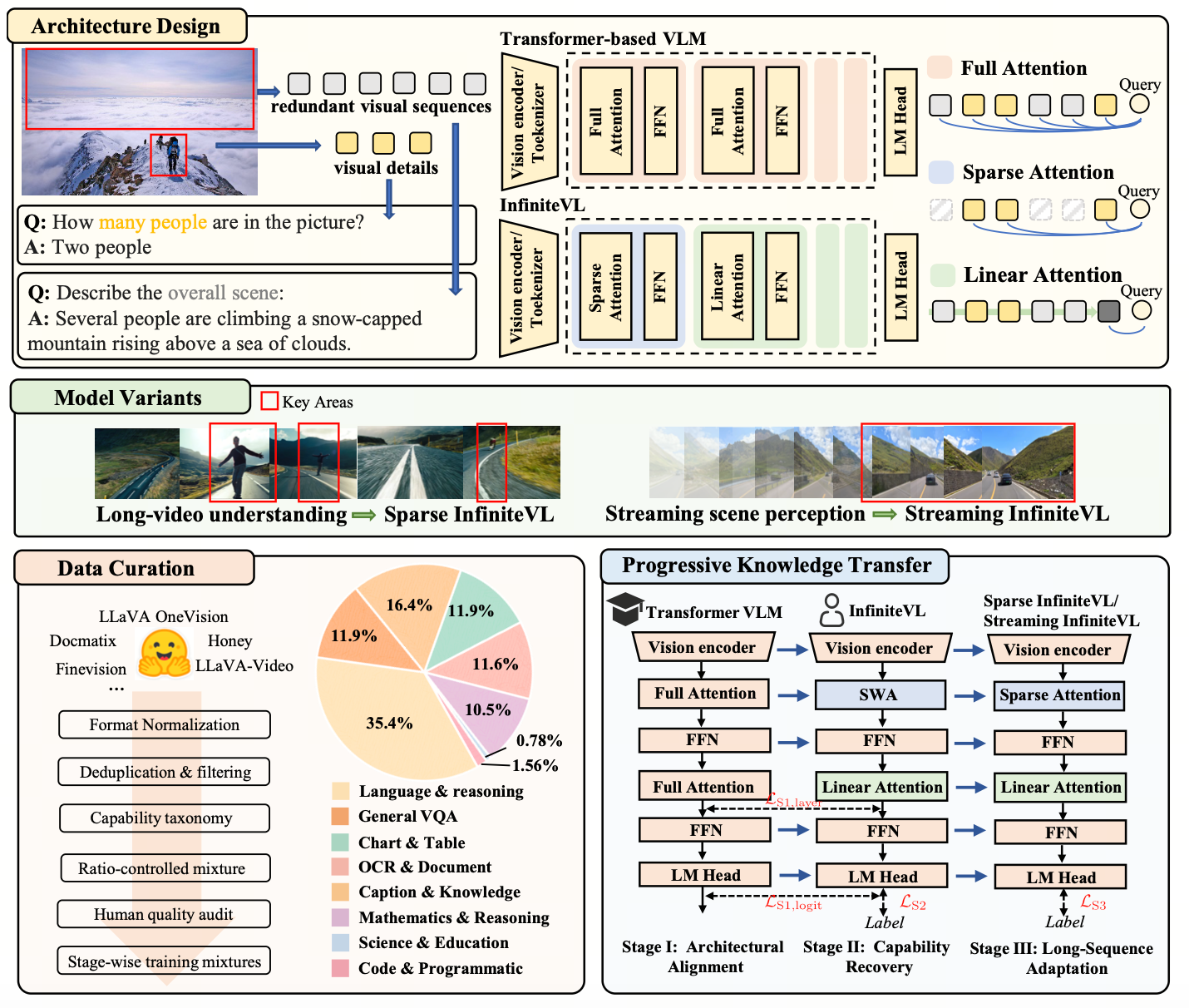
InfiniteVL combines sparse attention for precise visual perception with linear attention for efficient long-term memory. Based on this architecture, we develop two variants for different long-context scenarios:
- Sparse InfiniteVL targets offline long-video understanding with dynamic sparse retrieval.
- Streaming InfiniteVL targets continuous scene perception with efficient bounded-memory streaming.
Our training follows a three-stage progressive knowledge-transfer pipeline:
- Architectural Alignment: Transfer knowledge from a Transformer VLM to InfiniteVL through layer-wise and logit distillation.
- Capability Recovery: Restore strong general multimodal capabilities with continuous supervised fine-tuning.
- Long-Sequence Adaptation: Specialize InfiniteVL into Sparse InfiniteVL and Streaming InfiniteVL for offline and online long-context understanding.
⚙️ Reproduction Steps
Our training codebase is built upon LLaMA-Factory. Please refer to their repository for detailed documentation and framework usage.
We provide standard scripts to reproduce our three-stage training pipeline. The training is launched via train.sh.
Note: Before running, please modify the
model_name_or_path,datasetandcheckpoint_pathinside the.yamlfiles to point to your local directories.
1. Distillation Pretraining (layer to layer)
bash train.sh examples/train_linear/train_config_distill_stage1.yaml
2. Distillation Pretraining (End to End)
bash train.sh examples/train_linear/train_config_distill_stage2.yaml
3. Instruction SFT
bash train.sh examples/train_linear/train_config_distill_sft.yaml
Performance
🚀 Efficiency & Streaming
InfiniteVL is engineered for unlimited-input scenarios. Unlike Transformer-based models where cost grows linearly with history, InfiniteVL maintains constant computational cost and memory usage.
Hardware Setup: All efficiency results are measured on a single NVIDIA RTX 4090 GPU.
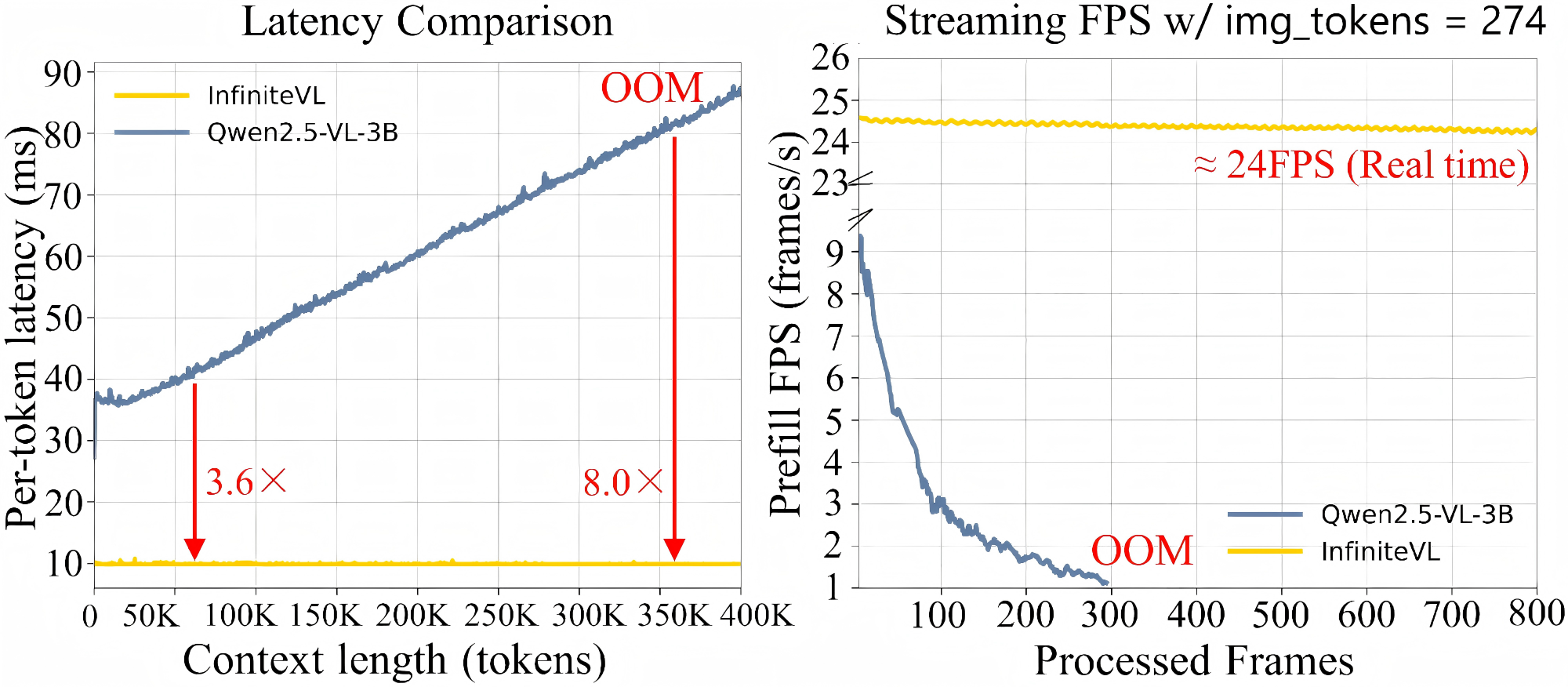
Figure 1: Comparison of streaming FPS and latency. InfiniteVL sustains real-time performance while Transformer baselines degrade rapidly.
🏆 Multimodal Benchmarks
InfiniteVL achieves state-of-the-art performance among linear-complexity VLMs. Crucially, thanks to our Hybrid Architecture and High-quality training strategies, it overcomes the traditional weakness of linear models in information-intensive tasks (e.g., OCR, Document Understanding), achieving results comparable to top-tier Transformer VLMs.
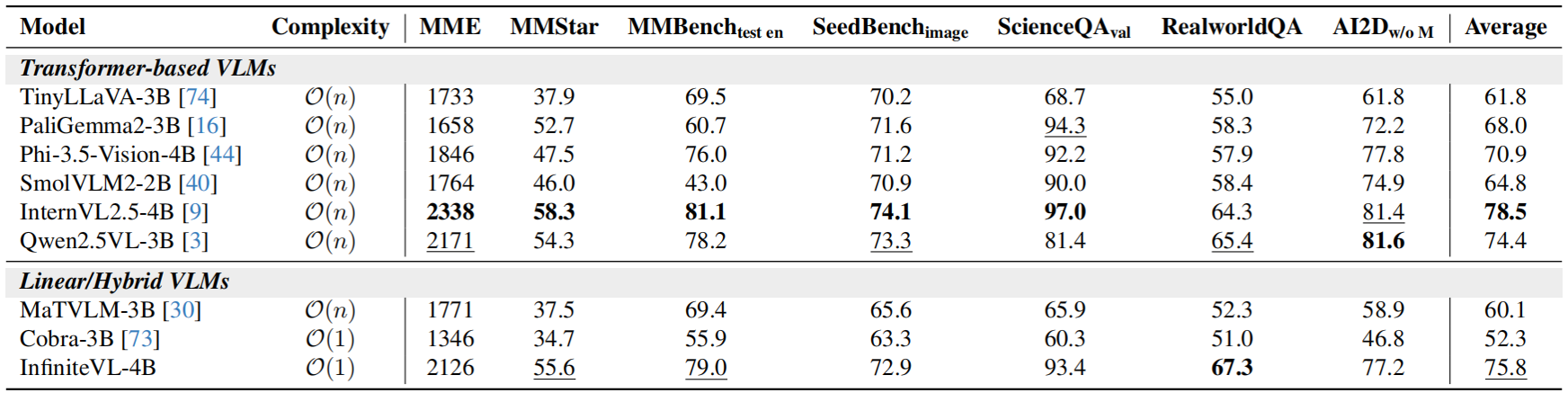
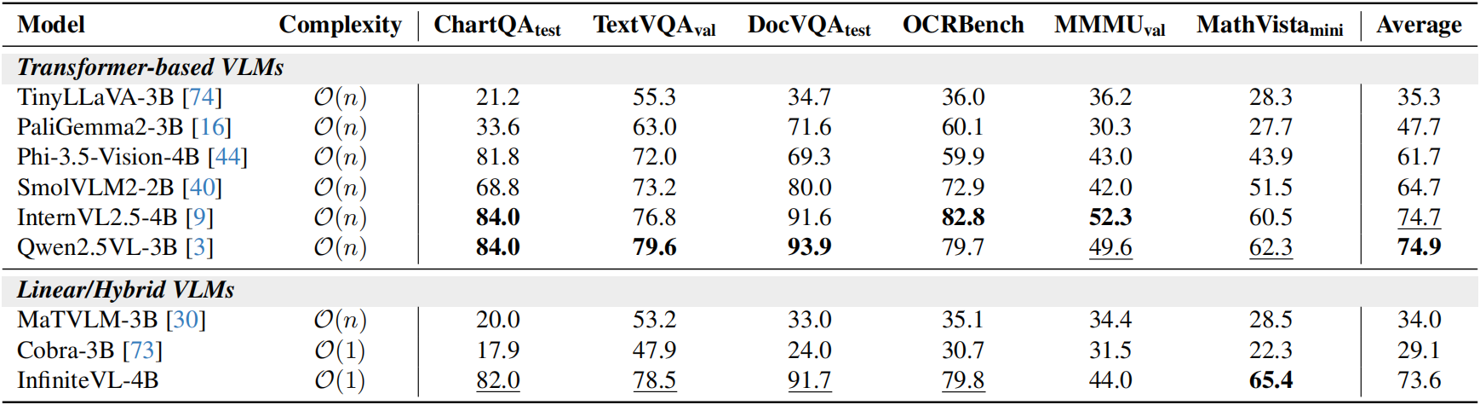
Figure 2: Comparison of InfiniteVL with existing VLMs on public multimodal understanding, real-world comprehension, text-rich, reasoning-centric multimodal benchmarks.
Key Takeaways:
- Best-in-Class Linear Model: Significantly outperforms previous linear VLMs (Cobra, MaTVLM) by large margins (+40-60 points on DocVQA/OCRBench).
- Transformer-Level Quality: Matches the performance of Qwen2.5-VL-3B on complex reasoning and text-rich tasks while being significantly faster in long contexts.
Model Zoo
We release two versions of InfiniteVL-4B to cater to different application scenarios.
| Model | Stage | Description | Training context Length | Download |
|---|---|---|---|---|
| InfiniteVL-4B | Stage 2 | Best Generalist / Base. The checkpoint directly after Instruction SFT. It delivers the peak foundational performance on standard multimodal benchmarks (e.g., OCR, MMMU, MathVista) and preserves the most robust knowledge. | 8K | 🤗 Hugging Face |
| InfiniteVL-4B-LongSFT | Stage 3 | Long-Context Adapted. Fine-tuned using only a small amount of long-sequence multimodal data. It successfully activates length generalization for streaming scenarios, though its full potential on extreme contexts is not yet fully exploited. | 32K | 🤗 Hugging Face |
💡 Recommendations:
- For Long-Context Inference: Please use the Stage 3 model. It enables stable streaming inference and avoids memory explosion.
- For Training / Fine-tuning: We strongly recommend using the Stage 2 model as your starting point. Since it maintains the strongest general capabilities and hasn't shifted towards the specific long-context distribution, it serves as the best foundation for adaptation to new tasks or domains.
🚀 Advanced Usage: CUDA Graph Acceleration
Unlike Transformer-based VLMs where the KV cache grows dynamically, InfiniteVL maintains a constant-size memory state. This unique property allows us to use CUDA Graphs to capture the entire computation graph for both streaming prefill and decoding, eliminating kernel launch overheads and maximizing GPU utilization.
This is the key technology behind our 24 FPS real-time streaming performance.
⚡ Accelerated Streaming Inference
Unlike Transformer-based VLMs where the KV cache grows dynamically, InfiniteVL maintains a constant-size memory state. This unique property allows us to use CUDA Graphs to capture the entire computation graph for streaming prefill, eliminating kernel launch overheads.
We provide a complete script in examples/demo_streaming_inference.py to demonstrate this capability.
🎥 Simulation Note: This script simulates a real-time streaming scenario by reading a local video file frame-by-frame. It treats the video as a continuous data stream, updating the global linear memory state on-the-fly without retraining.
⚠️ Requirement: This demo relies on the specialized model implementation (supporting
StaticCachePreallocand CUDA Graphs) located in theinfinitevl/infinitevl_streamingdirectory. Please ensure your environment is set up correctly to import these modules.
1. Run the Simulation Demo
# Make sure you are in the project root
python examples/demo_streaming_inference.py \
    --model_path /path/to/InfiniteVL-4B \
    --video_path assets/demo.mp4 \
    --fps 30
⚡ Accelerated Decode
In addition to streaming prefill, InfiniteVL natively supports CUDA Graph-accelerated decoding. By capturing the decoding step into a static graph, we can achieve extremely low-latency token generation, further enhancing the responsiveness of real-time interactions.
🚧 Coming Soon: The code for accelerated decoding is currently being refactored and cleaned up. We are working hard to release it as soon as possible. Please stay tuned!
Qualitative Analysis & Visualization
We provide visualization cases to demonstrate InfiniteVL's robust performance across diverse scenarios, ranging from information-intensive static tasks to ultra-long streaming video understanding.
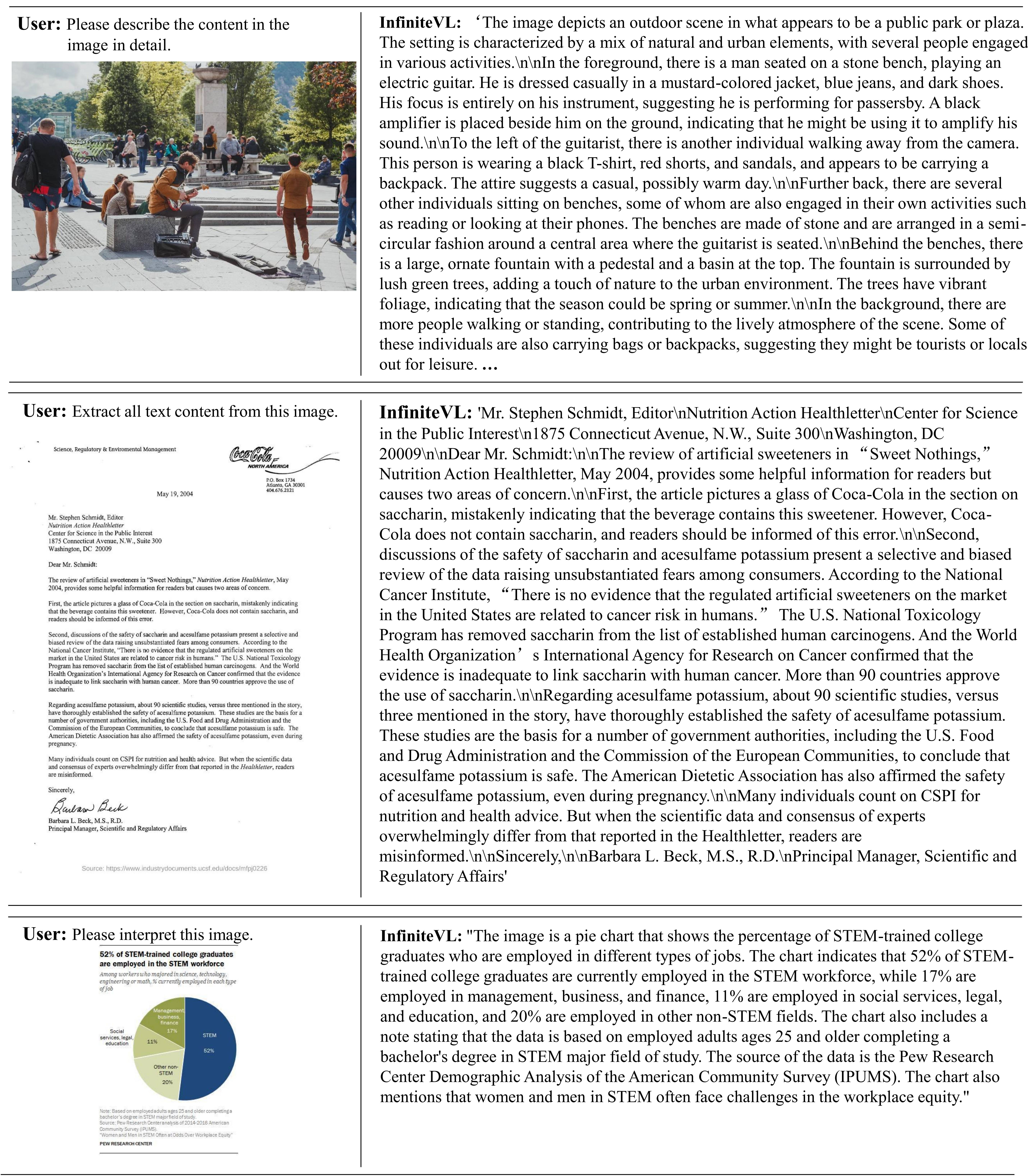
1. Fundamental Visual-Language Capabilities (OCR & Reasoning)
InfiniteVL effectively overcomes the traditional limitations of linear attention in detailed visual perception. By combining Sliding Window Attention with Gated DeltaNet, it excels at Dense Text Recognition (OCR), Chart Interpretation, and Complex Scene Description, delivering performance comparable to full-attention Transformers.
2. Long-Term Streaming Understanding
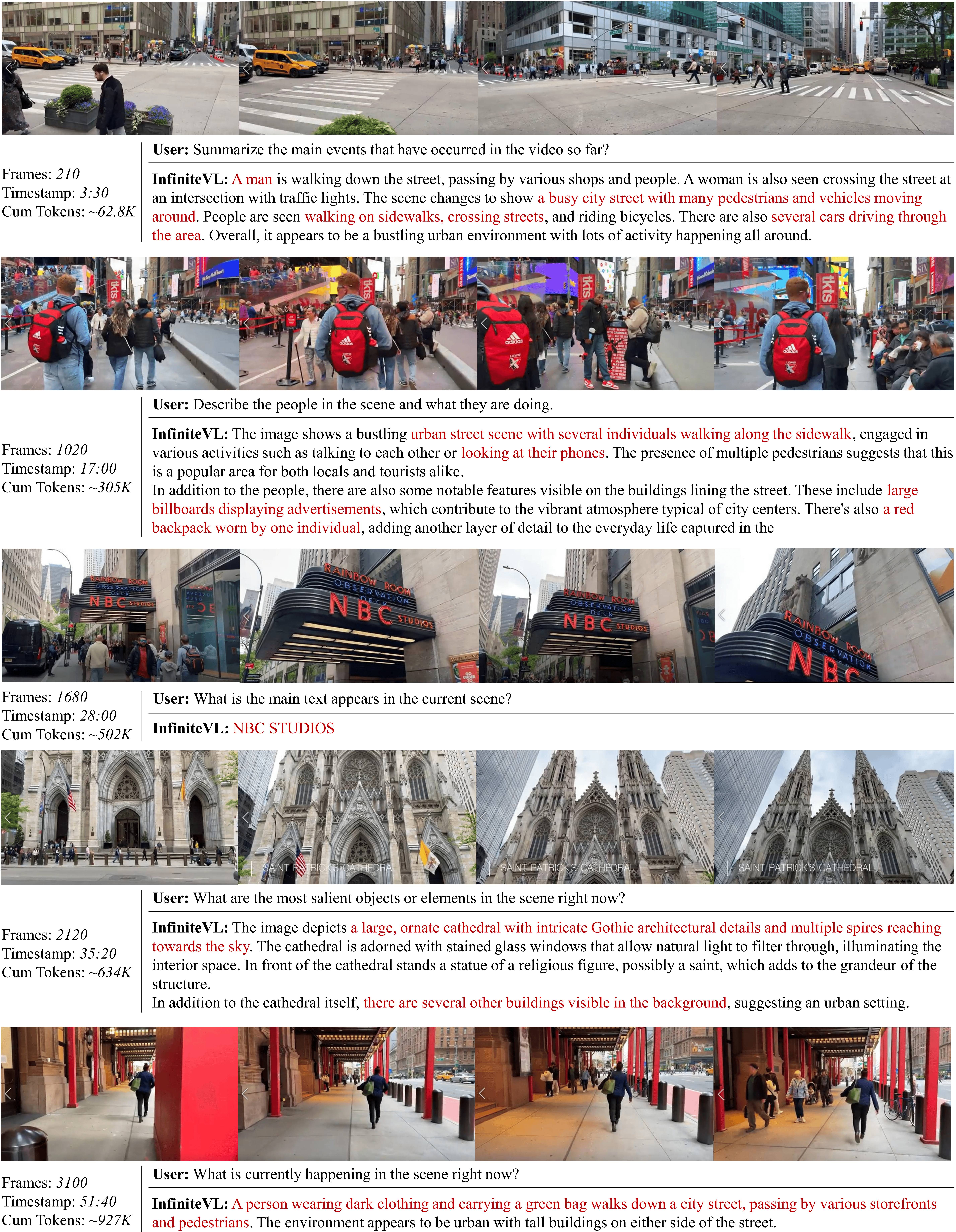
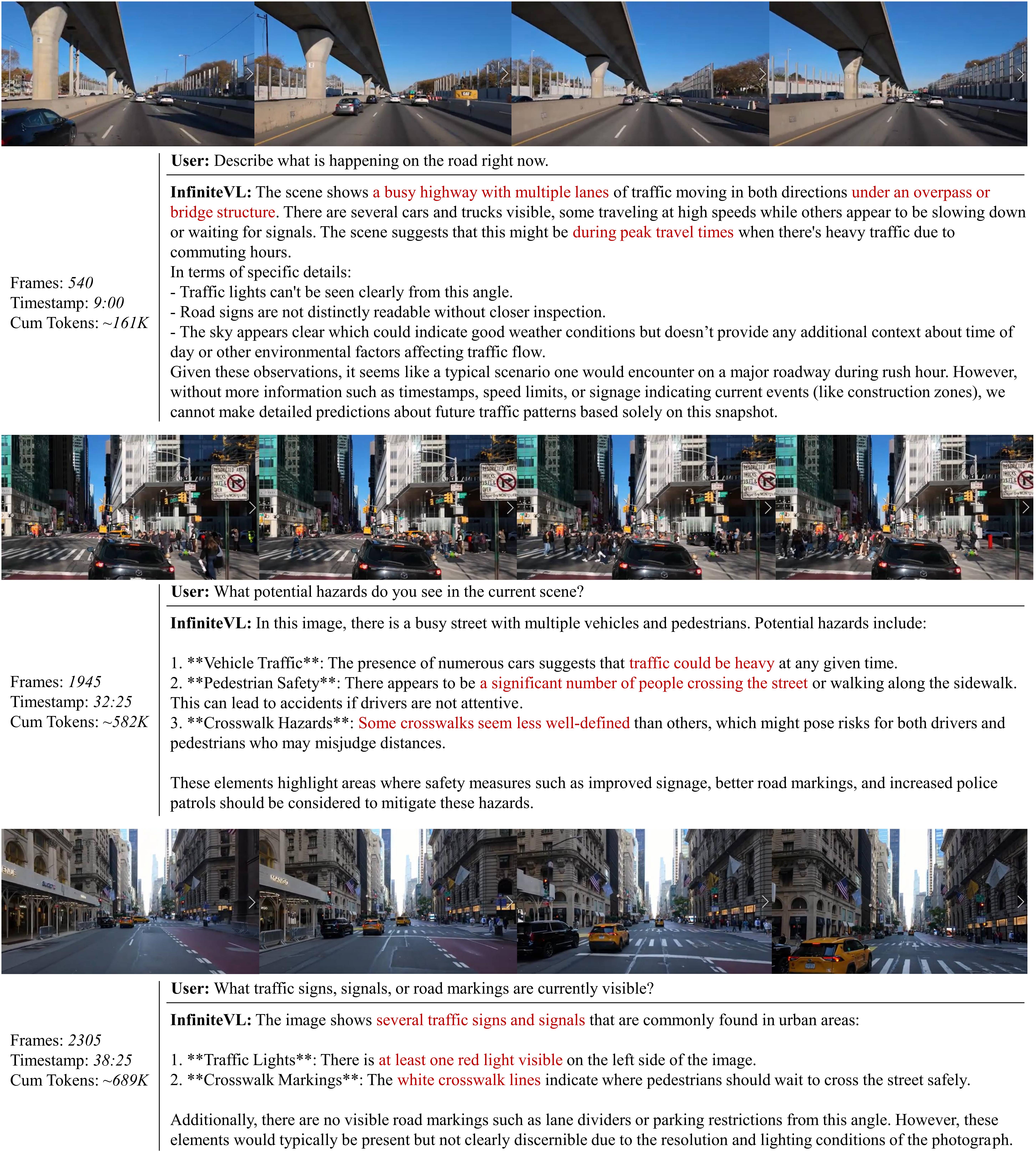
The core strength of InfiniteVL lies in its ability to maintain coherent memory over unlimited input streams.
The examples below demonstrate a continuous street-view video stream. InfiniteVL maintains a constant memory state and accurately answers questions at various timestamps (e.g., Frame 3100, ~1M tokens processed), recalling specific details like "NBC Studios" text or the color of a pedestrian's bag without forgetting.
Contact
If you have any questions, please contact Hongyuan Tao via email (hongyuantao@hust.edu.cn).
Citation
If you find InfiniteVL useful for your research or applications, please consider citing our paper:
@article{tao2025infinitevl,
  title={InfiniteVL: Synergizing Linear and Sparse Attention for Highly-Efficient, Unlimited-Input Vision-Language Models},
  author={Tao, Hongyuan and Liao, Bencheng and Chen, Shaoyu and Yin, Haoran and Zhang, Qian and Liu, Wenyu and Wang, Xinggang},
  journal={arXiv preprint},
  year={2025}
}
Acknowledgement
InfiniteVL is built upon the giants of the open-source community. We would like to express our gratitude to:
- Qwen2.5-VL: For providing a powerful vision-language codebase and vision encoder.
- Gated DeltaNet: For the efficient linear attention mechanism and CUDA kernel implementations (FLA).
- Open-Source Datasets: We sincerely thank the creators of the high-quality datasets used in our training, including FineVision, LLaVA-OneVision, PixMo, The Cauldron, Docmatix, LLaVA-Video, and others. Their contributions are essential to the development of efficient multimodal models.
Significant stargazers

216 followers · starred Mar 2026
Similar repos


Languages
Python
99.8%
[NeurIPS 2026] InfiniteVL: Synergizing Linear and Sparse Attention for Highly-Efficient, Unlimited-Input Vision-Language Models
Python
118
15 commits
updated Sep 24, 2026
README
InfiniteVL: Synergizing Linear and Sparse Attention for Highly-Efficient, Unlimited-Input Vision-Language Models
Hongyuan Tao1, Bencheng Liao1, Shaoyu Chen2, Haoran Yin2, Qian Zhang2, Wenyu Liu1, Xinggang Wang1,✉️
1Huazhong University of Science and Technology, 2Horizon Robotics
(✉️) corresponding author: xgwang@hust.edu.cn
🔥 [Aug. 2026] GLM-5.3 & Qwen3.8-next both adopt linear + sparse attention as their core architecture.
InfiniteVL is one of the first fully open-source implementations of this design — with paper, training code, and checkpoints.
Introduction
InfiniteVL is an efficient Vision-Language Model that combines linear attention for compact long-term memory with sparse attention for precise visual perception. It achieves Transformer-level multimodal performance while supporting highly efficient long-context processing.
Based on InfiniteVL, we develop two specialized variants:
- Sparse InfiniteVL for offline long-video understanding, using dynamic sparse retrieval to preserve fine-grained visual information.
- Streaming InfiniteVL for continuous scene perception, enabling real-time streaming with bounded memory usage.
✨ Key Highlights
- 🚀 Efficient Foundation: InfiniteVL achieves Transformer-level multimodal performance with a 1.7× decoding speedup.
- 🔎 Sparse Long-Context Retrieval: Sparse InfiniteVL achieves a 5× prefill speedup at 256K context.
- ⚡ Real-Time Streaming: Streaming InfiniteVL sustains 25 FPS with a constant O(1) memory footprint.
- 🧠 Precise and Long-Range: Sparse attention preserves critical visual details, while linear attention efficiently maintains long-term context.
News
Sep. 25th, 2026: InfiniteVL has been accepted by NeurIPS 2026! 🎉🎉🎉Aug. 28th, 2026: 🔥 Today's released GLM-5.3 and Qwen3.8-next both adopt linear + sparse attention as their core architecture — the design InfiniteVL explored and fully open-sourced (paper + training code + checkpoints) last year. If you want to understand, reproduce, or build on this architecture, this repo is a complete starting point!Feb. 2nd, 2026: 🚀 We have released the full training code and scripts! You can now reproduce our results following the Training Strategy.Dec. 10th, 2025: We release the InfiniteVL model weights and inference code! Please check Model Zoo.Dec. 10th, 2025: We release our paper on Arxiv.
Getting Started
🛠️ Environment Setup
We recommend using Anaconda or Miniconda to manage the environment. The code is tested on Python 3.11 + PyTorch 2.6.0 + CUDA 12.1.
1. Clone the repository:
git clone https://github.com/hustvl/InfiniteVL.git
cd InfiniteVL
2. Create and activate a virtual environment:
conda create -n infinitevl python=3.11 -y
conda activate infinitevl
3. Install Environment:
pip install -r requirements.txt
Table of Contents
- Introduction
- Getting started
- Architecture & Training
- Performance & Main Results
- Model Zoo
- Advanced Usage (Streaming)
- Qualitative Analysis & Visualization
- Citation
- Acknowledgement
Architecture & Training
InfiniteVL combines sparse attention for precise visual perception with linear attention for efficient long-term memory. Based on this architecture, we develop two variants for different long-context scenarios:
- Sparse InfiniteVL targets offline long-video understanding with dynamic sparse retrieval.
- Streaming InfiniteVL targets continuous scene perception with efficient bounded-memory streaming.
Our training follows a three-stage progressive knowledge-transfer pipeline:
- Architectural Alignment: Transfer knowledge from a Transformer VLM to InfiniteVL through layer-wise and logit distillation.
- Capability Recovery: Restore strong general multimodal capabilities with continuous supervised fine-tuning.
- Long-Sequence Adaptation: Specialize InfiniteVL into Sparse InfiniteVL and Streaming InfiniteVL for offline and online long-context understanding.
⚙️ Reproduction Steps
Our training codebase is built upon LLaMA-Factory. Please refer to their repository for detailed documentation and framework usage.
We provide standard scripts to reproduce our three-stage training pipeline. The training is launched via train.sh.
Note: Before running, please modify the
model_name_or_path,datasetandcheckpoint_pathinside the.yamlfiles to point to your local directories.
1. Distillation Pretraining (layer to layer)
bash train.sh examples/train_linear/train_config_distill_stage1.yaml
2. Distillation Pretraining (End to End)
bash train.sh examples/train_linear/train_config_distill_stage2.yaml
3. Instruction SFT
bash train.sh examples/train_linear/train_config_distill_sft.yaml
Performance
🚀 Efficiency & Streaming
InfiniteVL is engineered for unlimited-input scenarios. Unlike Transformer-based models where cost grows linearly with history, InfiniteVL maintains constant computational cost and memory usage.
Hardware Setup: All efficiency results are measured on a single NVIDIA RTX 4090 GPU.
Figure 1: Comparison of streaming FPS and latency. InfiniteVL sustains real-time performance while Transformer baselines degrade rapidly.
🏆 Multimodal Benchmarks
InfiniteVL achieves state-of-the-art performance among linear-complexity VLMs. Crucially, thanks to our Hybrid Architecture and High-quality training strategies, it overcomes the traditional weakness of linear models in information-intensive tasks (e.g., OCR, Document Understanding), achieving results comparable to top-tier Transformer VLMs.
Figure 2: Comparison of InfiniteVL with existing VLMs on public multimodal understanding, real-world comprehension, text-rich, reasoning-centric multimodal benchmarks.
Key Takeaways:
- Best-in-Class Linear Model: Significantly outperforms previous linear VLMs (Cobra, MaTVLM) by large margins (+40-60 points on DocVQA/OCRBench).
- Transformer-Level Quality: Matches the performance of Qwen2.5-VL-3B on complex reasoning and text-rich tasks while being significantly faster in long contexts.
Model Zoo
We release two versions of InfiniteVL-4B to cater to different application scenarios.
| Model | Stage | Description | Training context Length | Download |
|---|---|---|---|---|
| InfiniteVL-4B | Stage 2 | Best Generalist / Base. The checkpoint directly after Instruction SFT. It delivers the peak foundational performance on standard multimodal benchmarks (e.g., OCR, MMMU, MathVista) and preserves the most robust knowledge. | 8K | 🤗 Hugging Face |
| InfiniteVL-4B-LongSFT | Stage 3 | Long-Context Adapted. Fine-tuned using only a small amount of long-sequence multimodal data. It successfully activates length generalization for streaming scenarios, though its full potential on extreme contexts is not yet fully exploited. | 32K | 🤗 Hugging Face |
💡 Recommendations:
- For Long-Context Inference: Please use the Stage 3 model. It enables stable streaming inference and avoids memory explosion.
- For Training / Fine-tuning: We strongly recommend using the Stage 2 model as your starting point. Since it maintains the strongest general capabilities and hasn't shifted towards the specific long-context distribution, it serves as the best foundation for adaptation to new tasks or domains.
🚀 Advanced Usage: CUDA Graph Acceleration
Unlike Transformer-based VLMs where the KV cache grows dynamically, InfiniteVL maintains a constant-size memory state. This unique property allows us to use CUDA Graphs to capture the entire computation graph for both streaming prefill and decoding, eliminating kernel launch overheads and maximizing GPU utilization.
This is the key technology behind our 24 FPS real-time streaming performance.
⚡ Accelerated Streaming Inference
Unlike Transformer-based VLMs where the KV cache grows dynamically, InfiniteVL maintains a constant-size memory state. This unique property allows us to use CUDA Graphs to capture the entire computation graph for streaming prefill, eliminating kernel launch overheads.
We provide a complete script in examples/demo_streaming_inference.py to demonstrate this capability.
🎥 Simulation Note: This script simulates a real-time streaming scenario by reading a local video file frame-by-frame. It treats the video as a continuous data stream, updating the global linear memory state on-the-fly without retraining.
⚠️ Requirement: This demo relies on the specialized model implementation (supporting
StaticCachePreallocand CUDA Graphs) located in theinfinitevl/infinitevl_streamingdirectory. Please ensure your environment is set up correctly to import these modules.
1. Run the Simulation Demo
# Make sure you are in the project root
python examples/demo_streaming_inference.py \
    --model_path /path/to/InfiniteVL-4B \
    --video_path assets/demo.mp4 \
    --fps 30
⚡ Accelerated Decode
In addition to streaming prefill, InfiniteVL natively supports CUDA Graph-accelerated decoding. By capturing the decoding step into a static graph, we can achieve extremely low-latency token generation, further enhancing the responsiveness of real-time interactions.
🚧 Coming Soon: The code for accelerated decoding is currently being refactored and cleaned up. We are working hard to release it as soon as possible. Please stay tuned!
Qualitative Analysis & Visualization
We provide visualization cases to demonstrate InfiniteVL's robust performance across diverse scenarios, ranging from information-intensive static tasks to ultra-long streaming video understanding.
1. Fundamental Visual-Language Capabilities (OCR & Reasoning)
InfiniteVL effectively overcomes the traditional limitations of linear attention in detailed visual perception. By combining Sliding Window Attention with Gated DeltaNet, it excels at Dense Text Recognition (OCR), Chart Interpretation, and Complex Scene Description, delivering performance comparable to full-attention Transformers.
2. Long-Term Streaming Understanding
The core strength of InfiniteVL lies in its ability to maintain coherent memory over unlimited input streams.
The examples below demonstrate a continuous street-view video stream. InfiniteVL maintains a constant memory state and accurately answers questions at various timestamps (e.g., Frame 3100, ~1M tokens processed), recalling specific details like "NBC Studios" text or the color of a pedestrian's bag without forgetting.
Contact
If you have any questions, please contact Hongyuan Tao via email (hongyuantao@hust.edu.cn).
Citation
If you find InfiniteVL useful for your research or applications, please consider citing our paper:
@article{tao2025infinitevl,
  title={InfiniteVL: Synergizing Linear and Sparse Attention for Highly-Efficient, Unlimited-Input Vision-Language Models},
  author={Tao, Hongyuan and Liao, Bencheng and Chen, Shaoyu and Yin, Haoran and Zhang, Qian and Liu, Wenyu and Wang, Xinggang},
  journal={arXiv preprint},
  year={2025}
}
Acknowledgement
InfiniteVL is built upon the giants of the open-source community. We would like to express our gratitude to:
- Qwen2.5-VL: For providing a powerful vision-language codebase and vision encoder.
- Gated DeltaNet: For the efficient linear attention mechanism and CUDA kernel implementations (FLA).
- Open-Source Datasets: We sincerely thank the creators of the high-quality datasets used in our training, including FineVision, LLaVA-OneVision, PixMo, The Cauldron, Docmatix, LLaVA-Video, and others. Their contributions are essential to the development of efficient multimodal models.
Similar repos
Significant stargazers
216 followers · starred Mar 2026
Languages
Python
99.8%