
Write and run custom C kernels for Intel Core Ultra NPUs
C
40
58 commits
updated Sep 23, 2026
See what people are saying
README
npunlock
Intel ships programmable SHAVE cores inside its NPUs, but the public stack
exposes only graph-level programming. npunlock reconstructs the missing path
from custom C code to a runnable NPU kernel.
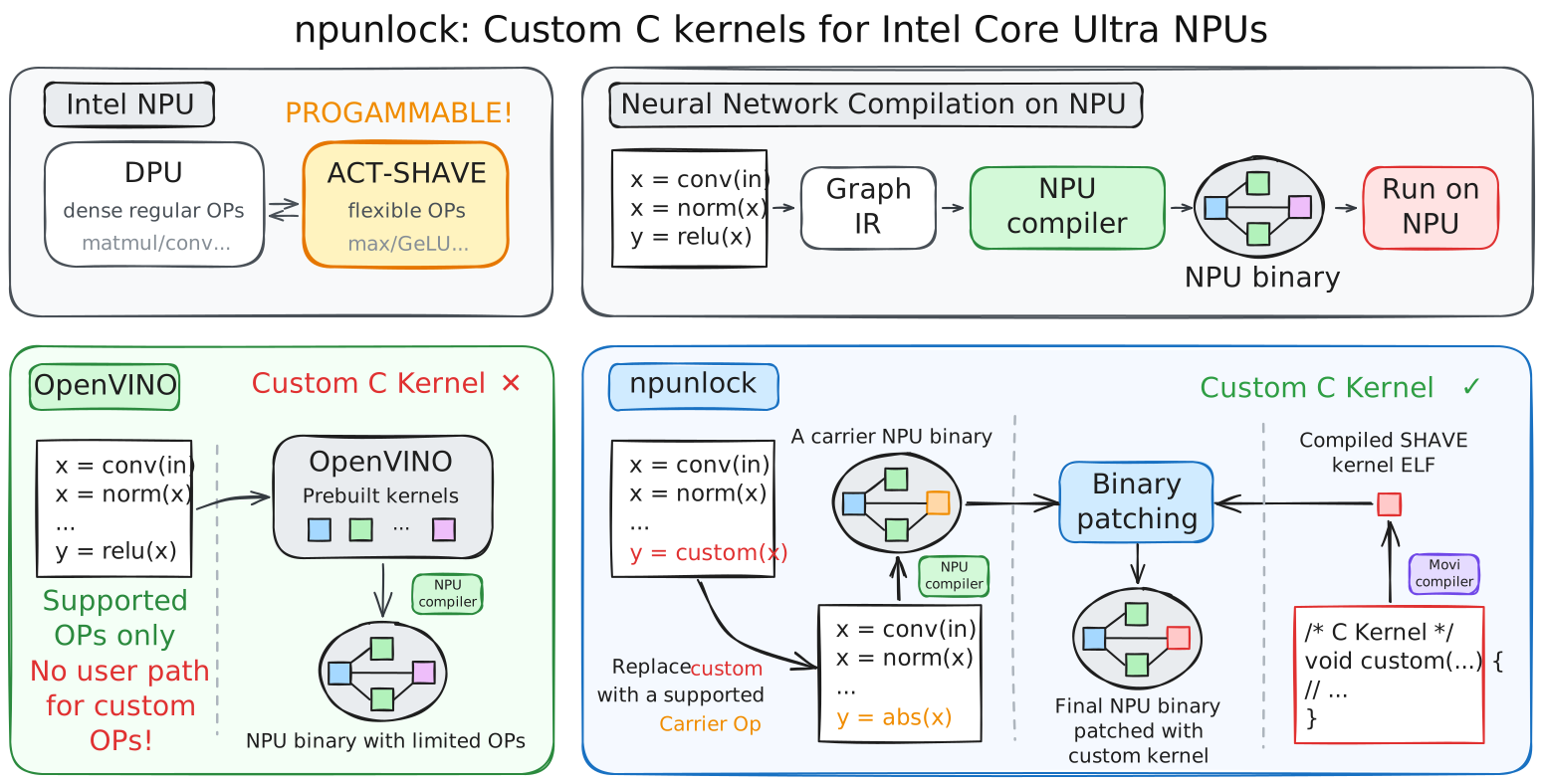
The current implementation has been verified on Windows x64 with Meteor Lake / NPU3720.
Latest breakthrough — 2026-09-23: One native graph can execute independent FP32-unary and FP16-binary custom branches; explicit ACT-group preflight handles the compiler's branch reordering. Evidence and limits.
Quick example
This complete FP32 GELU example embeds the C kernel in Python, places it in an
NPU graph, and checks the result against NumPy. The bundled
npunlock/npu3720_kernel.h target header supplies the NPU3720 invocation and
tensor-address helpers. The tested MoviTools toolchain makes most conventional
libm functions available to kernels without including <math.h>; this
example calls tanhf directly. See the
mlibm.a symbol inventory for the observed candidates.
import numpy as np
import npunlock as npu

npu.configure(movi_dll_dir=r"C:\path\to\MVC_DEPEND")

gelu_c: bytes = b"""
#define MLIBM_DEFINE_LINK_COMPAT 1
#include <npunlock/npu3720_kernel.h>

void controlled_act(unsigned layerParams) {
    act_abi_invocation invocation;
    ACT_ABI_LOAD_INVOCATION32_OR_RETURN(layerParams, invocation);
    const float *in = ACT_ABI_INPUT_PTR32(const float, invocation, 0u);
    float *out = ACT_ABI_OUTPUT_PTR32(float, invocation, 1u);
    const float SQRT_2_DIV_PI = 0.7978845608028654f;
    for (unsigned i = 0; i < invocation.element_count; ++i) {
        float x = in[i];
        float w = x + 0.044715f * x * x * x;
        w = tanhf(w * SQRT_2_DIV_PI);
        out[i] = 0.5f * x * (1.0f + w);
    }
}
"""

N = 2048
x = npu.input("x", shape=(1, N), dtype="f32")
y = npu.custom(
    x,
    source=gelu_c,
    carrier="Abs",
    _name="y",
)

program = npu.compile(npu.Graph(inputs=[x], outputs=[y], name="gelu_f32_example"))

input_value = np.linspace(-4, 4, N, dtype=np.float32).reshape(1, -1)
output = program.run({"x": input_value})["y"]
reference = 0.5 * input_value * (
    1.0
    + np.tanh(
        np.sqrt(2.0 / np.pi)
        * (input_value + 0.044715 * input_value**3)
    )
)
print(f"maximum absolute error: {np.max(np.abs(output - reference)):g}")
The same code is available as the runnable FP32 GELU example. See also the FP16 GELU and multi-layer two-input examples, plus a mixed-precision graph with unary and binary custom branches.
Why npunlock?
Intel's normal NPU software accepts graphs made from operations its compiler
supports; it does not expose a public workflow for supplying a C implementation
for an operation. The NPU's ACT-SHAVE processors are programmable and run
software kernels. npunlock makes those processors usable for compatible
custom graph operations while retaining Intel's compiler and driver for the
surrounding graph and hardware execution.
Requirements
- Windows x64
- Meteor Lake / Intel NPU3720
- an installed Intel NPU driver for the device
- Python 3.10 or newer
- CMake 3.24 or newer and an installed MSVC toolchain for source installation
- the extracted MoviTools
MVC_DEPENDtoolchain for custom C compilation
OpenVINO is not required as a runtime, Python package, or compiler frontend.
npunlock does emit OpenVINO-format IR for the installed Intel driver.
Install
npunlock is currently installed from a source checkout:
python -m pip install .
The build bundles npunlock.dll and npunlock_worker.exe inside the Python
package, so normal Python use does not require a separate native path.
Get MoviTools
Custom C compilation uses Intel/Movidius MoviTools, which npunlock does not
redistribute or download.
A MoviTools package verified to work was found in a legacy Lenovo driver pack. See Getting MoviTools for the official download, hash, extraction command, and expected layout.
Extract the MVC_DEPEND payload from Lenovo's older
Intel NPU driver package 31.0.100.1688, but remember, DO NOT install or downgrade to
that driver. All we need is the bundled MoviTools.
Run an example
Point npunlock at the extracted MVC_DEPEND root and run GELU:
$env:NPUNLOCK_MOVITOOLS_DIR = 'C:\path\to\MVC_DEPEND'
python examples\example_gelu.py
The example runs on the NPU and reports its maximum error against a NumPy reference.
What currently works
- compile user-written C into ACT-SHAVE machine code
- run custom kernels inside Intel NPU graphs
- static dense FP16 unary and two-input custom kernels
- a verified unary FP32 path
- one graph containing independent FP32-unary and FP16-binary custom branches
- nonlinear math such as GELU and
tanhf - reusable NumPy-compatible host/NPU shared input and output buffers
- Python, CLI, and native C APIs
Current limitations
Support is experimental and currently limited to Windows x64, Meteor Lake / NPU3720, static shapes, compatible ACT carriers, and known tensor layouts. Connected mixed-precision conversion groups are not yet patch-discoverable; the verified mixed-precision example uses independent branches. Other NPU generations have not been verified. See Current limitations for the full compatibility boundary.
Help test Linux and newer NPUs
Have an NPU3720 Linux system or a newer Intel NPU? Contributions are welcome. Two routes look especially promising but remain untested:
- a patched NPU3720 graph produced on Windows may run on Linux because the NPU firmware executes the custom machine code; building SHAVE code on Linux would additionally require a way to load the Windows MoviTools DLLs;
- newer NPUs may execute the existing
3720xxSHAVE image, or an older OEM driver package for that generation may provide matching MoviTools components.
Both need hardware validation, driver/firmware version records, and output comparison against a host oracle. If you can test either path, feedback, failure reports, and code contributions are welcome. See Porting to Linux and newer NPUs for the hypotheses, caveats, and a suggested test plan.
Documentation
- Getting MoviTools — obtain the compiler toolchain without installing the legacy driver
- Python API — construct, compile, and execute graphs from Python
- Writing custom kernels — C entry point, tensor contract, and examples
- How npunlock works — graph compilation and custom-kernel integration
- Reverse-engineering breakthroughs — the experiments and discoveries that made custom kernels possible
- From model to machine code — step-by-step lowering and the components involved
- Intel NPU architecture — DPU and ACT-SHAVE overview
- Current limitations — verified hardware and ABI scope
- Porting to Linux and newer NPUs — experimental routes and contribution guide
- Development and native APIs — CMake, testing, packaging, CLI, and C interfaces
- Full documentation index
[!WARNING] A note on AI use: I did use AI while building this project--for scaffolding, repetitive implementation work, converting my reverse-engineered results into organized documentation, and fixing my English. The reverse engineering, experiments, debugging, and technical conclusions came from hands-on work. If that doesn’t bother you, there’s a pretty deep and surprisingly satisfying rabbit hole ahead.
License
npunlock is licensed under the Apache License 2.0. MoviTools and
the Intel/Movidius libraries are external proprietary dependencies and are not
covered or redistributed by this repository.
Contributors

58 commits
Similar repos


Languages
C
76.8%
Python
20.0%
CMake
2.8%
Write and run custom C kernels for Intel Core Ultra NPUs
C
40
58 commits
updated Sep 23, 2026
See what people are saying
README
npunlock
Intel ships programmable SHAVE cores inside its NPUs, but the public stack
exposes only graph-level programming. npunlock reconstructs the missing path
from custom C code to a runnable NPU kernel.
The current implementation has been verified on Windows x64 with Meteor Lake / NPU3720.
Latest breakthrough — 2026-09-23: One native graph can execute independent FP32-unary and FP16-binary custom branches; explicit ACT-group preflight handles the compiler's branch reordering. Evidence and limits.
Quick example
This complete FP32 GELU example embeds the C kernel in Python, places it in an
NPU graph, and checks the result against NumPy. The bundled
npunlock/npu3720_kernel.h target header supplies the NPU3720 invocation and
tensor-address helpers. The tested MoviTools toolchain makes most conventional
libm functions available to kernels without including <math.h>; this
example calls tanhf directly. See the
mlibm.a symbol inventory for the observed candidates.
import numpy as np
import npunlock as npu

npu.configure(movi_dll_dir=r"C:\path\to\MVC_DEPEND")

gelu_c: bytes = b"""
#define MLIBM_DEFINE_LINK_COMPAT 1
#include <npunlock/npu3720_kernel.h>

void controlled_act(unsigned layerParams) {
    act_abi_invocation invocation;
    ACT_ABI_LOAD_INVOCATION32_OR_RETURN(layerParams, invocation);
    const float *in = ACT_ABI_INPUT_PTR32(const float, invocation, 0u);
    float *out = ACT_ABI_OUTPUT_PTR32(float, invocation, 1u);
    const float SQRT_2_DIV_PI = 0.7978845608028654f;
    for (unsigned i = 0; i < invocation.element_count; ++i) {
        float x = in[i];
        float w = x + 0.044715f * x * x * x;
        w = tanhf(w * SQRT_2_DIV_PI);
        out[i] = 0.5f * x * (1.0f + w);
    }
}
"""

N = 2048
x = npu.input("x", shape=(1, N), dtype="f32")
y = npu.custom(
    x,
    source=gelu_c,
    carrier="Abs",
    _name="y",
)

program = npu.compile(npu.Graph(inputs=[x], outputs=[y], name="gelu_f32_example"))

input_value = np.linspace(-4, 4, N, dtype=np.float32).reshape(1, -1)
output = program.run({"x": input_value})["y"]
reference = 0.5 * input_value * (
    1.0
    + np.tanh(
        np.sqrt(2.0 / np.pi)
        * (input_value + 0.044715 * input_value**3)
    )
)
print(f"maximum absolute error: {np.max(np.abs(output - reference)):g}")
The same code is available as the runnable FP32 GELU example. See also the FP16 GELU and multi-layer two-input examples, plus a mixed-precision graph with unary and binary custom branches.
Why npunlock?
Intel's normal NPU software accepts graphs made from operations its compiler
supports; it does not expose a public workflow for supplying a C implementation
for an operation. The NPU's ACT-SHAVE processors are programmable and run
software kernels. npunlock makes those processors usable for compatible
custom graph operations while retaining Intel's compiler and driver for the
surrounding graph and hardware execution.
Requirements
- Windows x64
- Meteor Lake / Intel NPU3720
- an installed Intel NPU driver for the device
- Python 3.10 or newer
- CMake 3.24 or newer and an installed MSVC toolchain for source installation
- the extracted MoviTools
MVC_DEPENDtoolchain for custom C compilation
OpenVINO is not required as a runtime, Python package, or compiler frontend.
npunlock does emit OpenVINO-format IR for the installed Intel driver.
Install
npunlock is currently installed from a source checkout:
python -m pip install .
The build bundles npunlock.dll and npunlock_worker.exe inside the Python
package, so normal Python use does not require a separate native path.
Get MoviTools
Custom C compilation uses Intel/Movidius MoviTools, which npunlock does not
redistribute or download.
A MoviTools package verified to work was found in a legacy Lenovo driver pack. See Getting MoviTools for the official download, hash, extraction command, and expected layout.
Extract the MVC_DEPEND payload from Lenovo's older
Intel NPU driver package 31.0.100.1688, but remember, DO NOT install or downgrade to
that driver. All we need is the bundled MoviTools.
Run an example
Point npunlock at the extracted MVC_DEPEND root and run GELU:
$env:NPUNLOCK_MOVITOOLS_DIR = 'C:\path\to\MVC_DEPEND'
python examples\example_gelu.py
The example runs on the NPU and reports its maximum error against a NumPy reference.
What currently works
- compile user-written C into ACT-SHAVE machine code
- run custom kernels inside Intel NPU graphs
- static dense FP16 unary and two-input custom kernels
- a verified unary FP32 path
- one graph containing independent FP32-unary and FP16-binary custom branches
- nonlinear math such as GELU and
tanhf - reusable NumPy-compatible host/NPU shared input and output buffers
- Python, CLI, and native C APIs
Current limitations
Support is experimental and currently limited to Windows x64, Meteor Lake / NPU3720, static shapes, compatible ACT carriers, and known tensor layouts. Connected mixed-precision conversion groups are not yet patch-discoverable; the verified mixed-precision example uses independent branches. Other NPU generations have not been verified. See Current limitations for the full compatibility boundary.
Help test Linux and newer NPUs
Have an NPU3720 Linux system or a newer Intel NPU? Contributions are welcome. Two routes look especially promising but remain untested:
- a patched NPU3720 graph produced on Windows may run on Linux because the NPU firmware executes the custom machine code; building SHAVE code on Linux would additionally require a way to load the Windows MoviTools DLLs;
- newer NPUs may execute the existing
3720xxSHAVE image, or an older OEM driver package for that generation may provide matching MoviTools components.
Both need hardware validation, driver/firmware version records, and output comparison against a host oracle. If you can test either path, feedback, failure reports, and code contributions are welcome. See Porting to Linux and newer NPUs for the hypotheses, caveats, and a suggested test plan.
Documentation
- Getting MoviTools — obtain the compiler toolchain without installing the legacy driver
- Python API — construct, compile, and execute graphs from Python
- Writing custom kernels — C entry point, tensor contract, and examples
- How npunlock works — graph compilation and custom-kernel integration
- Reverse-engineering breakthroughs — the experiments and discoveries that made custom kernels possible
- From model to machine code — step-by-step lowering and the components involved
- Intel NPU architecture — DPU and ACT-SHAVE overview
- Current limitations — verified hardware and ABI scope
- Porting to Linux and newer NPUs — experimental routes and contribution guide
- Development and native APIs — CMake, testing, packaging, CLI, and C interfaces
- Full documentation index
[!WARNING] A note on AI use: I did use AI while building this project--for scaffolding, repetitive implementation work, converting my reverse-engineered results into organized documentation, and fixing my English. The reverse engineering, experiments, debugging, and technical conclusions came from hands-on work. If that doesn’t bother you, there’s a pretty deep and surprisingly satisfying rabbit hole ahead.
License
npunlock is licensed under the Apache License 2.0. MoviTools and
the Intel/Movidius libraries are external proprietary dependencies and are not
covered or redistributed by this repository.
Similar repos
Contributors
58 commits
Languages
C
76.8%
Python
20.0%
CMake
2.8%