
GLM-TTS: Controllable & Emotion-Expressive Zero-shot TTS
351
10 commits
6 linked in READMEs
updated Jan 12, 2026
README
GLM-TTS: Controllable & Emotion-Expressive Zero-shot TTS

📜 Paper | 💻 GitHub Repository | 🛠️ Audio.Z.AI
📖 Model Introduction
GLM-TTS is a high-quality text-to-speech (TTS) synthesis system based on large language models, supporting zero-shot voice cloning and streaming inference. The system adopts a two-stage architecture combining an LLM for speech token generation and a Flow Matching model for waveform synthesis.
By introducing a Multi-Reward Reinforcement Learning framework, GLM-TTS significantly improves the expressiveness of generated speech, achieving more natural emotional control compared to traditional TTS systems.
Key Features
- Zero-shot Voice Cloning: Clone any speaker's voice with just 3-10 seconds of prompt audio.
- RL-enhanced Emotion Control: Utilizes a multi-reward reinforcement learning framework (GRPO) to optimize prosody and emotion.
- High-quality Synthesis: Generates speech comparable to commercial systems with reduced Character Error Rate (CER).
- Phoneme-level Control: Supports "Hybrid Phoneme + Text" input for precise pronunciation control (e.g., polyphones).
- Streaming Inference: Supports real-time audio generation suitable for interactive applications.
- Bilingual Support: Optimized for Chinese and English mixed text.
System Architecture
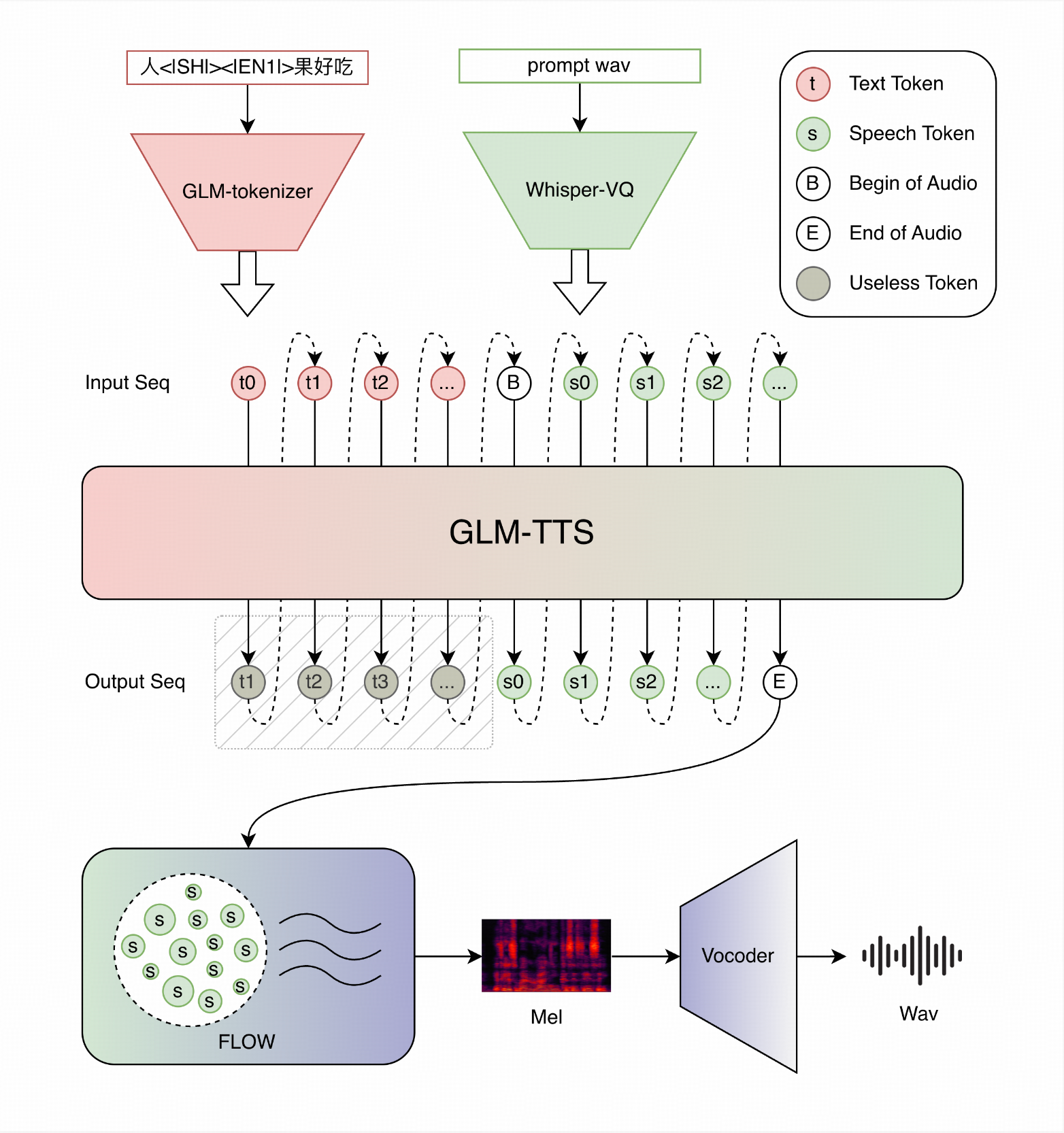
GLM-TTS follows a two-stage design:
- Stage 1 (LLM): A Llama-based model converts input text into speech token sequences.
- Stage 2 (Flow Matching): A Flow model converts token sequences into high-quality mel-spectrograms, which are then turned into waveforms by a vocoder.
Reinforcement Learning Alignment
To tackle flat emotional expression, GLM-TTS uses a Group Relative Policy Optimization (GRPO) algorithm with multiple reward functions (Similarity, CER, Emotion, Laughter) to align the LLM's generation strategy.
Evaluation Results
Evaluated on seed-tts-eval. GLM-TTS_RL achieves the lowest Character Error Rate (CER) while maintaining high speaker similarity.
| Model | CER ↓ | SIM ↑ | Open-source |
|---|---|---|---|
| Seed-TTS | 1.12 | 79.6 | 🔒 No |
| CosyVoice2 | 1.38 | 75.7 | 👐 Yes |
| F5-TTS | 1.53 | 76.0 | 👐 Yes |
| GLM-TTS (Base) | 1.03 | 76.1 | 👐 Yes |
| GLM-TTS_RL (Ours) | 0.89 | 76.4 | 👐 Yes |
Quick Start
Installation
git clone [https://github.com/zai-org/GLM-TTS.git](https://github.com/zai-org/GLM-TTS.git)
cd GLM-TTS
pip install -r requirements.txt
Command Line Inference
python glmtts_inference.py \
    --data=example_zh \
    --exp_name=_test \
    --use_cache \
    # --phoneme # Add this flag to enable phoneme capabilities.
Shell Script Inference
bash glmtts_inference.sh
Acknowledgments & Citation
We thank the following open-source projects for their support:
- CosyVoice - Providing frontend processing framework and high-quality vocoder
- Llama - Providing basic language model architecture
- Vocos - Providing high-quality vocoder
- GRPO-Zero - Reinforcement learning algorithm implementation inspiration
If you find GLM-TTS useful for your research, please cite our technical report:
@misc{cui2025glmttstechnicalreport,
      title={GLM-TTS Technical Report},
      author={Jiayan Cui and Zhihan Yang and Naihan Li and Jiankun Tian and Xingyu Ma and Yi Zhang and Guangyu Chen and Runxuan Yang and Yuqing Cheng and Yizhi Zhou and Guochen Yu and Xiaotao Gu and Jie Tang},
      year={2025},
      eprint={2512.14291},
      archivePrefix={arXiv},
      primaryClass={cs.SD},
      url={https://arxiv.org/abs/2512.14291},
}
}
Contributors

9 commits

1 commits
Similar repos




Linked in READMEs



GLM-TTS: Controllable & Emotion-Expressive Zero-shot TTS
351
10 commits
6 linked in READMEs
updated Jan 12, 2026
README
GLM-TTS: Controllable & Emotion-Expressive Zero-shot TTS
📜 Paper | 💻 GitHub Repository | 🛠️ Audio.Z.AI
📖 Model Introduction
GLM-TTS is a high-quality text-to-speech (TTS) synthesis system based on large language models, supporting zero-shot voice cloning and streaming inference. The system adopts a two-stage architecture combining an LLM for speech token generation and a Flow Matching model for waveform synthesis.
By introducing a Multi-Reward Reinforcement Learning framework, GLM-TTS significantly improves the expressiveness of generated speech, achieving more natural emotional control compared to traditional TTS systems.
Key Features
- Zero-shot Voice Cloning: Clone any speaker's voice with just 3-10 seconds of prompt audio.
- RL-enhanced Emotion Control: Utilizes a multi-reward reinforcement learning framework (GRPO) to optimize prosody and emotion.
- High-quality Synthesis: Generates speech comparable to commercial systems with reduced Character Error Rate (CER).
- Phoneme-level Control: Supports "Hybrid Phoneme + Text" input for precise pronunciation control (e.g., polyphones).
- Streaming Inference: Supports real-time audio generation suitable for interactive applications.
- Bilingual Support: Optimized for Chinese and English mixed text.
System Architecture
GLM-TTS follows a two-stage design:
- Stage 1 (LLM): A Llama-based model converts input text into speech token sequences.
- Stage 2 (Flow Matching): A Flow model converts token sequences into high-quality mel-spectrograms, which are then turned into waveforms by a vocoder.
Reinforcement Learning Alignment
To tackle flat emotional expression, GLM-TTS uses a Group Relative Policy Optimization (GRPO) algorithm with multiple reward functions (Similarity, CER, Emotion, Laughter) to align the LLM's generation strategy.
Evaluation Results
Evaluated on seed-tts-eval. GLM-TTS_RL achieves the lowest Character Error Rate (CER) while maintaining high speaker similarity.
| Model | CER ↓ | SIM ↑ | Open-source |
|---|---|---|---|
| Seed-TTS | 1.12 | 79.6 | 🔒 No |
| CosyVoice2 | 1.38 | 75.7 | 👐 Yes |
| F5-TTS | 1.53 | 76.0 | 👐 Yes |
| GLM-TTS (Base) | 1.03 | 76.1 | 👐 Yes |
| GLM-TTS_RL (Ours) | 0.89 | 76.4 | 👐 Yes |
Quick Start
Installation
git clone [https://github.com/zai-org/GLM-TTS.git](https://github.com/zai-org/GLM-TTS.git)
cd GLM-TTS
pip install -r requirements.txt
Command Line Inference
python glmtts_inference.py \
    --data=example_zh \
    --exp_name=_test \
    --use_cache \
    # --phoneme # Add this flag to enable phoneme capabilities.
Shell Script Inference
bash glmtts_inference.sh
Acknowledgments & Citation
We thank the following open-source projects for their support:
- CosyVoice - Providing frontend processing framework and high-quality vocoder
- Llama - Providing basic language model architecture
- Vocos - Providing high-quality vocoder
- GRPO-Zero - Reinforcement learning algorithm implementation inspiration
If you find GLM-TTS useful for your research, please cite our technical report:
@misc{cui2025glmttstechnicalreport,
      title={GLM-TTS Technical Report},
      author={Jiayan Cui and Zhihan Yang and Naihan Li and Jiankun Tian and Xingyu Ma and Yi Zhang and Guangyu Chen and Runxuan Yang and Yuqing Cheng and Yizhi Zhou and Guochen Yu and Xiaotao Gu and Jie Tang},
      year={2025},
      eprint={2512.14291},
      archivePrefix={arXiv},
      primaryClass={cs.SD},
      url={https://arxiv.org/abs/2512.14291},
}
}
Similar repos
Linked in READMEs
Contributors
9 commits
1 commits