
Llama3.1-8B-MegaScience is a model fine-tuned on MegaScience, a large-scale mixture of high-quality open-source scientific datasets totaling 1.25 million instances, as presented in the paper "MegaScience: Pushing the Frontiers of Post-Training Datasets for Science Reasoning". The MegaScience dataset features truthful reference answers extracted from 12k university-level scientific textbooks, comprising 650k reasoning questions spanning 7 scientific disciplines. This model significantly outperfor
1
9 commits
2 linked in READMEs
updated Jul 24, 2025
README
MegaScience: Pushing the Frontiers of Post-Training Datasets for Science Reasoning
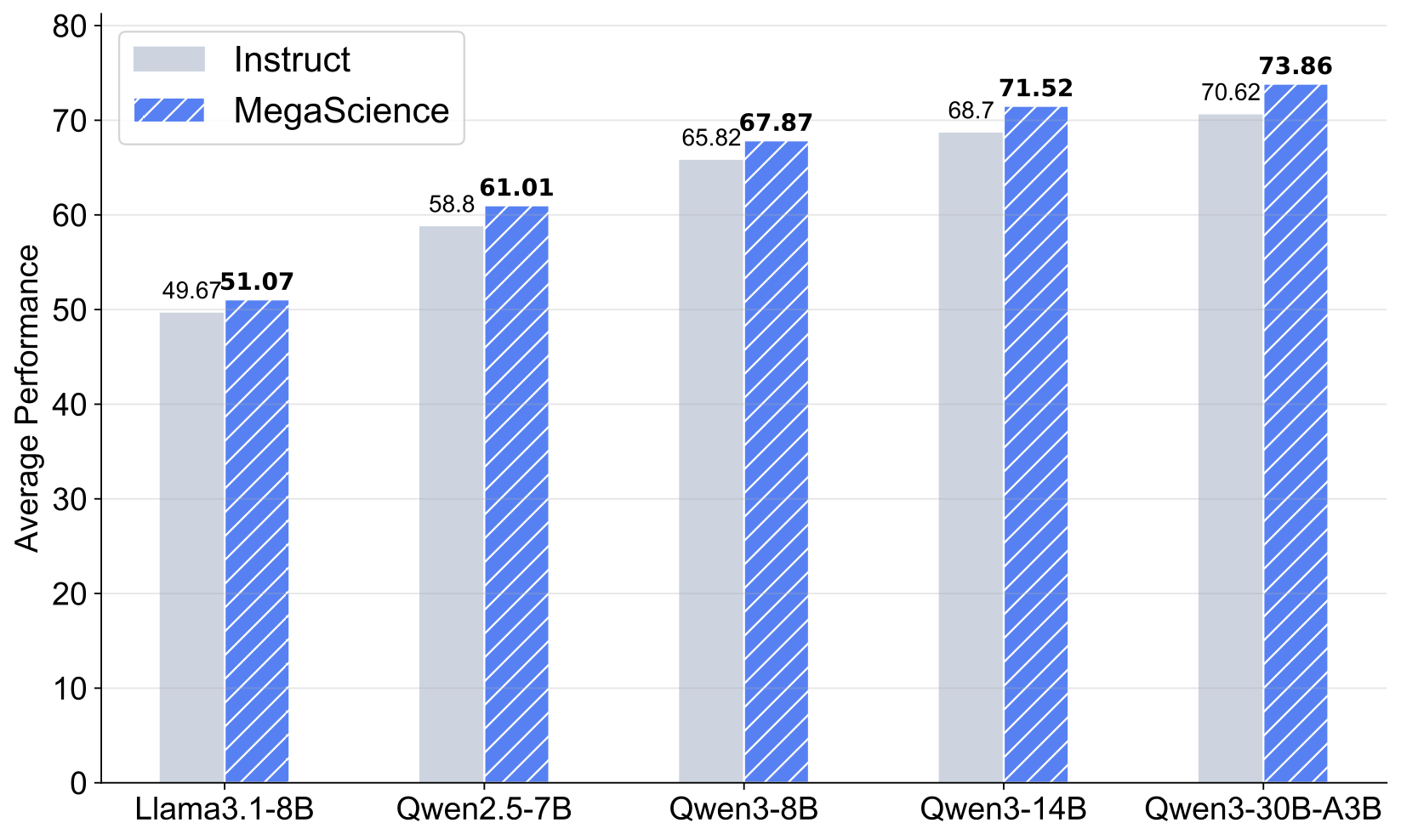
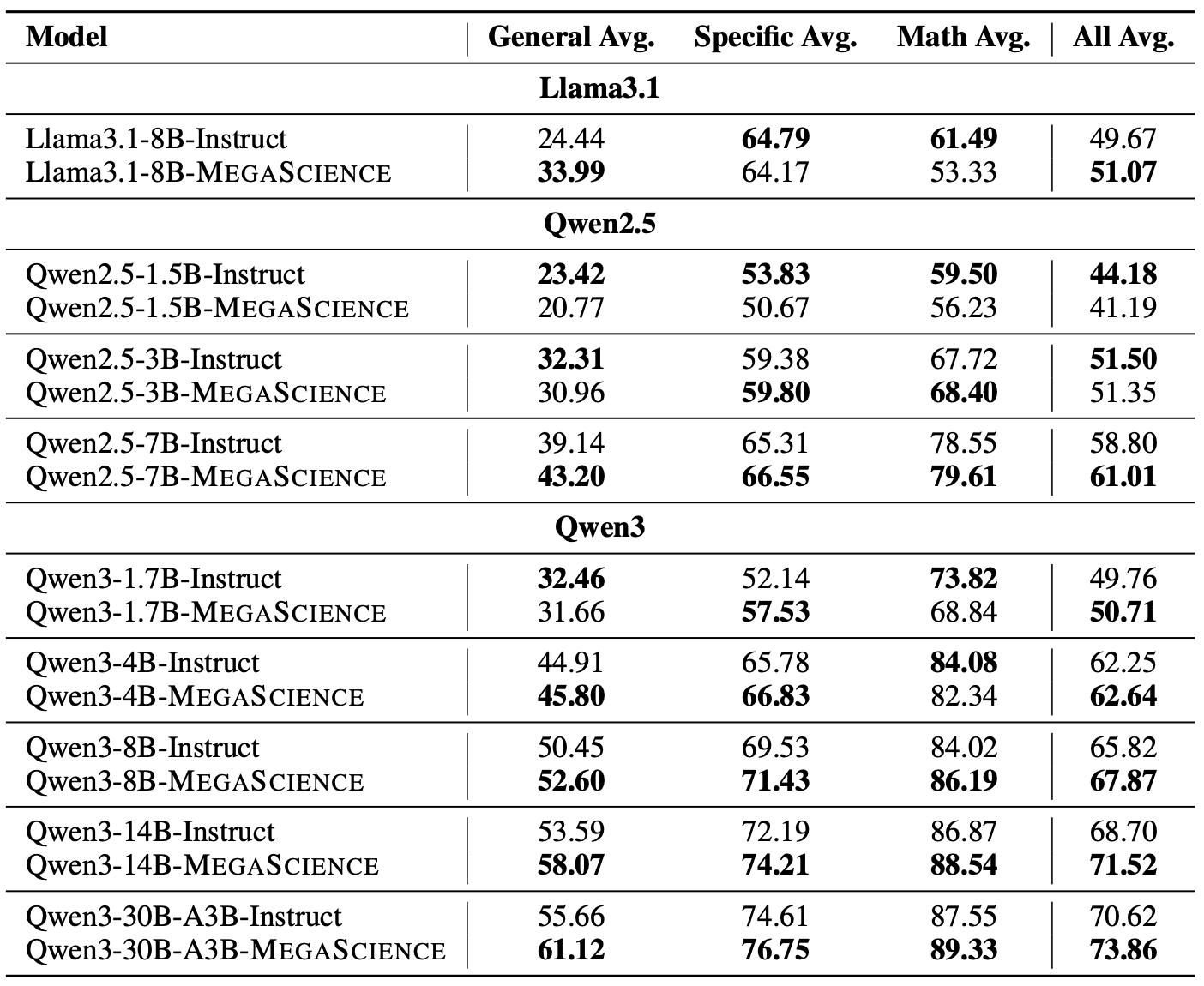
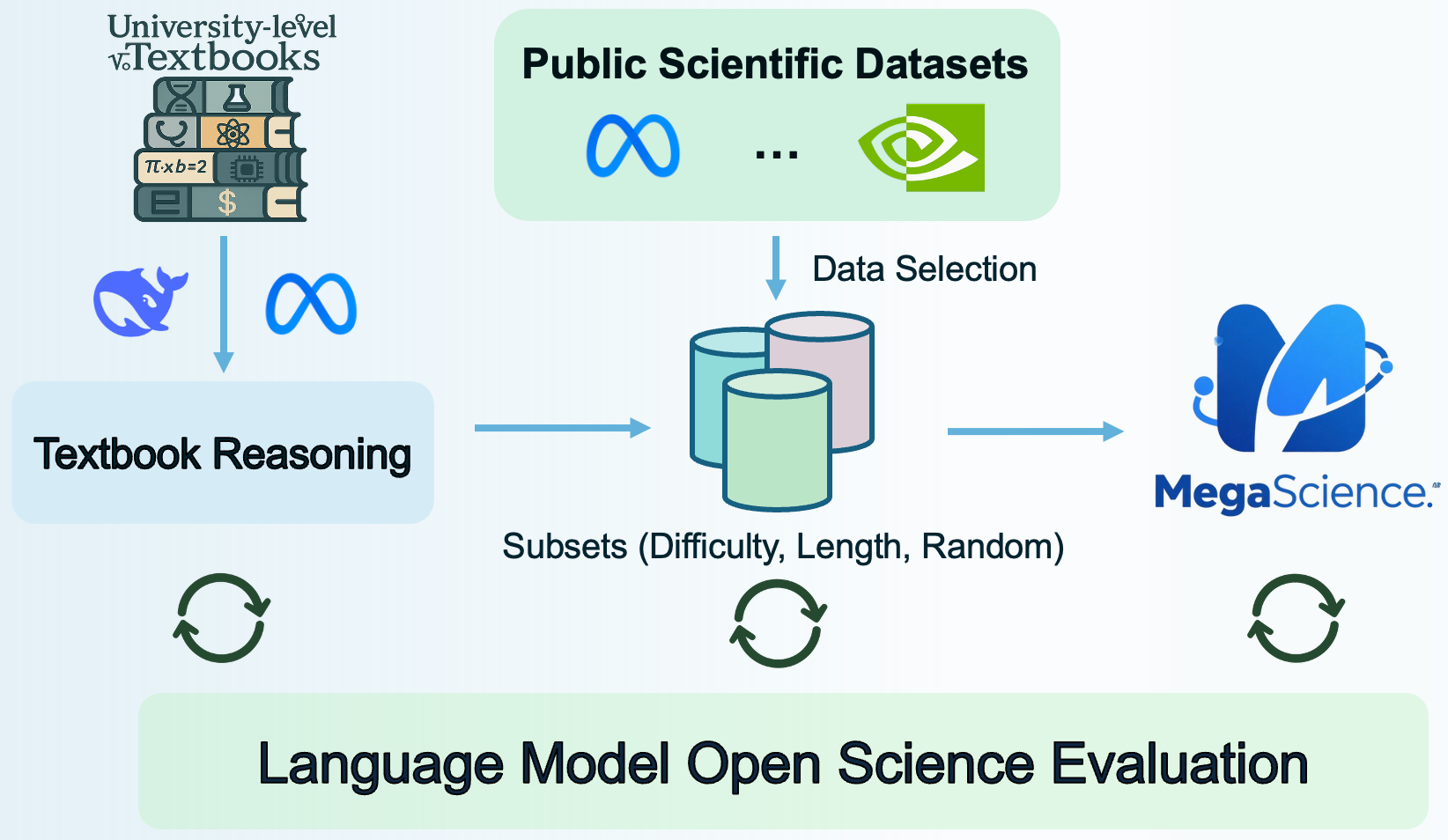
Llama3.1-8B-MegaScience is a model fine-tuned on MegaScience, a large-scale mixture of high-quality open-source scientific datasets totaling 1.25 million instances, as presented in the paper "MegaScience: Pushing the Frontiers of Post-Training Datasets for Science Reasoning". The MegaScience dataset features truthful reference answers extracted from 12k university-level scientific textbooks, comprising 650k reasoning questions spanning 7 scientific disciplines. This model significantly outperforms corresponding official instruct models in average performance on scientific reasoning tasks and exhibits greater effectiveness for larger and stronger models, suggesting a scaling benefit for scientific tuning.
For more details on the project, including the data curation pipeline and evaluation system, visit the official GitHub repository.
Llama3.1-8B-MegaScience
Training Recipe
- LR: 5e-6
- LR Schedule: Cosine
- Batch Size: 512
- Max Length: 4,096
- Warm Up Ratio: 0.05
- Epochs: 3
Evaluation Results
More about MegaScience
Usage
You can use the model with the transformers library:
from transformers import AutoTokenizer, AutoModelForCausalLM
import torch

model_id = "MegaScience/Llama3.1-8B-MegaScience"

tokenizer = AutoTokenizer.from_pretrained(model_id)
model = AutoModelForCausalLM.from_pretrained(
    model_id,
    torch_dtype=torch.bfloat16,
    device_map="auto"
)

messages = [
    {"role": "user", "content": "Explain the concept of quantum entanglement."},
]

input_ids = tokenizer.apply_chat_template(
    messages,
    add_generation_prompt=True,
    return_tensors="pt"
).to(model.device)

outputs = model.generate(
    input_ids,
    max_new_tokens=512,
    eos_token_id=tokenizer.eos_token_id,
    do_sample=True,
    temperature=0.7,
    top_p=0.9
)
response = tokenizer.decode(outputs[0], skip_special_tokens=True)
print(response)
Citation
Check out our paper for more details. If you use our dataset or find our work useful, please cite
@article{fan2025megascience,
  title={MegaScience: Pushing the Frontiers of Post-Training Datasets for Science Reasoning},
  author={Fan, Run-Ze and Wang, Zengzhi and Liu, Pengfei},
  year={2025},
  journal={arXiv preprint arXiv:2507.16812},
  url={https://arxiv.org/abs/2507.16812}
}


Similar repos

Llama3.1-8B-MegaScience is a model fine-tuned on MegaScience, a large-scale mixture of high-quality open-source scientific datasets totaling 1.25 million instances, as presented in the paper "MegaScience: Pushing the Frontiers of Post-Training Datasets for Science Reasoning". The MegaScience dataset features truthful reference answers extracted from 12k university-level scientific textbooks, comprising 650k reasoning questions spanning 7 scientific disciplines. This model significantly outperfor
1
9 commits
2 linked in READMEs
updated Jul 24, 2025
README
MegaScience: Pushing the Frontiers of Post-Training Datasets for Science Reasoning
Llama3.1-8B-MegaScience is a model fine-tuned on MegaScience, a large-scale mixture of high-quality open-source scientific datasets totaling 1.25 million instances, as presented in the paper "MegaScience: Pushing the Frontiers of Post-Training Datasets for Science Reasoning". The MegaScience dataset features truthful reference answers extracted from 12k university-level scientific textbooks, comprising 650k reasoning questions spanning 7 scientific disciplines. This model significantly outperforms corresponding official instruct models in average performance on scientific reasoning tasks and exhibits greater effectiveness for larger and stronger models, suggesting a scaling benefit for scientific tuning.
For more details on the project, including the data curation pipeline and evaluation system, visit the official GitHub repository.
Llama3.1-8B-MegaScience
Training Recipe
- LR: 5e-6
- LR Schedule: Cosine
- Batch Size: 512
- Max Length: 4,096
- Warm Up Ratio: 0.05
- Epochs: 3
Evaluation Results
More about MegaScience
Usage
You can use the model with the transformers library:
from transformers import AutoTokenizer, AutoModelForCausalLM
import torch

model_id = "MegaScience/Llama3.1-8B-MegaScience"

tokenizer = AutoTokenizer.from_pretrained(model_id)
model = AutoModelForCausalLM.from_pretrained(
    model_id,
    torch_dtype=torch.bfloat16,
    device_map="auto"
)

messages = [
    {"role": "user", "content": "Explain the concept of quantum entanglement."},
]

input_ids = tokenizer.apply_chat_template(
    messages,
    add_generation_prompt=True,
    return_tensors="pt"
).to(model.device)

outputs = model.generate(
    input_ids,
    max_new_tokens=512,
    eos_token_id=tokenizer.eos_token_id,
    do_sample=True,
    temperature=0.7,
    top_p=0.9
)
response = tokenizer.decode(outputs[0], skip_special_tokens=True)
print(response)
Citation
Check out our paper for more details. If you use our dataset or find our work useful, please cite
@article{fan2025megascience,
  title={MegaScience: Pushing the Frontiers of Post-Training Datasets for Science Reasoning},
  author={Fan, Run-Ze and Wang, Zengzhi and Liu, Pengfei},
  year={2025},
  journal={arXiv preprint arXiv:2507.16812},
  url={https://arxiv.org/abs/2507.16812}
}