
Evaluation of LLMs Should Not Ignore Non-Determinism
0
8 commits
5 linked in READMEs
updated Jul 17, 2024
README
Evaluation of LLMs Should Not Ignore Non-Determinism
Official sampling results for The Good, The Bad, and The Greedy: Evaluation of LLMs Should Not Ignore Non-Determinism
Dataset Details
Authors: Yifan Song, Guoyin Wang, Sujian Li, Bill Yuchen Lin.
Current evaluations of large language models (LLMs) often overlook non-determinism, typically focusing on a single output per example. This limits our understanding of LLM performance variability in real-world applications. Our study addresses this issue by exploring key questions about the performance differences between greedy decoding and sampling, identifying benchmarks’ consistency regarding non-determinism, and examining unique model behaviors.
Here are our findings:
- A notable performance gap is observed between greedy decoding and sampling generation.
- Greedy decoding outperforms sampling on most evaluated benchmarks, except for AlpacaEval.
- Math reasoning and code generation were most impacted by sampling variance.
- The above findings remain consistent across different sizes and families of LLMs.
- Alignment methods, e.g., DPO, can significantly reduce the sampling variance for most benchmarks.
- High temperature will significantly harm the reasoning and code generation capabilities of LLMs, while higher repetition penalty leads to improved performance on AlpacaEval.
- In the best-of-N sampling setting, 7B-level LMs have the potential to outperform GPT-4-Turbo.
We evaluate non-determinism generation of LLMs on seven benchmarks: AlpacaEval 2, Arena-Hard, WildBench v2, MixEval, MMLU-Redux, GSM8K, and HumanEval.
| Dataset | Instance Num. | Sample Num. | Metric |
|---|---|---|---|
| AlpacaEval 2 | 805 | 16 | LC |
| Arena-Hard | 500 | 16 | Win Rate |
| WildBench v2 | 1024 | 16 | WB-Score |
| MixEval | 4000 | 16 | Score |
| MMLU-Redux | 3000 | 32 | Acc |
| GSM8K | 1319 | 128 | EM |
| HumanEval | 164 | 128 | Pass@1 |
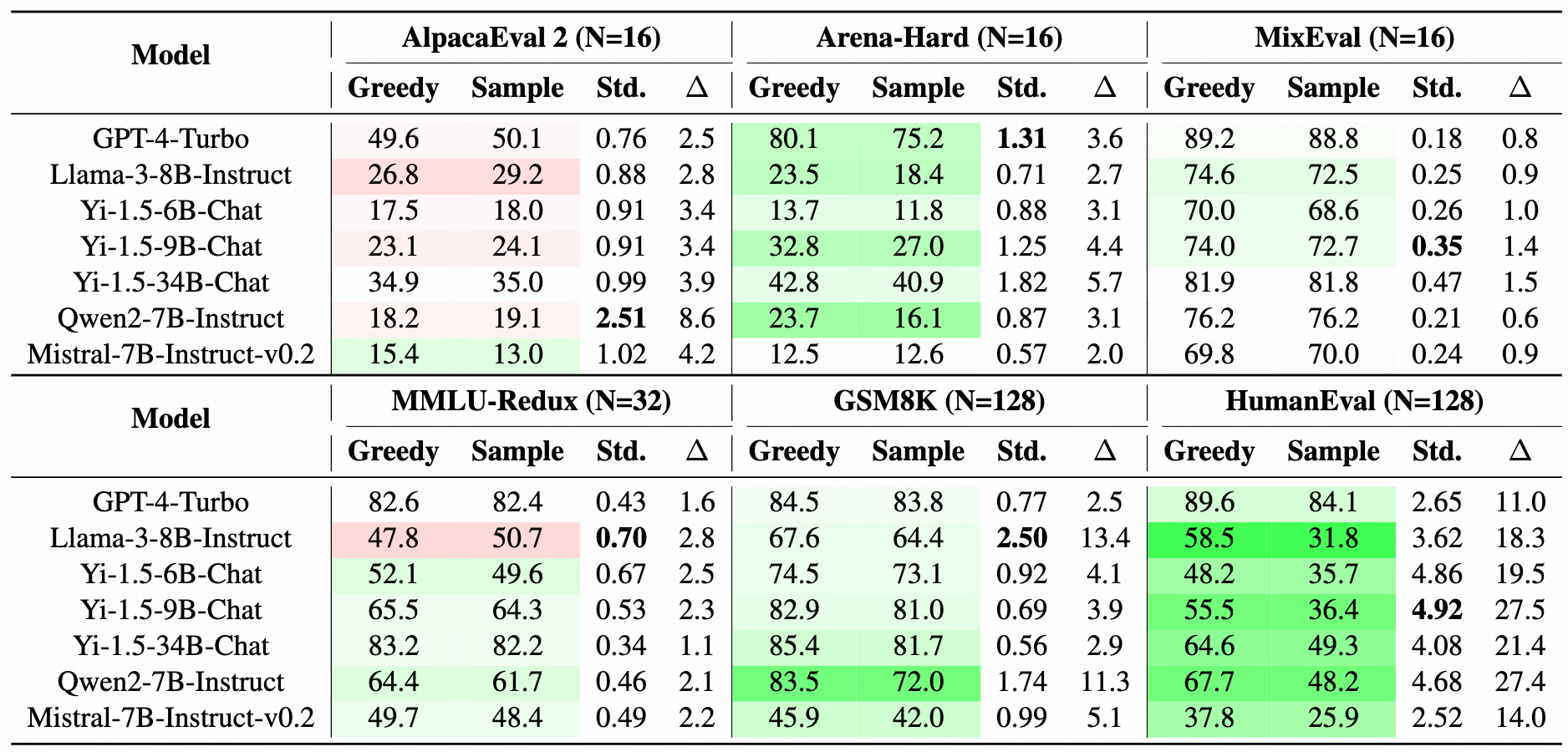
From the results, we observe a consistent performance gap between greedy decoding and the sampling method. Greedy decoding generally proves more effective for most tasks, except for AlpacaEval.
📖 Citation
If you find this repo helpful, please cite out paper:
@article{song2024good,
    author={Yifan Song and Guoyin Wang and Sujian Li and Bill Yuchen Lin},
    title={The Good, The Bad, and The Greedy: Evaluation of LLMs Should Not Ignore Non-Determinism},
    year={2024},
    archivePrefix={arXiv},
    primaryClass={cs.CL}
}
arxiv id: 2407.10457


Similar repos




Linked in READMEs


Evaluation of LLMs Should Not Ignore Non-Determinism
0
8 commits
5 linked in READMEs
updated Jul 17, 2024
README
Evaluation of LLMs Should Not Ignore Non-Determinism
Official sampling results for The Good, The Bad, and The Greedy: Evaluation of LLMs Should Not Ignore Non-Determinism
Dataset Details
Authors: Yifan Song, Guoyin Wang, Sujian Li, Bill Yuchen Lin.
Current evaluations of large language models (LLMs) often overlook non-determinism, typically focusing on a single output per example. This limits our understanding of LLM performance variability in real-world applications. Our study addresses this issue by exploring key questions about the performance differences between greedy decoding and sampling, identifying benchmarks’ consistency regarding non-determinism, and examining unique model behaviors.
Here are our findings:
- A notable performance gap is observed between greedy decoding and sampling generation.
- Greedy decoding outperforms sampling on most evaluated benchmarks, except for AlpacaEval.
- Math reasoning and code generation were most impacted by sampling variance.
- The above findings remain consistent across different sizes and families of LLMs.
- Alignment methods, e.g., DPO, can significantly reduce the sampling variance for most benchmarks.
- High temperature will significantly harm the reasoning and code generation capabilities of LLMs, while higher repetition penalty leads to improved performance on AlpacaEval.
- In the best-of-N sampling setting, 7B-level LMs have the potential to outperform GPT-4-Turbo.
We evaluate non-determinism generation of LLMs on seven benchmarks: AlpacaEval 2, Arena-Hard, WildBench v2, MixEval, MMLU-Redux, GSM8K, and HumanEval.
| Dataset | Instance Num. | Sample Num. | Metric |
|---|---|---|---|
| AlpacaEval 2 | 805 | 16 | LC |
| Arena-Hard | 500 | 16 | Win Rate |
| WildBench v2 | 1024 | 16 | WB-Score |
| MixEval | 4000 | 16 | Score |
| MMLU-Redux | 3000 | 32 | Acc |
| GSM8K | 1319 | 128 | EM |
| HumanEval | 164 | 128 | Pass@1 |
From the results, we observe a consistent performance gap between greedy decoding and the sampling method. Greedy decoding generally proves more effective for most tasks, except for AlpacaEval.
📖 Citation
If you find this repo helpful, please cite out paper:
@article{song2024good,
    author={Yifan Song and Guoyin Wang and Sujian Li and Bill Yuchen Lin},
    title={The Good, The Bad, and The Greedy: Evaluation of LLMs Should Not Ignore Non-Determinism},
    year={2024},
    archivePrefix={arXiv},
    primaryClass={cs.CL}
}
arxiv id: 2407.10457