A unified benchmark for document-centric multimodal retrieval-augmented generation (MM-RAG).
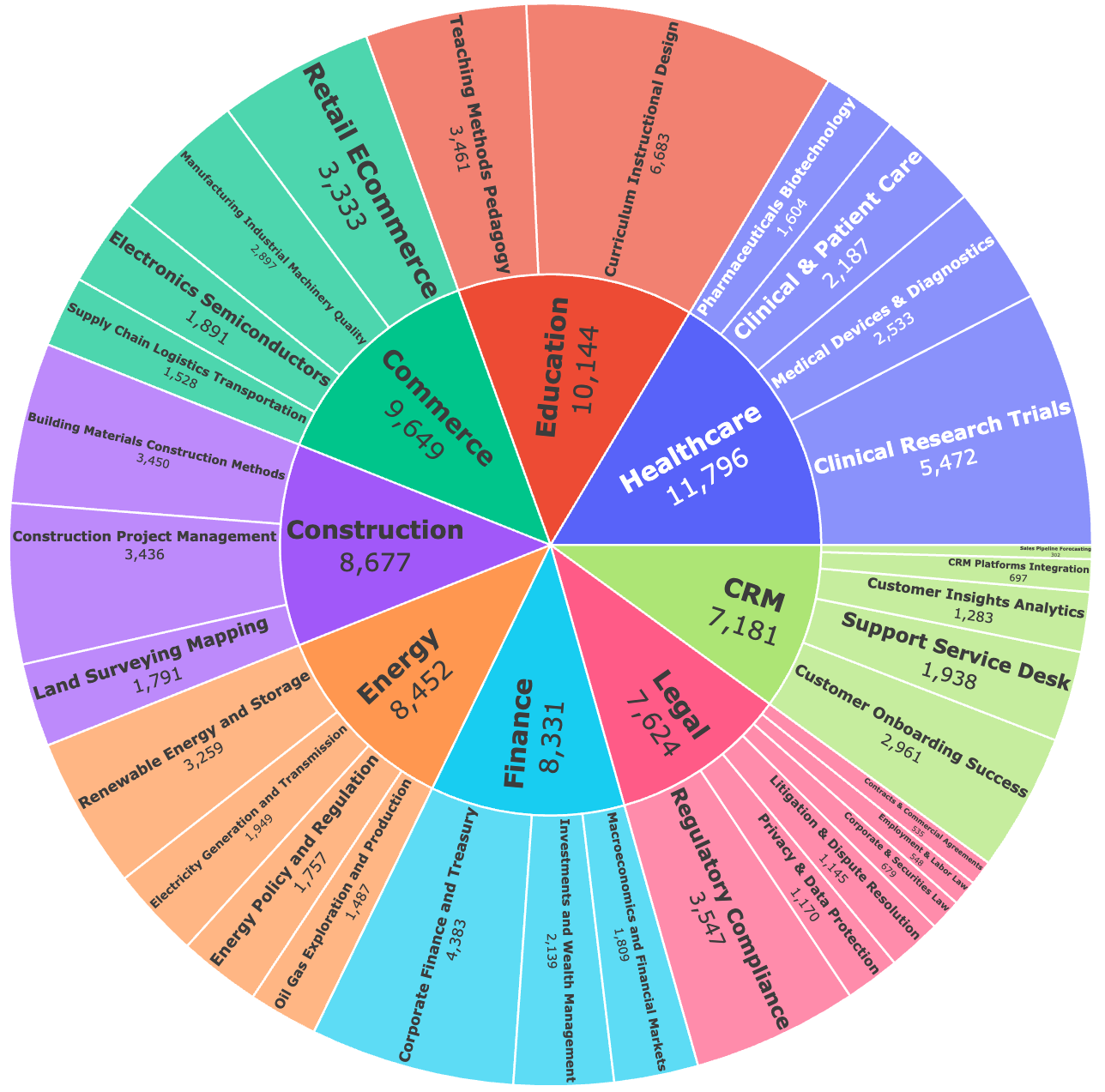
UNIDOC-BENCH is the first large-scale, realistic benchmark for multimodal retrieval-augmented generation (MM-RAG) and Visual Question Answering (VQA) built from 70,000 real-world PDF pages across eight domains. The dataset extracts and links evidence from text, tables, and figures, then generates 1,700+ multimodal QA pairs spanning factual retrieval, comparison, summarization, and logical reasoning queries. Each QA pair includes image paths (mage_paths) for the entire pdf for direct VQA evaluation, making it suitable for both MM-RAG and VQA research.
longdoc_image_paths and gt_image_paths) for direct VQA evaluationThe dataset is organized as a single split named test containing all 1,742 QA pairs. Each QA pair includes a domain field that indicates which of the 8 domains it belongs to. To access domain-specific data, filter the test split by the domain field.
Dataset splits:
test: 1,742 QA pairs across all 8 domainsAvailable domains:
commerce_manufacturingconstructioncrmeducationenergyfinancehealthcarelegal| Domain | PDF Count | Description | Download |
|---|---|---|---|
| Healthcare | 1,100 | Medical documents, research papers, clinical guidelines | 📥 Download |
| Legal | 911 | Legal documents, court cases, regulations, contracts | 📥 Download |
| Education | 812 | Educational materials, textbooks, academic papers | 📥 Download |
| CRM | 776 | Customer relationship management documents, manuals | 📥 Download |
| Energy | 766 | Energy sector reports, technical specifications | 📥 Download |
| Construction | 736 | Construction plans, safety manuals, technical docs | 📥 Download |
| Commerce & Manufacturing | 719 | Business documents, manufacturing guides, catalogs | 📥 Download |
| Finance | 621 | Financial reports, banking documents, investment materials | 📥 Download |
The dataset contains 1,742 question-answer pairs in a single test split. Each QA pair has the following structure:
{
  "question": "Which procedures are part of Hunt Design's corrective measures process as defined in QMSP-1011?",
  "answer": "The procedures part of Hunt Design's corrective measures process as defined in QMSP-1011 include the analysis of data, internal audits, corrective actions, control of non-conforming products, and management review.",
  "gt_image_paths": [
    "/path/to/images/commerce_manufacturing/0355944/0355944_page_0004.png"
  ],
  "question_type": "factual_retrieval",
  "answer_type": "image_only",
  "domain": "commerce_manufacturing",
  "longdoc_image_paths": [
    "/path/to/images/commerce_manufacturing/0355944/0355944_page_0001.png",
    "/path/to/images/commerce_manufacturing/0355944/0355944_page_0002.png",
    "/path/to/images/commerce_manufacturing/0355944/0355944_page_0003.png",
    "/path/to/images/commerce_manufacturing/0355944/0355944_page_0004.png",
    "/path/to/images/commerce_manufacturing/0355944/0355944_page_0005.png"
  ]
}
question: The question text (obscured version for evaluation)answer: The complete answer to the questiongt_image_paths: Ground-truth image paths - List of image file paths that contain the answer. These are the exact pages/images needed to answer the question correctly. Use this for Retrieval evaluation.longdoc_image_paths: All image paths in this doc - List of all image file paths from the document(s). These include all pages from the source document(s). Use this for VQA evaluation.question_type: Type of question (factual_retrieval, comparison, summarization, logical_reasoning)answer_type: Answer modality (text_only, image_only, table_required, multimodal)domain: Domain category (commerce_manufacturing, construction, crm, education, energy, finance, healthcare, legal)| Domain | File Size | PDF Count |
|---|---|---|
| 🏥 Healthcare | 1.19 GB | 1,098 |
| 🎓 Education | 816.9 MB | 812 |
| 🏗️ Construction | 844.2 MB | 736 |
| ⚡ Energy | 708.4 MB | 766 |
| 👥 CRM | 704.7 MB | 776 |
| ⚖️ Legal | 541.4 MB | 909 |
| 🏭 Commerce & Manufacturing | 504.9 MB | 719 |
| 💰 Finance | 360.8 MB | 621 |
from datasets import load_dataset

# Load the dataset from Hugging Face
# The dataset has 8 domain-based splits, each containing 200 QA pairs
dataset = load_dataset("Salesforce/UniDoc-Bench")

# Available splits: commerce_manufacturing, construction, crm, education, energy, finance, healthcare, legal
print(dataset.keys())

# Access QA pairs by domain
healthcare_qa = dataset["healthcare"]
construction_qa = dataset["construction"]
crm_qa = dataset["crm"]
education_qa = dataset["education"]
energy_qa = dataset["energy"]
finance_qa = dataset["finance"]
commerce_manufacturing_qa = dataset["commerce_manufacturing"]
legal_qa = dataset["legal"]

# Or load a specific domain directly
healthcare_only = load_dataset("Salesforce/UniDoc-Bench", split="healthcare")
The dataset includes compressed PDF files for each domain that can be used for RAG database construction:
from datasets import load_dataset
import tarfile
import os
from huggingface_hub import hf_hub_download

# Method 1: Download specific PDF archives
def download_pdf_archive(domain_name, save_path="."):
    """Download PDF archive for a specific domain"""
    filename = f"{domain_name}_pdfs.tar.gz"
    file_path = hf_hub_download(
        repo_id="Salesforce/UniDoc-Bench",
        filename=filename,
        repo_type="dataset",
        local_dir=save_path
    )
    return file_path

# Method 2: Extract PDFs for RAG database construction
def extract_pdfs_for_rag(domain_name, extract_to="pdf_database"):
    """Download and extract PDFs for RAG database"""
    # Download the archive
    archive_path = download_pdf_archive(domain_name)

    # Create extraction directory
    domain_dir = os.path.join(extract_to, domain_name)
    os.makedirs(domain_dir, exist_ok=True)

    # Extract PDFs
    with tarfile.open(archive_path, 'r:gz') as tar:
        tar.extractall(domain_dir)

    print(f"Extracted {domain_name} PDFs to {domain_dir}")
    return domain_dir

# Example: Extract healthcare PDFs for RAG
healthcare_pdfs = extract_pdfs_for_rag("healthcare")
import fitz  # PyMuPDF
from pathlib import Path
import json
from huggingface_hub import hf_hub_download
import tarfile

def build_rag_database(domain_name, output_dir="rag_database"):
    """Build RAG database from domain PDFs"""

    # Download and extract PDFs
    archive_path = hf_hub_download(
        repo_id="Salesforce/UniDoc-Bench",
        filename=f"{domain_name}_pdfs.tar.gz",
        repo_type="dataset"
    )

    # Extract to temporary directory
    temp_dir = f"temp_{domain_name}_pdfs"
    with tarfile.open(archive_path, 'r:gz') as tar:
        tar.extractall(temp_dir)

    # Process PDFs for RAG
    rag_data = []
    pdf_dir = Path(temp_dir)

    for pdf_file in pdf_dir.glob("**/*.pdf"):
        doc = fitz.open(pdf_file)

        for page_num in range(len(doc)):
            page = doc[page_num]
            text = page.get_text()
            images = page.get_images()

            # Create RAG entry
            entry = {
                "source": str(pdf_file),
                "page": page_num,
                "text": text,
                "images": len(images),
                "domain": domain_name
            }
            rag_data.append(entry)

        doc.close()

    # Save RAG database
    os.makedirs(output_dir, exist_ok=True)
    with open(f"{output_dir}/{domain_name}_rag.json", "w") as f:
        json.dump(rag_data, f, indent=2)

    print(f"Built RAG database for {domain_name}: {len(rag_data)} entries")
    return rag_data

# Example: Build RAG database for healthcare
healthcare_rag = build_rag_database("healthcare")
import fitz  # PyMuPDF
from pathlib import Path

# Load a specific PDF
pdf_path = "data/final_database/healthcare/medical_doc.pdf"
doc = fitz.open(pdf_path)

# Extract text and images
for page_num in range(len(doc)):
    page = doc[page_num]
    text = page.get_text()
    images = page.get_images()

    # Process multimodal content
    for img_index, img in enumerate(images):
        xref = img[0]
        pix = fitz.Pixmap(doc, xref)
        # Process image...
from datasets import load_dataset

# Load the dataset from Hugging Face
dataset = load_dataset("Salesforce/UniDoc-Bench")

# Access the dataset (contains all 1,742 QA pairs)
data = dataset["test"]

# Filter QA data for a specific domain
healthcare_qa = data.filter(lambda x: x["domain"] == "healthcare")
construction_qa = data.filter(lambda x: x["domain"] == "construction")

# Filter by query type within a domain
healthcare_factual = healthcare_qa.filter(lambda x: x["question_type"] == "factual_retrieval")

# Filter by answer type within a domain
healthcare_image_only = healthcare_qa.filter(lambda x: x["answer_type"] == "image_only")

# Filter by multiple criteria
healthcare_factual_image = data.filter(
    lambda x: x["domain"] == "healthcare"
    and x["question_type"] == "factual_retrieval"
    and x["answer_type"] == "image_only"
)
UNIDOC-BENCH supports Visual Question Answering (VQA) evaluation, where models answer questions based on document images. The dataset provides image paths (image_paths) that contain the answer, enabling direct VQA evaluation.
Each QA item includes:
longdoc_image_paths: All relevant document pages (for retrieval-based evaluation)question: The question to answeranswer: The ground-truth answerfrom datasets import load_dataset
from PIL import Image
# Load the dataset
dataset = load_dataset("Salesforce/UniDoc-Bench", split="test")
# Get an example with all relevant images
example = dataset[0]
question = example["question"]
all_images = example["longdoc_image_paths"] # All relevant document pages
# Simulate retrieval: select top-k images
top_k = 5
retrieved_images = all_images[:top_k]
# Load retrieved images
retrieved_image_list = []
for img_path in retrieved_images:
image = Image.open(img_path) # Adjust path based on your setup
retrieved_image_list.append(image)
# Use with your VQA model
# model_answer = vqa_model(question, retrieved_image_list)
According to the UNIDOC-BENCH paper:
We evaluate three state-of-the-art vision-language models: GPT-5, Claude-4.5-Sonnet, and Gemini-2.5-Pro across all domains. Results are reported for three retrieval settings:
| Domain | Gemini-2.5-Pro (topk=10) | Gemini-2.5-Pro (topk=20) | Gemini-2.5-Pro (GT) | Claude-4.5-Sonnet (topk=10) | Claude-4.5-Sonnet (topk=20) | Claude-4.5-Sonnet (GT) | GPT-5 (topk=10) | GPT-5 (topk=20) | GPT-5 (GT) |
|---|---|---|---|---|---|---|---|---|---|
| Commerce Manufacturing | 0.6871 | 0.7130 | 0.7005 | 0.8040 | 0.7977 | 0.8246 | 0.7229 | 0.7369 | 0.7692 |
| Construction | 0.6481 | 0.6380 | 0.6455 | 0.6977 | 0.7016 | 0.7284 | 0.6407 | 0.6367 | 0.6946 |
| CRM | 0.6586 | 0.7012 | 0.7511 | 0.7570 | 0.7603 | 0.8157 | 0.6603 | 0.6671 | 0.7707 |
| Education | 0.6703 | 0.7131 | 0.7135 | 0.7366 | 0.7817 | 0.8196 | 0.6369 | 0.6947 | 0.7651 |
| Energy | 0.6573 | 0.6801 | 0.6332 | 0.8108 | 0.7777 | 0.7978 | 0.7017 | 0.7048 | 0.7098 |
| Finance | 0.6738 | 0.6659 | 0.6722 | 0.7753 | 0.7550 | 0.7721 | 0.7079 | 0.7021 | 0.7212 |
| Healthcare | 0.6884 | 0.6754 | 0.7494 | 0.7762 | 0.7525 | 0.8459 | 0.6699 | 0.6851 | 0.7582 |
| Legal | 0.7299 | 0.7327 | 0.6949 | 0.7673 | 0.7489 | 0.7902 | 0.7049 | 0.7297 | 0.7554 |
| Average | 0.6767 | 0.6899 | 0.6950 | 0.7656 | 0.7594 | 0.7993 | 0.6806 | 0.6946 | 0.7430 |
Key Findings:
If you use this dataset in your research, please cite:
@article{peng2025unidoc,
  title={UNIDOC-BENCH: A Unified Benchmark for Document-Centric Multimodal RAG},
  author={Peng, Xiangyu and Qin, Can and Chen, Zeyuan and Xu, Ran and Xiong, Caiming and Wu, Chien-Sheng},
  journal={arXiv preprint arXiv:2510.03663},
  year={2025}
}
This dataset is released under the Creative Commons Attribution-NonCommercial 4.0 International License (CC-BY-NC 4.0).
🚫 This dataset was generated using GPT-4.1 and should not be used to develop models that compete with OpenAI.
For full license details, see: https://creativecommons.org/licenses/by-nc/4.0/
UNIDOC-BENCH: A Unified Benchmark for Document-Centric Multimodal RAG
For questions about this dataset, please open an issue on the GitHub repository or contact the authors.
We thank the annotators and domain experts who contributed to the validation of this dataset. This work was supported by Salesforce Research.
A unified benchmark for document-centric multimodal retrieval-augmented generation (MM-RAG).
UNIDOC-BENCH is the first large-scale, realistic benchmark for multimodal retrieval-augmented generation (MM-RAG) and Visual Question Answering (VQA) built from 70,000 real-world PDF pages across eight domains. The dataset extracts and links evidence from text, tables, and figures, then generates 1,700+ multimodal QA pairs spanning factual retrieval, comparison, summarization, and logical reasoning queries. Each QA pair includes image paths (mage_paths) for the entire pdf for direct VQA evaluation, making it suitable for both MM-RAG and VQA research.
longdoc_image_paths and gt_image_paths) for direct VQA evaluationThe dataset is organized as a single split named test containing all 1,742 QA pairs. Each QA pair includes a domain field that indicates which of the 8 domains it belongs to. To access domain-specific data, filter the test split by the domain field.
Dataset splits:
test: 1,742 QA pairs across all 8 domainsAvailable domains:
commerce_manufacturingconstructioncrmeducationenergyfinancehealthcarelegal| Domain | PDF Count | Description | Download |
|---|---|---|---|
| Healthcare | 1,100 | Medical documents, research papers, clinical guidelines | 📥 Download |
| Legal | 911 | Legal documents, court cases, regulations, contracts | 📥 Download |
| Education | 812 | Educational materials, textbooks, academic papers | 📥 Download |
| CRM | 776 | Customer relationship management documents, manuals | 📥 Download |
| Energy | 766 | Energy sector reports, technical specifications | 📥 Download |
| Construction | 736 | Construction plans, safety manuals, technical docs | 📥 Download |
| Commerce & Manufacturing | 719 | Business documents, manufacturing guides, catalogs | 📥 Download |
| Finance | 621 | Financial reports, banking documents, investment materials | 📥 Download |
The dataset contains 1,742 question-answer pairs in a single test split. Each QA pair has the following structure:
{
  "question": "Which procedures are part of Hunt Design's corrective measures process as defined in QMSP-1011?",
  "answer": "The procedures part of Hunt Design's corrective measures process as defined in QMSP-1011 include the analysis of data, internal audits, corrective actions, control of non-conforming products, and management review.",
  "gt_image_paths": [
    "/path/to/images/commerce_manufacturing/0355944/0355944_page_0004.png"
  ],
  "question_type": "factual_retrieval",
  "answer_type": "image_only",
  "domain": "commerce_manufacturing",
  "longdoc_image_paths": [
    "/path/to/images/commerce_manufacturing/0355944/0355944_page_0001.png",
    "/path/to/images/commerce_manufacturing/0355944/0355944_page_0002.png",
    "/path/to/images/commerce_manufacturing/0355944/0355944_page_0003.png",
    "/path/to/images/commerce_manufacturing/0355944/0355944_page_0004.png",
    "/path/to/images/commerce_manufacturing/0355944/0355944_page_0005.png"
  ]
}
question: The question text (obscured version for evaluation)answer: The complete answer to the questiongt_image_paths: Ground-truth image paths - List of image file paths that contain the answer. These are the exact pages/images needed to answer the question correctly. Use this for Retrieval evaluation.longdoc_image_paths: All image paths in this doc - List of all image file paths from the document(s). These include all pages from the source document(s). Use this for VQA evaluation.question_type: Type of question (factual_retrieval, comparison, summarization, logical_reasoning)answer_type: Answer modality (text_only, image_only, table_required, multimodal)domain: Domain category (commerce_manufacturing, construction, crm, education, energy, finance, healthcare, legal)| Domain | File Size | PDF Count |
|---|---|---|
| 🏥 Healthcare | 1.19 GB | 1,098 |
| 🎓 Education | 816.9 MB | 812 |
| 🏗️ Construction | 844.2 MB | 736 |
| ⚡ Energy | 708.4 MB | 766 |
| 👥 CRM | 704.7 MB | 776 |
| ⚖️ Legal | 541.4 MB | 909 |
| 🏭 Commerce & Manufacturing | 504.9 MB | 719 |
| 💰 Finance | 360.8 MB | 621 |
from datasets import load_dataset

# Load the dataset from Hugging Face
# The dataset has 8 domain-based splits, each containing 200 QA pairs
dataset = load_dataset("Salesforce/UniDoc-Bench")

# Available splits: commerce_manufacturing, construction, crm, education, energy, finance, healthcare, legal
print(dataset.keys())

# Access QA pairs by domain
healthcare_qa = dataset["healthcare"]
construction_qa = dataset["construction"]
crm_qa = dataset["crm"]
education_qa = dataset["education"]
energy_qa = dataset["energy"]
finance_qa = dataset["finance"]
commerce_manufacturing_qa = dataset["commerce_manufacturing"]
legal_qa = dataset["legal"]

# Or load a specific domain directly
healthcare_only = load_dataset("Salesforce/UniDoc-Bench", split="healthcare")
The dataset includes compressed PDF files for each domain that can be used for RAG database construction:
from datasets import load_dataset
import tarfile
import os
from huggingface_hub import hf_hub_download

# Method 1: Download specific PDF archives
def download_pdf_archive(domain_name, save_path="."):
    """Download PDF archive for a specific domain"""
    filename = f"{domain_name}_pdfs.tar.gz"
    file_path = hf_hub_download(
        repo_id="Salesforce/UniDoc-Bench",
        filename=filename,
        repo_type="dataset",
        local_dir=save_path
    )
    return file_path

# Method 2: Extract PDFs for RAG database construction
def extract_pdfs_for_rag(domain_name, extract_to="pdf_database"):
    """Download and extract PDFs for RAG database"""
    # Download the archive
    archive_path = download_pdf_archive(domain_name)

    # Create extraction directory
    domain_dir = os.path.join(extract_to, domain_name)
    os.makedirs(domain_dir, exist_ok=True)

    # Extract PDFs
    with tarfile.open(archive_path, 'r:gz') as tar:
        tar.extractall(domain_dir)

    print(f"Extracted {domain_name} PDFs to {domain_dir}")
    return domain_dir

# Example: Extract healthcare PDFs for RAG
healthcare_pdfs = extract_pdfs_for_rag("healthcare")
import fitz  # PyMuPDF
from pathlib import Path
import json
from huggingface_hub import hf_hub_download
import tarfile

def build_rag_database(domain_name, output_dir="rag_database"):
    """Build RAG database from domain PDFs"""

    # Download and extract PDFs
    archive_path = hf_hub_download(
        repo_id="Salesforce/UniDoc-Bench",
        filename=f"{domain_name}_pdfs.tar.gz",
        repo_type="dataset"
    )

    # Extract to temporary directory
    temp_dir = f"temp_{domain_name}_pdfs"
    with tarfile.open(archive_path, 'r:gz') as tar:
        tar.extractall(temp_dir)

    # Process PDFs for RAG
    rag_data = []
    pdf_dir = Path(temp_dir)

    for pdf_file in pdf_dir.glob("**/*.pdf"):
        doc = fitz.open(pdf_file)

        for page_num in range(len(doc)):
            page = doc[page_num]
            text = page.get_text()
            images = page.get_images()

            # Create RAG entry
            entry = {
                "source": str(pdf_file),
                "page": page_num,
                "text": text,
                "images": len(images),
                "domain": domain_name
            }
            rag_data.append(entry)

        doc.close()

    # Save RAG database
    os.makedirs(output_dir, exist_ok=True)
    with open(f"{output_dir}/{domain_name}_rag.json", "w") as f:
        json.dump(rag_data, f, indent=2)

    print(f"Built RAG database for {domain_name}: {len(rag_data)} entries")
    return rag_data

# Example: Build RAG database for healthcare
healthcare_rag = build_rag_database("healthcare")
import fitz  # PyMuPDF
from pathlib import Path

# Load a specific PDF
pdf_path = "data/final_database/healthcare/medical_doc.pdf"
doc = fitz.open(pdf_path)

# Extract text and images
for page_num in range(len(doc)):
    page = doc[page_num]
    text = page.get_text()
    images = page.get_images()

    # Process multimodal content
    for img_index, img in enumerate(images):
        xref = img[0]
        pix = fitz.Pixmap(doc, xref)
        # Process image...
from datasets import load_dataset

# Load the dataset from Hugging Face
dataset = load_dataset("Salesforce/UniDoc-Bench")

# Access the dataset (contains all 1,742 QA pairs)
data = dataset["test"]

# Filter QA data for a specific domain
healthcare_qa = data.filter(lambda x: x["domain"] == "healthcare")
construction_qa = data.filter(lambda x: x["domain"] == "construction")

# Filter by query type within a domain
healthcare_factual = healthcare_qa.filter(lambda x: x["question_type"] == "factual_retrieval")

# Filter by answer type within a domain
healthcare_image_only = healthcare_qa.filter(lambda x: x["answer_type"] == "image_only")

# Filter by multiple criteria
healthcare_factual_image = data.filter(
    lambda x: x["domain"] == "healthcare"
    and x["question_type"] == "factual_retrieval"
    and x["answer_type"] == "image_only"
)
UNIDOC-BENCH supports Visual Question Answering (VQA) evaluation, where models answer questions based on document images. The dataset provides image paths (image_paths) that contain the answer, enabling direct VQA evaluation.
Each QA item includes:
longdoc_image_paths: All relevant document pages (for retrieval-based evaluation)question: The question to answeranswer: The ground-truth answerfrom datasets import load_dataset
from PIL import Image
# Load the dataset
dataset = load_dataset("Salesforce/UniDoc-Bench", split="test")
# Get an example with all relevant images
example = dataset[0]
question = example["question"]
all_images = example["longdoc_image_paths"] # All relevant document pages
# Simulate retrieval: select top-k images
top_k = 5
retrieved_images = all_images[:top_k]
# Load retrieved images
retrieved_image_list = []
for img_path in retrieved_images:
image = Image.open(img_path) # Adjust path based on your setup
retrieved_image_list.append(image)
# Use with your VQA model
# model_answer = vqa_model(question, retrieved_image_list)
According to the UNIDOC-BENCH paper:
We evaluate three state-of-the-art vision-language models: GPT-5, Claude-4.5-Sonnet, and Gemini-2.5-Pro across all domains. Results are reported for three retrieval settings:
| Domain | Gemini-2.5-Pro (topk=10) | Gemini-2.5-Pro (topk=20) | Gemini-2.5-Pro (GT) | Claude-4.5-Sonnet (topk=10) | Claude-4.5-Sonnet (topk=20) | Claude-4.5-Sonnet (GT) | GPT-5 (topk=10) | GPT-5 (topk=20) | GPT-5 (GT) |
|---|---|---|---|---|---|---|---|---|---|
| Commerce Manufacturing | 0.6871 | 0.7130 | 0.7005 | 0.8040 | 0.7977 | 0.8246 | 0.7229 | 0.7369 | 0.7692 |
| Construction | 0.6481 | 0.6380 | 0.6455 | 0.6977 | 0.7016 | 0.7284 | 0.6407 | 0.6367 | 0.6946 |
| CRM | 0.6586 | 0.7012 | 0.7511 | 0.7570 | 0.7603 | 0.8157 | 0.6603 | 0.6671 | 0.7707 |
| Education | 0.6703 | 0.7131 | 0.7135 | 0.7366 | 0.7817 | 0.8196 | 0.6369 | 0.6947 | 0.7651 |
| Energy | 0.6573 | 0.6801 | 0.6332 | 0.8108 | 0.7777 | 0.7978 | 0.7017 | 0.7048 | 0.7098 |
| Finance | 0.6738 | 0.6659 | 0.6722 | 0.7753 | 0.7550 | 0.7721 | 0.7079 | 0.7021 | 0.7212 |
| Healthcare | 0.6884 | 0.6754 | 0.7494 | 0.7762 | 0.7525 | 0.8459 | 0.6699 | 0.6851 | 0.7582 |
| Legal | 0.7299 | 0.7327 | 0.6949 | 0.7673 | 0.7489 | 0.7902 | 0.7049 | 0.7297 | 0.7554 |
| Average | 0.6767 | 0.6899 | 0.6950 | 0.7656 | 0.7594 | 0.7993 | 0.6806 | 0.6946 | 0.7430 |
Key Findings:
If you use this dataset in your research, please cite:
@article{peng2025unidoc,
  title={UNIDOC-BENCH: A Unified Benchmark for Document-Centric Multimodal RAG},
  author={Peng, Xiangyu and Qin, Can and Chen, Zeyuan and Xu, Ran and Xiong, Caiming and Wu, Chien-Sheng},
  journal={arXiv preprint arXiv:2510.03663},
  year={2025}
}
This dataset is released under the Creative Commons Attribution-NonCommercial 4.0 International License (CC-BY-NC 4.0).
🚫 This dataset was generated using GPT-4.1 and should not be used to develop models that compete with OpenAI.
For full license details, see: https://creativecommons.org/licenses/by-nc/4.0/
UNIDOC-BENCH: A Unified Benchmark for Document-Centric Multimodal RAG
For questions about this dataset, please open an issue on the GitHub repository or contact the authors.
We thank the annotators and domain experts who contributed to the validation of this dataset. This work was supported by Salesforce Research.