
A Vite-based React framework with native multi-app support — one repo, several independently-deployed apps sharing a core.
3
stars
25
commits
TypeScript
primary language
Sep 13, 2026
updated
README

Devora.js


A Vite-based React framework built around one idea : a project is more than one app.
Devora.js lets you define several apps in one repo — a marketing site, a product app, an admin panel — that share a core and a backend, but build and deploy independently. Each app gets its own render mode, its own auth mode, and its own deploy target, without duplicating the plumbing between them.
Why
Most React frameworks assume one app per project. The moment a real product needs a marketing site, a product app, and an admin panel — a pretty normal shape — you're either cramming them into one app with route groups, or maintaining separate repos that share nothing. Devora.js treats "one repo, several independently-deployed apps sharing a core" as the default, not a workaround bolted on later.
The other design choice: no implicit caching. Every render mode (ssr/ssg/csr/isr) is an
explicit, route-level opt-in — no hidden revalidation windows to reverse-engineer, no undocumented
build format standing between you and a plain reverse proxy if you ever need one.
Live demo
- Vercel: marketing · dashboard · admin
- Netlify: devorajs.netlify.app
- Docs site, built with the published npm packages rather than this monorepo: devorajs-docs-docs.vercel.app
Screenshots
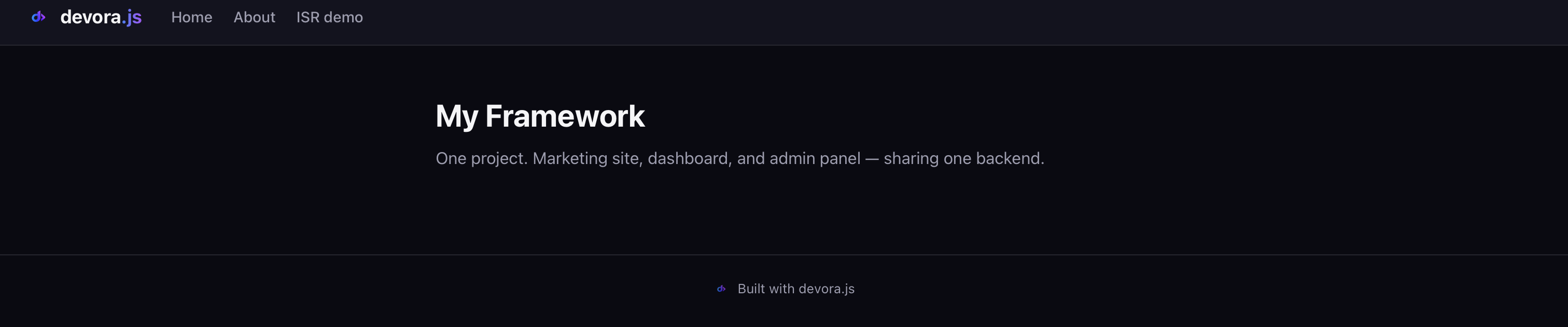
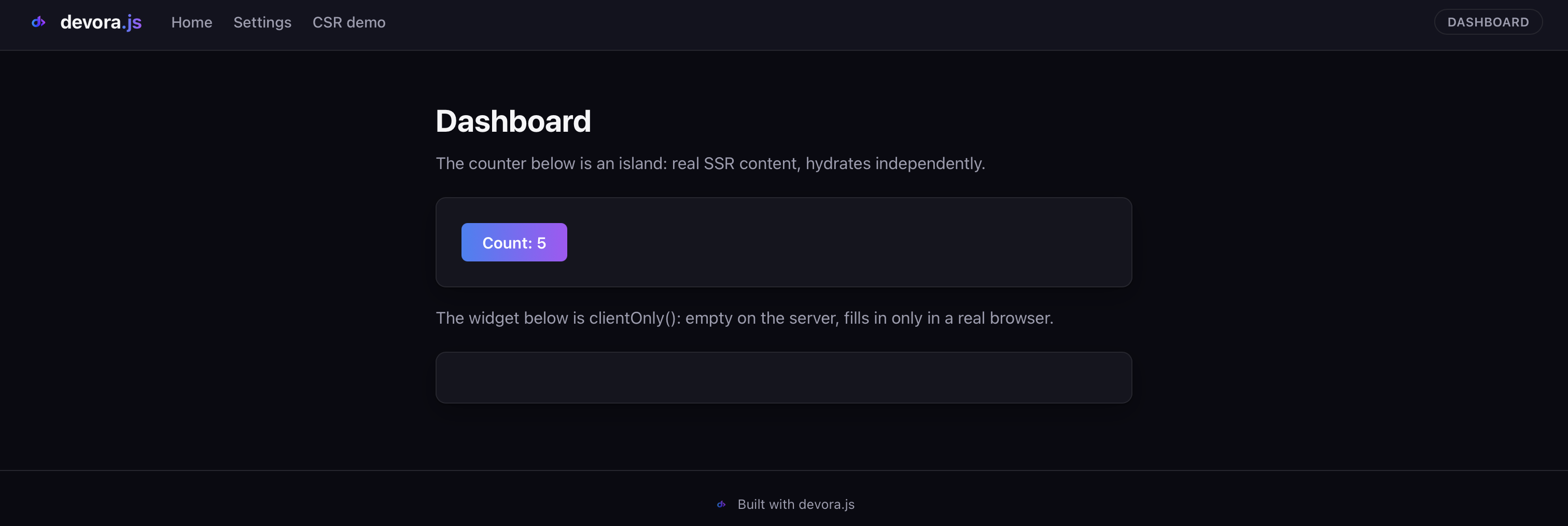
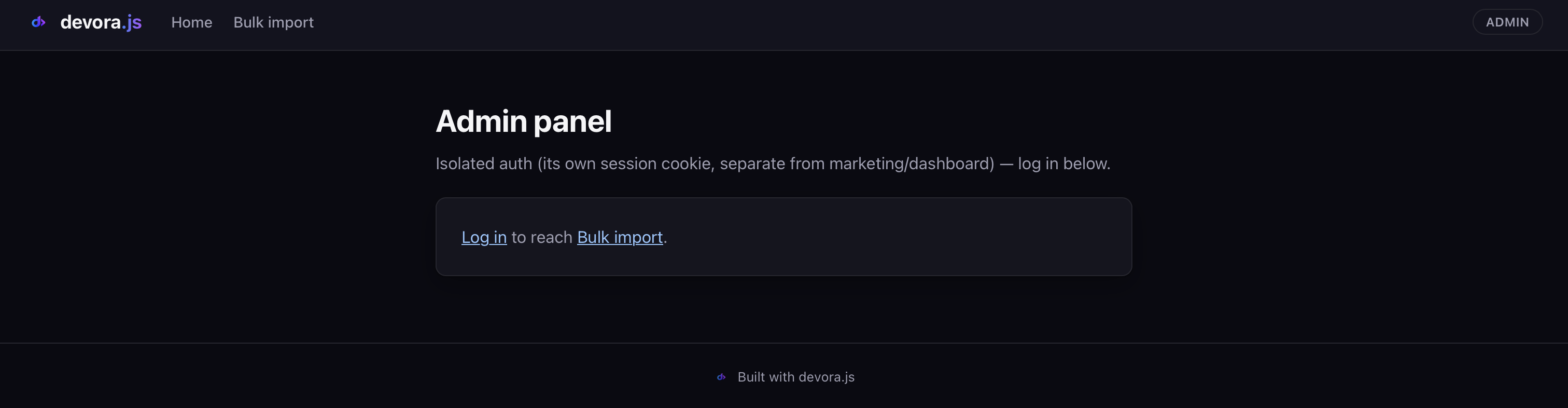
The same shared header/theme (<PageShell>) across all three apps — one design, not three ad
hoc ones.
Marketing (auth: "none" — no login anywhere on this app)
Dashboard (auth: "shared" — an island counter and a clientOnly() widget)
Admin (auth: "isolated" — its own session cookie, separate from the other two)
Quickstart
git clone https://github.com/hassanalsa3aka/devora.js.git
cd devora.js
pnpm install
pnpm exec devora dev --app=dashboard
Or start a brand-new standalone project, outside this repo:
npm create devora@latest
npm and Yarn work too, not just pnpm — see VERIFICATION.md for what's actually been tested
under each.
Key features
- Multi-app, one repo —
devora.config.tsdeclares each app;devora build/devora deployhandle each one independently. - SSR, SSG, CSR, ISR — set per route, explicitly. (
streamingis planned, see below.) - Islands —
island(() => import("./Widget"))hydrates just that component; the rest of the page stays static HTML. - Sessions & CSRF built in — three auth modes per app:
shared,isolated, ornone(skip the whole cookie/session carrier for apps that don't need login, like a marketing site). - Security headers on by default — CSP, HSTS, X-Frame-Options, overridable per app.
- SEO — OG tags and an auto-generated
sitemap.xml, opt-in per app. - Dynamic routes —
routes/users/[id].tsxmatches/users/123, with the value available asctx.params.id. A static route at the same depth always wins over a dynamic one. - Deploy anywhere — Vercel, Netlify, Docker, or a plain VPS with a generated nginx/Caddy
config. See
DEPLOYING.md. - No built-in ORM or auth provider — bring your own (Prisma, Drizzle, Clerk, Lucia, whatever you already use).
Current limitations
Stated plainly, not buried:
- Dynamic routes don't support
ssg/isryet.ssrandcsrboth work on a[id].tsxroute; pre-rendering one at build time needs a static-params API this doesn't have yet, and fails the build with a clear error rather than silently mis-building. - No streaming SSR yet.
renderMode: "streaming"is typed but not implemented — it needs a Suspense-boundary-based rewrite of how islands hydrate, planned for v2. isris weaker on Vercel/Netlify than on a self-hostedadapter-nodeserver. A serverless function's filesystem isn't guaranteed to persist between requests, so ongoing background regeneration there hasn't been verified (the initial build's output still serves correctly).- No DB client, by design. Framework internals never touch a database — you bring your own
ORM (architecture-v1.md §6). If you use a driver with native bindings, see
packages/backend/DATABASE.mdfor a verified pattern that avoids a real crash this framework's own dev server can otherwise cause.
Testing
Automated tests exist for @devorajs/core (sessions, CSRF, security headers, config, ISR
caching, route rendering) and one CLI build-time check. Everything else — the adapters, most CLI
commands, Docker, the proxy generator — has been manually verified during development but isn't
covered by a repeatable test yet. Full breakdown, including exactly what "manually verified"
means here, is in VERIFICATION.md. If something's broken, that gap is the most likely place —
please open an issue.
Packages
@devorajs/core— SSR request handling, sessions/CSRF, security headers, islands, config loading.@devorajs/cli— thedevoracommand.@devorajs/adapter-vercel@devorajs/adapter-netlifycreate-devora— scaffolds a new standalone project (npm create devora@latest).
Docs
- 📖 Architecture & design spec — the vision doc this is built against
- 🗺️ Roadmap — what's done, in progress, and planned, with the detailed build log
- 🚀 Deploying — Vercel, Netlify, Docker, self-hosted VPS, CI
- ✅ Testing & verification
- 📝 Changelog
- 🤝 Contributing
Status
Devora.js is early — pre-1.0, built by one person so far, actively developed. The core framework works and is live in production on the demos above, but it hasn't been used outside this repo yet. If you try it, I'd genuinely like to hear what breaks or what's missing — issues and PRs welcome.
License
MIT
Contributors

25 commits
See what people are saying
Similar repos


Languages
TypeScript
95.5%
JavaScript
3.3%
Dockerfile
1.2%
A Vite-based React framework with native multi-app support — one repo, several independently-deployed apps sharing a core.
3
stars
25
commits
TypeScript
primary language
Sep 13, 2026
updated
README
Devora.js
A Vite-based React framework built around one idea : a project is more than one app.
Devora.js lets you define several apps in one repo — a marketing site, a product app, an admin panel — that share a core and a backend, but build and deploy independently. Each app gets its own render mode, its own auth mode, and its own deploy target, without duplicating the plumbing between them.
Why
Most React frameworks assume one app per project. The moment a real product needs a marketing site, a product app, and an admin panel — a pretty normal shape — you're either cramming them into one app with route groups, or maintaining separate repos that share nothing. Devora.js treats "one repo, several independently-deployed apps sharing a core" as the default, not a workaround bolted on later.
The other design choice: no implicit caching. Every render mode (ssr/ssg/csr/isr) is an
explicit, route-level opt-in — no hidden revalidation windows to reverse-engineer, no undocumented
build format standing between you and a plain reverse proxy if you ever need one.
Live demo
- Vercel: marketing · dashboard · admin
- Netlify: devorajs.netlify.app
- Docs site, built with the published npm packages rather than this monorepo: devorajs-docs-docs.vercel.app
Screenshots
The same shared header/theme (<PageShell>) across all three apps — one design, not three ad
hoc ones.
Marketing (auth: "none" — no login anywhere on this app)
Dashboard (auth: "shared" — an island counter and a clientOnly() widget)
Admin (auth: "isolated" — its own session cookie, separate from the other two)
Quickstart
git clone https://github.com/hassanalsa3aka/devora.js.git
cd devora.js
pnpm install
pnpm exec devora dev --app=dashboard
Or start a brand-new standalone project, outside this repo:
npm create devora@latest
npm and Yarn work too, not just pnpm — see VERIFICATION.md for what's actually been tested
under each.
Key features
- Multi-app, one repo —
devora.config.tsdeclares each app;devora build/devora deployhandle each one independently. - SSR, SSG, CSR, ISR — set per route, explicitly. (
streamingis planned, see below.) - Islands —
island(() => import("./Widget"))hydrates just that component; the rest of the page stays static HTML. - Sessions & CSRF built in — three auth modes per app:
shared,isolated, ornone(skip the whole cookie/session carrier for apps that don't need login, like a marketing site). - Security headers on by default — CSP, HSTS, X-Frame-Options, overridable per app.
- SEO — OG tags and an auto-generated
sitemap.xml, opt-in per app. - Dynamic routes —
routes/users/[id].tsxmatches/users/123, with the value available asctx.params.id. A static route at the same depth always wins over a dynamic one. - Deploy anywhere — Vercel, Netlify, Docker, or a plain VPS with a generated nginx/Caddy
config. See
DEPLOYING.md. - No built-in ORM or auth provider — bring your own (Prisma, Drizzle, Clerk, Lucia, whatever you already use).
Current limitations
Stated plainly, not buried:
- Dynamic routes don't support
ssg/isryet.ssrandcsrboth work on a[id].tsxroute; pre-rendering one at build time needs a static-params API this doesn't have yet, and fails the build with a clear error rather than silently mis-building. - No streaming SSR yet.
renderMode: "streaming"is typed but not implemented — it needs a Suspense-boundary-based rewrite of how islands hydrate, planned for v2. isris weaker on Vercel/Netlify than on a self-hostedadapter-nodeserver. A serverless function's filesystem isn't guaranteed to persist between requests, so ongoing background regeneration there hasn't been verified (the initial build's output still serves correctly).- No DB client, by design. Framework internals never touch a database — you bring your own
ORM (architecture-v1.md §6). If you use a driver with native bindings, see
packages/backend/DATABASE.mdfor a verified pattern that avoids a real crash this framework's own dev server can otherwise cause.
Testing
Automated tests exist for @devorajs/core (sessions, CSRF, security headers, config, ISR
caching, route rendering) and one CLI build-time check. Everything else — the adapters, most CLI
commands, Docker, the proxy generator — has been manually verified during development but isn't
covered by a repeatable test yet. Full breakdown, including exactly what "manually verified"
means here, is in VERIFICATION.md. If something's broken, that gap is the most likely place —
please open an issue.
Packages
@devorajs/core— SSR request handling, sessions/CSRF, security headers, islands, config loading.@devorajs/cli— thedevoracommand.@devorajs/adapter-vercel@devorajs/adapter-netlifycreate-devora— scaffolds a new standalone project (npm create devora@latest).
Docs
- 📖 Architecture & design spec — the vision doc this is built against
- 🗺️ Roadmap — what's done, in progress, and planned, with the detailed build log
- 🚀 Deploying — Vercel, Netlify, Docker, self-hosted VPS, CI
- ✅ Testing & verification
- 📝 Changelog
- 🤝 Contributing
Status
Devora.js is early — pre-1.0, built by one person so far, actively developed. The core framework works and is live in production on the demos above, but it hasn't been used outside this repo yet. If you try it, I'd genuinely like to hear what breaks or what's missing — issues and PRs welcome.
License
MIT
See what people are saying
Similar repos
Contributors
25 commits
Languages
TypeScript
95.5%
JavaScript
3.3%
Dockerfile
1.2%