A Multi-Modal Cohesive Framework for Narrative-Driven Rich Cinematic Soundscape Generation
Generating immersive, synchronized, and cinematic audio for long-form textual narratives remains a significant challenge in multi-modal AI. While current Text-to-Audio (TTA) frameworks successfully synthesize isolated sound effects, they struggle with narrative cohesion, temporal alignment, and cinematic emotional depth.
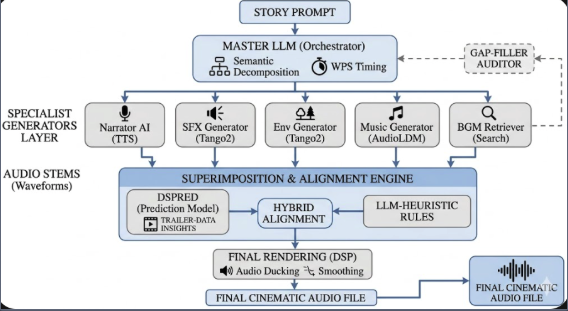
BackgroundMellow is a framework that treats story-to-audio generation as a precise orchestration and signal processing problem. This framework is enabled without ground-truth through a master-specialist agent architecture that decomposes text into precise and multi-layered audio cues, generates each category of sounds with a suitable specialist model, and superimposes the soundscapes to create a unified and aligned audio segment.
Our pipeline is built over the Tango2 latent diffusion model for environmental synthesis alongside a novel Cinematic BGM Retriever mined from professional soundtracks. To automate the sound mixing process, we use an NLP-based module that predicts precise audio parameters—like start time, duration, and relative loudness—based on the narrative timeline. We further empirically evaluate and show the efficacy of the proposed framework leveraging nearest-neighbor retrieval against a curated dataset of YouTube cinematic trailers to measure temporal synchronization, coverage, and spectral richness.
Check out our generated cinematic soundscapes in action:
Below is the high-level architecture of the BackgroundMellow master-specialist framework:
Create and activate a new Conda environment:
conda create -n bgmellow python=3.12
conda activate bgmellow
Navigate to the backend directory and install dependencies:
cd .backgroundMellow/backend
pip install -r requirements.txt
Configure Environment Variables:
Create a .env file inside the .backgroundMellow/backend directory and add your API keys:
HUGGINGFACEHUB_ACCESS_TOKEN="your_huggingface_token_here"
GEMINI_API_KEY="your_gemini_api_key_here"
Start the Backend Server: You can run the server directly via Uvicorn on port 8080:
uvicorn main:app --port 8080 --reload
Alternatively, if configured in your package.json, you can run:
npm run dev:backend
Navigate to the main project folder (backgroundMellow).
Configure Environment Variables:
Create a .env file in the root of the main frontend directory to point to your local backend API:
VITE_BACKEND_ENDPOINT="http://localhost:8080/api"
Install Node modules:
npm i
Start the Frontend Server:
npm run dev:frontend
The application should now be running locally. Check your terminal for the localhost port (usually http://localhost:5173).
We empirically evaluated BackgroundMellow using a nearest-neighbor retrieval approach against a curated dataset of YouTube cinematic trailers, measuring temporal synchronization (Sync Score), coverage, and spectral richness.
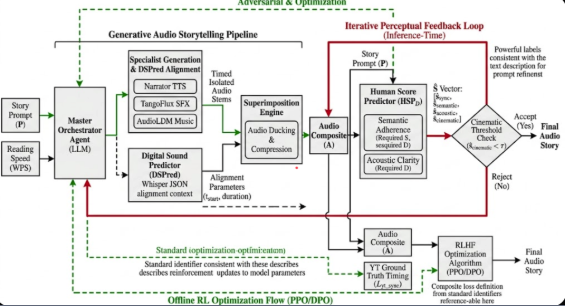
./Model Evaluation.xlxs🔮 Future Work: Perceptual Refinement & RLHF While the current framework relies on deterministic DSP algorithms and supervised fine-tuning, cinematic audio is inherently subjective. Our primary future direction is to integrate human perception directly into the orchestration loop via an adversarial Reinforcement Learning from Human Feedback (RLHF) architecture.
Human Score Predictor (HSP): We are training a surrogate reward model based on human-in-the-loop evaluations to predict multi-dimensional satisfaction vectors (Sync, Semantic, Acoustic, and Cinematic Impact).
Inference-Time Feedback Loop: The HSP acts as a zero-shot discriminator. If a generated mix scores below a cinematic threshold, it forces the Master Agent to actively reflect, rewrite mixing parameters (e.g., softening an overpowering SFX), and regenerate the stems.
PPO/DPO Optimization: Ultimately, we will formulate orchestration as a Markov Decision Process (MDP), utilizing Proximal Policy Optimization (PPO) or Direct Preference Optimization (DPO) to fine-tune our alignment models against both objective YouTube metrics and subjective human rewards.
If you use BackgroundMellow or our dataset in your research, please cite our paper:
@article{backgroundmellow2026,
  title={BackgroundMellow: A Multi-Modal Cohesive Framework for Narrative-Driven Rich Cinematic Soundscape Generation},
  author={},
  journal={TBD},
  year={2026}
}
A Multi-Modal Cohesive Framework for Narrative-Driven Rich Cinematic Soundscape Generation
Generating immersive, synchronized, and cinematic audio for long-form textual narratives remains a significant challenge in multi-modal AI. While current Text-to-Audio (TTA) frameworks successfully synthesize isolated sound effects, they struggle with narrative cohesion, temporal alignment, and cinematic emotional depth.
BackgroundMellow is a framework that treats story-to-audio generation as a precise orchestration and signal processing problem. This framework is enabled without ground-truth through a master-specialist agent architecture that decomposes text into precise and multi-layered audio cues, generates each category of sounds with a suitable specialist model, and superimposes the soundscapes to create a unified and aligned audio segment.
Our pipeline is built over the Tango2 latent diffusion model for environmental synthesis alongside a novel Cinematic BGM Retriever mined from professional soundtracks. To automate the sound mixing process, we use an NLP-based module that predicts precise audio parameters—like start time, duration, and relative loudness—based on the narrative timeline. We further empirically evaluate and show the efficacy of the proposed framework leveraging nearest-neighbor retrieval against a curated dataset of YouTube cinematic trailers to measure temporal synchronization, coverage, and spectral richness.
Check out our generated cinematic soundscapes in action:
Below is the high-level architecture of the BackgroundMellow master-specialist framework:
Create and activate a new Conda environment:
conda create -n bgmellow python=3.12
conda activate bgmellow
Navigate to the backend directory and install dependencies:
cd .backgroundMellow/backend
pip install -r requirements.txt
Configure Environment Variables:
Create a .env file inside the .backgroundMellow/backend directory and add your API keys:
HUGGINGFACEHUB_ACCESS_TOKEN="your_huggingface_token_here"
GEMINI_API_KEY="your_gemini_api_key_here"
Start the Backend Server: You can run the server directly via Uvicorn on port 8080:
uvicorn main:app --port 8080 --reload
Alternatively, if configured in your package.json, you can run:
npm run dev:backend
Navigate to the main project folder (backgroundMellow).
Configure Environment Variables:
Create a .env file in the root of the main frontend directory to point to your local backend API:
VITE_BACKEND_ENDPOINT="http://localhost:8080/api"
Install Node modules:
npm i
Start the Frontend Server:
npm run dev:frontend
The application should now be running locally. Check your terminal for the localhost port (usually http://localhost:5173).
We empirically evaluated BackgroundMellow using a nearest-neighbor retrieval approach against a curated dataset of YouTube cinematic trailers, measuring temporal synchronization (Sync Score), coverage, and spectral richness.
./Model Evaluation.xlxs🔮 Future Work: Perceptual Refinement & RLHF While the current framework relies on deterministic DSP algorithms and supervised fine-tuning, cinematic audio is inherently subjective. Our primary future direction is to integrate human perception directly into the orchestration loop via an adversarial Reinforcement Learning from Human Feedback (RLHF) architecture.
Human Score Predictor (HSP): We are training a surrogate reward model based on human-in-the-loop evaluations to predict multi-dimensional satisfaction vectors (Sync, Semantic, Acoustic, and Cinematic Impact).
Inference-Time Feedback Loop: The HSP acts as a zero-shot discriminator. If a generated mix scores below a cinematic threshold, it forces the Master Agent to actively reflect, rewrite mixing parameters (e.g., softening an overpowering SFX), and regenerate the stems.
PPO/DPO Optimization: Ultimately, we will formulate orchestration as a Markov Decision Process (MDP), utilizing Proximal Policy Optimization (PPO) or Direct Preference Optimization (DPO) to fine-tune our alignment models against both objective YouTube metrics and subjective human rewards.
If you use BackgroundMellow or our dataset in your research, please cite our paper:
@article{backgroundmellow2026,
  title={BackgroundMellow: A Multi-Modal Cohesive Framework for Narrative-Driven Rich Cinematic Soundscape Generation},
  author={},
  journal={TBD},
  year={2026}
}






